









In This Article (9 sections)
Phasmophobia Deildegast Evidence and Identification
The Deildegast has three standard pieces of evidence: EMF Level 5, Ghost Writing, and D.O.T.S. Projector. In a normal investigation where three evidence types are enabled, obtaining all three gives you the straightforward journal identification. The combination also creates useful comparisons with other ghosts. A Raiju shares EMF Level 5 and D.O.T.S. Projector but has Ghost Orbs rather than Ghost Writing. An Oni also has EMF Level 5 and D.O.T.S., while its third evidence is Freezing Temperatures. A Wraith has EMF and D.O.T.S. but pairs those with Spirit Box. Ghost Writing and D.O.T.S. also overlap with ghosts such as the Thaye, so two pieces of evidence alone are not always enough to identify the Deildegast.
EMF Level 5 is produced through qualifying ghost interactions. Keep an EMF Reader close to the ghost’s favorite room and check doors, thrown objects, light switches, and other interactions when they occur. Ordinary EMF activity is not enough, as you need the actual Level 5 reading before marking it in the journal. The version 0.18.0.0 update also changed media functionality so a separate photo can capture an EMF Level 5 reading.
For Ghost Writing, place a Ghost Writing Book inside or close to the ghost’s favorite room and give the ghost opportunities to interact with it. The current mechanics provide repeated opportunities for eligible ghosts to write, with success probability depending on the tier of the book. Multiple books can improve coverage, particularly if the ghost roams around its favorite room. Do not automatically rule out Ghost Writing because the ghost throws a book instead of writing in it, especially on difficulties where evidence can be hidden.
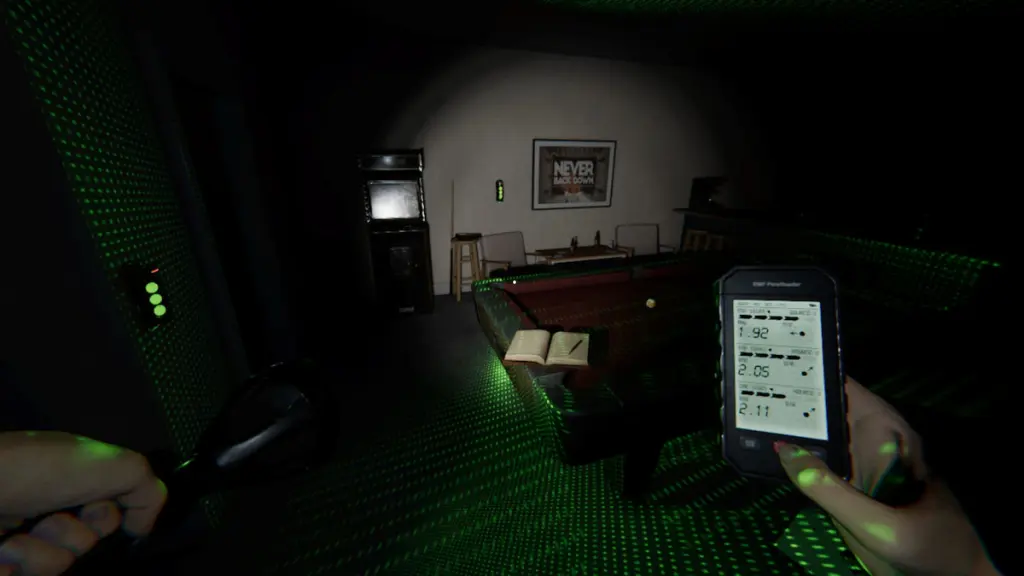
D.O.T.S. Projector evidence requires the ghost to enter its D.O.T.S. state while passing through the projected field. Place the projector across common pathways instead of pointing it into an inaccessible corner, and consider using a Video Camera to watch it remotely. D.O.T.S. may not appear immediately because ghost position, roaming, randomness, and projector coverage all affect the opportunity. Once EMF Level 5, Ghost Writing, and D.O.T.S. are confirmed in a three-evidence contract, the identification is complete.
The challenge becomes more interesting on Nightmare, Insanity, custom difficulties, and zero-evidence challenges because you may not receive the entire combination. A missing piece of evidence is not automatically proof that the Deildegast is impossible when hidden evidence systems are active. In those situations, behavioral mechanics become significantly more valuable. If you obtain two matching pieces of evidence while also hearing extraordinarily fast footsteps during an untouched early hunt, the Deildegast should become a major suspect.

What Is the Deildegast’s Special Ability and Item Moving Mechanic?
The Deildegast’s defining mechanic is its response to environmental objects and other interactable map elements. At the beginning of a hunt cycle, the Deildegast can potentially move at approximately 3.0 m/s. Each unique qualifying environmental interaction performed before the next hunt reduces the speed of that hunt by approximately 0.1 m/s, with a minimum of around 0.4 m/s after roughly 26 qualifying interactions.
Qualifying interactions include picking up non equipment objects and interacting with certain map features such as light switches, the fuse box, and taps. Each unique interactable counts once during a hunt cycle. Repeatedly picking up the same plate or toggling the same switch does not continually stack additional speed reduction. Investigation equipment does not count, so picking up a flashlight, thermometer, EMF Reader, camera, or other equipment cannot be used as an infinite source of slowing.
The objects also do not necessarily need to be inside the ghost’s favorite room. Current community testing indicates that qualifying interactions can count regardless of their proximity to the ghost, allowing players to prepare a safer slowing route elsewhere on the map. Dead investigators can also participate by moving qualifying objects and contribute to the next hunt’s slowdown, giving eliminated teammates an unusually useful role during a Deildegast investigation.
The mechanic fits the ghost’s theme. The Deildegast is associated with objects being moved or misplaced, while its name comes from Norwegian folklore involving a restless ghost connected with moved boundary stones. Phasmophobia adapts that folklore into its own gameplay mechanic.
What makes the ability particularly unusual is that investigators can directly influence the ghost’s next hunt. Instead of simply observing a fixed ghost speed, players can deliberately change how fast the Deildegast will move. Ignore the mechanic and it can be one of the fastest ghosts you encounter. Exploit it fully and the same ghost can be slowed to a crawl.
How to Slow Down and Test a Deildegast
To intentionally slow a suspected Deildegast, wait until there is no active hunt and start interacting with as many unique map objects as possible. Pick up different cups, plates, toys, tools, picture frames, and other loose props. Use different light switches and interact with additional eligible environmental features rather than repeatedly touching the same object.
Every unique qualifying interaction reduces the next hunt’s speed by approximately 0.1 m/s. Starting from 3.0 m/s, ten interactions can theoretically reduce it to approximately 2.0 m/s. Twenty interactions can bring it close to 1.0 m/s, while 26 or more can reach its roughly 0.4 m/s minimum. The practical rule is simple: one new qualifying interaction equals roughly 0.1 m/s off the next hunt.
Do not waste time throwing the same object repeatedly, because only its first qualifying interaction during that cycle matters. The speed modifier also resets, so after a hunt or qualifying hunt attempt, assume that you need to create another set of unique environmental interactions before deliberately testing or weakening the Deildegast again.
For a clean behavioral test, minimize unnecessary interaction with environmental objects before the first controlled hunt. A Deildegast that has not been weakened can move at approximately 3.0 m/s. More importantly, that speed does not increase through conventional line of sight acceleration, giving experienced players an audible clue. Once the first hunt ends, interact with many different environmental objects and then observe the next hunt. If the ghost is dramatically slower, particularly after roughly 15 to 26 unique interactions, the behavior strongly supports a Deildegast identification.
The critical point is that the speed modifier applies to the upcoming hunt. Once that hunt begins, its speed is locked. Moving more objects while the hunt is underway will not dynamically slow it further. This means the safest and most reliable test is a comparison between separate hunts rather than attempting to weaken the ghost during an active hunt.
How Fast Is the Deildegast and How Do You Identify It With No Evidence?
A fully unweakened Deildegast can hunt at approximately 3.0 meters per second, while enough qualifying environmental interactions can reduce it to approximately 0.4 m/s. Its possible range is therefore roughly 0.4 m/s to 3.0 m/s. This enormous difference makes its speed one of the most useful identification clues.
The Deildegast also does not gain conventional line of sight acceleration. Once a hunt has started, the prepared speed is effectively locked for that hunt rather than continuously increasing because the ghost sees a player. If you hear a ghost moving at an extremely high, steady pace before and after gaining visual contact, you should consider the Deildegast alongside other naturally fast ghosts.
A zero evidence Deildegast can therefore be identified through controlled speed testing. Begin immediately after a hunt cycle has reset and avoid touching unnecessary map props, switches, taps, and other interactables. Allow the next hunt to begin while positioned at a safe observation or looping location. Listen to the footsteps and test for both unusually high speed and the absence of conventional line of sight acceleration.
After surviving that hunt, interact with a large number of unique environmental objects. Aim for at least 15 to 20 if you want the difference to be immediately obvious, or reach 26 for the strongest possible slowdown. Trigger or wait for the next hunt under controlled conditions. If the ghost that previously moved at approximately 3.0 m/s is now dramatically slower, potentially approaching 0.4 m/s, the result is an exceptionally strong Deildegast tell.
This two hunt comparison is more reliable than judging one hunt in isolation because other ghosts can also move at unusual speeds. The Deildegast’s defining clue is that player interaction deliberately changes its predetermined speed.
Deildegast Strengths, Weaknesses, and Hunt Survival
The Deildegast’s greatest strength is its early danger. Players who do not know what they are facing may enter the location, touch very few environmental objects, lose enough sanity for a hunt, and suddenly encounter a ghost moving at approximately 3.0 m/s. That speed can be lethal when investigators have not prepared hiding spots or incense.
Another strength is uncertainty. Because ordinary investigation naturally involves moving objects and using switches, players can unintentionally weaken the Deildegast before ever hearing its maximum speed. The resulting moderate speed hunt may hide its most obvious clue. Its major weakness is that players can deliberately control its speed. A coordinated team can interact with enough unique environmental objects to make the next hunt far more manageable, while dead teammates can also contribute to the slowdown.
Its lack of standard line of sight acceleration is another useful weakness from an identification perspective. Once you understand how normal ghosts accelerate during prolonged visual pursuit, the Deildegast’s fixed hunt speed becomes easier to hear. The best investigators can therefore turn its biggest strength against it by conducting an untouched fast hunt test followed by a deliberately weakened slow hunt test.
Survival is primarily about preparation because its maximum speed leaves very little time to improvise. Before average sanity approaches normal hunting territory, identify at least one reliable hiding spot. Turn off or drop detectable electronics before hiding, avoid talking when the ghost is close, and close doors where appropriate.
Keep incense available when intentionally conducting a speed test. An unweakened Deildegast can close distance quickly enough that ordinary looping becomes dangerous if you misjudge its approach. A loopable kitchen island, vehicle, counter, or other map specific obstacle may work depending on the contract location, but the safest approach is to have a reliable escape plan before starting the test.
The better solution is to weaken it before a hunt. Every qualifying unique environmental interaction lowers the next hunt’s speed by around 0.1 m/s, so a coordinated team can greatly reduce the danger before deliberately staying in the building at low sanity. However, do not become complacent after surviving a heavily weakened hunt. Its speed resets after the hunt or hunt attempt, meaning the following hunt can once again be extremely fast if the team does not repeat the weakening process.
Treat every post hunt period as a fresh Deildegast cycle.

Frequently Asked Questions (FAQs)
- What is the easiest way to identify a Deildegast with zero evidence?
Allow one hunt after deliberately avoiding unnecessary environmental interactions and listen for the ghost’s extremely fast movement, which can approach 3.0 m/s. After surviving, interact with many unique environmental objects, ideally around 15 to 20 or as many as 26 for the strongest test, and observe another hunt. If the next hunt is dramatically slower and the ghost shows no normal line of sight acceleration, the change in speed provides a strong indication that you are dealing with a Deildegast. - What evidence does the Deildegast have in Phasmophobia?
The Deildegast has EMF Level 5, Ghost Writing, and D.O.T.S. Projector as its standard evidence combination. On a normal three evidence investigation, confirming all three provides a direct identification. On difficulties where some evidence is hidden, you may need to combine the available evidence with the Deildegast’s unusual hunt behavior. - How fast is a Deildegast at full speed?
An unweakened Deildegast can move at approximately 3.0 meters per second during a hunt. This makes it extremely dangerous if investigators have not interacted with enough qualifying environmental objects beforehand. Its speed also remains fixed during that hunt instead of increasing through conventional line of sight acceleration. - What is the slowest a Deildegast can become?
The Deildegast can be reduced to approximately 0.4 m/s after enough qualifying unique environmental interactions have occurred before its next hunt. This is a major difference from its 3.0 m/s maximum and can make an otherwise dangerous hunt considerably easier to survive. - How many objects do you need to move to fully slow a Deildegast?
Approximately 26 unique qualifying interactions are required to reduce the ghost from 3.0 m/s to its roughly 0.4 m/s minimum. Each qualifying interaction reduces the speed of the upcoming hunt by around 0.1 m/s. The objects must be different qualifying interactables, so repeatedly using the same object will not provide additional reductions. - Can you repeatedly throw the same object to slow a Deildegast?
No. Each qualifying environmental object or interactable only contributes once during the relevant hunt cycle. Picking up, throwing, or otherwise interacting with the same object repeatedly does not continuously reduce the Deildegast’s speed. To maximize the slowdown, you need to interact with different qualifying objects and map features. - Does player equipment slow the Deildegast?
No. Standard investigation equipment such as flashlights, thermometers, EMF Readers, and cameras does not count toward its environmental interaction mechanic. The mechanic specifically concerns qualifying environmental objects and map interactables, such as loose household items, light switches, taps, and the fuse box. - Can dead players slow the Deildegast?
Yes. Published testing following the ghost’s release indicates that dead teammates can interact with qualifying objects and contribute to reducing the speed of the upcoming hunt. This gives eliminated investigators a useful role during a Deildegast investigation, allowing them to help prepare the living team for a slower hunt. - Can you slow a Deildegast after the hunt begins?
No. The ghost’s speed is locked when the hunt begins. Environmental interactions need to be completed beforehand if you want them to affect that hunt. Moving additional objects after the Deildegast has started hunting will not gradually make it slower, so preparation should be completed between hunts. - Does a Deildegast get faster when it sees a player?
It does not gain the conventional line of sight acceleration used by many normal speed ghosts. Its prepared speed remains fixed through the hunt, whether or not it has a clear view of an investigator. This makes the lack of acceleration, combined with an unusually fast or slow movement speed, a useful behavioral clue when identifying it.

Conclusion
Phasmophobia: How To Identify A Deildegast is ultimately about understanding the difference between evidence based identification and behavior based identification. In ordinary three-evidence contracts, EMF Level 5, Ghost Writing, and D.O.T.S. Projector provide the formal combination needed to select the Deildegast in the journal.
Its real identity, however, is revealed through its movement mechanic.
A Deildegast begins a fresh hunt cycle with the potential to move at roughly 3.0 m/s. Every qualifying unique environmental interaction before the next hunt reduces that speed by approximately 0.1 m/s, eventually reaching a minimum near 0.4 m/s after 26 interactions. Equipment does not count, repeatedly touching the same item does not stack additional reductions, and the chosen speed is locked when the hunt begins. After the hunt or hunt attempt, the system resets.
That creates one of the clearest controlled behavioral experiments available to Phasmophobia players. Leave the environment alone and observe an exceptionally fast hunt. Survive, manipulate numerous unique props and interactables, and observe the next hunt. If the same ghost becomes dramatically slower without relying on line of sight, distance, temperature, electronics, or sanity based acceleration, the Deildegast becomes extremely difficult to mistake for anything else.
Its weakness is equally valuable for survival. Players who suspect a Deildegast do not have to accept its terrifying maximum speed. By deliberately moving and interacting with environmental objects before the next hunt, living investigators and even dead teammates can weaken it enough to make subsequent hunts substantially easier to survive.
The key rule is simple: evidence tells you what the Deildegast is, but environmental manipulation proves how it works.
Sources And Citations
- Kinetic Games — Phasmophobia v0.18.0.0 Patch Notes
- Official patch notes confirming the Deildegast, the 13 Willow Street rework, and the increased chance of encountering the new ghost during the first few weeks.
- Kinetic Games — v0.18.0.0 Patch Notes
- Kinetic Games — Phasmophobia 2026 and Beyond
- Official development roadmap covering the 13 Willow Street rework and the broader 2026 update plans.
- Kinetic Games — Phasmophobia 2026 and Beyond
- Kinetic Games — Official Phasmophobia Website
- Developer information about Phasmophobia and its core paranormal-investigation gameplay.
- Phasmophobia — Official Website
- Phasmophobia Wiki — Deildegast
- Community reference for the Deildegast’s evidence, movement-speed mechanics, environmental-object interaction and other unique behavior.
- Phasmophobia Wiki — Deildegast
- Phasmophobia Wiki — Hunt
- Community reference for hunt mechanics and ghost movement speeds, including the Deildegast’s speed range.
- Phasmophobia Wiki — Hunt
- Phasmophobia Wiki — Ghost Writing
- Community reference explaining the Ghost Writing Book, Ghost Writing evidence and the mechanics associated with equipment tiers.
- Phasmophobia Wiki — Ghost Writing
- Phasmophobia Wiki — D.O.T.S. Projector
- Community reference for D.O.T.S. evidence and how the projector detects a ghost in its D.O.T.S. state.
- Phasmophobia Wiki — D.O.T.S. Projector
- GAMES.GG — Phasmophobia: How to Identify a Deildegast
- Guide confirming the EMF Level 5 + Ghost Writing + D.O.T.S. Projector evidence combination and explaining the Deildegast’s speed and object-moving mechanic.
- GAMES.GG — How to Identify a Deildegast
- GameSpot — All Phasmophobia Unique Ghost Abilities
- Comparative reference covering the Deildegast’s evidence, 3.0 m/s starting speed, 0.1 m/s reduction per qualifying moved object, 0.4 m/s minimum and other ghost-specific mechanics.
- GameSpot — All Phasmophobia Unique Ghost Abilities
- The Escapist — Phasmophobia’s Deildegast Ghost Guide
- Independent guide covering the ghost’s July 2026 introduction, evidence combination, increased initial appearance rate and its ability to be slowed by objects moved by living or dead investigators.
- The Escapist — Phasmophobia’s Deildegast Ghost Guide
- GameRant — Deildegast Ghost Evidence in Phasmophobia
- Independent guide for the Deildegast’s evidence and object-interaction mechanics.
- GameRant — Phasmophobia Guides
Recommendations
- The 10 Best Football Game Covers of All Time Ranked
- Polymarket Blocked in Italy: Why the Prediction Market Faces Growing Global Restrictions
- Brawlhalla x DreamWorks Animation Shrek – Official Crossover Event Announcement Trailer
- Virtue and a Sledgehammer: Release Date, Gameplay, Story, Demo, and Everything We Know
- Gory Cartoony 2D Platformer About Immortal Goblin Hits 10,000
- Battlefield 6 is Getting Naval Combat and a Top Gun Collaboration: Release Dates, Maps, Jets, and Modes
- The Mummy 4 Moves Up to October 2027 as Miami Vice ’85 Shifts to May 2028
- Monster Hunter Wilds Gold Edition Is Out Now With All Cosmetic DLC on PS5, Xbox Series X|S, and PC
- Kingdom Come: Deliverance 2 Devs Hope to Be the “New Kings” of the RPG Genre
- How to Make Gen Z Slang Meme Videos with MetaHuman: Brainrot, Sigma, and Gooning-Style Content for Social Media



































































































