










In This Article (8 sections)
The Aaronson to Ambainis Conjecture and the Research Behind PSI’s Breakthrough
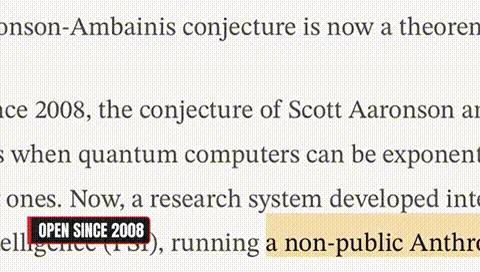
Physical Superintelligence, or PSI, says an AI research system powered by a non-public Anthropic model has proved the Aaronson to Ambainis conjecture. The company announced the result on November 6, 2026, alongside a research paper and a formal proof checked with Lean. The longstanding problem concerns mathematical limits on certain quantum computing advantages. Scott Aaronson publicly welcomed the result, while researchers associated with MIT and Stanford published an exposition explaining the argument. Their engagement adds support beyond PSI’s announcement, although the theorem’s implications require careful interpretation. It restricts particular advantages in the query model without establishing that classical computers can efficiently replace quantum computers for every task.
The conjecture concerns polynomials evaluated on strings of bits whose outputs stay within a bounded range, such as zero to one. Their degree must not exceed a specified limit. If such a polynomial varies substantially across inputs, the conjecture says at least one input variable must have sufficiently large influence. Influence measures the squared change in the output when a particular bit is flipped, averaged over all inputs. For example, if the output equals the first input bit, flipping that bit always changes the result, while flipping any other bit changes nothing. The first bit therefore carries all the influence, whereas the difficult cases involve many interacting variables whose individual effects can be small.
The required lower bound depends polynomially on the degree and variance, without weakening merely because the number of variables increases. Variance matters because an almost constant output requires little information to predict. The theorem becomes useful when enough variation remains that a classical algorithm must learn something meaningful about the input. Showing that some variable has a nonzero effect would not be sufficient, since that effect might be too small to support an efficient query procedure. A bound that declines as the inverse of a fixed power behaves very differently from one that declines exponentially as the degree grows. Obtaining the stronger quantitative guarantee was the central mathematical obstacle.
The problem’s history reaches back to Aaronson’s work in 2008, followed by the joint paper with Andris Ambainis on arXiv in November 2009. Its journal version appeared in 2014. These dates mark different stages of the same research history and explain the description of the conjecture as 18 years old in 2026. Researchers continued making progress in restricted settings throughout that period. In August 2026, Guy Blanc, Jordan Docter, Carmen Strassle, and Li-Yang Tan proved an appropriate classical simulation result for quantum algorithms with a fixed number of parallel query rounds. That substantial special case left unrestricted query depth unresolved, so the eventual proof completed a research program with meaningful intermediate advances.
An important earlier approach came from Shachar Lovett and Jiapeng Zhang’s 2023 work on fractional certificates for bounded functions. An ordinary certificate identifies enough information to establish a function’s value, while a fractional certificate uses weighted constraints on coordinates. This flexibility helps analyze functions with real-valued outputs rather than only zero or one. Lovett and Zhang established results that would imply the conjecture if an additional proposed inequality could be proved.
PSI’s argument follows that research direction but supplies a different inequality to complete the connection, also drawing on David Reimer’s Butterfly Lemma and related combinatorial inequalities. Its contribution therefore lies in extending and combining existing mathematical ideas to establish a general conclusion that those earlier results had not already proved.

How PSI’s AI System Developed and Improved the Proof
The paper describes multiple instances of an Anthropic model searching the literature, proposing mathematical ideas, combining and testing arguments, and coordinating their work. The disclosure attributes substantive mathematical development and communication between instances to the model. David Turturean built the surrounding research system, selected the problem, reviewed the manuscript, and took responsibility for its correctness. Jim Halverson audited the proof, while Phiala Shanahan commented on the Lean formalization. These roles distinguish the model’s mathematical contributions from the software that organized the work and the people who directed and reviewed it. The underlying model was non-public, and the disclosure does not identify a publicly available product version with which readers could reproduce the discovery process.
The mathematical argument connects fractional certificates, inequalities on the discrete cube, and a determinant-based construction. In broad terms, the certificates assign weights to coordinates that constrain how changes to those coordinates can affect a function. The proof converts information about these weighted changes into a guarantee that at least one individual coordinate has substantial influence. Developing that argument required connecting useful lemmas, earlier literature, intermediate inequalities, and formal reasoning. This goes beyond finding a numerical pattern in a large collection of examples, which would leave infinitely many possible cases unexamined. A proof must establish why every object satisfying the stated assumptions obeys the conclusion.
The first proof established a bound with exponent 22 in the conjecture’s original formulation, which subsequent work improved to 11 and then 7. For a polynomial pp taking values between zero and one, with degree at most dd and variance at least ε\\varepsilon, the resulting guarantee is Infi(p)≥(ε/d)7\\operatorname{Inf}_i(p)\\geq(\\varepsilon/d)^7 for at least one variable ii. The paper attributes the improvements to stronger intermediate arguments, including integration over levels and averaging over coordinates.
A smaller exponent strengthens the guarantee because the ratio being raised to that power lies below one, making 0.170.1^7, for example, vastly larger than 0.1220.1^{22}. The initial fixed exponent already resolved the qualitative conjecture, while the later improvements forced at least one coordinate to have a larger guaranteed influence. Settling the conjecture and finding the best possible parameters remain separate achievements, so the stronger bound does not imply that further improvements are impossible.
According to the discovery timeline, the first complete proof was written during the third day of the run and then checked in Lean. That wording does not establish an exact elapsed duration of 72 hours. It also separates discovery time from the time spent developing the software, preparing the problem, arranging computing resources, reviewing the manuscript, and assembling verification materials.
The November 6 announcement cannot be used to infer a November 3 start, because the repository records verification checks from October 22. Those earlier records show that parts of the work predated the public announcement. The reported achievement is the speed of producing a complete argument once the research run was underway, while a broader productivity comparison would need preparation time, unsuccessful attempts, resource use, and subsequent checking.
The result supports a claim about the combined research system rather than isolating the performance of the underlying model. The surrounding software organized work that included idea generation, coordination, and the development of a formal argument. A controlled comparison would require comparable tasks run with different models and coordination systems under similar resource budgets. The disclosed proof does not reveal the model’s training data or the project’s total computational cost. Those limits matter when assessing which parts of the system produced the improvement and whether the process could be reproduced under other conditions.
What the Theorem Establishes About Quantum Computing
The connection to quantum computing begins with the polynomial method. Robert Beals, Harry Buhrman, Richard Cleve, Michele Mosca, and Ronald de Wolf established that the acceptance probability of a quantum algorithm making TT input queries can be represented by a polynomial of degree at most 2T2T. Acceptance probability is the probability that the algorithm outputs “yes.” The influential-variable theorem gives a classical algorithm a way to learn enough about that probability by examining selected input bits. The resulting guarantee concerns approximation on most uniformly distributed Boolean inputs. For fixed accuracy and a fixed tolerated fraction of exceptional inputs, the number of classical queries grows polynomially with the number of quantum queries.
Both approximation and the input distribution are essential to that conclusion. The simulation does not have to reproduce an exact probability on every possible input string. A relatively small exceptional set may remain outside its guarantee. For example, success on 99 percent of uniformly sampled strings would not automatically cover an application whose inputs all lie within the remaining one percent. Everyday descriptions of “random data” can refer to noisy measurements, shuffled records, randomly chosen mathematical objects, or independent random bits, and those distributions are not interchangeable. Data can contain noise while retaining algebraic or physical relationships that an algorithm can exploit.
Such relationships help explain why structured problems remain important to quantum computing. A function may repeat with an unknown period, obey an algebraic identity, or satisfy a promise that excludes most possible inputs. Quantum algorithms use interference to make useful outcomes more likely, requiring a way to turn those properties into a measurable signal. Simply placing many possibilities into superposition does not automatically reveal the correct answer. Aaronson’s survey of quantum speedups discusses this issue and distinguishes the query model from the circuit model, which more directly captures an algorithm’s full computational work. The new theorem must therefore retain its specific task and model: a limitation concerning decision algorithms on uniformly random Boolean inputs.
Shor’s algorithm illustrates why these qualifications matter. It provides efficient quantum methods for integer factorization and discrete logarithms, with running time that grows polynomially with input size, such as the number of digits in the integer being factored. Its factoring procedure uses an order-finding problem in which repeated modular exponentiation produces a periodic sequence. The quantum computation helps extract information about that period.
Choosing the integer randomly does not remove the arithmetic relationships in the resulting function, so a randomly selected integer is not equivalent to a uniformly random function. Aaronson explicitly stated that the new proof has no effect on Shor’s factoring method because the relevant oracle is periodic rather than random. Shor’s algorithm is faster than known classical factoring algorithms, but there is still no proof that every possible classical factoring algorithm must be slow, and the new theorem does not settle that separate question.
The distinction between query counts and total running time also limits what the theorem establishes. Query complexity counts access to input information while ignoring the calculations performed between those accesses. An algorithm can make relatively few queries and still perform enormous amounts of computation. Consequently, a polynomial query bound alone does not guarantee polynomial total running time. This prevents the result from being described as a universal efficient classical simulation of quantum computers. It establishes a boundary within a particular model, leaving the computational work outside that model to separate analysis.
The requested output creates another boundary. Decision problems require a yes-or-no answer, search problems require an object satisfying a condition, and sampling problems require outputs drawn from a specified distribution. Takashi Yamakawa and Mark Zhandry demonstrated quantum advantages for search problems relative to a random oracle. Their work explicitly discusses compatibility with the Aaronson to Ambainis conjecture, providing a concrete reason not to generalize the theorem to every task involving randomness. Polynomial quantum advantages also remain possible and can still represent large practical improvements at relevant problem sizes. Other computational objectives, input distributions, and models therefore require their own analysis rather than being resolved by this proof.

Formal Verification, Expert Responses, and the Implications for AI Research
Lean checks proofs expressed in a formal mathematical language. Its kernel verifies that a proof establishes a precisely stated proposition from the definitions and permitted assumptions on which it depends. This differs from asking another language model whether a prose argument appears convincing. Missing steps must be supplied according to explicit logical rules rather than replaced with confident assertions. Lean’s documentation also distinguishes the validity of a formal proof from whether its statement accurately captures the intended mathematical claim. Human interpretation remains necessary to connect the checked proposition with the original conjecture and explain its significance.
PSI’s audit materials report that the main results depend only on standard Lean axioms. They identify no additional project-specific axioms or unfinished proof placeholders in the dependency chain of those results. The documentation also describes replaying proofs through separate checking implementations, providing stronger evidence than a successful software build alone. However, the paper-to-Lean guide identifies sections without formal counterparts, including the discussion of quantum consequences, historical context, and the discovery timeline. Lean therefore does not certify every sentence in the paper or public announcement. Formal checking and expert mathematical reading address complementary parts of evaluating the work.
PSI quoted Guy Blanc, Jordan Docter, Carmen Strassle, and Li-Yang Tan describing the proof as “a huge result.” Their public exposition, dated November 7, 2026, provides more substantive evidence of engagement than the company’s quotation alone. It lists Blanc at MIT and the other three authors at Stanford. The authors explain that they worked to understand the proof and present its main ideas. They use weaker quantitative parameters to make the argument easier to follow. This exposition helps readers examine the mathematical reasoning while remaining distinct from the original proof and its strongest stated bound.
The exposition’s authors disclose using public Anthropic models during their work. They also state that they received no financial compensation from Anthropic or PSI. Their document is not intended for conference or journal publication and should not be described as completed journal peer review. In his November 8 response, Aaronson said he believed the proof was correct because of the Lean certificate and expert scrutiny, while acknowledging that he had not yet personally understood the argument. These responses show meaningful mathematical engagement without establishing that every named researcher independently checked every step. Preserving those qualifications gives a clearer account of the support the result has received.
The research paper, titled A proof of the Aaronson-Ambainis conjecture, is listed on arXiv under identifier 2611.09773 with David Turturean as its author. The record dates its submission to November 6, 2026. The accompanying public GitHub repository is named physical-superintelligence/aaronson-ambainis. Its formalization guide separates theorem statements, final proofs, supporting definitions, and intermediate arguments. Readers examining the formal claim can begin with Conjecture.lean, particularly the definition PrintedConjecture, while Main.lean contains the final theorem declarations. The guide then directs readers through the supporting proof structure.
The verification documentation records software versions, commands, and checking results to support reproducibility. Its pinned environment matters because the project depends on particular versions of Lean and its mathematical libraries. The paper explains the mathematics, the formal source expresses checked logical statements, and the verification records document how those checks were performed. Each component answers different questions, so reading one does not automatically substitute for examining the others. Together, they allow the result to be scrutinized independently of the system that generated it. This separation between discovery and justification is central to the scientific value of the work.
The case suggests that AI research systems can contribute across literature search, the proposal of intermediate statements, mathematical argument, and formal proof production. A research system may explore speculative or unsuccessful ideas, but the published result must provide a defensible chain of reasoning. One successful project cannot establish a general success rate across advanced mathematics. Broader evaluation would require information about problem selection, failed attempts, resource use, and performance across different fields. People remain responsible for choosing worthwhile questions, evaluating assumptions, relating formal statements to established mathematics, and explaining the consequences. The achievement’s lasting value lies in the knowledge produced and the reliability of its justification, rather than assigning every contribution exclusively to humans or software.

Frequently Asked Questions (FAQs)
- What did PSI announce?
PSI announced that an internal AI research system using a non-public Anthropic model had produced a proof of the Aaronson to Ambainis conjecture. The conjecture concerns how strongly individual input variables must influence certain bounded polynomials. Its implications include limits on particular quantum advantages in the query model. PSI released a research paper and formal verification materials so others could examine the mathematical argument. The achievement involved the combined research system, alongside human contributions to problem selection, manuscript review, and responsibility for correctness. - Was the conjecture really 18 years old?
The 18-year description counts from the problem’s origins in Aaronson’s 2008 work to the proof announced in 2026. The joint Aaronson to Ambainis paper first appeared on arXiv in 2009. Its journal version followed in 2014. These dates refer to different stages of the research and publication process, which explains why accounts may give different starting points. Researchers also established results for restricted cases during that period, so the long interval does not mean the problem remained untouched. - Did the AI complete the proof in exactly three days?
The published timeline says the first complete proof was written during the third day of the research run. That wording does not specify an exact elapsed duration of 72 hours. The proof was then checked in Lean. The discovery period should also be distinguished from the time spent building the system, preparing the problem, reviewing the manuscript, and assembling verification materials. A full assessment of research speed would need those activities, resource use, and any unsuccessful attempts to be considered alongside the reported run. - Which Anthropic model was used?
The research materials describe the underlying Anthropic model as non-public. They do not provide a public product name or model identifier that readers can select through an ordinary subscription. Assigning the result to a particular publicly available Anthropic model would therefore go beyond the disclosure. The work also depended on PSI’s surrounding software, which coordinated multiple model instances and their research activities. Reproducing the discovery process would require the relevant model and research setup, beyond access to the published proof. - What does Lean verification establish?
Lean verification establishes that a formal proof follows from its definitions and permitted logical assumptions. It checks explicit mathematical steps rather than judging whether a written explanation sounds convincing. Researchers must still confirm that the formal statement faithfully represents the intended conjecture. The project’s guide identifies the quantum consequences, historical discussion, and discovery timeline as sections without formal counterparts. Lean therefore supports the validity of the formalized mathematics while expert interpretation remains necessary to explain its meaning and scope. - Does the result make quantum computers useless?
No, the proof does not establish that quantum computers are useless. It limits certain quantum query advantages for decision algorithms on most uniformly distributed Boolean inputs. Those assumptions leave other input distributions and computational objectives outside the theorem’s stated guarantee. Quantum benefits for structured problems are not eliminated, and search, sampling, and simulation tasks require their own analysis. Polynomial quantum advantages also remain possible and may still offer substantial practical improvements at relevant problem sizes. - Does it disprove Shor’s algorithm?
No, the result does not disprove Shor’s algorithm or invalidate its factoring method. Shor’s algorithm uses arithmetic relationships that produce periodic behavior through modular exponentiation. The quantum computation extracts information about that period to support factorization. Even a randomly selected integer retains the arithmetic structure used by this procedure, making it different from a uniformly random function. Aaronson explicitly said the proof has no effect on Shor’s factoring method because its relevant oracle is periodic rather than random. - Can classical computers now simulate all quantum computations efficiently?
No, the result does not provide an efficient classical replacement for every quantum computation. It bounds the number of input queries needed for a particular kind of approximation. Query complexity counts access to input information while leaving out the calculations performed between queries. A classical algorithm could therefore use relatively few queries yet still require enormous amounts of total computation. The theorem’s polynomial query guarantee should not be interpreted as a general polynomial-time simulation of quantum computers. - Has anyone outside PSI examined the proof?
Yes, Guy Blanc, Jordan Docter, Carmen Strassle, and Li-Yang Tan published an exposition explaining the argument. They used weaker quantitative parameters to make its main ideas easier to follow. Their document was not intended for conference or journal publication, so it should not be described as completed journal peer review. Aaronson also expressed confidence based on the Lean certificate and expert scrutiny. He acknowledged that he had not yet personally understood the proof, which is an important qualification when describing his assessment. - Are the paper and proof publicly available?
Yes, the research paper is available on arXiv under identifier 2611.09773. The public GitHub repository contains the Lean formalization, explanatory documentation, and verification records. These materials let readers inspect the mathematical argument and examine how the formal checks were performed. Reproducing those checks requires attention to the documented versions of Lean and its mathematical libraries. Access to the public proof materials does not provide access to the non-public Anthropic model used during discovery.

Conclusion
PSI’s Aaronson to Ambainis result is significant both for the longstanding mathematical question it resolves and for the materials available to examine its proof. The published argument and Lean formalization give researchers a foundation for checking the reasoning, explaining its consequences, and developing sharper results. Its implications for quantum computing remain specific: it constrains certain query advantages for decision tasks on most uniformly distributed Boolean inputs, without establishing an efficient classical replacement for quantum computation as a whole.
Structured quantum algorithms retain their relevance, and practical applications still require separate assessment of their assumptions and computational costs. For mathematical research, the case shows how AI systems can contribute to discovery while formal verification and human interpretation establish what the resulting argument proves. The lasting contribution is a proof that others can inspect, refine, and build upon, alongside a more precise understanding of the conditions that limit quantum speedups.
Sources and Citations
- Physical Superintelligence, November 6, 2026, “A proof of the Aaronson-Ambainis conjecture”: PSI’s official announcement says its internal research system, using multiple instances of a non-public Anthropic model, produced a complete proof during the third day of the research run and that Lean accepted the formalized proof. PSI also explains the conjecture’s connection to quantum query speedups and credits prior work including Lovett and Zhang, Reimer, and others. PSI · Physical Superintelligence
Physical Superintelligence, A proof of the Aaronson-Ambainis conjecture - David Turturean, November 6, 2026, “A proof of the Aaronson-Ambainis conjecture”: The arXiv preprint formally proves that every bounded low-degree polynomial on the discrete cube has an influential variable, giving the original-formulation bound of at least \((\varepsilon/d)^7\). The paper explicitly connects this result to classical simulation of quantum query algorithms on most inputs and links to the Lean formalization and reproducibility materials. arXiv
David Turturean, arXiv:2611.09773 - Physical Superintelligence, Aaronson-Ambainis GitHub repository: PSI’s public repository contains the paper, Lean 4 formalization, theorem statements, verification materials, and project documentation. Its citation file identifies the release as version 1.1.0, dated November 6, 2026, and states that the formalization uses Mathlib v4.33.0 and proves the \((\varepsilon/d)^7\) bound. GitHub
PSI Aaronson-Ambainis GitHub repository - Scott Aaronson, November 8, 2026, “Aaronson-Ambainis Conjecture proved! (By AI, of course)”: Aaronson describes the result as solving a significant open problem in quantum complexity theory while stressing that it does not eliminate quantum advantage generally. He explains that the theorem rules out a class of superpolynomial quantum query speedups for decision problems on most random Boolean inputs, rather than showing that quantum computers are broadly useless or classically simulable. Shtetl-Optimized
Scott Aaronson, Aaronson-Ambainis Conjecture proved! - Guy Blanc, Jordan Docter, Carmen Strassle, and Li-Yang Tan, November 8, 2026, “Proof of the Aaronson-Ambainis Conjecture: An Exposition”: Their exposition independently explains the main structure of Turturean’s proof and intentionally uses weaker parameters to make the ideas clearer. The authors disclose that PSI’s proof was discovered using a non-public Anthropic model, that they used public Anthropic models while preparing their exposition, received no financial compensation from PSI or Anthropic, and did not intend the document as a conference or journal submission. arXiv
Blanc, Docter, Strassle and Tan exposition - Scott Aaronson and Andris Ambainis, “The Need for Structure in Quantum Speedups”: The original paper formulates the influential-variable conjecture for bounded low-degree polynomials and shows that, if true, every T-query quantum algorithm can be simulated on most inputs by a classical algorithm using polynomially many queries. The arXiv version appeared in November 2009, while the journal version was published in Theory of Computing in 2014. arXiv
Theory of Computing, The Need for Structure in Quantum Speedups - Guy Blanc, Jordan Docter, Carmen Strassle, and Li-Yang Tan, August 2026, “Quantum Speedups Require Structure or Depth”: This earlier paper proves the relevant classical-simulation result for parallel quantum algorithms with a fixed number of query rounds, establishing a major special case before the full conjecture was solved. The authors show a classical simulation using \(t^{O(d^2)}\) queries for a t-query, d-round quantum algorithm. arXiv
Quantum Speedups Require Structure or Depth - Robert Beals, Harry Buhrman, Richard Cleve, Michele Mosca, and Ronald de Wolf, “Quantum Lower Bounds by Polynomials”: This foundational work develops the polynomial method for quantum query complexity and establishes polynomial-based lower bounds for black-box quantum algorithms. It is central background for the later connection between quantum query algorithms and bounded low-degree polynomials. DOI
Quantum Lower Bounds by Polynomials - Shachar Lovett and Jiapeng Zhang, 2023, “Fractional Certificates for Bounded Functions”: The ITCS 2023 paper introduces fractional-certificate techniques for bounded functions, proves that bounded low-degree polynomials have small fractional certificate complexity, and gives additional conjectures which, together with their results, would imply the Aaronson-Ambainis conjecture. PSI and Aaronson both identify this line of work as an important precursor to the 2026 proof. DROPS
Lovett and Zhang, Fractional Certificates for Bounded Functions - Peter W. Shor, “Polynomial-Time Algorithms for Prime Factorization and Discrete Logarithms on a Quantum Computer”: Shor’s paper gives efficient quantum algorithms for integer factorization and discrete logarithms with polynomial running time in the input size. It is useful for explaining why the Aaronson-Ambainis result does not invalidate structured quantum algorithms such as Shor’s factoring method. DOI
Peter Shor, Polynomial-Time Algorithms for Prime Factorization and Discrete Logarithms - Takashi Yamakawa and Mark Zhandry, “Verifiable Quantum Advantage without Structure”: This work proves quantum advantages for search and cryptographic problems relative to a random oracle, including NP search problems solvable quantumly but not classically in that model. The authors explicitly note that their results do not contradict the Aaronson-Ambainis conjecture, illustrating why the 2026 theorem should not be generalized from decision problems to every possible quantum task. arXiv
Yamakawa and Zhandry, Verifiable Quantum Advantage without Structure - Lean Language Reference, “Validating a Lean Proof”: Lean’s official documentation explains that kernel acceptance establishes that a theorem follows from its formal definitions, imported results, and permitted axioms. It also stresses the distinction between “does the theorem have a valid proof?” and “what does the theorem statement mean?”, and documents stronger checks including
#print axioms,lean4checker,comparator, and external checkers. This is the strongest primary source for explaining what PSI’s Lean verification does and does not establish. Lean Language
Lean Language Reference, Validating a Lean Proof
Recommendations
- Where Winds Meet, Official Imperial Palace Gameplay Trailer Explained: Release Date, Story, Combat Details & Everything We Know
- Diablo 4 3Rd Anniversary Event: Goblins, Massive XP Boost, Free Cosmetics, and Full June 2–9 Celebration Guide
- IO Interactive and Build A Rocket Boy End MindsEye Partnership as Hitman Crossover DLC Is Canceled
- All Anomalies in Animal Hospital Guide: Every Roblox Anomaly Explained
- Every Release Date from Every Event at Summer Game Fest 2026
- First Gameplay Trailer of Silent Hill: Townfall: It’s a First-Person Game and Everything We Know (2026)
- Best New Anime to Watch Right Now: Spring 2026 Picks
- Switch 2 Software Update Adds “Handheld Mode Boost” for Old Games – Performance Upgrade Explained
- We Build LEGO Winnie the Pooh: A 100th Anniversary Set Worth the Hype for Disney and LEGO Fans
- Echoes of Aincrad: Complete Guide to Growth Points (Best Stat Builds & Leveling Tips)



































































































