





In This Article (9 sections)
Pompeii: Out of Time Trailer Breakdown, Story, and Two-Timeline Structure
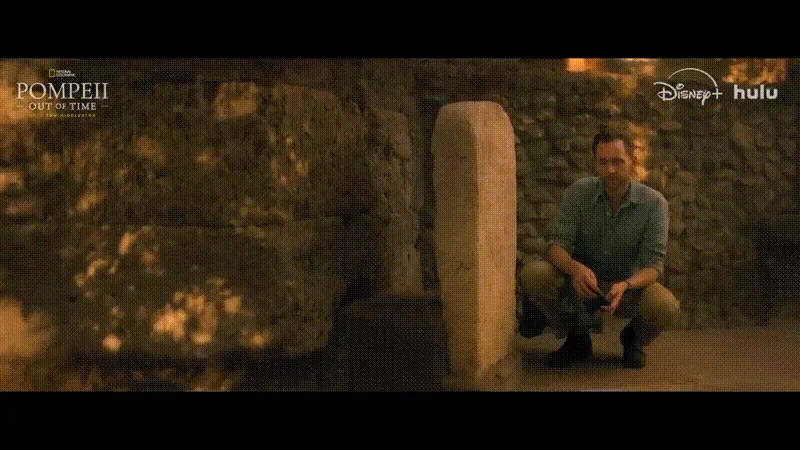
The official trailer for Pompeii: Out of Time presents the destruction of Pompeii and Herculaneum as both a historical investigation and an intimate human tragedy. Tom Hiddleston’s narration guides viewers from the surviving ruins of the modern archaeological site into a computer-generated reconstruction of the cities before Mount Vesuvius erupted in AD 79.
The opening footage establishes a calm Mediterranean world before gradually introducing the signs of approaching disaster. Wide views of the Bay of Naples give way to reconstructed streets filled with traders, children, workers, soldiers, enslaved people, and wealthy Roman citizens. Seismic tremors, distant smoke, falling ash, and damaged buildings then transform that ordinary life into a desperate struggle for survival.
The story is structured around two connected timelines. The ancient timeline follows different levels of Roman society during the final days before the eruption, showing how class, wealth, occupation, and access to transportation could influence a person’s chances of escape. The modern timeline follows archaeologists, historians, and scientists examining ruins, artifacts, frescoes, human remains, and casts left behind by the disaster.
This structure allows the series to explain how modern researchers reconstruct individual lives from incomplete evidence. A household object can reveal a profession, a building layout can expose a family’s status, and the location of human remains can suggest how residents reacted when the eruption intensified. The disaster remains central, but the people who lived in Pompeii are treated as more than anonymous victims.
The larger themes include survival, social inequality, the fragility of apparently secure civilizations, and the extraordinary way volcanic material preserved the city. Pompeii is presented as a time capsule, but the trailer also emphasizes that the preserved streets once belonged to a busy community filled with routines, ambitions, conflicts, relationships, and private lives.

Tom Hiddleston’s Narration, Scene-by-Scene Trailer Analysis, and Docudrama Format
Tom Hiddleston serves as the narrator and interpretive guide rather than portraying a Roman character in the reconstructed timeline. His voice connects the archaeological research with the dramatized human stories, helping the series move between scientific explanation and emotional storytelling without treating them as unrelated formats.
The trailer begins with peaceful images of the coastline before entering the reconstructed city. Marketplaces, homes, public spaces, and amphitheaters establish Pompeii as a thriving urban center. The atmosphere then changes through small warning signs, including tremors and smoke above the mountain, before the footage returns to the present and shows researchers examining preserved evidence.
The final part of the trailer presents the eruption with considerably greater intensity. Mount Vesuvius releases a vast column of ash, people flee through damaged streets, buildings begin collapsing, and pyroclastic material moves across the surrounding landscape. The closing images return to the silent ruins, reinforcing the contrast between the active city shown earlier and the archaeological site that survives today.
The series is best described as a hybrid docudrama. Its documentary material includes expert interviews, archaeological footage, explanations of volcanic activity, and analysis of artifacts and human remains. Its dramatic material includes scripted reenactments, reconstructed personal stories, computer-generated cityscapes, and cinematic disaster sequences.
That combination allows the production to explain complicated historical evidence without becoming a conventional academic lecture. The dramatized scenes give the research emotional context, while the documentary sections clarify which parts of the reconstruction come from archaeology and scientific interpretation. Personal dialogue and individual storylines may be created for dramatic purposes, but they are used to represent experiences that could plausibly have occurred within the documented social world of Pompeii.

Historical Accuracy, Mount Vesuvius, Survivors, and National Geographic’s Role
The historical foundation centers on the eruption of Mount Vesuvius in AD 79. The supplied material presents the disaster as an event that unfolded over more than 24 hours, beginning with earthquakes and heavy ash before entering a far deadlier stage involving destructive pyroclastic flows. Those later conditions overwhelmed buildings and people who had remained inside or near the cities.
The reconstruction pays particular attention to Roman architecture and social organization. Frescoed walls, mosaic floors, bathhouses, forums, religious spaces, marketplaces, domestic courtyards, and gladiatorial culture are used to show how the city functioned before the eruption. The series also examines the divisions separating elites, merchants, soldiers, laborers, and enslaved residents.
Survival is treated as possible but far from guaranteed. Some residents may have recognized the danger early enough to leave, while others attempted to escape through the Bay of Naples or surrounding roads. The source also refers to nearby soldiers helping civilians and to wealthier residents having greater access to transportation, servants, information, and supplies.
The series does not present every resident as waiting helplessly for the disaster. It examines the decisions people may have made as the situation worsened, including whether to abandon property, remain with relatives, seek shelter, or attempt an increasingly dangerous journey away from the city. These choices give the destruction a human scale beyond the movement of the volcano itself.
The supplied production information identifies National Geographic as an important collaborator. Historians, archaeologists, volcanologists, documentary filmmakers, and computer-generated imagery specialists are described as working together to rebuild the ancient environment. That combination is intended to give the series the research foundation of a historical documentary while preserving the visual scale and emotional urgency of a drama.

Release Date, Disney+ and Hulu Availability, Cast, Crew, and Filming Locations
An exact worldwide release date is not provided in the supplied promotional information. The series is expected to form part of a larger historical-documentary lineup, with availability anticipated through Disney+ and Hulu depending on regional distribution arrangements. Viewers should therefore expect release timing and platform availability to vary between countries.
The cast differs from that of a conventional historical drama. Tom Hiddleston is the principal named performer through his narration, while reenactment actors collectively represent merchants, families, soldiers, workers, enslaved people, and other members of Roman society. The source does not identify one permanent fictional protagonist whose experience controls every episode.
Experts are equally important to the presentation. Archaeologists interpret objects and excavation sites, historians explain Roman society, and volcanologists examine how the eruption developed. Their contributions allow the reconstructed scenes to be followed by explanations showing how particular conclusions were reached.
Production reportedly used a combination of archaeological locations in southern Italy, studio-built Roman streets, digital reconstructions, and volcanic-environment simulations. Real ruins provide visual and spatial references, while controlled studio spaces allow the filmmakers to reproduce crowded streets, domestic interiors, falling debris, and hazardous conditions that could not be created at the protected site.
Digital scanning and three-dimensional reconstruction help preserve the measurements and proportions of surviving buildings. Computer-generated imagery then restores missing walls, roofs, decorations, statues, and public spaces. Carefully designed lighting recreates the Mediterranean atmosphere before the eruption and the increasingly unnatural darkness caused by volcanic ash.
The result is intended to move smoothly between surviving evidence and reconstructed history. Modern footage shows what remains, while dramatized sequences attempt to show how the same locations may have looked when they were occupied, decorated, and used as part of everyday urban life.

Tom Hiddleston as a Time Detective, Reconstructing Roman Life, and Early Reactions
Tom Hiddleston uses the description “time detective” to explain the investigative structure of the series. The phrase reflects how historians and archaeologists must assemble incomplete pieces of information rather than simply read one complete account of what happened.
Artifacts function like clues within that investigation. Pottery can reveal food preparation and trade, inscriptions can identify occupations or political loyalties, and household objects can suggest who occupied a building. Human remains and their locations may reveal whether someone was sheltering, escaping, carrying possessions, or attempting to protect another person.
The reconstruction extends beyond the final hours of the disaster. The series depicts street vendors, household routines, food preparation, religious ceremonies, commercial activity, slavery, public entertainment, and the social importance of homes decorated with frescoes and courtyards. This broader view prevents Pompeii from being defined only by the way it ended.
Early reactions described in the supplied material emphasize the cinematic quality of the reconstructed city, the emotional effect of Hiddleston’s narration, the educational value of the archaeological sections, and the visual force of the eruption sequences. Viewers appear particularly interested in the way the series combines scientific research with a dramatic structure that remains accessible to people without specialist knowledge of Roman history.
That accessibility does not require removing complexity. The series can show the destruction on a large scale while also examining how historians disagree, how evidence can remain incomplete, and how modern interpretations change when new areas are excavated. The “time detective” framing makes uncertainty part of the experience instead of pretending that every private detail about the victims can be known with complete confidence.

Frequently Asked Questions (FAQs)
- What is Pompeii: Out of Time about?
Pompeii: Out of Time is a historical docudrama examining life in Pompeii and nearby Roman communities before and during the eruption of Mount Vesuvius in AD 79. It combines dramatized stories about ancient residents with modern archaeological and scientific investigations into the city’s destruction and preservation. - Who narrates the series?
Tom Hiddleston narrates the series and acts as its interpretive guide. His role connects the reconstructed ancient timeline with the work of modern archaeologists, historians, and volcanologists examining the surviving evidence. - Is Pompeii: Out of Time historically accurate?
The series is based on archaeological discoveries, surviving architecture, volcanic research, artifacts, and evidence of Roman social life. Some dialogue, individual relationships, and personal storylines are dramatized because the historical record cannot provide a complete account of every person’s final days. - Is it a documentary or drama?
It is a hybrid docudrama combining both formats. Expert interviews, excavation footage, and scientific explanations provide the documentary foundation, while scripted reenactments and computer-generated environments dramatize life before and during the eruption. - What caused the destruction of Pompeii?
Pompeii was destroyed by the eruption of Mount Vesuvius in AD 79. Falling ash, earthquakes, collapsing structures, extreme heat, and pyroclastic flows created increasingly deadly conditions across Pompeii, Herculaneum, and nearby communities. - Where can I watch it?
The supplied information expects the series to be available through Disney+ and Hulu, depending on regional distribution. An exact global release date and complete country-by-country streaming schedule are not provided. - Who produced the series?
The production is presented as a collaboration involving National Geographic and specialists in historical documentary filmmaking. Archaeologists, historians, volcanologists, reconstruction artists, and computer-generated imagery teams are also described as contributing to the series. - Does it show real Pompeii ruins?
Yes. The series includes footage connected with the real archaeological site and modern excavation work. Those surviving ruins are combined with digital and physical reconstructions showing how streets, homes, businesses, and public buildings may have appeared before the eruption. - What makes this series unique?
Its defining feature is the combination of scientific research, cinematic reconstruction, and human-centered storytelling. It does not examine Pompeii only as a destroyed city but attempts to restore the routines, social divisions, relationships, and personal decisions of the people who lived there. - Is Tom Hiddleston acting in it?
Tom Hiddleston serves as the narrator rather than portraying a character within the ancient timeline. His performance provides the emotional and investigative voice connecting the historical reenactments with the modern research.

Conclusion
Pompeii: Out of Time with Tom Hiddleston Official Trailer Breakdown, Story, Cast, Release Date, and Hidden Historical Details presents a powerful reimagining of one of history’s most tragic events. By combining expert archaeology, cinematic reconstruction, and compelling narration from Tom Hiddleston, the series transforms the ancient city of Pompeii into a vivid, emotionally resonant experience.
Through its hybrid format, it bridges the gap between education and entertainment, offering viewers not just a history lesson but a human story frozen in time by the eruption of Mount Vesuvius.
Sources and Citations
- National Geographic – Official TV & Documentary Collection
https://www.nationalgeographic.com/tv/ - National Geographic – Pompeii: Out of Time with Tom Hiddleston
https://www.nationalgeographic.com/tv/show/fa4f7c0e-2bce-4ceb-846f-f956076ff950 - National Geographic Press – Pompeii: Out of Time Press Releases
https://www.detpress.com/natgeo/shows/pompeii-out-of-time-with-tom-hiddleston/press-releases/ - UNESCO World Heritage Centre – Archaeological Areas of Pompeii, Herculaneum and Torre Annunziata
https://whc.unesco.org/en/list/829/ - Pompeii Sites (Official Archaeological Park of Pompeii)
https://pompeiisites.org/en/ - Smithsonian Magazine – Pompeii Archaeology Coverage
https://www.smithsonianmag.com/tag/pompeii/ - National Geographic – Pompeii Articles and Archaeological Research
https://www.nationalgeographic.com/history/topic/pompeii - U.S. Geological Survey (USGS) – Volcano Hazards Program
https://www.usgs.gov/programs/VHP - Encyclopaedia Britannica – Mount Vesuvius
https://www.britannica.com/place/Mount-Vesuvius - Disney+ Official Site
https://www.disneyplus.com/ - Hulu Official Site
https://www.hulu.com/ - Disney+ Help Center – Watching Hulu on Disney+
https://help.disneyplus.com/article/disneyplus-hulu-via-disney-plus/ - Hulu – Pompeii: Out of Time with Tom Hiddleston
https://www.hulu.com/series/b412d95b-b4da-48c1-81b2-31222f133e2d - Hulu – National Geographic Collection
https://www.hulu.com/network/national-geographic-9fec1bb4-9059-493d-a4c5-fedc84672445 - The Metropolitan Museum of Art – Ancient Roman Art
https://www.metmuseum.org/about-the-met/collection-areas/greek-and-roman-art - The British Museum – Roman Empire Collection
https://www.britishmuseum.org/collection/galleries/roman-empire - World History Encyclopedia – Pompeii
https://www.worldhistory.org/Pompeii/ - World History Encyclopedia – Ancient Rome
https://www.worldhistory.org/Rome/
Recommendations
- What is the “Lock Camera to View” feature in Blender?
- Best Palworld 1.0 Server Settings for Solo, Co-Op, PvE, and PvP
- Handle Cloth & Muscle Simulations in Houdini: Complete Guide for Realistic FX and Character Deformation
- A Kratos-less God of War Spin-Off Is In The Works: Latest Rumors, Leaks, and What We Know So Far (March 2026)
- PEGI Rating Update 2026: Loot Boxes Get PEGI 16 and Unrestricted Communication Gets PEGI 18
- Switch 2 Just Got One Of The Most Nostalgic Pokemon Spin-Offs – Pokémon Pokopia Explained, Gameplay, Release Date, and Why Fans Love It
- Only Xbox Understood Kojima’s Horror Game: Why Other Companies Rejected OD
- Huntdown: Overtime – Official Early Access Launch Trailer and Everything We Know
- Undead Labs Reportedly Won’t Be Required to Bring State of Decay 3 to Xbox Game Pass After Microsoft Sale
- How to Export MetaHuman to Blender: Comprehensive Step-by-Step Guide



































































































