









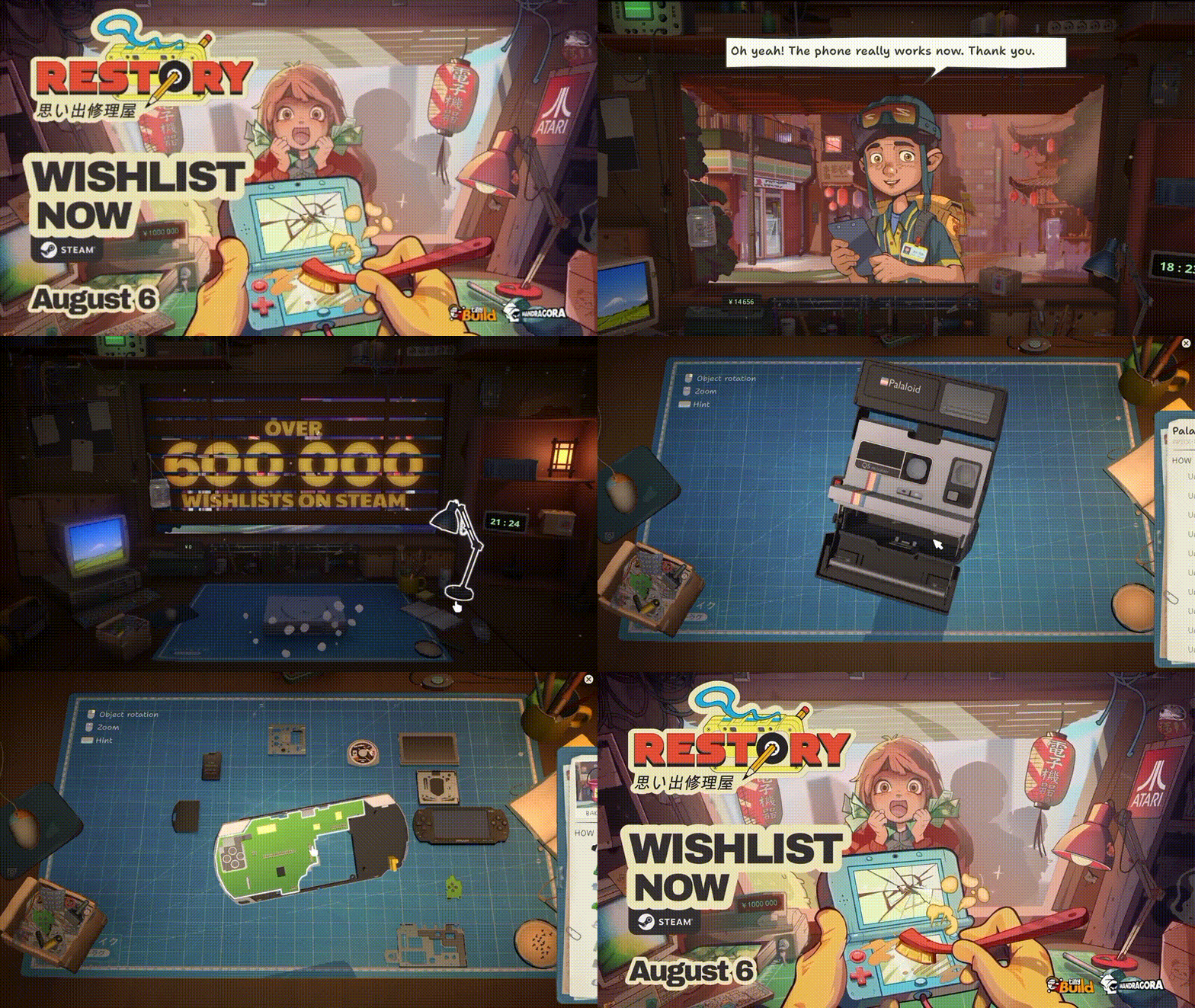
ReStory: Chill Electronics Repairs, We’re invited to open a small electronics repair shop in Tokyo in the 2000s, where broken mobile phones, game consoles, music players, cameras, household electronics, and other nostalgic devices arrive at the workbench. Instead of treating restoration as a simple button press, the game asks players to remove screws, separate components, clean dirty surfaces, identify damaged parts, purchase replacements, and carefully rebuild each machine.
ReStory: Chill Electronics Repairs Overview, Release Details, and Gameplay
Developed by Mandragora and published by tinyBuild, ReStory: Chill Electronics Repairs is a first-person repair and shop-management simulation set in a fictionalized version of mid-2000s Tokyo. Mandragora is also known for I Am Future, but ReStory shifts the focus from post-apocalyptic survival to the quieter pressures of customer service, small-business finances, personal relationships, and the satisfaction of returning an old gadget to working condition. It combines a detailed restoration loop with dialogue choices, customer stories, online orders, workshop improvements, and several possible endings.
The game launched on August 6, 2026, after attracting substantial attention through demos and public playtests. Its presentation draws heavily from Japanese Y2K electronics culture, early internet aesthetics, parody technology brands, and the atmosphere of Tokyo’s Akihabara district. However, nostalgia is only one part of the experience. Behind the colorful devices and relaxing music is a story about a missing repair master, an unfamiliar neighborhood, financially difficult decisions, and customers whose lives gradually become connected to the player’s shop.
ReStory: Chill Electronics Repairs is a narrative-driven job simulator in which the player operates a small electronics repair business. The main activities involve accepting damaged devices, examining the customer’s instructions, disassembling the equipment, cleaning individual components, replacing defective pieces, completing optional restoration services, and delivering the finished product. Money earned from those jobs can be invested in tools, replacement parts, software, licenses, shop decorations, storage improvements, and additional devices that can be restored and resold.
The game begins with the player stepping into the position of a local repair master in a fictionalized Tokyo neighborhood commonly described as Akiba. The previous master has disappeared under mysterious circumstances, leaving behind a workshop, unfinished relationships, and questions that cannot be answered simply by repairing more electronics. The player must therefore establish a reputation while learning what happened before their arrival. Independent launch reviews describe the disappearance as an important narrative thread that links the shop-management mechanics to the wider neighborhood story.
Its genre is broader than a conventional repair simulator. Steam classifies it with tags including job simulator, cozy, management, economy, building, crafting, shopkeeper, choices matter, multiple endings, nonlinear, story rich, and dialogue heavy. These classifications reflect the way its systems overlap. A repair can generate income, influence a customer relationship, unlock a conversation, reveal information about the neighborhood, or lead toward a different outcome later in the story.
The word “chill” in the title describes the game’s general tone rather than an absence of consequences. Players can work methodically, decorate the shop, listen to its ambient soundtrack, and take additional restoration orders at their own pace. At the same time, rent, bills, tool costs, customer expectations, delivery schedules, and dialogue decisions create enough pressure to keep the business meaningful. This balance allows ReStory to function as both a relaxing workbench simulator and a character-focused management game.
In This Article (20 sections)
Release Date and PC Availability
ReStory: Chill Electronics Repairs was released on August 6, 2026. It is available through Steam for Windows and macOS, with single-player gameplay, Steam achievements, cloud support, trading cards, and Family Sharing. The Steam release includes 50 achievements, giving completion-focused players additional objectives related to repairs, business growth, characters, tools, finances, and story progress.
The Windows version requires a 64-bit operating system. Its published minimum requirements are Windows 10 x64, a processor with two cores and four threads, 4 GB of RAM, an Nvidia GeForce GTX 750 Ti or comparable graphics hardware, DirectX 11, and approximately 1 GB of available storage. These requirements are relatively modest for a 2026 release and reflect the game’s stylized visual presentation rather than a demand for high-end photorealistic rendering.
The macOS version requires macOS 14 or newer, an Apple M1 processor, 8 GB of RAM, Apple integrated M1 graphics, and roughly 1 GB of storage. The published requirements specify an Apple processor, meaning users of older Intel-based Macs should not assume compatibility simply because a macOS edition exists.
At launch, the developer described the Steam Deck version as “Playable” rather than fully Verified. This distinction indicates that the game can run on the handheld, but certain interface, text, input, or usability elements may not yet meet all of Valve’s verification criteria. Mandragora stated that it was continuing to work toward a better Steam Deck experience.
The launch price was $19.99 in the United States, €19.99 in the eurozone, £14.99 in the United Kingdom, and ¥1,999 in Japan, with other regional prices set separately. A 10 percent introductory discount was announced for the launch period through August 20, 2026. Pricing can vary by territory, taxes, exchange-rate adjustments, and future promotions, so the local Steam store remains the authoritative source for the amount charged in a particular region.
No console version was part of the August 6 launch announcement. ReStory arrived as a Steam release for Windows and macOS, so players searching for PlayStation, Xbox, or Nintendo editions should not treat unofficial store listings or speculation as confirmation.

Gameplay and Repair Mechanics
The central gameplay loop begins when a customer brings a device to the shop or submits an order through the workshop’s computer. Each request contains one or more requirements. A customer may want a broken part replaced, dirt removed, a case repainted, software installed, firmware corrected, or several services completed together. The player accepts the job, places the device on the workbench, and begins examining how it is assembled.
Disassembly is performed directly in first person. Screws must be removed, shells lifted away, internal layers separated, and components detached in a sensible order. Once the device is open, the player can inspect individual parts for dirt or damage. Broken components may have to be purchased online, salvaged from another machine, repaired with an appropriate tool, or replaced with a compatible alternative. The device is then cleaned, reconstructed, tested, packaged, and returned.
The apparent simplicity of that loop is expanded by the variety of requests. A device that only needs exterior cleaning can be finished quickly, while another may require complete disassembly, circuit-board work, new internal components, cosmetic restoration, and software services. Later tools such as an improved screwdriver, soldering equipment, painting tools, compressed-air alternatives, and firmware-related programs reduce repetitive work or introduce additional repair possibilities.
Not every job comes from the main story. ReStory includes in-person customer assignments and online orders, allowing players to continue earning money beyond the most important narrative requests. Story jobs introduce characters, unlock progression, or advance the mystery surrounding the previous repair master. Online work provides a more repeatable business loop and can help finance expensive upgrades, parts, licenses, and decorations.
The shop also participates in competitions and technical challenges. Some of these activities test how efficiently the player can complete a restoration, while others are connected to licenses or narrative progression. They prevent every assignment from feeling like an identical commercial order and reinforce the idea that the protagonist is becoming recognized as a skilled repair professional.
Official information estimates more than 15 hours for the main story, although the exact length depends on reading speed, optional work, shop customization, replaying choices, and the amount of time spent buying and restoring devices for resale. One independent reviewer reported finishing the main story in slightly more than 12 hours, showing that experienced or faster players may complete it below the official estimate.
Marvel Tōkon: Story Mode, Online Multiplayer, Stages, and Arc System Works Design
Episode Mode and Story Explained
Episode Mode is the game’s single-player story experience. It presents five team-based narratives connected to an original threat facing Earth. Rather than simply repeating the same arcade ladder with different endings, the mode explores how each official group forms, why its members enter the conflict, and how their individual motivations affect their cooperation.
The central event is a high-stakes tournament organized by a mysterious figure called the Promoter. Her true name is Xirena Awhina, and she is identified as an Elder of the Universe who travels the cosmos arranging entertainment on an enormous scale. She invites Marvel’s heroes and villains to a competition that will determine Earth’s fate. Another mysterious figure, the Champion, appears as the conflict develops.
The five stories correspond to the Unbreakable X-Men, Amazing Guardians, Fighting Avengers, Knights of Doom, and Samurai Outriders. The Amazing Guardians narrative follows Spider-Man as he brings together Ms. Marvel, Star-Lord, and Peni Parker. The Unbreakable X-Men story focuses on Storm leading a reduced mutant team against the new danger. Other episodes explain alliances that appear especially unstable, including Doctor Doom’s villain team and the mismatched Samurai Outriders.
Episode Mode was written by Marvel comics writer Kieron Gillen and contains five distinct stories illustrated by different artists. Its presentation combines American comic-book composition with Japanese manga influences. Narrative scenes use motion-comic artwork, full voice acting, and battles that emerge from the events of each chapter.
The game supports full voice acting in ten languages and text in additional languages. The opening movie and cinematic sequences used throughout Episode Mode were produced by Japanese animation studio Sanzigen, whose work emphasizes the game’s 2.5D anime presentation.
Episode Mode is valuable even for players primarily interested in multiplayer. It introduces the personalities and intended relationships of the five teams, creates opportunities to use different characters, and connects unfamiliar roster choices to the larger Marvel storyline. It is also fully accessible as part of the game’s offline content.
Online Multiplayer, Ranked, and Casual Modes
Marvel Tōkon supports online competition between PlayStation 5 and PC through cross-play. Casual Match is designed to connect players with opponents at a similar skill level without placing the same emphasis on visible competitive progression. Ranked Match uses a ladder structure for players who want their results to influence an online rank.
Room Matches provide private spaces for organized sets between friends, practice partners, community members, or tournament participants. These rooms are useful for playing repeated matches without returning to open matchmaking after every result. The game also includes an Online Lobby that can host up to 64 players.
The lobby is presented as a social hub containing miniature representations of Marvel stages. Players can select avatars, move through the environment, communicate through available messaging tools, and approach arcade cabinets to begin battles. Cosmetic items such as lobby avatars, pets, equipment, and rides are separate from playable combat characters.
Local Versus allows two people to fight on the same system, while CPU opposition supports offline practice. This distinction is important because the game’s 4v4 label does not mean four friends can each control one hero on the same team. A standard match still consists of two opposing players, each controlling an entire squad of four.
PlayStation 5 users need PlayStation Plus for online multiplayer but not for Episode Mode or other offline activities. PC players must link a PlayStation Account for connected features. Internet access and an account are required for the Online Lobby, Casual Matches, Ranked Matches, private Room Matches, player profiles, and related network services.
New players should spend time in Casual Match before treating Ranked results as a measure of progress. The 4v4 structure creates numerous unfamiliar situations, and early losses often reflect incomplete matchup knowledge rather than a lack of long-term ability. Watching how opponents use assists, unlock later team members, and defend against Link Attacks can provide information that is difficult to obtain from training against a stationary dummy.
Stages, Interactive Transitions, and Marvel Locations
The official game page profiles seven Marvel-themed stages: Asgard, Marvel’s New York during the day, Marvel’s New York at night, Wakanda, Savage Land, X-Mansion, and Knowhere. These locations are not limited to static background art. Several contain multiple connected areas, hidden references, changing scenery, and cinematic transitions that influence the progress of a match.
Marvel’s New York includes the City Center, Hell’s Kitchen, and Avengers Park. The night variation changes the atmosphere through neon lighting, shadows, fog, and nighttime versions of the city’s recognizable districts. It also serves as the Knights of Doom’s associated stage and contains Marvel Easter eggs.
Wakanda moves between natural, royal, and technological spaces, including Warrior Falls, the Royal Palace, and Shuri’s laboratory. Savage Land is spread across five areas within the prehistoric preserve hidden in Antarctica. X-Mansion represents the X-Men’s headquarters and school, while Knowhere creates a connected cosmic battlefield inside the enormous head of a Celestial.
Asgard contains five areas: the Observatory, Bifrost Bridge, Throne Room, Treasure Vault, and Yggdrasil. Its combination of advanced technology, magic, mythology, and royal architecture makes it a fitting home stage for the Samurai Outriders, whose lineup includes Loki.
A stage transition can be triggered by landing eligible moves, combinations, wall bounces, or throws near the edge of an area. The resulting sequence moves the battle into another portion of the location. More importantly, it can unlock the third and fourth characters on the attacking player’s team. Stage awareness is therefore connected directly to roster access and strategy.
This system changes how players should evaluate corner position. In many traditional fighters, driving an opponent to the edge is valuable mainly because it restricts movement and enables specialized combos. In Tōkon, the same position may also create a route into a new area and expand the player’s available team. Giving up a small amount of immediate damage to secure a transition can be the stronger long-term decision.
The stages also reinforce the game’s crossover identity. Moving through several parts of Wakanda, New York, Asgard, or Knowhere gives each battle a sense of progression more closely associated with a comic-book set piece than a conventional single-screen arena.

Anime Art Style and Arc System Works Gameplay Design
Marvel Tōkon’s visual direction combines recognizable Marvel features with the stylized animation methods associated with Arc System Works. The developers initially experimented with a shader intended to reproduce a Western comic-book appearance. Marvel Games encouraged the team to move toward a more distinctly Arc System Works presentation, leading to what the producer described as a Japanimation-inspired approach.
The characters retain important features from their established identities but receive new costumes, silhouettes, effects, and movement styles. Iron Man, Storm, Doctor Doom, and other familiar figures are recognizable without appearing to be direct recreations of a particular film or earlier game. Less common characters such as Danger and Peni Parker also give the studio space to design unusual animation, machinery, and character-specific systems.
American comics and Japanese manga influence the menus and match presentation. The character-select screen draws from both traditions, while certain finishes involving transitions or powerful attacks use manga-panel compositions. The result is not simply Marvel characters placed inside another Arc System Works game. The interface, cinematics, stage movement, and team structure have been designed around this particular collaboration.
Each fighter has bespoke Normal, Special, Unique, Super, and Ultimate attacks based on that character’s abilities. Spider-Man can use a Spidey Sense mechanic to evade and counter. Ghost Rider manages a Vengeance Gauge. Hulk’s strength is tied to a Gamma system, Magneto manipulates objects and debris, and Loki can convert apparently normal attacks into feints or counters. These individual mechanics prevent the large roster from feeling like a set of similar characters with different visual effects.
Sanzigen produced the opening animation and Episode Mode cinematic sequences. The opening was created to evoke energetic fighting-game introductions and anime openings from the early 2000s, supported by a rock-focused theme song. The studio’s experience with 2.5D animation complements Arc System Works’ use of three-dimensional models that appear to move with the timing and exaggeration of hand-drawn animation.
The gameplay design follows the same philosophy of combining accessibility and spectacle with technical depth. Easy chains and Quick Skills let a Marvel fan create recognizable attacks immediately, while motion commands, team order, assist selection, defensive systems, and optimized transitions provide room for high-level competition.
ReStory Shop Management, Finances, and Online Orders Explained
ReStory’s economy is based on the difference between the amount paid for a completed job and the total cost of fulfilling it. Replacement parts, tools, licenses, whole devices, software, decorations, bills, and workshop improvements all consume money. A large payment may appear profitable until the player subtracts several emergency purchases made during the restoration.
The safest financial approach is to inspect a device completely before placing a parts order. A partially dismantled machine may appear to need only a screen, but deeper layers can reveal a failed battery, damaged board, broken button, or dirty component. Ordering after a full inspection reduces duplicated delivery fees, wasted time, and the temptation to purchase an expensive part that could have been salvaged elsewhere.
Online orders expand the business beyond walk-in customers. The player can accept repair requests through the computer, package the finished device, and receive payment and ratings after delivery. These orders provide repeatable work and are useful when the next story request requires more money than the shop currently holds. However, ratings and deadlines mean that accepting every available contract is not always a good strategy.
Marketplace purchases introduce another business model. A damaged or inexpensive device can be bought, repaired, and resold for a profit. It can also be dismantled and used as a source of replacement components. Seller ratings help indicate the likely condition of a purchase, but lower-rated listings may provide bargains for players willing to accept uncertainty. Reviews describe whole devices as useful both for donor parts and refurbishment, turning inventory knowledge into an important financial skill.
Licenses are a major long-term expense because they unlock additional product families and repair opportunities. Purchasing a license before the shop has enough spare cash can leave the player unable to buy parts for the new devices it permits. Licenses are most valuable when connected to available work, an upcoming competition, or a profitable resale opportunity.
Bills should be treated as unavoidable operating costs rather than optional objectives. Launch-day achievement documentation describes bills arriving through the shop systems and being paid from available business funds. The presence of recurring obligations prevents the player from spending every payment immediately on decorations or speculative purchases.
Online work, reselling, story assignments, and customer repairs therefore form a connected economy. Story jobs create progress, routine orders stabilize income, donor devices reduce component costs, reselling rewards market knowledge, and upgrades increase productivity. Financial success comes from balancing all five rather than relying exclusively on a single activity.
How to Find Spare Parts Using ReStory’s Y2K Web Browser
The shop computer contains a stylized browser designed to resemble the internet of the mid-2000s. Its bright layouts, parody names, simple navigation, and specialized websites turn ordinary inventory purchasing into part of the game’s period atmosphere. Official descriptions confirm that the browser is used to find spare parts, manage orders, purchase tools, acquire licenses, and interact with the online marketplace.
Launch-day guides identify the browser as Gozilla Fairfox, a combination of names associated with popular browsers from the period. They also document services such as Outlink Express for online repair requests, Binotaro for tools and workshop items, Packuten for licenses and related purchases, and a marketplace or auction area for secondhand electronics. These names are fictional and exist entirely inside the game.
The most direct method of finding a spare part is to identify the damaged component during disassembly and search for a compatible replacement. Compatibility matters because a component that looks similar may belong to a different device family. The repair notebook and job interface help the player recognize what is missing, but purchasing should still be delayed until the entire machine has been inspected.
Whole devices can be more economical than single parts. A poorly maintained handheld may contain a working screen, battery, board, buttons, and shell even when it cannot function as a complete product. Buying it as a donor can provide enough components for several repairs. The disadvantage is that its condition may be uncertain, especially when the seller has a weak rating.
Software is another form of workshop inventory. Firmware tools, rating-related programs, repair utilities, and other applications can unlock services or improve access to information. A review also mentions hacker-related software, reflecting the game’s playful interpretation of the early internet rather than an attempt to teach real-world intrusion techniques.
The browser should be checked before ending a day. If a customer job requires a component that will arrive during the next delivery period, ordering it in advance avoids wasting the following morning. Players should also compare the price of one replacement part against the cost and potential resale value of an entire donor machine.
The Y2K browser is consequently more than a menu. It connects repair, finances, customer deadlines, device collecting, licenses, reselling, and shop progression. Learning where each service is located becomes part of operating efficiently.
ReStory Cleaning, Disassembly, and Device Restoration Guide
A successful restoration begins by reading the complete customer request. Repairing the obvious fault is not enough when the order also asks for cleaning, painting, software installation, or another service. The task panel should be treated as a contract. Before touching the device, note every requested result and consider whether any of them require tools or materials that are not currently available.
Begin disassembly by rotating the device and examining every surface. Screws can appear on the back, sides, battery compartment, handles, or beneath removable sections. Remove the clearly accessible fasteners first, then test which shell or component can be lifted. Forcing the wrong layer is unnecessary because the game’s interaction system indicates when a part is available.
Continue until every area relevant to the order has been exposed. Stopping as soon as one damaged component appears can lead to a second parts order later. Full inspection is especially important for devices obtained from the marketplace because they may contain multiple broken or dirty pieces.
Cleaning should be performed on both visible and hidden surfaces. A shell that looks acceptable from the outside may still contain grime on its inner face. Circuit boards, buttons, displays, and detached components should be examined individually. Early tool upgrades make this stage faster, and reviewers recommend relying on reusable brush improvements rather than repeatedly purchasing short-lived canned air.
Once every defect is known, decide whether to buy individual replacements or use a donor machine. Individual components are predictable, while donor devices can be more profitable when several parts are required. Seller ratings should influence the decision because the lowest price does not guarantee the lowest total cost.
Repairs involving soldering, firmware, painting, or software should be completed while the relevant component remains accessible. Reassembling too early can force the player to reopen the device. Cosmetic work must also match the customer’s request rather than the player’s personal preference.
During reassembly, use the notebook as a reverse-order guide. Verify that all required components are present before attaching an outer shell. The game is lenient about the exact historical location of individual screws, but missing essential parts will prevent completion. A hint can reveal the next actionable item when a small fastener or hidden layer cannot be found.
After reconstruction, check the order requirements one final time. A device can be technically functional yet incomplete if it was not fully cleaned, painted, updated, or configured. Only package the item after every requested service is marked as complete.
This method minimizes unnecessary purchases and repeated labor. Read the request, inspect fully, clean every layer, identify all defects, buy parts once, perform specialist services, rebuild carefully, and verify the final checklist.

Officially Licensed Atari Consoles in ReStory Explained
Most ReStory devices use fictional brands that resemble famous electronics without copying their original names. Atari is the major exception. An official partnership between tinyBuild and Atari allowed Mandragora to include authentic Atari-branded hardware among the game’s repairable products.
The Atari 2600 is one of the confirmed licensed consoles. Its inclusion is historically appropriate because Atari’s early home hardware remained influential throughout later retro-gaming culture, even though the company had a more limited mainstream presence in Japan than in the United States. Mandragora’s development post explains that the system was redesigned and sold in Japan as the Atari 2800. The Japanese version never achieved the same commercial prominence as competing domestic hardware, but Atari products developed a lasting niche presence in specialist retro stores.
The Atari CX40 joystick is represented as a separate repairable device. Mandragora compared the game’s model with a real teardown and described a recognizable structure containing four screws, a board, the joystick mechanism, upper and lower shells, a red button, and power connections. The developers simplified certain internal connections so the restoration would remain readable and enjoyable rather than becoming a perfect technical simulation.
The Atari Lynx is also officially confirmed. Its portable design gives it a different restoration structure from the 2600 and CX40, helping the licensed collection cover both home and handheld gaming. Launch coverage additionally identifies the Atari Jaguar among the represented hardware, although Mandragora’s earlier development post concentrated primarily on the 2600, CX40, and Lynx.
Authentic branding gives these repairs a different kind of nostalgic appeal. Parody products invite players to recognize their inspirations, while the Atari devices act as digital recreations of identifiable hardware. Their presence also strengthens the connection between the fictional shop and the specialized retro-electronics businesses associated with Akihabara.
The licensed machines still follow ReStory’s accessible design philosophy. They resemble real hardware and are informed by real teardowns, but they do not require professional repair knowledge. The goal is to preserve the visual logic and emotional recognition of the original products while keeping each job understandable.
ReStory Customers, Dialogue Choices, and Personal Stories
The customers in ReStory are not simply anonymous sources of damaged equipment. Many return throughout the story, reveal information about one another, and become connected to the unresolved disappearance of the previous repair master. Their devices often carry personal meaning, which makes a restoration feel different from a randomly generated commercial request.
Hashimoto Genzo is the landlord associated with the shop’s high-traffic location. Official character material presents him as a man who understands the value of the property and remains strongly interested in receiving rent. His role connects the cozy workshop fantasy to the less relaxing reality of keeping a small business financially stable.
Baketsu is a mysterious young resident and skilled online Pac-Man player who lives above the shop. The character’s knowledge of neighborhood activity makes Baketsu potentially valuable when the player begins asking questions. The official profile also links Baketsu to a spare controller, reinforcing the way personal stories and electronics are interwoven.
Yamato Takeru is the courier responsible for moving purchases and orders through the neighborhood. Mandragora’s description presents his constant motion as more than professional enthusiasm. His family history and tendency to avoid stopping give emotional context to a character the player regularly encounters through an ordinary business system.
Inspector Sakamoto Kenji is a police inspector whose discomfort with silence leads him to surround himself with noise. That characteristic makes electronics, radios, televisions, and other sound-producing equipment personally significant rather than disposable objects. Suzumi Haruhi, Hoshino Yui, and rival repairer Aoyama Takumi similarly arrive with motivations that extend beyond the condition of the machines on the workbench. Yui’s attachment to an Eggotchi and Aoyama’s connection to the former master are particularly relevant examples.
Dialogue choices influence how the player responds to these people. Some decisions concern trust, empathy, information, loyalty, or business priorities rather than technical repair. A profitable answer may not be the most compassionate one, while helping a customer can create consequences elsewhere.
Because characters return, earlier conversations can acquire new significance. A minor remark may explain a later request, and an apparently routine job can reveal an unresolved relationship. This structure encourages players to read dialogue rather than treating every conversation as an obstacle between repair sessions.
How Choices Affect ReStory’s Branching Story and Multiple Endings
Choices in ReStory affect more than isolated lines of dialogue. The Steam store explicitly identifies choices, nonlinear storytelling, and multiple endings as major features, while independent reviews report that decisions have meaningful consequences for the conclusion.
The branching structure develops through repeated interactions rather than one obvious final question. How the player responds to customers, which relationships receive attention, what information is trusted, and how particular conflicts are handled can change later scenes. This approach makes the shop feel like part of a community rather than a neutral service counter.
Business decisions can also carry narrative weight. An order may involve an object with emotional significance, and the technically fastest solution may not align with what its owner needs. Choosing which customer to support can influence another character. Information about the previous repair master may also be interpreted differently depending on the relationships already established.
Multiple endings give the game replay value beyond collecting every device or achievement. A second playthrough can prioritize different dialogue responses, licenses, customer relationships, and interpretations of the mystery. Official launch information specifically lists branching narrative paths and device customization among the reasons to replay after completing the main story.
Players seeking a particular ending should avoid skipping conversations. The repair request explains what must be done to the device, but the surrounding dialogue often explains why the job matters. Selecting responses quickly can close or alter later possibilities without making the consequence immediately obvious.
The best first playthrough is therefore not necessarily one guided by an ending checklist. ReStory is designed to make personal judgment part of the experience. Following the responses that seem appropriate produces an ending based on the player’s own version of the repair master. Later playthroughs can then explore alternatives without reducing every conversation to a mechanical optimization problem.
ReStory Mid-2000s Tokyo Setting and Japanese Y2K Nostalgia
ReStory takes place in a fictionalized version of mid-2000s Tokyo influenced strongly by Akihabara. The setting is important because Akihabara’s identity is closely connected to electronic parts, specialist shops, home computers, games, anime, hobby culture, and small businesses filled with highly specific products.
The district’s electronics reputation has deep historical roots. Official Japanese tourism information traces its “Electric Town” identity to the postwar trade in radio and electrical components. Small stores and narrow shopping areas remained part of Akihabara even as the district expanded into computers, games, pop culture, collectibles, and entertainment.
GO TOKYO describes the area around the station as a compact district that once contained approximately 1,000 electronics stores before transforming into the wider “Akiba” associated with games, anime, manga, and emerging trends. ReStory draws from both identities. Its workshop belongs to the older culture of repair parts and specialist knowledge, while its customers, game systems, virtual pets, online communities, and colorful devices reflect the expanding youth culture of the 2000s.
The period browser is one of the clearest expressions of Y2K nostalgia. Instead of a modern application with minimalist icons and automated recommendations, the player navigates exaggerated websites with parody names and distinct purposes. Email orders, online auctions, seller ratings, early digital marketplaces, and specialized software recall a period when internet commerce felt less centralized.
The devices also capture a transitional technological era. Feature phones existed beside portable game systems, dedicated music players, digital cameras, virtual pets, home consoles, and experimental handheld media products. A modern smartphone can perform many of those functions, but the mid-2000s consumer often carried several separate machines. ReStory turns that fragmentation into mechanical variety.
Its nostalgia is not limited to recognizable shapes. Workshop clutter, delivery routines, shop bells, radio audio, music, interface sounds, bright plastic shells, and device startup noises contribute to the feeling of working inside a neighborhood electronics store. Reviewers have praised the soundtrack and environmental audio for supporting the atmosphere, even when repetitive repair jobs begin to settle into a routine.
The setting also supports the game’s theme of preservation. Repairing an old device is not just a way to earn money. It keeps a customer’s saved memories, entertainment, photographs, communication, or emotional attachment alive. That idea gives the Y2K imagery a purpose beyond visual nostalgia.

ReStory Beginner Tips for Repairing Devices and Growing Your Shop
The most useful early upgrade is generally the screwdriver. Screws appear in nearly every teardown, so reducing the time required to remove and reinstall them improves almost every job. Launch guides also recommend investing in reusable cleaning tools rather than relying heavily on canned air, which is consumed quickly.
Do not purchase replacement parts immediately after finding the first broken component. Complete the teardown, inspect every layer, and write down everything the job needs. One consolidated order is usually more efficient than several emergency purchases spread across multiple delivery periods.
Avoid accepting more online orders than the shop can finish. Additional contracts look like guaranteed income, but unfinished work occupies storage, consumes parts, and can reduce customer ratings. Since top online ratings are connected to quick completion, a smaller number of efficiently managed orders can be more valuable than a crowded queue.
Use marketplace devices strategically. A cheap machine with several intact components can become an excellent donor, especially when the same parts are needed for multiple customer jobs. However, seller ratings matter. The lowest-priced listing may contain fewer usable parts than expected, so maintain enough cash to recover from an unsuccessful purchase.
Keep a reserve for bills and story repairs. Spending every payment on decorations, licenses, or speculative devices can leave the shop unable to finish an important assignment. A license only becomes profitable when there is enough money left to purchase the parts and tools required by its new device category.
Check the delivery schedule before ending the day or promising a quick turnaround. If the courier has stopped operating, a missing component may not arrive until the next service period. Ordering earlier reduces idle time and makes online deadlines easier to meet.
Use the hint function when progress is blocked by a very small screw or hidden connection. There is little value in rotating the same device for several minutes when the game provides an accessibility feature designed to identify the next step. The repair challenge is supposed to come from understanding the device, not from fighting visibility.
Read every requirement before packaging the finished product. Cleaning, painting, firmware work, and optional services can remain incomplete even after the machine has been rebuilt. Opening it again wastes time, particularly when the missed component is beneath several shells.
Pay attention to customer dialogue. A choice that appears unrelated to the workbench can influence later relationships or endings. ReStory rewards technical efficiency, but it also expects the player to understand the people bringing those devices into the shop.
Finally, allow the workshop to grow gradually. Better tools, storage, decorations, licenses, software, and resale inventory are all useful, but buying everything at once is unnecessary. Upgrade the systems that slow down the current workload, then expand when regular income can support the next stage.
ReStory Review, PC System Requirements, Price, and Player Reception
ReStory: Chill Electronics Repairs succeeds most clearly when its repair mechanics, setting, and customer stories support one another. Disassembling a device is satisfying because each layer provides visible progress. Cleaning a dirty board or replacing a broken screen produces an immediate transformation, while returning the finished machine gives that mechanical work a human purpose.
The simplified teardown system makes the game accessible without removing the pleasure of observation. Players still need to find screws, understand component order, diagnose damage, and plan purchases, but they are not required to manage electrical hazards or possess professional technical knowledge. Reviewers have compared the devices favorably with real electronics while acknowledging that the internal structures are intentionally streamlined.
Its strongest secondary feature is the narrative. The missing master, returning customers, neighborhood relationships, and dialogue choices prevent the shop from becoming a collection of unrelated repair puzzles. Multiple endings also make conversations feel consequential and provide a reason to revisit the story.
The main criticism is repetition. Every device has a different layout, but many jobs still involve the same sequence of unscrewing, brushing, replacing, rebuilding, and packaging. Try Hard Guides described it as a strong niche simulation while observing that the central loop could become repetitive or grind-heavy. DayOne similarly praised its pleasant presentation and accurate repair theme while assigning an 8 out of 10 score.
Other reported weaknesses include tiny screws that can be difficult to see, an in-game clock that advances while the player is concentrating on the bench, occasional launch bugs, inconsistent zoom behavior during certain tool interactions, and orders involving software or firmware combinations that may not always communicate their requirements clearly. These problems do not eliminate the appeal of the restoration loop, but they can interrupt its otherwise relaxing rhythm.
Early critical reception was generally positive. Steam displayed recommendations from outlets including MonsterVine, which awarded 5 out of 5, and Wand, which awarded 8 out of 10. The official launch announcement also highlighted strong aggregate critical results, although aggregate scores can change as additional reviews are published.
Player reception was especially strong during the opening days. As of August 7, 2026, the Steam store showed 748 reviews from Steam purchasers, with 97 percent positive and an “Overwhelmingly Positive” classification. The broader displayed total was 796 reviews, including non-purchase sources recognized by Steam. These figures are a launch-day snapshot and will change as more players submit reviews.
The game’s minimum Windows requirements are Windows 10 x64, a two-core and four-thread processor, 4 GB of RAM, a GeForce GTX 750 Ti-class graphics card, DirectX 11, and 1 GB of storage. Mac users need macOS 14 or newer, an Apple M1 processor, 8 GB of RAM, M1 integrated graphics, and 1 GB of storage.
Its standard launch price of $19.99 places it below many full-price management games, while the announced 10 percent launch discount lowered the initial cost further. The value depends on the player’s tolerance for repetition. Someone interested only in the main story may finish in approximately 12 to 15 hours, while a player completing online orders, collecting licenses, restoring marketplace devices, customizing the workshop, earning achievements, and exploring different endings can spend considerably longer.
Overall, ReStory is best suited to players who enjoy methodical job simulators, nostalgic electronics, cozy management games, character-driven stories, and visible restoration progress. It is less suitable for anyone expecting a highly technical engineering simulation or constant mechanical novelty. Within its intended niche, however, the combination of tactile repair work and branching storytelling gives it a stronger identity than a conventional workshop simulator.
Frequently Asked Questions
1. What is the ReStory: Chill Electronics Repairs release date?
ReStory: Chill Electronics Repairs was released on August 6, 2026. The launch followed public demos, playtests, community surveys, and a substantial Steam-wishlist campaign. It arrived as a complete release rather than an Early Access title.
2. Is ReStory: Chill Electronics Repairs available on PC and Mac?
Yes. ReStory is available through Steam for Windows and macOS. The Windows version supports 64-bit Windows 10 or newer hardware that meets the published requirements. The Mac version requires macOS 14 or newer and an Apple M1 processor or compatible newer Apple silicon.
3. Is ReStory: Chill Electronics Repairs available on PlayStation, Xbox, or Nintendo Switch?
No console release was included in the August 6, 2026 launch information. The confirmed versions are Windows and macOS through Steam. A future console edition should not be assumed until Mandragora or tinyBuild makes an official announcement.
4. Does ReStory work on Steam Deck?
The developer described ReStory as Playable on Steam Deck at launch rather than fully Steam Deck Verified. It can therefore run on the handheld, but some interface, text, controls, or configuration elements may require adjustment. The development team said it was continuing to work toward improved verification support.
5. How long does ReStory: Chill Electronics Repairs take to complete?
The official estimate is more than 15 hours for the main story, depending on playstyle. One independent reviewer completed the central campaign in slightly more than 12 hours. Optional online jobs, device reselling, workshop customization, achievements, licenses, competitions, and alternate endings can extend the total playtime.
6. Are the electronics in ReStory based on real devices?
Many are fictional products inspired by recognizable Y2K electronics. Examples include the Pokia 3310, Autorolla Razor, Nony PMP, Nony Goman, Eggotchi, Patento BS, and Palaloid. Atari hardware is officially licensed, allowing real products such as the Atari 2600, CX40 joystick, and Atari Lynx to appear under their authentic names.
7. Is ReStory a realistic electronics repair simulator?
It is inspired by real device layouts and teardown methods, but it deliberately simplifies the process. Players remove screws, separate shells, inspect boards, clean components, replace damaged parts, solder, repaint, and perform firmware-related work. However, complex wiring, electrical testing, adhesives, hidden fasteners, safety risks, and professional diagnostics are reduced or omitted to keep the experience accessible.
8. Does ReStory have multiple endings?
Yes. Choices matter, the story is nonlinear, and several endings are available. Dialogue decisions and character relationships can change later events, making replaying the story with different responses one of the game’s main sources of additional value.
9. What should beginners upgrade first in ReStory?
The screwdriver is one of the strongest early upgrades because almost every repair requires removing and reinstalling screws. Reusable brush improvements are also valuable, while repeatedly purchasing disposable canned air can be inefficient. Players should maintain a cash reserve and avoid buying specialist upgrades before relevant jobs become available.
10. Is ReStory: Chill Electronics Repairs multiplayer?
No. ReStory is a single-player game. Online orders are simulated customer requests received through the in-game computer and do not involve cooperative or competitive online players. The Steam store lists single-player support rather than online multiplayer.

Conclusion
ReStory: Chill Electronics Repairs turns a small Tokyo electronics workshop into a detailed combination of restoration simulation, business management, Y2K nostalgia, and character-driven storytelling. Its core loop in ReStory is easy to understand but broad enough to support different kinds of work. In ReStory, players disassemble phones, consoles, handhelds, controllers, cameras, music players, appliances, and other devices before cleaning, repairing, repainting, reprogramming, and rebuilding them.
The surrounding management systems in ReStory give those repairs practical consequences. In ReStory, parts cost money, deliveries take time, online customers expect fast service, licenses unlock new opportunities, and poorly planned purchases can leave the shop unable to cover essential expenses. The marketplace in ReStory creates additional options through donor devices and refurbishment, while tool upgrades in ReStory gradually reduce the amount of routine work.
Its story gives the ReStory workshop emotional significance. Customers in ReStory return with recognizable personalities and personal attachments to their devices. Dialogue choices in ReStory affect relationships and contribute to multiple endings, while the mystery of the missing repair master in ReStory provides a reason to look beyond each individual job.
Repetition in ReStory, small visual details, time management, and occasional launch issues may limit its appeal for players seeking constant mechanical complexity. Nevertheless, the positive early critical and player response suggests that ReStory has found an audience interested in its specific combination of cozy work, Japanese Y2K atmosphere, tactile restoration, and branching narrative. For players who have ever wanted to reopen a worn handheld, restore a favorite mobile phone, rebuild a classic controller, or operate a tiny electronics shop in mid-2000s Tokyo, ReStory delivers that fantasy with unusual care.
Sources and Citation
- Official Release, Gameplay, Platforms, Achievements, and Requirements
- ReStory: Chill Electronics Repairs — Official Steam Store
This is the primary source for the August 6, 2026 release date, Mandragora as developer, tinyBuild as publisher, Windows and macOS availability, core repair-shop gameplay, branching storyline, online and in-person orders, licensed Atari devices, spare-part purchasing, restoration tools, language support, and PC and Mac system requirements. The listing specifies nine interface and subtitle languages, 50 Steam achievements, and a 1 GB storage requirement on both operating systems. Its user-review classification and review totals are live values that will continue to change. (Steam Store) - ReStory — Official Steam Global Achievements List
This official Steam Community page supplies the complete list of 50 achievements, their descriptions, and changing global unlock percentages. It includes achievements connected to soldering, first repairs, bills, email orders, customer reviews, licenses, marketplace purchases, cleaning, tools, customization, contests, firmware work, and long-term shop operation. (Steam Community)
- Launch Price, Regional Pricing, Length, Steam Deck, and Full-Release Additions
- ReStory: Prices & Launch Times — Official Steam Announcement
This August 4, 2026 announcement is the strongest source for the $19.99 USD launch price, 10 percent launch discount, and listed regional prices, including £14.99, €19.99, ¥1,999, ₩19,900, A$29.99, ¥55, ₽499, R$49.99, C$24.99, Mex$189.99, and 49.99 zł. These are launch-period prices and should not be presented as permanently fixed storefront prices. (Steam Store)The same announcement estimates 15 or more hours for the main story, depending on playstyle, while noting additional replayability through branching choices, device customization, and recurring online jobs. It states that the game would be marked Steam Deck Playable, but not Verified, at launch, and confirms that the macOS version would be available on release day. (Steam Store)Its full-release section documents additional gadgets, new restoration mechanics, upgradable tools, more characters, wall painting, interchangeable shelving, additional in-game storage, and placeable decorations. It also commits the team to quality-of-life improvements, bug fixes, general improvements, and further post-launch support. (Steam Store) - ReStory: 300,000 Sales, Update 1.0.010r, and Future Content
This August 13 announcement provides the clearest later confirmation of continued support. Mandragora says it is developing a new gadget for the game’s first free content update and working on a longer-term roadmap involving updates, collaborations, and downloadable content. It also documents fixes for long saves, possible save-related crashes, missing screws, and a Robby wiring bug. (Steam Store)
- Official Atari Partnership and Hardware Development
- Devlog #2: Atari Continues to Live on in ReStory
This is the principal source for the game’s Atari material. The developers explain that tinyBuild has an official partnership with Atari, allowing real Atari hardware to appear alongside fictionalized versions of other electronics. (Steam Store)The feature discusses the Atari 2600, its Japanese redesign and rebranding as the Atari 2800, and the limited but enduring presence of Atari hardware in specialist Akihabara retro stores. It also introduces the Atari Lynx as another licensed device planned for the game. (Steam Store)For the Atari CX40 joystick, the developers compare the real hardware with its in-game construction. The modeled teardown retains the four screws, circuit board, joystick, upper and lower casing, red button, and power cable, while simplifying the circuit-board-to-cable connection because reproducing it exactly would make the repair process more complicated. (Steam Store)
- Official Character Information
- Devlog #3: New Character Reveal?!
This consolidated official character feature covers all seven named characters in the source statement:- Hashimoto Genzo, the shop’s landlord
- Baketsu, the mysterious upstairs neighbor and online gaming champion
- Yamato Takeru, the courier
- Inspector Sakamoto Kenji, the local police inspector
- Suzumi Haruhi, a hostess connected to Yamato
- Hoshino Yui, the young Eggotchi owner
- Aoyama Takumi, the player’s repair-shop rival
- Independent Reviews and Gameplay Cross-Checks
- The Wand Report: ReStory Review
Wand’s review supports the descriptions of customer requests, device cleaning, repairs, painting, firmware updates, disassembly tools, soldering, online orders, spare-part shopping, licenses, and marketplace purchases. It also documents the game’s restoration assists, including warnings about incorrectly reinstalled dirty components, forgiving screw placement, less exacting dust removal, and a step-by-step reassembly notebook. (The Wand Report)The review particularly praises the combination of early-2000s nostalgia, tactile restoration mechanics, customer stories, and consequential narrative choices, awarding the game 8/10. (The Wand Report) - SmashPad: ReStory Review
SmashPad independently confirms that Atari is the only real licensed hardware brand among the review’s examples and observes that the virtual devices closely resemble real hardware while simplifying hidden screws, wires, and other teardown complications. (SmashPad)The review covers replacement-part orders, donor devices bought through the marketplace, upgraded tools, soldering, painting, cleaning equipment, firmware tools, licenses, and online jobs. It specifies that online orders must be completed within three in-game days to obtain the maximum customer rating. (SmashPad)SmashPad reports completing the main story in a little over 12 hours when concentrating on story jobs and lists an estimated completion time of 14 hours. This is compatible with the developer’s broader 15-plus-hour estimate because both sources explicitly tie completion time to playstyle. (SmashPad)It also documents a launch-build problem involving a guitar controller that required a firmware update but was incompatible with the available hacking tool, as well as smaller visibility, soldering-zoom, and accessibility concerns. The reviewer nevertheless describes the game as highly satisfying and places it among the strongest relaxing simulation games. (SmashPad) - First Update 1.0.009r — Official Steam Patch Notes
These official patch notes corroborate several reported launch issues. The update addressed achievements unlocking incorrectly, firmware problems affecting Guitar Legend and MyPod devices, inventory access during competitions, IDM disassembly errors, missing email notifications, ultrawide-screen problems, gadgets becoming stuck in the sonic bath, and bugs involving several other devices. (Steam Community)
- Critical Reception
- ReStory Reviews — Metacritic
As of August 14, 2026, Metacritic lists an 81 Metascore based on 11 critic reviews and an 8.8 user score based on nine ratings. These figures are dynamic and may change as more reviews and ratings are added. (Metacritic)The distinction between current and historical figures is important. The August 6 official launch post reported an early Metacritic snapshot of 85, while the August 7 Steam announcement reported 84. The present Metacritic page should therefore be cited for the current score, while the Steam announcements should be cited only when discussing how reception appeared at launch. (Steam Store) - ReStory Official Steam Store — Featured Critic References
Steam currently displays featured references from MonsterVine, The Wand Report, and Netto’s Game Room. The official August 7 announcement provides a broader launch-period collection that also includes ZTGD, GameSpew, and Kyusai. (Steam Store)
- Official Akihabara Historical Context
- Visit Chiyoda: Akihabara and Kanda
Chiyoda City’s official tourism site provides an additional local-government source describing Akihabara as both a major electronics center and a hub for anime, manga, art, and wider Japanese popular culture. (visit-chiyoda.tokyo) - JNTO: Akihabara — Travel Japan
The Japan National Tourism Organization explains that Akihabara’s “Electric Town” identity developed from the black market that appeared after World War II, where wires, cables, light bulbs, and other electrical goods were sold. It traces the area’s evolution into a center for household appliances before stores shifted toward calculators, watches, toys, games, computers, and other technology. It also documents modern Akihabara’s focus on anime, manga, gaming, cosplay, and other forms of otaku culture. (Japan Travel) - GO TOKYO: A Guide to Akihabara
This official Tokyo tourism guide describes Akihabara’s beginnings as a center of postwar black-market activity and its later development into a showcase for Japanese electronics and information technology. It specifically identifies postwar electronics-parts sellers, modern electronics retailers, specialist component shops, megastores, amateur-radio retailers, and the later expansion into games, manga, anime, figures, themed cafés, and other pop-culture businesses. (Go Tokyo) - GO TOKYO: Akihabara Electric Town
This official destination listing documents the district’s transformation from a concentrated electronics-shopping area into a broader pop-culture destination. It highlights computer, anime, manga, game, figure, retro-game, and specialist computer-parts stores, supporting the description of Akihabara as both an electronics district and a diversified games and entertainment center. (Go Tokyo)
Recommendations
- Blender 5.1: Release Date, Key Features, Performance Improvements, and Upgrade Guide
- Sony Is Quietly Shutting Down One of the Two PlayStation VR2 Exclusives It Published: Firewall Ultra Ends in 2026
- Alienware Reveals Four New Gaming Monitors for Competitive and Creative Users
- How The Blood of Dawnwalker’s Vampire Court Adapts to Your Choices and Changes the Story
- The Walking Dead: Streets of Survival: Release Date, Gameplay, Characters, and Beat ‘Em Up Details
- GTA V Free PS5 and Xbox Series Upgrade for PS4 and Xbox One Players
- Peaky Blinders: The Immortal Man Review – Is Tommy Shelby’s Return Worth It?
- Resident Evil Requiem Demo Is Out: How to Download on PC, PS5, Xbox, and Switch 2
- Fable Is Still Coming to PS5 Despite Xbox Reevaluating Exclusivity — No Delay Confirmed for 2026 Release
- Marathon Sells 1.2 Million Copies Across Steam, PS5, and Xbox: Sales Split, Revenue Estimates, and What It Means for Bungie



































































































