










In This Article (9 sections)
Riven 2024 Remake Release, Story, Platforms, and Reimagined Design
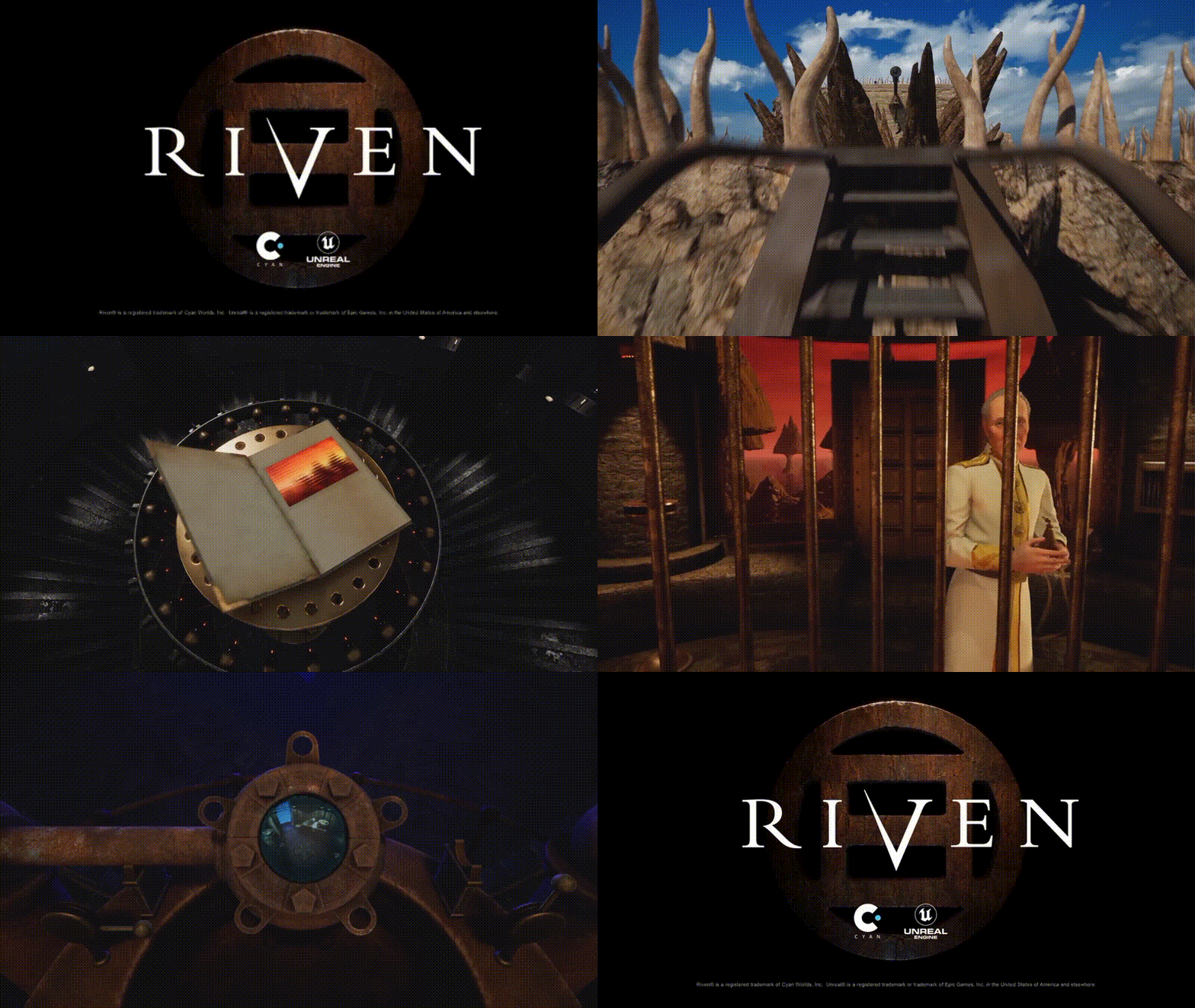
2024’s Riven remake brings one of the most influential puzzle-adventure games ever made into a fully explorable, real-time 3D world. Developed and published by Cyan Worlds, the studio behind Myst and the original Riven, the remake retains the mysterious setting, environmental storytelling, and interconnected puzzles of the 1997 release while introducing redesigned challenges, expanded locations, modern controls, and virtual reality support. Rather than simply improving the resolution of the original artwork, Cyan rebuilt Riven from the ground up so players can walk freely through its islands, examine machines from different angles, and experience environments that were previously presented through thousands of fixed, pre-rendered images.
The game is a modern recreation of Riven: The Sequel to Myst, originally released on October 31, 1997. It remains the second major game in the Myst series and continues the story of Atrus, Catherine, Gehn, and the mysterious civilization associated with the D’ni Art. This new version is a remake rather than a remaster. A remaster would normally preserve most of the original game while improving resolution, compatibility, sound, or interface features. Riven was instead rebuilt as a real-time 3D game with free movement, redesigned environments, altered puzzles, expanded narrative material, new locations, and revised interactions.
Several important creators associated with the 1997 game contributed to the remake, including Rand Miller, Richard Vander Wende, Mark DeForest, and Robyn Miller. Their involvement helped the new version preserve Riven’s visual identity and underlying design philosophy while correcting inconsistencies and expanding ideas that could not be fully developed in the original production. The remake is both a faithful recreation and a substantial reimagining, designed to challenge newcomers as well as players who already know the original game.
Riven remains a first-person, single-player puzzle adventure. There is no conventional combat system, quest marker trail, or constant tutorial narration. Progress comes from observing the environment, understanding unfamiliar machines, interpreting symbols, reading journals, recognizing patterns, and connecting information found across different islands. This guide covers the release history, available platforms, VR compatibility, system requirements, gameplay, puzzle changes, story, endings, reviews, and best version of 2024’s Riven remake.
The original release date for 2024’s Riven remake was June 25, 2024. It launched simultaneously for Windows PCs, Apple-silicon Macs, Meta Quest 2, and Meta Quest 3. The Windows version initially appeared through Steam and GOG, while a native Mac edition was released through the Mac App Store. The Meta Quest edition offered a complete standalone VR version that did not require a gaming computer. Cyan set the original standard price at $34.99 in the United States, although regional prices and temporary discounts vary.
The game was developed for flatscreen and virtual reality play in parallel rather than treating VR as a simple post-release conversion. This allowed Cyan to reconsider movement, object interaction, environmental scale, and puzzle presentation for both formats. The platform list expanded after the 2024 launch. On May 19, 2026, the same remake was released for PlayStation 5, PlayStation VR2, Xbox Series X|S, and the Microsoft Store. The console editions include modern features such as HDR and 4K support. The PS5 version offers optional PS VR2 play and PS5 Pro enhancements, while the Xbox edition supports Xbox Play Anywhere, cloud saves, achievements, and optimization for Xbox Series X|S.

Riven Remake Platforms, VR Support, and System Requirements
The Riven remake is currently available on Windows PC, macOS, Meta Quest, PlayStation 5, PlayStation VR2, Xbox Series X|S, and the Microsoft Store for PC. Windows players can purchase it through Steam, GOG, or the Microsoft Store. Apple-silicon Mac users can obtain it through the Mac App Store, while Cyan’s FAQ also states that Steam and GOG purchases provide supported Windows, Mac, and PCVR options. Meta Quest 2 and Meta Quest 3 have a separate standalone VR release.
The PlayStation edition runs on PS5 and can be played either on a conventional display or with PlayStation VR2. The Xbox edition runs on Xbox Series X|S and is also playable on supported Windows PCs through Xbox Play Anywhere. The 2024 remake is not listed for Nintendo Switch, PlayStation 4, Xbox One, iPhone, iPad, or Android. Older mobile listings titled Riven or Riven Legacy refer to adaptations of the original 1997 game, not the real-time 3D remake.
VR is one of the defining features of 2024’s Riven remake. A standalone edition launched for Meta Quest 2 and Meta Quest 3 on June 25, 2024. Because it runs directly on the headset, this version does not require a PC or cable. Cyan and Meta said that considerable work was required to maintain performance on Quest hardware, particularly in complex environments containing water, distant scenery, vegetation, and moving structures.
PCVR is also supported. Steam’s requirements identify Meta Quest headsets connected through Air Link or a Link cable, HTC Vive Pro, and Valve Index among the supported configurations. Cyan’s FAQ states that PCVR is included with the relevant Steam and GOG versions. PlayStation VR2 support arrived with the PS5 version on May 19, 2026. The PlayStation purchase includes both normal flatscreen play and optional PS VR2 content, so a headset is not required to play the PS5 edition.
VR makes the game’s architecture, machinery, cliffs, caverns, and transportation systems feel more physically convincing. However, flatscreen play can be more convenient for extensive note-taking. Players who are sensitive to artificial movement should review the available comfort and movement settings before beginning a long session, especially because Riven rewards slow observation and repeated travel through its environments.
For Windows, the official minimum configuration requires a 64-bit version of Windows 10 or Windows 11. The listed minimum processor is an AMD Ryzen 7 2700X or an Intel Core i5 from the 7000 series. The minimum memory requirement is 16 GB of RAM. Cyan lists an AMD Radeon RX 5700 XT or NVIDIA GeForce GTX 1070 8GB, with at least 6 GB of video memory, along with DirectX 12 and 30 GB of available storage.
The recommended Windows configuration calls for an AMD Ryzen 7 3800X or an Intel Core i5 from the 11000 series, 32 GB of RAM, and either an AMD Radeon RX 6800 XT or NVIDIA GeForce GTX 1080 Ti 11GB, with at least 8 GB of video memory. DirectX 12 and 30 GB of storage remain required. Cyan specifically warns that laptops using an NVIDIA RTX 3050 or RTX 3050 Ti do not satisfy its stated graphics requirements despite the newer model numbers.
For PCVR at minimum settings, the Steam listing identifies Quest 2 through Air Link or a Link cable, HTC Vive Pro, and Valve Index. Its recommended configuration lists Quest 3 through Air Link or a Link cable, HTC Vive Pro, and Valve Index. The Mac version requires macOS Sonoma 14.5 or later and Apple silicon.
The minimum configuration lists 8 GB of unified memory, 36 GB of available storage, and an M-series MacBook Air as the baseline example. The recommended configuration requires 16 GB of memory and suggests an M-series Pro or Max device. Intel-based Macs are not supported, and Cyan warns that the game may fail to start on an Intel Mac or a system running an earlier version of macOS.
These requirements are relatively demanding for a puzzle game because Riven renders detailed landscapes, water, lighting, vegetation, machinery, and long sightlines in real time. Players with hardware close to the minimum specification should expect to adjust resolution scaling, shadows, reflections, foliage quality, or other graphics settings. VR generally requires more consistent performance than flatscreen play, so meeting only the basic requirements may not provide the best headset experience.

Riven 2024 Gameplay, Exploration, and Puzzle Changes
Riven 2024 is played from a first-person perspective. Instead of clicking between fixed images, players move continuously through a real-time 3D environment. They can turn freely, examine objects from different positions, walk around machinery, revisit locations, and observe environmental details that were visible only from predetermined angles in the original game. This change fundamentally alters how the world is read, because structures that once appeared as carefully framed images now have to function as physical places.
The world consists primarily of five interconnected islands. Transportation systems, pathways, rotating structures, tunnels, doors, lifts, and other mechanisms gradually create a network across the environment. Progress is not strictly linear. A location encountered early may contain a machine that cannot be understood until the player finds a journal, symbol, sound, number, or physical relationship somewhere else. The central gameplay loop is observation, experimentation, interpretation, and return.
The environment itself effectively serves as the game’s interface and primary source of instruction. Players inspect an unfamiliar device, test its controls, record the result, explore elsewhere, discover contextual information, and then return with a better understanding. The remake includes an in-game notebook and screenshot system, allowing players to capture important views and consult them later instead of repeatedly travelling across the entire archipelago. Screenshots are particularly useful for recording symbols, diagrams, machinery settings, written passages, and objects that may become meaningful several hours later.
Riven is intentionally quiet and unhurried. It does not continuously confirm that a clue is important, announce the beginning of a puzzle, or separate every challenge into a self-contained room. Its strongest puzzles emerge naturally from the history, technology, language, wildlife, beliefs, and political structure of the world. The most obvious difference from the original is the transition from pre-rendered presentation to real-time 3D. The 1997 game used more than 4,000 rendered images and over three hours of animation to create the illusion of a physical place, while the remake allows complete freedom of movement and viewing direction.
The original point-and-click navigation has been replaced by modern first-person controls. Some paths, objects, doors, and structures were repositioned because designs that worked from fixed camera angles did not always make physical sense when approached from any direction. The original game’s live-action character presentation has also been replaced by real-time 3D characters and animation. This change allows characters to appear naturally within a freely moving camera system, although some longtime fans prefer the distinctive full-motion-video performances of the 1997 release.
The remake contains new locations, revised spaces, expanded lore, additional narrative context, and structural alterations intended to make Riven’s world more consistent. Richard Vander Wende explained that the team revisited the history behind the setting and its characters, corrected discrepancies, and developed material that previously needed more explanation. Cyan has described the remake as containing hundreds of changes. Examples include simplifying the granularity of a major marble-related puzzle, replacing a short pipe-crawling sequence with a more substantial environment, and adding a puzzle to an island that previously lacked meaningful resistance.
Many puzzles in 2024’s Riven remake are different from their 1997 counterparts. Some retain the same broad purpose but use new mechanisms, clues, or spatial relationships. Others have been substantially redesigned, replaced, or expanded. Certain solutions are randomized when a new game begins, preventing players from bypassing the intended reasoning process by copying a universal code from an online walkthrough.
The shift to real-time 3D required practical changes. A puzzle based on clicking beneath a partially closed gate could feel acceptable in a fixed-image game but awkward in VR, where forcing the player’s viewpoint under the obstruction would be uncomfortable. The remake therefore turns that moment into a different interaction. An animal-symbol puzzle also became more spatial because players can now stand in different positions and inspect the environment from any angle.
The revised puzzles are not simply easier versions of the originals. Some steps are more intuitive, but the game still expects players to combine information found far apart, learn unfamiliar symbolic systems, identify relationships between machines, and distinguish meaningful details from atmospheric decoration. Returning players should approach the remake as a new puzzle game. Knowledge of the world and story may help, but memorized solutions from 1997 are often incomplete or misleading. The changed puzzles are deliberately intended to restore uncertainty for experienced Riven fans.

Riven 2024 Beginner’s Guide, Puzzle Tips, and Completion Time
Begin by reading Atrus’s journal rather than immediately treating it as optional lore. It establishes the purpose of the journey, explains essential concepts, and provides context for objects that otherwise appear meaningless. Riven frequently places practical puzzle information inside narrative writing, so documents should be treated as part of the puzzle structure rather than separate background material.
Temple Island functions as an introduction to the game’s logic. Explore every accessible route, test doors and mechanisms, look above and below eye level, and notice how apparently separate structures affect one another. Do not assume that a locked object requires a conventional key. The opening area teaches that physical construction and environmental context matter as much as labeled controls. After leaving Temple Island, explore Jungle Island carefully, since this area contains branching paths, wildlife, cultural details, symbols, transportation routes, and environmental relationships that become important later.
Boiler Island introduces industrial systems and spaces connected to the production and use of books. Survey Island focuses heavily on observation, mapping, scale, and understanding how different parts of Riven correspond to one another. Prison Island presents an important objective, but players should not assume that every obstacle can be overcome during the first visit. A common spoiler-light progression is Temple Island, Jungle Island, Boiler Island, Survey Island, a return to Jungle Island, and then deeper access to the network leading toward Prison Island and later destinations. This order is not mandatory, and the game permits discovery in different sequences.
During the middle of the game, concentrate on connecting information rather than completing every machine immediately. If a device appears to require knowledge you do not possess, capture a screenshot and continue exploring. Repeatedly attempting random combinations usually wastes time and may prevent you from recognizing the intended logic. The later stages require information gathered across several islands, so read every journal again, organize your screenshots, and create a clear legend for symbols, numbers, colors, sounds, and locations. Before entering a destination that appears to be a major narrative turning point, create a separate manual save.
Treat Riven as one large puzzle rather than a collection of unrelated challenges. A machine on one island may be explained by architecture on another, while a symbol seen during the opening hour may not become understandable until much later. Keep both digital and physical notes. The screenshot notebook is excellent for preserving exact visual information, but paper can be faster when comparing symbols, drawing maps, translating numbers, or rearranging relationships. Write down where each clue was found so that it retains its context.
Read every document completely. Journals in Riven are not optional background collectibles. They may explain a character’s habits, identify a machine’s purpose, reveal a numbering principle, or clarify why a structure was built in a particular way. Listen as carefully as you look, because some mechanisms communicate through rhythm, pitch, repetition, or mechanical sound. Headphones can make subtle audio information easier to distinguish. When stuck, search for unexplored paths before searching for a solution, since a puzzle may be unsolvable because the necessary information has not yet been discovered.
Do not assume that every visible switch should remain activated. Experimentation is important, but record the original state of complicated equipment before changing several settings. This makes it easier to identify cause and effect. Create separate saves before important character encounters and final mechanisms, since Riven includes multiple outcomes and a well-placed save allows players to view alternatives without repeating many hours of exploration. Avoid copying a complete solution unless necessary. Several important values are randomized, so a guide may explain the method without providing the exact answer for a particular playthrough.
A first playthrough of Riven 2024 commonly takes approximately 10 to 20 hours, but the total depends heavily on observation skills, familiarity with Myst-style puzzle design, willingness to use hints, and the amount of time spent exploring. A detailed review from GamingTrend estimated roughly 15 to 20 hours for a thorough experience. Experienced Riven players have reported completion times closer to eight to ten hours because they already understand the world’s overall structure even when individual puzzles have changed.
A newcomer who refuses all hints can take considerably longer. Riven does not place a time limit on puzzles, and much of the experience involves thinking away from the computer, reviewing notes, or returning to an unresolved problem with a new interpretation. Achievement completion and alternate endings add extra time. The Steam edition includes 34 achievements, some of which relate to exploration, optional observations, unusual choices, and different outcomes.
Riven Remake Story, Endings, Reviews, and Whether it is Worth Playing
Riven begins shortly after the events of Myst. The player is reunited with Atrus, a writer who understands the D’ni Art: a discipline involving specially written books that connect to other worlds known as Ages. Atrus needs help rescuing his wife, Catherine, who is being held in Riven. He also needs the player to neutralize Gehn, his dangerous father, without giving Gehn an opportunity to escape into another Age. The mission is complicated by the fact that Riven itself is unstable and gradually deteriorating.
After arriving, the player discovers a divided society shaped by Gehn’s rule. Its islands contain religious structures, surveillance systems, industrial facilities, transportation networks, wildlife, villages, and evidence of resistance. The story is rarely delivered through direct exposition. Instead, players reconstruct it through journals, architecture, machines, overheard activity, abandoned spaces, and the reactions of the people they encounter.
The game can be understood without completing Myst first. Cyan and Meta have described Riven as a standalone experience, although playing Myst or reading a brief summary provides useful context for Atrus, Catherine, Gehn, linking books, and the D’ni civilization. Riven’s greatest narrative strength is that its puzzles and story are inseparable. Understanding how the world functions also reveals who built it, who controls it, what its inhabitants believe, and why the Age is approaching collapse.
The Riven remake has multiple endings determined by the player’s actions, timing, and decisions. There is an intended successful conclusion, but it is also possible to trigger several unsuccessful or alternate outcomes. These may result from using an important object incorrectly, acting before completing essential objectives, trusting the wrong situation, or activating the final sequence under unsafe conditions.
The exact number of endings is sometimes described differently because guides do not always count endings in the same way. Several achievement-focused guides group the outcomes into four principal categories, while completionist walkthroughs document additional situational variants and dialogue differences. The most accurate general description is that Riven contains one primary successful outcome and numerous alternate failure outcomes. Players interested in seeing several endings should create multiple manual saves during the late game, especially before using important linking books, before major character interactions, and before activating the mechanism associated with the finale.
The Riven remake received strong critical reviews. Its PC release holds a Metacritic score of 86, indicating generally favorable reception. PC Gamer awarded it 90 out of 100, PCGamesN gave it 9 out of 10, and GamingTrend awarded it 100 out of 100. Reviewers consistently praised the world design, atmosphere, environmental storytelling, sound, puzzle integration, and the way Cyan transformed fixed scenes into a convincing 3D landscape. The redesigned puzzles were also welcomed for giving returning players genuine new problems rather than allowing them to rely entirely on memory.
The most frequent criticisms concern the demanding hardware requirements, extensive backtracking, limited guidance, and the appearance of some real-time character models. Players accustomed to explicit objectives or rapid rewards may find the pacing frustrating. Riven expects patience and may allow several hours to pass between discovering a clue and understanding its purpose. For players who enjoy escape rooms, environmental mysteries, note-taking, unusual machinery, and difficult logic puzzles, 2024’s Riven remake is worth playing. It is less suitable for anyone seeking combat, constant dialogue, a linear campaign, or frequent hints. Its appeal lies in being left alone inside a coherent world and slowly learning how that world works.

Frequently Asked Questions (FAQs)
- Do I need to play Myst before Riven?
No. Riven is designed to work as a standalone story, so new players can begin with it and still understand the central mission. Playing Myst first, or reading a brief summary, provides helpful context for Atrus, Catherine, linking books, and the D’ni Art, but it is not required to solve Riven’s puzzles or follow the basic plot. - Is Riven 2024 a remaster or a remake?
It is a from-the-ground-up remake. Cyan rebuilt the game in real-time 3D and added free movement, revised puzzles, expanded locations, new narrative details, and altered interactions. It does not simply upscale or clean up the 1997 version, although it preserves the original game’s world, tone, and environmental puzzle philosophy. - Is VR required to play the Riven remake?
No. Riven can be played normally on a monitor or television. VR is optional on supported PC headsets and PS VR2, while Meta Quest has a dedicated standalone VR edition. Players who prefer note-taking, longer sessions, or traditional first-person controls can play the complete game without using a headset. - Can people who completed the original Riven reuse the old puzzle solutions?
Not reliably. Many puzzles have been redesigned, and several solutions are randomized for each new game. Familiarity with the original may help with the world’s general structure, story, and style of reasoning, but returning players still need to investigate the remake carefully and solve its revised challenges on their own terms. - Does the Steam version include VR and flatscreen play?
Yes. The Steam listing identifies the game as VR supported, and Cyan states that the computer purchase includes supported flatscreen and PCVR options. This means players can experience the same game on a normal display or through compatible PCVR hardware, depending on their setup and preferences. - Is the Riven remake available on PS5 and Xbox?
Yes. The Riven remake was released for PS5, PS VR2, Xbox Series X|S, and the Microsoft Store on May 19, 2026. The PS5 version supports normal flatscreen play and optional PS VR2 content, while the Xbox version supports Xbox Series X|S features and Xbox Play Anywhere through the Microsoft Store ecosystem. - Is the Riven remake available on Nintendo Switch or mobile devices?
The real-time 3D remake is not currently listed for Nintendo Switch, iPhone, iPad, or Android. Mobile versions with Riven or Riven Legacy in their names are adaptations of the original game, not the 2024 remake. Players looking for the rebuilt version should use one of the supported PC, Mac, Meta Quest, PS5, PS VR2, Xbox Series X|S, or Microsoft Store options. - Does Riven have a built-in system for recording clues?
Yes. The remake includes an in-game screenshot notebook that can preserve important images for later reference. This is useful for symbols, diagrams, machine settings, written passages, and locations that may become important later. A physical notebook is still useful when translating symbols, drawing maps, or comparing information gathered from several islands. - How difficult is the Riven remake?
It remains a difficult puzzle game. Some interactions are more intuitive than in 1997, but the game still requires careful observation, reading, note-taking, symbolic reasoning, and the ability to combine clues found hours apart. It gives players room to think rather than constantly pointing toward the next objective. - Which edition of Riven is best for a first-time player?
The standard edition contains the complete game and is the best value for most newcomers. The Deluxe Edition is worthwhile when the official art book and strategy guide are desirable, but it does not contain exclusive gameplay. Players who only want to experience Riven itself can safely choose the standard edition.

Conclusion
2024’s Riven remake succeeds because it does more than modernize the graphics of a classic adventure game. Cyan Worlds reconstructs Riven as a physically explorable place while preserving the qualities that made the original distinctive: environmental storytelling, interconnected puzzles, cultural detail, restrained dialogue, and the feeling of entering a world that existed before the player arrived.
The remake’s free movement, redesigned challenges, expanded locations, randomized solutions, notebook system, and VR support make it accessible on modern hardware without turning it into a conventional guided adventure. Returning players receive enough changes to make Riven mysterious again, while newcomers gain a more natural way to explore one of the puzzle genre’s most carefully constructed settings.
Its demanding system requirements, slow pace, backtracking, and limited guidance will not suit every player. For those willing to observe carefully and think patiently, however, the Riven remake remains an exceptional puzzle adventure and one of the most ambitious examples of how a historically important game can be reimagined rather than merely restored.
Sources and Citations
- Cyan Worlds – Riven Official Website
Riven Official Page - Cyan Worlds – Riven FAQ
Riven FAQ - Cyan Worlds – Console Release Announcement (PS5, PS VR2, Xbox Series X|S)
Myst and Riven Console Launch Announcement - Cyan Worlds – Official News Archive
Cyan News Blog - Steam Store – Riven
Riven Steam Page - SteamDB (additional technical reference)
Riven SteamDB Listing - Cyan Support Documentation
Cyan Support Center - Meta Interview – Cyan Development Director Hannah Gamiel and Rand Miller
Meta Developer Interview on Riven VR - GameSpot – Riven Returns with VR Support and New Puzzles
GameSpot Riven Preview - PS5, PS VR2, Xbox Series X|S & Xbox Play Anywhere Information
- PlayStation Store – Riven
Riven on PlayStation Store - Microsoft Store – Riven
Riven on Microsoft Store - Xbox Store – Riven
Riven on Xbox Store - Cyan Console Launch Announcement
Official Console Release Details - Metacritic Review Aggregator
Riven Metacritic Page - PC Gamer Review
PC Gamer Review of Riven - GamingTrend Review
GamingTrend Review (via Metacritic citation) - PCGamesN Review
PCGamesN Riven Review - The Guardian Review
The Guardian Review of Riven
Recommended
- How to Create a Metahuman from a Photo: The Ultimate Guide to Digital Character Creation
- Final Fantasy 7 Remake Part 3: Chadley’s Return Confirmed, Naoki Hamaguchi Teases Big Role in Final Chapter as “Nerd We Love to Hate” Comes Back
- The Internet Reacts to God of War Laufey: Fans Divided Over Faye’s New Role, Gameplay Changes, and Story Direction
- How to Hook a GoPro to Your Computer for Faceware: The Ultimate Step-by-Step Guide for Real-Time Facial Capture
- Xenoblade Chronicles X Switch 2 Edition Update Called the “Worst Switch 2 Edition” Why Players Are Requesting Refunds
- Stray on Switch 2: Release Date, Performance Upgrades, and What’s New Four Years Later
- Assassin’s Creed TV Show: Here’s Who Will Star In And Direct (Netflix Cast & Director Update)
- BAFTA Film Awards 2026 Predictions: Marty Supreme, Timothée Chalamet, Leonardo DiCaprio, Sinners, Frankenstein and Hamnet
- Assassin’s Creed Shadows Winter Roadmap Includes Major Update 1.1.8, A Parkour Challenge, And Switch 2 Claws of Awaji DLC



































































































