










In This Article (9 sections)
IRON NEST: Heavy Turret Simulator Gameplay, Release Date, and Platforms
IRON NEST: Heavy Turret Simulator is a first-person action and simulation game developed and published by Nick Nieuwoudt and Dominik Latos. The project was created by a two-person team with a strong interest in artillery, interwar machinery, industrial engineering, dieselpunk worlds, and methodical simulation games. The developers describe it as a heavy-artillery experience that combines tactical problem-solving, complicated machine operation, and strategic decision-making.
The defining feature is its rejection of automation. The player is personally responsible for almost every part of the firing procedure. Levers, valves, loading bridges, teleprinters, powder charges, elevation controls, turret-rotation mechanisms, ammunition cylinders, and firing switches all have practical functions. The cannon does not automatically reload, calculate its own firing angle, or identify the correct target. When a step is skipped or a number is entered incorrectly, the resulting shell can miss its intended destination or strike something that should have been protected.
Although the word “simulator” appears in the title, the game is not attempting to reproduce every detail of real artillery warfare. Its machinery draws inspiration from actual naval turrets, railway guns, heavy artillery systems, and early autoloaders, but the controls are simplified enough for one Operator to perform jobs that would normally require an entire crew. The result is a fictional but mechanically coherent war machine designed around readable equipment and satisfying interaction rather than complete engineering realism.
The launch version includes an interactive tactical map, procedurally generated objectives, a handcrafted campaign, two challenge modes, leaderboards, 15 regions, more than 100 medals, unlockable ammunition and abilities, newspaper reports, a functional warhorn, and a customizable cat companion. The game is entirely single-player at launch, although future multiplayer support has been announced.
IRON NEST: Heavy Turret Simulator received its full version 1.0 release on August 6, 2026. It did not enter Early Access, meaning the August release was presented as the complete launch version rather than the beginning of a publicly sold development period. A separate free demo previously launched on June 15, 2026, and remains available for players who want to learn the basic operation of the turret before purchasing the full game.
At launch, the game became available for Windows PC through Steam, GOG, and the Epic Games Store. The GOG edition is DRM-free and can be played without a mandatory internet connection or GOG Galaxy installation. Steam provides achievements, cloud functionality, family sharing, leaderboards, and official Steam Deck verification.
Console versions were not available on August 6. The developers have said that ports for major consoles are planned after the PC release, potentially within the following months, but no final console list, release date, or launch schedule has been announced. A virtual-reality version is also planned, although the developers have placed it behind the PC and console editions in their order of priorities. These plans should therefore be treated as future intentions rather than confirmed release dates.
The launch version is a single-player game. The developers have subsequently confirmed plans to add multiplayer to Heavy Turret Simulator, with proposed cooperative missions and competitive battles in which each player controls a separate IRON NEST. A different standalone cooperative game, intended to let several players serve aboard the same platform, is also planned for the wider IRON NEST universe. Neither project currently has a firm release date that should be treated as final.

IRON NEST Heavy Artillery Gameplay, Tactical Map, Firing, and Ammunition
A typical mission in IRON NEST begins when the Operator receives printed information from the machine’s teleprinters. One teleprinter carries priority orders from High Command, while another relays reports and requests from soldiers, observers, or other personnel closer to the front. These messages may contain the IRON NEST’s location, target coordinates, spotter positions, bearings, target descriptions, ammunition restrictions, friendly locations, reconnaissance requests, or special conditions for completing the operation. The player must read the entire order and transfer the relevant information to the notebook or tactical map before beginning the firing process.
The tactical map is the central workspace through which nearly every mission is understood. The player cannot see the conventional battlefield from the perspective of an infantry soldier or vehicle commander. Instead, information arrives as printed coordinates, bearings, reports, and reconnaissance images that must be converted into an accurate picture of what is happening outside the machine. The first essential step is to mark the current position of the IRON NEST because every bearing and range measurement depends on the location from which the guns will fire. If the machine is repositioned, old firing lines must be discarded and every target solution recalculated from the new origin.
Direct coordinates are the simplest form of intelligence. The player marks the supplied location and measures a line from the IRON NEST to that point. More complicated missions can require the player to triangulate an enemy position from two observers, extend a bearing from a reference point, search a reported sector, interpret an impact correction, or establish the IRON NEST’s new position after an emergency move.
When two observers provide bearings toward the same target, the player draws lines from both observer locations and places the target at their intersection. A separate line must then be drawn from the IRON NEST to that newly established target because the observers’ bearings reveal the target’s location rather than automatically providing the turret’s firing bearing.
Corrections work in a similar manner. If an observer reports that the previous impact landed a specified distance north, south, east, or west of the target, the correction begins at the impact point. The player uses the new information to move the target marker and then calculates a fresh bearing and range from the IRON NEST. The same principle applies after the machine relocates. Even if the target has not moved, a different firing origin creates a different bearing and range.
The map includes pencils, markers, a drafting compass, an Iris tool for visualizing shell effects, icon references, and reconnaissance overlays. Different colored lines can be used to separate permanent firing solutions from temporary construction work. Keeping the map clean becomes increasingly important during complicated operations because old intersections, destroyed targets, previous IRON NEST positions, expired corrections, and outdated firing lines can remain visually convincing even though they are no longer valid. Removing obsolete information reduces the chance of entering a correct number from the wrong stage of the operation. Aerial reconnaissance photographs and updated icons can also reveal new targets, confirm destruction, display the results of a missed shot, or expose collateral damage.
Once the target has been established, the player draws a final line from the current IRON NEST position to the target. That measurement provides two essential values: bearing and range. Bearing controls the horizontal direction of the turret, while range is entered into the ballistic calculator. The player then selects a viable number of powder charges, and the calculator produces the gun elevation required for that combination of range and propellant.
An accurate firing solution therefore connects bearing, range, powder charges, and elevation. These values should be recorded together for each target, particularly when the left and right guns are being prepared for different shots. A dependable firing record should include the target name or number, intended gun side, bearing, range, charge count, elevation, and ammunition type. The recommended process is to complete the map work first, confirm the current IRON NEST position, establish the target, draw the final firing line, measure bearing and range, enter the range into the ballistic calculator, select the charge count, and record the resulting elevation before loading the weapon.
Powder charges and elevation cannot be treated as independent settings. A solution calculated for two charges will not remain accurate if three charges are physically loaded. Likewise, copying the correct elevation while forgetting one charge changes the shell’s trajectory. Complicated missions may also provide approximate information rather than a completed solution, requiring the player to find the target before calculating the actual line from the IRON NEST. Corrections should always produce a new firing solution rather than reusing the previous bearing, range, or elevation.
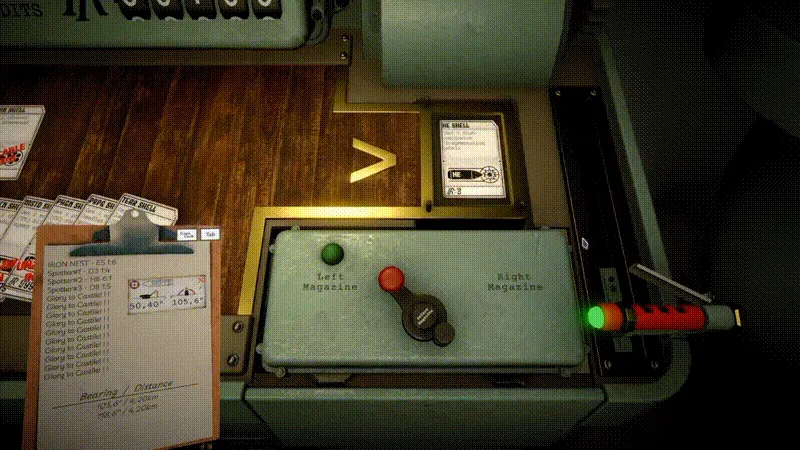
Preparing the 5,000-ton turret is intentionally physical. Reloading requires the Operator to interact with handles, the loading bridge, chamber controls, ammunition mechanisms, and powder charges. The turret contains two guns, and each side can carry different shells, different quantities of powder, and different elevation settings. The guns can also be loaded or armed independently, so players preparing separate targets must clearly label each firing solution to avoid setting the left gun with the right gun’s elevation or pulling the wrong firing control.
A reliable loading sequence begins by confirming the required shell, moving the ammunition into position, operating the loading mechanism, adding the exact number of charges used in the ballistic calculation, and securing the weapon. The turret is then rotated to the measured bearing. Rotation is deliberately slow because the machine represents thousands of tons of steel, and the developers encourage experienced Operators to use this period to perform other tasks rather than simply waiting beside the controls. The selected gun must then be elevated to the calculated angle. Before firing, the player should verify the physical charge count, shell type, turret bearing, gun elevation, and firing side.
The IRON NEST carries a ready supply in two shell cylinders positioned toward the rear of the turret. The developers describe these cylinders as holding a combined 12-round supply inspired by early autoloading systems. Additional ammunition is stored outside on logistical vehicles and must be hoisted into the machine when needed. Mechanical problems can also interrupt the normal sequence and require the Operator to repair or reset equipment. Combined with incoming reports, multiple loaded guns, time pressure, and enemy counter-battery fire, these failures can turn a familiar procedure into a demanding test of organization.
The game provides a range of ammunition and abilities through its progression system. The launch Steam page advertises 30 unlockable ammunition types and abilities. Standard high-explosive ammunition is intended for conventional destructive missions against unarmored targets, while high-capacity explosive shells cover a wider area and can affect several closely grouped targets. Armor-piercing ammunition has a smaller area of effect and is intended for bunkers, armored positions, underground facilities, or situations requiring a more concentrated impact.
Illumination or STAR shells can reveal an area or support observation, while smoke ammunition can screen friendly movements or assist allied forces. The official store description also identifies chemical ammunition, including phosgene, as part of the fictional campaign’s arsenal and presents such weapons as morally consequential tools rather than ordinary damage upgrades.
The correct ammunition depends on the mission, target, uncertainty level, surrounding units, and intended effect. The most destructive shell is not automatically the most effective. A large blast can eliminate several enemies but may also destroy friendly forces or civilian infrastructure, while a smaller armor-piercing impact may be safer when a hostile target is close to allies. Abilities and operational support are obtained through the requisition console and can include additional powder charges, intelligence, air reconnaissance, emergency repositioning, position reports, specialized ammunition, and battlefield-control tools.
Reconnaissance planes are particularly useful when reports identify only a broad search area. The Operator supplies a starting position and direction, after which the resulting photographs can reveal units or confirm the aftermath of previous fire. Requisition resources should therefore be spent in response to a defined problem. Purchasing specialized ammunition before confirming the target can leave the wrong shell inside the loading system, while ordering reconnaissance over an area that has already been photographed wastes resources that may be required later. Progression expands the Operator’s tactical options without replacing the central manual firing process.
The complete operation does not end with the explosion. The machine recoils, the battlefield changes, and the Operator must wait for confirmation rather than assuming the shot succeeded. New teleprinter reports, reconnaissance photographs, map updates, or correction instructions may require another complete firing solution. Completed operations are followed by newspaper reports that summarize the battle and describe the wider political narrative. The Operator can then use the requisition console, interact with equipment inside the machine, and eventually sleep to begin the next assignment. This repeated cycle of reading, measuring, calculating, loading, firing, verifying, and dealing with the consequences forms the core of IRON NEST.
IRON NEST Campaign Story and Alternate-History Spain Setting
The campaign takes place in a dystopian alternate version of Spain during the late 1920s. In this timeline, the Great War never occurred, Europe’s monarchies retained their authority, and republican opposition is spreading against the Spanish crown. The conflict is not a direct recreation of the historical Spanish Civil War but a fictional political crisis shaped by a radically different European history.
Royal ambition and a military junta have transformed Spain into a testing ground for experimental industrial weapons. The player controls the first IRON NEST prototype, an enormous land-based fortress constructed around repurposed naval-style artillery. Its deployment changes the nature of the war by allowing one isolated Operator to destroy targets from far beyond the visible front.
The story is delivered indirectly through the same systems that control the artillery. High Command does not provide a conventional voiced mission briefing. Instead, orders arrive through teleprinters, while field reports, observer messages, intercepted communications, reconnaissance photographs, and newspaper propaganda reveal different versions of the same conflict. The player must compare those sources and infer what has actually happened.
The absence of voice acting is an intentional design decision. According to the developers, text-based teleprinters reinforce the distance between the Operator and the people affected by each shot. High Command feels cold and impersonal, while the player remains physically isolated inside the machine. The silence also makes mechanical sounds, alarms, printing equipment, artillery impacts, and the record player more important to the atmosphere.
Newspapers appear after missions and reinterpret the Operator’s actions for the public. A successful strike may become a celebrated victory, while collateral damage may be blamed on the opposition or hidden beneath propaganda. These reports connect individual firing missions to the wider campaign and show how official history can be manufactured.
The narrative is not intended to provide simple heroic choices. It focuses on compromised decisions, incomplete information, institutional violence, and the gap between a distant command structure and soldiers near the front. Even a technically perfect firing solution can create a morally disastrous result, making the Operator’s responsibility extend beyond simply calculating whether a shell will hit its target.

IRON NEST Mission Structure, Procedural Objectives, Challenge Modes, and Progression
High Command supplies top-priority directives, coordinates, restrictions, and political expectations, while a second information channel carries messages from soldiers or observers closer to the battlefield. These sources do not always agree, creating situations in which the player must decide which information deserves attention before firing. A High Command order may identify an official target while a frontline report warns of friendly troops, civilians, medical facilities, or a different tactical emergency.
The game does not structure this agency as a simple “obey or rebel” system. The Operator does not press one button to remain loyal and another to join the opposition. Instead, narrative agency appears through practical decisions: which report to investigate, whether to spend requisition resources on additional reconnaissance, how precisely to follow an order, which shell to select, and whether to prioritize a request from soldiers over an institutional directive. Entering an incorrect bearing may be an accident, but selecting an unnecessarily destructive shell is a decision. Failing to inspect a warning from the front line may preserve obedience while creating preventable casualties.
This structure makes mechanical accuracy part of the story. Spending resources on reconnaissance can expose information that High Command omitted, but doing so may reduce the ammunition or support available for later objectives. The aftermath is communicated through map changes, aerial images, teleprinter messages, sound, and post-mission newspapers rather than cinematic execution scenes. The game therefore preserves the Operator’s physical separation from the destruction while repeatedly confronting the player with evidence of what the machine has done.
High Command also affects mission difficulty. Later assignments provide less direct guidance, forcing the player to locate targets through reconnaissance, spotter information, map work, and deduction. Orders can contain ammunition restrictions, time limits, protection requirements, or conditions that determine when counter-battery fire begins. Reading every page is therefore necessary both for understanding the narrative and for completing the operation correctly.
IRON NEST combines this handcrafted story campaign with procedural variation. The wider narrative, political setting, mission progression, and major operations are authored, while target layouts and certain objectives can vary. This allows the game to preserve a structured campaign without making every firing problem identical on repeated attempts. Procedural targets are particularly important in challenge missions because players cannot rely entirely on memorized coordinates from a previous run. Enemy positions, clusters, priority targets, and efficient firing opportunities can change, requiring the underlying map and artillery procedure to be solved again.
The campaign covers 15 regions, allowing new environments and strategic situations to complicate the same central process. Direct coordinate missions gradually give way to incomplete intelligence, reconnaissance problems, moving targets, protected units, ammunition restrictions, timed interceptions, smoke support, emergency repositioning, and enemy counter-battery pressure. The developers estimate that completing every mission once without significant replaying takes approximately eight to twelve hours, based on internal and community testing. This should be treated as a developer estimate rather than a universal completion time because inexperienced players may take longer while experienced Operators can complete familiar procedures more quickly.
Replayability also comes from performance. A mission can be completed successfully while leaving medals, efficiency goals, alternative decisions, or leaderboard positions unclaimed. Players can return to reduce ammunition use, avoid collateral damage, complete an operation faster, destroy multiple targets with one shell, operate without certain reconnaissance aids, or improve the sequencing of both guns. The game does not discard its map measurement and manual loading systems after the tutorial. Instead, it repeatedly changes the information surrounding those systems, making replayability particularly dependent on whether the player enjoys refining the artillery procedure itself.
The launch Steam listing advertises two challenge modes with leaderboards. Some older promotional descriptions referred to a larger planned number of challenge modes, but the current launch page lists two, so the launch listing is the more reliable reference. Developer and community discussions identify Counter-Battery and Uncontested Front as the two established challenge experiences.
Counter-Battery is the more pressured mode. Enemy artillery attempts to determine the IRON NEST’s location, creating a timer that rewards rapid planning and efficient firing. Players can improve their performance by preparing multiple solutions in advance, loading both guns, identifying valuable target clusters, destroying priority artillery, and minimizing unnecessary turret rotation.
Uncontested Front removes the same degree of counter-battery pressure and functions as a more relaxed or sandbox-like alternative. It gives players room to practice firing solutions, experiment with ammunition, improve accuracy, and pursue efficiency without having every decision dominated by a countdown. The developers created this option for players who want to be judged primarily by precision and resource use rather than speed.
Leaderboards turn these single-player challenges into asynchronous competition. A high score depends on more than rapid firing. Efficient ammunition use, target prioritization, successful multi-target impacts, intelligent use of both guns, reconnaissance decisions, and avoiding wasted movement can all affect the quality of a run. Counter-Battery rewards preparation and the ability to continue operating under time pressure, while Uncontested Front is better suited to deliberate experimentation and learning how shell effects, requisition tools, map geometry, and target placement interact. Because the central game remains single-player, leaderboard participation does not mean another person controls units inside the player’s campaign. It records and compares individual challenge performance.
Progression introduces more than 100 medals, 15 regions, unlockable ammunition and abilities, and 33 Steam achievements. Medals and achievements are related to progression but are not the same system. Steam achievements are platform-level accomplishments, while medals represent in-game recognition for particular operational feats. Campaign progression introduces additional regions and increasingly complicated operations, although the store page does not publish a complete region-by-region unlock chart. The practical method is to advance through campaign assignments, complete the required objectives, and use newly available tools as later missions introduce more demanding targets.
Medals encourage players to complete objectives in specific ways. Community discussions reference awards associated with ammunition efficiency, uninterrupted volleys, rapid engagement, single-impact multi-target destruction, unaided fire, and other specialized accomplishments. Some medals reward accuracy, while others test speed, economy, planning, or the willingness to operate without convenient reconnaissance tools. A player pursuing medals should read each description carefully and plan the entire operation before firing. An efficiency medal may require waiting until several enemies are close enough for one shell, while a rapid-engagement award may favor preloaded guns and a prepared sequence of bearings. An unaided-fire challenge may restrict aerial reconnaissance, making STAR shells, observers, or deduction more important.
Upgrades focus primarily on new ammunition, reconnaissance abilities, battlefield-control tools, map support, and targeted improvements to the turret. The developers have explicitly rejected the idea that progression should replace the machine’s defining manual systems. Players should not expect an upgrade that turns the game into automatic point-and-click artillery. The requisition console is used during operations to acquire ammunition, powder, intelligence, reconnaissance, and related support. Long-term progression determines which tools can become available, while mission-level requisition decisions determine which resources are actually obtained for the current operation.
The most effective progression strategy is therefore to master the basic firing loop before chasing every specialized tool. New ammunition and abilities widen the range of possible solutions, but map accuracy and organized gun handling remain more valuable than an advanced item used with an incorrect bearing.

IRON NEST Cat Companion, Steam Deck Support, and PC System Requirements
The customizable cat companion is included in the base game and is not sold as separate downloadable content. The developers originally considered releasing it separately but decided not to place gameplay content behind an additional purchase. The cat becomes available after the opening mission, when the Operator’s bed is unlocked, and can then be found in the same general living area while roaming around the lower deck of the IRON NEST. Players can prevent it from entering the upper deck, which is useful when they do not want it walking across the tactical map during an operation.
When the cat disappears somewhere inside the machine, opening the customization interface causes it to reappear. The menu provides extensive control over its appearance, including fur color, eye color, head shape, ear shape, nose and snout proportions, cheeks, body shape, leg thickness, neck, jaw, pupils, tail, tired-looking eyes, and a general’s hat. Players can also pick up the cat or move it away from a restricted work area.
The companion does not calculate firing solutions, load shells, or improve the turret’s combat statistics. Its purpose is atmospheric and emotional. The cat introduces a small domestic element into an otherwise oppressive metal environment filled with propaganda, machinery, teleprinter orders, and distant destruction. Other non-combat details, including the coffee machine, record player, bed, and living area, serve a similar function by making the IRON NEST feel like a place in which the Operator exists between assignments rather than a collection of disconnected menus. The contrast between caring for a customizable animal and operating devastating artillery reinforces the game’s unusual mixture of humor, comfort, industrial spectacle, and moral unease.
IRON NEST: Heavy Turret Simulator is officially Steam Deck Verified. Valve’s Steam listing indicates that the game’s default controller setup, interface, text readability, SteamOS compatibility, and default graphics performance meet the requirements for the Verified classification. The developers announced Steam Deck support before the full release and continued requesting performance reports from handheld players.
The minimum PC requirements call for a 64-bit processor and operating system, an Intel Core i5-4460 or AMD FX-8350 processor, 4 GB of RAM, Intel UHD or AMD Vega 8 graphics, DirectX 10, and 5 GB of available storage. The developers state that this configuration targets an average of 30 frames per second at 720p using low settings. A dedicated graphics card is recommended for a smoother experience, and performance can vary according to hardware configuration and thermal conditions.
The recommended specification lists an Intel Core i5-8400 or AMD Ryzen 5 2600 processor, 8 GB of RAM, an Nvidia GeForce GTX 1060 with 6 GB of video memory or an AMD Radeon RX 580 with 8 GB, DirectX 10, and 5 GB of storage. These are relatively accessible requirements for a 2026 PC release, although the physical map, small printed information, effects, and interface density may still make a larger display preferable for some players.
The game does not currently offer officially supported native Linux software. The developers previously reported that it appeared to run through Proton, and the official Steam Deck verification now confirms compatibility with Valve’s Linux-based SteamOS environment. Native Linux support and Proton compatibility should nevertheless be treated as separate matters.
Steam Deck users should pay particular attention to text size, motion settings, battery consumption, and control familiarity. The Verified status confirms that the game can be operated with the default handheld controls, but its deliberately dense procedure may still feel easier with a mouse on a larger screen. The free demo offers the best opportunity to test whether map work and small printed reports remain comfortable on the handheld display.
Frequently Asked Questions (FAQs)
- When was IRON NEST: Heavy Turret Simulator released?
IRON NEST: Heavy Turret Simulator was released as version 1.0 on August 6, 2026. It launched as a complete game rather than entering Early Access, so the August release represented the full launch version instead of the beginning of a public development period. A separate free demo became available earlier, on June 15, 2026, allowing players to learn the basic turret operation before purchasing the full game. - What platforms is IRON NEST: Heavy Turret Simulator available on?
The launch version is available on Windows PC through Steam, GOG, and the Epic Games Store. The Steam edition is officially Steam Deck Verified, while the GOG edition is DRM-free and can be played without a mandatory internet connection or GOG Galaxy installation. Console versions were not available at launch. - Is IRON NEST: Heavy Turret Simulator coming to consoles?
The developers have said that major console ports are planned after the PC launch, but they have not confirmed the exact consoles, release dates, or final release sequence. A VR version is also planned for a later stage. These should therefore be treated as future development plans rather than confirmed release dates or platform launches.
- Does IRON NEST: Heavy Turret Simulator have multiplayer?
The August 2026 launch version is entirely single-player. Multiplayer has been announced as a future addition, with proposed cooperative missions and competitive battles in which each player operates a separate IRON NEST machine. A different standalone cooperative project is also planned for the wider IRON NEST universe, allowing several players to serve aboard the same platform, but neither project currently has a firm release date.
- How long does the IRON NEST campaign take to complete?
The developers estimate that completing the campaign once, without extensive replaying, takes approximately eight to twelve hours. That figure is not a fixed completion time, since players who spend longer solving map problems or experimenting with the artillery can take more time. Challenge modes, medals, leaderboards, procedural targets, and unlockable ammunition and abilities provide additional reasons to replay missions and can substantially extend the overall experience.
- Do players need real artillery knowledge to understand the game?
No. Players do not need previous artillery training or professional military knowledge. The game provides a tactical map and ballistic calculator, while the opening missions introduce the relationship between bearing, range, powder charges, elevation, ammunition, and firing controls. The main challenge is learning to read orders carefully, organize information, measure targets correctly, and follow the firing procedure without making mistakes.
- How many challenge modes are included at launch?
The live Steam page lists two challenge modes at launch: Counter-Battery and Uncontested Front. Counter-Battery places the player under greater pressure as enemy artillery attempts to locate the IRON NEST, rewarding quick planning and efficient firing. Uncontested Front provides a less time-sensitive environment where players can focus on accuracy, experimentation, and resource efficiency. Older promotional descriptions that mentioned a larger number of challenge modes do not reflect the current launch listing.
- Is the customizable cat included in the base game?
Yes. The cat is included in the base game and is not sold as separate paid DLC. It becomes available after the opening mission and can be found around the living area of the IRON NEST. Players can extensively customize its appearance, pick it up, recall it through the customization interface if it disappears, and prevent it from entering the upper tactical deck when they need the workspace to remain clear.
- Is IRON NEST historically accurate?
IRON NEST is inspired by real military and industrial technology but is not intended to be a completely accurate simulation of historical artillery warfare. Its machinery draws ideas from naval turrets, giant artillery pieces, railway guns, and early autoloading systems, while the controls are simplified so one Operator can perform tasks that would normally require a larger crew. The political setting is also heavily fictionalized: the Great War never occurred, European monarchies remained in power, and the conflict in Spain takes place within an invented alternate-history timeline.
- Can IRON NEST: Heavy Turret Simulator be played offline?
Yes, the core game can be played as a single-player experience offline. The GOG edition is specifically sold as DRM-free and does not require an internet connection or the GOG Galaxy client for normal offline play. Online features such as leaderboards require connectivity when scores need to be submitted, updated, or compared, but an internet connection is not necessary simply to play the main single-player game.

Conclusion
IRON NEST: Heavy Turret Simulator turns a single artillery platform into an entire tactical workspace. Its appeal does not come solely from the destructive power of the 5,000-ton machine. It comes from the sequence required to use that power responsibly or irresponsibly: reading conflicting reports, plotting a target, measuring bearing and distance, calculating elevation, choosing ammunition, loading powder, rotating the turret, firing, and examining the consequences.
The dieselpunk setting gives those procedures a strong visual identity, while the alternate-history campaign prevents the game from becoming a collection of disconnected firing exercises. High Command, frontline soldiers, propaganda newspapers, reconnaissance photographs, and imperfect information place every mechanical action inside a larger political conflict.
Its two challenge modes, procedural objectives, leaderboards, medals, regions, ammunition choices, abilities, Steam Deck verification, and future development plans give the launch version substantial scope. The customizable cat and domestic equipment inside the machine provide welcome contrast to the oppressive military environment.
Players seeking fast action may find the deliberate pace restrictive. Players who enjoy simulation, map puzzles, manual machinery, and consequence-driven storytelling are more likely to find that the slow preparation is precisely what makes every successful impact satisfying. IRON NEST: Heavy Turret Simulator succeeds by making the Operator perform the work that most war games hide behind a targeting cursor.
Sources and Citations
- IRON NEST: Heavy Turret Simulator — Official Steam Store Page
Nick Nieuwoudt and Dominik Latos. “IRON NEST: Heavy Turret Simulator.” Steam, released August 6, 2026. The current store page confirms the developers, release date, two Challenge Modes, procedurally generated objectives, 15 regions, 100+ unlockable medals, 30 unlockable ammunition types and abilities, leaderboards, achievements, the alternate-history Spain campaign setting, and system requirements. (Steam Store) - IRON NEST Playable on Steam Deck — Official Steam
Nieuwoudt, Nick, and Dominik Latos. “IRON NEST Playable on Steam Deck.” Steam, July 10, 2026. The official Steam page carries the developer announcement confirming that IRON NEST is playable on Steam Deck. (Steam Store) - Frequently Asked Questions — Official IRON NEST Developer FAQ on Steam
Scream_Wattson [Developer]. “Frequently Asked Questions.” Steam Community: IRON NEST: Heavy Turret Simulator, updated August 1, 2026. This is the official developer FAQ covering the version 1.0 full release, PC-first launch, planned console ports and VR version, single-player structure, multiplayer plans, estimated 8–12-hour campaign, Challenge Missions, progression, ammunition, manual operation, story presentation, system requirements, and the gameplay loop. (Steam Community) - IRON NEST: Heavy Turret Simulator — Official GOG Store Page
GOG. “IRON NEST: Heavy Turret Simulator.” GOG.com, 2026. The official listing confirms the August 6, 2026 Windows release, developers Nick Nieuwoudt and Dominik Latos, single-player support, and the DRM-free edition. GOG explicitly states that no activation or online connection is required to play. (GOG.com) - Coming Soon: IRON NEST: Heavy Turret Simulator — GOG Announcement
GOG. “Coming Soon: IRON NEST: Heavy Turret Simulator.” GOG.com, April 30, 2026. GOG’s official announcement confirmed ahead of launch that IRON NEST would be released through the GOG storefront. (GOG.com) - IRON NEST: Heavy Turret Simulator Is Coming on August 6th — GOG
GOG. “IRON NEST: Heavy Turret Simulator Is Coming on August 6th!” GOG.com, 2026. This subsequent official GOG announcement specifically confirms the August 6 release date. (GOG.com) - IRON NEST GOG DRM-Free and Offline Installer Information
GOG. “IRON NEST: Heavy Turret Simulator.” GOG.com. GOG confirms that the release is DRM-free and does not require activation or an internet connection to play. GOG’s listing also supports using a standalone/offline installer without requiring GOG Galaxy. (GOG.com) - Iron Nest Guide: Missions, Triangulation & Shells — Whisper of the House
“IRON NEST Guide: Missions, Triangulation & Shells.” Whisper of the House, updated August 8, 2026. The current full-release guide covers all 15 campaign missions, firing solutions, tactical-map procedures, bearing and range calculations, powder charges, elevation, corrections, requisition decisions, ammunition, left/right gun management, Counter-Battery mechanics, Position Reports, and troubleshooting. (Whisper of the House) - Possible to Move Nest? — Developer Steam Discussion
“Possible to Move Nest?” Steam Community: IRON NEST: Heavy Turret Simulator, June 15, 2026. Developer Nick confirms that movement is handled through the Requisition Console, describes Tactical Movement and Emergency Move cards, and identifies Counter Battery Challenge and Uncontested Front as the relevant Challenge missions. (Steam Community) - Counter-Battery Challenge — Steam Community Discussion
“Counter-Battery Challenge (guide me pls).” Steam Community: IRON NEST: Heavy Turret Simulator, 2026. The discussion provides practical community information about Counter-Battery scoring, ammunition efficiency, powder-charge decisions, Forward Observer management, and Challenge Mode strategy. (Steam Community) - What Happened to the “Play Chill” Mode? — Steam Community
“What Happened to the ‘Play Chill’ Mode?” Steam Community: IRON NEST: Heavy Turret Simulator, June 2026. The discussion clarifies the no-counter-battery practice/sandbox-style mode and how medal progress is finalized, including the need to end the mission rather than simply quit it. (Steam Community) - Tried the Demo: A Question — Developer Counter-Battery Explanation
“Tried the Demo: A Question.” Steam Community: IRON NEST: Heavy Turret Simulator, June 2026. Developer Nick explains how Counter-Battery pressure works, when the timer becomes relevant, the eight-minute later phase, and how Star shells and reconnaissance aircraft can be used to locate hostile artillery. (Steam Community) - Open World? — IRON NEST Steam Discussion
“Open World?” Steam Community: IRON NEST: Heavy Turret Simulator, June 26, 2026. This pre-release discussion is useful for distinguishing demo-era and proposed features from the final launch feature list, including ammunition counts, possible upgrades, movement, reconnaissance, map scale, and systems that were still being discussed before release. (Steam Community) - How to Find and Customize Your Cat in IRON NEST — Destructoid
Sarkar, Arka. “How to Find and Customize Your Cat in IRON NEST: Heavy Turret Simulator.” Destructoid, August 2026. The launch guide confirms that the cat becomes available after the initial mission, normally roams the lower deck, can be restricted from the upper deck/map area, can be recalled through the customization menu, and has multiple appearance customization options. (Destructoid) - One of the Best Steam Next Fest Demos Is About a Cannon — Kotaku
Parker, Lewis. “Steam’s New Military Sim Has You Spend 30 Minutes Loading a Big Cannon and It’s Awesome.” Kotaku, June 20, 2026. Kotaku’s Steam Next Fest impressions provide the strongly positive pre-release critical reaction to the IRON NEST demo. (Kotaku) - IRON NEST: Heavy Turret Simulator — Metacritic
Metacritic. “IRON NEST: Heavy Turret Simulator.” Metacritic, 2026. The listing confirms the PC release date of August 6, 2026 and provides the game’s launch-era review record. (Metacritic) - IRON NEST: Heavy Turret Simulator Critic Reviews — Metacritic
Metacritic. “IRON NEST: Heavy Turret Simulator PC Critic Reviews.” Metacritic, 2026. As of August 13, 2026, the page lists only three critic reviews—PCGamesN at 90, Game8 at 90, and INVEN at 87—so it supports describing the early post-launch reception as positive, but not yet as a broad or mature critical consensus. (Metacritic)
Recommended
- Terraria Turns 15: 70 Million Players, Crossplay Patch, and Updates Beyond 1.4.6
- Rush Royale Has Already Earned Over $500 Million: How the Tower Defense Giant Reached a Historic Milestone
- Outersloth Announces Its Financial Partnership With Game Developers: Funding Model, Revenue Share, and Indie Support
- TOEM 2: Release Date, Gameplay, Platforms, Demo, and Everything We Know
- Treasure Maps and Buried Treasure Locations in Assassin’s Creed Black Flag Resynced: Complete Treasure Hunting Guide
- Original Sonic Games Return on New Sega Genesis Cartridges for $100 Each
- Fortnite Pollo Sprite Guide: How to Get It, Summon Cost, Ability, and Best Strategies
- PS5, Xbox Series X|S, And Switch 1 Sales Dropped In January For The US — January 2026 Circana Report Breakdown
- 2 Fights 2 Tight Spaces Early Access Launch Trailer Breakdown: Gameplay, Co-Op Features, New Cards, and Everything You Need to Know



































































































