










In This Article (7 sections)
South Korea Announces $3.5 Billion Sovereign Frontier AI Investment for March 2027
South Korea is preparing one of its most ambitious artificial intelligence investments, with plans to commit 4.7 trillion won, approximately $3.5 billion, to a national frontier AI development initiative beginning in March 2027. Announced by the Ministry of Science and ICT in early October 2026, the project aims to develop an advanced domestic AI model capable of competing with leading systems from the United States and China. The initiative represents a significant development in South Korea’s efforts to strengthen technological independence, expand national computing infrastructure, and establish a more competitive artificial intelligence industry.
According to Reuters reporting from October 6, 2026, the government intends to concentrate investment, research talent, advanced computing resources, and training data around a coordinated development effort. Unlike its existing sovereign foundation model program, which distributes support among competing teams, the new initiative will emphasize larger investments in a selected developer or organization. Second Vice Minister of Science and ICT Ryu Je-myung explained that participants would be chosen through an open application and evaluation process, with companies, startups, universities, research institutions, and specially established organizations potentially eligible.
The planned investment is structured around government equity participation rather than conventional research grants alone. This means the government could obtain an ownership interest in the project or an entity established to manage its development, potentially allowing public resources to generate financial returns if the technology becomes commercially successful. Private companies are also expected to contribute funding, making the initiative a combined public and private investment effort. However, the government has not finalized the organizational structure, ownership arrangements, or precise contribution requirements.
The proposed 4.7 trillion won investment includes two major funding priorities:
• 3.9 trillion won for advanced computing infrastructure: Intended to support powerful AI processors, networking systems, and the facilities needed for large model development.
• 800 billion won for training data: Intended to support the acquisition, preparation, and organization of high quality information required to train competitive AI models.
These allocations are components of the proposed investment rather than additional funding commitments. The $3.5 billion equivalent may also change with exchange rates, making the amount denominated in Korean won the more reliable financial reference. Importantly, this commitment represents one major initiative within South Korea’s broader AI strategy, not the country’s entire artificial intelligence budget for 2027.
The project is scheduled to begin in March 2027, following parliamentary consideration of the national budget and the selection of a lead development organization. Reuters reported that the National Assembly is expected to consider the 2027 budget in December 2026, with a winning developer potentially selected as early as February 2027. The government is expected to provide additional participation details during October 2026, allowing interested organizations to prepare applications and research proposals.
The proposed timeline includes several important milestones:
• October 2026: The Ministry of Science and ICT outlines the investment strategy and prepares further participation requirements.
• December 2026: Parliamentary consideration of the 2027 national budget is expected to determine the financing framework.
• February 2027: The government could select a lead developer or development organization.
• March 2027: The frontier AI development initiative is scheduled to begin.
• Beyond March 2027: Selected teams would undertake model development, training, evaluation, safety testing, and preparation for potential deployment.
March 2027 is the proposed starting date for development, not the public release date of a completed frontier model. The government has not announced a definitive launch schedule for the resulting technology, and the timetable remains subject to budget approval, organizational decisions, and successful participant selection.
The motivation behind the investment extends beyond technological prestige. Artificial intelligence is increasingly important to scientific research, software engineering, manufacturing, cybersecurity, digital services, and industrial automation. Countries controlling advanced models can influence how these technologies are developed, licensed, deployed, and integrated into their economies. For South Korea, excessive dependence on foreign AI providers could expose businesses and public institutions to changing access conditions, subscription costs, data handling policies, and licensing restrictions.
Sovereign frontier AI combines technological independence with advanced model capability. Sovereign AI generally refers to systems that a country can develop, operate, govern, and adapt while maintaining meaningful control over their underlying technology. Frontier AI refers to models approaching the highest levels of available capability in reasoning, mathematics, coding, scientific analysis, and other demanding tasks. South Korea wants to pursue both objectives rather than relying exclusively on international models or developing domestic systems that remain significantly behind global competitors.
This approach is particularly relevant for Korean language applications and institutions handling sensitive information. Domestic models could be adapted to Korean cultural, linguistic, regulatory, and industrial requirements while supporting stronger national control over data governance and deployment. However, sovereignty does not necessarily mean complete independence from foreign technology. The proposed initiative includes Nvidia computing infrastructure, demonstrating that international hardware suppliers will remain important.
South Korea already possesses major advantages in semiconductors, electronics, telecommunications, and advanced manufacturing. Companies such as Samsung Electronics and SK hynix contribute significant expertise in memory technology and computing components, while domestic research institutions and AI developers have experience building foundation models. The government’s strategy aims to bring these strengths together through coordinated investment.
Nevertheless, funding alone does not guarantee a globally competitive AI model. The initiative must combine advanced hardware with skilled researchers, effective training methods, reliable datasets, and rigorous evaluations. Its success will ultimately depend on whether the investment produces measurable technical improvements and practical economic benefits.

South Korea’s Frontier AI Development Strategy, Nvidia GPUs, and Domestic Technology Companies
South Korea’s frontier AI strategy involves more than financing a new language model. The government intends to coordinate advanced computing infrastructure, technical expertise, research institutions, and industry partnerships to create an internationally competitive development environment. Its new approach differs from the existing Sovereign AI Foundation Model program by concentrating greater resources on a coordinated frontier research effort while continuing to support domestic models for practical industrial applications.
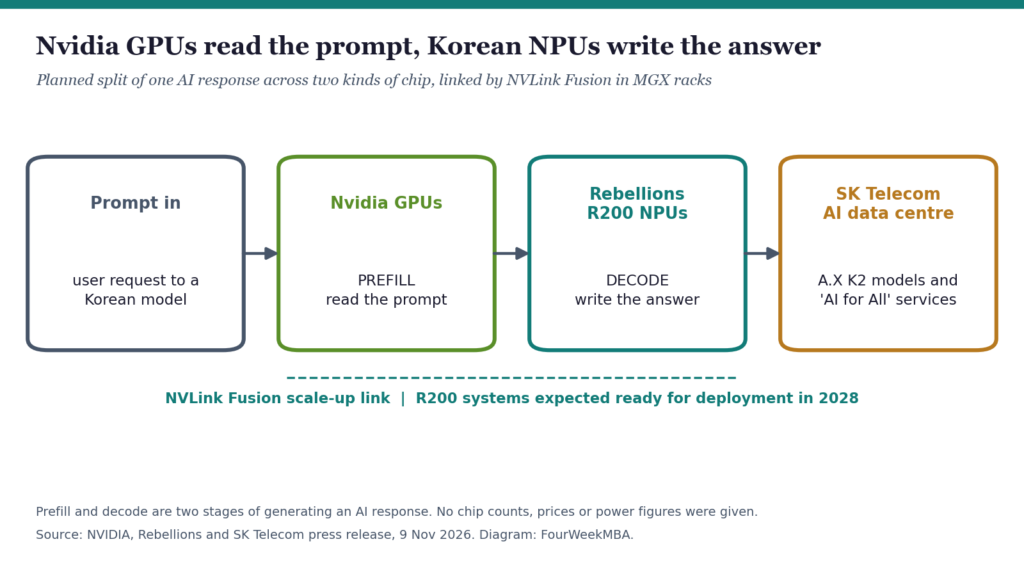
Advanced computing infrastructure is central to the plan, with October 2026 reporting identifying approximately 10,000 Nvidia Vera Rubin GPUs among the proposed resources. Nvidia’s Vera Rubin platform represents a newer generation of AI computing technology intended for demanding training and inference workloads. Access to these processors could allow Korean researchers to conduct larger experiments, evaluate different architectures, and train more capable models without facing the same limitations associated with smaller computing allocations.
However, purchasing GPUs does not automatically create a functioning AI supercomputer. Large training clusters require powerful networking systems, reliable storage, high bandwidth connections, specialized software, cooling facilities, and substantial electrical capacity. The government must also consider hardware availability, procurement schedules, infrastructure management, and long term operating expenses. The exact delivery timeline and technical configuration of the proposed Vera Rubin deployment have not been fully disclosed.
South Korea’s semiconductor industry could benefit from increased demand for advanced computing infrastructure. Samsung Electronics and SK hynix possess substantial expertise in memory technology, particularly high bandwidth memory used in demanding AI workloads. Domestic semiconductor companies may therefore find opportunities to support the wider ecosystem, although the proposed Nvidia purchases should not be interpreted as confirmed contracts awarded to specific Korean suppliers.
The country’s broader computing strategy also includes the National AI Computing Center initiative. In August 2026, the Ministry of Science and ICT announced a groundbreaking for the facility in Haenam, emphasizing the importance of expanding domestic AI infrastructure. However, the frontier project’s precise computing arrangements have not been established as identical to those of the national center.
Developing a frontier AI model requires several interconnected technical capabilities:
• Model architecture: Researchers must select suitable designs for processing information efficiently, potentially considering dense transformer or mixture of experts approaches.
• Training data: Large collections of text, code, mathematical information, and other relevant material must be acquired, filtered, organized, and evaluated.
• Computing infrastructure: Advanced GPUs, high speed networking, storage, and supporting facilities must operate efficiently throughout training.
• Training methods: Researchers must develop effective pretraining, instruction tuning, reinforcement learning, and optimization processes.
• Evaluation: Models must be tested for reasoning, coding, factual reliability, language understanding, and practical usefulness.
• Safety and security: Development teams must identify vulnerabilities involving misinformation, privacy, insecure outputs, and other operational risks.
• Deployment: Successful models must eventually support practical applications through reliable infrastructure, licensing arrangements, and suitable commercial services.
The government has not announced a specific architecture for its proposed frontier model. Its eventual technical design will depend on the selected research organization and the results of early development work. Strong performance will require more than increasing model size because training efficiency, data quality, research innovation, and evaluation methods also influence capability.
South Korea’s existing Sovereign AI Foundation Model program, launched in 2025, provides a foundation for this effort. The original initiative selected five teams led by Naver Cloud, Upstage, SK Telecom, NC AI, and LG AI Research. Its competitive structure involved successive evaluations intended to identify strong domestic models while encouraging wider availability and practical adoption.
The original program included an objective of reaching at least 95% of leading international model capabilities on selected benchmarks. Government support involved GPUs, training data, technical resources, and opportunities for domestic AI development. However, as international frontier models advanced, officials questioned whether distributing limited computing resources among several competing teams would provide enough capacity for genuinely frontier level research.
The new initiative aims to address that concern by concentrating substantially greater investment around one coordinated development effort. Meanwhile, the existing foundation model program is expected to continue with increased emphasis on industrial deployment and specialized applications. This creates two complementary priorities: developing an advanced general purpose model and supporting domestic AI adoption across the Korean economy.
In August 2026, the Ministry of Science and ICT announced that Upstage, SK Telecom, and LG AI Research had advanced following the second evaluation stage. The government’s updated October plan identifies February 2027 as the expected period for selecting two finalist teams. These organizations may have opportunities to contribute to future national projects, but their participation in the new frontier initiative has not been confirmed.
Several Korean technology companies possess relevant capabilities:
• LG AI Research: Develops the EXAONE family of models and has experience in foundation model research and industrial AI applications.
• SK Telecom: Invests in AI infrastructure, model development, telecommunications services, and enterprise applications.
• Upstage: Specializes in foundation models and enterprise AI technology, demonstrating the role smaller research organizations can play.
• Naver Cloud: Develops the HyperCLOVA X model family and provides cloud computing and Korean language AI expertise.
• NC AI: Works on specialized AI technologies, including three dimensional content generation and industrial applications.
• Samsung Electronics and SK hynix: Possess semiconductor expertise relevant to advanced AI infrastructure and memory systems.
These organizations represent potential sources of research, technical expertise, infrastructure, or commercial partnerships. No company has been confirmed as the lead developer of the March 2027 frontier initiative. The government intends to conduct a separate selection process open to different organizational structures, including corporate consortiums, universities, startups, and research partnerships.
Technical competence, research experience, infrastructure readiness, financial capacity, and the ability to attract specialized personnel may influence the evaluation process. However, detailed scoring requirements have not been finalized publicly. Officials have also indicated that the initiative should not automatically favor large corporations simply because they possess greater financial resources.
The possibility of a special purpose company remains under consideration. Such an organization could coordinate government investment, private contributions, intellectual property arrangements, and research activities. It might also establish common governance rules for companies with different commercial priorities. However, disputes involving ownership, model licensing, technical direction, or financial returns could complicate cooperation.
Public and private investment will need effective oversight to ensure that national resources produce benefits beyond a limited group of participants. Transparent financial management, measurable technical targets, responsible data practices, and clear intellectual property arrangements will be important for sustaining confidence in the initiative.
South Korea’s strategy is therefore designed to combine the resources of established corporations with the flexibility of startups and the research capabilities of universities. Whether this approach produces a competitive frontier model will depend on how successfully those participants coordinate their expertise and translate infrastructure investment into technical progress.
South Korea vs the US and China: AI Competition, Economic Benefits, and Challenges Beyond 2027
South Korea’s proposed frontier AI investment reflects growing international competition to develop advanced artificial intelligence. The United States and China currently possess major AI research ecosystems supported by substantial computing infrastructure, investment capital, specialized talent, and established technology companies. South Korea operates on a smaller scale but has strengths in semiconductor manufacturing, electronics, telecommunications, and industrial research that could support a more independent domestic AI industry.
The United States benefits from internationally influential AI laboratories, cloud providers, semiconductor designers, and research universities, while China has developed a large domestic technology ecosystem with increasingly capable foundation models and strong emphasis on efficient development and models with openly available weights. South Korea’s government has identified leading Chinese AI systems as important competitive reference points for its proposed initiative, demonstrating its ambition to move beyond domestic adoption toward internationally recognized model capabilities.
However, AI competitiveness cannot be measured solely through individual benchmark scores. Computing resources, research quality, commercialization, infrastructure ownership, talent development, and industrial adoption all contribute to a country’s position. In August 2026, the Ministry of Science and ICT reported that models developed by four sovereign AI teams had been included among Epoch AI’s notable models. This recognition demonstrated growing Korean research activity, although inclusion in such a database does not establish that those systems outperform the strongest international models.
The government hopes its new investment will help close remaining performance gaps while strengthening domestic control over important technologies. If successful, advanced Korean models could support several industries, particularly those already central to the country’s economy.
Potential economic applications include:
• Semiconductor manufacturing: Advanced AI could support chip design, manufacturing optimization, quality control, and research into computing components.
• Industrial production: Manufacturers could use AI for predictive maintenance, supply chain analysis, automation, and technical documentation.
• Automotive technology: Domestic models could assist with software engineering, robotics, product development, and advanced vehicle research.
• Healthcare and biotechnology: Researchers could use AI to analyze scientific literature, organize medical information, and investigate complex datasets.
• Finance: Banks and financial institutions could explore locally governed systems for document processing, customer assistance, and fraud detection.
• Education: Korean language AI tutors and research assistants could support students and teachers.
• Public services: Government agencies could develop more accessible digital assistance while maintaining appropriate security and privacy controls.
• Startups and software companies: Domestic models could provide foundations for enterprise applications, cybersecurity tools, entertainment products, and specialized services.
South Korea’s Ministry of Science and ICT has also announced an AI for All initiative intended to expand public access to domestically developed AI services. These include chatbot and agent based applications, alongside longer term ambitions for more personalized AI assistance. A successful frontier program could eventually strengthen the technology supporting such services, although the specific models and deployment arrangements have not been finalized.
The expansion of domestic AI infrastructure could also increase demand for researchers, data engineers, software developers, cybersecurity specialists, and computing professionals. Universities may benefit from additional research partnerships and technical education opportunities. However, automation could change existing employment requirements, making workforce development and retraining important considerations.
Despite its potential, South Korea’s $3.5 billion initiative faces substantial technological and economic challenges. Frontier AI is advancing rapidly, meaning a model considered competitive when training begins could be overtaken before development is complete. International AI laboratories continually improve reasoning systems, architectures, training efficiency, and software tools, creating demanding targets for any new entrant.
The main challenges include:
• Rapid technological change: Development targets must remain competitive as international models improve.
• High operating costs: GPUs require electricity, cooling, networking, storage, maintenance, and specialized engineering support.
• Research talent: South Korea must attract and retain experts in machine learning, distributed computing, optimization, and AI safety.
• Training data: High quality datasets require careful licensing, filtering, privacy protection, and technical preparation.
• Infrastructure dependence: Imported computing hardware creates exposure to international suppliers and procurement risks.
• Organizational coordination: Government agencies, corporations, startups, and universities must agree on leadership, research priorities, and ownership arrangements.
• Model reliability: Advanced systems require rigorous evaluation for accuracy, cybersecurity, privacy, and safe deployment.
• Commercial adoption: Domestic models must offer competitive performance, costs, and practical advantages over established international alternatives.
Energy requirements are another important concern. Large computing clusters consume substantial electricity and require dependable cooling infrastructure. South Korea must balance increased computing capacity with operating costs, energy security, and environmental responsibilities.
Commercialization presents an equally important challenge. A technically impressive model may struggle to attract customers if established international services offer lower costs, stronger developer tools, or better integration with existing business systems. Korean AI developers must therefore demonstrate practical value rather than relying exclusively on national investment or competitive benchmark results.
The government’s longer term roadmap extends beyond the proposed March 2027 starting date, although no definitive public release schedule has been established. Following the selection of a development organization, the next stages would involve assembling research teams, deploying computing infrastructure, acquiring data, beginning model training, evaluating performance, and preparing suitable deployment arrangements.
Future decisions will also involve how the resulting technology should be distributed. Models with openly available weights could support research and startup development, while commercial licensing and hosted services may provide revenue opportunities and greater control over certain applications. Each approach involves different considerations concerning accessibility, security, and sustainability.
International cooperation will remain important even as South Korea pursues greater technological independence. Partnerships with hardware suppliers, universities, research organizations, and standards bodies may help the country improve its capabilities while maintaining control over critical domestic systems.
The initiative could also influence how other governments approach national AI development. Its combination of public equity investment, private capital, and concentrated research resources offers an alternative to programs based primarily on grants or distributed competition.
However, success should be measured through more than the acquisition of advanced GPUs or the publication of a large model. Important indicators will include research performance, training efficiency, deployment costs, scientific contributions, domestic adoption, international partnerships, and economic returns.
South Korea’s frontier AI initiative represents an attempt to become a developer of foundational technologies rather than remaining primarily a consumer of systems created elsewhere. The country’s established industrial capabilities provide a strong starting point, but its future position will depend on sustained research, effective investment, and the ability to deliver internationally competitive technology.
If successful, the initiative could strengthen South Korea’s AI industry, improve technological independence, and support innovation across manufacturing, software, public services, and scientific research. Even if the project falls short of the world’s leading models, its infrastructure, research expertise, and industrial partnerships could provide lasting benefits for the country’s technology ecosystem.

Frequently Asked Questions (FAQs)
- How much is South Korea investing in sovereign frontier AI?
South Korea plans to invest 4.7 trillion won, approximately $3.5 billion, in a national frontier artificial intelligence development initiative. The proposed investment uses government equity financing and is expected to attract additional private company contributions. Around 3.9 trillion won is associated with advanced computing infrastructure, while approximately 800 billion won is intended for training data. These amounts are part of the overall proposal rather than separate additional commitments. As of October 2026, the investment remains subject to the government’s 2027 budget approval process and final program arrangements. - When will South Korea’s frontier AI project begin?
The project is scheduled to begin in March 2027, according to the Ministry of Science and ICT’s October 2026 announcement. The government expects to finalize the financing framework following parliamentary consideration of the national budget in December 2026. A lead developer or participating organization could be selected as early as February 2027, allowing development work to begin the following month. March represents the expected start of the initiative, not the release date of a completed AI model. No definitive public launch date has been announced. - What is the main objective of South Korea’s $3.5 billion AI initiative?
The primary objective is to develop an advanced domestic AI model capable of competing with leading international systems, particularly those developed in the United States and China. South Korea wants to strengthen technological sovereignty by gaining greater control over model development, data governance, infrastructure, and deployment. The initiative also aims to support research, industrial innovation, and economic competitiveness. By concentrating funding, computing resources, and specialized researchers, the government hopes to pursue more ambitious capabilities than those achievable through smaller, separately funded projects. - Will South Korea use Nvidia Vera Rubin GPUs for its frontier AI project?
The government’s reported infrastructure plans include approximately 10,000 Nvidia Vera Rubin GPUs, intended to provide substantial computing resources for developing advanced AI models. Around 3.9 trillion won of the proposed investment is associated with computing infrastructure, including the equipment and supporting systems required for large training operations. However, the exact procurement contracts, hardware delivery dates, facility arrangements, and final technical configuration have not been fully disclosed. The government must also provide sufficient networking, storage, cooling, and electrical capacity to operate such a large computing cluster effectively. - Which companies are participating in South Korea’s frontier AI initiative?
As of October 8, 2026, no lead developer has been officially selected for the new frontier initiative. Companies with relevant experience include LG AI Research, SK Telecom, Upstage, Naver Cloud, and NC AI, all of which participated in South Korea’s existing sovereign foundation model program. Their involvement in that earlier initiative does not automatically confirm participation in the new project. The government intends to conduct a separate competitive selection process that may include established corporations, startups, universities, research partnerships, and specially established organizations. - Is South Korea replacing its existing Sovereign AI Foundation Model program?
No. South Korea intends to continue its existing Sovereign AI Foundation Model program while introducing the separate frontier initiative. The new project will concentrate greater resources on developing a highly capable general purpose AI system that can compete internationally. The original program is expected to place more emphasis on domestic model development, industrial applications, and practical deployment. The government plans to select two finalist teams from the existing program in February 2027. Both initiatives are intended to contribute to a stronger national AI ecosystem through complementary research and commercial objectives. - Why does South Korea want its own AI foundation models?
South Korea wants greater control over critical artificial intelligence technologies and less dependence on foreign providers. Domestic models could support Korean language applications, public institutions, businesses, and industries requiring specific security or regulatory arrangements. Developing national capabilities may also reduce exposure to changes in international AI pricing, licensing conditions, service availability, and data policies. Additionally, Korean researchers could adapt models to local industrial requirements while strengthening the country’s technological competitiveness and creating opportunities for domestic AI companies. - How will private companies contribute to the frontier AI investment?
The proposed funding arrangement combines government equity investment with financial participation from private companies. Participating organizations may contribute capital, computing expertise, research personnel, infrastructure, or other resources, depending on the final program requirements. The government is also considering establishing a special purpose company to coordinate investment and development activities. Such an arrangement could allow public and private participants to share responsibilities and potentially benefit from successful commercial outcomes. However, precise contribution requirements, ownership rights, and organizational structures have not yet been finalized. - Can South Korea compete with the United States and China in artificial intelligence?
South Korea possesses significant technological strengths in semiconductor manufacturing, electronics, telecommunications, and advanced industrial research. Domestic organizations such as LG AI Research, SK Telecom, Upstage, and Naver Cloud have also developed foundation models and related technologies. However, the United States and China benefit from larger AI research ecosystems, substantial computing infrastructure, and internationally established model developers. South Korea’s proposed investment could narrow the competitive gap, but its success will depend on research quality, training efficiency, talent development, infrastructure availability, and the actual capabilities of the models produced. - What could South Korea’s frontier AI project achieve after 2027?
If successful, the initiative could produce advanced domestic AI models, strengthen national computing infrastructure, support scientific research, and create new opportunities for Korean technology companies. Potential applications include manufacturing automation, semiconductor research, software engineering, healthcare research, finance, education, and public services. The project could also support startups through access to locally developed AI technology and encourage stronger university research partnerships. However, the government has not announced a confirmed release date for a completed frontier model, and its long term technical and economic outcomes remain uncertain.

Conclusion
South Korea’s proposed $3.5 billion sovereign frontier AI investment represents a major commitment to developing advanced artificial intelligence and strengthening its position in the global AI industry. Scheduled to begin in March 2027, the initiative includes 4.7 trillion won in planned government equity investment, computing infrastructure involving approximately 10,000 Nvidia Vera Rubin GPUs, and substantial funding for training data.
The strategy aims to concentrate national research capabilities while continuing South Korea’s existing Sovereign AI Foundation Model program. By combining frontier research with industrial applications, the government hopes to reduce dependence on foreign AI providers and strengthen domestic technological innovation.
However, success will depend on research expertise, computing resources, data quality, effective funding, and international competitiveness. The proposed investment does not guarantee that South Korea will match the most advanced American or Chinese AI models.
If successful, the initiative could strengthen the country’s semiconductor industry, manufacturing sector, research institutions, and public services. Ultimately, South Korea’s goal is to move beyond adopting foreign AI technologies and become a globally competitive developer of advanced artificial intelligence systems.
Sources and Citations
- Reuters, “South Korea Plans to Develop $3.5 Billion Frontier AI Model,” October 6, 2026: Reports South Korea’s proposed $3.5 billion frontier AI investment, March 2027 development schedule, government financing plans, and expected developer selection process.
- The Korea Times, “Korea to Launch $3.5 Billion Frontier AI Project Next Year,” October 5, 2026: Details the 4.7 trillion won investment, proposed Nvidia Vera Rubin computing infrastructure, training data funding, and national frontier AI development strategy.
- Seoul Economic Daily, “Korea’s AI Model Project to Proceed With Third Round as Planned,” October 5, 2026: Explains the government’s decision to continue its existing Sovereign AI Foundation Model program alongside the new frontier AI initiative.
- Ministry of Science and ICT (MSIT), “Proprietary AI Foundation Model Project Enters Full Scale Launch”: Provides official information about the national foundation model initiative, its development objectives, and government support for domestic AI research.
- Ministry of Science and ICT (MSIT), “Phase 1 Evaluation Results”: Documents the first evaluation stage of the Sovereign AI Foundation Model program, including participating development teams and selection procedures.
- Citation: MSIT – Phase 1 Evaluation Results
- Ministry of Science and ICT (MSIT), “Phase 2 Evaluation Results”: Reports the second evaluation results, highlighting the progress of domestic AI developers and the government’s assessment of model capabilities.
- Citation: MSIT – Phase 2 Evaluation Results
- Ministry of Science and ICT (MSIT), “MSIT Begins AI for All Project”: Explains the government’s efforts to expand public access to domestically developed AI services, including chatbots and AI agents.
- Citation: MSIT – AI for All Project
- Korea.net, “MSIT Selects Five Elite Teams for the Sovereign AI Foundation Model Project,” August 18, 2025: Confirms the selection of five development teams for South Korea’s Sovereign AI Foundation Model program and explains their role in strengthening national AI capabilities.
Recommendations
- Data Visualization Tool Using Blender: Build 3D Charts, Scientific Plots, and Animated Renders (2026 Guide)
- Digimon Story Time Stranger A Hero’s Eternal Legacy DLC: 2027 Release, Story and 50+ New Digimon
- Stylized Fire in Blender: How to Make Cartoon Flames with Geometry Nodes and Shaders
- Sales of Subnautica 2 Have Exceeded 4 Million Copies: Why the Survival Sequel is Dominating Steam and Console Charts
- UNSUNG Tile Crawl Unity Shader Turns Hex Tiles Into a Globe
- EA Sports FC 27 at Tokyo Game Show 2026: SEGA Partner Lineup and Demo Details
- Developers Are Turning Baldur’s Gate 4 Down Because They Don’t Want to Follow in Larian’s Footsteps: Everything We Know
- Solo Leveling’s Successor “Tomb Raider King” Is Coming to Crunchyroll This Summer
- Hellraiser: Revival is a Horror-Action Game that Borrows from Resident Evil and P.T.
- GTA 6 Criminal Profile Has a Permanent Point of No Return



































































































