








In This Article (9 sections)
Splatoon Raiders Review: a Single-Player Spin-Off that Shines
Splatoon Raiders Review: Single-Player Spin-Off Shines is an accurate description of Nintendo’s boldest attempt to transform its ink-shooting series into a complete player-versus-environment adventure. Released exclusively for Nintendo Switch 2 on July 23, 2026, Splatoon Raiders removes competitive Turf War from the center of the experience and replaces it with treasure hunting, Salmonid battles, equipment drops, mechanical gadgets, base development, character progression, and short replayable missions.
The transition is more successful than it initially sounds. Splatoon’s shooting was always connected to movement rather than conventional weapon damage alone. Ink creates paths, restores ammunition, opens climbable surfaces, provides escape routes, and determines where a player can move safely. Those fundamentals remain satisfying when the opposing team is replaced by Salmonid hordes, large bosses, timed objectives, environmental hazards, and hidden treasure.
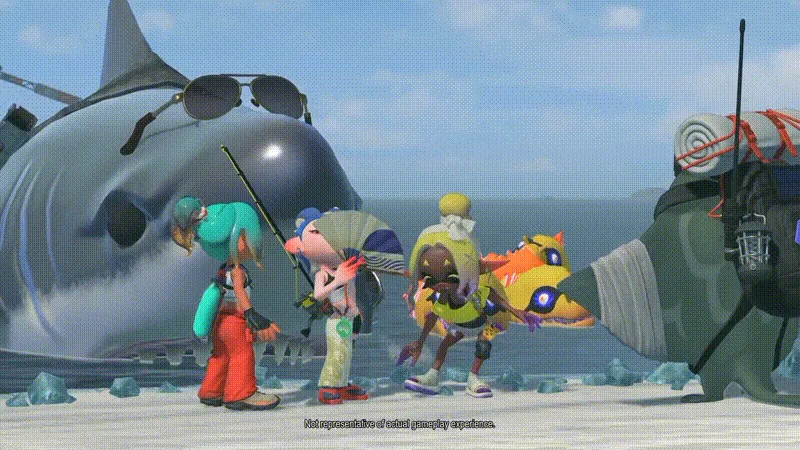
Players create an Inkling or Octoling mechanic who accompanies Shiver, Frye, and Big Man of Deep Cut on an expedition to the remote Spirhalite Islands. When the journey goes wrong, the group becomes stranded and constructs a makeshift hideout ship from salvaged materials. That vessel becomes the campaign’s home base, equipment center, workshop, training area, mission hub, and visible record of how far the expedition has progressed.
The central loop is simple but effective. Players prepare a weapon, select one of three tank styles, equip several gadgets, enter an island mission, complete the objective, recover as much equipment and treasure as possible, and return to the hideout to improve the next loadout. Better weapons and upgraded gadgets make harder areas manageable, while new facilities gradually transform the fragile hideout into a capable operational base.
Splatoon Raiders resembles a cooperative action RPG and looter shooter, but it never loses the movement, humor, visual identity, and strange enemy design associated with Splatoon. Nintendo originally experimented with a more passive base-defense idea involving automated traps, but the developers decided that watching systems defeat enemies did not feel active enough. The finished game instead demands constant multitasking as players shoot, swim, paint terrain, deploy gadgets, manage ink, protect the Exploration Bot, collect resources, and respond to several threats at once.
The result is positive but qualified. Splatoon Raiders is strongest when enormous Salmonid groups force the player to use every part of the combat system in rapid succession. It is less successful when repeated objectives and rising enemy statistics make progression feel like an equipment check. Players who enjoy collecting stronger gear and refining builds can find dozens of rewarding hours here. Those expecting competitive multiplayer, densely written storytelling, or an entirely new puzzle idea in every mission may find the spin-off more conventional.

Deep Cut, the Spirhalite Islands, and the Solo Gameplay Loop
The story begins with Deep Cut pursuing another treasure-hunting opportunity. Shiver, Frye, and Big Man travel with the customizable mechanic because the expedition requires someone capable of repairing equipment, constructing gadgets, and maintaining the group’s machinery. After becoming stranded, the characters begin investigating the islands while gathering the materials needed to expand their hideout and continue the search for treasure.
The Spirhalite Islands are deliberately removed from the fashionable urban spaces normally associated with Splatoon. Rusted structures, abandoned facilities, overgrown terrain, irregular coastlines, improvised machinery, mysterious crystals, and Salmonid-controlled areas make the setting feel more isolated and dangerous than Splatsville. Bright ink remains visually important, but it is placed against a grimier and more subdued environment.
Spirhalite and the islands’ mysterious salt provide the main explanation for the Salmonids’ increasingly dangerous behavior. The substance attracts them and appears to make them stronger and more aggressive. As the expedition moves deeper into the region, the enemies and environments become stranger, giving the campaign a gradual sense of escalation even when the main narrative remains relatively light.
Deep Cut receives considerably more attention than in Splatoon 3. The trio appears throughout the story, supports the mechanic between missions, comments on discoveries, and operates important hideout facilities. Shiver manages gadget construction, Frye assists with weapons and materials, and Big Man records information gathered during the expedition. These responsibilities make them part of the progression system instead of limiting them to dialogue scenes.
One member of Deep Cut also accompanies the mechanic through the Exploration Bot. The machine can identify nearby treasure, assist with drilling, contribute during combat, create traversal opportunities, and activate a powerful Showstopper ability. It does not complete missions automatically, but it gives solo players another tool to manage while fighting and exploring. This supports Nintendo’s goal of reproducing the busy rhythm of Salmon Run without requiring human teammates.
The moment-to-moment solo gameplay remains immediately recognizable. Players fire ink to damage Salmonids and paint the environment, then transform into swim form to recover ammunition, move quickly, avoid attacks, and climb painted walls. Enemy ink slows the mechanic and restricts safe movement, making control of the surrounding floor important even though there is no opposing human team trying to win a Turf War.
Later encounters significantly increase the number of simultaneous responsibilities. A player may need to maintain an escape route, monitor ink reserves, control a turret, avoid a charging enemy, trigger an area attack, collect dropped resources, protect the Exploration Bot, and complete a timed objective within the same battle. Nintendo introduces those demands gradually, keeping the opening hours accessible before expecting more complicated combinations.
Most ordinary missions last approximately five to ten minutes, making the structure well suited to handheld sessions. Bosses, dungeons, extensive searches, and advanced variants can take longer, but the frequent returns to the hideout create a persuasive rhythm. There is usually another weapon to inspect, gadget to improve, facility to construct, or mission to attempt.
The story mainly serves that progression loop rather than dominating it. Briny Scrolls, hidden relics, environmental details, Deep Cut conversations, and the optional Island Misadventures prequel material provide additional context, but the narrative rarely becomes as surprising or experimental as the strongest earlier Splatoon campaigns. Deep Cut fans should appreciate the trio’s larger role, although players seeking a complicated dramatic story may consider the writing too restrained.

Weapons, Tanks, Gadgets, Loot, Missions, and Four-Player Co-Op
Weapons, tanks, and gadgets create the mechanical depth that keeps the short missions interesting. Nintendo promotes more than 100 weapon variations, while reviews identify 11 broader weapon families. Familiar categories include rapid shooters, dual weapons, rollers, chargers, sloshers, and other equipment adapted from the wider series. Individual versions can differ through level, rarity, statistics, and special properties, giving players reasons to inspect new drops even when they already own the same general weapon type.
The three ink tanks function like broad character classes. The Speed Tank emphasizes mobility, evasive movement, and rapid repositioning. The Power Tank supports direct damage and aggressive attacks. The Tactical Tank concentrates on range, deployable equipment, and battlefield control. Each tank has its own development path and associated gadgets, so changing tanks affects the complete approach to an encounter rather than adding one passive bonus.
Speed-oriented equipment includes the Blast Boot, Dash Bomb, and Booyarang. Power builds can use tools such as the Splatchet, Splatellites, and Spinwheel. Tactical options include the Shot Pot turret, Bombloons, and Tether Wail. Their names preserve Splatoon’s playful tone, but their functions cover useful roles involving movement, burst damage, crowd control, persistent pressure, knockback, and long-range support.
Players begin with a limited number of active gadget slots and unlock additional capacity through progression. This limitation prevents one loadout from carrying every powerful tool. A build intended for dense waves may require different equipment from one designed for platforming, treasure collection, boss damage, or rapid mission completion.
Gadget parts provide further specialization. Components can improve damage, activation speed, duration, ink generation, knockback, or other mechanical properties. Slot restrictions encourage coherent builds rather than unrestricted stacking. A seemingly minor enhancement can become extremely useful when combined with the correct tank and weapon.
Every expedition can provide weapons, Power Eggs, salvage, treasure, crafting materials, gadget components, and other progression items. Those resources are brought back to the hideout and used to develop the mechanic, upgrade tanks, improve equipment, and construct facilities. Defeating Salmonids also provides character experience, increasing survivability and combat effectiveness over time.
Failure is relatively forgiving. Reviews indicate that players retain valuable experience, recovered weapons, and useful materials even when an expedition ends unsuccessfully. A difficult attempt therefore contributes to the upgrades needed for the next one instead of erasing the entire period of play. This becomes especially important when later missions introduce sudden increases in enemy strength.
The mission selection includes standard raids, Salmonid Dens, Buried Ruins, Sampler Dungeons, specialized facilities, treasure searches, and boss encounters. Raids mix exploration, combat, resource gathering, and objective completion in open areas. Salmonid Dens create more concentrated battles involving enemy targets, Power Egg collection, or time limits. Buried Ruins are longer multi-stage expeditions that can end with stronger Seasoned Salmonids.
Sampler Dungeons use fixed tanks, weapons, or gadgets rather than allowing the player’s preferred build. Some introduce platforming and light puzzle solving, while others function as advanced lessons showing how particular gadgets interact. These missions prevent equipment progression from completely replacing mechanical understanding, although the campaign still reuses several environments, enemies, and objectives at higher difficulties.
Cooperative play supports two to four participants through online multiplayer or local wireless communication. Up to three additional mechanics can join the host and progress through missions together. Enemy strength scales for the larger team, so four players cannot simply overwhelm every activity without coordination. Mixed tank roles are especially useful because one player can emphasize mobility, another direct damage, and another ranged battlefield control.
Online play requires Nintendo Switch Online. Local wireless cooperation also requires separate compatible systems and may require additional game copies or accessories. There is no listed split-screen or shared-screen mode for several people playing on one Nintendo Switch 2.
A Call for Help feature lets solo players request temporary assistance during eligible missions. Another person can join, help complete the activity, and receive participation rewards. The system is useful when a player encounters an unexpected difficulty wall, although it is not a completely seamless drop-in campaign solution for every activity. Dedicated rooms remain the better option for groups intending to play together for extended periods.

Character Customization, Performance, Campaign Length, and the Postgame
Character creation allows players to choose an Inkling or Octoling mechanic and adjust facial characteristics, hairstyles, and other appearance details. The system is not as extensive as a dedicated role-playing game creator, but it provides enough variety to make the protagonist feel personal, particularly when several customized characters appear together during co-op.
Additional outfits can be earned through progression and challenge completion. Their practical expedition designs fit the salvaged setting, replacing some of Splatsville’s fashionable clothing with overalls and equipment suited to mechanical work and island exploration. Cosmetic rewards provide another reason to complete optional activities beyond collecting stronger weapons.
Compatible Splatoon-series amiibo unlock additional outfits. The Shiver, Frye, and Big Man Splatoon Raiders figures provide clothing inspired by their respective Deep Cut members. These rewards remain cosmetic. Players without amiibo can still complete the campaign, develop every tank, obtain powerful weapons, construct gadgets, and access the principal gameplay systems.
Splatoon Raiders was designed specifically for Nintendo Switch 2. The newer hardware allows the game to display larger groups of Salmonids while simultaneously processing ink coverage, companion actions, projectiles, gadgets, and environmental effects. That increased enemy volume is essential to the intended multitasking because late encounters would be considerably less threatening without the number of targets appearing at once.
Review coverage consistently describes the game as targeting 60 frames per second and maintaining stable performance even during demanding encounters. The exact native rendering resolution has not been established clearly. Different reviewers have described the docked image in different ways, so the safest conclusion is that Splatoon Raiders appears sharp and maintains a convincing 60-frame-per-second presentation rather than promising one specific unconfirmed native resolution.
The visual direction is more weathered and organic than Splatoon 3. Grass, uneven surfaces, rusted machinery, abandoned facilities, and salvaged structures give the Spirhalite Islands a distinct identity. Some reviewers appreciated the unfamiliar environment, while others missed the immediate brightness and urban energy of Splatsville. The experimental soundtrack similarly reflects the Salmonid setting, sounding less like fashionable city music and more like something emerging from an unsettling ecosystem.
The principal campaign generally requires approximately 15 to 20 hours. A focused player using assistance and completing only the required objectives may finish closer to 12 hours, while someone searching every area, completing dungeons, comparing weapon drops, and improving several tanks will take longer. The compact mission format means much of that time is divided between expeditions, equipment management, hideout development, and preparation.
Optional play can extend the total beyond 25 or 40 hours. Players can search for concealed relics, complete outfit challenges, improve facilities, collect gadget parts, develop alternate tanks, and revisit missions for stronger equipment. The game’s progression is built to continue after the final story mission rather than ending immediately when the credits appear.
Tourist, Raider, and Survivalist difficulty settings adjust the general strength of enemies. Standard loot is not restricted exclusively to Survivalist, allowing less experienced players to progress without losing access to the basic equipment pool. Harder settings therefore function as tests of execution and efficiency instead of compulsory reward gates.
Super Spicy Mode creates more difficult versions of many campaign missions, adds stronger and more numerous enemies, and locks those activities to Survivalist difficulty. Hidden Ruins introduce tank-specific challenges that encourage players to develop Speed, Power, and Tactical paths instead of investing entirely in one favorite.
The Bottomless Buffet is the largest repeatable endgame destination. It presents changing challenges, distributes rewards at intervals, and establishes level 100 as an important boss and story milestone. Reaching that point can add at least another ten hours after the main campaign. Randomized challenges continue afterward, giving dedicated players an open-ended place to test builds and collect equipment.
The postgame is substantial, but it does not become a completely separate second campaign. Much of it remixes familiar enemies, objectives, and locations at greater intensity. Players who enjoy optimization and escalating difficulty will find considerable value, while anyone already tired of the standard mission loop may not be persuaded by tougher variations of similar activities.

Splatoon Raiders Versus Splatoon 3 and Whether the Spin-Off is Worth Buying
The most important difference between Splatoon Raiders and Splatoon 3 is their primary purpose. Splatoon 3 is built around competitive multiplayer, rotating stages, Turf War, Anarchy Battles, seasonal progression, social spaces, and human team competition. Splatoon Raiders is designed around a PvE campaign, permanent character progression, equipment rarity, crafting, exploration, and repeated battles against Salmonids.
Splatoon Raiders does not contain a replacement for Turf War or a ranked Anarchy ladder. Co-op participants work toward shared objectives rather than trying to cover more territory than an opposing player-controlled team. Anyone buying the spin-off specifically for traditional competitive Splatoon should continue playing Splatoon 3.
The controls remain closely related. Players fire ink, transform into squid or octopus form, swim through painted surfaces, restore ammunition, climb walls, and select from familiar weapon families. Existing Splatoon players can understand the basics immediately, while newcomers can learn at their own pace without being placed against experienced competitive teams.
The clearest influence comes from Salmon Run. Both experiences feature Salmonid enemies, crowded arenas, rapid threat prioritization, and cooperation against PvE pressure. Splatoon Raiders develops those ideas into a complete adventure with a hideout, persistent levels, three tank paths, crafted gadgets, equipment drops, treasure hunting, exploration, story scenes, and long-term endgame activities.
Earlier Splatoon campaigns often emphasized obstacle courses, tightly constructed puzzles, and specific weapon lessons. Raiders includes fixed-loadout dungeons and platforming, but most of the campaign revolves around repeatable combat expeditions. This makes the spin-off more approachable and potentially more addictive, but it also explains why some critics missed the constant mechanical invention found in earlier solo stages.
Nintendo’s official United States digital price is $49.99, with regional and physical prices varying. The value depends on whether the player enjoys repeating missions for better equipment and harder challenges. Someone interested only in reaching the credits receives a solid 15-to-20-hour campaign. A player who develops every tank, hunts for equipment, completes Super Spicy missions, and advances through the Bottomless Buffet can spend considerably longer.
The strongest qualities are the responsive shooting, fluid ink swimming, stable performance, noticeable upgrades, flexible builds, energetic Salmonid encounters, optional four-player cooperation, and substantial postgame. Splatoon Raiders also gives Deep Cut a larger and more meaningful role while offering a less intimidating entry point for people interested in the series but uncomfortable with competitive multiplayer.
Its weaknesses are equally clear. The story is relatively light, repeated objectives can become predictable, some weapons are more useful than others, and late-game advancement occasionally depends more on raising equipment numbers than mastering a new idea. Players expecting the intricate puzzles of previous campaigns or the social pressure of Turf War may find the new structure less distinctive.
Those limitations do not outweigh the strengths for the intended audience. TechRadar praised the solo reinvention and progression, Game Informer highlighted the continued quality of the movement and shooting, and VGC found the large-scale action compelling enough to continue into the postgame. More critical assessments correctly identified repetition and familiar looter-shooter conventions, but the broader response supports a favorable verdict.
Splatoon Raiders is worth buying for players seeking polished solo or cooperative PvE, character growth, loot collection, build experimentation, and frantic battles against Salmonids. Splatoon 3 remains the stronger choice for competitive play, but Raiders establishes a convincing second direction for Nintendo’s ink-shooting series without replacing what came before it.

Frequently Asked Questions (FAQs)
- Is Splatoon Raiders a single-player game?
Yes. The complete main adventure can be played alone. The Exploration Bot and Deep Cut provide computer-controlled support during missions, so cooperative multiplayer is optional rather than required to finish the story. - When was Splatoon Raiders released, and what platform is it on?
Splatoon Raiders was released on July 23, 2026, exclusively for Nintendo Switch 2. It is not listed for the original Nintendo Switch, PlayStation, Xbox, or PC. - Does Splatoon Raiders support four-player co-op?
Yes. Groups of two to four players can complete missions through online multiplayer or local wireless communication. Internet play requires Nintendo Switch Online. Local wireless groups need separate systems, and additional copies or accessories may be required. - Does Splatoon Raiders have split-screen multiplayer?
No shared-screen or split-screen option is listed. Standard system play supports one player, while nearby multiplayer uses local wireless between separate Nintendo Switch 2 systems. - Does Splatoon Raiders include Turf War or competitive PvP?
No. Splatoon Raiders is a PvE-focused spin-off built around Salmonid encounters, treasure hunting, equipment progression, and cooperative missions. Players seeking Turf War or ranked Anarchy Battles should continue using Splatoon 3. - How many weapons and tank classes are available?
Nintendo promotes more than 100 weapon variations across approximately 11 broader weapon families. Players can also develop Speed, Power, and Tactical tanks, each with different strengths, gadgets, and progression paths. - How long does Splatoon Raiders take to complete?
The main campaign generally takes around 15 to 20 hours, although a focused player may finish closer to 12. Extensive optional content can raise the total to 25 or 40 hours, while the repeatable postgame can continue much longer. - What postgame content does Splatoon Raiders include?
The postgame includes Super Spicy mission variants, tank-specific Hidden Ruins, and the Bottomless Buffet. Reaching level 100 in the Bottomless Buffet can add at least another ten hours, and randomized challenges continue beyond that milestone. - What do Splatoon Raiders amiibo unlock?
Compatible Splatoon-series amiibo unlock cosmetic outfits. The Shiver, Frye, and Big Man figures provide clothing inspired by the corresponding Deep Cut character. Amiibo are not required for weapons, gadgets, tank development, or campaign completion. - Is Splatoon Raiders worth buying?
Yes, for players who enjoy Splatoon’s movement and shooting but prefer solo or cooperative PvE over competitive multiplayer. Its progression, equipment system, stable performance, and endgame are strong, although the lighter story and repeated missions may disappoint players seeking elaborate puzzles or constant narrative development.
Conclusion
Splatoon Raiders Review: Single-Player Spin-Off Shines because the game successfully identifies which parts of Splatoon remain enjoyable when competitive multiplayer is removed. Ink still transforms every battlefield into a movement puzzle. Swimming remains one of the most satisfying traversal systems in a third-person shooter. Salmonids create immediate pressure, weapons feel distinct, and the combination of tanks, gadgets, parts, companion abilities, and equipment drops gives players meaningful decisions before and during missions.
The campaign is not flawless. Its story is lighter than its setting initially suggests, repeated activities can become predictable, and numerical progression occasionally replaces mechanical invention. Players expecting the intricate puzzle stages of earlier campaigns or the social competition of Splatoon 3 may find the new direction too conventional. The game’s appeal depends heavily on enjoying short PvE missions and the gradual construction of more effective character builds.
For its intended audience, however, Splatoon Raiders is one of the most convincing examples of how a competitive series can expand without simply copying its previous format. It provides a complete solo adventure, optional four-player cooperation, a substantial equipment system, polished Nintendo Switch 2 performance, and an endgame that can continue long after the principal story.
Most importantly, the spin-off still feels like Splatoon. Its progression may resemble a looter shooter, but the movement, ink management, visual humor, strange enemies, experimental music, and expressive equipment prevent it from becoming anonymous. Nintendo has not replaced the main series. It has demonstrated that the same foundation can support a different kind of game.
Splatoon Raiders is therefore recommended for players seeking a polished single-player or cooperative action game on Nintendo Switch 2. It may not satisfy every competitive Splatoon fan, but as an accessible, energetic, and surprisingly deep PvE spin-off, it passes its most important test with flying colors.
Sources and Citations
- Nintendo – Splatoon Raiders Official Product Page
- https://www.nintendo.com/us/store/products/splatoon-raiders-switch-2/
- Official product information covering the platform, release date, genre, player counts, local wireless support, online requirements, protagonist, Deep Cut, and the Spirhalite Islands setting.
- Nintendo – Splatoon Raiders Direct
- https://www.youtube.com/watch?v=3JxK6mT6P4A
- Nintendo Direct presentation introducing Splatoon Raiders, including the Exploration Bot, hideout ship, treasure hunting, Salmonids, weapons, gadgets, Ink Tanks, difficulty settings, co-op, amiibo support, and hidden collectibles.
- Nintendo – Ask the Developer Vol. 22: Splatoon Raiders
- Part 1: https://www.nintendo.com/us/whatsnew/ask-the-developer-vol-22-splatoon-raiders-part-1/
- Part 2: https://www.nintendo.com/en-gb/News/2026/July/Ask-the-Developer-Vol-22-Splatoon-Raiders-Chapter-2-3143587.html
- Part 3: https://www.nintendo.com/us/whatsnew/ask-the-developer-vol-22-splatoon-raiders-part-3/
- These interviews explain the game’s origins, Salmon Run adaptation for solo play, multitasking design philosophy, Switch 2 development goals, Spirhalite Islands art direction, mysterious salt, Deep Cut’s role, and gameplay mechanics.
- TechRadar – Splatoon Raiders Review
- https://www.techradar.com/gaming/splatoon-raiders-review
- Covers mission structure, character customization, Ink Tank roles, weapon families, gadgets, campaign length, progression systems, accessibility, and co-op support.
- Game Informer – Splatoon Raiders Review
- https://www.gameinformer.com/review/splatoon-raiders
- Reviews movement, ink swimming, weapon responsiveness, visual identity, and the game’s shift away from competitive multiplayer.
- Video Games Chronicle (VGC) – Splatoon Raiders Review
- https://www.videogameschronicle.com/review/splatoon-raiders/
- Examines Switch 2 performance, large-scale Salmonid battles, postgame content, and repetitive gameplay elements.
- The Guardian – Splatoon Raiders Review
- https://www.theguardian.com/games/2026/jul/21/splatoon-raiders-review-nintendo-switch-2
- Provides the more critical perspective on repeated missions, minimal storytelling, straightforward level design, and familiar looter-shooter conventions.
- Nintendo Life – Splatoon Raiders Review
- Nintendo Life – Splatoon Raiders Review Roundup
- Nintendo Life – Splatoon Raiders Postgame Guide
- https://www.nintendolife.com/guides/splatoon-raiders-postgame-guide
- Covers Super Spicy Mode, Hidden Ruins, the Bottomless Buffet, the level 100 milestone, estimated postgame duration, and randomized endgame challenges.
Recommendations
- AMD Radeon RX 9070 GRE Review: Full Performance Breakdown, 1440p Benchmarks, Specs, and Value Analysis
- Maxon Adds Real-Time Renderer Redshift Live to Redshift 2026.4: Features, Workflow Benefits, and What It Means for 3D Artists
- Road To Empress 2 Achievement Guide: 100 Percent Completion
- Skin Texturing in Substance Painter: How to Create Realistic Digital Skin Step by Step
- Lost Castle 2 Wandering Knight Boss Guide
- Resident Evil Requiem Includes A Surprising Homage To The Lord Of The Rings Movies — Fans Spot Hidden Shelob-Inspired Scene
- Silent Hill 2 Remake Reaches 6 Million Players: Official Milestone Date (April 24, 2026)
- EVE Online’s Next Trilogy Expansions: War, Conquest, and the Future of New Eden
- Goro Abe, the Director Behind WarioWare, Has Parted Ways with Nintendo After 25+ Years
- All Playable Characters in Marathon: Bungie’s New FPS – Community Reactions, Developer Insights, and Unique Visual Style



































































































