









In This Article (9 sections)
Task Bar Hero Overview, Steam Popularity, and Always-on Idle RPG Appeal
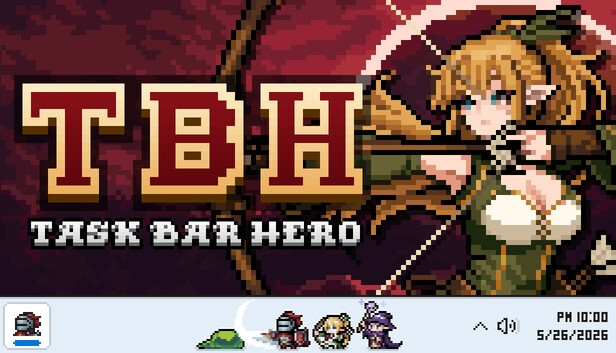
Task Bar Hero is an idle RPG where pixel art characters embark on a small-scale role-playing adventure at the bottom of the player’s screen while the user continues with other tasks. Often described as a pixel art RPG where characters fight on the taskbar, it blends passive progression, retro-inspired visuals, and a persistent on-screen combat loop that continues even while players are focused on work, browsing, or other applications. This hybrid design has helped position it as one of the most talked-about modern idle RPG experiences on Steam.
The game represents a shift in how players engage with idle games. Instead of demanding full-screen attention, Task Bar Hero integrates directly into daily computer use by placing progression in a visible but unobtrusive space. Characters fight enemies, gain experience, collect loot, and continue advancing without requiring constant input. That makes the game especially appealing to players who like progress systems but do not want to dedicate focused play sessions to them.
Its accessibility is one of the biggest reasons players are trying it. Task Bar Hero does not require long time blocks or intense mechanical commitment. Progression is continuous, and the player can glance down at the taskbar to check upgrades, combat progress, or loot drops. That micro-interaction loop creates sustained engagement without the fatigue that can come from more demanding games. The passive structure also fits the habits of modern PC users, who often move between productivity apps, browsers, chats, and entertainment throughout the day.
The game’s success on Steam is tied to several larger gaming trends. Idle and incremental games have steadily grown in popularity because they reward players frequently and make progress feel constant. Steam also gives experimental indie games a path to large audiences when early traction leads to word-of-mouth sharing, streamer curiosity, and algorithmic visibility. Task Bar Hero benefits from all of those forces while adding a distinctive visual hook: tiny pixel characters fighting directly on the user’s taskbar.
Its “always visible” design also gives it an advantage over many other idle games. Traditional idle titles often run in a window, browser tab, or minimized state, which can make progress feel distant. Task Bar Hero stays present on-screen, increasing retention and daily interaction frequency. Social media virality has amplified that effect, as clips showing pixel characters fighting along the bottom of a screen while users work or browse have driven curiosity and downloads.
Task Bar Hero Gameplay, Platform Details, and Pixel Art Design
The gameplay loop in Task Bar Hero is built around automated progression with optional player intervention. Characters automatically engage enemies that spawn in cycles, and each encounter produces experience points, gold, and potential item drops. Over time, characters level up, unlock skills, and become more efficient in combat. The game continues without player input, but players can still step in to improve efficiency, adjust builds, and optimize progression.
Players can interact by:
- Upgrading heroes
- Equipping gear
- Assigning skill trees
- Managing party composition
- Triggering abilities at key moments
This structure makes Task Bar Hero ideal for background play. The taskbar placement is not just an aesthetic choice. It is functional because it keeps players visually connected to progression without interrupting their primary tasks. The player does not need to switch tabs, open a full interface, or stop working to remain aware of what is happening. The RPG loop becomes part of the desktop environment.
Task Bar Hero was developed by an independent studio focused on experimental idle game design and released on Steam for PC platforms. Its primary target is Windows, since the taskbar integration mechanics are central to how the game works. The development approach emphasizes lightweight system usage, allowing it to run smoothly in the background without consuming significant CPU resources or interfering with productivity applications.
Platform availability includes:
- PC through Steam
- Windows optimization as the primary focus
- Potential future support for Linux compatibility layers
Pixel art plays a central role in the game’s identity. The visual style is intentionally minimalistic so that characters, enemies, attacks, and effects remain readable even at taskbar scale. This matters because the game operates in a very small screen space, where overly detailed art would become muddy or distracting. By using clear silhouettes, simple animations, and retro RPG visual language, Task Bar Hero communicates combat progress quickly and efficiently.
Key advantages include:
- High readability at low resolution
- Nostalgic appeal for retro RPG fans
- Low performance requirements
- Clear visual distinction between characters and enemies
The pixel art also allows characters to retain personality despite the limited space. Attack motions, idle animations, and visual effects make the combat loop feel active without overwhelming the screen. That balance reinforces the idle nature of the game: players can understand what is happening at a glance, then return to whatever they were doing.

Classes, Loot, Gear, and Steam Marketplace Trading
Character progression in Task Bar Hero is built around class-based archetypes. Each class serves a different role in combat and affects how efficiently the party advances while the game runs in the background. This gives the idle loop more strategic depth than a simple automatic battle system, since players still need to think about class roles, skill investment, and long-term synergy.
Common class structures include:
- Damage-focused attackers
- Defensive tanks
- Support or healing units
- Hybrid utility characters
The skill system allows customization within each class. As players progress, they unlock branching upgrades that modify combat behavior, improve efficiency, or strengthen specific roles. Progression is usually divided into early-game rapid leveling, mid-game specialization, and late-game optimization, where synergy builds become more important. This keeps the game from feeling completely passive, since efficient growth depends on how well the player shapes the party over time.
Progression is typically divided into:
- Early-game rapid leveling
- Mid-game specialization
- Late-game optimization and synergy builds
Loot systems are central to the game’s long-term engagement. Enemies drop randomized items with varying rarity levels, and those items influence character performance. Gear gives players a reason to keep checking progress even during inactive periods, since a useful weapon, armor piece, or accessory can shift the efficiency of a build. This helps maintain the sense that something meaningful might happen even when the player is not actively watching.
Gear typically includes:
- Weapons for attack scaling
- Armor for defense scaling
- Accessories for passive bonuses
Item rarity tiers determine stat strength and possible enhancements. Some items include special effects such as bonus gold gain or increased experience accumulation, which makes gear valuable for more than direct combat power. These effects support different playstyles and can help players optimize for faster leveling, stronger idle farming, or better survival.
Task Bar Hero also includes an advanced integration with Steam’s marketplace infrastructure, allowing certain in-game items to be traded. This adds a semi-economic layer to the idle RPG structure, as rare drops can gain value based on player demand. The system encourages longer farming strategies without making trading the only path to progress.
Trading mechanics generally include:
- Item listing for sale or exchange
- Market-driven pricing fluctuations
- Rarity-based demand variation
The marketplace system is balanced to prevent pay-to-win dominance, keeping core progression accessible to all players. Trading adds value to rare items and gives collectors another reason to stay engaged, but the game’s basic growth loop remains built around idle combat, upgrades, loot, and party management.

Player Count Success, Fast Progression Builds, and Beginner Strategy
Task Bar Hero’s success is often measured through concurrent player engagement and sustained daily activity. Unlike traditional games, its idle structure creates long session duration because the game can remain open while players do other things. That means its engagement model is not only about active playtime, but also about presence time, where the game remains visible and progressing in the background.
The game benefits from:
- Long session duration due to idle nature
- Persistent background activity
- High return rate from passive progression loops
This hybrid model has contributed to its classification among Steam’s most-played titles in its category. Players may not always be actively clicking, fighting, or managing menus, but the game’s persistent presence keeps them connected. Its taskbar format also encourages return behavior because progress is always close enough to check without fully interrupting the user’s workflow.
Optimizing builds in Task Bar Hero revolves around synergy rather than raw power alone. The fastest progression usually comes from improving idle efficiency, not from focusing only on active combat decisions. Players who progress efficiently tend to build around automation, experience gain, survivability, and late-game scaling instead of spreading resources randomly across every unit.
Effective strategies include:
- Balancing damage and survivability early
- Prioritizing experience-boosting gear mid-game
- Focusing on critical hit scaling in late-game
- Combining support buffs with high DPS units
Automation synergy is key because characters need to perform well without constant supervision. A build that requires frequent manual intervention may feel strong during active play but weaker as an idle setup. Strong Task Bar Hero builds work even when the player is not watching closely, allowing the game to fulfill its background RPG purpose.
New players benefit most from understanding foundational mechanics early. Since progression is time-based, consistency matters more than intense active play. Keeping the game running, checking loot regularly, and prioritizing efficient upgrades can produce stronger progress than trying to micromanage every encounter.
Important beginner strategies include:
- Focus on upgrading one core damage unit first
- Avoid spreading resources too thin across multiple characters
- Prioritize experience gain upgrades early
- Regularly check loot drops for rare items
- Keep the game running in the background consistently
Idle RPG fans are switching to Task Bar Hero because it integrates directly into the operating system environment. It remains visible at all times, requires no tab switching, and encourages passive engagement while users work or browse. This reduces friction between gameplay and daily computer use, while the novelty of a game operating directly in the taskbar gives it a distinct identity among Steam idle RPGs.

Reviews, Strengths, Weaknesses, and Comparisons to Other Idle RPGs
Player feedback around Task Bar Hero highlights how much of its appeal comes from its unusual format. Many players praise the taskbar-based gameplay, smooth progression, pixel art, and satisfying idle reward loop. The game gives players the feeling of constant RPG advancement without asking them to stop what they are doing, which is the central reason its concept has resonated.
What players love:
- Innovative taskbar-based gameplay
- Smooth progression system
- Strong pixel art design
- Satisfying idle reward loop
At the same time, criticisms focus on the limits of the format. Because the game is built for passive engagement, it naturally has less active gameplay depth than a traditional RPG. Combat visuals can become repetitive over time, and some players may find the reliance on passive progression limiting. Late-game balancing concerns have also appeared in player feedback, especially as optimization becomes more important.
What players dislike:
- Limited active gameplay depth
- Repetitive combat visuals over time
- Heavy reliance on passive progression
- Occasional balancing concerns in late game
Despite those criticisms, the game maintains strong engagement because its concept is distinctive. Many idle RPGs rely on menus, dashboards, and stat panels, but Task Bar Hero emphasizes real-time visual presence. The player does not need to open a full interface to feel that something is happening. That constant small-scale visibility gives the game a stronger sense of life than many minimized or browser-based idle titles.
Compared to traditional idle RPGs, Task Bar Hero differentiates itself in several ways:
- Constant visibility versus hidden background progression
- Taskbar integration versus full-screen or minimized play
- Lightweight system usage versus heavier simulation games
This makes Task Bar Hero feel more naturally embedded into daily PC use. Other idle RPGs may offer deeper menus, larger worlds, or more elaborate automation systems, but Task Bar Hero’s strength is that it turns the desktop itself into part of the game. Its appeal comes from being small, persistent, readable, and always nearby.
The result is a passive RPG experience that feels more immersive than its size suggests. Task Bar Hero does not need to dominate the screen to stay present in the player’s mind. By combining retro visuals, automated combat, progression systems, loot, classes, Steam trading, and taskbar integration, it creates a version of idle play that feels uniquely suited to modern multitasking habits.

Frequently Asked Questions (FAQs)
- Is Task Bar Hero suitable for casual gamers?
Yes, it is designed for both casual and idle gameplay audiences. Its passive progression, low system demands, simple visual presentation, and optional interaction make it accessible to players who want steady RPG growth without committing to full attention sessions. - What type of game is Task Bar Hero?
Task Bar Hero is an idle RPG that runs on the taskbar while players multitask. Pixel art characters continue fighting enemies, gaining experience, collecting loot, and progressing even while the player is working, browsing, or using other applications. - Do I need to actively play Task Bar Hero?
No, progression continues automatically in the background. Players can interact by upgrading heroes, equipping gear, assigning skills, managing party composition, or triggering abilities, but the main combat loop keeps moving without constant input. - Is Task Bar Hero free to play?
It depends on the version, but it is commonly distributed on Steam with standard pricing models. Players should check the current Steam listing to confirm the exact price, edition, or availability at the time they want to download it. - Can I play Task Bar Hero while working?
Yes, it is designed specifically for background play. Because it runs along the bottom of the screen in the taskbar area, players can continue using productivity apps, browsers, or other programs while the game remains visible and active. - Does Task Bar Hero use a lot of system resources?
No, it is optimized to remain lightweight. Its minimal pixel art presentation, small screen footprint, and background-focused design help it run without significantly affecting productivity applications or overall system performance. - What makes Task Bar Hero different from other idle games?
Its taskbar integration and constant visibility make it stand out. While many idle games run in a window, browser tab, or minimized state, Task Bar Hero stays directly visible on the desktop, creating a persistent RPG loop that players can check at a glance. - Can I trade items in Task Bar Hero?
Yes, through supported Steam trading systems where applicable. Certain in-game items can be listed, exchanged, or valued based on rarity and player demand, adding a semi-economic layer to the idle progression loop. - Is there strategy involved in the game?
Yes, especially in class builds and gear optimization. Players need to manage hero roles, skill trees, party composition, item rarity, passive bonuses, and build synergy to improve idle efficiency and long-term progression. - Does the game pause when minimized?
No, it continues running even when not actively viewed. The game is built around persistent background progression, so characters keep fighting and advancing while the player focuses on other tasks.

Conclusion
Task Bar Hero represents a modern evolution of idle RPG design by integrating gameplay directly into the user’s desktop environment. Its combination of pixel art aesthetics, passive progression systems, and constant taskbar visibility creates a unique engagement loop that aligns with contemporary multitasking habits.
While it may not replace traditional active RPG experiences, it successfully carves out a niche in the idle gaming ecosystem by redefining how and where games can exist on a user’s device. Its continued success depends on balancing depth with simplicity while maintaining the seamless background experience that defines its identity.
Sources and Citations
- Steam Community Discussions
https://steamcommunity.com/discussions/ - Steam Store: RPG Category
https://store.steampowered.com/tags/en/RPG/ - Steam Store: Idle Games Tag
https://store.steampowered.com/tags/en/Idler/ - Airbridge: 2023 Idle RPG Trends
https://www.airbridge.io/blog/idle-rpg-trend-2023 - MarketIntelo: Idle Games Market Report
https://marketintelo.com/report/idle-games-market - Growth Market Reports: Idle Games Market Research
https://growthmarketreports.com/report/idle-games-market - PC Gamer: Steam Idle RPG Market Coverage
https://www.pcgamer.com/games/ - GamesRadar: Idle RPG Success Stories
https://www.gamesradar.com/games/rpg/ - Steam User Reviews and Player Feedback
https://store.steampowered.com/reviews/ - Reddit: Idle RPG Community Discussions
https://www.reddit.com/r/incremental_games/ - Reddit: Mobile Games Community
https://www.reddit.com/r/MobileGames/ - Game Developer: Game Design Analysis
https://www.gamedeveloper.com - KCI Study: Mobile Idle RPG Usability Research
https://www.kci.go.kr - KCI Study: Characteristics of Idle Games
https://www.kci.go.kr - CHOSUNBIZ: Idle RPG Market Growth Analysis
https://biz.chosun.com/en/en-it/2026/04/08/4OJEYSZWMJABFHAP3MG3L2BJEE/ - CHOSUNBIZ: Global Idle RPG Revenue Report
https://biz.chosun.com/en/en-it/2025/12/24/BB7XSYTGXRAHRAW2L2RQJ6PYKM/
Recommended
- Remedy new CEO former EA VP Jean-Charles Gaudechon: start date, background, and Remedy’s self-publishing plans
- Lego Batman: Legacy Of The Dark Knight Samurai Armor Explained
- How do I render from a specific camera in Blender?
- 007 First Light Unlock Times, Early Access, and Global Release Details Explained
- The Witcher 3 Secret DLC Rumors: CD Projekt Says No New Cyberpunk 2077 DLC Planned
- Create Your Own Metahuman in Unreal Engine 5: Step-by-Step Tutorial for Beginners
- 3D Satisfying Physics Simulation in Blender: How to Create Rigid Body, Cloth, and Soft Body Animations
- Apple Design Awards 2026 Winners Announced: Blue Prince and Cyberpunk 2077 Lead Apple’s Biggest Design Showcase Yet
- Saros Walkthrough Guide (2026): Complete Biome Walkthrough, Boss Strategies, Builds, and True Ending
- Freelance and Indie Commercial License



































































































