






In This Article (8 sections)
The Witcher 3: Songs of the Past Gamescom Reveal, Letten, and Dandelion’s Story
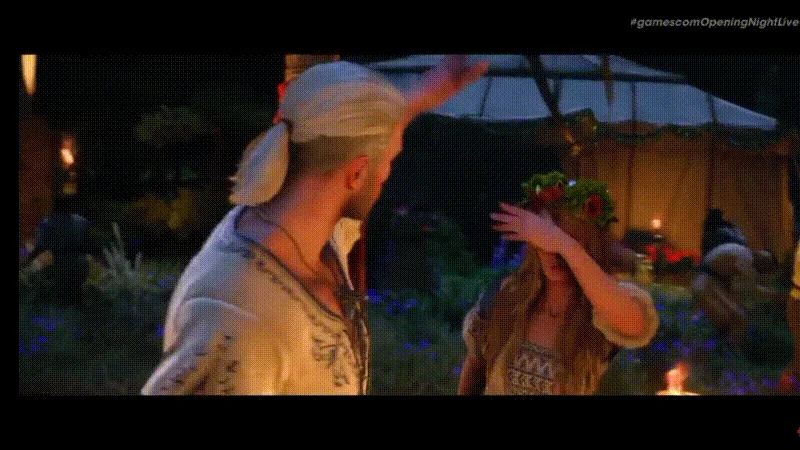
The Witcher 3: Wild Hunt, Songs of the Past brings Geralt of Rivia back for a third major expansion more than a decade after the original game launched in 2015. Its most substantial public presentation took place during Gamescom Opening Night Live on August 25, 2026, where CD PROJEKT RED revealed Letten, the homeland of Geralt’s longtime friend Dandelion. The expansion introduces a completely new open-world region, additional quests and characters, unfamiliar monsters, new combat possibilities and a silver chain weapon inspired by earlier Witcher material.
The Gamescom showcase followed the expansion’s initial announcement in May 2026. On July 21, CD PROJEKT RED confirmed that additional information would be presented during Opening Night Live, hosted by Geoff Keighley, before further demonstrations took place at the company’s Gamescom booths in Cologne. The August 25 trailer finally showed Letten in detail and established the expansion as another substantial Witcher story rather than a short epilogue or isolated contract.
Letten initially appears far more peaceful than the war-ravaged areas associated with much of The Witcher 3. CD PROJEKT RED describes it as an idyllic region shaped by rural traditions, folklore, successful harvests and extravagant celebrations. Vision director Karolina Kuzia identified Letten as a lush valley in northern Redania surrounded by mountains. Unlike Velen and other parts of the Continent, the region largely escaped the destruction of war, allowing its inhabitants to live comparatively peaceful lives alongside nature. That prosperity is deliberately misleading, however, because a long-dormant darkness remains concealed beneath the area’s beauty.
The Opening Night Live trailer served as the headline first look, while substantially more gameplay was shown during Gamescom and later released publicly. CD Projekt’s September 2026 financial update identified Gamescom as the first time the general public received a gameplay trailer for Songs of the Past. A public showcase video lasting approximately 13 minutes was assembled from a longer demonstration of roughly 45 minutes, showing Geralt exploring Letten, visiting the Lettenhove family estate and entering material connected to the quest called A Bed of Thorns.
The fundamental gameplay remains recognizably The Witcher 3. Geralt investigates environments using witcher senses, explores on foot and horseback, questions characters, negotiates when possible and fights when peaceful solutions fail. One early sequence follows Geralt investigating Dandelion’s missing lute, with a confrontation that can be resolved through dialogue or a fistfight. This preserves the game’s familiar balance of investigation, conversation and combat while placing those systems inside an entirely new region.
Letten is being designed as more than a visually attractive map. The region’s dense vegetation, active roads, settlements and agricultural environments created technical and traversal challenges during development, particularly when the team attempted to move Roach through heavily detailed terrain. Improvements developed for The Witcher 3: Wild Hunt; Remastered helped Fool’s Theory and CD PROJEKT RED realize the richer vegetation and more complex geography they wanted without making horseback travel impractical.
Dandelion’s personal history forms the narrative foundation of the expansion. His full name is Julian Alfred Pankratz, Viscount de Lettenhove, and Songs of the Past brings Geralt directly into the aristocratic household and landscape that shaped him. Players have long known Dandelion as a poet, performer, storyteller, troublemaker and fiercely loyal friend, but the expansion examines parts of his family background that the previous games did not explore deeply.
Geralt travels to Lettenhove, the estate belonging to Dandelion’s family, while attempting to understand his friend’s disappearance. There, he meets relatives who reveal a less familiar side of the bard’s life. Among them is Dandelion’s cousin Lilla, who becomes involved in a family dispute concerning Dandelion’s grandmother. Geralt’s investigation eventually leads him and Lilla toward stories about Dandelion’s ancestor, Count Humbert de Lettenhove, and a family history connected to the supernatural danger hidden within the region.
The relationship between Geralt and Dandelion gives the expansion more personal stakes than the main game’s battle against the Wild Hunt. Geralt is not leaving his post-Blood and Wine life because another continent-wide disaster requires his intervention. He returns because one of his closest friends needs him. CD PROJEKT RED developers have described the expansion as an opportunity to examine who Dandelion really is, where he came from and what his friendship with Geralt means after years of shared danger.
The underlying story concept also has a longer history than the 2026 announcement suggests. Developers have indicated that the narrative originated years earlier but was not produced at the time. It later returned when CD PROJEKT RED and Fool’s Theory had the opportunity to develop it as a complete expansion. The studios have also resisted the assumption that Songs of the Past exists primarily to connect The Witcher 3 with The Witcher 4. Instead, they describe it as a missing chapter within Geralt and Dandelion’s established story.

Silver Chain Combat, New Monsters, a Bed of Thorns, and Letten’s Dark Folklore
The most immediately recognizable gameplay addition revealed at Gamescom was Geralt’s silver chain. The weapon has roots in Andrzej Sapkowski’s fiction and recalls Geralt’s use of a chain against a striga in the opening cinematic of the original 2007 The Witcher. Songs of the Past turns that familiar image into a fully usable combat tool within The Witcher 3’s battle system.
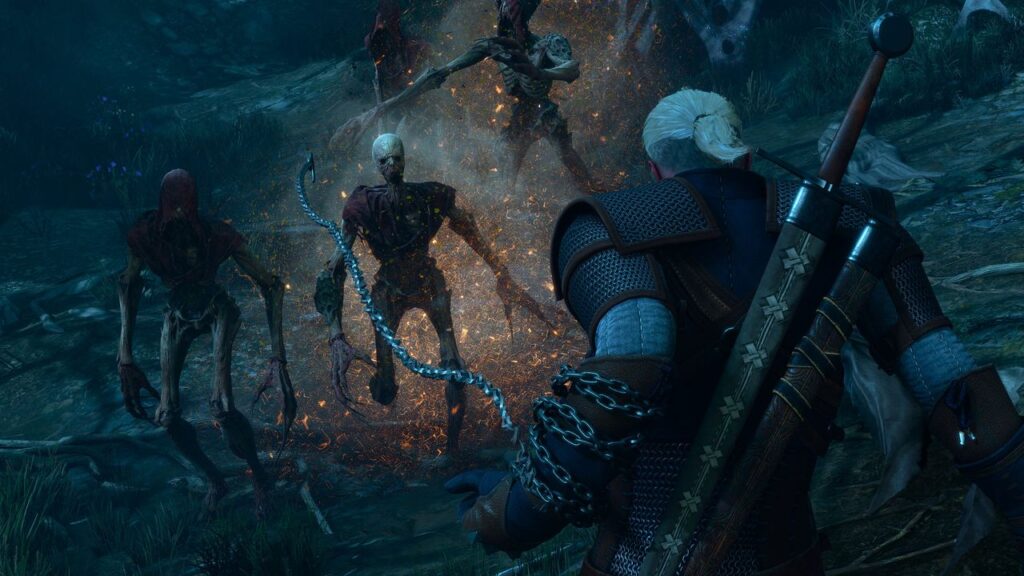
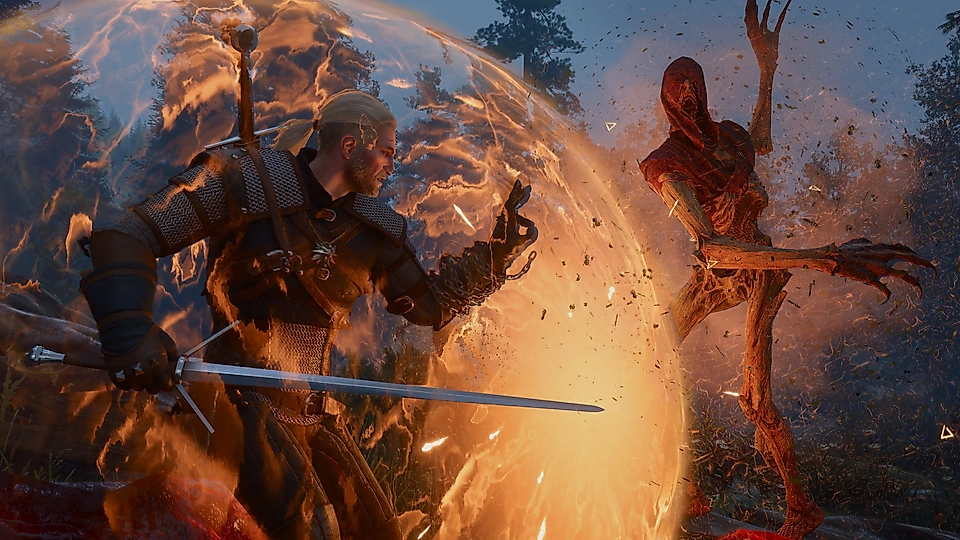
CD PROJEKT RED describes the chain primarily as a crowd-control weapon. Geralt can use it to pull individual enemies away from groups, interrupt attacks and create space when surrounded. Gamescom demonstrations showed him isolating targets before following with conventional sword attacks, making the chain useful for controlling the shape of a battle rather than simply inflicting additional damage.
The weapon can be deployed quickly during ordinary combat, but it also supports more deliberate targeting. Geralt can slow time and aim the chain at specific areas of an enemy in a manner comparable to aiming the crossbow. This potentially allows players to disrupt particular defenses or create openings that swords and Signs may not produce as efficiently.
The Slumbering Knight provides one of the clearest demonstrations of the chain’s intended purpose. Geralt uses it to break the creature’s defensive posture before continuing the fight with his normal attacks. The encounter suggests that the chain will play an important role against enemies whose armor, guard or positioning makes straightforward sword strikes less effective.
The Gamescom demonstrations also introduced several creatures not previously encountered in The Witcher 3. Swarmions were presented as one of the expansion’s signature new monster types. They attack in groups, creating situations in which Geralt can use the chain to pull one creature away from the swarm or separate several attackers before they overwhelm him.
Centipede-like threats and other unfamiliar creatures appeared as Geralt and Lilla moved deeper into Letten’s dangerous areas. CD PROJEKT RED’s official description promises never-before-seen enemies connected to the dormant evil beneath the region’s peaceful exterior. The company has not released the complete bestiary, so the Swarmion, Slumbering Knight and creatures visible during Gamescom should be treated as examples rather than the full monster roster.
A Bed of Thorns is one of the first major quests publicly connected to the expansion. The Gamescom demonstration begins after a night of local celebrations, with Geralt waking to discover that Dandelion is missing. What initially resembles another impulsive disappearance by the bard gradually becomes more serious as Geralt follows clues to the Lettenhove estate and uncovers information about Dandelion’s family.
Geralt eventually joins Lilla as the investigation turns toward Count Humbert de Lettenhove and an old family legend. Their journey leads away from the bright settlements and prosperous estates into darker terrain where the supernatural history of Letten becomes more visible. The quest combines family conflict, environmental investigation, conversations, folklore and combat rather than reducing Dandelion’s disappearance to a simple rescue mission.
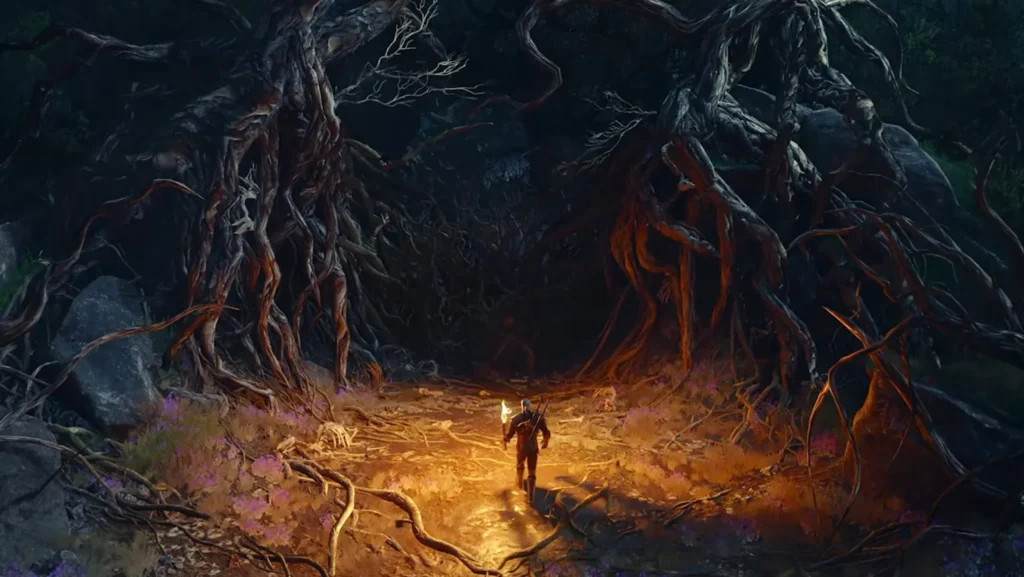
The Garden of Thorns represents the darker side of the region. Gamescom coverage describes it as an ominous location associated with Letten’s hidden supernatural past and avoided by ordinary residents. Geralt and Lilla move through gnarled woodland while investigating the curse connected to Count Humbert, eventually reaching a mysterious well linked to both the Lettenhove family and Dandelion’s disappearance.
The sequence culminates in Geralt’s confrontation with the Slumbering Knight. Its placement near the well suggests that the creature is more than an unrelated monster contract. The fight appears connected to the family curse and the historical secret beneath Letten’s prosperity, turning the surrounding environment into a physical manifestation of the region’s buried past.
CD PROJEKT RED has not yet provided a complete explanation of the Garden of Thorns. Its full size, number of internal locations and ultimate importance to the story remain undisclosed. The available footage establishes it as a major supernatural location rather than a small monster nest or optional combat arena.
Letten’s festivals and folklore are equally important to the expansion’s identity. CD PROJEKT RED emphasizes rural traditions, prosperous harvests and lavish celebrations, while the Gamescom demonstration begins after Belleteyn festivities. Artwork displayed around the studio’s Gamescom booth had already caused players to suspect that the festival would appear before the gameplay footage confirmed its role.
Belleteyn is associated in Witcher lore with spring, fertility and celebration. In Songs of the Past, it creates an intentionally cheerful opening atmosphere before Dandelion’s disappearance pushes Geralt toward the region’s darker history. Letten initially appears alive and prosperous, with carts traveling between settlements, shepherds moving livestock, children playing and residents participating in local traditions.
That sense of normal life makes the supernatural discovery more effective. Letten’s folklore can function both as communal identity and as a warning about real dangers the population has chosen to mythologize or ignore. The expansion appears ready to use songs, family legends and celebrations as narrative evidence rather than decorative background material.
This approach reflects a familiar Witcher theme. Beautiful countryside, successful families and apparently peaceful communities can conceal histories of exploitation, violence and curses. Geralt’s investigation gradually forces him to determine which stories are harmless traditions and which preserve distorted memories of something genuinely dangerous.
The Witcher 3 Remastered Gameplay Improvements and Their Impact on Songs of the Past
Songs of the Past retains the familiar Witcher 3 gameplay loop but is being constructed on top of the extensive improvements introduced through The Witcher 3: Wild Hunt; Remastered. The expansion and remaster are separate products, yet their development is closely connected. Systems created to modernize the original game also support Letten’s denser environments, revised combat encounters and more active settlements.
The remaster launches on September 29, 2026, several months before the expansion’s still-unspecified 2027 date. CD PROJEKT RED says the project revisits visuals, movement, combat, animation, camera behavior, enemy behavior, accessibility, progression and numerous quality-of-life systems while preserving the identity of the original game.
Developers described their guiding question as how The Witcher 3 might have played if it had originally launched in 2026. The intention is not to rebuild the entire game into a different action RPG, but to remove friction, modernize presentation and make Geralt more responsive without abandoning the systems players already recognize.
Combat is being made smoother and more flexible. Developers told PC Gamer that players can change targets while Geralt is already performing an attack, reducing situations in which he remains awkwardly committed to an enemy who has moved or is no longer the most important threat. Animation transitions, camera behavior and enemy responses have also received attention.
The remaster’s announced gameplay and quality-of-life improvements include:
- Smoother and more responsive combat
- Improved traversal and character movement
- Revised combat and movement animations
- Updated camera behavior
- Improved enemy and monster behavior
- New visual effects for Witcher Signs
- Revised horse controls and mount handling
- A reworked skill tree
- Armor transmogrification
- Additional combat finishers
- Expanded photo mode options
- Cross-platform mod support
- Improved quest tracking
- Interface and user-experience revisions
- Changes to looting
- Modernized tutorials
- New accessibility options
Visual improvements include updated textures, enhanced foliage shading, revised lighting, HDR changes, improved ray tracing and newer rendering technologies on supported hardware. PC features include DLSS 4.5, FSR 4, XeSS 2.0 and path-tracing-related improvements, while console versions receive their own platform-specific enhancements.
The remaster’s movement and environmental changes were particularly useful when constructing Letten. Early versions of the region contained dense terrain that created difficulties for Roach, but revised traversal systems allowed the developers to retain the lush vegetation and complex geography instead of simplifying the landscape around the limitations of the 2015 version.
Population and NPC improvements also support Letten’s intended atmosphere. The region is meant to feel active and comparatively prosperous, with workers, carts, animals, families and celebrations creating a stronger sense of ordinary rural life. Those details are important because the expansion depends on the contrast between a functioning community and the supernatural danger beneath it.
Songs of the Past adds its own mechanics on top of this foundation, most notably the silver chain and enemies designed around crowd control, separation and guard disruption. The remaster improves the responsiveness and readability of the existing combat, while the expansion introduces encounters that specifically take advantage of Geralt’s new tool.
The two releases remain distinct. The Witcher 3: Wild Hunt, Remastered upgrades the existing game and its systems, while Songs of the Past adds an entirely new region, story, quests, monsters, characters and combat possibilities. Releasing Remastered first allows players to revisit Geralt’s established journey with the modernized systems before those improvements are used within Letten.
Existing owners on qualifying platforms receive the remaster as a free upgrade. CD PROJEKT RED also made Hearts of Stone and Blood and Wine available to owners of the base game, bringing the existing Witcher 3 story content together before Songs of the Past expands it again.
The Nintendo Switch 2 version of the remaster is also scheduled for September 29, 2026. Owners of the original Nintendo Switch edition can claim the native Switch 2 Remastered version through CD PROJEKT RED’s announced upgrade program. Nintendo says the new version includes features such as gyro aiming, Joy-Con 2 mouse controls and touchscreen support.
The modernization is therefore intended to create one updated Witcher 3 foundation across current platforms. Players can experience the original campaign and its first two expansions with the revised systems before entering Letten when Songs of the Past arrives.
Songs of the Past Platforms, 2027 Release Window, Development, and Expansion Scope
The Witcher 3: Wild Hunt, Songs of the Past is officially confirmed for PlayStation 5, Xbox Series X|S, Nintendo Switch 2 and PC. The PC version will be distributed through GOG, Steam, the Epic Games Store and Battle.net. Battle.net support is part of a new partnership between CD PROJEKT RED and Blizzard Entertainment.
Nintendo Switch 2 joined the confirmed platform lineup during the Gamescom announcements. Nintendo later reiterated that the paid expansion would reach the system in 2027 and made it available for wishlisting through its ecosystem. It will run alongside the native Switch 2 version of The Witcher 3: Wild Hunt; Remastered rather than relying solely on backward compatibility with the original Switch release.
No versions have been announced for PlayStation 4, Xbox One or the original Nintendo Switch. The current platform list is therefore:
- PlayStation 5
- Xbox Series X
- Xbox Series S
- Nintendo Switch 2
- GOG
- Steam
- Epic Games Store
- Battle.net
The expansion will be released sometime in 2027, but CD PROJEKT RED has not announced an exact day or month. Gamescom Opening Night Live did not narrow the window, and the company’s official Gamescom material continues to list the project simply for 2027.
At one stage, CD Projekt considered releasing the expansion in 2026. During the company’s first-quarter 2026 earnings discussion, joint CEO Michał Nowakowski explained that earlier planning had included a 2026 possibility, but the company and development team selected 2027 because they believed the additional time would result in a stronger product.
CD PROJEKT RED has not announced a price. Any listing assigning the expansion a specific cost or release date should be treated as unconfirmed until the company publishes the information through its official marketing campaign.
The expansion is being co-developed by CD PROJEKT RED and Fool’s Theory. Fool’s Theory includes developers with previous experience on The Witcher 3, giving the team familiarity with Geralt, the game’s technology and its quest structure. The collaboration also connects Songs of the Past with the broader modernization work being completed for Remastered.
CD Projekt deliberately calls Songs of the Past an expansion rather than DLC. The company historically used “DLC” for smaller additions distributed free to players, while the word “expansion” is reserved for larger paid story content such as Hearts of Stone and Blood and Wine. That terminology signals that the new release is intended to provide a substantial adventure rather than a small quest pack.
Nowakowski described the intended scope as closer to Blood and Wine than to a minor piece of content, while cautioning that exact playtime depends heavily on how individual players approach exploration, side quests and optional activities. CD PROJEKT RED has not published a formal hour count or complete quest total.
The Gamescom demonstrations support the idea of a large expansion. Letten is a complete region with its own settlements, cultural identity, family histories, monsters, quests and hidden supernatural areas. Geralt gains a new combat tool, encounters enemies designed around different mechanics and investigates a story rooted in one of his longest friendships.
The expansion is also not being marketed as a direct prologue to The Witcher 4. Although it returns players to Geralt shortly before CD PROJEKT RED moves deeper into its next Witcher project, developers describe Songs of the Past as a self-contained missing chapter focused on Geralt and Dandelion.
The confirmed information following Gamescom can therefore be summarized as follows:
- Geralt returns for a third major expansion.
- Letten is a new open-world region in northern Redania.
- Letten is Dandelion’s homeland.
- The story examines Dandelion’s family and relationship with Geralt.
- Lilla and Count Humbert de Lettenhove are connected to the central mystery.
- The expansion includes the A Bed of Thorns quest and the Garden of Thorns.
- Geralt gains a silver chain with crowd-control and guard-breaking functions.
- New monsters include Swarmions and the Slumbering Knight.
- The expansion benefits from Remastered combat, movement, animation and technical improvements.
- CD PROJEKT RED and Fool’s Theory are co-developing it.
- The confirmed platforms are PS5, Xbox Series X|S, Switch 2 and PC.
- The release window is 2027.
- No exact date or price has been announced.
- Its intended scope is closer to Blood and Wine than to a small DLC release.
Songs of the Past is therefore being positioned as a substantial return to The Witcher 3, not a brief anniversary mission. Its combination of a new region, personal Dandelion-focused story, unfamiliar monsters, revised combat and Remastered technology gives Geralt another major adventure while preserving the investigative structure and morally complicated folklore that defined the original game.

Frequently Asked Questions (FAQs)
- What is The Witcher 3: Wild Hunt; Songs of the Past?
Songs of the Past is the third major paid expansion for The Witcher 3: Wild Hunt, following Hearts of Stone and Blood and Wine. It brings Geralt of Rivia back for a substantial new adventure set in Letten, an unexplored region containing original quests, characters, monsters, secrets and combat additions. CD PROJEKT RED is co-developing the expansion with Fool’s Theory, a studio that includes developers with previous experience working on The Witcher 3. - Was The Witcher 3 Songs of the Past shown at Gamescom Opening Night Live on August 25, 2026?
Yes. CD PROJEKT RED presented the first major public look at Songs of the Past during Gamescom Opening Night Live on August 25, 2026. The trailer introduced Letten, Geralt’s new silver chain and several unfamiliar enemies. Additional Gamescom demonstrations and a later showcase supercut provided a longer look at exploration, conversations, combat and quests involving Dandelion’s family. - Where is The Witcher 3 Songs of the Past set?
The expansion takes place in Letten, Dandelion’s homeland in northern Redania. It is a prosperous rural valley surrounded by mountains and shaped by farming, folklore, seasonal celebrations and long-standing local traditions. Although Letten appears peaceful and was largely spared the devastation of war, Geralt gradually discovers that a supernatural darkness and troubling family history are hidden beneath its idyllic surface. - Why does Geralt go to Letten in Songs of the Past?
Geralt travels to Letten because the story centers on Dandelion and the bard’s connection to his family homeland. Gamescom footage begins after local celebrations, when Geralt discovers that Dandelion has disappeared under increasingly suspicious circumstances. His investigation takes him to the Lettenhove estate, where relatives such as Lilla help uncover a mystery involving the family’s past, Count Humbert de Lettenhove and a long-buried curse. - What is Geralt’s new weapon in Songs of the Past?
Geralt gains a silver chain designed primarily for crowd control, enemy positioning and the disruption of defenses. He can use it to pull individual creatures away from groups, create space when surrounded and target particular parts of stronger enemies. The weapon also pays tribute to earlier Witcher material, including Geralt’s famous use of a chain during the striga cinematic from the original 2007 game. - What is the Swarmion in The Witcher 3 Songs of the Past?
The Swarmion is one of the new monster types introduced in the expansion and demonstrated during Gamescom. Swarmions attack in groups, making them dangerous when they surround Geralt or pressure him from several directions. His new chain is especially useful against them because it can isolate a single creature, separate parts of the group and give Geralt more control over the battlefield before he follows with sword attacks or Signs. - What is A Bed of Thorns in Songs of the Past?
A Bed of Thorns is a quest line featured during the Gamescom 2026 gameplay demonstration and later public showcase footage. It follows Geralt and Dandelion’s cousin Lilla as they investigate the Lettenhove family’s history and the supernatural mystery connected to Dandelion’s disappearance. The quest takes them away from Letten’s celebrations and estates into darker areas associated with Count Humbert, an old family curse and the dangerous Garden of Thorns. - Is Songs of the Past part of The Witcher 3 Remastered?
No. The Witcher 3: Wild Hunt, Remastered and Songs of the Past are separate releases. Remastered launches on September 29, 2026 and modernizes the existing game through improved visuals, combat, movement, animations, enemy behavior, accessibility and quality-of-life features. Songs of the Past is a new paid story expansion arriving in 2027, although its combat, environments and traversal benefit from the technology and gameplay improvements created for Remastered. - Which platforms will receive The Witcher 3 Songs of the Past?
Songs of the Past is confirmed for PlayStation 5, Xbox Series X|S, Nintendo Switch 2 and PC. PC players will be able to purchase it through GOG, Steam, the Epic Games Store and Battle.net. CD PROJEKT RED has not announced versions for PlayStation 4, Xbox One or the original Nintendo Switch, indicating that the expansion is being developed around current-generation hardware. - When is The Witcher 3 Songs of the Past release date?
The official release window is 2027, but CD PROJEKT RED has not announced an exact month or day. The expansion had previously been considered for a 2026 release, but the company and development team decided that moving it into 2027 would provide more time to achieve the intended quality and scope. CD Projekt has described the expansion as being closer in scale to Blood and Wine than to a small downloadable quest pack.
Conclusion
The Witcher 3 Songs of the Past at Gamescom Opening Night Live August 25 reveal established the expansion as much more than a nostalgic return to an eleven-year-old RPG. CD PROJEKT RED and Fool’s Theory are developing a substantial new Witcher 3 adventure built around Geralt’s friendship with Dandelion, an unexplored part of Dandelion’s personal history and a completely new region designed around the contrast between rural prosperity and supernatural horror.
Letten is the centerpiece. Its green valleys, agricultural communities, festivals, folklore and apparently peaceful lifestyle deliberately separate it from the devastation associated with Velen and other war-torn parts of The Witcher 3. That tranquility is deceptive. The disappearance of Dandelion draws Geralt toward the Lettenhove estate, a family legend, Count Humbert, dangerous forests and a mystery associated with a place described in Gamescom coverage as the Garden of Thorns.
The gameplay demonstrations also make clear that Geralt is not returning with exactly the same toolset. His silver chain provides a new approach to crowd control, enemy positioning and defense-breaking while simultaneously referencing one of the oldest recognizable weapons associated with the character. Swarmions, the Slumbering Knight and other creatures shown during Gamescom demonstrate how the developers can construct encounters specifically around those new abilities without discarding The Witcher 3’s familiar swords, Signs, alchemy and investigative systems.
The Witcher 3: Wild Hunt, Remastered is equally important to understanding Songs of the Past. Launching September 29, 2026, the remaster modernizes combat, movement, enemy behavior, animations, progression, visuals, accessibility and numerous quality-of-life elements. Songs of the Past is able to benefit from this revised foundation rather than being forced to operate exactly within the technological boundaries of the 2015 release.
There is still a considerable amount that CD PROJEKT RED has not revealed. The exact release date within 2027 remains unknown, pricing has not been announced, and the complete quest list, map size, bestiary and branching consequences remain under wraps. What is confirmed is already substantial: Geralt returns, Dandelion becomes the emotional center of the story, Letten provides an entirely new open-world setting, a silver chain expands combat, unfamiliar monsters are waiting, and the expansion is being treated internally as a major release with a scope closer to Blood and Wine than a small DLC package.
More than a decade after Blood and Wine appeared to provide Geralt with a final retirement, Songs of the Past is reopening the Path for one more major story. Gamescom 2026 showed why CD PROJEKT RED believes there is still meaningful territory to explore within The Witcher 3: not by undoing Geralt’s previous ending, but by giving one of his oldest friendships and one of the game series’ least-explored regions the space for a story of their own.
Sources and Citations
- CD PROJEKT RED — “The Witcher 3: Wild Hunt — Remastered Announced, Songs of the Past Gets First Look” — August 25, 2026
This is the strongest official source for the Letten setting, 2027 release, paid-expansion status, September 29 Remastered launch, and PC/PS5/Xbox Series/Switch 2 plans. (CD PROJEKT RED Press Center)
CD PROJEKT RED official announcement - CD PROJEKT RED Press Center — “The Witcher 3: Wild Hunt — Songs of the Past at gamescom 2026” — July 21, 2026
Confirms the Gamescom Opening Night Live appearance and the subsequent public/business-area Gamescom presentations in Cologne. (CD PROJEKT RED Press Center)
CD PROJEKT RED Gamescom announcement - The Witcher official website — “A Look at The Witcher 3: Wild Hunt — Songs of the Past” — August 25, 2026
Confirms Geralt’s journey to Letten, new quests/characters/secrets, the 2027 window, and the PC and console platforms. (The Witcher)
The Witcher official website article - PC Gamer — Joshua Wolens, “We saw The Witcher 3: Songs of the Past in action, and the full-game remaster that’s coming this year too” — August 26, 2026
This is the relevant Gamescom preview covering Dandelion’s disappearance, Lettenhove, Lilla, Count Humbert, the Swarmion, silver chain weapon, Slumbering Knight and Remastered gameplay changes. (PC Gamer)
PC Gamer — Joshua Wolens - PC Gamer — Lauren Morton, “The Witcher 3 Remastered: Everything new coming in the big free upgrade” — August 26, 2026
Covers the September 29 launch and Remastered’s combat, movement, skill-system, graphical, accessibility and quality-of-life improvements. (PC Gamer)
PC Gamer — Lauren Morton - Xbox Wire — Marta Piwońska, “Geralt Returns in The Witcher 3: Wild Hunt — Songs of the Past and Remastered” — August 25, 2026
Confirms details about Remastered, the 2027 expansion, the chain weapon and the new gameplay/content. The article is authored by CD PROJEKT RED’s PR Manager. (XBOX Wire)
Xbox Wire article - CD PROJEKT Q1 2026 earnings transcript
This is particularly important because it contains Michał Nowakowski’s comments that Songs of the Past was initially targeted for 2026, was moved to 2027, is an expansion rather than a smaller DLC, and is closer in scope to Blood and Wine. It also confirms that pricing had not yet been announced at that time. (CD PROJEKT RED)
CD PROJEKT Q1 2026 earnings transcript (PDF) - Fool’s Theory — “The Witcher 3: Wild Hunt – Songs of the Past”
Officially confirms that Songs of the Past is the third Witcher 3 expansion and is being co-developed by CD PROJEKT RED and Fool’s Theory, whose team includes veteran Witcher 3 developers. (Fools Theory)
Fool’s Theory — Songs of the Past - TheSixthAxis — “Watch The Witcher 3: Songs of the Past gameplay reveal supercut from Gamescom” — August 30, 2026
Confirms the A Bed of Thorns material, Lilla, Swarmion, chain weapon and the difference between the roughly 13-minute public supercut and the longer ~45-minute Gamescom demonstration. (TheSixthAxis)
TheSixthAxis Gamescom supercut coverage - Nintendo — September 9, 2026 Nintendo Direct coverage
Official Nintendo coverage confirms Songs of the Past as a paid 2027 expansion for Switch 2, while also detailing the Switch 2-specific features of Remastered, including gyro aiming, Joy-Con 2 mouse controls and touchscreen support. (Nintendo Co., Ltd.)
Nintendo Direct — September 2026 - CD PROJEKT RED — “CD PROJEKT RED wraps up the first half of 2026” — September 2, 2026
Confirms that Gamescom provided the public’s first Songs of the Past gameplay trailer, reiterates the 2027 expansion release, and places it alongside Remastered and The Witcher 4 in CD PROJEKT RED’s broader publishing schedule. (CD PROJEKT RED)
CD PROJEKT RED — First Half of 2026 Review
Recommended
- What is Hot Dogs, Horseshoes & Hand Grenades 2? Everything We Know so Far
- Shadow of the Colossus director says “clunky” elements “are what actually end up being memorable”
- Fears to Fathom: Scratch Creek Explained. Story, Gameplay, Co-Op Horror Mechanics & Survival Guide for the Dilapidated City Escape
- Epstein Files Reveal Gaming Connections, Plans to Buy Activision Stock: Bobby Kotick Emails, Call of Duty, and More
- Netflix Abandons Warner Bros. Buyout, Paving Way for Paramount Takeover: What Happens Next
- LEGO Batman: Legacy of the Dark Knight Early Access & Full Release Times Confirmed (May 2026 Launch Schedule Explained)
- The Invite Review: Olivia Wilde’s A24 Comedy Explained
- All Bond Characters in 007 First Light Compared to the Films – Full Cast Breakdown, Differences, and Hidden Connections Explained
- Free 3D Sculpting Software: Best Tools for Artists on a Budget



































































































