









In This Article (7 sections)
Trojanized Claude Code Extension in Cursor: Affected Versions, Attack Timeline and 5,000 Potentially Exposed Users
A Trojanized Claude Code extension distributed through Cursor’s marketplace potentially exposed up to 5,000 developer machines to a reverse SSH backdoor in October 2026. However, the reported figure represents possible exposure rather than confirmed unauthorized access to 5,000 computers. Reuters reported Cursor’s estimate while noting that a necessary step for enabling remote access would fail on most machines without administrator privileges. The incident demonstrates how compromised software distribution can expose development environments to security threats, even when the affected extension carries a familiar product name.
The investigation requires distinguishing several events: downloading a malicious package, executing its payload, modifying system configuration, establishing remote connectivity and successfully authenticating an attacker. Each requires different evidence. A machine may have received the malicious software without allowing remote access, while another may retain unauthorized configuration even after the original extension has been removed. Understanding these distinctions is essential for assessing the actual impact and determining an appropriate security response.
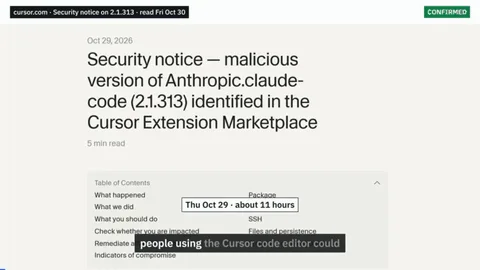
Cursor’s updated security advisory identified two affected Windows and macOS extension releases, Anthropic.claude-code versions 2.1.312 and 2.1.313. Although the packages appeared under the Claude Code identifier, Anthropic did not develop the malicious versions. The incident involved tampered software distributed through Cursor’s extension marketplace rather than a confirmed compromise of Anthropic’s official extension development systems.
An editor extension is executable software capable of operating within a developer’s working environment. Installing one can provide access to project files and other resources available to the editor. Consequently, a recognizable product name does not guarantee that a particular downloaded package is authentic. The relevant security question concerns the origin and contents of the delivered artifact, not merely its displayed publisher or version.
StepSecurity’s analysis also revealed an important distribution distinction. Its examination of version 2.1.312 obtained from Open VSX found that package to be clean, demonstrating that identical version identifiers do not necessarily mean downloaded files contain identical code. StepSecurity subsequently corrected its earlier description of the distribution source.
For incident response, organizations should therefore record the extension identifier, version, marketplace, operating system, installation timestamp and available file hashes. These details help distinguish potentially malicious packages from legitimate copies. A version match is an important investigative lead, but it does not independently establish that a machine was compromised.
Cursor identified the malicious distribution period as October 29, 2026, from approximately 2:27 a.m. to 1:35 p.m. Pacific Daylight Time, corresponding to 09:27 through 20:35 UTC. The window lasted approximately 11 hours and eight minutes.
However, the distribution timeline differs from the period during which malicious activity could occur. Expel investigated four customer incidents involving Macs and reported that one first showed malicious activity approximately eight hours after the distribution window closed. This illustrates why investigators should examine activity beyond the time when the packages were available for download.
A computer may download software before executing it, remain offline for part of the incident or load the extension during a later editor session. Marketplace removal therefore prevents further distribution through the affected channel but does not automatically eliminate threats from previously installed copies.
Security teams should reconstruct the relevant sequence of events, including:
- Package download: Whether the developer obtained an affected extension through Cursor’s marketplace.
- Installation: When the package became available within the editor.
- Extension execution: Whether the compromised module loaded and ran its injected code.
- System modifications: Whether unauthorized SSH configuration or persistence files were created.
- Network activity: Whether the payload attempted or established external connections.
- Remote authentication: Whether evidence indicates that an attacker successfully accessed the workstation.
- Remediation: When the malicious extension and associated system changes were removed.
The estimate of up to 5,000 affected users should be interpreted within these distinctions. Sophos also described the incident as potentially affecting up to 5,000 users while emphasizing that SSH setup failures did not necessarily prevent other malicious changes.
A malicious package reaching a workstation does not prove that an attacker established an interactive session or stole confidential information. Nevertheless, developer computers often contain valuable resources, including source repositories, development credentials, deployment permissions and authenticated service sessions. Their actual accessibility must be evaluated individually.
The incident’s confirmed scope also does not extend automatically to every Claude Code installation. Microsoft reported that the malicious packages were not distributed through Microsoft Visual Studio Marketplace or the official @anthropic-ai/claude-code npm package. Anthropic also confirmed that its systems were not compromised.
StepSecurity reported that Anthropic moved to version 2.1.314 to avoid confusion and that version 2.1.313 had not been published through its official distribution hosts. These details reinforce why marketplace provenance is central to understanding the incident.
The most accurate conclusion is that the affected Cursor marketplace packages created a potentially serious software supply chain exposure. The number of successful intrusions, extent of unauthorized activity and consequences for individual machines require separate investigation rather than assumptions based on the exposure estimate.

How the Claude Code Reverse SSH Backdoor Worked on Windows and macOS
StepSecurity’s technical analysis found malicious JavaScript inserted at the beginning of the extension’s extension.js bundle. The injected loader could execute when the extension module loaded, meaning users did not need to start a Claude conversation for malicious activity to begin. The legitimate extension functionality remained present, allowing the software to appear operational while additional code performed unauthorized actions. This execution method is particularly significant because developers might assume that avoiding direct interaction with the AI assistant prevented exposure. In reality, loading the compromised extension could trigger the payload during ordinary editor operation.
The malicious behavior extended beyond normal AI coding functionality. An extension may legitimately access project context or communicate with supporting services, but changes to SSH authorization, startup configuration, and remote access settings require separate security scrutiny. Removing the original extension does not necessarily reverse modifications made elsewhere on the operating system. The backdoor used a reverse SSH arrangement intended to provide remote access to the affected workstation. Phorion’s analysis identified two separate SSH identities. One was associated with authorizing access to the victim’s account, while the other authenticated an outbound connection from the workstation to infrastructure controlled by the attacker.
Reverse SSH forwarding allows the workstation to initiate a connection outward rather than requiring an external attacker to connect directly to the device. The forwarding arrangement can then make a local service accessible through the remote connection. However, an outbound tunnel does not automatically establish a successful attacker login. The relevant SSH service must be available, authentication must work, and the forwarding configuration must support the intended connection. Investigators must therefore distinguish an attempted connection from an established tunnel and an authenticated remote session. The malware also attempted to maintain access through operating system persistence mechanisms. Cursor’s advisory described different approaches for Windows and macOS:
- macOS persistence: A LaunchAgent intended to restart the malicious connection.
- Windows persistence: An attempted scheduled task, with a Startup folder fallback.
- SSH authorization: Unauthorized configuration intended to permit access to the affected account.
- Outbound connectivity: A reverse SSH connection to infrastructure controlled by the attacker.
- Background retries: Mechanisms intended to restore connectivity after interruptions.
These components could remain relevant even when the original extension was uninstalled. Their effects depended on system configuration, permissions, and whether individual stages executed successfully. Microsoft’s analysis also identified a reconnaissance component collecting host and account metadata. The information included the hostname, username, operating system, system architecture, directories, and configured Git email address. The payload also collected up to 40 matching environment variable names rather than the secret values stored in those variables.
This distinction matters because identifying a variable associated with a cloud service does not necessarily mean that its credential was stolen. However, the names can reveal which development services or authentication mechanisms may be configured on the workstation. The reported reconnaissance behavior should therefore be separated from information potentially accessible during a subsequent interactive attacker session. The first concerns what the analyzed payload collected, while the second requires host and service evidence showing whether unauthorized access actually occurred.
Technical errors also limited the backdoor’s effectiveness on many affected systems. Phorion identified a macOS logic error involving the Remote Login status check. Instead of receiving the expected disabled state, the malware encountered an administrator access message and skipped the step intended to enable the service. On Windows, researchers found that part of the SSH setup incorrectly relied on /bin/sh, which is unavailable on standard Windows installations. Sophos similarly reported that coding mistakes prevented SSH enablement on most affected macOS and Windows machines.
These failures reduced the likelihood of successful remote access under the affected circumstances, but they did not establish that every malicious action failed. An unauthorized SSH key could still be written, a startup entry might remain, or reconnaissance activity could occur even if the tunnel never became usable. Existing configuration also mattered. A workstation with SSH already enabled could present different conditions from one where the malware needed to activate the service. Investigators should therefore examine what occurred on each host rather than assume that a coding error made every installation harmless. Expel published several indicators associated with its investigation, including:
- External address:
134.209.82[.]225 - SSH communications: TCP port 22.
- Beacon activity: TCP port 8099.
- macOS persistence path:
~/Library/LaunchAgents/com.apple.sysmond.plist - Associated files:
.smtand.smtkartifacts. - Temporary filenames: Files beginning with
.stk_. - SSH key identifier:
svc-telemetry.
These indicators can help narrow an investigation, but their meaning depends on context. A matching filename may justify further inspection, while a cryptographic hash can provide stronger evidence that a particular file matches a known malicious artifact. Hash comparisons must also involve equivalent objects. The hash of an entire extension package cannot be directly equated with the hash of an extracted JavaScript file. Similarly, a connection attempt does not establish that an attacker completed authentication or accessed sensitive files. A stronger assessment combines installation records, suspicious configuration changes, process activity, network evidence, and authentication logs.
The incident demonstrates a broader software supply chain problem. Attackers did not need to compromise the underlying Claude model or persuade it to follow malicious instructions. Instead, they inserted executable code into software developers trusted and installed. Because editor extensions operate within environments containing source code and development tools, their compromise can create risks extending beyond the editor itself. Protecting against malicious prompts is therefore insufficient when executable software distributed through a marketplace can independently alter operating system configuration.

How to Detect, Remove and Prevent the Cursor Claude Code Extension Backdoor
Developers and security teams should begin by determining whether the affected extension was installed through Cursor’s marketplace during the relevant period. The investigation should record the package version, source, installation history, and operating system. Finding a newer extension installed today does not establish that an older malicious version never executed, particularly when automatic updates or manual cleanup may have changed the current installation.
Cursor’s published quick check identifies the SSH key comment svc-telemetry as an indicator. On macOS, administrators can examine the relevant user’s ~/.ssh/authorized_keys file. Windows checks include the user’s SSH authorization file and, where applicable, C:\ProgramData\ssh\administrators_authorized_keys. A matching entry requires investigation, while its absence does not conclusively establish that the workstation was unaffected. Previous cleanup, incomplete account coverage, or unavailable historical records can limit the usefulness of a single check.
Before removing suspicious components, organizations should preserve relevant evidence through established incident response procedures. Useful records include the installed extension package, suspicious files, SSH configuration, startup entries, running processes, security alerts, and network activity. Investigators should document collection times and examine relevant user profiles rather than assuming one account represents the entire machine. Security teams should avoid launching a suspicious extension merely to test whether it operates. The investigation should establish historical and current exposure without unnecessarily executing the malicious code again. Sophos warned that uninstalling the extension alone does not remove every component associated with the backdoor. Unauthorized SSH keys, startup configuration, and running tunnel processes may remain outside the extension directory. A complete recovery process should therefore include:
- Containment: Isolate affected devices when necessary to prevent further unauthorized connections.
- Evidence preservation: Collect relevant files, logs, and security records before cleanup.
- Malicious extension removal: Remove the affected package and verify that a trusted distribution is used for replacement.
- SSH authorization review: Identify and remove confirmed unauthorized access entries.
- Persistence removal: Examine suspicious LaunchAgents, scheduled tasks, and Startup folder entries.
- Process inspection: Identify and terminate confirmed malicious tunnel or persistence processes.
- Network investigation: Review suspicious connections and possible remote authentication activity.
- Credential recovery: Assess exposed development credentials and authenticated sessions.
- Validation: Confirm that unauthorized configuration and suspicious behavior do not return.
Cleanup should target verified malicious components rather than indiscriminately deleting legitimate configuration. Removing an entire SSH directory, for example, could destroy valid access settings while leaving unrelated persistence mechanisms untouched. After remediation, security teams should verify that suspicious processes remain absent, unauthorized startup entries do not return, and unexpected network connections do not resume following normal login or restart activity. Rebuilding the workstation may be appropriate when its integrity cannot be established confidently. That decision should depend on the available evidence, the privileges potentially exposed, and organizational recovery requirements. Backups should also be reviewed because restoring files containing malicious startup configuration could reintroduce the problem.
Credential security deserves particular attention. Cursor advised affected users to rotate accessible credentials and sessions from a trusted system. Although the analyzed reconnaissance routine collected environment variable names rather than secret values, successful remote access could have exposed additional resources. Organizations should assess the credentials available to the affected account, including repository access, cloud services, development platforms, deployment permissions, and authenticated sessions. The objective is to identify which credentials could have been accessed rather than automatically assuming every credential across the organization was compromised.
Rotation and revocation are different operations. Replacing a password or token does not always terminate previously established sessions. Recovery should follow the relevant provider’s procedures for invalidating credentials and active access. Replacement credentials should be created from a trusted machine rather than a potentially compromised workstation. Credentials with elevated privileges, particularly those associated with production systems or shared development infrastructure, should receive priority. Security teams should also review relevant service logs for suspicious activity before and after credential replacement. A documented record of rotated tokens, revoked sessions, and reviewed systems helps establish whether recovery has been completed.
Cursor reported several actions taken to contain the incident. The company removed the malicious packages, temporarily disabled its extension marketplace, audited access, rotated keys, rebuilt the marketplace, and worked with the hosting provider to disable the attacker’s server. These measures addressed the distribution infrastructure and part of the external attack environment. However, marketplace recovery and endpoint recovery remain separate responsibilities. Disabling attacker infrastructure does not automatically reverse operating system changes already made on affected computers. Organizations should therefore track vendor remediation alongside their own device investigations. A marketplace returning to normal operation does not mean every potentially exposed workstation has been restored.
The incident also highlights the importance of preventive controls for developer extensions. Organizations should maintain inventories identifying installed extensions, publishers, versions, and distribution sources. Historical records are particularly useful because an inventory showing only current installations may miss previously executed malicious packages. Managed development environments should use approved installation channels and procedures for evaluating unfamiliar extensions. Developers should avoid routinely running editors with elevated operating system privileges, while production administration should remain separate from ordinary coding activity wherever possible.
Credential access should follow the principle of least privilege. Development tokens should have limited permissions and appropriate lifetimes, reducing the potential consequences if an extension is compromised. Monitoring should also consider the behavior of editor extensions and their child processes. Unexpected SSH activity, modifications to startup configuration, unfamiliar network destinations, and changes to authorization files can provide useful indicators when evaluated alongside legitimate development activity. The main preventive measures include:
- Maintain an inventory of installed extensions and their distribution sources.
- Restrict software installation to approved and trusted channels.
- Avoid unnecessary administrator privileges during routine development.
- Limit access to production credentials and sensitive repositories.
- Monitor unusual processes, SSH configuration changes, and outbound connections.
- Preserve sufficient endpoint logs to investigate historical activity.
- Establish clear procedures for workstation isolation and credential recovery.
- Verify that malicious persistence has been removed before restoring normal access.
These safeguards cannot eliminate every software supply chain risk, but they can reduce the likelihood that a compromised extension gains extensive access or remains undetected. The October 2026 Cursor incident also illustrates why security reporting must distinguish potential exposure from confirmed compromise. Up to 5,000 developers may have received affected packages, but that estimate does not demonstrate successful attacker access to every machine. Technical errors prevented important SSH setup stages from succeeding on many systems, while other malicious modifications could still have occurred.
The strongest recovery assessment therefore combines a documented timeline, verified removal of malicious files and configuration, review of possible unauthorized activity, completion of necessary credential recovery, and evidence that suspicious behavior has not returned. Ultimately, the Trojanized Claude Code extension demonstrates how trusted development tools can become entry points for unauthorized access when their software distribution is compromised. Protecting developer environments requires attention to the authenticity of installed packages, the privileges available to extensions, and the ability to investigate and reverse unwanted system changes.

Frequently Asked Questions (FAQs)
- Did attackers successfully access 5,000 developer machines?
No confirmed evidence establishes that attackers successfully accessed 5,000 developer computers. The figure represents Cursor’s estimate of potentially affected users rather than verified remote intrusions. Some machines may have downloaded the malicious extension without executing it, while others may have experienced configuration changes without successful attacker authentication. Investigators must examine installation records, network connections and login activity to determine what actually occurred on individual devices. - Does having an affected version number prove compromise?
No. Versions2.1.312and2.1.313were identified as affected in Cursor’s marketplace, but the distribution source and actual package contents matter. StepSecurity found that a copy of version2.1.312obtained from Open VSX was clean. A version match should therefore trigger further investigation rather than an automatic conclusion that malicious code executed or an attacker gained access. - Was opening a Claude conversation necessary?
No. StepSecurity found that the malicious JavaScript could execute when the extension module loaded, even if the user never started a Claude conversation. This means simply avoiding interaction with the assistant would not necessarily prevent execution. Security teams should examine extension loading, installation history and endpoint activity rather than relying exclusively on whether the developer remembers using Claude Code. - Does a failed SSH setup mean the computer needs no investigation?
No. Researchers identified implementation errors that prevented important SSH setup steps from succeeding on many Windows and macOS systems. However, failure of the remote access stage does not establish that other malicious actions failed. Unauthorized SSH configuration, startup files or reconnaissance activity may still have occurred. Each component should be examined separately before determining that a workstation is safe. - Were environment variable secret values necessarily stolen?
The analyzed reconnaissance routine collected matching environment variable names rather than the secret values stored in those variables. This means the documented collection behavior should not be described as confirmed theft of every associated credential. However, if an attacker subsequently established remote access, additional information may have been accessible. Investigators should examine host activity and relevant service logs before determining whether credentials were exposed. - Is uninstalling the extension enough?
No. Uninstalling the affected extension removes the original software package but does not necessarily reverse changes made to the operating system. The malware could leave unauthorized SSH keys, startup entries or background processes outside the extension directory. Recovery requires identifying and removing those components, reviewing suspicious activity and validating that the malicious behavior does not return after restarting the device. - Can the absence of
svc-telemetryconclusively clear a computer?
No. Thesvc-telemetrySSH key comment is a useful indicator, but a negative search does not prove that the malicious extension never executed. Configuration may already have been removed, multiple user profiles may exist or relevant historical evidence may be unavailable. Investigators should combine the check with extension installation records, startup configuration, network activity and other available indicators. - Should every Claude Code user reset every password?
Not automatically. The confirmed distribution incident concerned particular packages delivered through Cursor’s marketplace. Users of unaffected official distribution channels should not be classified as victims solely because they use Claude Code. However, developers whose machines received and executed the malicious packages should assess credentials and sessions accessible to the affected account. Necessary rotation and revocation should take place from a trusted system. - Does updating to a clean release reverse earlier malicious changes?
No. Installing a clean extension replaces the affected software but does not automatically remove unauthorized SSH authorization entries, persistence mechanisms or other changes made during earlier execution. A machine may appear to have the latest trusted version while retaining malicious configuration from the compromised package. Organizations should investigate historical exposure and confirm that any remaining components have been removed. - What evidence is most useful for closing the incident?
A reliable closure assessment should combine installation and execution timelines, evidence that malicious files and persistence mechanisms were removed, review of suspicious network and authentication activity, and completion of necessary credential recovery. Security teams should also verify that unexpected processes or connections do not return after normal system operation resumes. Where historical evidence is incomplete, the remaining uncertainty should be documented rather than treating missing logs as proof that no compromise occurred.

Conclusion
The trojanized Claude Code extension incident highlights the importance of verifying software authenticity beyond its name or publisher. Malicious packages distributed through Cursor’s marketplace potentially exposed up to 5,000 developers, but this figure does not represent confirmed successful intrusions. Technical failures and individual system configurations affected whether the reverse SSH backdoor could establish remote access.
For affected developers, recovery requires identifying the installed package, investigating suspicious activity, removing malicious configuration and securing potentially exposed credentials. The incident reinforces the need for trusted extension sources, restricted permissions, effective monitoring and recovery procedures that address the entire development environment.
Sources and Citations
- Cursor, October 29–30, 2026: Confirms affected extension versions, exposure timeline, security response, and remediation steps.
https://cursor.com/blog/claude-code-extension-security-notice - Microsoft Security Research, October 30, 2026: Analyzes the SSH backdoor, malicious code, and unaffected distribution channels.
https://www.microsoft.com/en-us/security/blog/2026/10/30/inside-malicious-claude-code-branded-cursor-extension-persistent-ssh-backdoor/ - Phorion, October 30–31, 2026: Examines SSH persistence, attacker-controlled keys, and technical implementation failures.
https://phorion.io/blog/offical-claude-code-vsx-compromise/ - StepSecurity, October 2026: Investigates compromised packages, malicious execution, and distribution methods.
https://www.stepsecurity.io/blog/claude-code-extension-trojanized - Expel, October 30, 2026: Documents endpoint investigations, compromise indicators, and persistent backdoor activity.
https://expel.com/blog/blog-fake-claude-code-extension-cursor-ssh-backdoor/ - Sophos X-Ops, October 2026: Explains backdoor risks, detection methods, and recommended removal procedures.
https://www.sophos.com/en-us/blog/malicious-claude-code-extension-distributed-through-cursor-marketplace - Reuters, October 30, 2026: Reports the compromised extension and potential exposure of up to 5,000 users.
https://www.reuters.com/business/media-telecom/cursor-says-up-5000-users-affected-by-tampered-claude-code-extension-2026-10-30/
Recommendations
- A Hacker Has Allegedly Stolen Employee Data From Nintendo
- Madden NFL 27 Gets Shown Ahead of Its August 13 Release Date
- Machine Party 2.0 Adds Couch Co-Op as the Brutal Party Game Surpasses 1 Million Copies Sold
- Magic: The Gathering Arena Event Schedule For Marvel Super Heroes: All Dates, Rewards, and MTG Arena Events Guide
- Assassin’s Creed Codename Hexe is Expected to Get a DLC Set in Würzburg
- Grafit Studio the Academic Essentials Bundle: 4,800+ Academic Model Photos for Figure Drawing, Portraits & Anatomy Studies
- Gnomon Workshop Battle-Worn Titan Photoshop Tutorial Guide
- Kingdom Hearts IV Gets Surprise New Gameplay Trailer: Everything Revealed From the Nintendo Direct 2026 Showcase
- Mario Kart World Adds Two New Knockout Tours in Version 1.7.0, with More Routes Coming Soon
- DoorDash Q3 2026: Why AI Agents Have Generated So Few Orders



































































































