






In This Article (7 sections)
Machine Party 2.0 Couch Co-Op, Local Multiplayer, and Controller Support
Machine Party 2.0 introduced native couch co-op to the PC party game, allowing two to four players to compete on one computer. It is a free update for existing owners rather than a sequel or separate edition. After installing version 2.0, players can open the new Local section and choose Original, Custom, or Arcade. Up to four controllers are supported, with each participant joining from the lobby by pressing a button on their assigned device. One player can instead use a keyboard and mouse, meaning a full four-player group needs only three controllers if desired. Combining four controllers with a keyboard does not create a fifth position because the maximum group size remains four.
The local lobby was redesigned specifically for shared-system play. Each participant enters a name, selects cosmetics, and confirms readiness before the session begins. Once everyone is ready, a five-second countdown starts, but changing a lobby setting interrupts it so the game does not launch while someone is still adjusting a character or option.
Names and customization choices remain saved when players return to the lobby after a session, making it easy to start another game without rebuilding the group. Controllers should ideally be connected and recognized before joining, and players should test movement and menu inputs before beginning a long session. Version 2.1.1 later fixed a possible crash caused by disconnecting a controller in the local lobby and corrected achievements that were not registering properly in Local mode.
The three local modes provide different structures:
- Original preserves the standard Machine Party presentation, including the introductory and concluding material. It is the best starting point for a group experiencing the game for the first time.
- Custom allows players to select a preferred simulation playlist, repeat favorites, or remove challenges that do not suit the group. Version 2.1.1 added a Shuffle option that randomizes the selected simulations when a session begins.
- Arcade, originally introduced in version 1.5 on August 4, 2026, creates a faster session containing 10 random simulations with randomized rounds while removing the intro and outro sequences.
Local briefing and intermission screens were also modified so that all participants can change the current briefing page rather than allowing one player to control the explanation. This matters because Machine Party rapidly moves between different objectives, controls, hazards, and failure conditions. Reading the briefing before each simulation can prevent avoidable confusion, particularly for first-time players.
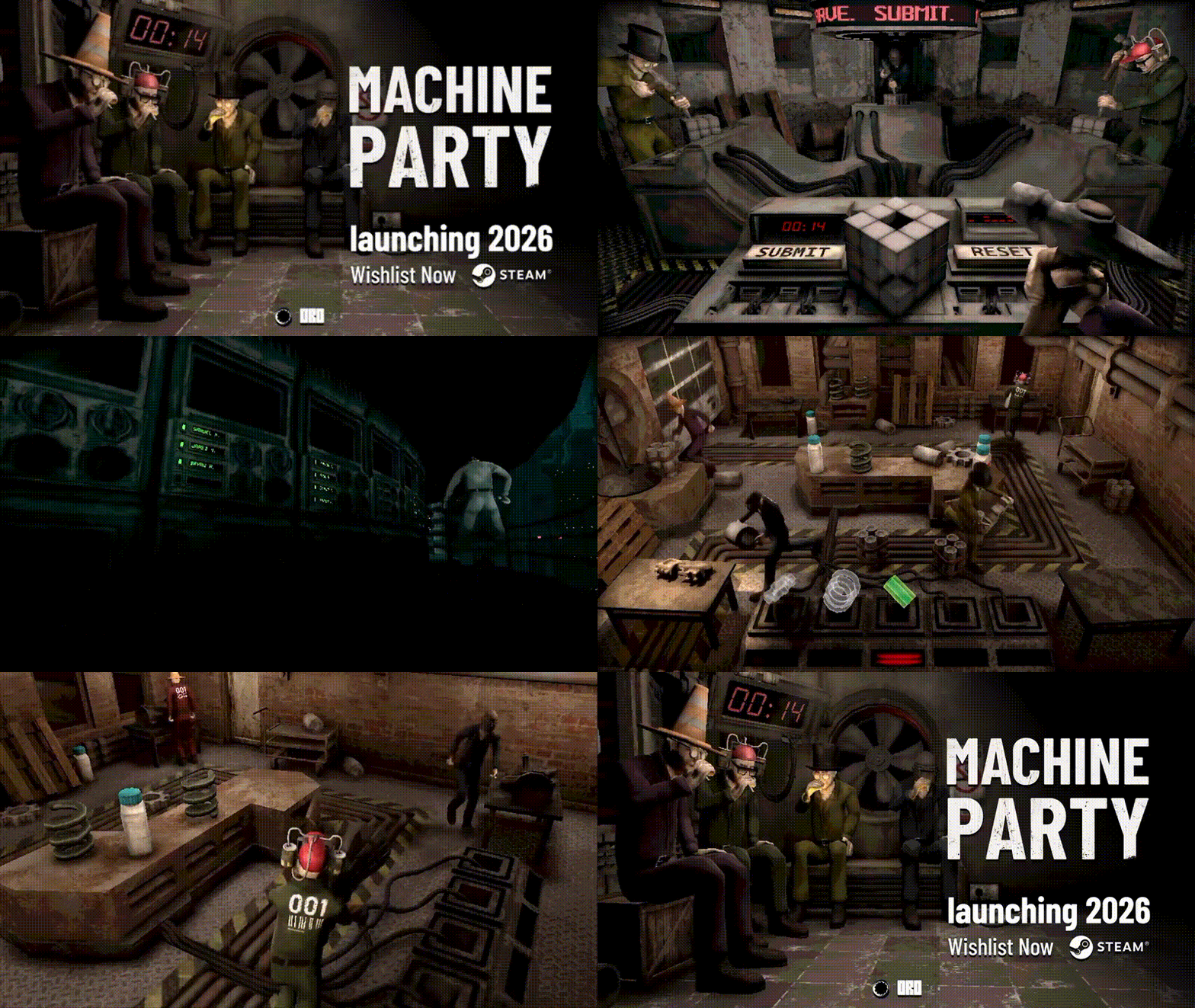
Version 2.0 also adapted individual minigames for one-screen play. Minefield uses a shared camera that responds to the distance between participants. Chisel Gauntlet switches between a shared view and split screen depending on whether players need to examine the central jumbotron. Duck Hunt places the runners on the left side of the screen and the hunter on the right, with the runners’ view adjusting according to their positions.
Inside Job and The Filter use split screen to preserve individual visibility, while Firearm Factory now displays the required assembly ingredient at each workbench instead of relying on one inconvenient shared location. Inside Job also received a balance adjustment that increases the movement speed of infected participants, including the syringe holder, to 1.15 times the normal speed.
Machine Party supports Shared/Split Screen, Shared/Split Screen Co-op, and Steam Remote Play Together, but the native couch co-op implementation is the most direct option for players gathered in the same room. One compatible PC, one copy of the game, and enough input devices are sufficient for the entire group.

Machine Party Minigames, Horror Gameplay, and Why It Works Best With Friends
Machine Party is built around 15 dangerous minigames that mix familiar party-game challenges with industrial horror, sabotage, and exaggerated punishment. Instead of colorful mascots moving around a board, players control test subjects inside hostile facilities filled with firearms, crushers, trains, machinery, moving blades, explosives, and other lethal hazards. Losing usually results in an intentionally excessive death, turning simple mistakes into dark comedy and giving each challenge an immediately understandable consequence.
The simulations test a wide range of skills. Firearm Factory emphasizes speed and recognition as players assemble weapons before their opponents. Chisel Gauntlet combines memory and precision by asking participants to reproduce a displayed pattern. Wrong Way requires directional inputs under pressure, while Table Manners uses a stop-and-go observation rule. Tunnel Hazard asks players to identify safe spaces before a train passes through the room, and Inside Job combines hiding, pursuit, infection, and social deception.
Other challenges increase direct competition. Minefield sends participants across explosive terrain while a harvester closes in from behind. Duck Hunt gives one player the role of hunter while the others advance between cover. Stable Footing places the group on a hazardous grid suspended over an abyss, and Debris Platforms allows players to throw unwanted objects into rivals’ areas. Forklift Certified turns industrial cargo handling into a competition where boxes can be stolen, while Lethal Rebound fills a confined space with moving blades. Spine Breaker introduces another pursuing mechanical threat, Smoke Break tests controlled timing, and The Filter requires rapid classification of items moving through a production line.
The game becomes increasingly unpredictable with four players. More participants mean more competition for safe space, more opportunities for sabotage, and more complicated asymmetric situations. Alliances can form and disappear almost immediately, while one player may deliberately mislead another or exploit confusion around an objective. Two-player sessions still work, particularly for precision or reaction-based challenges, but a full group better supports the social chaos around which the game was designed.
Machine Party’s structure invites comparisons with Mario Party because both games revolve around rapidly changing multiplayer minigames, but the surrounding design is very different. Traditional Mario Party uses a board-game framework, franchise characters, resource collection, and longer strategic sessions. Machine Party deliberately minimizes those systems. Mike Klubnika explained that the developers reduced dialogue, transitions, and conventional board-game elements so players could move rapidly from one challenge to another with little downtime.
Its tone is also aimed at a different audience. Machine Party relies on anonymous test subjects, dirty industrial spaces, weapons, mechanical hazards, betrayal, stylized gore, and dark humor rather than family-friendly slapstick. Direct interference is central to the premise, with players encouraged to push rivals toward hazards, steal objects, mislead friends, or capitalize on mistakes. The Steam description warns of frequent gory outcomes, making the game unsuitable for groups seeking a family-friendly party experience.
The rapid setup and visually obvious consequences have also made Machine Party well suited to livestreams and short social clips. A player can carefully cross a minefield only to be caught at the end, nearly finish a weapon before losing to another participant, or reach the final cover in Duck Hunt before being eliminated by a last-second shot. Even viewers unfamiliar with the game can usually understand the challenge and failure within seconds.
Its audiovisual identity strengthens that appeal. Low-poly characters, oppressive industrial locations, machinery, harsh sound design, abrupt violence, and Alex Peipman’s soundtrack give the game a recognizable style connected to Klubnika’s earlier work without simply repeating Buckshot Roulette. Machine Party is not designed around hundreds of hours of solo progression or a huge collection of unlockable boards. Its primary purpose is to produce memorable competitive sessions with friends, and couch co-op makes that concept more natural by putting the group around the same screen.

Machine Party Sales Success, Development, and Whether Version 2.0 Is Worth Playing
Machine Party crossed one million copies sold on August 12, 2026, only 13 days after its July 30 launch. Mike Klubnika and GDeavid announced the milestone alongside the version 2.0 couch co-op update. The game’s commercial momentum had already become clear during its first week, when reports based on information from the developers and publisher Oro Interactive said it had sold more than 500,000 Steam copies and exceeded 20,000 concurrent players. China was also identified as one of its fastest-growing markets.
Those figures mean the game appears to have doubled its publicly announced sales total in less than a week. They are first-party commercial milestones rather than audited financial results, but they demonstrate an unusually rapid launch for a project created primarily by two developers. Klubnika said that he and GDeavid worked on Machine Party for roughly eight months, with creating 15 distinct minigames representing one of the project’s major production challenges.
Machine Party began development in September 2025, was revealed during the 2026 Triple-i Initiative showcase, and was published by Oro Interactive. Mike Klubnika was already best known for Buckshot Roulette, the industrial-horror strategy game based around a modified form of Russian roulette involving a shotgun. He also created the keyboard-focused psychological horror game s.p.l.i.t. and released the Unsorted Horror collection. His work frequently combines oppressive spaces, detailed machinery, straightforward rules, and sudden consequences, and Machine Party expands that style into a larger multiplayer format.
Klubnika began learning 3D art around 2018 and had released 16 small games by the end of 2023 while studying or working full time. The success of Buckshot Roulette eventually allowed him to make games professionally. After previously working with Unity, he moved to Godot following Unity’s controversial runtime-fee announcement and has praised Godot’s open-source model, fast iteration, AnimationPlayer tools, and accessible workflow. In February 2026, the Godot Foundation identified him as a Corporate Platinum sponsor of its development fund. Machine Party also uses Godot, with version 1.5 upgrading the project to Godot 4.5.2 to address graphics problems across different hardware and adding an optional Direct3D 12 launch mode for users experiencing rendering issues.
Version 2.0 strengthens Machine Party’s original social purpose because groups no longer need multiple systems and copies to play together locally. It is particularly suited to parties, conventions, social gatherings, and streams where spectators can immediately react to the same screen. A full group of four provides the strongest experience because additional players increase confusion, sabotage, and asymmetric role possibilities, although two or three participants remain fully supported.
The game’s main limitation is its deliberately compact scope. Fifteen minigames provide meaningful variety during early sessions, but groups expecting a large board-game framework, extensive progression, or dozens of environments may learn the complete selection relatively quickly. Original provides the full presentation, Arcade creates faster repeat sessions, and Custom lets players concentrate on favorites or shuffle a chosen playlist, helping extend replayability through changing social situations rather than a constant stream of new content.
Public matchmaking is another limitation. The developers created Machine Party primarily for existing groups of friends rather than random online lobbies and have directed players looking for teammates toward an official looking-for-group community instead of promising a conventional matchmaking browser.
For groups comfortable with stylized gore, competitive sabotage, and a focused collection of fast minigames, version 2.0 provides the game’s most natural format. Couch co-op removes a major practical barrier, supports up to four people on one PC, and allows the immediate reactions, arguments, betrayals, and celebrations that fit Machine Party better than four players sitting on isolated systems.

Frequently Asked Questions (FAQs)
- Does Machine Party have couch co-op now?
Yes. Native couch co-op was added in Machine Party version 2.0 on August 12, 2026. Instead of requiring everyone to play from separate systems, two to four people can now gather around one PC and play together. The Local menu provides access to Original, Custom, and Arcade sessions, with the lobby handling player names, cosmetics, readiness, and controller assignments. - How many people can play Machine Party locally?
Machine Party supports two to four local players on the same computer. The maximum remains four regardless of which input devices are connected, so adding a keyboard and mouse alongside four controllers does not create a fifth player slot. The game is designed around small groups, with four players generally creating the most chaotic interactions and opportunities for sabotage. - How many controllers are needed for four-player Machine Party?
Four players can each use a controller, but a full set of four gamepads is not required. One participant can use the keyboard and mouse while the other three use controllers, reducing the minimum controller requirement for a four-player session to three. Smaller groups can also mix the available input types in the same way. - Can Machine Party use a keyboard and controllers together?
Yes. Local mode officially supports one keyboard and mouse player alongside controller users. This is particularly useful for groups that want four-player couch co-op but only own three controllers. The keyboard and mouse occupy one of the normal four player positions rather than functioning as an additional fifth input slot. - What local multiplayer modes are available in Machine Party 2.0?
Local multiplayer includes Original, Custom, and Arcade. Original keeps the game’s standard presentation and is the best introduction for a new group. Custom allows players to build a preferred simulation playlist, while Arcade removes the intro and outro and runs 10 random simulations with randomized rounds for a faster session. A later update also added a Shuffle option for Custom playlists. - Does every Machine Party minigame use split screen?
No. Machine Party uses different camera solutions depending on what each simulation needs. Chisel Gauntlet, Duck Hunt, Inside Job, and The Filter received specific split screen implementations because players may need separate viewpoints. Minefield instead uses a dynamic shared camera that adjusts as participants spread apart, while other simulations retain shared views or receive interface changes. - When did Machine Party reach one million sales?
The developers announced that Machine Party had sold one million copies on August 12, 2026, only 13 days after its July 30 launch. The milestone followed an earlier report that the game had already passed 500,000 Steam sales during its first week, showing how quickly its audience grew after release. - Does Machine Party have public matchmaking?
No traditional public matchmaking or random lobby browser has been announced. The developers explained that Machine Party was primarily designed for existing groups of friends and that public matchmaking was not part of their core vision. Players without a group were instead directed toward the official community server to find other people interested in playing. - Is Machine Party available on consoles?
The confirmed release is on Steam for Windows and SteamOS/Linux. No official PlayStation, Xbox, or Nintendo version has been announced in the cited material. Couch co-op therefore currently refers to several players sharing one compatible PC rather than playing a console version. - What engine does Machine Party use?
Machine Party is built with Godot. Version 1.5 updated the project to Godot 4.5.2, which the developers said helped address graphical problems affecting different hardware configurations. The same update also introduced an optional Direct3D 12 launch mode for players encountering rendering issues with the standard setup.

Conclusion
Machine Party 2.0 adds couch co op at the ideal moment for the fast-growing horror party game. Released shortly after launch, the update allows two to four friends to share one computer, connect controllers, combine controller input with a keyboard and mouse and select Original, Custom or Arcade sessions.
The developers did not simply place four characters on one display and consider the work finished. Local lobbies received new readiness and customization systems, intermission controls were revised and several simulations gained dynamic cameras, split screen layouts or more readable information. Those adaptations preserve the mechanics that were originally designed around separate online displays.
Crossing one million copies in 13 days demonstrates the strength of Machine Party’s premise. Its combination of readable rules, fast challenges, social betrayal, industrial horror and shareable failures gives it unusually broad appeal for such a compact independent production. The lack of public matchmaking and the limited pool of 15 simulations remain important considerations, but Original, Custom and Arcade provide different ways to use that content.
Most importantly, couch co op aligns the delivery method with the game’s central idea. Machine Party is built around hearing friends panic, watching them make terrible decisions and arguing about who caused the latest fatal accident. Version 2.0 places all of those reactions in the same room, making the million selling game a stronger and more complete party experience.
Sources and Citations
- Mike Klubnika — “Machine Party v2.0.0: Couch co-op, 1 million copies sold” — August 12, 2026
Mike Klubnika – Machine Party v2.0.0 Couch Co-op Update
Klubnika’s official announcement explains how to start couch co-op, including connecting up to four controllers, selecting Local → Original, Custom, or Arcade, joining from the lobby, and using keyboard and mouse for one player if desired. It also documents changes made to simulations for local play and confirms that Machine Party passed 1,000,000 copies sold. (Mike Klubnika) - Steam Community — Machine Party Official Announcements / v2.0, v2.1.1 and v2.1.2
Machine Party – Official Steam Announcements
The official feed contains the expanded v2.0 couch co-op changelog, followed by v2.1.1 Patch Notes on August 13 and the v2.1.2 Hotfix on August 14. Version 2.1.1 added the Custom playlist Shuffle option and addressed controller, localization, achievement and Filter input problems, while v2.1.2 corrected the Local Mode Original intro cutscene. (Steam Community) - Steam — Machine Party Official Store Page
Machine Party on Steam
Steam confirms the July 30, 2026 release date, developers Mike Klubnika and GDeavid, publisher Oro Interactive, multiplayer/co-op functionality, supported languages, game description, mature-content information and PC requirements. The updated listing also identifies shared/split-screen functionality following the local co-op update. (Steam Store) - Mike Klubnika — “Machine Party v1.5.0: Arcade mode, fixes, and couch co-op news” — August 4, 2026
Mike Klubnika – Machine Party v1.5.0 Update
The official v1.5 update introduced Arcade Mode, described as ten randomized simulations without the normal intro and outro segments. It also added a Direct3D 12 launch option, upgraded the game to Godot 4.5.2, explained why public matchmaking was not part of the design, and confirmed that couch co-op was already being tested and polished. (Mike Klubnika) - Mike Klubnika — “‘Machine Party’ is out now!” — July 30, 2026
Mike Klubnika – Machine Party Launch Log
Klubnika’s launch log states that he and GDeavid had worked on the game for roughly eight months, describes the difficulty of creating 15 minigames, and discusses how the game remained entertaining even after extensive internal testing. Klubnika also credits Alex Peipman for the soundtrack and discusses his continued involvement during development. (Mike Klubnika) - Mike Klubnika — “‘Machine Party’ – Announcement” — April 9, 2026
Mike Klubnika – Original Machine Party Announcement
This is Klubnika’s original announcement following the game’s reveal at the 2026 Triple-i Initiative. It confirms development with GDeavid, explains that work had begun around September 2025, and describes the deliberate decision to reduce dialogue, transitions and board-game-style downtime in favor of rapid back-to-back minigames. (Mike Klubnika) - Godot Engine — “Godot Showcase: Buckshot Roulette” — February 27, 2026
Godot Engine – Mike Klubnika Developer Showcase
The official Godot interview provides background on Klubnika’s game-development career. He explains that he began creating games after learning 3D art, had released 16 smaller games by the end of 2023, previously used Unity for roughly three years, and moved toward Godot following Unity’s runtime-fee announcement. Godot also identifies Klubnika as a Corporate Platinum sponsor of the Godot Development Fund. (Godot Engine) - Destructoid — “All Machine Party minigames and how to win” — August 4, 2026
Destructoid – All 15 Machine Party Minigames and How to Win
Destructoid documents all 15 launch minigames and their objectives: Minefield, Chisel Gauntlet, Firearm Factory, Wrong Way, Duck Hunt, Stable Footing, Table Manners, Tunnel Hazard, Inside Job, Smoke Break, Debris Platforms, Spine Breaker, Lethal Rebound, Forklift Certified, and The Filter. (Destructoid) - Oro Interactive — Official Machine Party Page
Oro Interactive – Machine Party
Oro Interactive identifies Mike Klubnika and GDeavid as the developers and confirms 2–4 player support, an industrial soundtrack by Alex Peipman, test-subject character customization, and multiple mechanics built around sabotaging the other players. (Oro Interactive) - COGconnected — “Machine Party Has Sold Over 500K Copies in Just One Week and Hits 20K Concurrent Players” — August 6, 2026
COGconnected – Machine Party 500K Sales and 20K Concurrent Players
COGconnected reported that Machine Party had sold more than 500,000 copies during its first week and had reached over 20,000 daily concurrent players. The report also discusses its 15-minigame structure and the then-upcoming couch co-op update. (cogconnected.com)
Recommended
- Final Fantasy Resonance Pixel Trailer Showcases Stunning HD-2D Art Ahead of Its October 2026 Release
- April Game Releases Revenue Breakdown: Pragmata, Windrose, Tomodachi Life: Living the Dream Sales & Performance Metrics Explained
- Battlefield 6: Best Weapons for Each Class in Season 4
- Star Trek: Outposts Unknown Release Date, Gameplay, Demo, and Everything We Know
- Donkey Kong 64 Coming to Switch Online N64 Library Next Month: Release Details and What to Know
- Microsoft Accused of Violating Labor Laws over Xbox Layoffs
- Splatoon Raiders Becomes a Top-10 Highest User-Rated Game on Metacritic‘
- Marathon Gets New Experimental Mode: What It Is, How to Play, and What’s Changing
- How to Reduce Topology in Blender: Decimate, Remesh, and Retopology Methods to Lower Polycount



































































































