







In This Article (9 sections)
Unreal Engine 5.8 Features: Release Date, Downloads, and the UE6 Transition
Unreal Engine 5.8 is one of the most important late-stage releases in the Unreal Engine 5 cycle because it concentrates on the production challenges developers encounter throughout real projects. Open-world scalability, terrain creation, lighting cost, shader iteration, character workflows, MetaHuman crowds, virtual production, mobile deployment, and AI-assisted editor control all receive significant attention. Rather than relying on one headline feature, Epic presented UE 5.8 at State of Unreal 2026 as a maturity release that strengthens established systems while introducing experimental technology connected to the future direction of Unreal Engine 6.
The update expands nearly every major production area inside the engine. Mesh Terrain introduces an experimental 3D mesh-based foundation for more complex landscapes, while the PCG framework and Procedural Vegetation Editor improve art-directed procedural worldbuilding. Rendering changes include Production-Ready MegaLights, the lower-cost Lumen Lite mode, shader compilation optimization, and improved PSO pre-caching. Character production gains Control Rig Physics, Control Rig Dynamics, Direct Mesh Controls, improved retargeting, scalable MetaHuman crowds, full-body Mesh to MetaHuman support, markerless performance capture, and open-source access to RigLogic and DNA through the MetaHuman Devkit.
Epic officially announced Unreal Engine 5.8 as available on June 17, 2026. The release can be downloaded through the Epic Games Launcher, GitHub, or the Unreal Engine Linux page. For most users, installation begins with downloading the Epic Games Launcher, signing in or creating an Epic Games account, opening the Unreal Engine tab, and selecting the Install option for the latest engine version. Developers who need deeper control over the engine can instead obtain the source code and build Unreal Engine from source.
UE 5.8 also strengthens virtual production and cross-platform development. Live Link Hub and Movie Render Graph are now Production-Ready, Mocap Manager provides a more centralized capture workflow, and the experimental Unreal MCP plugin allows compatible AI agents to interact with editor functionality. Mobile improvements cover Android workstation setup, faster cooking, input previewing, and more accurate platform visualization, while Lumen Lite provides a clearer scalability path for Nintendo Switch 2 and lower-end PCs.
The release functions as both a substantial upgrade and a stabilization point for studios working with Unreal Engine 5. Epic says UE 5.8 is the last planned major Unreal Engine 5 release as development shifts toward Unreal Engine 6, although the company has left open the possibility of UE 5.9 if another major update becomes necessary. That position makes UE 5.8 particularly relevant to teams beginning new UE5 projects or consolidating production pipelines during the transition toward UE6.

Mesh Terrain: PCG and Procedural Vegetation for Open World Creation
Mesh Terrain is the central open-world creation feature in Unreal Engine 5.8. Unlike conventional landscape systems based primarily on heightfields, Mesh Terrain uses an experimental 3D mesh-based architecture. Heightfields work well for mountains, hills, valleys, and broad outdoor surfaces, but they become restrictive when artists need tunnels, caves, overhangs, floating formations, vertical voids, sheer cliff walls, undercuts, or other shapes that cannot be represented as elevation over a flat plane. Mesh Terrain allows environment teams to create terrain that behaves more like sculpted three-dimensional geometry while preserving terrain-oriented authoring tools.
Terrain resolution also does not need to remain uniform across an entire environment. Important gameplay spaces and visually detailed points of interest can use greater resolution, while distant or less complex regions can use lower resolution. Nondestructive modifiers allow artists to layer terrain changes without permanently altering the underlying level. When a landscape feature is repositioned, the surrounding terrain can regenerate automatically, reducing the cost of late revisions to roads, rivers, cliffs, caves, traversal routes, and gameplay areas.
Mesh Terrain is interoperable with PCG and integrates with World Partition and One File Per Actor. World Partition supports automatic distance-based streaming across large environments, while One File Per Actor reduces level-file conflicts when several developers work in the same world. These connections reflect the broader demands of open-world production, where terrain must support art direction, gameplay, collaboration, streaming, and data management at the same time. Mesh Terrain remains experimental, so shipping teams must evaluate its stability and suitability before relying on it for a final project.
The Procedural Content Generation framework also becomes more flexible in UE 5.8. PCG allows technical artists, designers, and programmers to create iterative tools for asset placement, biome generation, modular environments, roads, buildings, cities, and complete worlds. The update allows manual edits to be layered over procedurally generated content without destroying the underlying procedural logic. Artists can remove vegetation near a landmark, adjust objects around a quest area, refine a road boundary, or preserve a hand-authored composition while keeping the procedural system available for later regeneration.
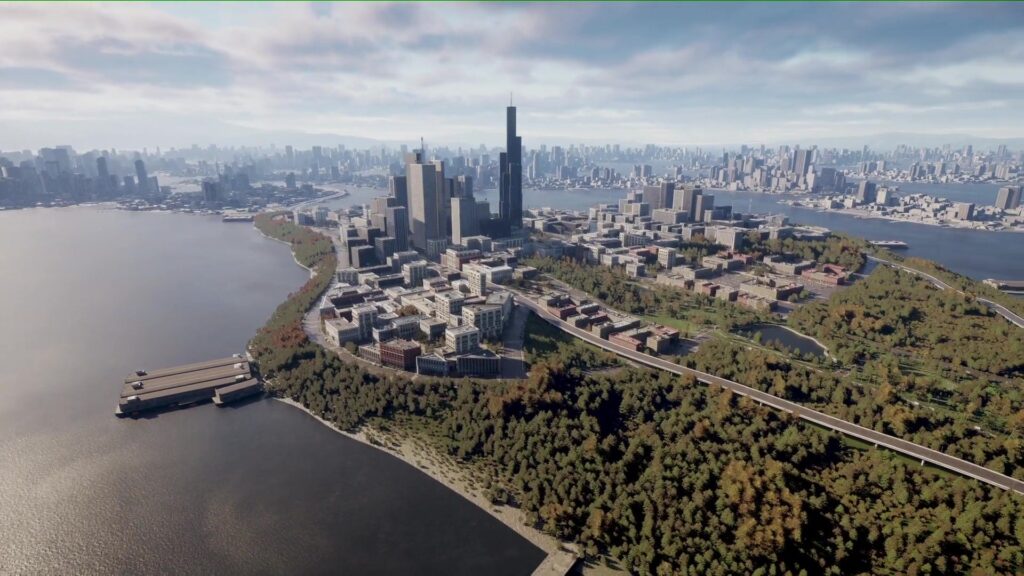
Support for arrays, structures, sets, and maps expands the types of information that PCG graphs can store and process. These richer attributes are useful for procedural cities, modular structures, biome rules, road networks, property-driven placement, and advanced spatial operations. New example graphs also demonstrate workflows involving buildings and city streets. PCG Biome tools use local and global graph structures to generate and compare point data, layer biome logic, spawn static meshes or actors, apply property overrides, control collision, enforce exclusions, and process custom biome information.
The experimental Procedural Vegetation Editor extends this procedural approach into plant creation. PVE is a graph-based tool for producing high-quality, Nanite-ready vegetation directly in Unreal Engine. It draws on botanical principles such as hormone distribution, adaptive growth, competition for light, and plant responses to nearby objects. This allows trees to form clusters, grow around external meshes, and develop more believable structural variation.
PVE uses Megaplants as preset assets containing species-specific data such as skeletal meshes, materials, textures, Nanite foliage support, and multiple variations. Artists can combine these presets in a PVE Graph, sculpt branches, remove unwanted growth, or convert external DCC meshes into compatible assets with extracted skeletons. Two-dimensional sketches and photographs can also serve as inputs. Finished vegetation can then be placed manually or distributed through PCG, allowing teams to create varied plant species and populate large environments through repeatable, art-directed systems.

Lumen Lite, MegaLights, Shader Compilation, and PSO Performance
Unreal Engine 5.8 focuses heavily on making dynamic lighting more scalable. Lumen Lite is a lower-cost global illumination path designed to preserve much of Lumen’s visual character while reducing GPU demand. Epic states that Lumen Lite is twice as fast as Lumen High Quality and is intended to support games that rely on dynamic global illumination for artistic purposes while targeting 60 fps on Nintendo Switch 2. The mode is also available for lower-end PC configurations.
Lumen scalability settings divide global illumination and reflection costs across different performance targets. Medium global illumination quality is aimed at Nintendo Switch 2 and lower-end PCs, while High targets 60 fps on current-generation consoles other than Switch 2. Lumen Lite uses an Irradiance Field Gather approach that positions World Space Radiance Cache probes around visible pixels, calculates irradiance in advance, and interpolates the lighting with probe occlusion. The result is faster but lower-quality illumination than the higher Lumen settings, including support for a 60 fps target in Switch 2 handheld mode.
This lower-cost path gives developers a clearer compromise between visual consistency and frame rate. Fully dynamic global illumination can simplify lighting production and allow environments to react naturally to changing conditions, but it remains expensive across varied hardware. Lumen Lite helps teams retain a dynamic GI look on less powerful targets instead of rebuilding the lighting direction or disabling major effects entirely.
MegaLights has reached Production-Ready status in UE 5.8. The system is a direct lighting path that supports large numbers of dynamic, shadowed area lights with improved performance, reduced noise, and better debugging and optimization tools. This is particularly relevant to dense interiors, neon city streets, concert spaces, stadiums, virtual production stages, night markets, and science-fiction environments where many local lights may need to remain active at the same time.
Epic describes MegaLights as supporting orders of magnitude more dynamic and shadowed area lights than traditional approaches, with a design aimed at current-generation consoles and ray-traced soft shadows from different area-light types. It lowers the cost of dynamic shadowing and unshadowed light evaluation, making more expensive sources such as textured area lights practical on consoles. MegaLights also supports Volumetric Fog and translucency. Once enabled in the Direct Lighting section of Project Settings, local lights are processed through the MegaLights path.
The practical benefit extends beyond increasing the number of lights. Artists can develop lighting more naturally without constantly baking, faking, deleting, or simplifying sources during look development. UE 5.8 also adds Fog Screen Space Scattering for Volumetric Fog and Local Fog Volumes. An experimental Toon Shader built on Substrate provides another rendering option for stylized two-dimensional, anime, cartoon, and hand-drawn visual directions.
Shader compilation and PSO pre-caching receive equally important production improvements. Epic optimized shader compilation and strengthened deduplication to remove redundant work, contributing to a 68 percent reduction in Fortnite’s shader count. Fewer unnecessary shader permutations can shorten compilation, reduce storage pressure, improve build iteration, and limit wasted work in continuous integration systems.
A Pipeline State Object packages preconfigured GPU state for graphics APIs such as Direct3D 12, Vulkan, and Metal. Creating a PSO only when it is first required can take 100 milliseconds or more because the application must configure many parameters. That delay can appear to players as hitching or stutter when a new material, effect, mesh, or lighting state enters the scene. Unreal Engine can collect GPU state data from a running build and use the resulting cache to generate PSOs before they are needed. UE 5.8 improves this process while simplifying fallback rendering, tuning, debugging, and profiling, benefiting both runtime smoothness and the daily development workflow.

Character Animation, MetaHuman Crowds, and Groom Compatibility
Unreal Engine 5.8 expands character and animation creation inside the editor through improvements to facial sculpting, shot sculpting, target mirroring, weight locking, blend shape authoring, pose correction, animation baking, Sequencer, the Curve Editor, and retargeting. These changes support a broader effort to let animators create, revise, and finalize more work without repeatedly moving between Unreal Engine and external applications.
Control Rig Physics has moved to Beta and can generate effects such as ragdoll movement and secondary motion. Animators can build modular physics rigs, layer physics over existing animation, and keyframe the influence of physical simulation over time. This preserves direct artistic control while allowing selected parts of a performance to respond dynamically.
Control Rig Dynamics is a new particle-based solver intended for runtime use. Epic says it evaluates five times faster than the original solver, allowing teams to exchange some accuracy for real-time performance. That distinction is important because cinematic solving can prioritize final visual quality, while runtime animation must remain within interactive frame budgets and platform constraints. Direct Mesh Controls provide another experimental option by placing Control Rig controls directly on selected parts of a skeletal mesh. Animators can manipulate the character surface instead of navigating a crowded collection of abstract controls, which can make facial animation more direct and readable.
Retargeting improvements include new foot-definition options and Retarget Override Sets. These tools help transfer motion between characters with different proportions, body structures, or stylized anatomy. Better retargeting can reduce repeated animation work across human characters, creatures, custom rigs, and projects that combine MetaHumans with other skeletal assets.
MetaHuman 5.8 introduces major changes for crowd creation and character conversion. MetaHuman Collections is an experimental asset type designed to support hundreds of characters on mobile platforms and thousands on high-end systems. It balances fidelity, memory, and rendering cost by changing between detailed characters and optimized representations according to camera distance. The system works with Mass for crowd orchestration and can use Nanite where supported. Nearby characters can remain individual Actors with greater detail, while distant characters transition to less expensive Instanced Skinned Meshes.
Mesh to MetaHuman now extends beyond head conversion to include body conforming. A human character mesh with arbitrary topology can be converted into a fully rigged MetaHuman using MetaHuman topology in a unified workflow. Scans, generated characters, existing assets, and meshes created in DCC applications can therefore enter the MetaHuman pipeline more directly.
MetaHuman Animator also gains experimental markerless full-body performance capture. Standard video from a single camera, including webcam footage, can be used to generate body animation or combined face and body animation without markers, a helmet camera, or a dedicated motion-capture rig. Body and combined face-and-body capture are available only on Windows in UE 5.8. Open-source access to technologies such as RigLogic and DNA through the MetaHuman Devkit further broadens the options available to teams building customized digital-human pipelines.
PixelHair is not identified by Epic as an official Unreal Engine 5.8 feature. It belongs more accurately within the discussion of third-party hair assets, Unreal Engine’s Groom system, and MetaHuman-compatible groom workflows. Strand-based hair can be created in a DCC application, exported as an Alembic file, imported through the Groom and Alembic Groom Importer plugins, assigned to a Groom Asset, attached with a Groom Component, bound to a skeletal mesh, given hair materials, and configured for physics simulation.
MetaHuman for Houdini supports character assembly and the creation of MetaHuman-compatible grooms. MetaHumans can also be assembled for UE Cine, UE Optimized, UEFN Export, and other production targets. Cinematic configurations can use full strand-based hair at LOD 0, while optimized versions depend on cheaper groom settings and alternative approaches. PixelHair-style assets and other third-party grooms must therefore be evaluated for Alembic quality, binding accuracy, MetaHuman topology compatibility, materials, physics, LOD behavior, deformation, and performance. High-fidelity strands may suit cinematics, while crowds, gameplay, and mobile projects may require optimized grooms or hair cards.
Virtual Production, Unreal MCP, and Mobile Development Workflows
Unreal Engine 5.8 strengthens virtual production by making Live Link Hub and Movie Render Graph Production-Ready while improving motion-capture organization. Live Link Hub can monitor live video feeds from several sources, control devices over IP throughout a mocap studio, synchronize Live Link data, manage Unreal Editor clients, and operate recording devices from one interface. This reduces the need to coordinate the same production through multiple disconnected tools.
Mocap Manager provides a centralized, linear workflow that moves from session creation through stage setup, Live Link subjects, performers, props, characters, recording, and review. It can generate session folder structures, organize productions, create session data layers or sub-levels, configure performers from Live Link subjects, and manage recordings through takes. These features give capture teams a clearer structure for preparing and operating a shoot.
Movie Render Graph now provides a Production-Ready graph-based system for exporting high-quality renders. Its redesigned Queue Window supports graph configuration, direct control over render settings, nDisplay, and light isolation. Different versions of a shot can be rendered with changes to light intensity, color, or other properties without rebuilding the complete setup. The graph can remain simple for smaller teams or expand into more complex logic for larger production pipelines.
Together, Live Link Hub, Mocap Manager, MetaHuman Animator, and Movie Render Graph create a more connected virtual production process. Live Link Hub handles incoming data and devices, Mocap Manager organizes sessions, MetaHuman Animator processes performance capture, and Movie Render Graph controls final output. Film, television, broadcast, previs, animation, and in-camera VFX teams benefit from reduced fragmentation across capture and rendering stages.
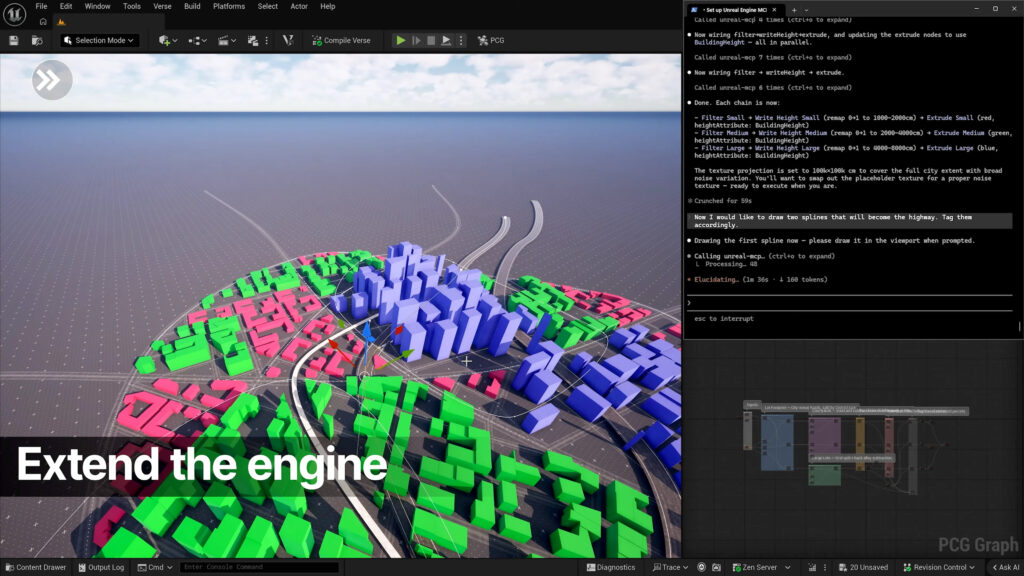
UE 5.8 also introduces the experimental Unreal MCP plugin, which embeds a Model Context Protocol server inside the Unreal Editor process. MCP-compatible agents such as Claude Code, Cursor, and MCP Inspector can communicate with the editor through a local HTTP connection. The exposed tools can spawn actors, configure lighting, create material instances, inspect Slate widgets, and run automation tests. Configuration support also covers Claude Code, Cursor, VS Code, Gemini, Codex, and All.
Unreal MCP differs from a general-purpose chatbot because its agents interact with Unreal Engine through structured calls backed by engine functionality. This creates possibilities for local automation, editor scripting, test execution, material creation, level setup, and custom production tools. The plugin remains experimental, however, and several features are incomplete or missing. APIs and data formats may change, and the server has no authentication layer by default. It should not be exposed beyond the local machine and requires careful review before entering secure or shared pipelines.
Mobile production receives practical improvements aimed at reducing setup and iteration delays. Unreal Engine 5.8 automates Android workstation configuration, updates mobile documentation, improves Unreal Engine Remote for testing touch controls and gestures without deploying to a physical device, makes Platform Preview resemble target-device visuals more closely, and accelerates Android cook times. These changes can help engineers, designers, user-interface teams, and quality-assurance staff obtain more frequent platform-specific feedback.
Nintendo Switch 2 is a major part of the updated scalability strategy because Lumen Lite targets 60 fps dynamic global illumination on Switch 2 and lower-end PCs. Medium scalability uses Irradiance Field Gather for that performance class, including handheld mode. This does not guarantee that every UE 5.8 project will reach 60 fps automatically. Teams must still control content complexity, resolution, materials, effects, streaming, CPU cost, interfaces, and platform-specific optimization. Lumen Lite instead provides a clearer lighting tier for preserving a more consistent visual direction across high-end and lower-cost hardware.
Frequently Asked Questions (FAQs)
- Is Unreal Engine 5.8 officially released?
Yes. Epic announced Unreal Engine 5.8 as available on June 17, 2026. Developers can install it through the Epic Games Launcher, obtain its source code through GitHub, or use the release provided through the Unreal Engine Linux page. - Is Unreal Engine 5.8 the last Unreal Engine 5 release?
UE 5.8 is the last planned major Unreal Engine 5 release on Epic’s current roadmap. Development attention is shifting toward Unreal Engine 6, although Epic has retained the option to release Unreal Engine 5.9 if another major UE5 update becomes necessary. - What is the biggest new worldbuilding feature in Unreal Engine 5.8?
Mesh Terrain is the largest new worldbuilding addition. It is an experimental 3D mesh-based terrain system that supports forms such as tunnels, overhangs, caves, vertical cliffs, floating structures, and other shapes that conventional heightfields cannot represent easily. It also supports variable resolution, nondestructive modifiers, PCG interoperability, World Partition, and One File Per Actor. - Does Unreal Engine 5.8 improve procedural generation?
Yes. UE 5.8 allows artists to make manual changes over procedurally generated content without breaking the underlying logic. PCG also gains richer attribute support, new spatial example graphs, and closer interaction with Mesh Terrain and the Procedural Vegetation Editor, giving teams more control over cities, biomes, buildings, vegetation, and other large-scale procedural systems. - What is Lumen Lite in Unreal Engine 5.8?
Lumen Lite is a lower-cost dynamic global illumination mode designed for lower-end PCs and Nintendo Switch 2. It uses irradiance fields and probe occlusion to reduce GPU cost, offering faster performance at a lower visual quality than higher Lumen settings. Epic positions it as a path toward 60 fps dynamic GI targets, including Switch 2 handheld mode. - Is MegaLights production-ready in Unreal Engine 5.8?
Yes. MegaLights reached Production-Ready status in UE 5.8. It allows scenes to use many dynamic and shadowed area lights while improving performance, noise, debugging, and optimization, giving lighting artists greater freedom in complex interiors, cities, cinematic environments, and virtual production stages. - What changed for MetaHuman in Unreal Engine 5.8?
MetaHuman 5.8 adds experimental MetaHuman Collections for scalable crowds, full-body support for Mesh to MetaHuman, and markerless full-body performance capture from standard video. It also expands access to MetaHuman technology through Devkit work and includes workflow improvements such as custom lighting previews and unbaked texture editing. These changes support hero characters, larger crowds, customized pipelines, and faster character conversion. - Does Unreal Engine 5.8 support AI-assisted workflows?
Yes. The experimental Unreal MCP plugin allows compatible agents and clients to communicate with Unreal Editor through structured local tool calls. Supported configurations include Claude Code, Cursor, VS Code, Gemini, Codex, and other MCP-compatible clients. Agents can interact with functions such as actor placement, lighting configuration, material creation, widget inspection, and automation testing, although the plugin requires caution because it remains experimental and lacks authentication by default. - Is PixelHair an official Unreal Engine 5.8 feature?
No official Epic announcement identifies PixelHair as an Unreal Engine 5.8 engine feature. It should be treated as a third-party groom or MetaHuman-compatible hair workflow and evaluated through Unreal Engine’s Groom system, Alembic importing, skeletal-mesh binding, materials, physics, LOD behavior, MetaHuman assembly requirements, and performance targets. - When is Unreal Engine 6 expected?
Epic is targeting Unreal Engine 6 Early Access for the end of 2027. The full UE6 release is expected 12 to 18 months after that Early Access milestone, placing it within a broader transition from Unreal Engine 5 and UEFN toward a unified development platform.

Conclusion
Unreal Engine 5.8 is a practical and strategically important release. It improves the systems that define modern Unreal Engine production: open-world authoring, procedural content, vegetation, dynamic lighting, shader and PSO iteration, character animation, MetaHuman crowds, virtual production, AI-assisted tooling, and mobile scalability. Its biggest immediate value is that it makes UE5 workflows more production-ready and less fragile. Mesh Terrain, PVE, Lumen Lite, MegaLights, Control Rig updates, MetaHuman Collections, markerless MetaHuman Animator workflows, Movie Render Graph, Live Link Hub, and Unreal MCP all point toward a version of Unreal Engine where artists, designers, and engineers can iterate faster inside one environment.
The larger significance is that UE 5.8 is also a bridge to Unreal Engine 6. UE 5.8 stabilizes and extends Unreal Engine 5, while UE6 is being positioned as a more fundamental convergence of Unreal Engine, UEFN, Verse, Scene Graph, portable content, shared economies, and AI-assisted production. For teams shipping projects now, Unreal Engine 5.8 is the key release to evaluate. For teams planning long-term pipelines, the State of Unreal 2026 message is clear: master UE 5.8’s mature workflows now, but prepare for UE6’s broader shift in how games and real-time experiences are built.
Sources and Citations
- Epic Developer Community Documentation — “Mesh Terrain”
Mesh Terrain Documentation - Epic Developer Community Documentation — “Lumen Performance Guide”
Lumen Performance Guide - Epic Developer Community Documentation — “MegaLights”
MegaLights Documentation - Epic Developer Community Documentation — “PSO Caches”
PSO Caches Documentation - Epic Developer Community Documentation — “Unreal MCP”
Unreal MCP Documentation - Epic Games — “The road to Unreal Engine 6”
The road to Unreal Engine 6
Recommended
- Hyper-Realistic CGI Steam: Blender, Houdini, Cinema 4D & Unreal Engine Real-Time Simulation Guide (Free & Paid Tools)
- Heroes of Might and Magic: Olden Era Early Access Release Date, Wishlist Milestone, and What to Expect
- Mastering Massive Crowd Animation in Unreal Engine: Techniques, Tools, and Optimization Strategies
- Persona 4 Revival Gets Official Release Date for February 2027, Full Details, Platforms, and Gameplay Revealed
- Cash Cleaner Simulator & Desynced Publisher Surpasses $10M Revenue on Steam: Indie Success Story Explained
- All Cars From The 1980s In Forza Horizon 6
- 11 Nioh 3 Tips to Help You Defeat the Yokai and Become Shogun (Beginner Combat & Exploration Guide)
- Delphi Interactive, the publisher/developer behind the new FIFA game on Netflix Games: release date, platforms, and what to expect
- Avatar Legends: The Fighting Game – Official Sokka Developer Overview, Gameplay Breakdown, and Full Character Mechanics Explained



































































































