







Untold Studios Masters of the Universe Title Sequence Making Of and Creative Process
The Untold Studios Masters of the Universe title sequence making of reveals how a brief opening can establish an entire mythology through animation, visual effects, lighting, and carefully controlled simulation. Created for the 2026 live action Masters of the Universe film directed by Travis Knight, the sequence transforms the forging of the Sword of Power into a cosmic creation story filled with nebula beings, celestial storms, internal light, and monumental scale.
Rather than approaching the assignment as a conventional collection of visual effects shots, Untold Studios treated it as a piece of feature animation infused with visual effects. Executive VFX Supervisor Peter Jopling explained that every creative and technical decision had to support a clear dramatic progression. The audience needed to understand who was forging the sword, how its power was created, why that power mattered, and how it ultimately passed into the hands of a legendary hero.
Although the finished sequence lasts just over 40 seconds, it tells a complete visual story. The imagery moves through immense cosmic environments, recognizable figures formed from swirling clouds, the construction of the Sword of Power, battles against evil forces, and the hero’s transformation. Untold Studios reportedly spent approximately four and a half months producing its contribution. While the assignment was officially divided into four shots, the complexity of the work meant the team effectively managed closer to 12 sections to make production more practical.
The completed opening blends the bold color palette associated with the classic Filmation cartoon with a more physically inspired photographic style influenced by NASA imagery, giant storms, internal illumination, and layered atmospheric motion. The making of presentation is especially valuable because it shifts between the final rendered images, underlying three dimensional geometry, character animation, and the procedural simulations that create the sequence’s distinctive celestial appearance. It demonstrates that beneath the colorful clouds are carefully animated digital characters, structured geometry, procedural effects networks, lighting controls, and numerous compositing passes that transform conventional three dimensional assets into seemingly living astronomical phenomena.
Production Pressure, Storyboards, and Scope
Untold Studios joined the production relatively late, requiring the team to deliver the sequence under significant time pressure while maintaining the quality expected of a major theatrical release. Even though the title sequence occupies only a short portion of the film, it carries the important responsibility of opening the movie and establishing its visual identity and tone.
According to VFX Supervisor James HattSmith, the production already provided strong storyboards and animatics created by director Travis Knight and VFX Supervisor David Vickery. These established the key narrative beats and remained very close to the structure seen in the finished film. Instead of reinventing the story, Untold Studios focused on translating that established visual blueprint into a rich cinematic experience.
The studio’s work extended beyond the title sequence itself. It also created the opening view of Eternia, a brief journey across its landscape, and a dragon fly by. Even so, the central showpiece remained the cosmic forging sequence, where the Sword of Power is created and a hero receives the energy needed to defeat evil.

In This Article (13 sections)
How Untold Studios Created the Masters of the Universe Opening Sequence and Sword of Power
Untold Studios approached the Masters of the Universe opening titles as a carefully planned piece of visual storytelling rather than a collection of visual effects shots. Development began with storyboards, animatics, and broad creative discussions that established how the sequence should communicate the mythology of the Sword of Power. One of the earliest decisions involved determining whether the cosmic beings would appear as solid figures surrounded by atmospheric effects or as genuinely ethereal forms whose bodies existed within the nebula itself. That choice influenced every stage of production, including modeling, animation, simulation, lighting, and compositing.
Art Department Supervisor Cameron Johnson explored real nebula photography to inspire the design of the colossal Blacksmith. Instead of copying specific astronomical images, the team extracted recognizable structures, colors, and lighting patterns to create a believable yet original cosmic environment. Although the sequence presents an entirely fictional universe, its visual language was rooted in natural celestial phenomena to make the fantasy feel convincing.
Because the production schedule was compressed, the project did not follow a traditional linear pipeline. Concept art, asset creation, animation, effects development, lighting, and compositing all progressed simultaneously, with departments constantly sharing updated work rather than waiting for previous stages to finish. Frequent creative discussions, described by HattSmith as “Creative Huddles,” helped Untold Studios and the filmmakers refine the tone, pacing, and appearance of every sequence. The studio also collaborated closely with Industrial Light and Magic’s animation supervisors, whose experience on the film helped ensure the work matched Travis Knight’s creative vision and the production’s established visual language.
Cosmic Forging Sequence and Narrative Focus
The Sword of Power forging sequence itself was conceived as an epic journey through the cosmos toward an immense source of universal power. Rather than depicting a conventional forge, the sequence transforms the weapon’s creation into a cosmic myth, with nebular formations and celestial energy combining to forge the legendary sword. Throughout the spectacle, the Sword of Power remains the narrative focus. The Blacksmith’s movements, shifting celestial formations, changes in lighting, and the rhythm of the edit continually direct the viewer’s attention back to the weapon.
Early development explored presenting the sequence as a single continuous shot, but the filmmakers ultimately found that dividing it into multiple segments created clearer storytelling. Breaking the journey into distinct visual beats improved pacing, composition, transitions, and dramatic emphasis while allowing each major stage of the sword’s creation to stand out. Untold Studios repeatedly reviewed the entire sequence from the editorial timeline instead of judging individual shots in isolation, ensuring the growing visual complexity never distracted from the simple story of the sword’s creation.
The completed opening functions as a condensed origin myth for the Masters of the Universe universe. A colossal Blacksmith emerges from living nebula clouds, demonstrating that cosmic matter itself possesses intention and purpose. The Sword of Power is then forged within this living universe before its energy is transferred to a heroic figure destined to confront forces of evil. Longtime fans immediately recognize the significance of the sword and its connection to He Man, while new audiences understand the narrative through visual cause and effect rather than lengthy exposition. The sequence also establishes the film’s hybrid identity by blending fantasy, science fiction, superhero transformation, and cosmic mythology into a single visual introduction.
Masters of the Universe Opening Sequence Animation, 3D Geometry and Visual Effects Breakdown
The visual effects breakdown reveals that every cosmic figure begins with traditional character animation and carefully modeled geometry before any procedural effects are added. Each character is first built with readable anatomy, recognizable silhouettes, and deliberate poses that establish performance and timing. Procedural simulations then use the models’ underlying topology as the foundation for growing nebula inspired structures, allowing the cloud formations to follow anatomical landmarks instead of obscuring them.
This workflow was especially important for the massive Blacksmith. Although the finished character appears to consist entirely of luminous gas and shifting cosmic clouds, invisible 3D geometry defines its proportions, posture, and movement. Stable anatomical forms allow the audience to read the character’s physical labor and immense scale even as the surrounding volumes constantly evolve. The progression from finished shots back to the underlying models demonstrates that the organic appearance is the result of careful design decisions involving pose, silhouette, camera placement, spacing, and timing rather than random simulation.
Animation also establishes a clear hierarchy of movement throughout the sequence. The enormous cosmic environment moves slowly to convey scale, while activity surrounding the Sword of Power becomes faster and more energetic. Simplified stand in models provide dependable forms that let animators refine poses and performances before more complex surface treatments are introduced. The procedural effects system then transforms those animated models into nebula based characters while preserving the underlying motion. One of the project’s biggest technical challenges was determining how much movement should transfer into the simulations so the cloud formations remained dynamic without losing the clarity of the original performance.
Simulation, Lighting, and Final Art Direction
Rather than covering models with a uniform gaseous layer, procedural tools generated varied structures capable of producing dense masses, delicate strands, broad sheets, turbulent regions, and dark voids. These variations remained connected to the underlying topology, allowing each figure to retain a recognizable shape despite its constantly changing appearance.
Lighting and compositing completed the illusion by transforming raw simulations into luminous celestial beings. Different parts of the clouds could appear intensely illuminated, nearly opaque, thin and threadlike, or silhouetted against colorful backgrounds. Instead of permanently embedding colors within the effects simulations, Untold Studios generated attributes based on properties such as density. This gave lighting and compositing artists the flexibility to adjust colors, brightness, and atmosphere late in production without rebuilding complex simulations.
The breakdown ultimately demonstrates that the title sequence succeeds because every department supports the same dramatic intent. Modeling, animation, geometry, procedural effects, lighting, and compositing all preserve the characters’ performances and the sequence’s storytelling. Although the final imagery appears chaotic and naturally formed, every cloud, movement, and beam of light is carefully art directed to ensure the Sword of Power remains the emotional and visual center of the opening.

How Untold Studios Created the Masters of the Universe Cosmic Journey and Fluid Simulations
The cosmic journey expands the origin of the Sword of Power into an event with universal significance. Rather than moving through empty black space filled with stars, the sequence travels through a layered universe where color, matter, and energy appear to possess history and purpose. The journey follows a clear narrative path toward a central source of power, passes through the forging of the Sword of Power, and culminates in the hero’s transformation. This progression prevents the visuals from becoming a collection of disconnected effects and instead reinforces the mythology at the heart of the story.
To achieve this, Untold Studios relied on fluid style simulations that allowed characters and environments to exist between recognizable forms and cosmic abstraction. Characters could emerge naturally from nebulae, perform actions, and dissolve back into surrounding energy without abrupt visual transitions. The simulations supported the performances rather than replacing them. Broad movements came from animation, while procedural simulation added constantly evolving surface detail that gave the cosmic beings a sense of life and unpredictability.
The swirling clouds were inspired by two primary sources. NASA imagery provided references for nebular structures, internal illumination, dramatic color separation, and immense scale, while slow motion footage of powerful storms revealed how large currents interact, break apart, and move at different speeds. The artists grouped astronomical references according to structure and color, then created distinct visual languages for the Blacksmith, the hero, and the opposing creatures so audiences could distinguish them even though they were all formed from similar cosmic material.
Storm references proved especially valuable because convincing clouds require movement on multiple scales. Massive formations drift slowly while smaller currents curl, stretch, shear, and dissipate across their surfaces. Fine structures create texture and visual interest, while broader movement communicates size and weight, making the clouds feel monumental instead of resembling ordinary smoke. Density also became an important storytelling tool. Thin regions produced delicate, threadlike silhouettes, while denser volumes concealed light and created imposing forms. Artists could continue adjusting local density during lighting to improve readability, contrast, and dramatic emphasis.
Character Simulations and Scale Challenges
The Blacksmith and the hero were among the most technically demanding simulation subjects because their vastly different scales required unique treatment while still appearing to belong in the same universe. Throughout production, the team continually refined density, inherited motion, internal detail, and the balance between animation and procedural evolution. The hero’s transformation also had to remain visually consistent with the rest of the film, so Untold Studios studied transformation elements created by ILM and recreated the necessary components for the opening sequence, ensuring that it felt like a natural extension of the movie rather than a separate visual piece.
Scale throughout the cosmic journey is communicated through layered depth, restrained camera movement, relative motion, and varying levels of detail. Large cloud formations evolve gradually while smaller strands and particles move rapidly across their surfaces, allowing audiences to perceive enormous size through contrast. Broad areas of color separate characters and strengthen silhouettes, while delicate threadlike details enrich the edges of the forms. This combination allows the imagery to function simultaneously as mythology, animation, and sophisticated visual effects.
How Untold Studios Rendered Eternia and Honored the Original Masters of the Universe
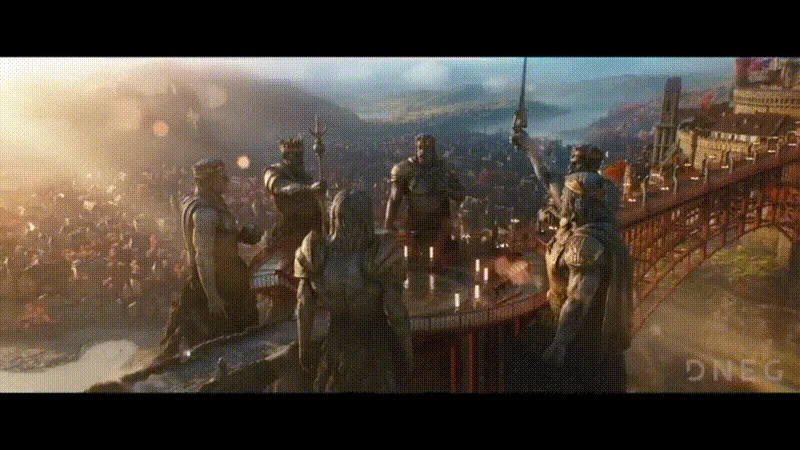
Beyond the abstract cosmic opening, Untold Studios also recreated Eternia itself. The studio produced the opening view of the planet, explored parts of its landscape, and created a dragon fly by that introduces the world before the story begins. These sequences had to present a setting familiar from decades of toys, comics, animation, and earlier adaptations while reimagining it at the scale expected of a modern theatrical production.
Rather than reproducing one definitive version of Eternia, the artists focused on preserving the qualities that define the franchise across its many interpretations. The world needed to combine wild fantasy, strange technology, vivid colors, imposing architecture, dangerous creatures, and mythic landscapes. The opening shots orient audiences by establishing Eternia as a spectacular world worth defending, while the landscape and dragon immediately signal that this is a realm unlike ordinary human environments.
Visual continuity was equally important. Although the Eternia scenes are environmental and the opening title sequence is highly abstract, both needed to feel as though they belonged in the same film. Consistent use of bold colors, cinematic composition, optical qualities, and an emphasis on immense scale helped unify the two very different visual styles.
The final renders brought together carefully balanced lighting, atmospheric density, colorful nebula structures, character silhouettes, layered backgrounds, and energy effects to create the impression of a universe sized environment rather than a conventional digital set. Lighting was especially critical because astronomical clouds reveal their forms through a balance of glowing interiors and contrasting dark regions. The artists carefully balanced internal illumination with environmental lighting so characters remained readable without flattening the volumetric forms.
Balancing Real Astronomy with Masters Nostalgia
The team also studied how astronomical imagery is produced, including observations captured beyond visible wavelengths that are later translated into visible colors. This encouraged them to treat color as an artistic interpretation of scientific data rather than as a fixed property, allowing the sequence to remain visually inspired by real astronomy while embracing the bold, saturated palette associated with Masters of the Universe.
To maintain flexibility during finishing, the renders generated extensive AOVs, or separate image passes containing different lighting and material information. According to HattSmith, the characters required an unusually large number of AOVs, giving compositors precise control over hue, brightness, density, highlights, silhouettes, and atmospheric integration without having to re render entire shots.
The title sequence also pays tribute to the 1980s Filmation cartoon through its vibrant use of color and its reference to the iconic spinning Sword of Power. Team members, including HattSmith, had personal connections to the original toys and television series, allowing them to focus on preserving the franchise’s core identity rather than relying on superficial nostalgia. The goal was to retain the emotional impact of transformation, heroism, colorful fantasy, and the Sword of Power while presenting them through contemporary visual effects.
The Filmation palette remained an important influence even as the artists drew inspiration from NASA imagery and optical phenomena. Those references complemented each other, since astronomical color mapping naturally produces vivid reds, blues, greens, and golds that fit the heightened aesthetic of the original series. Likewise, the spinning sword reference functions as part of the larger visual language of the sequence, rewarding longtime fans while remaining clear and meaningful for audiences with no prior knowledge of the classic cartoon.

Frequently Asked Questions[FAQS]
- What does the Untold Studios Masters of the Universe title sequence show?
The sequence presents a cosmic origin story centered on the forging of the Sword of Power and the rise of the legendary hero destined to oppose evil. Rather than using a traditional opening montage, it tells the story through vast nebular characters, celestial energy, swirling clouds, and large scale atmospheric effects that gradually build the mythology of the film. - How long is the Sword of Power forging sequence?
Untold Studios stated that the Sword of Power forging sequence lasts more than 40 seconds. Although relatively short, it required extensive planning, visual effects work, animation, lighting, and simulation to create the feeling of an epic myth unfolding on a cosmic scale. - How long did Untold Studios work on Masters of the Universe?
VFX Supervisor James HattSmith said the studio worked on the project for approximately four and a half months. During that time, the team developed the concept, created animated characters, built complex simulations, refined lighting and compositing, and completed the final visual effects for the opening sequence. - How many VFX shots did Untold Studios create?
The official technical count was four visual effects shots. However, the lengthy forging sequence was divided into smaller sections during production, making the practical workload closer to 12 individual shots that could be developed, refined, and reviewed more effectively. - Was the opening designed as one continuous shot?
The sequence was originally planned to feel much closer to one continuous camera journey. As production progressed, the filmmakers found that separating it into smaller sections improved pacing, storytelling, and creative control while still maintaining the illusion of a seamless cinematic flow. - What references inspired the cosmic visual effects?
The artists studied NASA imagery of nebulae to understand large scale cosmic forms, color variations, and internal lighting. They also examined slow motion footage of massive storms to recreate believable cloud movement, while the classic Filmation animated series influenced the sequence’s color palette and the iconic spinning Sword of Power imagery. - How were the cloud characters made recognizable?
The artists first created detailed animated character models before applying procedural cloud and nebula effects. Using the underlying models allowed the final characters to retain clear anatomy, poses, facial direction, and recognizable silhouettes, making them expressive even though they were composed entirely of swirling cosmic material. - Why was lighting so important to the title sequence?
Lighting was essential because it made the cloud characters appear filled with glowing energy while also defining them from the outside. It controlled color, contrast, density, highlights, shadows, and overall depth, helping viewers clearly follow the action despite the highly atmospheric environment. - Did Untold Studios recreate elements from ILM’s transformation work?
Yes. Untold Studios studied visual elements provided by ILM and recreated the relevant components so the hero’s transformation in the opening sequence matched the visual language already established elsewhere in the film. This helped maintain consistency between the title sequence and the movie itself. - Does the making-of reveal which software created the sequence?
Public reports focus primarily on the creative process rather than the exact software used. While the making of confirms techniques such as modeling, animation, procedural effects, lighting, compositing, and large scale simulations, it does not provide a complete verified list of the tools or applications used to produce the final sequence.al effects, simulation, lighting, rendering, extensive AOVs, and compositing.

Conclusion
The Untold Studios Masters of the Universe title sequence making-of reveals a production built on the close integration of animation and visual effects. Its spectacular surface is composed of recognizable character performances, purposeful staging, procedural nebula structures, simulation, internal illumination, flexible color controls, and detailed compositing.
More importantly, every part of that technical system serves the story. The cosmic journey introduces a vast source of power, the Blacksmith gives its creation a sense of intention, the forging establishes the Sword of Power as a mythic artifact, and the hero’s transformation connects that energy to the central conflict. In just over 40 seconds, the sequence communicates an origin, a transformation, and the promise of an epic struggle.
Untold Studios also found an effective balance between nostalgia and reinvention. The bold Filmation palette and spinning sword reference honor the animated series, while nebula photography, storm studies, volumetric effects, and contemporary rendering give the imagery a distinct cinematic identity. The result does not merely reproduce an older introduction with more detail. It translates the franchise’s foundational ideas into a new visual language appropriate for a large-scale live-action film.
Sources and Citation
- Untold Studios
https://untoldstudios.tv/work/ - The Art of VFX
https://www.artofvfx.com/masters-of-the-universe-james-hattsmith-vfx-supervisor-peter-jopling-executive-vfx-supervisor-untold-studios/ - CG Channel
https://www.cgchannel.com/2026/08/see-how-untold-studios-created-masters-of-the-universe-titles/
Recommendations
- Camera Switching in Blender Animations: Mastering The View Keeper
- Two Iconic Sci-Fi Universes Collide in Predator vs. Planet of the Apes – Release Date, Story, and What to Expect
- Media Molecule New Open World Game Explained
- The Next Kingdom Come Game Is Coming Soon: Release Window, Leaks & What We Know
- Borderlands 4’s New $30 Expansion Pack Isn’t Winning Over Fans: Mad Ellie DLC Price, Length, and Steam Backlash
- EA Is Laying Off Workers From All Battlefield 6 Studios: What Happened, Which Teams Are Affected, and What’s Next
- Ghost of Yotei Saved PlayStation From Five Straight Years of Declining First-Party Sales: What the Data Really Shows
- Best Uniforms in College Football 27: Teams With the Coolest Jerseys and Alternate Looks
- Roblox Introduces Mandatory Age-Gated Account Tiers: Roblox Kids vs Roblox Select and What Changes in 2026
- Mistfall Hunter Brings Dark Fantasy Extraction RPG Combat and Deep Class Builds



































































































