









In This Article (14 sections)
Framestore’s War Machine VFX Scope, Supervision and Creative Challenge
The central challenge behind War Machine was making an alien machine feel dangerous before it fired a weapon. Its presence had to suggest purpose, physical power and the ability to hunt. Framestore’s Melbourne and Mumbai studios contributed 252 visual effects shots to War Machine, the military science-fiction film, combining a major digital character with environments and destructive action. Their approach treated the robot as a creature with behaviour, rather than simply a collection of moving mechanical parts.
Directed by Patrick Hughes and starring Alan Ritchson as a soldier identified as 81, the 2026 film War Machine follows an Army Ranger selection exercise that becomes a struggle against an extraterrestrial threat. That survival premise made the relationship between human vulnerability and the machine’s overwhelming capabilities central to the War Machine effects work.
Framestore’s 252-shot contribution to War Machine included the principal creature, battlefield environments and action effects. Melbourne and Mumbai collaborated on the War Machine work rather than functioning as unrelated suppliers. The number also needs context: production VFX supervisor Ray McIntyre Jr. reported approximately 1,050 VFX shots in the finished film, meaning Framestore’s work was a major contribution but not the film’s entire VFX workload. Framestore led development of the robot asset and shared its textured model with Rising Sun Pictures.
A useful way to understand this War Machine workload is to separate an asset from a finished shot. The asset is the reusable digital subject, while the shot is a particular performance, camera position, lighting situation and interaction. A robot standing against a distant landscape might depend mainly on silhouette and lighting, while the same robot pressing into heavy machinery must communicate contact, resistance and force. Both shots can use the same underlying War Machine character, but they require different artistic and technical solutions.
Supervision and Interdisciplinary Creative Challenges
Joao Sita supervised Framestore’s contribution to War Machine, while Ray McIntyre Jr. held the production-wide VFX supervisor role. That distinction matters because supervising a studio’s delivery is not the same as overseeing every vendor and effects sequence across a film. Framestore’s published team credits identify Daniel Fotheringham as animation supervisor, Zaini Jalani as animation lead, and Sam Doolan, Prashant Nair and Rakesh Thota as CG supervisors. Darcy George supervised compositing, with departmental leadership also including Drew Wood-Davies for lighting and look-development technology, Dudley Birch for environments, Luke Flanagan for layout and Matt Omond for 2D.
These responsibilities show why the War Machine robot cannot be judged as an animation problem alone. A threatening movement might become unreadable under unsuitable lighting, an impressive explosion might obscure a necessary character action, and an environment that looks convincing in isolation might not support the camera route required by a sequence. Sita’s background in compositing and broader supervision, including credits on Jurassic World and Lost in Space, also helps explain the balance between image integration and large-scale visual storytelling, without implying that assets or techniques from those projects were reused in War Machine.

Designing and Animating the Alien Robot as a Predatory Machine
Framestore’s animation approach drew on dinosaurs and other bipedal creatures, emphasising weight, imbalance and predatory behaviour. The aim was to create an instinctive screen presence for War Machine rather than conventionally robotic movement. This does not mean the machine was built as a direct copy of any specific dinosaur. The useful reference for War Machine was broader: the relationship between attention, posture and locomotion. A hunting performance suggests why a character moves, what has attracted its attention and what it might do next, while a mechanical demonstration only proves that a joint can rotate.
That distinction creates suspense around War Machine. A pause can imply assessment rather than inactivity, a change of orientation can suggest that the machine has selected a target, and a measured approach can communicate confidence more effectively than constant high-speed movement. The published material does not identify a particular dinosaur species as the definitive reference for War Machine, so describing the robot as a direct reconstruction of a Tyrannosaurus or Velociraptor would go beyond the evidence. The supported conclusion is that creature-animation thinking helped turn a mechanical antagonist into a purposeful pursuer.
Framestore also refined the supplied models of War Machine by removing familiar construction cues, including panels, hinges and welds. This was a change in visual language rather than a rejection of engineering. Familiar assembly details can suggest a recognisable manufacturing process. Removing some of those cues gives the audience fewer clues about who built War Machine, how it was assembled or where its limitations might lie. Concept designer Alex Senechal’s own project description adds context, describing a direction developed with Hughes around sliding magnetic plates, unfolding components and a balance between advanced human technology and something alien. His account also connects the pursuing machine, War Machine, to 81’s internal struggle.
Alien Readability, Damage Behaviour, and Environmental Response
The robot still needed to be readable enough to feel physically present while remaining unfamiliar enough to resist easy explanation. Simplification also helped protect the silhouette of War Machine, which matters during fast action. The broad relationship between body, limbs and direction of travel can be more important than the number of small surface features. None of this means War Machine became biological. “Organic” describes the performance philosophy, not evidence that the character contains flesh, muscles or living tissue. Its dramatic effect comes from combining machine-like power with behaviour that can be interpreted as predatory.
A damaged variant of War Machine with a broken wing changed the robot’s locomotion and introduced instability into its performance. This illustrates an important principle: damage becomes more persuasive when it changes behaviour, not merely appearance. A visibly compromised component that has no effect on movement risks feeling decorative, while an adjustment in balance gives the damage a consequence. If a huge character such as War Machine instantly reverses direction without preparing, resisting or recovering, the motion may communicate agility but fail to communicate mass. A readable transition lets the audience interpret effort.
McIntyre’s account also reinforces the importance of environmental response. War Machine needed to disturb ground and water rather than appear detached from them. Weight is relational: it does not exist only in the animation curves of a digital body, but in how that body appears to affect everything around it. A step from War Machine, the resulting disturbance and the subsequent settling should read as parts of one event.
Scanning Visibility, Destruction Continuity, and Shared Materials
War Machine’s scanning system added another layer of behaviour. The scanner is described through an inhalation-like intake of atmospheric particles and a sweeping laser visualisation. London explored the effect before Melbourne refined it. Its dramatic value lies in making perception visible. A silent digital antagonist such as War Machine cannot explain what it knows, but a scanning action can show that the machine is examining its surroundings, creating a period in which discovery feels possible but has not necessarily occurred. The inhalation-like movement gives the sensing action a physical gesture without requiring a literal biological explanation.
The robot’s six destruction states combined geometry changes with texture variations. The published case study does not provide a numbered, shot-by-shot catalogue defining every stage of War Machine’s destruction, so it would be inaccurate to invent an official progression. The confirmed information concerns the number of states and the combination of structural and surface changes. This mattered for continuity because damage is a record of previous events. Once the audience has seen a component of War Machine break, later images must either preserve that condition or provide a reason for a change.
Lead look-development artist Alex Canniccioni describes a layered “uber” shader supporting consistent updates across variants, with stealth aircraft and worn machinery informing the material references. Here, “uber” refers to a broad material system, not the transport company. The useful concept is a shared foundation with controlled variation, rather than a completely independent material rebuilt for each condition of War Machine. Pixar’s documentation describes a layered surface system in which a central material controls global features across connected layers. That illustrates the principle, but it does not identify Framestore’s specific shader implementation.
The distinction between reference and imitation is important. Studying an aircraft surface does not require making War Machine look like an aircraft. The reference can help answer narrower questions about finish, reflected light and accumulated wear. The creative challenge was consistency without uniformity: every state of War Machine needed to belong to the same object, while each communicated a different history.
Vehicle Chases, Long Takes, CG Environments and Major Battle Sequences
The Guardian chase involved a practical M1117-style vehicle built on a Mercedes Unimog, with practical and digital versions used across the sequence. “Guardian” refers to the military vehicle involved in the action, not another alien creature. The chase depends on the interaction between a vulnerable moving refuge, its occupants and a much more powerful pursuer. The central visual problem was maintaining readable geography, so the audience could infer where the threat was, which direction the vehicle was travelling and what prevented escape.
Destruction alone does not automatically strengthen a chase. An impact ahead of a vehicle can imply a narrowing route, while an impact behind it can emphasise pursuit. Similar effects carry different meanings depending on placement and timing. The sequence also needed to preserve the occupants’ perspective. Exterior spectacle communicates scale, but the interior view communicates confinement. The more dangerous the world outside becomes, the more important it is that the vehicle still feels like a coherent physical space.
The film’s long-take oner used stitched takes, whip pans and wipes. Its interior was filmed on a blue-screen gimbal set, with extensive CG surroundings. This is an essential clarification: an apparently uninterrupted shot is not necessarily a single uninterrupted camera recording. The achievement lies in preserving continuity across material created through different methods. The production account describes a sequence lasting more than three minutes, which made continuity a sustained design problem. Without conventional cuts to reset the viewer’s understanding of location, doorways, windows and passing obstructions could become reference points that needed to remain persuasive as the camera moved.
Seamless Oner and Modular Environment Workflow
Framestore used modular environments to accommodate evolving animation. The benefit of modularity is flexibility. If a camera path moves closer to a surface or an action beat shifts position, a modular construction gives artists more options than a tightly fixed background. The emotional value of the oner is different from its technical difficulty. Remaining with the action can deny the viewer a moment of release, turning separate highlights into one developing crisis. Its success depends on concealment as much as display, because the joins, replacements and transitions should support momentum without becoming the subject of the sequence.
Framestore also combined flexible 360-degree environments with reference photography and digital matte painting. In this context, “360-degree” describes an environment that can support viewing from different directions. It does not mean the finished film was presented as interactive panoramic video or virtual reality. This flexibility matters whenever the camera or action changes, since a background designed for one fixed view may fail if a revised shot exposes a previously unseen angle.
Digital matte painting contributed a different kind of control. At a general technical level, imagery can be projected onto geometry rather than remaining a flat background. Foundry’s documentation explains how projection cameras place still images or image sequences onto surfaces in a 3D scene. This is contextual information, not confirmation of the exact software used for War Machine. The objective was not maximum complexity everywhere, but enough coherent detail in the right places to prevent the audience from noticing where one method ended and another began.
Ravine Pyro Quarry and Practical Anchor
A late-added ravine expanded into terrain development, ground interaction, atmospheric work and large pyro effects. A ravine creates a distinctive staging problem because its boundaries are part of the danger. The terrain is not merely scenery; it defines where characters can move, where effects can expand and how much of the action remains visible. Atmosphere adds another layer of interpretation. A dust cloud can establish distance, conceal a threat or reveal the aftermath of an impact, depending on what information it removes and what it adds.
For technical context, SideFX’s pyro documentation distinguishes fields for motion, smoke density, temperature and expansion, alongside collision information. These are examples of how volumetric effects can be represented and controlled, not evidence of the film’s specific simulation setup. The distinction helps explain why “adding smoke” is not a single creative decision. A cloud may have the right outline but unsuitable motion, or it may move convincingly while obscuring the central action. Terrain and atmosphere therefore need to be evaluated together.
The quarry sequence required partial and, in some shots, complete CG replacement of the excavator. The dramatic endpoint is grounded in the film’s established action: 81 exploits the robot’s ventilation system by directing rocks into it during the quarry confrontation. This placed unusual demands on the relationship between machine, construction equipment and environment. The action had to make the trap understandable, since merely showing a large collision would not communicate the same causal sequence.
Practical photography remained valuable even when it was not retained unchanged, because it supplied a concrete visual target. Hughes emphasised real locations, physical interaction and on-set effects in his discussion with GamesRadar+, but that preference should not be mistaken for a claim that the finished action was entirely practical. If the photographed vehicle did not react at the moment the digital robot applied force, replacing the affected vehicle movement could allow both sides of the interaction to follow the same dramatic timing. The important judgement was not whether practical or digital work was inherently better, but whether the final combination communicated a single physical event.
Destructive Effects, Lighting, Rendering and Cross-Studio Pipeline Control
Framestore’s effects included lasers, plasma fire, sparks, dust and explosions. These should not be treated as interchangeable forms of brightness. Each can serve a different storytelling function: a beam can establish direction, a burst can mark an impact, and dust can preserve the spatial trace of an event after its brightest moment has passed. A useful way to analyse an effects-heavy shot is to follow its causal structure: emission, travel, contact and aftermath. The audience does not need a technical explanation, but it should be able to connect the visible consequences.
As general CG context, simulation and final appearance are distinct stages. SideFX’s documentation describes preparing volume data for rendering and using a shader to produce the appearance of smoke, fire and explosions. A simulation therefore does not determine every aspect of the final image by itself. This separation creates artistic choices. A physically elaborate cloud may need a different presentation to preserve an actor’s silhouette, while a bright effect may need restraint so the viewer notices the damage it causes.
The strongest analytical criterion is consequence rather than spectacle alone. An effect should reveal an attack, change the environment, threaten a character or clarify a reversal. When everything is equally intense, the image loses the hierarchy that makes individual moments matter. This was especially important in a film where destructive action had to support the survival premise rather than overwhelm it.
Layered Rendering and Pipeline Consistency
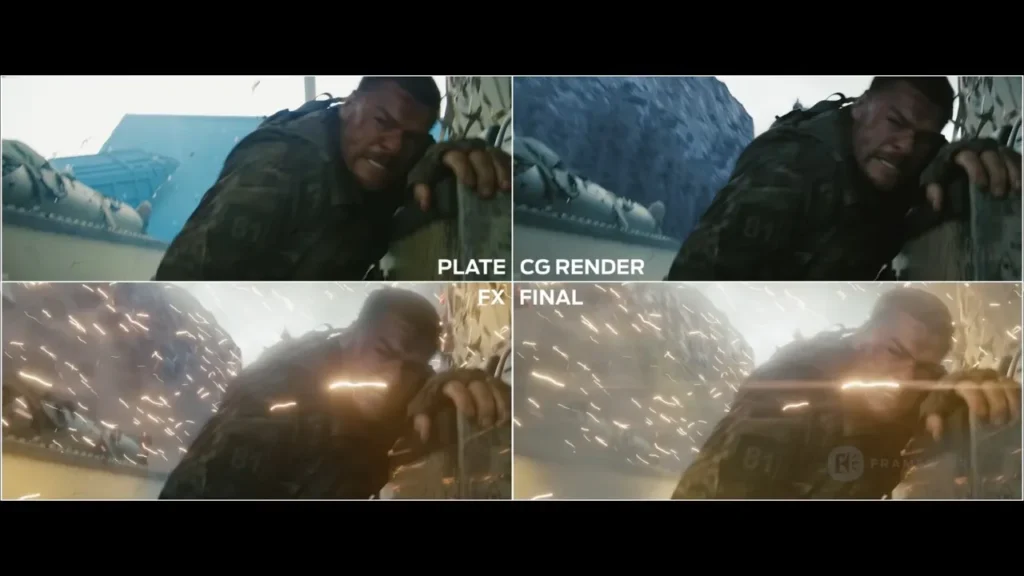
Rakesh Thota highlights structured layers and efficient volume rendering, while Melbourne and Mumbai coordinated reviews and priorities across the work. The practical value of separating elements is control. A finished image may combine subjects and effects that need different treatment, and changing one component should not unnecessarily force every other component to change with it. Foundry’s channel documentation provides general context: compositing can use separate shadow, specular, lighting, depth and mask information alongside the main image, making it possible to adjust selected contributions rather than treating a render as an indivisible picture.
For example, reducing an obscuring atmospheric contribution is a different decision from changing the robot’s surface response. Keeping those decisions distinguishable makes creative review more precise. The goal is not unlimited adjustment after rendering, but useful control over the aspects most likely to require refinement. Cross-studio work also raises the issue of consistent viewing. OpenColorIO’s documentation describes a system intended to maintain consistent colour handling across supporting applications. That illustrates a general pipeline concern, but it does not establish the exact configuration used on this film.
The available production case study is not a complete software inventory. It does not justify confidently assigning a particular renderer, software version, simulation resolution or render-farm specification to the project. The supported conclusion is about workflow: complex imagery needed to remain adjustable, comparable and coherent as it moved between departments and locations. Technical efficiency mattered because it preserved room for creative decisions.

Frequently Asked Questions (FAQs)
- How many War Machine VFX shots did Framestore create?
Framestore’s Melbourne and Mumbai studios contributed 252 shots to the film. This number refers specifically to Framestore’s credited portion of the visual effects work, rather than the film’s total VFX shot count. Large productions often divide work between multiple vendors, so a studio’s shot count usually describes its own assigned sequences, assets or effects contributions. - Which War Machine film does this breakdown cover?
It covers Patrick Hughes’s 2026 military science-fiction film starring Alan Ritchson as 81. The story follows an Army Ranger selection exercise that escalates into a fight for survival after the soldiers encounter an alien machine. This is the War Machine discussed in the Framestore breakdown, not another project with a similar title. - Who supervised Framestore’s War Machine visual effects?
Joao Sita supervised Framestore’s visual effects work on the film. Daniel Fotheringham served as animation supervisor, overseeing the performance, movement and physical behaviour of animated elements such as the machine. Ray McIntyre Jr. was the production-wide VFX supervisor, meaning he helped guide the broader visual effects approach across the film, beyond Framestore’s individual contribution. - Was War Machine’s robot based on a specific dinosaur?
The public breakdown describes dinosaurs and other bipedal creatures as design and movement references, but it does not identify one exact dinosaur species as the robot’s source. The goal appears to have been behavioural rather than literal: the team wanted the machine to feel predatory, agile and heavy, while still reading as an alien technological threat rather than a direct mechanical copy of an animal. - Why were familiar mechanical details removed?
Familiar mechanical details were reduced because they can make a design feel too recognisable or too obviously human-built. By removing some of those cues, the robot could feel stranger and less tied to known machinery. However, this did not make it organic or creature-like in a biological sense; the design still remained technological, just with a more unfamiliar and alien visual language. - How many damage stages did the robot have?
The robot had six damage stages, created through changes to its model and textures. These stages allowed the asset to reflect progressive wear, impact and destruction as the action developed. The public breakdown confirms the number of stages, but it does not provide a detailed official list explaining exactly what changed in each individual state. - What did the layered uber shader do?
The layered uber shader helped manage the robot’s different material variations in a consistent way. In practical terms, a shared layered material setup can keep core properties, such as metal, surface response, dirt, damage or wear, connected across multiple versions of an asset. This makes it easier to update the robot’s look while still allowing specific shots or damage stages to have their own local differences. - Was the oner filmed as one continuous take?
No. The oner was designed to look like continuous action, but it was assembled from multiple takes. This is common in complex action filmmaking, especially when visual effects, stunts, camera moves and environmental changes must align precisely. The result gives the audience the feeling of an uninterrupted sequence, even though the camera did not record the entire moment in one single take. - Was the quarry excavator real or computer-generated?
Both practical and digital methods were used. A real excavator or practical photography could provide physical reference, scale and believable interaction, while computer-generated replacements or enhancements were used when the action required more control than the practical element could provide. The balance between real and digital varied from shot to shot depending on what the scene needed. - Is Framestore’s complete software pipeline publicly documented?
No. The cited production breakdown does not publicly document Framestore’s complete software pipeline for War Machine, including every application, tool or version used. General documentation about visual effects workflows can explain concepts such as layered materials, volumetric effects and compositing, but it cannot prove exactly which software choices were made on this specific film unless those details are confirmed by the studio or production team.

Conclusion
The most useful lesson from War Machine is that a convincing digital antagonist requires agreement between design, performance and consequence. An unfamiliar silhouette establishes the threat, but movement gives that threat intention. Physical interaction makes its power legible, while accumulated damage allows the audience to recognise that the conflict is changing it.
The same principle applies to the larger action. A chase needs understandable geography. A continuous-looking sequence needs sustained spatial logic. A climactic collision needs a readable relationship between force and reaction. Complexity is valuable only when it strengthens those relationships.
Framestore’s production account documents an approach spanning creature development, environments, effects and image integration. Its broader significance is not that one technique replaced every other technique. It is that different methods could contribute to the same dramatic event without drawing attention to their boundaries.
That is the central achievement this breakdown illuminates: the audience should not have to think about asset variants, digital replacements or compositing layers. It should understand what the machine wants, believe that the environment resists it and feel that every encounter leaves a consequence.
Sources and Citations
- Framestore — War Machine case study — Principal Framestore production account, including the 252 shots, VFX supervision and detailed production credits.
Framestore — War Machine - AEAF — War Machine — Framestore’s AEAF project entry with production credits and VFX breakdown details.
AEAF — War Machine - Ausfilm — Animalistic Androids, Brash Bears, and Fresh Faces at Framestore — March 30, 2026 feature with additional Framestore team comments and War Machine production details.
Ausfilm — War Machine / Framestore feature - The Art of VFX — War Machine: Ray McIntyre Jr. – Production VFX Supervisor — Vincent Frei’s interview with Ray McIntyre Jr., covering the film’s VFX strategy, practical effects and vendor workflow.
The Art of VFX — Ray McIntyre Jr. interview - Alex Senechal — portfolio — I could not verify an exact War Machine portfolio page for Alex Senechal from the available search results, so I would not use an unverified URL.
- Netflix Tudum — War Machine — Official Netflix film page with the synopsis, cast/film context and related coverage.
Netflix Tudum — War Machine - GamesRadar+ — War Machine director says practical FX was “paramount”… — Direct Patrick Hughes interview covering the production’s practical-effects approach.
GamesRadar+ — Patrick Hughes interview - Pixar RenderMan — Fundamentals: Materials — Documentation covering layered materials and MaterialX Lama.
Pixar RenderMan — Materials documentation - SideFX — Pyro effects (smoke and flames) — Houdini documentation covering Pyro simulation for smoke, fire and explosions.
SideFX — Pyro documentation - SideFX — Pyro: Shading and rendering — Technical documentation for rendering and shading volumetric Pyro effects.
SideFX — Pyro shading and rendering - Foundry — Channels — Nuke documentation explaining standard and custom image channels, layers and multi-pass image data. Foundry — Nuke Channels documentation
- Foundry — Projection Node — Foundry Mari documentation explaining planar, cylindrical and spherical image projection.
Foundry — Projection Node documentation - OpenColorIO — Overview — Official documentation describing OCIO as a color-management solution for VFX and computer animation.
OpenColorIO — Overview
Recommendations
- How to Animate Metahuman in Unreal Engine 5: The Ultimate Step-by-Step Guide to Bringing Digital Characters to Life
- Magic The Gathering Marvel Super Heroes Prerelease Guide
- TweenFX Animation Library For Godot 4: Install the Plugin, Use 48 Ready-Made Tween Animations, and Add “Juice” Fast
- Japanese Theme Park Bomb Collar Escape Room: Why the Alice in Borderland Experience is Going Viral
- Thrash VFX Breakdown: Troll VFX’s Water Walls and Floating Cars
- Final Fantasy 14 Patch 7.55: All Mounts And Minions And How To Get Them
- Tomb Raider: Legacy of Atlantis at Xbox Gamescom Stream August 26, 2026
- Resident Evil Code Veronica Remake Announcement Rumors Explained
- Arc Raiders Event Timers and Trackers Guide (2026): Best Tools, Reset Times, and Live Event Schedules
- Xbox Layoffs Explained: “Catastrophic Mismanagement” and AI Gambits Behind Microsoft’s Cuts



































































































