







DNEG’s work on Star DNEG Star City VFX and Soviet Space Race Realism
DNEG’s work on Star City addresses a distinctive visual effects challenge: making an invented Soviet space race history feel technologically plausible, physically convincing, and appropriate to its period. The studio’s documented contribution includes lunar environments, Soviet spacecraft, cosmonaut digi doubles, lunar landings, a rocket launch, re entry scenes, and orbital docking. Together, these elements support the Soviet perspective of the alternate history universe introduced in For All Mankind while requiring landscape construction, mechanical design, digital character work, and shot integration to function as parts of the same believable world.
The most useful way to understand the period accurate visual effects is through three connected questions: whether the hardware belongs to the world being depicted, whether the environments and movement obey convincing physical rules, and whether the finished image looks as though it was captured by the production’s cameras. Those questions explain why photorealism depends on more than highly detailed spacecraft models. A lunar landscape has to establish credible scale, a digital performer must retain weight and intention, and reflections on a helmet visor need to correspond with the surrounding environment. Realism emerges when those details agree with one another rather than from any single spectacular effect.
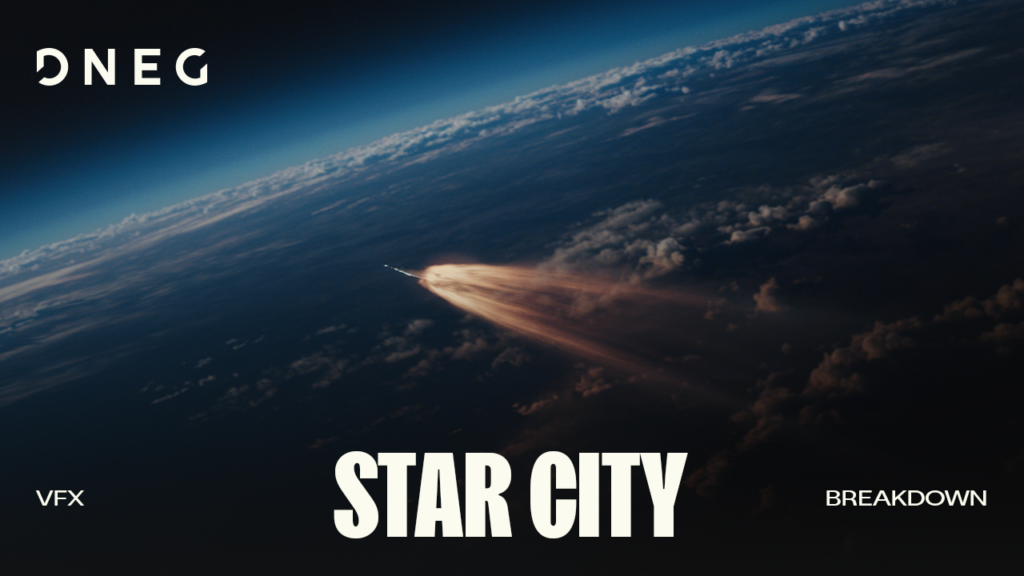
Visual effects supervisor Chris Keller identifies lunar landings, rocket launch material, re entry sequences, and orbital docking among DNEG’s assignments, making Star City a useful example of interconnected effects work. The same spacecraft may appear against the Moon, above Earth, or during atmospheric return, but each environment changes the lighting, surroundings, and apparent motion while the underlying asset must remain visually consistent. This makes the distinction between an asset and a completed shot especially important. A spacecraft model establishes geometry and surface properties, while the final image also depends on animation, illumination, camera perspective, and integration with any photographed material. Even a highly detailed model can appear artificial if those relationships do not match.
The same principle applies to lunar scenes, where terrain, boots, shadows, and reflected scenery need to work together. A convincing footprint becomes less believable if the foot appears to slide, while a credible horizon can be undermined if its reflection moves incorrectly across a visor. DNEG’s contribution is therefore most significant when viewed as a problem of coordination across scale, motion, materials, environment, and photography. Rather than treating realism as simply a matter of adding more digital detail, the effects can be understood as succeeding when all of those elements remain consistent within the shot.
In This Article (8 sections)
Star City Alternate History, Period Accuracy, and Soviet Moon Landing VFX
Star City premiered on May 29, 2026, as an expansion of the For All Mankind universe that shifts attention toward Soviet cosmonauts, engineers, and intelligence officers. Its shared continuity revisits the fictional Soviet achievement of putting the first humans on the Moon, but from a different dramatic perspective.
That connection creates two forms of continuity: narrative continuity, which concerns the events shared between the series, and visual continuity, which concerns whether those events appear to belong to the same technological world. DNEG brought direct franchise experience to the production through its earlier work on For All Mankind seasons four and five, although that does not establish that the studio created the first season’s original lunar landing or reused its original digital assets.
The change in perspective matters because the same fictional historical event can carry a different emotional meaning when Soviet participants become the central characters rather than figures observed through the consequences of American storylines. Visual continuity therefore does not require every earlier image to be recreated exactly. It can instead preserve the essential event while changing the audience’s access to it, whether through closer proximity to the performers, a more direct view of machinery, or a greater sense of physical danger surrounding the mission.
This same principle shapes the balance between historical accuracy and science fiction. Star City changes history, but its speculative developments still need to feel as though they emerged from recognizable institutions, engineering priorities, and material culture. A fictional spacecraft should not simply look futuristic. Its shape, surfaces, and visible systems need to feel connected to the technological tradition of the world around it. Cinematographer Brendan Uegama’s research into Soviet still photography and preference for imagery that did not feel excessively polished supports that approach. The objective is not simply to make images appear old, but to give them a visual character appropriate to the fictional period.
The strongest conceptual balance is therefore one of disciplined imagination. Historical plausibility does not mean pretending that the fictional missions actually happened, just as accuracy is not the same as copying a familiar vintage appearance. A grain overlay cannot compensate for an unsuitable spacecraft silhouette, implausible movement, or a digital object that looks sharper and cleaner than the surrounding photography. Period accuracy works when individual visual choices belong to the same technological and photographic world.
The Soviet first Moon landing itself belongs specifically to the fictional continuity of For All Mankind and Star City. In actual history, Apollo 11 completed the first crewed lunar landing on July 20, 1969, so the real and alternate histories should remain clearly separated when discussing the production. For the recreation, DNEG visual effects supervisor Chris Keller describes reproducing characteristics associated with late 1960s television broadcasts, creating a contrast between how the event might appear to the public and how it can be experienced through a closer cinematic view.
Those two forms of observation serve different purposes. A broadcast image can make the landing feel remote, institutional, and limited by the technology of the period, while a closer exterior can reveal physical effort, hesitation, and vulnerability that the transmission cannot communicate as clearly. The challenge is not solved by applying a generic vintage filter. The underlying action still needs to remain spatially and emotionally understandable through both presentations. A body pose that reads immediately in a close shot may become difficult to interpret when reduced to a distant television image, so the sequence needs to communicate the same essential action across different forms of observation.
Star City Lunar South Pole, NASA Terrain Data, and Period Accurate Soviet Spacecraft
DNEG specifically identifies a detailed lunar south pole environment among its principal assets for the second Soviet Moon landing, meaning not every lunar sequence should be assumed to depict the same location. The south pole presents distinctive visual conditions because the Sun remains low near the horizon, producing long shadows across rugged terrain while nearby depressions can receive dramatically different illumination. Some crater interiors remain permanently shadowed, making terrain and lighting inseparable parts of the environment rather than independent design elements.
For visual storytelling, the lunar landscape needs to function at several scales. Distant terrain establishes geography, the middle distance communicates obstacles and travel space, and the foreground provides contact between the performer and the surface. A ridge can determine whether a character remains visible, whether a route appears navigable, and how easily the audience can judge the distance between a spacecraft and the ground. These are analytical requirements for understanding the environment rather than disclosed specifications for DNEG’s model resolution. The strongest result also requires restraint, since exaggerating every crater or shadow could increase immediate drama while weakening the sense of a coherent lunar location.
Keller confirms that DNEG used NASA heightmaps and scientific measurements of lunar albedo and reflectance. A heightmap contributes spatial information about slopes, ridges, and depressions rather than functioning as a simple photograph turned into scenery. Surface color data serves a different purpose by describing appearance before lighting and viewing conditions are applied. NASA’s CGI Moon resources help illustrate the distinction between these kinds of data, although their availability does not establish that DNEG used one specific packaged resource.
Apollo photography belongs to a different category of reference. NASA archives contain close views of astronauts, equipment, bootprints, and surface interaction that can help explain what photographic lunar realism looks like. However, the production material described here does not establish a specific Apollo photographic collection as part of DNEG’s documented workflow. This distinction is especially important for a polar environment because photographs from one historic landing site should not automatically determine the lighting or topography of another. The defensible conclusion is that NASA terrain data and scientific surface measurements are documented in DNEG’s work, while the precise production role of Apollo still photography remains unconfirmed.
DNEG’s spacecraft inventory includes Soyuz, Salyut, a descent module, and a lunar lander, providing a firmer basis for discussing the production than assigning unconfirmed vehicle variants or technical specifications to individual shots. Period accurate spacecraft design requires more than attaching appropriate markings to a generic vehicle. Each major form should communicate function, so a transport spacecraft, orbital station, descent vehicle, and lunar lander do not become interchangeable collections of panels and antennas.
Silhouette is one of the strongest foundations for that believability because it remains readable even when a spacecraft is distant, partly shadowed, or seen against a bright planetary background. Smaller mechanical details become increasingly important as the camera approaches, but they cannot compensate for incorrect large scale proportions. The relationships between parts also need to appear functional: a hatch should look usable relative to a human body, a docking interface should appear capable of meeting its counterpart, and landing structures should look physically connected to the mass they support.
These are general principles for evaluating the imagery rather than a disclosed DNEG modeling checklist. They explain why convincing period accuracy is not the same as maximum detail. The strongest spacecraft model is one whose visible forms, mechanical relationships, materials, and movement make sense together at the distance and under the lighting in which the audience actually sees it.

Star City Docking, Cosmonaut Digi Doubles, and Low Gravity Movement
DNEG’s confirmed spacecraft assets for Star City include Soyuz and Salyut, establishing the broader visual context for the series’ docking work without proving the exact historical mission, engineering reconstruction, or simulation method used in every shot. Salyut 1 provides an important historical reference point because it launched on April 19, 1971 as the world’s first space station and was designed to operate with Soyuz crew transport spacecraft. That real history should remain separate from the fictional missions and character events created for Star City.
Docking creates a different visual problem from a launch because the audience must understand the changing relationship between two vehicles rather than simply watch one spacecraft accelerate. The important information may be the alignment of the spacecraft, the shrinking distance between them, or a small rotational or lateral error that threatens contact. A stable camera reference can make those subtle differences easier to perceive, while excessive camera movement can make the same error harder to read. The sequence also needs a clear progression from approach to contact and finally to a visually resolved combined configuration. These principles explain the challenge of making orbital docking understandable without implying that DNEG published a complete orbital mechanics reconstruction.
DNEG also confirms creating cosmonaut digi doubles for action and spaceflight sequences. A digi double is a computer generated representation of a performer that can be animated and integrated into a shot. The visible model establishes the character’s shape and appearance, while rigging provides controls for posing and animation turns those controls into movement. For a suited cosmonaut, continuity does not depend only on facial detail. Body proportions, helmet scale, posture, and the way a performer initiates an action can all help connect photographed footage with the digital version.
The most important test is whether the transition preserves the character’s intention. A cautious reach should not suddenly become an effortless movement simply because the shot changes from live action to digital animation. Restraint is therefore valuable. A digital performer does not need to use every movement technically possible in animation. The more convincing choice is usually the one that reflects what the character would realistically attempt while constrained by the suit, the task, and the surrounding danger.
That principle becomes especially important when recreating movement on the Moon. Lunar motion should not be confused with weightlessness because the Moon still has gravity, approximately one sixth of Earth’s. Reduced gravity changes how long a body remains airborne and how balance behaves, but it does not make every gesture uniformly slow. A cosmonaut may initiate an action quickly and then experience a longer airborne interval after pushing away from the ground. Simply slowing ordinary footage would not reproduce that distinction.
NASA’s Apollo surface footage provides useful observational reference because it shows locomotion and interaction with equipment unfolding over time. Orbital weightlessness is different again. Cinematographer Brendan Uegama describes Star City using combinations of suspension cables, balancing rigs, performer controlled movement, and differently oriented sets for weightless scenes, but those comments relate to orbital staging and should not automatically be applied to every lunar sequence. Across both environments, the most important objective is continuity of effort: the audience should be able to understand what begins the movement, what affects it, and what eventually stops it.
Star City Visor Reflections, Lunar Regolith, Rocket Launch, and Re Entry VFX
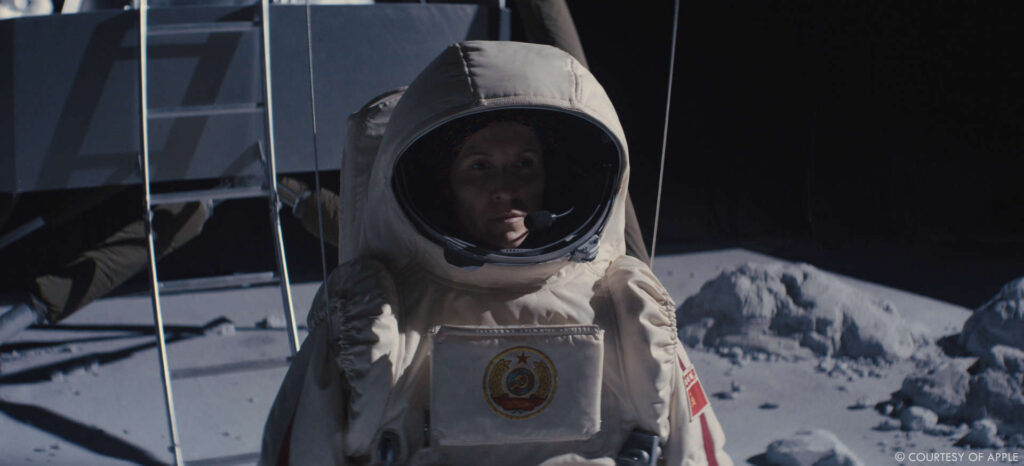
DNEG visual effects supervisor Chris Keller states that helmet visor reflections were created digitally, including shots where reflected lunar horizons could interfere with the visibility of Anastasia’s face. A visor is particularly demanding because it must function simultaneously as a physical surface enclosing the character, a reflective view of the surrounding environment, and a transparent layer through which the audience can still read the performance when necessary.
The underlying problem involves both reflection and transmission, and the balance between them changes with viewing angle and material properties. That means a convincing visor cannot simply use a fixed reflection placed over the actor’s face. In close shots, the challenge becomes partly compositional because a bright horizon or other high contrast reflected feature may compete directly with the eyes and facial expression. As the character moves, the relationship between the face, the visor, and the environment must remain coherent. Reflections that appear attached to the camera or that drift independently of the helmet can quickly break the illusion of a real physical surface.
DNEG also replaced the practical concrete lunar surface digitally, with Keller identifying one close shot of Anastasia’s boot as requiring a full Houdini regolith simulation. That specific example should not be expanded into a claim that every lunar footprint or particle effect was created with the same level of granular simulation. The importance of the shot lies in the contact between boot and surface: the deformation needs to occur in the correct place, match the shape and pressure of the boot, and move material in a way that remains connected to the action causing it.
The amount of detail required depends heavily on camera distance. A distant figure may only need believable overall contact with the ground, while an extreme close up exposes small deformations, displaced material, and other interactions to direct scrutiny. The broader lesson is one of selective complexity. The most advanced simulation is not automatically the best choice for every frame, and a targeted detailed effect can be more valuable when it resolves the specific physical interaction on which a shot depends.
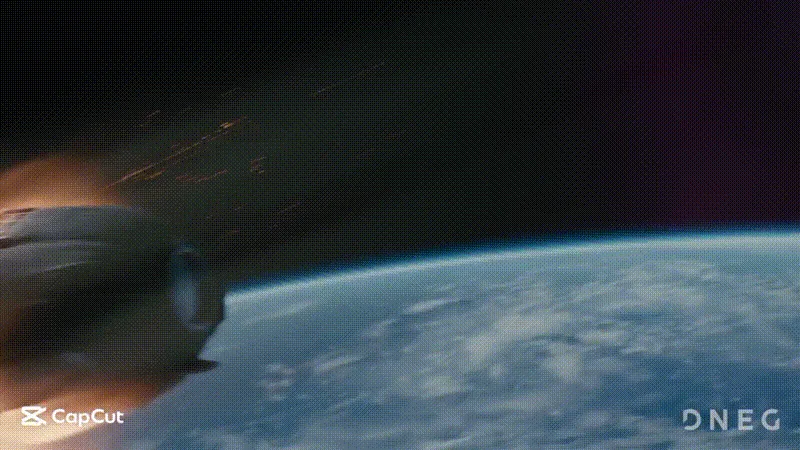
Rocket launches and atmospheric re entry create another pair of effects challenges, but they should not be treated as variations of the same fiery spectacle. A launch needs to communicate departure, acceleration, and increasing separation from the ground, while a re entry sequence needs to communicate a spacecraft surviving a hazardous return through the atmosphere. NASA’s descriptions of thermal protection provide useful physical context for why re entry is dangerous, although specific technologies associated with other spacecraft should not automatically be assigned to the fictional Soviet vehicles in Star City.
For a launch, scale can be communicated through the relationship between the rocket, its support structures, and the increasing distance from the surface. Re entry asks a different question: the audience needs to understand where the spacecraft is within the surrounding luminous activity and how it is oriented while enduring that environment. If the vehicle disappears completely into brightness and effects, the image may communicate spectacle without clearly communicating danger.
Across these sequences, the strongest standard is clarity of cause and consequence. Whether the shot involves a reflecting visor, lunar dust, a departing rocket, or a vehicle returning through the atmosphere, the audience should understand what the object or character is doing, what physical forces or surroundings are affecting it, and why the moment matters. Spectacle becomes more convincing when those relationships remain readable rather than being overwhelmed by visual complexity.
Frequently Asked Questions (FAQs)
- What is Star City, and how is it connected to For All Mankind?
Star City is set in the same alternate history universe as For All Mankind, but it shifts the perspective toward the Soviet side of the space race. The series focuses on Soviet cosmonauts, engineers, intelligence officers, and institutions connected to the fictional achievement of reaching the Moon first. Because both shows share the same timeline, events can overlap even when they are presented from very different emotional and political viewpoints. - When did Star City premiere?
Star City premiered on May 29, 2026. That date is supported by Apple’s official series information and by DNEG’s own announcement tied to the show’s availability. The premiere establishes the point at which the Soviet focused expansion of the For All Mankind universe became available to viewers. - What visual effects did DNEG contribute to Star City?
DNEG’s documented work includes lunar environments, Soviet spacecraft, cosmonaut digi doubles, lunar landings, rocket launch material, re entry sequences, and orbital docking. Those confirmed elements show that the studio handled several major categories of spaceflight and character effects. However, the available production information does not establish that DNEG created every VFX shot in the entire series, so its confirmed contribution should not be expanded beyond what has been documented. - Which Star City Moon landing uses the lunar south pole environment?
DNEG specifically identifies its detailed lunar south pole landscape with the second Soviet Moon landing. That distinction matters because it would be inaccurate to assume that every lunar scene in Star City uses the same terrain or represents the same location. Different lunar sequences can therefore have different geographic and lighting requirements within the story. - Did Soviet cosmonauts actually land on the Moon before American astronauts?
No. The Soviet first Moon landing is part of the fictional alternate history shared by For All Mankind and Star City. In real history, Apollo 11 completed the first crewed lunar landing on July 20, 1969. The production may use historically grounded spacecraft, photography, and visual references, but those choices are there to make the fictional event believable rather than to suggest that it actually occurred. - What is a lunar heightmap?
A lunar heightmap is data that represents changes in surface elevation across the Moon. It can be used to help construct digital terrain by defining ridges, slopes, depressions, and other geographic forms. That is different from a color or surface image, which mainly describes visual appearance. NASA’s CGI Moon resources help illustrate why elevation data and surface color information serve different purposes when creating a digital lunar environment. - What is a cosmonaut digi-double?
A cosmonaut digi double is a computer generated version of a performer that can be posed, animated, and integrated into a shot when live action alone is impractical. Its credibility depends on more than matching the actor’s appearance, because body proportions, posture, movement, helmet scale, and the intention behind each action all need to remain consistent. Modeling, rigging, and animation are separate stages of creating that digital performance. - Are cosmonauts weightless while walking on the Moon?
No. The Moon has surface gravity of roughly one sixth of Earth’s, so a person walking there still falls toward the surface and has to manage balance and contact with the ground. Lunar movement can include longer airborne intervals and different body mechanics, but it is not the same as floating freely in orbit. That is why lunar walking and orbital weightlessness require different approaches in both performance and visual effects. - Why must digital effects match anamorphic lens characteristics?
Digital objects need to behave photographically like the live action material around them. Anamorphic lenses can introduce specific distortion, squeeze, focus behavior, and image characteristics, and a CG object that ignores those traits may look artificially separated from the photographed scene even if its model and lighting are otherwise accurate. Matching the lens behavior helps the spacecraft, environments, reflections, and digital characters feel as though they were captured by the same camera. - Is every technical detail of DNEG’s Star City workflow publicly confirmed?
No. The available production material confirms several specific elements, including NASA heightmap use, lunar environments, Soviet spacecraft, digi doubles, digital visor reflections, and at least one detailed Houdini regolith simulation. However, it does not document every reference source, software setting, solver choice, or shot specific engineering decision. For example, NASA terrain data is confirmed, while the use of any particular Apollo photographic collection has not been specifically established.

Conclusion
DNEG’s Star City VFX offers a useful case study in how historical grounding can strengthen speculative storytelling. Its documented assets connect the lunar south pole, Soviet spacecraft and cosmonaut digi-doubles within a shared visual world.
The central artistic challenge is consistency. Terrain must support the action, movement must suit the environment, mechanical details must communicate function, and digital imagery must belong to the photography surrounding it. None of these requirements can be replaced by complexity alone.
The most persuasive interpretation of period accuracy is therefore not that every fictional mission reproduces history. It is that the invented events remain constrained by recognizable technology, believable physical relationships and a coherent photographic identity.
That distinction also protects the value of the production research. Confirmed techniques deserve precise attribution, while general scientific explanations should remain separate from undisclosed studio procedures. Star City is most interesting not as proof that alternate history can become documentary, but as an example of how carefully coordinated visual effects can make an impossible history feel materially present.
Sources and Citations
- DNEG. Star City Is Now Streaming. Official VFX Production Announcement. May 29, 2026.
https://www.dneg.com/news/star-city-is-now-streaming - Apple TV. Star City Official Series Page. Premiere Date, Cast, Crew and Series Information.
https://www.apple.com/tv-pr/originals/star-city/ - Apple TV. Apple Unveils First Look at Star City, the Space Race Drama From the Creators of For All Mankind. February 26, 2026.
https://www.apple.com/tv-pr/news/2026/02/apple-tv-unveils-a-first-look-at-star-city-the-gripping-new-space-race-drama-set-in-the-world-of-for-all-mankind-from-award-winning-creators-ben-nedivi-matt-wolpert-and-ronald-d-moore/ - Apple TV. Star City Premieres at CANNESERIES. April 27, 2026.
https://www.apple.com/tv-pr/news/2026/04/apples-gripping-new-space-race-drama-star-city-from-award-winning-creators-ben-nedivi-matt-wolpert-and-ronald-d-moore-premieres-at-canneseries/ - Apple TV. For All Mankind Official Series Page.
https://www.apple.com/tv-pr/originals/for-all-mankind/ - NASA. Apollo Missions and Lunar Exploration Archive.
https://www.nasa.gov/the-apollo-program/ - NASA. Apollo Image Gallery and Historical Photography.
https://www.nasa.gov/history/alsj/picture.html - NASA. Earth Observatory. Earth Imagery and Scientific Observation Resources.
https://earthobservatory.nasa.gov/ - NASA. Moon Facts and Lunar Science Information.
https://science.nasa.gov/moon/facts/ - SideFX. Houdini Official Documentation and VFX Technical Resources.
https://www.sidefx.com/docs/houdini/ - Foundry. Nuke Official Product and Compositing Documentation.
https://www.foundry.com/products/nuke-family/nuke - Physically Based Rendering. Official PBRT Technical Reference.
https://www.pbr-book.org/
Recommendations
- How to Unlock the Blacksmith in Nioh 3: The Hamamatsu Incident, Eternal Rift Location, and Crafting Basics
- Avatar Aang Movie Footage Leak: What We Know About the Alleged Paramount+ Leak Before Release
- Pokémon Legends: Z-A is getting a physical edition with its DLC on October 29
- The Tower of Beggars: Stormfell Academy Book One Review
- Fortnite Raising V-Buck Prices and Cutting Bonus Rewards “To Help Pay the Bills” — What the New Changes Mean for Players
- Nintendo Switch Online Adds Super Mario Sunshine August 13
- Should You Pick Samurai or Ninja in Nioh 3? Best Choice, Differences, and When to Use Both
- Fable Deep Dive Video Reveals Massive Life Sim System: NPC Relationships, Housing, Jobs, and Reputation Mechanics Explained
- Far Far West Sales Surpass One Million Copies: Full Breakdown, Success Factors, and Industry Impact
- PokémonXP and 2026 Pokémon World Championships Pokémon Center Merch Reveal



































































































