










The Witcher 3: Wild Hunt is widely remembered for the extraordinary amount of effort CD Projekt Red put into making its open world feel inhabited rather than merely populated. Villagers work, eat, seek shelter, move betweWhy Witcher 3 NPCs Dropped Babies During Development
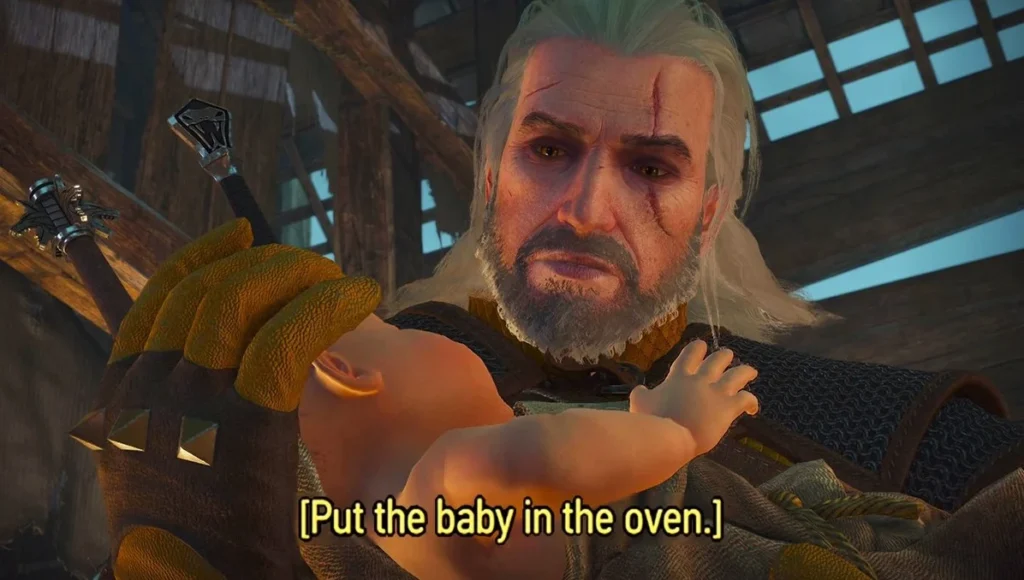
During development of The Witcher 3, CD Projekt Red experimented with more reactive NPC systems designed to make characters respond naturally to their surroundings, weather, time of day, danger, and other events. One unintended result was considerably less believable: frightened mothers could drop the babies they were cradling and run away. CD Projekt Red developer Philipp Weber explained that the behavior came from an experimental fear reaction rather than a deliberately scripted scene.
The system allowed frightened NPCs to stop whatever activity they were performing, release the object associated with that activity, and flee. This worked reasonably well for ordinary jobs involving tools or other objects, but the NPC system also categorized holding and cradling a baby as one of the available forms of “work.” As a result, when the same fear logic interrupted childcare, the mother could release the baby just as another worker might drop an axe, cup, hammer, sack, or other object. According to Weber, this behavior remained possible for several weeks during development before the system was removed, and it did not appear in the retail version of The Witcher 3.
The incident is a useful example of how individually sensible rules can create unintended behavior when combined. The fear mechanic was broadly doing what it had been instructed to do: interrupt the NPC’s current task, drop whatever was connected to that task, and escape. The problem was contextual. The system did not understand that an infant should be treated differently from an ordinary work object, creating a situation that was mechanically consistent but visually and narratively absurd.
This illustrates one of the major challenges of systemic open world design. General rules allow developers to support large numbers of NPCs and situations without manually scripting every possible reaction. A rule such as “when frightened, abandon the current task and flee” can apply across many locations, occupations, and circumstances, making development considerably more manageable. However, these systems must also account for interactions between schedules, weather, combat, player actions, quests, pathfinding, animations, object handling, and emergency reactions. Once different systems begin interacting, outcomes can appear that developers never specifically intended.
The Witcher 3 baby dropping behavior therefore highlights the difference between mechanical consistency and believable behavior. A computer can consistently apply the same instruction to every object associated with an NPC activity, while a human immediately understands that a tool and an infant cannot reasonably be treated in the same way. The removed system shows why creating convincing NPCs involves much more than giving characters daily routines. Developers must also determine how those routines should react when unexpected events interrupt them.

In This Article (7 sections)
How The Witcher 3’s NPC Fear System Caused Mothers to Drop Babies
The Witcher 3’s experimental fear reaction system was built around interrupting NPC activities when danger appeared nearby. NPCs could already perform routines designed to make settlements feel alive, but the developers wanted them to react when Geralt behaved threateningly instead of continuing their work as though nothing were happening. Under the early system, a frightened NPC could stop the current activity, drop whatever was associated with that activity, and run away.
This made sense for activities such as chopping wood or carrying ordinary objects because abandoning an axe or another item during an emergency looked believable. The problem was that believable reactions required more context than the generalized system could provide. A mother holding a child needed completely different behavior, such as fleeing with the child, placing the child somewhere safe, or protecting the infant.
The issue was partly caused by how The Witcher 3 represented NPC activities. In this context, “work” referred broadly to an activity or job an NPC could perform, not necessarily paid employment. NPC jobs consisted of sequences of actions and animations that determined what characters did throughout the day and night. Sitting, handling objects, performing labor, and other environmental activities could therefore be represented through the same general system.
Cradling an infant fit naturally into this design because a mother holding a baby helped communicate family life, domestic routines, and the existence of ordinary civilians without requiring dialogue or a quest. However, the fear mechanism did not understand the narrative difference between an ordinary object associated with an activity and a human infant.
When fear activated, the system followed a simple sequence: terminate the current activity, release the thing associated with it, and make the NPC flee. Because holding and cradling a baby could be assigned as an activity to female NPCs, the infant became the thing released when that activity was interrupted. The result was computationally consistent but dramatically absurd, with frightened mothers dropping their babies before running away. The system lacked the equivalent of human common sense telling it that certain carried things required special treatment. This demonstrated one of the challenges of complex NPC simulations, where interactions between otherwise reasonable systems can create unexpected results.
A fully robust fear system could have required special handling for adults carrying infants, seated characters, merchants, guards, injured NPCs, quest characters, people using equipment, characters inside buildings, and many other situations. As an open world grows more complex, ensuring that every possible interruption produces an appropriate response becomes increasingly difficult.
Philipp Weber’s Account, Bug Duration, and Why the Fear Mechanic Was Cut
Philipp Weber, who worked as a quest designer on The Witcher 3, provided the central account of the baby dropping behavior while discussing how CD Projekt Red created believable settlements and NPC routines. He explained that the game’s rural settings created an unusual challenge because small villages encouraged players to closely examine whether inhabitants appeared to have genuine lives or simply functioned as scenery. The team therefore invested heavily in realistic day and night behavior, while NPC reactions to Geralt initially received less detailed treatment. Weber described the experimental fear system as one in which NPCs abandoned what they were doing, allowed the relevant thing to fall, and ran away.
The developers eventually discovered the unintended interaction with mothers whose available activities included holding and cradling babies. According to Weber, women were dropping their babies for “a few weeks” during development, showing that the problem persisted long enough to become a memorable example of how the game’s simulation systems could interact unexpectedly.
The available account does not provide exact start and end dates for the problem, so Weber’s description of several weeks is the most precise supported timeline. There is also no evidence here that the behavior lasted for months or survived into the released game. The Witcher 3 was developed for years before its May 2015 launch, and the baby dropping behavior should be understood as an internal development artifact rather than a post launch defect encountered by ordinary players. Calling it a “bug in The Witcher 3” is therefore slightly misleading. More precisely, it was an unintended behavior that appeared while the game and its NPC systems were still being built.
The experimental fear mechanic was ultimately removed. The baby dropping result demonstrated that a generalized interruption rule could generate unacceptable behavior when applied across the wide range of activities assigned to NPCs. Keeping the system could have required extensive special case logic defining which activities could be interrupted, which objects could safely be dropped, which characters needed unique escape animations, which states needed protection, and how all those conditions interacted with quests. Such exceptions would also have created additional engineering, animation, scripting, testing, and maintenance work.
The removal of this implementation did not mean CD Projekt Red abandoned reactive NPC behavior altogether. Other behaviors remained in the released game, including civilians reacting to weather, changing routines according to the time of day, and different populations appearing at night. What was removed was this particular version of the fear response system because its generalized rules were not sophisticated enough to handle every activity appropriately.
How The Witcher 3 NPC Simulation Created Believable Daily Routines and Unexpected Problems
The famous Witcher 3 story about NPC mothers dropping babies was not a feature of the released game. No evidence from CD Projekt Red developer Philipp Weber’s account indicates that the behavior shipped in the final version of The Witcher 3: Wild Hunt. The game launched in May 2015 without the fear system behaving in the way Weber described. Reports about his comments consistently characterize the incident as an unintended development problem connected to a fear mechanic that was removed, rather than something players could routinely reproduce in the finished game.
This distinction matters because The Witcher 3 includes infants and children as part of its environmental storytelling, along with other deliberately shocking scenes involving children, but those should not be confused with Weber’s development anecdote. The story specifically concerns NPC mothers performing an ordinary cradling activity who became subject to a generalized fear reaction, causing them to abandon what they were doing. It was an emergent development behavior, not a hidden quest, scripted joke, or intentional mechanic.
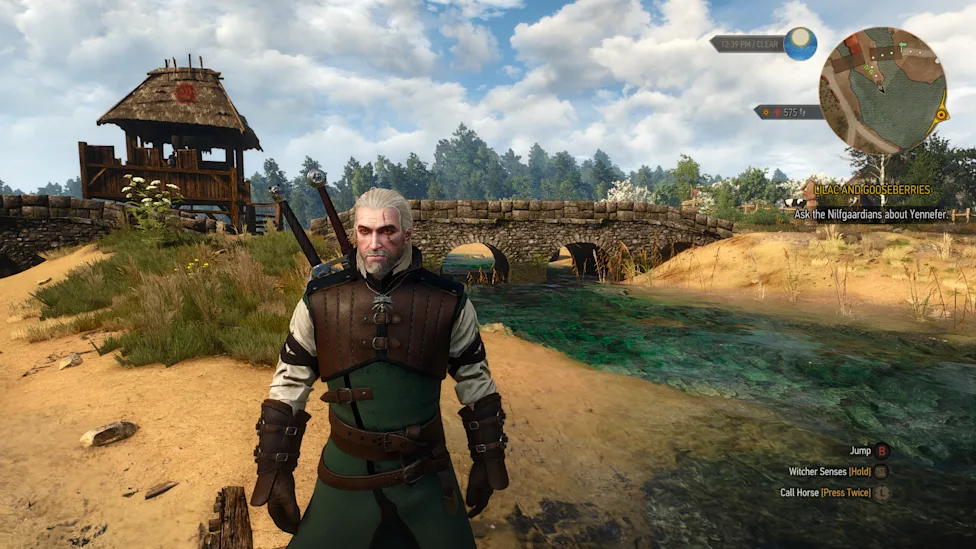
The baby dropping problem makes more sense when viewed within The Witcher 3’s broader NPC simulation. CD Projekt Red wanted settlements to feel like changing communities rather than static collections of characters. NPCs therefore use schedules, jobs, action points, environmental reactions, and time based systems to create the impression of daily life. Official Witcher 3 REDkit documentation confirms that community systems can use timetables to control NPC behavior during different periods of the day and night, while Job Trees define activities characters can perform. Timetables can associate particular times and categories with action points that instruct NPCs to perform activities such as sitting or hammering.
Developer interviews before release also emphasized that the day and night cycle affected more than lighting. Rain could send inhabitants toward shelter, nighttime could cause market workers to pack up and return home, inns could become busier in the evening, dangerous characters could become more noticeable after dark, and some quests could depend on the time of day. The world therefore changes its populations, activities, monsters, environmental presentation, and NPC routines rather than simply changing the appearance of the sky.
Weber later explained that background characters did not always follow one rigidly authored route. Developers could instead provide several possible activity locations and allow NPCs to choose between them before using pathfinding to reach the selected destination. The developers still controlled what activities existed and where they could take place, but the game handled part of the movement and selection dynamically. This created controlled variation, helping settlements appear less repetitive without turning the NPCs into unrestricted artificial intelligence.
Weber used activities such as woodcutting and carpentry to illustrate the system. Many village NPCs were not assigned one permanent route. Instead, designers could provide a collection of eligible locations. After finishing one activity, an NPC might choose another available point and pathfind there. A villager who had finished chopping wood, for example, could move toward another location outside a house where carpentry could be performed. This approach offered several advantages:
- It introduced visible variation, making it less obvious that villagers were repeating predetermined behavior.
- It allowed multiple NPCs to share a settlement without requiring designers to manually create a completely unique route for every character.
- It reduced the likelihood of all characters converging on the same activity location when enough alternative destinations were available.
The system was still heavily authored. Developers created the schedules, activities, animations, locations, and conditions available to each NPC. The apparent autonomy came from characters choosing among those designed possibilities. NPC behavior in The Witcher 3 was therefore neither a completely scripted performance nor an unrestricted simulation. It combined authored content with runtime selection and pathfinding.
Points of interest were central to this design because they provided destinations around which NPC activities could be organized. Instead of assigning most villagers permanent paths, designers could supply a collection of activity spots. When an NPC completed one job, the character could select another destination and use the game’s pathfinding system to determine how to reach it. This separated two important parts of NPC behavior. Developers decided what an NPC could do by creating jobs, animations, action points, and valid activity locations, while pathfinding determined how the character could travel to the chosen destination through the environment. Combining the two systems gave designers substantial control without requiring them to manually define every journey.
The same approach helped create the impression of densely populated environments. A harbor worker could rotate among locations associated with maritime work, while villagers could move between domestic and agricultural activities. Since every character was not locked into the same simple circular route, settlements could appear less mechanically synchronized. However, the system required careful authoring. Developers needed enough valid destinations, those locations had to be reachable, NPCs could not constantly collide with or obstruct one another, suitable animations had to exist, schedules needed to remain believable, quest states could not be disrupted, and dynamic reactions had to understand what an NPC was currently doing.
The baby dropping incident demonstrated what could happen when one layer of this architecture failed to recognize the meaning of another. A generalized system for interrupting an activity might work when an NPC was carrying an ordinary object, but not when that activity involved cradling a child.
Novigrad harbor provides one of Weber’s clearest examples of how much authored content supported this apparent spontaneity. For approximately 50 sailors, developers created roughly 200 possible activity spots. That works out to around four potential locations per sailor as a simple ratio, although the locations were not permanently assigned to individual NPCs. The important point was the large surplus of available destinations. If 50 NPCs had only 50 locations, the system would have much less flexibility when all characters were active.
NPCs could repeatedly compete for the same positions, gather unnaturally, or expose obvious patterns. With around 200 possible spots, different sailors could occupy different areas whenever the player observed the harbor, creating far more combinations and helping the location resemble an active workplace instead of a collection of synchronized animations.
This example also shows how believable open worlds can depend on large amounts of carefully placed content that players are never expected to notice individually. A player might simply see a busy waterfront filled with sailors who appear to know where to work. Behind that impression are hundreds of authored locations telling NPCs where appropriate activities can occur. The design succeeds when those points disappear into the larger illusion of a functioning environment rather than drawing attention to themselves as individual game systems.
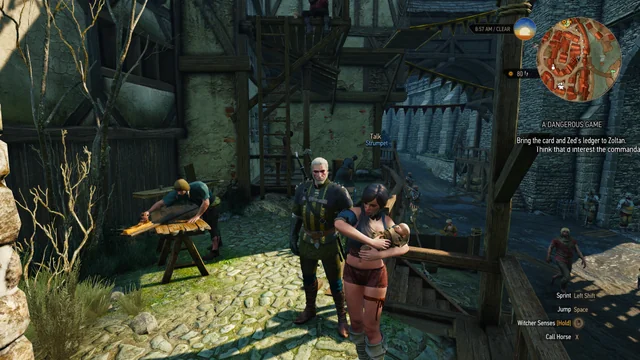
Small villages created a different challenge. Although large cities might appear more difficult to simulate, Weber noted that simple settlements can actually be easier for players to inspect closely. If a village contains only around eight houses, players can realistically explore most of them, watch the inhabitants, enter buildings, follow NPCs, return at different times, and judge whether the community behaves coherently.
The countryside encouraged this kind of curiosity because players could investigate whether residents seemed to genuinely exist within the world or whether the settlement was merely presenting an illusion. A large city can sometimes conceal repetition through crowds, architecture, sound, movement, and visual density. A tiny village provides fewer distractions, meaning a single character behaving strangely can become much more noticeable.
These villages were also important to the game’s storytelling. Much of Geralt’s journey takes place among farmers, refugees, laborers, soldiers, families, and ordinary people affected by war. If those communities felt artificial, some of the political and human consequences presented by the game would lose their impact. Mundane actions such as chopping wood, eating, sitting, taking shelter, and cradling children therefore contributed to the larger illusion that everyday life continued independently of the player.
Ironically, adding more of these ordinary activities also created more opportunities for different systems to interact incorrectly. Once cradling a baby became a valid routine, every generic system capable of interrupting that routine needed to understand that the object involved was not something an NPC could simply discard before running away.
Frequently Asked Questions[FAQ]
- Why did Witcher 3 NPCs drop babies during development?
They dropped babies because an experimental fear reaction instructed frightened NPCs to stop whatever activity they were performing, drop what they were handling, and run away. Cradling a baby was treated as one of the activities a mother NPC could perform, so the same general rule that worked for tools and other objects was accidentally applied to infants. This created the unintended sight of mothers dropping babies when they became frightened. - Who revealed The Witcher 3 baby-dropping bug?
CD Projekt Red developer Philipp Weber revealed the behavior while discussing the challenges of designing believable NPC routines and reactions for The Witcher 3. He used the example to show how seemingly logical behavioral rules could produce unexpected results when they interacted with the many different activities NPCs were capable of performing. His comments were later reported by outlets including GamesRadar, PC Gamer, and Kotaku. - How long were Witcher 3 mothers dropping babies during development?
Weber said the behavior remained in the game for “a few weeks” during development. The reports covering his comments do not provide a more precise timeframe, so it is unclear exactly when the problem appeared or how long it took developers to correct it beyond that general period. - Was the Witcher 3 baby-dropping behavior intentional?
No. The behavior was an unintended consequence of an experimental fear mechanic used during development. The system was designed to make frightened NPCs abandon their current activities and flee, but it did not initially distinguish between ordinary objects and babies being held by mother NPCs. The behavior was removed and should not be confused with deliberately scripted scenes involving babies or children elsewhere in The Witcher 3. - Why was holding a baby treated as work by The Witcher 3 NPC system?
“Work” in this context did not necessarily mean employment or a traditional job. It referred more broadly to an activity that an NPC could perform as part of their daily routine. Holding and cradling a baby could therefore be categorized within the same behavioral system used for activities such as working with tools, performing chores, or interacting with environmental objects. That broad classification is what allowed the fear rule to affect the baby carrying activity. - Did The Witcher 3 NPCs follow fixed paths?
Not all NPCs were restricted to a single predetermined path. Weber explained that many village characters could instead be assigned several available points of interest or activity locations. Once an NPC finished an activity such as chopping wood, the system could select another suitable location and have the character pathfind there. This approach helped NPC routines appear less rigid and repetitive. - Why were there 200 NPC activity spots for 50 sailors in Novigrad harbor?
The developers created far more activity locations than active sailors so NPCs would have plenty of choices when deciding what to do next. Weber said around 200 possible spots were available for approximately 50 sailors, meaning that even if every sailor was active at once, numerous unused locations would remain. This helped prevent excessive crowding around the same activities and made the harbor appear more varied and natural. - How did Witcher 3 NPCs choose their next activity?
NPCs could be given a selection of suitable activity locations rather than being forced to repeat one predefined routine. After finishing an activity, such as chopping wood, an NPC could choose another available point of interest and pathfind toward it. Having multiple possible destinations allowed characters to move through villages and other populated areas with more variety. - Why did The Witcher 3 use more activity spots than NPCs?
Providing more activity spots than NPCs gave the behavioral system additional options and helped prevent characters from repeatedly gathering at the same locations. The Novigrad harbor example shows this clearly, with about 200 possible activity spots for only 50 sailors. The extra choices allowed different combinations of activities to occur and reduced obvious repetition or overcrowding. - Do Witcher 3 NPCs react to time and weather?
Yes. CD Projekt Red explained before the game’s release that NPC routines could change according to both the weather and the time of day. Characters may seek shelter when it rains, while markets and other daytime activities become quieter at night. Inns can become busier in the evening, and different or more dangerous characters may appear after dark, helping settlements feel like they follow their own daily routines.
Conclusion
The story that Witcher 3 NPCs dropped babies because fear reactions made mothers drop their work is substantially accurate, but the context is essential. It was not an intentional feature and was not a notorious bug left for players to discover in the released game. It was an unintended development behavior produced by an experimental NPC fear mechanism.
Philipp Weber explained that CD Projekt Red wanted NPCs to react fearfully by abandoning their current work and fleeing. The problem was that cradling a baby counted as one of the possible activities available to mothers. When the generic fear rule interrupted that activity, the system treated the baby like the thing associated with the work. For a few weeks, mothers therefore dropped their infants when frightened. The problematic implementation was ultimately removed.
The anecdote becomes more interesting when examined alongside The Witcher 3’s wider NPC architecture. CD Projekt Red was attempting to populate an enormous open world with characters who did more than stand in predetermined locations. Villagers could rotate among activities, follow time-dependent routines, use action points, react to environmental conditions, and pathfind between available spots of interest.
Instead of assigning every NPC one rigid route, developers could provide a set of destinations and let characters move among them. Weber’s example of 50 sailors having access to roughly 200 activity spots in Novigrad harbor illustrates the scale of the authoring required to make a location appear naturally busy.
Small settlements created their own difficulties because players could closely scrutinize the lives of individual inhabitants. That pressure encouraged CD Projekt Red to invest heavily in day-and-night routines and ordinary activities. It also created more opportunities for unrelated systems to collide.
The Witcher 3 baby-dropping bug is consequently a useful case study in emergent game behavior. The system was not absurd because every individual design decision was absurd. It became absurd because several sensible decisions interacted without sufficient contextual safeguards.
A believable simulated world does not emerge simply from giving NPCs more rules. Those rules must understand one another well enough to produce appropriate outcomes. Sometimes the best design decision is therefore not to make a system more complicated but to remove or constrain a mechanic whose possible interactions cannot be made consistently convincing.
More than a decade after The Witcher 3’s original development, the story remains a concise illustration of why open-world NPC design is difficult. Players see a mother carrying her child, a woodcutter working, or sailors moving through a harbor. Underneath those apparently ordinary scenes are schedules, animations, pathfinding, action points, activity selection, environmental conditions, player reactions, and numerous safeguards designed to prevent the illusion from collapsing.
For several weeks during The Witcher 3’s development, one of those safeguards was missing. The result was mothers abandoning their babies whenever the game’s generalized fear logic told them to drop their work and run.
Sources and Citation
- GamesRadar+ — The Witcher 3 devs tried to give NPCs “fear reactions” but it got cut after a few horrifying weeks when “women were just dropping their babies, left and right”
GamesRadar+ - GamesRadar+ — The Witcher 3 lead says designing for player curiosity “really came to haunt us” when making sure it felt like “people truly exist” in the RPG’s villages
GamesRadar+ - PC Gamer — Witcher 3 designer says it wasn’t easy to convince players its NPC simulation wasn’t ‘just fakery’
PC Gamer - Kotaku — Witcher 3 Dev Explains How Ultra Realistic NPCs Created Weird Problems: ‘Women Were Just Dropping Their Babies Left and Right’
Kotaku - CD Projekt RED REDkit Wiki — Action points
REDkit Wiki
documents Action Points, Job Trees, predefined animations, Community timetables, and NPC reactions. - Game Informer — CD Projekt Explains The Witcher 3’s Ever-Changing Weather With Exclusive Screenshots
Game Informer
interview with Michał Stec covering day/night, weather, NPC reactions, crowded inns, and time-dependent behavior. Mateusz - Tomaszkiewicz interview — M. Tomaszkiewicz: “Our main design principle is immersion. You should feel you are impacting people’s lives and their world”
Start Videojuegos
covers NPC action points, work animations, reactions, daily cycles, and the expansion from roughly five major communities in The Witcher 2 to close to 200 in The Witcher 3.
Recommendations
- DragonSword: Awakening Release Guide: Orbis, Heroes, Combat, and Unreal Engine 5
- The Debate Over Arcane’s Animation Style
- Borderlands 4 Takedown at Hadron Abyss Reveal Trailer: Release Date, Bosses, Loot and Gameplay
- TouchDesigner and Unreal Engine Integrations: TouchEngine Plugin Workflows for Real-Time Data + Video
- LEGO is Releasing a SEGA Genesis Set Complete with Little Controllers (40926)
- Nivalis Nights Official Release Date Trailer Reveals September 2026 Launch for Cyberpunk Life Sim Game
- Borderlands 4’s New $30 Expansion Pack Isn’t Winning Over Fans: Mad Ellie DLC Price, Length, and Steam Backlash
- No Man’s Sky Launches the Swarm Update: Massive Hive of Glass “Death Star” Construct Arrives in 6.4 Update
- Pokémon Champions Mobile Release on June 17: Launch Time, Crossplay, and What’s New
- Toon Shader for Substance 3D Painter: NyanToon Guide



































































































