






In This Article (7 sections)
Asha Sharma’s Xbox 25th Anniversary Message Envisions Bigger Games From Smaller Teams
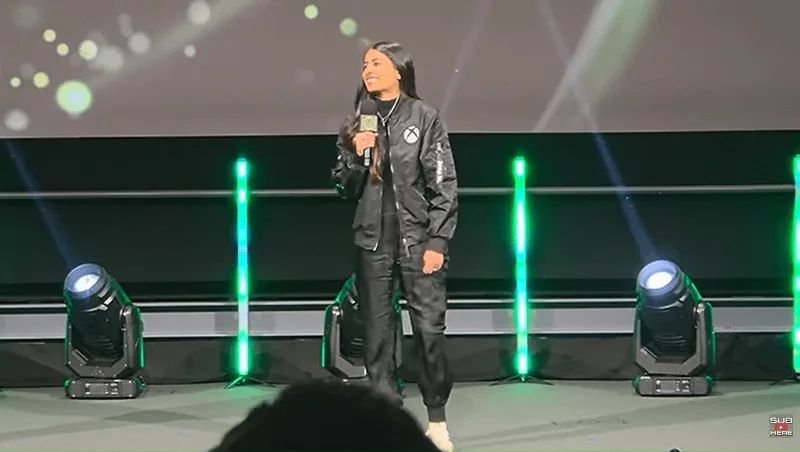
Xbox CEO Asha Sharma marked the console’s 25th anniversary with a prediction about who will get to make the next generation of games. “A single person will soon be able to wield capabilities that once required entire nations,” she wrote in a message shared with Xbox employees worldwide and published on Xbox Wire on November 12, 2026.
In the section titled “The Next 25,” Sharma imagined small teams building game worlds on a scale that currently takes hundreds of developers and hundreds of millions of dollars. She also saw an opportunity for major studios to attempt projects beyond the reach of today’s biggest productions. One detail drew particular attention from gaming publications. Although Sharma described a substantial change in what developers could accomplish, she never mentioned artificial intelligence.
The message appeared three days before the anniversary of the original Xbox, which launched in North America on November 15, 2001. Sharma traced Microsoft’s involvement in games back to Microsoft Adventure in 1979, followed by Microsoft Flight Simulator, Minesweeper, and Age of Empires. DirectX helped establish Microsoft’s place in PC gaming and contributed to the development of its console business. Halo: Combat Evolved gave the first Xbox its defining launch game, and Xbox Live subsequently expanded the possibilities for connected multiplayer on consoles. The anniversary celebrations revisited that history through backward compatibility, Xbox Playback, and announcements about upcoming games and platform features.
Sharma illustrated the scale of technological change with two editions of Microsoft Flight Simulator. By her account, the 1982 release occupied approximately 160 kilobytes, displayed graphics in two dimensions, supported 16 colors, and included 20 airports. Microsoft Flight Simulator 2024 draws on more than 2.5 petabytes of data to recreate the planet, including recognizable landmarks, detailed vegetation, and weather that closely follows conditions in the real world.
That figure refers to the data available to the simulation, much of it streamed. It is considerably larger than the installation on a player’s device. The achievement also reflects decades of work across mapping, cloud delivery, graphics, aircraft engineering, and environmental modeling. Knowing where an airport belongs and making an aircraft behave convincingly on approach are different problems, and the simulation has to solve both.
Game engines offer a smaller example of the change Sharma expects. Developers can already use rendering systems, animation tools, and software libraries that earlier teams would have had to build themselves. That gives a small studio a head start while leaving much of the underlying engineering to the people who maintain those systems. Sharma sees room for another advance of that kind through more capable engines, procedural generation, cloud computing, automation, and collaboration tools. Her message set out the scale of her ambition without announcing a new engine, a timetable, or an AI requirement for Xbox studios.
One commitment was more definite. Microsoft is planning a fifth generation of Xbox consoles alongside its Windows, subscription, cloud gaming, and digital distribution businesses. Sharma left specifications, performance targets, and a release date open. Future hardware could handle more demanding simulations, rendering, or some machine learning tasks locally, while remote systems could supply data beyond the capacity of a consumer device. Flight Simulator 2024 already demonstrates the appeal of combining local rendering with cloud data. It also illustrates a decision future developers will face. Every feature that depends on remote processing carries an ongoing cost, requires a reliable connection, and depends on the service remaining available to players.
How Microsoft’s AI Research Could Change Indie and AAA Game Development
PC Gamer, IGN, and GameSpot interpreted Sharma’s remarks as a reference to AI because the productivity gains she described resemble the case Microsoft has made for its development tools. Sharma had addressed the technology directly when Microsoft announced her appointment as gaming CEO on February 20, 2026. She emphasized human creativity and warned against pursuing short term efficiencies at the expense of artistic quality.
Microsoft’s fiscal 2026 annual report also identified AI and cloud computing as strategic priorities. Azure and other cloud services revenue rose 41% during the fiscal year, while Xbox content and services revenue declined 5%. Those figures help explain the interest in what Microsoft might bring from its wider business into Xbox. Decisions about how to use those resources on individual games remain with the company and its studios.
Microsoft’s partnership with Inworld AI, announced on November 6, 2023, explored two uses for generative technology. One was a design assistant that could help developers draft dialogue, shape characters, and work through quest ideas during production. The other was a system that could generate character interactions while someone was playing. The distinction matters to a writer. A suggestion made during development can be edited, rejected, or rewritten before release. A character responding during play has to remain consistent with earlier events, established relationships, and the player’s choices at the moment the response appears. The latter offers more room for unscripted interactions, but it also changes how writers and testers evaluate a scene.
Microsoft Research pursued a different question with Muse, developed with Xbox studio Ninja Theory using gameplay data from Bleeding Edge. Its World and Human Action Model, or WHAM, could generate sequences involving both game visuals and controller inputs. That gave researchers a way to explore how an interactive scene might unfold during early design. The research appeared in Nature on February 19, 2025, and Microsoft announced in September 2026 that the WHAM technology and team had moved into its Microsoft.AI product organization. The move showed continuing investment in the research. Whether teams working on Halo, Forza, Fable, Fallout, or future Bethesda games will use generative systems for finished artwork, dialogue, or gameplay remains an open question.
For independent developers, one of the clearest opportunities comes before a game has funding. A solo programmer could investigate an unfamiliar rendering or animation technique without first recruiting a specialist. A team of writers and designers could build enough of a technical prototype to find out whether its central mechanic is enjoyable. Artists could compare terrain layouts and organize assets, while testers could generate cases that expose unusual player behavior. Catching a weak idea early frees a studio to spend its limited budget on a more promising one. The gap between a prototype and a release is still considerable. Problems with navigation, progression, controls, or performance may emerge only after someone plays for several hours.
For AAA studios, the financial pressure comes from coordinating years of programming, animation, sound, narrative, localization, accessibility work, testing, and marketing. A delay extends those costs. At launch, a game has to recover its investment while competing for attention with established franchises, subscription libraries, free games, and persistent multiplayer worlds. That exposure gives publishers a reason to favor familiar properties and proven mechanics. Faster prototyping could make it less costly to test an unfamiliar idea before committing a full team. Better debugging and automated testing could also catch problems early enough to avoid reworking environments or systems late in production.
The savings depend partly on what a studio does with the time it gains. If artists can build an environment faster, a publisher might shorten the schedule, fund another project, or ask for a larger map, more characters, and a longer campaign. Only some of those choices reduce the budget. Cloud usage, licensing, security, specialist staff, and the effort of correcting generated material also carry costs.
Independent studios face an additional tradeoff when an outside provider controls a tool the project depends on. Changes to its price, license, or availability can affect whether the studio can afford to finish and maintain the game. Easier production may also bring more releases to digital storefronts, leaving developers with the familiar challenge of finding an audience.

What Xbox’s Vision Means for Jobs, Creative Rights, and the Games Players Get
The possibility of smaller teams takes on a different meaning for people who have already lost work. In July 2025, Microsoft announced approximately 9,000 job cuts across its global operations, affecting Xbox and other divisions. The cuts coincided with investment in AI and cloud infrastructure, although the available evidence does not establish that automation caused them. Sharma’s anniversary message announced no new layoffs or staffing targets.
The November 2026 GDC State of the Game Industry report helps explain why workers nevertheless paid attention. Among those surveyed, 34% had experienced a layoff in the preceding two years. Of the respondents who had lost jobs, 54% remained unemployed when surveyed. GDC acknowledged that displaced workers may have been overrepresented in its sample.
The survey also found that approximately 40% of respondents used generative AI professionally. Asked about its effect on the industry, 55% described the impact as negative, 35% expressed mixed views, and 8% judged it positive. A developer can find a tool useful for investigating a programming error and still have concerns about how management will use the time saved. Publishers could retain employees for more specialized work, approve additional games, reduce recruitment, or eliminate positions. Those choices affect writers, translators, animators, voice actors, testers, and external contractors as well as programmers.
Junior employees face a particular difficulty. Small programming assignments, animation corrections, and routine testing give beginners opportunities to learn how a game works and how to recognize a problem. If studios automate much of that work and hire fewer people to do it, they also reduce the opportunities through which future senior developers gain experience. New duties may emerge in integration, validation, creative supervision, and maintenance. Those duties still require people who understand the underlying craft well enough to notice when a plausible result is wrong. A studio’s staffing decisions today will influence whether it has that expertise on its next project.
For players, some consequences will be visible in the finished game. Generated code can introduce security flaws, compatibility problems, or poor performance. An environment can look convincing while repeating the same structures or leaving players without a usable route. A character that improvises dialogue can contradict an earlier scene, reveal inappropriate material, or undermine a relationship writers have spent hours establishing. Adaptive challenges and personalized interactions also raise questions about what player information a game collects and how it uses it. Across several games, heavy reliance on familiar visual and narrative patterns could make different studios’ work look and sound increasingly alike.
Reactions to Pure Xbox’s coverage reflected those different concerns. Some commenters welcomed tools that could give smaller teams the means to make more enjoyable games. Others questioned whether Microsoft would invest in those creators or use higher productivity to justify employing fewer people. Some players attached particular value to knowing that artists, writers, and performers had shaped the work. Ownership matters to the studios as well.
In January 2025, the U.S. Copyright Office explained that human creative contributions to a work made with AI assistance can qualify for protection, while prompts alone generally do not establish authorship of the resulting material. Developers building a franchise around characters, artwork, or stories also have to account for third party rights. The 2025 SAG-AFTRA Interactive Media Agreement addresses a separate issue through consent and disclosure requirements for covered uses of performers’ digital replicas.
For Xbox Game Studios, the decisions are likely to vary by game. A racing team may value a tool that helps test a simulation, while a role playing studio may want writers to retain direct control over every line a companion speaks. Allowing teams to choose tools for those specific needs would support the creative independence Sharma emphasized. Companywide productivity targets could put pressure on the same teams to adopt a system even when reviewing its output takes longer than doing the work themselves.
The promise of Sharma’s next 25 years is clearest at the moment a small studio decides whether it can afford to pursue an idea. Better tools could let its developers build a playable version, test it, and give an unusual game a chance to find an audience. Whether that opportunity lasts will depend on the cost of the technology, who controls the finished work, and whether the people who know how to make the game can stay long enough to finish it.

Frequently Asked Questions (FAQs)
- What did Xbox CEO Asha Sharma say in her 25th anniversary message?
Xbox CEO Asha Sharma predicted that emerging technologies could fundamentally change how video games are developed by giving individuals and smaller teams access to capabilities previously reserved for large organizations. She suggested that small development teams might eventually create gaming worlds comparable in scale to productions that currently require hundreds of employees and hundreds of millions of dollars. Her message also highlighted the increasing complexity and financial demands of modern game development. Sharma believes technological advancement could reduce some of these barriers and make ambitious projects more accessible to independent creators. However, her remarks represented a long-term vision rather than an announcement of specific development tools or confirmed production changes. - When did Asha Sharma release her Xbox 25th anniversary message?
Asha Sharma released her Xbox anniversary message on November 12, 2026, three days before the original Xbox console’s 25th anniversary. The message was initially distributed to Xbox employees worldwide and subsequently published through Xbox Wire. The anniversary commemorated the original Xbox’s North American launch on November 15, 2001. Sharma reflected on Microsoft’s gaming history, including Microsoft Flight Simulator, DirectX, Halo, and the expansion of Xbox into a broader gaming ecosystem. She also outlined her expectations for the next 25 years, focusing on technological innovation, creative accessibility, and the changing economics of video game production. - Did Asha Sharma explicitly mention artificial intelligence in her anniversary message?
No, Asha Sharma did not explicitly mention artificial intelligence, generative AI, or machine learning in her November 12, 2026, anniversary message. Instead, she discussed emerging technological capabilities that could enable individuals and smaller development teams to undertake increasingly ambitious projects. Gaming publications such as IGN, PC Gamer, and GameSpot interpreted these predictions as possible references to AI-assisted game development. Their interpretation was influenced by Microsoft’s investments in artificial intelligence and technologies designed to improve developer productivity. However, Sharma did not identify AI as the sole technology behind her vision or announce mandatory AI adoption across Xbox Game Studios. The distinction is important because her actual statement was broader than the AI-focused interpretations it generated. - Why are people interpreting Asha Sharma’s anniversary message as an AI push?
Many observers interpreted Sharma’s message as an AI push because her predictions closely resemble the productivity improvements commonly associated with generative artificial intelligence. She suggested that individuals could eventually perform tasks currently requiring enormous organizations, while smaller studios might create worlds comparable to major AAA productions. Microsoft has already invested in AI-powered developer tools, interactive content generation, and cloud computing, making artificial intelligence a plausible contributor to that vision. Existing projects such as Muse and the company’s partnership with Inworld AI provide further context for the interpretation. However, other technologies, including procedural generation, improved game engines, automated testing, and cloud infrastructure, could also support these changes. The anniversary message therefore suggests technological transformation without confirming an exclusively AI-driven development strategy. - Is Microsoft already developing artificial intelligence tools for video games?
Yes, Microsoft has already invested in research and partnerships exploring how artificial intelligence could assist video game development. In November 2023, the company announced a collaboration with Inworld AI to investigate tools for narrative design, dialogue creation, character interactions, and quest development. In February 2025, Microsoft Research introduced Muse, a generative AI model developed in collaboration with Ninja Theory using gameplay information from Bleeding Edge. Muse was designed to explore interactive gameplay generation and assist with early-stage experimentation. These initiatives demonstrate Microsoft’s interest in AI-assisted production, but they do not establish that every Xbox studio currently uses the technologies. Research tools and experimental systems must still undergo evaluation before they can become reliable components of commercial game development. - Can artificial intelligence help independent developers create AAA-quality games?
Artificial intelligence could help independent developers produce more ambitious games by reducing the time required for certain technical and repetitive tasks. Programming assistants may support coding and debugging, while other tools could help with environmental design, animation processing, early prototyping, and quality assurance. These capabilities may be particularly valuable for small studios that cannot afford extensive teams of specialists. However, AAA-quality development involves much more than generating large quantities of digital content. Games still require compelling mechanics, consistent artistic direction, effective storytelling, reliable performance, thorough testing, and professional production management. AI can support skilled creators and make some projects more achievable, but it does not guarantee that a solo developer can independently reproduce every aspect of a major AAA production. - Will Microsoft’s AI strategy cause more Xbox layoffs?
Microsoft’s AI strategy could influence future employment decisions, but there is no confirmed connection between Asha Sharma’s anniversary message and additional Xbox layoffs. Sharma did not announce workforce reductions, identify positions that would be automated, or establish targets for reducing development teams. AI-assisted tools could allow existing employees to complete certain responsibilities more efficiently, potentially creating opportunities to focus on specialized creative work. However, companies could also use productivity improvements to reduce recruitment or automate responsibilities previously handled by employees. Microsoft announced approximately 9,000 job cuts across its global operations in July 2025, but those reductions cannot automatically be attributed to AI replacing workers. The employment consequences of future automation will depend on Microsoft’s management decisions, development priorities, and how productivity gains are distributed. - Why did Asha Sharma compare the original Microsoft Flight Simulator with Microsoft Flight Simulator 2024?
Asha Sharma used Microsoft Flight Simulator to demonstrate how dramatically video game technology has advanced over several decades. According to her anniversary message, the original Microsoft Flight Simulator from 1982 occupied approximately 160 kilobytes, featured two-dimensional graphics, supported 16 colors, and included 20 airports. Microsoft Flight Simulator 2024, by comparison, draws upon more than 2.5 petabytes of underlying data to recreate the planet with detailed geography, vegetation, landmarks, and weather systems. The comparison illustrates how improvements in computing power, cloud infrastructure, graphics, and simulation technology can expand creative possibilities. However, the enormous dataset is not equivalent to the game’s local installation size, and its capabilities do not result exclusively from generative AI. Sharma used the example to suggest that future technological advances could transform game development just as dramatically. - What are the biggest risks of generative AI in game development?
Generative AI introduces several risks involving employment, creative ownership, technical reliability, and artistic quality. Automation could reduce demand for certain development responsibilities, while generated artwork, dialogue, or code may create copyright and licensing concerns. The unauthorized reproduction of performers’ voices, appearances, or movements also raises important consent and professional rights issues. From a technical perspective, generated code may contain vulnerabilities, while AI-created environments and dialogue can introduce inconsistencies or unpredictable behavior. Heavy reliance on automated content may also produce repetitive artistic styles and reduce opportunities for employees to develop essential professional skills. Responsible implementation therefore requires human oversight, appropriate licensing, thorough testing, transparent production policies, and safeguards protecting creative contributors. - What does Asha Sharma’s anniversary message mean for the future of Xbox?
Asha Sharma’s anniversary message suggests that Microsoft expects technological innovation to reshape both game development and the broader Xbox ecosystem over the next 25 years. Her vision emphasizes making advanced creative capabilities accessible to smaller teams while allowing established studios to pursue more ambitious projects. Artificial intelligence may contribute through programming assistance, prototyping, automated testing, and interactive content generation, although the message did not establish a detailed implementation roadmap. Sharma also reaffirmed Microsoft’s commitment to a fifth generation of Xbox consoles, indicating that dedicated gaming hardware remains part of its long-term strategy. However, advanced technology alone cannot guarantee successful games, reduced production costs, or improved working conditions for developers. The significance of her vision will ultimately depend on whether Microsoft uses these capabilities to support human creativity, sustainable development, and enjoyable gaming experiences.

Conclusion
Xbox CEO Asha Sharma’s 25th-anniversary message presents an ambitious vision of a gaming industry in which creative capabilities become increasingly independent of traditional financial and organizational limitations. Her prediction that individuals could eventually possess capabilities previously associated with entire nations reflects growing confidence in emerging technologies and their potential to transform video game production. Although artificial intelligence was not explicitly mentioned, Microsoft’s existing investments in generative AI, cloud computing, and intelligent development tools make the interpretation understandable.
The potential benefits of this transformation are considerable. More accessible technologies could allow independent developers to pursue ambitious projects, help established studios reduce unnecessary production complexity, and encourage greater experimentation across the industry. However, these opportunities are accompanied by serious concerns involving employment security, intellectual property ownership, artistic originality, and technical quality. Microsoft’s approach must address these challenges if AI-assisted development is to produce sustainable improvements rather than short-term financial advantages.
Ultimately, the next 25 years of Xbox will depend on how effectively Microsoft balances technological innovation with human creativity. Sharma’s anniversary message establishes a broad vision rather than a confirmed AI deployment roadmap, and her reasons for omitting explicit references to artificial intelligence remain unverified. The company’s future success will depend on whether its investments empower developers, protect creative integrity, support sustainable employment, and deliver memorable gaming experiences that justify the extraordinary technological ambitions outlined during Xbox’s 25th anniversary.
Sources and Citations
- Xbox Wire, November 12, 2026, 25 Years of XBOX: Asha Sharma’s official anniversary message, covering Xbox history, development costs, Microsoft Flight Simulator, and the future capabilities of individual creators and small development teams.
https://news.xbox.com/en-us/2026/11/12/25-years-of-xbox/ - PC Gamer, November 12, 2026: Coverage and interpretation of Asha Sharma’s anniversary message as an indirect discussion of artificial intelligence in video game development.
https://www.pcgamer.com/software/ai/xbox-ceo-looks-to-the-future-as-microsofts-console-turns-25-a-single-person-will-soon-be-able-to-wield-capabilities-that-once-required-entire-nations/ - IGN, November 12, 2026, via Yahoo Tech: Reporting on Sharma’s predictions about individual creators, smaller development teams, and the potential role of artificial intelligence.
https://tech.yahoo.com/gaming/articles/xbox-turns-25-ceo-asha-163218705.html - Pure Xbox, November 12, 2026: Coverage of Asha Sharma’s anniversary statement and community reactions concerning artificial intelligence and game development.
https://www.purexbox.com/news/2026/11/asha-sharma-issues-statement-on-xboxs-25th-anniversary-and-the-future-of-gaming
Recommendations
- GTA Online Fine Art Collector Program: Special Rewards, Double Diamond Casino Heist Payouts, and More
- Vampire Crawlers: All Relics and Where To Get Them (Complete Relic Locations Guide)
- The Elder Scrolls IV: Oblivion Remaster – Complete 2025 Guide & Overview
- GTA 6 Leaks Timeline: Every Major Leak So Far
- Assassin’s Creed Black Flag Resynced Long Bay 100% Collectible Locations Guide
- CD Projekt Red Pleased With The Witcher 3 Remaster Sales
- Burn-9 Turns Metal Gear Codec Scenes Into a Full Game: Everything You Need to Know About the “Reverse Metal Gear” Indie Thriller
- Marvel Tokon: Fighting Souls – How Long Does It Take to Beat?
- Like or Die: NC’s Survival FPS Where Streamers Reshape the Map With Blocks
- 3D texture painting app Wafer is now free in beta for Windows (download, features, and what to expect)



































































































