








In This Article (15 sections)
Xsolla GamePix Acquisition, Deal Timeline, Platform Scale, and Strategic Rationale
Xsolla publicly announced its acquisition of Italian browser game platform GamePix on October 29, 2026, while stating that GamePix had been part of Xsolla since August 2026. That makes August the ownership milestone and October 29 the public announcement date. Xsolla did not disclose the exact August closing day, purchase price, or other financial terms. The deal brought GamePix’s browser publishing operation, distribution network, developer tools, and more than 10,000 web games into the same company as Xsolla’s payments and commerce infrastructure. GamePix also contributed a developer community of more than 4,000 creators, studios, and publishers.
The catalog figure describes games distributed through GamePix’s business rather than establishing that Xsolla acquired the intellectual property behind every listed title. A browser game platform can host and distribute independently owned games under agreements with their creators or publishers. Xsolla said GamePix works with developers ranging from independent creators to larger studios and publishers, making the catalog a network of distributed titles rather than a single portfolio of wholly owned games. The acquisition therefore expands Xsolla’s role in game publishing and distribution without implying ownership of every game represented on GamePix. Individual publishing rights, revenue terms, and distribution arrangements still depend on the agreements covering each title.
Strategic Rationale and Commerce Alignment
Xsolla’s rationale for the acquisition is to connect game discovery and distribution with the commerce systems that can monetize a player after they begin playing. A payments company traditionally enters the process once a user has already decided to buy something. GamePix gives Xsolla an earlier position because it can host browser games, help developers prepare releases, distribute them through partner channels, and put playable experiences in front of users before checkout becomes relevant.
That makes the combined platform useful to developers arriving from several directions. A studio with a finished browser build can publish through GamePix, a studio with a native Unity or C++ title can investigate a browser port, and a creator using AI coding tools can turn a working web prototype into a release candidate.
The commercial path still differs by project. A short puzzle game may rely primarily on advertising, while a larger game with progression systems could support cosmetic items, virtual currency, subscriptions, or other purchases. An existing PC title might use a browser edition as a low-friction way to introduce players to the game before asking them to install a native version. AI-assisted creators may reach a playable prototype quickly but still need testing, distribution, identity, and monetization infrastructure before they have a finished product. The acquisition brings those stages closer together while leaving the game’s business model, distribution permissions, and technical requirements to be handled at the project level.
GamePix Origins and Dual Publishing Role
GamePix itself was founded in 2013 by Edouard Wawra, Valerio Pullano, and Justine Silipo. It operates both a player-facing browser game portal and a developer publishing business, while also distributing games through apps and partner websites. Xsolla identifies media and telecommunications companies among the types of organizations GamePix has worked with through its distribution network. That dual role explains why GamePix.com represents only one part of the company’s value. A developer can publish through GamePix while the final player may encounter the same title through an entirely different partner service.

GamePix Browser Publishing, SDK Integration, Porting, and Web Technology
The GamePix publishing process begins with a developer account and a working browser build. Developers integrate the GamePix SDK, test the required platform behavior, and submit the finished web game through the GamePix Dashboard. The platform documents a core JavaScript integration and engine-specific workflows for Unity, Godot, Construct, GDevelop, Cocos Creator, GameMaker, and Tuanjie. Unity developers can use GamePix’s plugin to create the required submission package, while JavaScript projects can use the platform’s core SDK reference directly. The submission also includes listing information such as the game name, icon, cover, and description.
GamePix’s SDK connects the title to platform features such as loading progress, gameplay start events, advertising, storage, pause and resume behavior, and user access. These integrations matter because browser games can be interrupted by events such as ads or sign-in prompts while gameplay is active. A timed game needs its countdown and movement to pause correctly when an interstitial appears. A rewarded ad needs a clear path for successful completion, cancellation, failure, and returning the player to a valid game state. The platform’s local testing tools help developers simulate several of these situations before the game is submitted for publication.
The developer also needs to test the exported build outside the editor or AI tool that produced it. A prototype can work inside a local development environment while still depending on missing files, temporary URLs, inconsistent filename capitalization, unsupported browser features, or assets that were never included in the final package. Running the web build independently helps expose those problems before players encounter them. It also gives the developer a chance to verify keyboard, touch, screen-size, and loading behavior. The useful build is the one that works in the hosted environment, not merely the one that worked inside the development tool.
Porting Service and Web Technology Considerations
GamePix also offers proprietary porting technology for eligible PC and mobile titles built with Unity or C++. That service is separate from the public Unity plugin because it addresses the larger task of adapting an existing native game for browser execution. A desktop title may depend on native file access, platform-specific plugins, operating system APIs, or assumptions about keyboard and mouse input. A mobile title can depend on app-store services, touch layouts, or device APIs that require a web-compatible alternative. The amount of reusable code and content therefore depends on how closely the original project already fits browser constraints.
Xsolla says GamePix can produce browser versions with load sizes reduced by up to 90% for supported native titles. The phrase “up to” describes the upper end of the company’s claim rather than a typical result across every port. The actual reduction depends on the original build, asset mix, audio, textures, code, and how much content is required before the first playable screen. Browser games can also load later levels and optional assets on demand instead of transferring the entire game before launch. That means initial transfer size, total session data, installed native size, and time to first play are different measurements and should not be treated as interchangeable.
GamePix’s evolution from Flash-era browser gaming to HTML5, WebGL, and WebGPU reflects broader changes in web technology. HTML5 and JavaScript provide the browser environment used by modern web games, while WebGL enables hardware-accelerated graphics on supported devices and WebGPU introduces newer graphics and compute capabilities.
A simple 2D title may require relatively modest browser support, while a complex 3D port can depend much more heavily on GPU capability, memory, asset loading, and browser implementation. AI-assisted game creation sits above this technical layer because AI tools can help generate or modify a game, but the finished browser build still has to run through conventional web technologies. The way the game was created does not remove the need for a compatible runtime.
GamePix Distribution, Monetization, Xsolla Payments, and AI-Created Games
GamePix distributes games through its own website, apps, and certified partner websites. Developers can decide whether their submitted title is authorized for broader third-party distribution or limited to GamePix.com. Wider distribution gives a game additional opportunities to reach players through services they already use, but it also places the same build in different technical and audience contexts. A dedicated game portal may attract users prepared for a longer session, while a partner website may deliver users who expect to understand the game almost immediately. The opening screen, loading sequence, controls, and first playable moments therefore become especially important when a title travels across multiple channels.
Distribution permission does not guarantee placement on any specific partner service. The actual reach of a title depends on whether GamePix selects it for a channel, whether the build is compatible with that environment, and how players respond after the game appears. Developers can evaluate performance through more than raw traffic because a large number of page visits is useful only if players reach gameplay and remain engaged.
A title may attract clicks with a strong thumbnail but lose players during loading, while another may draw fewer initial visits but achieve longer sessions or repeat play. The distribution network creates more opportunities for those patterns to emerge, while the developer still has to interpret which part of the funnel needs improvement.
Advertising and Xsolla Payment Integration
GamePix already supports advertising through its SDK, including interstitial and rewarded ad flows. Its developer program advertises a 45% revenue share, subject to the applicable terms and definition of revenue used by the platform. Interstitial ads can fit naturally between rounds or levels, while rewarded ads let players choose to watch in exchange for a defined benefit such as another attempt. These formats require careful pause, resume, reward, and failure handling so the game does not enter an invalid state. Advertising therefore depends on both commercial placement and reliable implementation.
Xsolla adds direct commerce capabilities for titles that have something appropriate to sell. The company says its payment network reaches more than 200 geographies and supports more than 1,000 payment methods worldwide. These are network-wide figures rather than a promise that every payment method will appear for every GamePix player. A game still needs to associate a successful transaction with the correct account, deliver the purchased item or entitlement, and recover properly if the player closes the checkout or returns before confirmation. Where Xsolla acts as merchant of record, it takes the merchant role for the transaction, while the developer remains responsible for integrating the game-side fulfillment experience.
For developers planning international monetization, the headline reach figure needs to be broken into practical questions. A studio has to confirm whether players in its target market can access the game, which payment methods appear for those players, and whether the studio itself can complete onboarding and receive settlement under its agreement. Pricing, currency display, purchase confirmation, and entitlement delivery should also be tested in the actual market. Broad geographic coverage is useful only when the complete purchase flow works reliably for the intended player. The acquisition gives GamePix developers access to Xsolla’s larger commerce infrastructure, but implementation details still determine whether that access produces a good player experience.
AI-Created Games and Release Pipeline
AI-created games are another part of the combined strategy. GamePix documents a route for creators using AI tools to register as developers, integrate the SDK, and upload a browser build. Xsolla also describes a faster workflow in which creators can connect GamePix and Xsolla services from within AI-assisted development tools. The claim that a title can move toward publishing quickly describes the intended efficiency of the process, not a guaranteed approval time for every game. A generated prototype still needs a complete gameplay loop, working controls, included assets, reliable loading, and rights to the code, art, music, fonts, and other material distributed with it.
An AI-assisted build also needs to survive ordinary release conditions. A game that works once inside a coding tool may fail when refreshed, resized, opened on mobile, or loaded without the local development server that supplied its assets. GamePix’s platform can help with the publishing and distribution steps, but the creator still needs to test repeat sessions, failure states, storage, sign-in behavior, and any outside services the game calls. The AI tool helps produce the software. GamePix provides the release pipeline that can turn a working browser build into something players can discover.
Browser Play, Shared Player Identity, Cross-Device Saves, and What the Acquisition Means for Players
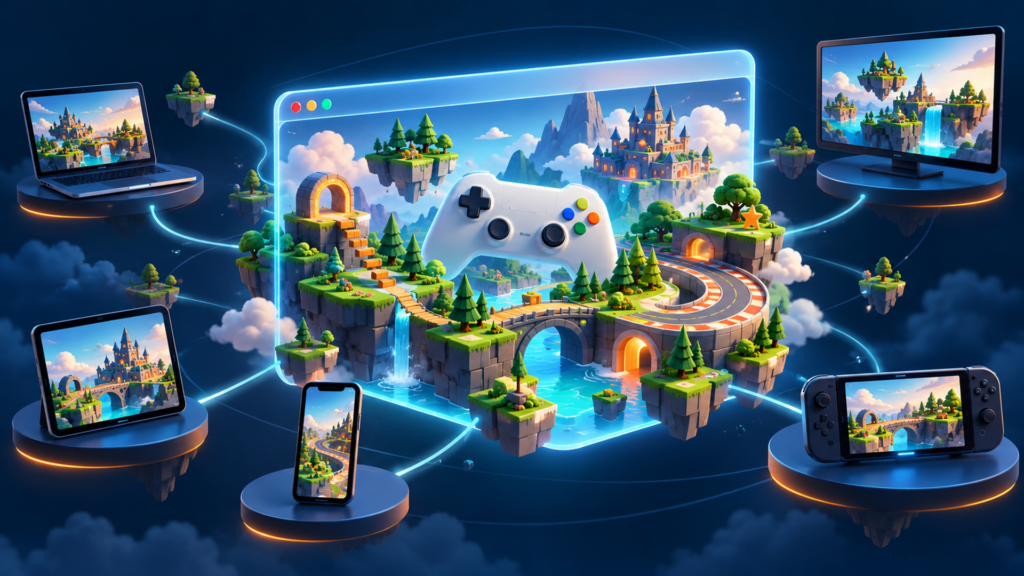
For players, GamePix’s central advantage is immediate browser access. A compatible title can be opened from its game page without installing a separate native application. The browser still downloads the files required to run the game, so “no installation” does not mean no data transfer. A lightweight game may start quickly, while a larger 3D build can require a longer load as the browser retrieves textures, audio, code, and other assets. The experience depends on the game, connection speed, device memory, controls, and graphics support.
GamePix also distributes games through apps and partner websites, so the same title may be encountered outside the main GamePix portal. The practical benefit of browser delivery is that a player can follow a link and reach the game without first finding an app-store page or installing a large package. That lower barrier can make a browser edition useful as a standalone experience or as a way to introduce players to a title that also exists on another platform. The trade-off is that browser compatibility becomes part of the product. Developers have to make sure the game still works well across the devices and browsers they intend to support.
Shared Player Identity and Cross-Device Saves
Xsolla describes a shared player identity across the GamePix website, apps, and games. GamePix’s SDK provides user-access functionality that can support a common sign-in flow, including Xsolla ID in the Unity integration. Shared identity gives the platform a way to recognize the same player in more than one environment. It does not automatically guarantee that saves, purchases, or settings follow that user everywhere. Each game has to implement the relevant storage and entitlement behavior.
Cross-device progress therefore depends on both identity and data storage. A player who completes a level on a laptop can resume on a phone only if the game stores progress in a way associated with that player and retrieves it in the second environment. A purchase similarly needs a persistent entitlement record if it is supposed to remain available after a device change or new session. Developers also have to decide how guest play behaves and whether progress made before sign-in can be attached to an account afterward. The SDK can provide the platform features, but the title still determines how those features are used.
Acquisition’s Broader Impact on Development and Monetization
The acquisition ultimately gives Xsolla a broader path from game creation to player access and monetization. GamePix contributes browser publishing, SDK integration, porting technology, hosting, partner distribution, a 10,000-plus game catalog, and a community of more than 4,000 developers. Xsolla adds global commerce infrastructure, payments, identity, and other services that can support games after they reach players. That combination gives studios several possible entry points, whether they already have an HTML5 game, need to adapt a native title, or are turning an AI-assisted prototype into a release.
The practical value will still be measured game by game. For players, success means following a link and reaching a responsive, playable experience without unnecessary friction. For developers, success means that distribution reaches the right audience, the build behaves correctly across channels, and the chosen advertising or payment systems actually support the game’s business model. Bringing those stages under the same owner can simplify the path from development to revenue, but it does not eliminate the technical and commercial decisions required at each step. The strength of the combined Xsolla and GamePix platform will depend on how well those tools work together without undermining the speed and simplicity that make browser games attractive in the first place.
Frequently Asked Questions (FAQs)
- When did Xsolla announce the GamePix acquisition?
Xsolla publicly announced the GamePix acquisition on October 29, 2026. In that announcement, the company also said GamePix had already been part of Xsolla since August 2026. That means August marks the ownership transition, while October 29 is the date the transaction was publicly disclosed. Xsolla did not provide a specific closing day in August. Keeping those dates separate avoids treating the announcement date as the actual acquisition date. - How much did Xsolla pay for GamePix?
The purchase price and other financial terms were not disclosed. Xsolla’s public materials focus instead on the strategic value of the deal, including GamePix’s browser publishing technology, distribution network, catalog, and developer community. Without a disclosed purchase price, there is no reliable basis for estimating what Xsolla paid or how the transaction was structured. The consideration could have involved cash, equity, or another arrangement, but the available public material does not specify. The confirmed fact is simply that GamePix became part of Xsolla in August 2026. - Who founded GamePix?
GamePix was founded in 2013 by Edouard Wawra, Valerio Pullano, and Justine Silipo. Xsolla identified Wawra as GamePix’s CEO and co-founder when it announced the acquisition. The company grew from the earlier browser gaming era into a platform focused on modern web publishing, distribution, and developer services. Its role now extends beyond operating a player-facing game portal because it also works with developers, publishers, and distribution partners. That broader structure helps explain why Xsolla viewed GamePix as more than simply a website containing browser games. - How many games are in the GamePix catalog?
Xsolla reported more than 10,000 browser games in the GamePix catalog at the time of the acquisition announcement. It also said GamePix had a developer community of more than 4,000 creators, studios, and publishers. The catalog figure describes the overall GamePix network rather than guaranteeing that every title appears on every distribution channel or works on every device. Individual partners may carry only a portion of the full library. A game’s actual reach therefore depends on where it is distributed, its technical compatibility, and whether players discover and launch it. - Can independent developers submit games to GamePix?
Yes. GamePix’s developer program is open to creators who want to publish compatible browser games. The general process involves registering for a developer account, integrating the GamePix SDK, validating that integration, and submitting the finished web build through the platform dashboard. Developers also provide listing materials such as a title, icon, cover image, and description. Submission does not automatically guarantee publication because the game still has to meet GamePix’s quality, content, compatibility, and rights requirements. Independent developers can therefore use the same publishing route as larger studios, provided their games satisfy the platform’s rules. - Can GamePix publish games built with Unity or C++?
Yes. GamePix provides a documented Unity plugin for developers who already have a browser-ready Unity project and want to publish it through the platform. Separately, Xsolla says GamePix has proprietary technology for porting eligible Unity and C++ games from PC or mobile to the browser. Those are two different workflows. The plugin helps developers package and integrate an existing web build, while the proprietary porting service addresses the larger technical task of adapting a native game that was not originally designed for browser execution. How much work is required depends on the game’s code, graphics, controls, plugins, storage, and other platform-specific dependencies. - Does every GamePix port load 90% less data?
No. Xsolla says GamePix’s porting technology can reduce load sizes by up to 90%, which describes the upper end of the reported capability rather than a guaranteed result for every game. The actual reduction depends on the original build, asset sizes, textures, audio, compression, and how much content must be loaded before gameplay begins. A browser version can also defer later assets until they are needed, which may reduce the initial transfer without shrinking the total data used during a long session by the same amount. Xsolla has not published a catalog-wide average or title-by-title benchmark for the 90% figure. Developers therefore need to measure their own port rather than assume the maximum reduction will apply. - How can GamePix developers make money from browser games?
GamePix supports advertising through its SDK, including interstitial and rewarded ad formats. A developer can use those tools for free-to-play games where revenue comes from player attention rather than direct purchases. Xsolla adds broader commerce capabilities for eligible projects that sell virtual items, subscriptions, access, or other digital content. A game can potentially use advertising, payments, or a combination of both depending on its design and business model. The developer still has to implement the relevant flows correctly so ads do not break gameplay and purchases are attached to the right player and delivered reliably. - Does GamePix accept AI-created browser games?
Yes. GamePix specifically includes AI-assisted and AI-created browser games in its publishing plans. Creators can register as developers, integrate the GamePix SDK, and submit a working browser build in the same way as other developers. Using an AI tool does not remove the need for testing, complete gameplay, working controls, reliable asset loading, and the right to use any included code, art, music, or other materials. A prototype generated by an AI coding assistant may still need substantial cleanup before it is ready for distribution. GamePix’s role begins once the creator has a browser build that can be prepared, reviewed, and published. - Will a GamePix account sync progress across devices?
Not automatically. A shared GamePix identity gives supported games a way to recognize the same signed-in player across the website, apps, and other compatible environments. Cross-device progress also requires the individual game to save data in a way associated with that account and retrieve it when the player returns elsewhere. If a title stores progress only in the local browser, that save may not follow the user to another device. Purchases and other entitlements have similar requirements. Shared login provides the identity layer, while each game’s storage and account implementation determine what actually syncs.
Conclusion
Xsolla’s acquisition of GamePix brings together two parts of the browser game business that developers often have to manage separately: getting a playable title in front of an audience and giving that audience a way to spend money once they are engaged. GamePix contributes a catalog of more than 10,000 web games, a community of over 4,000 developers, publishing tools, partner distribution, and technology for bringing supported native games to the browser.
Xsolla adds global commerce infrastructure, identity services, storefronts, subscriptions, and payment coverage across a wide range of markets. The value of that combination will differ by project, because a web-native title, a ported PC or mobile game, and an AI-assisted browser prototype each enter the process with different technical and commercial needs.
For developers, the real measure of the deal will be how much friction the combined platform removes from publishing, distribution, and monetization. A studio can evaluate how quickly a first-time player reaches gameplay, whether controls and performance remain reliable across the intended devices, and whether partner distribution brings the right audience rather than simply more traffic. If the game includes purchases, developers also need to verify which payment options appear in target markets, whether transactions complete cleanly, and whether entitlements remain available when players return. Shared identity can make cross-device continuity possible, but progress and purchases still depend on how each title implements storage and account systems.
For players, the appeal remains the immediacy of browser gaming: follow a link, load the game, and begin playing without installing a separate native application. For developers, the opportunity is broader because GamePix and Xsolla can now support more of the journey from build to discovery to repeat engagement or payment. The acquisition therefore matters less as a single catalog purchase than as an attempt to create a more complete browser game pipeline. Its success will depend on whether that pipeline makes distribution and monetization easier without weakening the fast, low-friction experience that gives browser games their advantage in the first place.
Sources and Citations
- Xsolla – Acquisition announcement and strategy
- Xsolla, October 29, 2026 Acquisition Announcement: The primary source confirming the public announcement date and GamePix’s August 2026 integration into Xsolla. It identifies founders Edouard Wawra, Valerio Pullano, and Justine Silipo, a catalog of more than 10,000 web games, and a community of over 4,000 developers. It also explains the plan to combine GamePix’s publishing and distribution infrastructure with Xsolla’s payment systems and introduce a shared player identity across games and apps. Xsolla
- Citation: Xsolla, October 29, 2026, Xsolla Acquires GamePix to Build a Complete Platform for Web and AI-Created Video Games.
- Xsolla, Unlocking the Future of Web and AI Gaming: Explains GamePix’s proprietary porting technology, which converts Unity and C++ PC and mobile games into browser versions with load sizes up to 90% smaller. It also describes the planned integration of GamePix’s publishing and distribution network with Xsolla’s global payment infrastructure, including support for more than 200 geographical markets and 1,000 payment methods. Xsolla
- Citation: Xsolla, October 29, 2026, Xsolla Acquires GamePix: Unlocking the Future of Web and AI Gaming.
- Dealroom – Acquisition terms
- Dealroom, October 29, 2026 Acquisition Coverage: Reports the Xsolla–GamePix acquisition and explicitly states that the financial terms were not disclosed. It also summarizes GamePix’s catalog size, developer community, founding team, and browser-game publishing technology. Dealroom News
- Citation: Dealroom, October 29, 2026, Xsolla Buys GamePix to Build a Web and AI Game Platform.
- GamePix – Developer Partner Program
- GamePix, Developer Partner Program: Official developer registration and publishing page explaining how creators register through the GamePix Dashboard, integrate the SDK, submit games, and receive approval and launch updates. It also describes hosting, optimization, distribution through partner websites, performance reporting, and the advertised 45% revenue share. GamePix
- Citation: GamePix, Developer Partner Program – Publish and Monetize Your Games.
- GamePix – SDK documentation
- GamePix, Game SDK Documentation: The main technical documentation hub for integrating games into the GamePix publishing network. It provides setup guides for HTML5/JavaScript, Cocos, Construct 2, Construct 3, GDevelop 5, Godot 3 and 4, GameMaker, Unity, and Tuanjie. GamePix
- Citation: GamePix, Game SDK Documentation.
- GamePix, JavaScript SDK Reference: Explains the HTML5 integration process, including SDK initialization, game lifecycle events, loading notifications, pause and resume callbacks, interstitial and rewarded advertisements, local storage synchronization, and player login. It is the best technical reference for describing how browser games communicate with the GamePix platform. GamePix
- Citation: GamePix, HTML5 Game SDK Documentation – JavaScript Integration Guide.
- GamePix, Unity Plugin Documentation: Covers supported Unity versions, WebGL build requirements, SDK integration, automatic lifecycle handling, pause and resume events, advertisement integration, and Xsolla ID authentication. It also explains how developers can test login functionality through the Unity Editor. GamePix
- Citation: GamePix, Unity Plugin Integration Guide.
- GamePix – AI-created and vibe-coded games
- GamePix, Vibe Coded Games: Explains how AI-assisted creators can build browser games using tools such as Claude Code, Cursor, Codex, Rosebud, Lovable, Replit, and Bolt. It describes how developers can register, integrate the GamePix SDK, and upload their builds. It also explains how players can discover and play these games on desktop, mobile, and tablet browsers without downloading them. GamePix
- Citation: GamePix, Vibe Coded Games – Play Free AI-Made Games Online.
- MDN Web Docs – Browser graphics technologies
- MDN Web Docs, WebGL API: Explains how WebGL enables hardware-accelerated 2D and 3D graphics inside compatible browsers without additional plugins. It describes the use of the HTML canvas element and notes that actual compatibility also depends on the browser and the device’s GPU capabilities. This provides technical background for GamePix’s references to WebGL-based browser games. MDN
- Citation: MDN Web Docs, WebGL: 2D and 3D Graphics for the Web.
- MDN Web Docs, WebGPU API: Describes WebGPU’s access to modern GPU capabilities for high-performance graphics rendering and general-purpose computation. It also explains that WebGPU is not yet supported across all widely used browsers and requires a secure context in supported environments. This is useful background for understanding GamePix’s references to WebGPU and newer browser-game technology. MDN
- Citation: MDN Web Docs, WebGPU API.
Recommendations
- Project Revenant Public Playtest: Precision Aiming 2D Sidescroller Explained
- Toy Story Producer Reacts to Disney Live-Action Remake Rumors: Please God No
- Crunchyroll Game Vault Adds 6 Major Games for Mega and Ultimate Fans
- DC Reverses One of Its Most Controversial Plot Twists, as Jon Kent Returns (Superman Unlimited #11 Spoilers)
- Tales of Eternia Remastered Will Be Released for Consoles and PC on October 16
- Christopher Nolan Confirms The Odyssey Runtime Is Shorter Than Oppenheimer But Still an “Epic Film” ([AP Summer Movie Preview])
- Best Movies and TV Shows to Watch After Backrooms, Eraserhead, Skinnamarink, and Severance
- Bugmeadow Fantasy Village: Eugenia Chernova’s Blender and Photoshop Concept Art Workflow
- Backrooms Director Already Planning Sequel While Searching for New Screenwriter
- Nivalis Nights is Coming to PC in September, Cozy Cyberpunk Life Sim Where You Build Business & Explore Neon-Lit City



































































































