




Yoshitaka Amano’s career connects character illustration, animation, games, publishing, and fine art. His official biography places Final Fantasy alongside projects such as Vampire Hunter D, Angel’s Egg, and Guin SYoshitaka Amano’s Artistic Legacy and ZAN
Yoshitaka Amano’s broader career illustrates how much of his work exists beyond any single franchise, which is essential to understanding ZAN, an animation project originating in his own imagined world. In David Jagneaux’s August 26, 2026, interview for 80 Level, Amano discussed artistic identity, collaboration, and ZAN, providing a useful starting point for examining how an individual illustrator’s imagination can survive the transition into a large collaborative production.
Published interviews, production announcements, and source material also reveal several important distinctions. ZAN has a publicly released pilot, but that is not the same as a completed series launch. DEVA ZAN is an established illustrated work, while the animation develops that material for a different medium. Understanding those differences helps distinguish the existing source material and pilot from broader promotional announcements about the project.
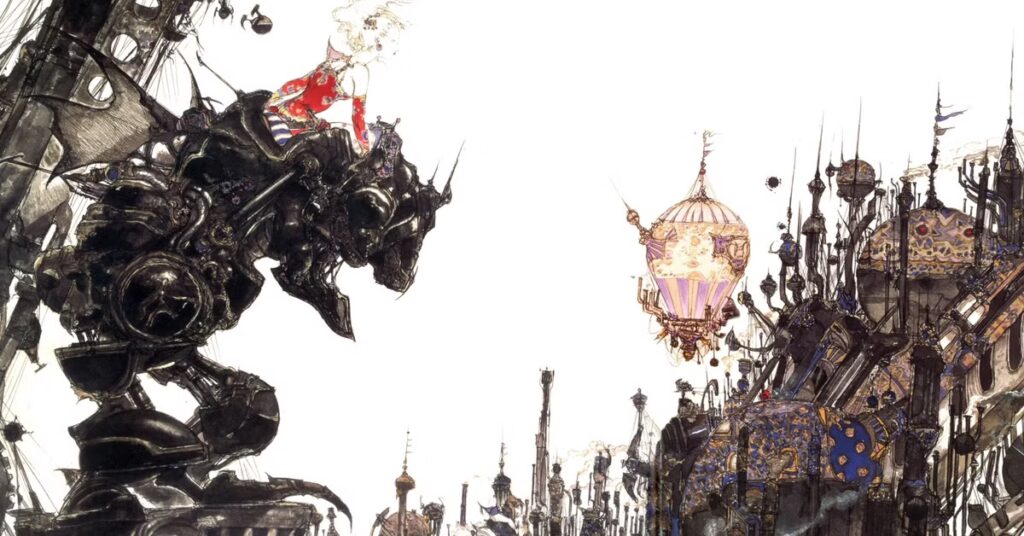
Amano’s contribution to Final Fantasy is best understood as a foundational artistic influence rather than sole authorship of everything the franchise depicts. His character and concept designs helped establish its visual identity, but those images entered productions involving numerous other artists and designers. A particularly useful example is his illustration of Terra riding Magitek armor. In a Square Enix interview, artist Toshitaka Matsuda identified that artwork as something that profoundly impressed him, providing a concrete example of Amano’s influence on another professional working within Final Fantasy rather than relying on a broader claim about what every fan remembers.
As a visual idea, a human figure paired with elaborate machinery can communicate more than a costume reference. It can suggest relationships between vulnerability and power, as well as between the individual and the constructed world. This illustrates the difference between concept art functioning as production information and illustration serving as an invitation to imagine a setting.
The collaborative nature of that work remains important. Square Enix’s Final Fantasy VI anniversary interview documents Tetsuya Nomura’s work on monsters and battle visuals while also identifying his later character design role on Final Fantasy VII. Amano’s importance should therefore not erase the contributions of other artists or imply that he originated every subsequent protagonist. His legacy is not simply a collection of individual designs, but an example of how a strong artistic sensibility can give a collaborative project an imaginative direction without determining every finished asset. That same principle provides useful context for ZAN, where ideas rooted in Amano’s own illustrated world are being adapted into a medium that necessarily involves a larger production team.

In This Article (8 sections)
Yoshitaka Amano’s Creative Identity Across Media
Yoshitaka Amano’s official career history begins at Tatsunoko Production, where his work included character design and concept art associated with Gatchaman, Time Bokan, Yatterman, Casshan, and The Adventures of Hutch the Honeybee. His later collaborations expanded across animation, games, and illustrated fiction, but those categories should not be collapsed into a single job description. Designing an animated character, interpreting a novelist’s protagonist, and creating imagery for a game involve different relationships with the finished work.
An illustrator may establish atmosphere and visual identity without controlling dialogue, plot, movement, or the audience’s eventual experience. Amano nevertheless described his underlying creative identity as consistent across media, making the distinction between a consistent artistic identity and changing creative responsibilities especially useful when considering his broader career.
That difference becomes clearer when comparing commissioned work with original projects. In commissioned illustration, an artist interprets material created by someone else, while in an original project the artist may establish the world from which later stories develop. DEVA ZAN makes this distinction explicit because its publisher identifies Amano as both author and illustrator of a fantasy novel rather than simply a contributor to somebody else’s existing franchise. The practical question is therefore not whether his style must completely change when moving into animation, but which parts of his visual identity should remain recognizable and which must be developed further so that characters can sustain complete scenes rather than individual images.
Amano described his work to 80 Level as a personal mixture of Eastern and Western influences, and his earlier interviews provide more detail about what that means. In a 1987 interview originally published in Beep and translated by Shmuplations, he discussed the influence of Frank Frazetta, particularly the force and physicality of the artwork. Decades later, a Nerdist interview recorded his admiration for Neal Adams and Frank Miller, alongside his interest in Kim Jung Gi.
These examples are more informative than broadly describing his art as a collision of cultures because they show him responding to specific approaches to drawing, composition, storytelling, and the human figure. Influence does not necessarily mean imitation, and an artist can absorb another creator’s energy or visual methods without adopting the same surface appearance. Likewise, Eastern and Western should not be treated as rigid stylistic categories. A more useful reading of Amano’s work focuses on selection and transformation, including what he notices, what he retains, and how those influences become part of a personally recognizable image.
Amano has also said that he does not consciously chase trends, but that position should not be confused with avoiding research or outside influence. His account of illustrating Guin Saga offers a clear example. He discussed studying leopard photographs and observing the animal at a zoo while working through the challenge of combining a feline head with a human figure. The important distinction is between gathering information to solve a creative problem and allowing a fashionable visual formula to determine the work. For character designers, this raises a useful question about whether a particular feature actually expresses the character or merely resembles what is currently popular.
Complicated costumes, exaggerated proportions, fashionable color palettes, and elaborate weapons can all be meaningful, but complexity or popularity alone does not establish identity. Avoiding trends also does not require deliberately opposing them, since making every decision in reaction against popular work would still allow those trends to control the process. A more durable approach is to develop priorities that remain useful as fashions change, including a clear relationship between form and personality, intentional use of detail, and continued curiosity about new visual possibilities.
From DEVA ZAN to the Hand Drawn ZAN Anime
ZAN was announced in June 2026 as a limited anime series based on Yoshitaka Amano’s original artwork, placing it within his own creative world rather than presenting it as a Final Fantasy adaptation. The word original refers to the project’s creative ownership and identity, not to the idea that its underlying characters and imagery first appeared in 2026.
The broader DEVA ZAN project predates the current anime production, and earlier animation initiatives were reported long before the release of the present pilot. For Final Fantasy audiences, the connection is therefore Amano himself rather than shared continuity. Familiarity with his game illustrations may provide an entry point, but it should not create expectations of established Final Fantasy characters, locations, or narrative rules.
The DEVA ZAN art project was unveiled in 2010 and encompasses more than 300 original works, while Dark Horse published the illustrated book in 2013. Those dates describe the project’s earlier development rather than the release of the current anime. The publisher presents DEVA ZAN as an illustrated fantasy novel, and its second edition description refers to more than 200 paintings. That figure should not be confused with the larger artwork count associated with the overall project because the contents of a published book and a creator’s broader development material are not automatically identical.
Amano explained to RPGamer that the images came first and that the story developed from them, while Dark Horse’s Michael Gombos described editor Carl Horn’s role in interpreting and organizing the visual material into a narrative. This reverses the more familiar assumption that a completed script generates illustrations, since in DEVA ZAN the images themselves became the starting point for constructing the story.
That origin creates both freedom and responsibility for an animated adaptation. A single image may imply a confrontation without explaining how it began, where the characters are, what they perceive, or why their next action matters.
Animation therefore requires more than reproducing attractive compositions. It must establish relationships between the images and make those relationships understandable over time while preserving the imaginative openness that made the source material compelling. The same applies to the project’s dark fantasy identity. In RPGamer’s interview, Amano emphasized audience enjoyment and the freedom for viewers to find their own meaning in the work. ZAN can therefore contain mythology, conflict, and difficult questions without requiring every viewer to arrive at the same interpretation. Its identity ultimately depends on the completed storytelling rather than assumptions attached to a genre label.
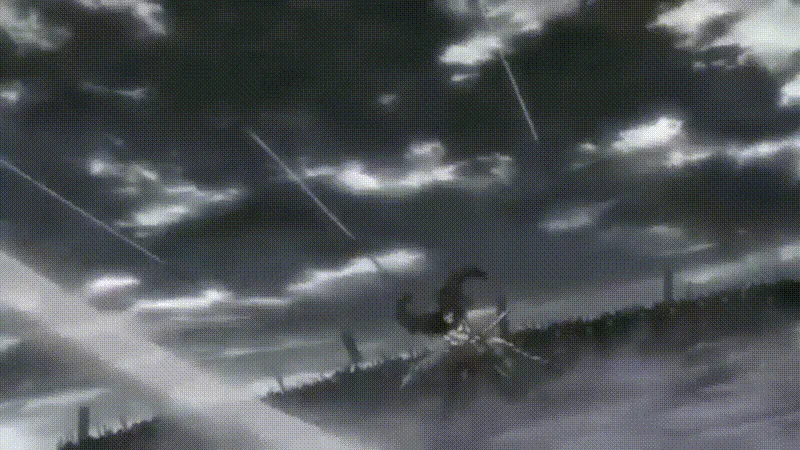
The ZAN pilot premiered during Amano’s Anime Expo panel on July 3, 2026. His official event recap describes it as a hand drawn production and identifies participating creators who discussed its development. Promotional material uses the phrase “100% hand drawn,” which establishes how the production presents its drawing approach, but it does not mean Amano personally drew every frame or that the eventual series has already been completed. In RPGamer’s interview, Amano connected this direction with a return to his animation roots and explained that earlier versions of the project had explored computer generated production before the current team pursued a different approach.
The hand drawn choice can be understood through the relationship between line and performance. In a still illustration, a mark can function mainly as texture, decoration, or atmosphere. In animation, comparable marks must also work across changing poses, spatial continuity, movement, and readable action. At the same time, hand drawn animation should not automatically be treated as an entirely analog production process, since the available interviews do not support presenting the project as a complete rejection of digital technology. The pilot is best understood as a public demonstration of the intended direction, giving audiences something tangible to examine without resolving every question about the finished production.
ZAN Anime Worldbuilding, Character Design, and Adaptation
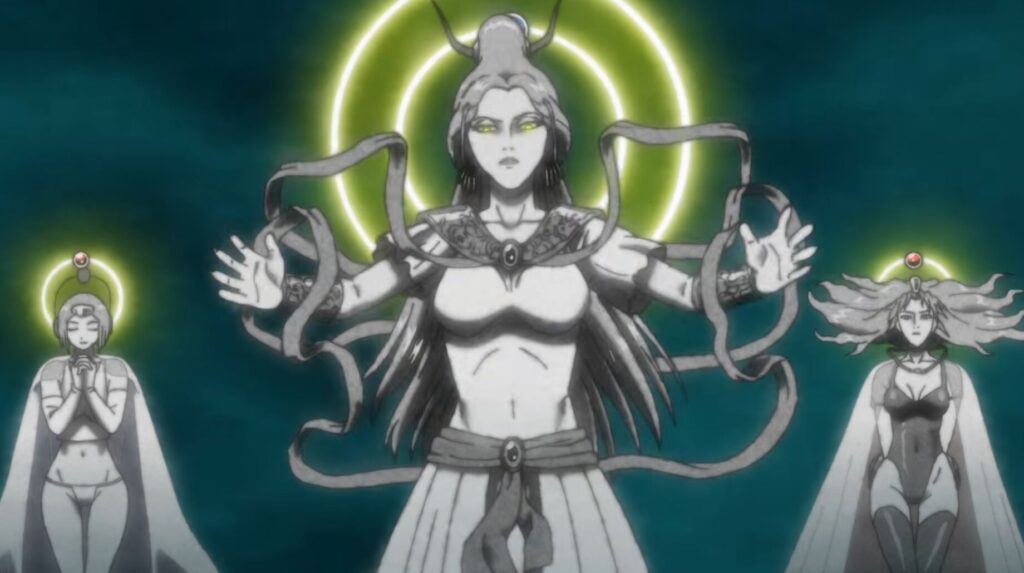
The official synopsis begins with ZAN fighting at Azuchi Castle during Japan’s Warring States period before a girl’s voice guides him beyond time and space. He encounters rivals and creatures called Tropes, commanded by RIKKA, while Panther and the mysterious Uzume accompany his search for truth. These elements establish several distinct sources of narrative interest. Historical imagery provides an initial point of orientation, while movement across time and dimensions takes the story beyond the boundaries of a conventional historical setting.
ZAN’s growing doubts about the justice of his battles also introduce a conflict that cannot necessarily be resolved through fighting alone. The DEVA ZAN book places different emphasis on an amnesiac warrior, vanished cosmic guardians, and a journey stretching from ancient Japan to modern New York and other dimensions. Those details belong to the published source material and do not confirm that every corresponding location or event will appear in the anime.
For the adaptation, the central challenge is coherence rather than the number of settings. A story can cross many worlds and still feel unified when its characters carry recognizable motives and unresolved questions between them. Striking locations alone cannot provide those connections. A stronger test of ZAN’s worldbuilding will be whether each environment changes the audience’s understanding of the characters rather than functioning only as another spectacular background. Amano has also identified ZAN and Panther as recurring motifs whose essential identities he intends to preserve. Official character information describes Panther as a mechanical lifeform, making it important not to assume from the name alone that the companion is simply an ordinary animal.
Preserving the identity of characters such as ZAN and Panther does not necessarily require reproducing every illustration literally. A painted image presents one arrangement of viewpoint, lighting, and pose, while animation must keep a character recognizable through constantly changing arrangements. This creates a distinction between decorative fidelity and expressive fidelity. Decorative fidelity concerns whether the same visible details remain, while expressive fidelity concerns whether a character retains the same presence, emotional tone, and relationship with the surrounding world.
The two goals can support one another, but they can also create difficult choices. A detail that enriches a large illustration may distract during a fast action sequence, while simplifying a shape can improve readability but potentially weaken a distinctive silhouette. Character adaptation therefore needs to work across different kinds of scenes. Recognition in a promotional pose is only one measure. A more demanding test is whether the character remains convincing while turning, reacting, resting, fighting, and interacting with others.
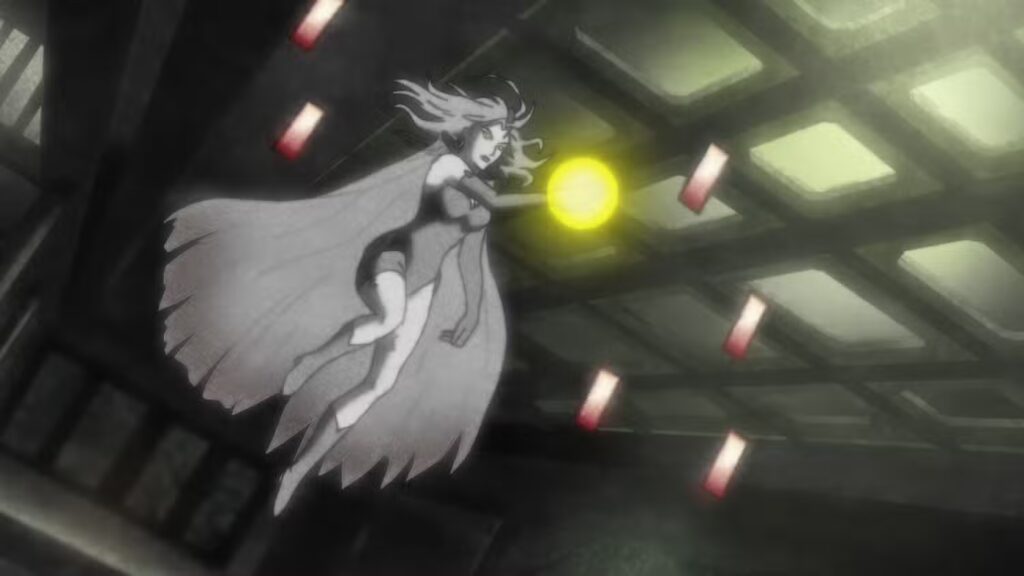
Amano has discussed the practical difficulties involved in translating illustrated characters into animation. In his 2018 Nerdist interview, he contrasted the freedom of drawing a character in a single image with an animator’s responsibility to resolve different angles and movement, using an elaborate cape as an example.
A cape can look convincing in one pose without explaining exactly how it is constructed, but once the character moves or turns, the production must determine how that material behaves and how its movement relates to the body. Similar questions apply to layered costumes, unusual proportions, and ornamental details. The animation team must decide which shapes are structural, which are decorative, which must remain visible for recognition, and which can change according to perspective.
Animation also controls how long the audience can examine visual information. An illustration allows viewers to decide how long they want to study a particular detail, while a moving sequence determines the available viewing time. When an action needs to be understood immediately, composition and movement must make the relevant information clear. These are general challenges involved in adapting detailed artwork rather than claims about undisclosed ZAN production methods. Beautiful source art alone does not guarantee a successful animated result. The strongest adaptation would instead establish a visual rhythm in which movement, stillness, detail, and atmosphere serve the same expressive purpose.

ZAN Anime Production, Release Updates, and the AMANO Experience
The official ZAN credits demonstrate how Amano’s original vision is being developed through a larger collaborative production. Masashi Ikeda and Tooru Yoshida are identified as animation directors, Moriyasu Taniguchi as principal animator, Ryosuke Takahashi for series composition and writing, and Yuya Takashima as a writer. Kunio Okawara handles mechanical design, Minoru Nishida serves as art director, and TEAM Anime R is responsible for animation production. Amano is credited as original creator, principal artist, and intellectual property owner. The pilot credits also identify Taniguchi’s character design and animation direction responsibilities, showing that translating Amano’s original imagery into animation is itself a distinct creative task.
Producer Hiroaki Ikegami explained in RPGamer’s interview that the collaborators joined the project with respect for Amano’s work, with the stated priority being to support rather than replace the original vision. The importance of the production team extends beyond the reputation of individual creators. Writing, directing, character adaptation, mechanical design, and background art each solve different problems, but all of those elements must ultimately agree about the world being presented.
An artist led production does not require the original creator to personally perform every task. Instead, it requires the decisions made across those different disciplines to remain connected to the central artistic idea. Collaboration inevitably introduces additional creative voices, with the key question being whether those voices help develop that idea into a more complete animated work.
As of September 23, 2026, ZAN’s official website states that a release date and distribution format have not been announced there. The available information therefore does not establish a confirmed series premiere or streaming destination. The verified public milestones remain separate from those unanswered questions. The limited series announcement arrived in June 2026, the Anime Expo panel took place on July 3, and the official July 7 website announcement confirmed that the pilot was available on YouTube. The existence of a publicly available pilot represents a production milestone rather than automatically serving as the first episode of a released series.
Older reports about ZAN should also be kept separate from the current production schedule. The project’s history includes an earlier spring 2012 target and a later film initiative associated with a projected 2025 to 2026 release. Those earlier plans should not be treated as the confirmed schedule for the present anime production. March 2, 2027 can create similar confusion because Penguin Random House lists that date for the second edition of the DEVA ZAN book. That is a publishing date rather than an anime premiere date. The project’s official news section and producer updates therefore remain the appropriate sources for distinguishing current production information from older plans or speculation.
The AMANO experience represents another expansion of Amano’s work, but it is separate from the ZAN anime. The June announcement describes plans involving galleries, immersive installations, collectibles, cafés, and merchandise, with an international rollout intended to begin in 2027. Amano described this spatial work as a collaboration with immersive artists. The challenge resembles animation in one important respect because audiences no longer encounter a single fixed composition under completely predictable conditions. Visitors can approach from different directions, stop at different points, and notice individual elements in different sequences. An immersive adaptation must therefore consider more than simply enlarging existing artwork. Scale, movement through the environment, and relationships between individual works can all change how the imagery is experienced.
These AMANO experience plans should also be distinguished from separately announced museum exhibitions. Yoshitaka Amano: Big Bang at Asia Society Texas is scheduled from September 23, 2026, through February 7, 2027, with its announcement describing approximately 40 works produced across nearly three decades and using materials including oil, ink, and automotive paint. The exhibition demonstrates the breadth of Amano’s fine art practice, but it does not by itself confirm the opening of every proposed AMANO entertainment location. Together, the anime, immersive projects, and museum exhibitions show different ways Amano’s work is being translated beyond individual illustrations, while remaining distinct projects with their own formats, schedules, and creative requirements.
Frequently Asked Questions (FAQs)
- What advice does Amano offer young artists?
Amano’s advice emphasizes continuing to draw, create, and express a personal worldview rather than waiting for a complete artistic identity to appear first. The practical idea is that a recognizable style develops through sustained work, experimentation, and repeated creative decisions. Instead of focusing only on trends, young artists can gradually build their own visual identity by continuing to produce work and discovering what consistently interests them. - Who is Yoshitaka Amano?
Yoshitaka Amano is a Japanese artist whose career spans animation, character design, concept art, illustration, and fine art. His official biography lists major projects such as Final Fantasy, Vampire Hunter D, Angel’s Egg, and Guin Saga. His work has therefore reached audiences through several different creative fields, rather than being limited to one franchise or medium. - Did Yoshitaka Amano design every Final Fantasy character?
No. Final Fantasy has always been a collaborative franchise involving many artists, designers, writers, and developers. Amano played a major role in establishing the series’ early visual identity, but Square Enix also documents Tetsuya Nomura’s contributions to Final Fantasy VI and his later character design role on Final Fantasy VII. Amano’s influence is important, but it should not be treated as sole authorship of every character or visual element in the series. - Is ZAN connected to Final Fantasy’s story?
No announced story connection has been established between ZAN and Final Fantasy. ZAN is presented as an original Amano project developed from DEVA ZAN, with its own characters, world, and narrative. The main connection is Yoshitaka Amano himself, since audiences may recognize elements of his artistic style from his work on Final Fantasy, but that does not mean the projects share the same fictional continuity. - What is DEVA ZAN?
DEVA ZAN is Yoshitaka Amano’s illustrated fantasy work and serves as the source material behind the ZAN animation project. The published story follows a warrior caught in a larger conflict that stretches across different times, places, and dimensions. Amano has explained that the images came first and that the story developed from them, making the project notable for building its narrative around an existing body of artwork. - Does the ZAN anime have a confirmed release date?
As of September 23, 2026, the official ZAN website states that no release date or distribution format has been announced there. This means there is no confirmed premiere date or officially identified streaming destination for the full series at that point. The existing pilot and production announcements show that the project is in development, but they should not be mistaken for confirmation of a finished series launch. - Is the ZAN pilot hand-drawn?
Yes. Amano’s official Anime Expo recap describes the ZAN pilot as hand drawn, and promotional material has emphasized that approach as part of the project’s visual identity. However, that description applies to the pilot and does not mean Amano personally drew every frame or that the entire planned series has already been completed. The pilot is best understood as a demonstration of the intended animation direction. - Where can the ZAN pilot be watched?
The official July 7, 2026, announcement confirms that the ZAN pilot is available on YouTube. The project’s official website also provides access to the video, giving audiences a public look at the animation style and creative direction being developed for the project. Its availability does not mean the complete series has been released. - What is releasing on March 2, 2027?
Penguin Random House lists March 2, 2027, as the release date for the second edition of the DEVA ZAN book. That date applies to the published book and should not be confused with a release date for the ZAN anime. The anime and the book are related through the same creative world, but their release schedules are separate. - What is the AMANO experience?
AMANO is a planned art and entertainment initiative designed to expand Yoshitaka Amano’s work into immersive experiences beyond traditional illustration. Announced plans include galleries, immersive installations, collectibles, cafés, merchandise, and other related experiences, with international expansion intended to begin in 2027. It is separate from the ZAN anime, although both projects explore different ways of presenting Amano’s artwork in new formats.
Conclusion
The Yoshitaka Amano interview on Final Fantasy visual identity and bringing ZAN into animation is ultimately about the relationship between personal imagination and collaborative execution. His published comments emphasize continuity of identity, while the production credits make clear that translating that identity into animation involves many specialized contributors.
ZAN is especially useful for considering that relationship because its images preceded the adaptation. The project must do more than preserve attractive designs: it must make them function through movement, narrative, and changing viewpoints.
The appropriate response is neither to dismiss the production as another adaptation nor to assume that distinguished contributors guarantee the result. The pilot provides an initial statement of direction. The finished work will need to demonstrate how successfully that direction supports sustained storytelling.
For artists, the broader lesson is equally practical. A distinctive visual identity is not protected only by keeping others away. It can also be strengthened by understanding what is essential, communicating it clearly, and allowing collaborators to help it succeed in forms one artist could not create alone.
Sources and Citations
- 80 Level, August 26, 2026 : David Jagneaux interviews Amano about his visual identity, artistic influences and approach to adapting ZAN for animation. The discussion also covers collaboration, avoiding trends and developing a distinctive personal style that can endure across generations.
Interview: Yoshitaka Amano on Creating Art That Transcends Games, Anime and Generations - RPGamer, July 11, 2026 : Jordan McClain’s Anime Expo interview explores ZAN’s development, its approach to hand drawn animation and Amano’s creative influences. It also discusses his Final Fantasy work and how illustrations can become the starting point for larger stories.
Yoshitaka Amano Interview - Nerdist, July 29, 2018 : Gretchen Smail interviews Amano about his drawing process, career and artistic inspirations. The discussion includes his admiration for Batman and comic book artists, providing historical context for the influences behind his illustration and character design work.
Final Fantasy’s Yoshitaka Amano Talks Art Process and His Favorite American Superhero - Yoshitaka Amano Inc., Official Artist Website : Provides Amano’s biography, career highlights and links to his current projects. It documents his work across animation, illustration and Final Fantasy, while directing readers to official ZAN information and recent company announcements.
Yoshitaka Amano Official Website - ZAN, Official Project Website : Presents the pilot film, story, characters, production team and connection to DEVA ZAN. It also provides production history and project updates, distinguishing the publicly available pilot from the larger animation project still in development.
ZAN Official Website - Yoshitaka Amano Inc., Official News and Announcements : Collects updates on ZAN, exhibitions, collaborations and public appearances. Its Anime Expo 2026 coverage documents Amano’s activities and the pilot presentation, while other posts provide links to the released pilot and subsequent project announcements.
Yoshitaka Amano Official News - Anime Expo Newsroom, June 16, 2026 : Publishes Yoshitaka Amano Inc.’s announcement that ZAN had entered production, alongside plans for its Anime Expo presentation. It introduces the project’s origins in DEVA ZAN and outlines the expanded AMANO experience planned for attendees.
Announcing ZAN, an Original Anime Project by Yoshitaka Amano, and an Expanded AMANO Experience - Anime Trending, August 20, 2026 : Interviews Amano and ZAN’s production team about its artistic direction, adaptation of DEVA ZAN and emphasis on hand drawn animation. It also explains how supporting digital tools fit into the production’s visual approach.
Yoshitaka Amano on the Artistic Direction of His Upcoming Dark Fantasy Anime ZAN - Anime Herald, July 10, 2026 : Discusses how selected material from DEVA ZAN is being adapted, why the project resumed and how Amano oversees storyboards. The interview also explores his creative influences and ambition to develop an original mythology.
ZAN: A Conversation with Yoshitaka Amano at Anime Expo 2026
Recommendations
- Gothic 1 Remake Official Launch Trailer Breakdown: Gameplay, Story Changes, Release Details, and Everything You Need to Know
- PEAK The Final Ascent Update Arrives August 11 as Its Final Major Update
- Unhinged: How to Play on Netflix with Your Phone Controller
- Alibaba launches $450 Qwen Glasses N1 AI smart glasses, N1 Pro adds eye tracking and iris payments
- How to Create a Metahuman from a Photo: The Ultimate Guide to Digital Character Creation
- No, I’m Not a Human Complete Guide to Humans and Visitors: Full Character Breakdown, Visitor Detection Tips, and How to Identify Every NPC in No, I’m Not a Human
- TetherGeist Review: Why Celeste Fans Need to Check Out This Clever New Platformer ASAP
- Jetpack Joyride Designer Luke Muscat Reveals New Golfing Simulation Game
- Echoes of Aincrad: Death Game Mode Explained, Permadeath Rules, Rewards & Survival Guide
- DLSS 5 Update: Reported 30–40% RTX 40 FPS Gains Explained



































































































