











What is a Steam Machine?
A Steam Machine is Valve’s concept of a living-room gaming PC that bridges the gap between console simplicity and PC gaming power. It is a compact PC/console hybrid designed to run SteamOS and play Steam libraries on a big screen with a gamepad. Originally introduced in 2015, the concept failed due to limited game support and confusing hardware lineups. In 2026, Valve is reviving it as an official, standardized device nicknamed the “GabeCube” due to its 6-inch cube-shaped design. It serves as a mini-PC for the living room that offers console-like convenience with PC flexibility.

Steam Machine 2026 Release Date and Shipping Window
Valve unveiled the new Steam Machine in November 2025, initially targeting an early 2026 release. In an early 2026 earnings call, Valve’s CEO confirmed the device was “on track” to ship in the first half of 2026. AMD’s CEO Lisa Su also stated shipping would begin “early this year.” While a tentative spring 2026 launch window is expected (by June), no exact date has been announced as of Q1 2026. Valve remains cautious about committing to a firm date due to industry supply issues.
Steam Machine Delayed Due to Memory and Storage Shortages
In February 2026, Valve announced a delay in the shipping schedule and a re-evaluation of pricing due to a global shortage of memory and storage components. Massive AI data center demand has caused RAM and NAND flash storage prices to skyrocket. Specifically, DDR5 RAM prices tripled over the past year. As a niche hardware manufacturer, Valve must compete with industry giants for these parts. While a modest pushback is expected, Valve still plans to ship the device in the first half of 2026 alongside a new Steam Controller and Steam Frame headset.

Steam Machine Price and Expected Cost in 2026
Valve is not subsidizing the Steam Machine like a traditional console; it is priced in line with PC hardware. Early estimates of $550–$600 have risen due to the memory crisis. Leaked European retailer listings suggested prices between $950 and $1,070, though these may include markups. Current industry estimates suggest a range of $700 to $1,000+ depending on the configuration. Valve engineers have confirmed the price will be “what you’d expect from the current PC market,” with the value coming from performance and small form factor rather than a bargain price.
Steam Machine Specs and Performance Expectations
The Steam Machine is built on a custom AMD APU with the following specifications:
- CPU: Semi-custom AMD Zen 4 (6 cores / 12 threads) up to 4.8 GHz.
- GPU: Semi-custom AMD RDNA 3 graphics (28 CUs) up to 2.45 GHz, delivering 9.6 TFLOPs (roughly 6x the power of Steam Deck).
- Memory: 16 GB DDR5 system RAM plus 8 GB dedicated GDDR6 VRAM.
- Storage: 512 GB or 2 TB NVMe SSD models, user-expandable via an M.2 slot and microSD slot.
- Connectivity: HDMI 2.0, DisplayPort 1.4, Gigabit Ethernet, Wi-Fi 6E, Bluetooth, and five USB ports (including one USB-C).
- Power & Cooling: Internal power supply and a 120mm fan designed for quiet operation.
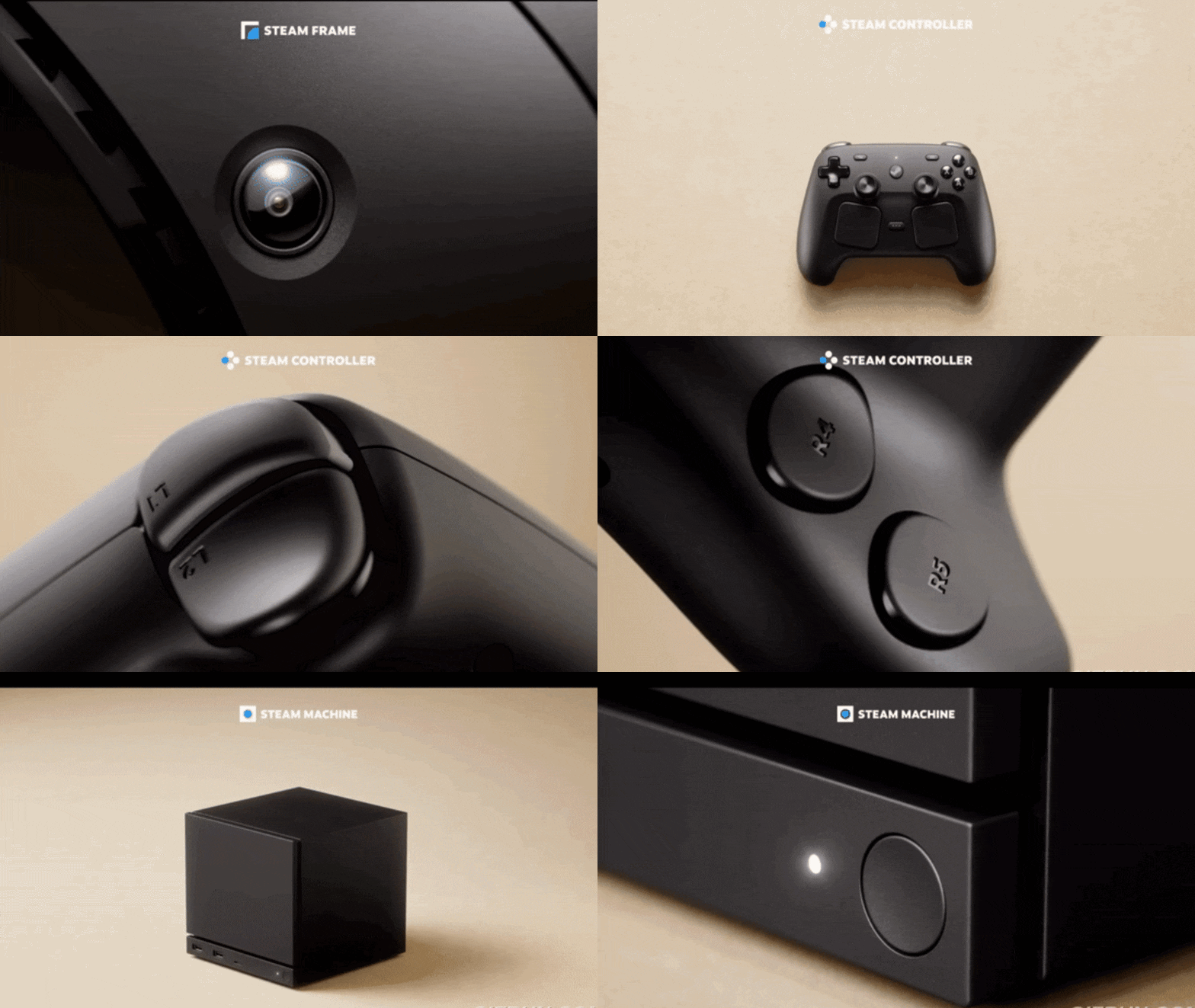
- Dimensions: ~15.6 × 15.2 × 16.2 cm with a customizable LED light bar.
Performance is comparable to a mid-to-high-tier 2023–2024 gaming PC or ninth-generation consoles (PS5/Xbox Series X). It is expected to handle most games at 1080p or 1440p ultra settings and 4K at 60 FPS with the help of FSR upscaling.

Can the Steam Machine Run 4K 60fps?
Yes, 4K 60 FPS is a core target. Valve states the hardware supports this resolution and frame rate specifically when using AMD’s FSR (FidelityFX Super Resolution) upscaling. While less demanding titles or indie games may run at native 4K, AAA titles will likely use dynamic resolution scaling or FSR to maintain 60 FPS. The device also supports ray tracing and can output up to 4K 120Hz via HDMI 2.0 or 8K 60Hz via DisplayPort.
SteamOS on Steam Machine Explained
The device runs SteamOS 3, an Arch Linux-based operating system designed to make PC gaming a seamless, background experience.
- Dual Interface: Boots into a console-style Game Mode (Big Picture UI) but includes a full KDE Plasma desktop mode for PC use.
- Steam Integration: Full access to the Steam store, cloud saves, and social features.
- Rolling Updates: The OS receives frequent driver and feature updates managed by Valve.
- Suspend/Resume: Allows users to pause a game and put the machine to sleep, resuming instantly later.
Because it is Linux-based, it does not run Windows applications by default, though users can install Windows if they choose.

Proton Compatibility on Steam Machine (Will Windows Games Work?)
Windows games will work on the Steam Machine thanks to Proton, a compatibility layer built into SteamOS. This solves the library limitations of the 2015 models.
- Ease of Use: Most of the 50,000+ titles on Steam are plug-and-play without requiring a Windows installation.
- Verified Program: Any game “Verified” on Steam Deck is automatically “Verified” for Steam Machine.
- Compatibility: Proton handles DirectX 11/12 games and many anti-cheat systems (Easy Anti-Cheat and BattlEye).
- Exceptions: A few titles with kernel-level anti-cheat (like Valorant) may not run on SteamOS.
Steam Machine vs Steam Deck (Which Should You Buy?)
The choice between the Steam Machine and the Steam Deck depends on whether you prioritize living-room console play or handheld portability.
- Form Factor & Use Case: The Steam Machine is a desktop console for entertainment centers, designed for big-screen TV gaming and local multiplayer. The Steam Deck is a handheld device with an integrated screen and controls for gaming on the go.
- Performance: The Steam Machine is over six times more powerful than the Steam Deck, utilizing a Zen4 CPU and RDNA3 GPU. While the Deck targets 720p-800p resolutions at medium settings, the Steam Machine targets 1080p-4K at high/ultra settings.
- Portability & Convenience: The Steam Deck is all-in-one with a battery for portable play. The Steam Machine requires a power outlet and an external display.
- Display & Controls: The Deck features a built-in 7-inch screen and integrated controls. The Steam Machine uses your TV/monitor and requires a gamepad or the new Steam Controller 2.
- Price: The Steam Deck is more budget-friendly, starting around $449, while the Steam Machine is expected to range from $700 to $1,000.
- Upgradeability: Both allow for SSD replacement, but the Steam Machine offers easier storage expansion via an internal NVMe slot and a microSD slot.

Steam Machine vs Gaming PC (Upgradeability and Value)
The Steam Machine is a pre-built gaming PC in a console form factor running SteamOS.
- Upgradeability: A custom PC tower offers total flexibility to swap GPUs, CPUs, and RAM. The Steam Machine is an integrated system; while storage is expandable, the custom CPU and GPU are not intended for user replacement.
- Customization: Like a PC, the Steam Machine is not locked down; users can install Windows 11 or other software.
- Form Factor vs Power: Valve engineered the Steam Machine as a quiet, 6-inch cube, which is difficult to replicate with DIY parts. It targets users who want PC power without the hassle of a custom build.
- Value and Cost: A DIY PC might offer more performance per dollar once component prices normalize, but the Steam Machine provides a polished, warrantied, “plug and play” experience.
Steam Machine vs PS5 and Xbox Series X (Console Replacement or Not?)
Valve positions the Steam Machine as a potential console replacement for the living room.
- Performance: Hardware is on par with ninth-gen consoles, featuring RDNA3 architecture and 16GB RAM with 8GB dedicated VRAM. It supports 4K60, ray tracing, and 120Hz output.
- Game Library: Steam offers an enormous library and better backward compatibility than consoles, but it lacks Sony, Microsoft, or Nintendo exclusives unless they are ported to PC.
- User Experience: Like a console, it boots into a controller-friendly UI. It has no subscription fees for online multiplayer, though it currently lacks native media apps like Netflix.
- Ecosystem: It offers the openness of the PC (mods, community patches) within a console-like environment.
- Price: The Steam Machine has a higher upfront cost than the $499 consoles but can recoup value through cheaper games and free online play.

Steam Machine Controller Support
The Steam Machine supports a diverse range of input options.
- Steam Controller (2026): A new proprietary controller featuring dual trackpads, HD haptics, and magnetically-sensed joysticks to prevent drift. It includes a dedicated wireless receiver built into the Steam Machine.
- Third-Party Controllers: Full support for Xbox, PlayStation (DualSense/DualShock), and Nintendo Switch Pro controllers via Bluetooth or USB.
- Steam Input: Allows for deep customization and community mapping for nearly any PC-compatible peripheral, including fight sticks and racing wheels.
- Local Multiplayer: Supports multiple controllers simultaneously for couch co-op sessions.
Steam Machine and Steam Frame Difference
Valve’s 2026 hardware lineup serves different categories:
- Steam Machine: A mini-PC/console for traditional flat gaming on a TV or monitor.
- Steam Frame: A standalone, wireless VR headset that succeeds the Valve Index. It runs SteamOS internally and plays VR games natively without a tether.
- Integration: While separate, the devices are designed to complement each other; the Steam Machine can potentially stream content to the headset.

Steam Machine for Living Room Gaming Setup
To optimize the living room experience:
- Display Connection: Use HDMI 2.0 for 4K60 HDR. Enable “Game Mode” on your TV to reduce input lag and turn on FreeSync/VRR if supported.
- Networking: Gigabit Ethernet is recommended for large downloads and stable play, though Wi-Fi 6E is included.
- Audio: Supports digital audio via HDMI, including multi-channel LPCM for surround sound systems.
- Placement: Designed to fit in media cabinets with a 120mm fan for cooling, but side intakes should remain unblocked.
- Rest Mode: Use the “suspend” feature to resume games quickly, similar to a console experience.
Steam Machine Streaming and Remote Play
Valve’s Remote Play ecosystem provides several features for the Steam Machine:
- As a Client: You can stream games from a more powerful Windows PC to the Steam Machine (useful for non-Linux compatible titles).
- As a Host: You can stream games from your Steam Machine to a phone, tablet, or laptop elsewhere in the house.
- Steam Link: The Steam Machine makes dedicated Steam Link hardware redundant, as it performs the same functions locally and with higher quality.
- Remote Play Together: Allows you to invite friends to join local multiplayer games over the internet.

Steam Machine Storage Upgrades and SSD Options
The device offers flexible storage management:
- Cloud Saves: Steam Cloud automatically syncs progress, allowing users to manage drive space without losing game data.
- Base Models: Available in 512 GB and 2 TB NVMe SSD configurations.
- Internal Expansion: Users can expand storage internally with NVMe SSDs via an accessible slot.
- MicroSD Slot: Provides a convenient way to add storage for indie games or to transfer libraries between a Steam Deck and Steam Machine.
- External Storage: USB 3.2 Gen2 ports allow for high-speed external SSDs or hard drives.
Steam Machine Preorder and Where to Buy
As of early 2026, official pre-orders for the Steam Machine have not yet opened. Based on Valve’s previous hardware launches, the following is expected:
- Valve’s Official Store (Steam): Valve will likely sell the device directly via the “Hardware” section on Steam. This may involve a reservation system similar to the Steam Deck to manage high demand and limited supply caused by memory shortages. A Steam account in good standing with Steam Guard enabled may be required.
- Retailers: Leaked pricing from Czech retailers suggests Valve may allow third-party retail distribution shortly after launch. Major electronics stores and retailers like GameStop or EB Games may carry the device, particularly the controller bundles.
- Pre-order Timing: While originally planned for earlier, announcements were delayed due to supply chain issues. Pre-orders are currently anticipated for Q2 2026, possibly opening weeks before the units begin shipping.
- Editions and Bundles: Two storage versions (512GB and 2TB) are expected. Valve has confirmed the device will be sold both standalone and in a bundle with the new Steam Controller.
- Regional Availability: Rollout is expected to be gradual, likely starting with North America and Europe. Valve typically uses authorized local partners, such as Komodo in Japan, for specific markets.
- Reservation Model: Due to component shortages, Valve may implement a $5 reservation deposit system to prioritize early customers and prevent scalping.

Steam Machine (2015) History and Original Hardware Partners
The original Steam Machine initiative (2013–2015) was a collaboration between Valve and various PC manufacturers to bring SteamOS to the living room. Unlike the 2026 model, Valve did not produce its own unified hardware for the initial launch.
- Hardware Partners: At CES 2014, Valve revealed a dozen partners, including:
- Alienware (Dell)
- CyberPowerPC (Syber)
- Zotac
- iBuyPower
- Falcon Northwest
- Origin PC
- Gigabyte
- Digital Storm
- Regional partners such as Alternate (Europe) and Scan Computers (UK).
- Launch and Variety: The first units launched in November 2015. Models varied wildly, ranging from $500 to $5,000, using different combinations of Intel/AMD CPUs and NVIDIA GPUs. This lack of a reference spec created a fragmented market and confusing messaging for consumers.
- Valve’s Role: Valve provided the Debian-based SteamOS and the Steam Controller but left the hardware design and sales to the partners.
- Outcome: The initiative failed to gain traction, with fewer than 500,000 units sold by mid-2016. Valve eventually removed the Steam Machines section from the store in April 2018.
Why the First Steam Machines Failed
Several factors contributed to the failure of the original 2015 hardware:
- Lack of Games on SteamOS: The biggest hurdle was the reliance on native Linux support. Most Steam games were Windows-only, leaving early adopters with a tiny fraction of their libraries.
- Windows 10 Dominance: The release of Windows 10 in 2015 improved the PC gaming experience, making the switch to a Linux-based OS less urgent for most users.
- Fragmented Hardware: Having dozens of different models with different specs confused consumers. There was no single “console” for developers to optimize for.
- High Price for Performance: Steam Machines were often more expensive than the PS4 and Xbox One. Enthusiasts found it cheaper to build their own PCs or use Windows-based small-form-factor units.
- OS and Driver Issues: Early SteamOS lacked polish and faced inferior driver support compared to Windows, leading to poor performance in some titles and a lack of media apps.
- Controller Learning Curve: The original Steam Controller’s trackpad-focused design was polarizing and had a significant learning curve compared to traditional sticks.
- Marketing and Competition: Valve lacked the massive marketing budgets of Sony or Microsoft. The device fell into a niche gap: it wasn’t simple enough for console players and wasn’t flexible enough for PC veterans.
The 2026 Steam Machine aims to rectify these mistakes by using a Valve-designed unified hardware spec and utilizing Proton to ensure almost the entire Windows game library is playable on Linux.

Is the Steam Machine Coming Back for Good?
Valve’s 2026 re-entry into the console arena is more promising than its 2015 attempt due to several factors:
- Proton and SteamOS Maturity: The “no games” issue has been solved. Proton allows Windows games to run on Linux, giving the device a massive library on day one.
- Unified Hardware: Valve is now building and supporting the hardware directly, ensuring better optimization and consumer confidence compared to the previous third-party model.
- Proven Demand: The success of the Steam Deck has demonstrated a strong market for Valve’s hardware and its “gaming-first” ecosystem.
- Market Shift: As Microsoft and Sony bring more titles to PC, the Steam Machine serves as an “all-in-one” platform for multi-platform gaming with more user freedom than traditional consoles.
- Natural Adoption: Users no longer need to be tech enthusiasts to use Linux-based systems; the experience is now as seamless as a dedicated console.
Challenges remain, particularly the high retail price (expected at $800–$1,000) and the lack of platform exclusives like those found on Nintendo or Sony systems. However, Valve’s long-term strategy involving a hardware ecosystem (Deck, Machine, Frame, and Controller) suggests they are committed for the long run.
Best Steam Machine Alternatives in 2026
If the Steam Machine is delayed or outside your budget, several alternatives exist:
- Mini Gaming PCs: Brands like Minisforum, Aoostar, Beelink, and GMKtec offer small desktops with Zen 4 or Intel Core processors. Many under $500 can handle 1080p gaming via powerful integrated RDNA3 graphics or support external GPUs via USB4/OCulink.
- Small Form Factor (SFF) Desktops: Building a Mini-ITX PC (e.g., in a Cooler Master NR200 case) allows for full desktop GPU performance and upgradeability, though it results in a larger footprint than the Steam Machine.
- Docked Steam Deck: The Steam Deck can act as a “Steam Machine Lite” when connected to a TV dock. It offers a similar UI at a lower price point, though it lacks the 4K performance of the dedicated console.
- Consoles + Streaming: Combining a PS5 or Xbox with services like GeForce Now or Steam Link apps can cover living-room gaming needs for some users.
- Handheld PC Consoles: Devices like the ROG Ally or Lenovo Legion Go can be docked to a TV to serve as a mini console.
- DIY SteamOS: Tech-savvy users can install SteamOS 3 or community versions (like HoloISO) on any mini PC or desktop to create a custom Steam Machine.

FAQ Questions and Answers
- Q: When is the Steam Machine 2026 release date?
Valve aims to ship the device in the first half of 2026, likely before July, following slight delays caused by component shortages. - Q: How much will the Steam Machine cost?
Official pricing is pending, but it is expected to range between $700 and $1,000. It is priced as a PC rather than a subsidized console. - Q: What are the specs of the new Steam Machine?
It features an AMD Zen 4 CPU, RDNA 3 GPU, 16GB DDR5 RAM, 8GB dedicated GDDR6 VRAM, and 512GB or 2TB NVMe SSD options. It supports 4K 60fps and ray tracing. - Q: Can I upgrade the storage or RAM?
The storage is upgradeable via internal NVMe or the microSD slot. The 16GB system RAM is likely soldered and not user-upgradeable. - Q: Will Windows games work on the Steam Machine?
Yes. Proton allows Windows games to run on SteamOS. Most titles in the Steam library are compatible out-of-the-box. - Q: Can I install Windows on the Steam Machine?
Yes. It is an open PC platform, allowing users to install Windows 11 or other operating systems if desired. - Q: Is it more powerful than a PS5 or Xbox Series X?
It is in the same ballpark. It has a newer CPU and GPU architecture, though it may have slightly less GPU brute force. It features 24GB of total combined memory compared to the consoles’ 16GB. - Q: What controllers can I use with Steam Machine?
Any PC-compatible controller, including the new Steam Controller, Xbox, PlayStation (DualSense/DualShock), and Switch Pro controllers. - Q: Do I still need a Steam Link to stream games to my TV?
No. The Steam Machine runs games locally on your TV, making a separate streaming box redundant. - Q: Will my existing games and saves carry over?
Yes. Your entire library and all cloud saves sync to the Steam Machine automatically; no re-purchasing is required.

Conclusion
The 2026 Steam Machine is a refined second attempt at a living-room PC. Unlike the 2015 version, this model features unified Valve-designed hardware and the Proton compatibility layer, ensuring a massive day-one game library. While it faces high component costs and stiff competition from traditional consoles, it offers a unique value proposition: the openness and massive library of a PC with the “plug and play” convenience of a console. For gamers invested in the Steam ecosystem, it represents a powerful, versatile, and permanent fixture in Valve’s growing hardware lineup.
Sources and Citations
- Valve delays Steam Machine launch due to memory shortages — Tom’s Hardware News (Feb 2026)
Link: https://www.tomshardware.com/video-games/console-gaming/valve-delays-steam-machine-and-says-it-is-reconsidering-pricing-critical-component-shortage-and-costs-behind-the-move - Valve confirms memory/storage shortage affecting Steam Machine & pricing — Steam Hardware blog via Road to VR (Feb 5, 2026)
Road to VR link: https://www.roadtovr.com/steam-frame-ram-shortage-release-date-price/
Valve Steam Hardware blog link (referenced by Road to VR): https://store.steampowered.com/news/group/45479024/view/625565405086220583 - Wccftech — Czech Retailer Leak of Steam Machine Price (Jan 2026)
Link: https://wccftech.com/steam-machine-price-leak-valve/ - Wccftech — AMD Confirms Steam Machine shipping early 2026, spec details (Feb 4, 2026)
Link: https://wccftech.com/amd-confirms-steam-machine-will-start-shipping-early-this-year/ - Reddit (IGN summary) — Valve’s next-gen Steam Machine specs + “6× Steam Deck” (Nov 2025)
Reddit link: https://www.reddit.com/r/computergaming/comments/1oxj8td/valves_nextgen_steam_machine_and_steam_controller/
IGN link (the article Reddit points to): https://www.ign.com/articles/valves-next-gen-steam-machine-and-steam-controller-the-big-interview - Nerdist — “Valve Announces New Steam Machine” (Nov 12, 2025)
Link: https://nerdist.com/article/valve-announces-next-gen-steam-machine-pc-console-hybrid/ - Valve SteamOS information — Wikipedia (SteamOS 3 based on Arch, Proton integration)
Link: https://en.wikipedia.org/wiki/SteamOS - Steam Machine vs Steam Deck performance comparison — Wccftech “It Just Works” article (Jan 2026)
Link: https://wccftech.com/it-just-works-steam-machine-verified-badge-will-have-fewer-constraints-than-steam-deck-verification-to-no-ones-surprise/ - Proton compatibility / Verified program — Valve interview (GameDeveloper.com via Wccftech, Jan 2026)
GameDeveloper link: https://www.gamedeveloper.com/pc/steam-machine-verified-requirements-will-have-fewer-constraints-than-steam-deck-says-valve
Wccftech link (covers/quotes the interview): https://wccftech.com/it-just-works-steam-machine-verified-badge-will-have-fewer-constraints-than-steam-deck-verification-to-no-ones-surprise/ - Steam Machine hardware specs recap — Wikipedia (Nov 2025 announcement section)
Link: https://en.wikipedia.org/wiki/Steam_Machine - Valve engineer quote on pricing strategy (“like current PC market”) — Wccftech leak analysis (Jan 2026)
Link: https://wccftech.com/steam-machine-price-leak-valve/ - Memory shortage impact on cost — Wccftech (AMD CEO remarks, Feb 2026)
Link: https://wccftech.com/amd-prepares-to-battle-pc-market-uncertainty-but-ceo-says-the-focus-will-stay-on-enterprise/ - Steam Machine vs PS5/XSX parity reference — Wikipedia (ninth-gen consoles)
Link: https://en.wikipedia.org/wiki/Ninth_generation_of_video_game_consoles - Steam Machine features (ports, LED, etc.) — Reddit/IGN-style recap (Nov 2025)
Link: https://www.reddit.com/r/GameDevSolutions/comments/1ow0z5k/valve_announces_nextgen_steam_machine_says_its/ - Controller support (“works with other controllers”) — Tom’s Hardware hands-on (Nov 2025)
Link: https://www.tomshardware.com/video-games/console-gaming/valve-brings-back-steam-machine-and-steam-controller-hands-on-with-valves-new-amd-based-living-room-gaming-hardware - Steam Controller 2 features — Valve press coverage (Nov 2025)
The Verge hands-on: https://www.theverge.com/games/815061/valve-steam-controller-hands-on-deck-frame-machine
PC Gamer hands-on/specs: https://www.pcgamer.com/hardware/controllers/steam-controller-specs-availability-hands-on/
PC Gamer feature (gyro/grip sensing story): https://www.pcgamer.com/hardware/controllers/how-gyro-support-was-added-into-the-new-steam-controller-is-a-typical-valve-story/ - Steam Deck subsidized pricing comment — Reddit user quote (discussion thread)
Link: https://www.reddit.com/r/Games/comments/1hvyxf6/steamos_expands_beyond_steam_deck/ - Original Steam Machines partners list — Fudzilla (Jan 2014)
Link: https://fudzilla.com/news/33579-valve-reveals-its-twelve-steam-machine-partners - Valve engineer reflection on why 2015 Steam Machines failed (lack of games) — Wikipedia reference
Link: https://en.wikipedia.org/wiki/Steam_Machine - TechRadar — “Best Steam Machine alternatives” (Nov 15, 2025)
Link: https://www.techradar.com/pro/forget-valves-new-steam-machine-here-are-5-mini-pcs-under-usd500-that-can-run-steamos-play-games-and-stream-media
Recommended
- Virtual Influencers: AI-Generated vs 3D-Modeled – Which Is Better?
- Mastering Hair Creation in Blender: A Step-by-Step Guide
- How do I create a circular camera animation in Blender?
- The Future of 3D Modeling: Insights on AI Advancements
- What Are the 7 Basic Camera Movements in 3D Animation? A Complete Guide
- Devil May Cry Netflix Series: Release Date, Plot, Cast, and Everything We Know So Far
- Intergalactic by Naughty Dog: Rumors, Leaks, and What We Know About the Studio’s Potential Sci-Fi Project
- Can I add motion blur to a Blender camera?
- How to Make a Character Follow a Path in Blender: A Complete Beginner’s Guide
- The Fastest Way to Groom Short Hair for Game Characters