





Maxon Cinema 4D for iPad announcement explained
Maxon formally announced Cinema 4D for iPad in April 2026, describing it as a major step in bringing professional 3D workflows to mobile devices. The press release notes this is “the first time such a professional 3D tool” will run on a tablet. Cinema 4D for iPad is designed to complement (not replace) the desktop version, with core modeling and animation features rebuilt for touch interfaces. The announcement tied into the NAB 2026 event (Maxon’s booth N2741), emphasizing that the iPad app extends the familiar Cinema 4D pipeline into a mobile context.
Cinema 4D for iPad beta sign up (Maxon)
Maxon has opened registration for the Cinema 4D on iPad public beta on its website. The beta sign-up page invites artists to fill out a form to be notified about early access. The site also notes that Maxon will be demoing the iPad beta at NAB 2026 (April 18–22) at booth N2741. In short, users can visit Maxon’s site and register for the Cinema 4D iPad beta program ahead of the full release.

Cinema 4D for iPad release date: when is it coming out
Cinema 4D for iPad is slated to ship in late 2026. Maxon’s press materials explicitly state the app “will be available in late 2026”. The company is using the intervening time to run the public beta, with the final release expected around the end of 2026. In summary, artists should plan on the full iPad version arriving by late 2026.
Cinema 4D for iPad system requirements and supported iPad models
Cinema 4D on iPad requires a recent Apple Silicon device. Officially the minimum supported chip is Apple’s M2 (found in the 2022 iPad Pro and 2024 iPad Air). For the best experience, Maxon recommends an iPad with an M3 chip or later. In practical terms, any iPad Pro or iPad Air from 2024 onward should meet requirements. Older iPads (with A-series chips) are not supported; the app needs the performance of the M2/M3-class processors to run smoothly.
Best iPad for Cinema 4D: M2 vs M3 vs M4 vs M5 performance
Apple’s M3 chip significantly outperforms the M2 in both CPU and GPU tasks. In benchmarks, an M3 iPad scores roughly 10–20% higher than an M2 iPad (for example GeekBench single-core +19%, multi-core +17%, and about +10% overall in AnTuTu). The M3 also has one more GPU core (9 vs 8) and a higher CPU clock, yielding smoother performance in 3D workloads. We can expect the future M4 and M5 chips (in upcoming iPads) to continue this trend: each generation boosts core counts and efficiency. In practice, using a higher-end iPad (M3 or later) will give faster rendering and more fluid viewport performance in Cinema 4D on iPad.

Does Cinema 4D for iPad support Apple Pencil Pro and keyboard
No special hardware is required. The iPad app is designed for touch input and “won’t require Pencil Pro or [an] keyboard” to operate. However, Maxon explicitly recommends using an Apple Pencil (Pro) for precision. The official FAQ notes that the app is fully functional with finger and touch controls, but an Apple Pencil Pro is “recommended for the best experience”. In other words, you can use Cinema 4D on iPad just by touching the screen, but having a Pencil and an optional keyboard will make complex tasks more comfortable.
Touch workflow UI in Cinema 4D for iPad
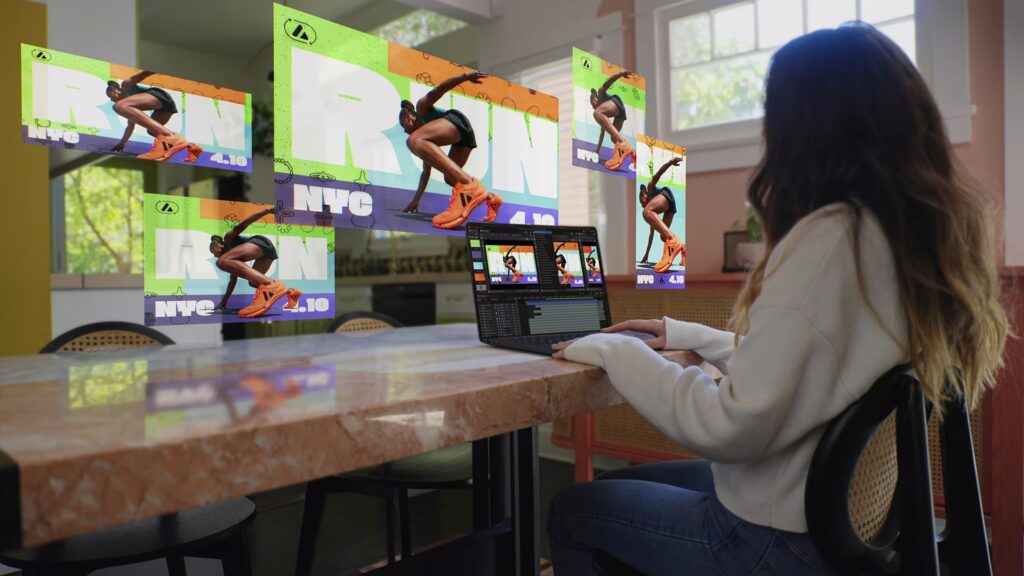
Cinema 4D for iPad features a brand-new touch-optimized interface. According to Maxon and coverage by industry press, the iPad edition’s core modeling and design tools have been “rebuilt around touch input” rather than simply porting the desktop UI. Artists manipulate geometry directly with gestures and the Apple Pencil, making the workflow feel native to the tablet. Maxon describes the interface as a “streamlined, mobile-first” UI designed for on-the-go creativity. In practice, this means familiar Cinema 4D functions (like move, scale, extrude, etc.) are accessed via touch gestures, onscreen handles, and Pencil taps/swipes, as shown in the embedded screenshot.
Cinema 4D for iPad vs desktop: file compatibility and workflow
Cinema 4D for iPad is designed to work hand-in-hand with the desktop version. The two share the same file formats and project compatibility, so you can move scenes between devices seamlessly. Maxon’s site explicitly promises “full compatibility” so users can “take your 3D projects with you everywhere”. In other words, a scene or asset created on the iPad can be opened in Cinema 4D on Mac/PC (and vice versa) without conversion. In practical terms, this means an artist could start modeling on the iPad, then finish on a desktop, or bring a desktop scene into the iPad app to tweak on the go, all under the same Maxon One subscription.

Cinema 4D for iPad Redshift support: what “Redshift capabilities” means
Yes – the iPad version will include Redshift features. Maxon confirms that Cinema 4D on iPad “will feature Redshift capabilities”. Redshift is Maxon’s high-end GPU-accelerated renderer for Cinema 4D. It provides advanced lighting and shading (fast path-traced or biased rendering) for photorealistic visuals. In practical terms, “Redshift capabilities” means the iPad app will integrate the Redshift engine so users can render scenes on the iPad. (On current hardware this may initially use CPU or Metal; on Apple’s GPUs it can tap hardware rendering.) Having Redshift on iPad allows artists to produce high-quality final renders and previews directly on the tablet, using Redshift’s shader system and fast rendering pipeline.
ZBrush for iPad to Cinema 4D for iPad workflow (open sculpts in C4D)
The apps integrate closely. Sculptures created in ZBrush for iPad can be opened directly in Cinema 4D on iPad. This means an artist can sculpt a model in ZBrush on the iPad and then import that mesh into C4D on the same device for further modeling, texturing, or rendering. It continues Maxon’s mobile workflow ethos (ZBrush and C4D exchanging files). In short, any ZBrush iPad project (ZTL) can be transferred into Cinema 4D for iPad with one click, enabling a smooth cross-app pipeline.
Cinema 4D for iPad features at launch vs future updates
At launch, the iPad app will include a core subset of features, with more to come later. Maxon says it will ship with essential modeling, animation and design tools “optimized for the platform,” and that the feature set will “evolve over time”. In other words, expect the first release to cover major functions (modeling, basic animation, MoGraph cloners, etc.) while more advanced tools (simulations, advanced render nodes, etc.) roll out in updates. Maxon also emphasizes that new features will track iPadOS and hardware improvements – so future iPad releases (and OS updates) may enable expanded functionality. For example, the interface and tools will be regularly updated to take advantage of the latest iPad features.
Cinema 4D for iPad pricing: subscription plans and expected cost
Maxon has not announced any final pricing yet. The company says it will make C4D on iPad “as accessible as possible”. Industry reports suggest it will follow the same model as ZBrush for iPad: likely included with Cinema 4D/Maxon One subscriptions, with a standalone plan for independent use. In other words, if you already subscribe to Cinema 4D on desktop (or Maxon One), the iPad app will probably be part of your subscription at no extra cost. A separate iPad-only subscription or free tier (as with ZBrush iPad) might also be offered. Detailed pricing will be clarified closer to the release.
Cinema 4D for iPad NAB 2026 demo details (booth info)
NAB 2026 is where Maxon will show off Cinema 4D on iPad in person. At the Las Vegas event (April 18–22, 2026), Maxon’s booth N2741 will feature live demos of the iPad app. The press release explicitly invites NAB attendees to visit booth N2741 to “see it all”. In summary, NAB is the debut showcase for C4D on iPad – it will be running in beta there and Maxon will be ready to demo its capabilities.
Using Cinema 4D on iPad for motion graphics, VFX, and visualization
Cinema 4D’s traditional strengths carry over to the iPad. As Maxon notes, C4D is widely used in motion graphics, visual effects and architectural visualization, and the iPad version supports those use-cases. For example, the MoGraph cloner tools and Redshift rendering can be used on the iPad to create animated title sequences or architectural renderings.
The app’s integration with Redshift means it can produce high-quality rendered frames (important for VFX and viz) on-device. Additionally, Maxon’s Autograph app (for 2D/3D motion design) is free and mobile-first, creating a workflow where users can handle motion graphics on iPad. In practice, artists will be able to start a 3D project – say, an animated explainer or a lighting preview for an architectural model – on the iPad, using familiar C4D tools and the Pencil, then finalize it on desktop or vice versa.

Frequently Asked Questions (FAQs)
- Which iPad models are supported?
Cinema 4D on iPad requires an Apple Silicon device with at least an M2 chip (for example, a 2022 iPad Pro or 2024 iPad Air). For optimal performance, Maxon recommends an iPad with the M3 chip or newer. Older iPads (A-series) are not supported. - Do I need an Apple Pencil Pro or a keyboard to use it?
No – the app is fully operable by touch. Maxon’s FAQ states that Cinema 4D on iPad “won’t require Pencil Pro or keyboard” to run. However, using an Apple Pencil (Pro) will improve precision and ease of use, so it’s recommended for detailed work. - Can I use Cinema 4D on iPad without the desktop version?
Yes. The iPad app can function as a completely independent tool. You do not need to be connected to or own a desktop license to use it. Of course, if you already have a Cinema 4D or Maxon One subscription, that account will include the iPad app at no extra charge. But you are free to run it standalone on an iPad. - How do I transfer projects between iPad and desktop?
The app is fully compatible with desktop Cinema 4D. You can open the same project files on both platforms. Maxon’s website emphasizes “full compatibility,” meaning you can move your 3D scenes back and forth seamlessly. In practice, you save a .c4d file on the iPad and load it on your desktop (or vice versa). This works within the same Maxon subscription (Maxon One), so projects stay in sync. - Does it support Redshift rendering?
Yes. Cinema 4D for iPad “will feature Redshift capabilities”. That means it includes Redshift – Maxon’s GPU-accelerated renderer – as part of the app. In other words, you can render scenes on the iPad using the Redshift engine, just like on desktop. - Can I import ZBrush for iPad sculpts into Cinema 4D on iPad?
Yes. Sculptures created in ZBrush for iPad can be opened directly in Cinema 4D for iPad. This provides a mobile pipeline where you sculpt in ZBrush and then immediately import the model into C4D for further work on the tablet. - When will it be released and how do I join the beta?
The full release is expected in late 2026. Until then, Maxon is running a public beta program. To join, go to Maxon’s website and register through the Cinema 4D on iPad beta page (the registration form there will notify you when you can download the beta). - What will it cost?
Maxon has not announced pricing. It has stated it wants the app to be “as accessible as possible”. It’s likely the iPad app will be included with existing Cinema 4D/Maxon One subscriptions (as was done with ZBrush for iPad). Any standalone plans or free tiers have yet to be confirmed. - Will it have the same features as desktop, or are there limitations?
Not initially. The iPad version will include core features but not the entire desktop feature set. Maxon says it will launch with a subset of tools optimized for mobile and then “evolve over time” to add more functions. Expect advanced desktop features (like complex simulations or plugin support) to arrive later or remain desktop-only. - Is it independent of a Mac/PC, or do I need a computer connection?
It runs entirely on the iPad and does not require a computer to operate. You can create and render projects wholly on the tablet. However, if you have a Cinema 4D desktop license, it covers the iPad app too. The two versions share the same subscription (Maxon One), so your software access is unified whether you’re on iPad or desktop.

Conclusion
Cinema 4D arriving on iPad is a major milestone in mobile 3D creativity. By bringing core Cinema 4D tools and Redshift rendering to the iPad, Maxon is literally putting professional 3D on the go. The company frames this as lowering the barrier to entry for creators – to let them “work where they want, how they want”. While the iPad version will start with a limited feature set, it promises full integration with existing workflows and an evolving roadmap. Between the announced late-2026 launch, the public beta program, and Maxon’s focus on accessibility, Cinema 4D for iPad looks set to expand how and where 3D artists can work.
Sources and citation
- Maxon Cinema 4D for iPad beta sign-up page (Maxon.net)
Maxon Announces Free Tools and Mobile Expansion of ZBrush and Cinema 4D - CG Channel report on Cinema 4D 2026.2 and iPad beta
Cinema 4D for iPad beta sign-up - VP-Land analysis article
Maxon ships Cinema 4D 2026.2, unveils Cinema 4D for iPad beta - ProVideo Coalition news article
Cinema 4D Lands on iPad as Maxon’s Autograph Goes Free and ZBrush Expands to Windows on Arm - Maxon ZBrush for iPad pricing info
Maxon to unveil beta of Cinema 4D for iPad at NAB 2026 - Maxon Redshift feature page
ZBrush for iPad pricing - NanoReview M3 vs M2 benchmark comparison
Redshift features page
Recommended
- Just Days Before the Oscars, Netflix Closes Deal for Maggie Kang and Chris Appelhans to Return for KPop Demon Hunters 2
- Sony Pictures Entertainment Will Reportedly Lay Off Hundreds of Its Employees: What to Know About the 2026 Restructuring
- The Witcher 3 Secret DLC Rumors: CD Projekt Says No New Cyberpunk 2077 DLC Planned
- Digital Fashion in Blender & Marvelous Designer: A Comprehensive Guide
- Famous 3D and AI Virtual Influencers and Avatars: Exploring the Digital Trendsetters of 2025
- Uncharted 5? Fans Believe Cryptic Naughty Dog Dev Post Is Teasing The Game
- Metahuman Facial Motion with Faceware: Complete Workflow for Realistic Face Animation in Unreal Engine 5