









Call of Duty: Black Ops 7 earns $30,000 for every negative review on Steam
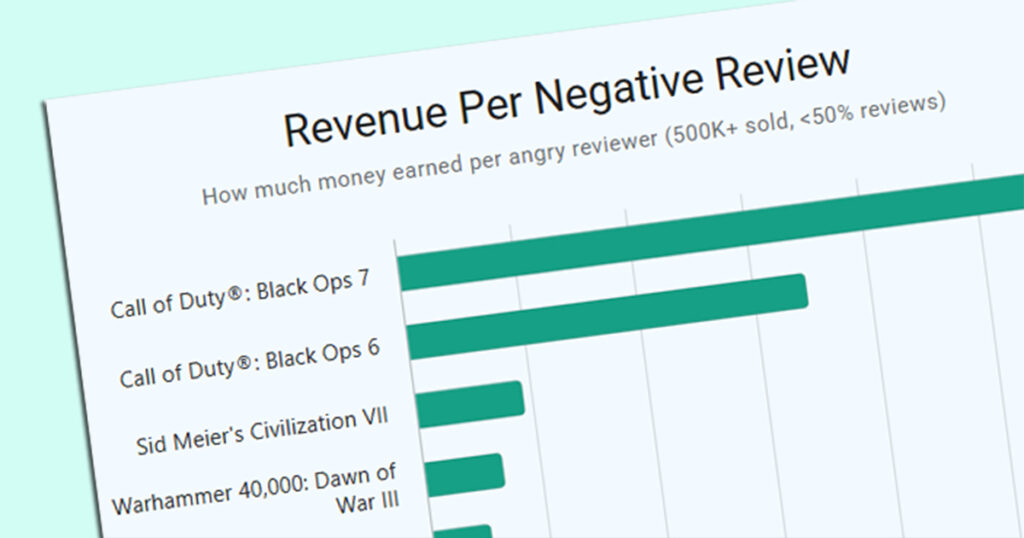
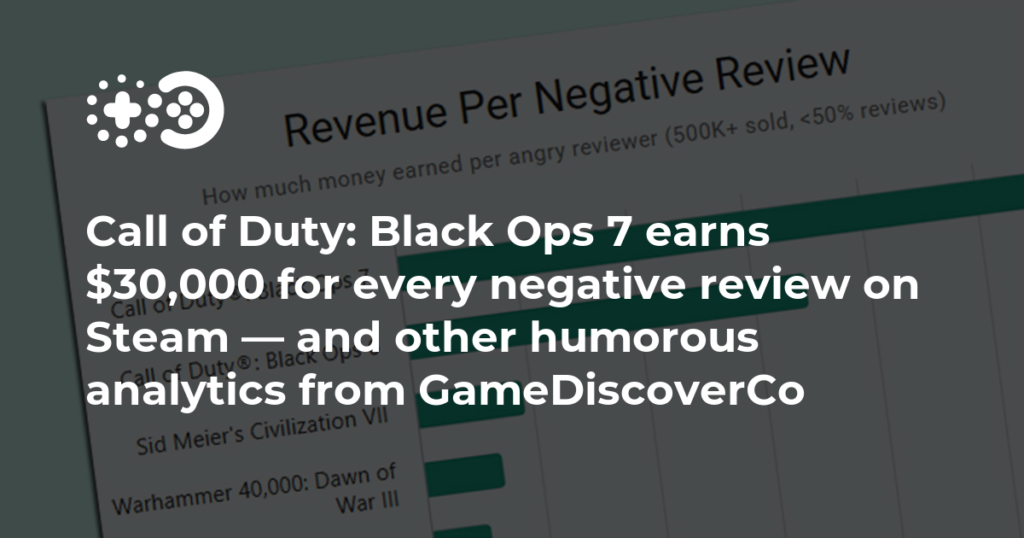
In an April 2026 Game Developer report, data from GameDiscoverCo’s “Insights Lab” (an analytical service) revealed a striking metric: Black Ops 7 generates roughly $30,000 in revenue for each negative review on Steam. This tongue-in-cheek analysis (timed for April Fool’s Day) is based on real sales estimates and review counts. GameDiscoverCo defines any Steam review under 50% positive as “negative” and only considers games with at least 500,000 copies sold. Under these rules, Activision’s Call of Duty: Black Ops 7 comes out on top, with an estimated $30K per negative review.
What revenue per negative review means for Call of Duty: Black Ops 7
In practice, the “$30K per negative review” figure highlights that Black Ops 7 sold enough copies and generated enough money that even each single angry reviewer corresponds to a massive amount of revenue. As Game Developer explains, “for every player disappointed enough to leave a negative review on Black Ops 7, Microsoft-owned Activision earns roughly enough money to buy a used car.”. In other words, a few negative reviews are negligible compared to the game’s overall sales haul. It underscores that a divisive blockbuster can still be hugely profitable – even if many players publicly criticize it.
- Activision’s total revenue from Black Ops 7 (estimated using unit sales and price) dwarfs the impact of hate reviews.
- The game’s strong marketing, console sales, and presence on Game Pass all contribute to the high revenue figure behind that $30K/statistic.
- In short, the metric is a playful way to show that bad press on Steam isn’t necessarily hurting Call of Duty’s bank account.
How Black Ops 7 negative Steam reviews compare to Black Ops 6
For context, GameDiscoverCo also calculated Black Ops 6’s figures using the same method. They found Black Ops 6 brings in about $17,000 per negative review. (One report cites roughly $17,300 per negative review for BO6.) This means Black Ops 7’s ratio is significantly higher – largely because Black Ops 7 sold many copies at full price despite its criticism. In both cases, the raw numbers reaffirm that both games made huge revenues on Steam.
Both titles opened to mixed reception among PC gamers, but BO7’s launch was even more polarizing. The drop from ~$30K per review in BO7 to ~$17K in BO6 suggests Black Ops 7 attracted even more negative reviews relative to its total sales. (Civ VII – a hypothetical title – was third on the list at only ~$4K per negative review, highlighting how much bigger the Call of Duty numbers are.) In absolute terms, Black Ops 6 also saw plenty of negative Steam feedback at launch (due to crashes and performance issues), but its extraordinary sales volume kept its revenue-per-negative number lower than BO7’s.
Why Call of Duty: Black Ops 7 Steam reviews are so negative
Multiple factors fueled the harsh Steam reviews of Black Ops 7. Critics and players pointed to several major complaints:
- Campaign and gameplay issues: Reviewers described the single-player campaign as “dismal” and criticized uninspired gunplay and clunky controls. Many noted technical problems and wonky performance on PC.
- AI-generated assets: Fans discovered that some in-game textures, voice lines or art appeared to be AI-generated or stock, which players saw as a cost-cutting measure undermining quality.
- Poor optimization: The game suffered from bugs and framerate drops at launch, frustrating PC users and fueling negative word-of-mouth.
- Predatory monetization: Users complained about heavy microtransactions and aggressive in-game purchases (“predatory monetization”) appearing too early in gameplay. For example, cosmetic bundles and season passes were seen as overpriced, triggering backlash.
- Lackluster multiplayer: Even veteran CoD players found BO7’s multiplayer modes uninspired compared to previous entries.
- Fan fatigue: Releasing another Black Ops so soon after 2023’s Black Ops 6 added to franchise fatigue. Many players were already accustomed to Call of Duty via Game Pass, reducing their urgency to buy.
These issues combined to provoke a “review bomb” where frustrated players left negative feedback in large numbers. One analysis notes Black Ops 7’s Steam rating “slipped to Mostly Negative”, with only about 39–40% of user reviews positive by late 2025. In summary, poor campaign quality, technical woes, and aggressive monetization policies drove the unusually negative community response.
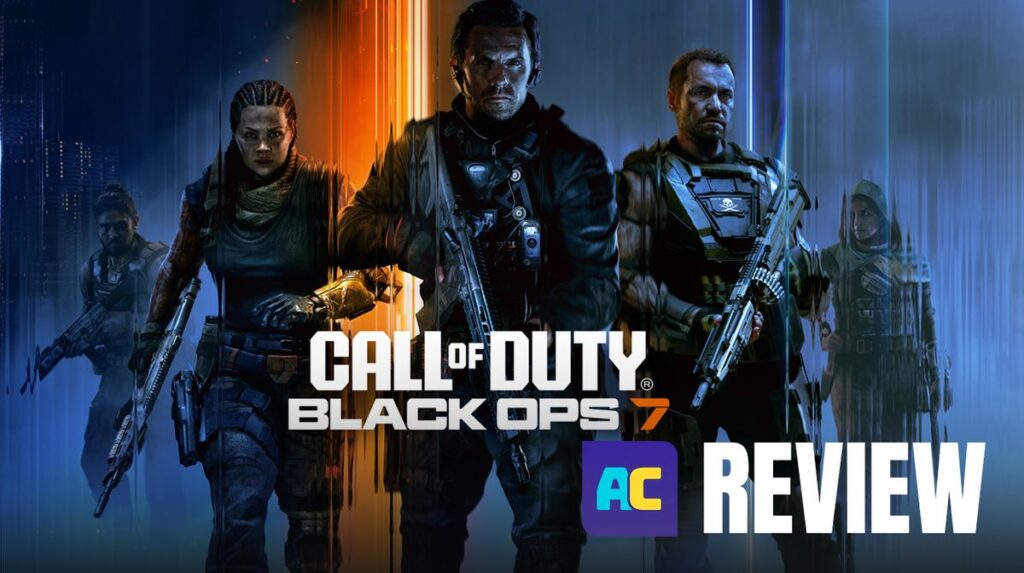
Call of Duty: Black Ops 7 Steam review score explained
On Steam, an overall rating depends on the percentage of positive vs. negative reviews. Black Ops 7’s “Mostly Negative” status means roughly 40% or fewer reviews are positive. As one report notes, by November 2025 only 39% of English-language Steam reviews for BO7 were thumbs-up. (Aggregating all languages, it hovered around 40% positive.) Steam labels 40–70% positive as “Mixed” and below 40% as “Mostly Negative”. BO7’s score had already teetered on the edge of negative territory, indicating broad discontent among the reviewing subset of players.
For context, the same analysis found actual gamers’ scores on Metacritic at 1.7/10, making it one of the worst-rated CoD campaigns ever, while critic scores also dropped sharply from around 83 to 70 as outlets reconsidered its quality. In short, Steam’s review breakdown reflects a rapid shift from lukewarm to outright negative sentiment, putting Black Ops 7’s PC reception near the bottom of the franchise in terms of user ratings.
How GameDiscoverCo calculated Black Ops 7 revenue per negative review
GameDiscoverCo’s calculation comes from their “Revenue Per Negative Review” chart, part of an experimental dashboard unveiled on April 1, 2026. The methodology is as follows:
- Data sources: They use their internal analytics to estimate total game sales and revenue on Steam (based on factors like chart positions, known sales data, and average price). Exact revenue isn’t public, so it’s a modelled estimate.
- Negative review count: They count every Steam review under 50% positive as “negative.”
- Sample criteria: Only games that sold over 500,000 units are included.
Using this, they divide the game’s estimated total revenue by its number of negative reviews. For Black Ops 7, this yields about $30,000 per negative review. Game Developer explains that the chart “measures a game’s estimated revenue against the number of negative reviews”. In plain terms: if BO7 sold, say, 5 million copies at $70 each (roughly $350M gross), and suppose 10,000 players left negative reviews, then revenue-per-negative-review ≈ $35,000. The exact figures depend on their sales estimate and review count, but the key point is it’s an approximate, analytical metric, not an official stat.
GameDiscoverCo made clear this was a lighthearted April Fools analysis, but it uses their live data pipeline. A staff member said the data “is pulled live from the company’s analytics backend” and then viewed through a “dead-serious” but satirical lens. Essentially, it’s a humor-driven way to spotlight how lucrative big franchises can be, even when a vocal segment of players complains.
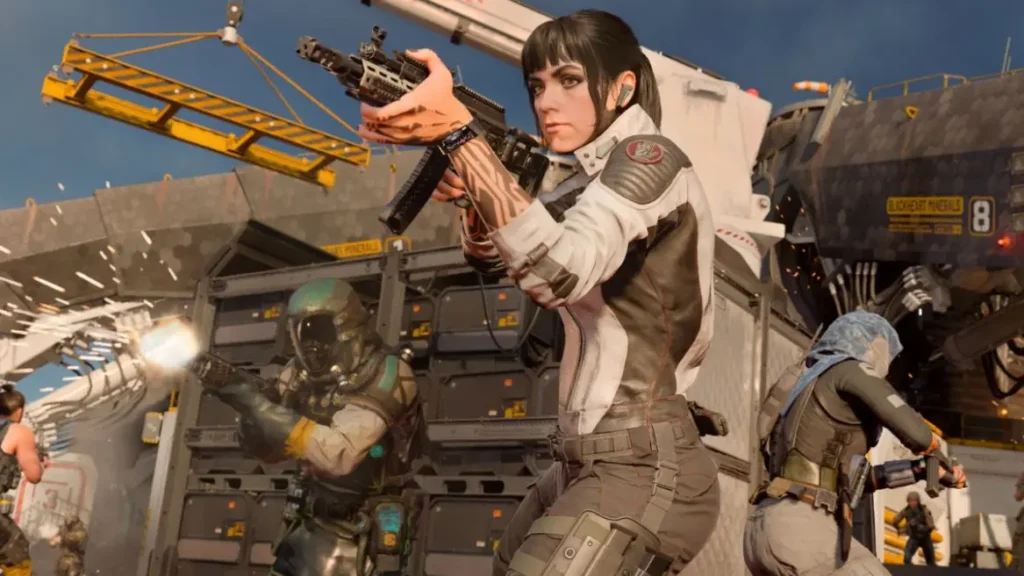
Is the $30,000 per negative review figure for Black Ops 7 accurate
The $30K number should be seen as a rough approximation, not an exact official metric. GameDiscoverCo’s analysis yielded $28,300 per negative review for Black Ops 7 (the Game World Observer article cites that figure), which is close to the “$30K” headline number. The small discrepancy likely comes from rounding or slightly different data snapshots. Because Activision doesn’t publish detailed Steam sales or exact number of reviewers, no one outside can confirm the exact revenue or review counts. The $30K estimate assumes current market prices and sales data as of early 2026.
In practice, even a figure in the mid-$20K range would mean the same conclusion: Black Ops 7’s total revenue is so large that negative reviews represent a tiny fraction. Moreover, the analysis only counts base game sales on Steam and doesn’t include console sales, microtransactions, or Game Pass metrics. The true revenue per unhappy Steam reviewer could be higher or lower depending on those factors.
In summary, the $30K statistic is a playful, ballpark figure rather than a precise calculation. It’s based on real (if proprietary) data, but small variances in price or sales drastically change the per-review number. Experts note it’s “not…anything really” beyond illustrating that the game is highly profitable despite criticism.
Call of Duty: Black Ops 7 monetization and player backlash
Activision’s monetization strategies also fueled backlash. Black Ops 7, like recent CoD titles, featured multiple premium currencies, loot boxes, and high-priced cosmetic packs. Many players felt these in-game purchases were overly aggressive for a $70 title. For example, some bundles were seen as loaded with reskins and complex point systems that confused or frustrated users. 80.lv specifically cites “predatory monetization” as a key issue in the negative reviews.
Additionally, Black Ops 7 launched on Xbox Game Pass day-one, meaning many players could play for free through subscription. This may have led some paying fans to complain that they paid the full price only to see the game quickly on Game Pass. (Conversely, Game Pass likely boosted the total number of players and download figures, but did not count as paid sales.)
This monetization backlash built on trends from earlier CoD games. By 2025, fans had grown weary of microtransactions in CoD; some view each new game as an opportunity for Activision to eke more revenue out of in-game items. The combination of all these factors – especially aggressive pricing of in-game items – contributed to the angry tone of many negative reviews.

Black Ops 7 live-service updates and their impact on Steam reviews
Like many modern shooters, Black Ops 7 was designed as a live-service game, with regular updates, seasonal content drops, and community events. In theory, ongoing patches and new modes (such as the promised “Zombotropolis” map or cross-promotional content) could improve player sentiment over time. However, Steam’s overall review score tends to remain anchored by initial reviews unless developers actively prompt players to re-evaluate.
Activision did respond after launch controversies by offering a free week of multiplayer and Zombies and promising “impossibly brilliant” seasonal updates. These moves were meant to address player concerns and entice lapsed users back. In practice, such updates might gradually bring in new positive reviews, but shifting a “Mostly Negative” score is very hard once the majority of launch-week reviews have been logged. If performance or gameplay is significantly improved and communicated clearly, some new players may post positive reviews later on Steam.
Ultimately, the live-service plan could stabilize or slightly improve the review trend, but the initial damage to its Steam rating was deep. Other big games have recovered from bad launches (for example, Cyberpunk 2077 eventually left Mixed reviews through major fixes), so a turnaround is possible if Call of Duty delivers on its post-launch promises. Until then, the live-service strategy mainly ensures the community continues to have something to talk about, potentially bringing some players back despite the negative buzz.
Why negative Steam reviews do not always hurt blockbuster game sales
Game franchises of Call of Duty’s scale often generate huge sales regardless of user scores. Several reasons explain why mostly-negative Steam feedback didn’t spell disaster for Black Ops 7’s bottom line:
- Multi-platform distribution: Call of Duty sales are overwhelmingly driven by console and bundled sales, not just Steam. Black Ops 7 was released on PS5, Xbox, and PC (Game Pass) simultaneously. Console buyers and subscribers often don’t see Steam reviews at all.
- Brand loyalty and pre-orders: The CoD franchise has many loyal fans who pre-order the game or buy at launch, sometimes without checking reviews. Marketing hype and franchise loyalty can eclipse negative word-of-mouth.
- Game Pass effect: On PC, Black Ops 7’s Game Pass release meant an enormous number of players didn’t need to buy the game separately. This both inflates player count and shifts potential sales from one pocket to another. Revenue from Game Pass licensing isn’t visible on Steam but does count toward Activision’s earnings.
- Strong installed base: Even if sales were down, the total revenue from millions of sales was still very large. As Kotaku notes, Activision expects BO7 to “likely make a solid profit” and still be “one of the best-selling games of 2025” despite the poor reception. This suggests that even a suboptimal CoD entry can move tens of millions of units.
- Timing and competition: Many hardcore players may prioritize playing Battlefield 6 or other games, but mainstream audiences with kids or on family consoles often still get the latest CoD regardless of reviews.
In short, Steam review scores matter less for AAA blockbuster earnings than for smaller games. The $30K metric itself underlines that a franchise like CoD can absorb negative feedback and still rack up huge sales and revenue. It’s one indication that, for top-tier titles, user sentiment on one platform is only part of the picture.
Call of Duty: Black Ops 7 sales estimates versus user sentiment
The reported sales data confirm that Black Ops 7 underperformed relative to its predecessors. For example, Alinea Analytics estimates that BO7 sold about 401,000 copies on Steam in the first 26 days, versus 2.3 million for Black Ops 6 in the same period. That’s a dramatic drop. Likewise, data firm Video Game Insights (cited by Pure Xbox) showed BO7’s concurrent Steam player count was roughly 80% lower than Call of Duty: Modern Warfare III’s during its first month. On the whole, Black Ops 7 appears to have had roughly half the total players of BO6 in its launch month.
At the same time, user sentiment is extremely low. As noted, only ~39–40% of Steam reviews were positive. Former Activision CEO Bobby Kotick even said in a legal filing that Call of Duty sales were down “over 60 percent” in 2025 versus 2024. Some regional data (like GfK UK retail charts) showed BO7’s physical sales plummeted 61% compared to BO6. In other words, both sales figures and user reviews fell sharply.
However, it’s notable that even with those declines, Black Ops 7 still outsold most other games on the market. The franchise’s overall revenue (counting microtransactions and Game Pass) likely remained in the hundreds of millions. Thus, while player sentiment (review scores) and actual sales volume both plunged, they remain large on absolute scale. This divergence highlights that a hit game can become a “flop” relative to its own high bar, yet still be very successful by ordinary standards.
What Black Ops 7 tells us about Steam reviews and AAA game economics
Black Ops 7’s case illustrates that Steam reviews alone don’t tell the whole story for big-budget games. The game’s falling review score reflects vocal player dissatisfaction, but it didn’t proportionally collapse revenue. This phenomenon has several implications for the industry:
- Volatility of user reviews: AAA titles often get “review bombed” if fans feel betrayed (by microtransactions, delays, etc.). The GameDiscoverCo metric implicitly shows that even this vocal negativity can’t sink a franchise that moves millions of units. In other words, review percentage and sales revenue can decouple.
- Multi-channel sales: For large publishers, a game’s success isn’t tied to Steam alone. Income from consoles, cloud, subscriptions and DLC means total revenue far exceeds Steam figures. A game might have mostly-negative Steam reviews yet perform admirably on other platforms.
- Economics of brand strength: Call of Duty’s brand is still strong enough that even a controversial entry drives significant profit. The gap between a massive revenue number and a small base of critical reviewers shows how economies of scale work in AAA.
- Need for nuance in metrics: The “$ per negative review” stat itself suggests metrics specialists should interpret data carefully. It’s a whimsical example that underlines the importance of looking at both community sentiment and sales/revenue metrics before judging a game’s health.
- Expectation management: High-profile games face much higher expectations. Activision’s own leaders admit that anything less than record-breaking is deemed a failure. The Black Ops 7 launch indicates that AAA economics now depend on measuring up to break-the-internet levels, not just turning a profit.
Overall, Black Ops 7 shows that while Steam scores can signal community outrage, they are just one piece of the bigger AAA puzzle that includes marketing, global audience, and long-tail monetization.
Can Call of Duty survive mostly negative Steam feedback
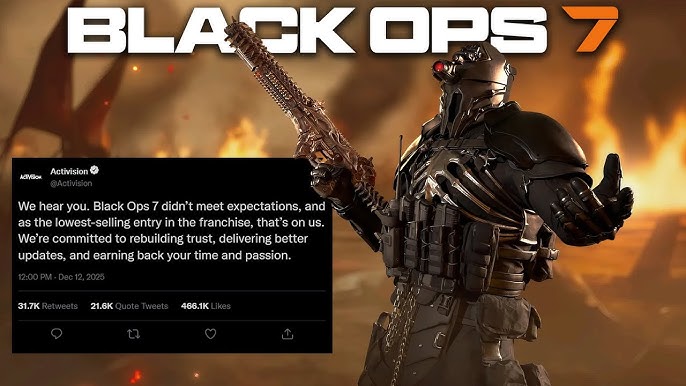
Yes – in fact, Call of Duty is continuing and will adapt. In response to the BO7 backlash, Activision announced it will stop the annual back-to-back release pattern for Modern Warfare and Black Ops games, promising more time to innovate. This strategic change suggests the company does not see one bad launch as game-ending; rather, it plans to regroup and try something different next time.
Historically, even the weakest CoD games eventually recovered. For example, Call of Duty: WWII had a troubled launch in 2017, but Activision stuck with the series and it bounced back in later years. In Kotaku’s words, Activision’s statement still insisted “the future of Call of Duty is very strong and our best days are ahead of us”. The brand’s fundamentals – large development budgets, global marketing, and a faithful player base (plus its vital role in Microsoft’s Game Pass strategy) – argue for its resilience.
Of course, survival will mean changes. Activision’s leadership is clearly aware that if they repeat the same mistakes (poor campaign, aggressive monetization), next year’s title could underperform again. They have publicly apologized to fans and promised to “listen” moving forward. Most analysts expect CoD to continue as a yearly franchise, but with shake-ups: more breaks between sub-series, deeper innovation, and perhaps a greater focus on Warzone and free-to-play modes.
In summary, while the Steam feedback is a blow to the community image of CoD, it’s unlikely to kill the franchise. The series’ sales and revenue power provide a buffer, and Activision is taking steps to address the issues revealed by the feedback.
Black Ops 7 controversy and the business of bad reviews
Black Ops 7’s situation highlights the business of controversy. High-profile games often court controversy (intentionally or not) and then ride the publicity to some degree. For instance, GameDiscoverCo noted Konami’s eFootball had a perfectly split 50/50 positive/negative review ratio on Steam, yet eFootball remains widely discussed (and profitable) due to its notoriety. Similarly, Black Ops 7’s controversies (AI art, microtransactions, etc.) kept it in the news.
From a revenue standpoint, bad reviews can even drive attention. Every news story about “why everyone hates BO7” is free marketing in a way. Of course, there is a limit – if a game’s reputation becomes overwhelmingly toxic, it can erode long-term sales and brand loyalty. But CoD’s huge launch base meant that, economically, the negative press likely had diminishing marginal cost. Activision still made a ton of money up front, regardless of the criticism splashed across gaming media.
GameDiscoverCo’s analysis itself is an example of how the industry views these controversies with irony: by treating negative reviews as just another metric, it implies such backlash is “business as usual.” It jokingly suggests that publishers of blockbuster titles might even tolerate a few bad reviews if they still clear tens of millions of sales.
What developers can learn from Call of Duty: Black Ops 7 on Steam
There are several lessons for developers gleaned from the BO7 story and its Steam reception:
- Prioritize technical polish at launch. Many of the early complaints about BO7 were technical (optimization, bugs). First impressions matter greatly on platforms like Steam.
- Be mindful of pricing strategy. Gamers react strongly to monetization. Developers should balance profitable live-service elements with fair pricing to avoid accusations of “predatory” practices.
- Listen to community sentiment early. If a genre like Multiplayer FPS tends to attract anger (as GameDiscoverCo’s “Rage Index” shows), community managers should engage and address concerns immediately.
- Use phased releases or betas. Many AAA games use early beta tests to iron out issues. CoD’s annual schedule may have reduced testing time; spreading release dates or open betas might catch glitches sooner.
- Act quickly on patching. BO7’s promise of free content and updates shows the need for rapid response. Developers should be ready with updates, knowing a sluggish patch schedule can sour player goodwill.
- Manage expectations with communication. Activision’s public apology and roadmap for next year are an attempt to realign player expectations. Transparency about future fixes/content can mitigate some negative feedback.
In addition, GameDiscoverCo’s own insights suggest genre trends: multiplayer and free-to-play games generate more negative reviews by volume. For teams working in those genres (like shooters), that means planning for more robust community support and perhaps moderating review bombs.
Finally, BO7’s case underscores that no review score is permanent. Developers should encourage satisfied players to update their reviews if issues are fixed. A mixed or negative launch reception can improve over time with concerted effort. For smaller developers, the lesson is even stronger: a few hundred negative reviews can decimate sales, so learning from BO7 means ensuring your core fans are heard from day one.
Frequently Asked Questions (FAQs)
- What does “$30,000 per negative review” mean?
It’s a metric from GameDiscoverCo’s analysis showing that Black Ops 7’s total revenue (estimated from sales) divided by its number of negative Steam reviews is about $30K. In other words, each critical review corresponds to about $30,000 in game revenue. It highlights that a blockbuster can absorb many negative reviews and still be highly profitable. - How did GameDiscoverCo get this number?
They used their analytics to estimate how many copies BO7 sold and at what average price on Steam. They counted “negative” reviews as anything below 50% positive. Dividing the estimated revenue by the count of negative reviews yields the $30K figure. It’s part of an April Fools data dashboard, but based on real sales estimates and review data. - Is the $30,000 figure official?
No. Activision never announced this number. It’s an estimate by GameDiscoverCo for fun (April 1). Different sources quote about $28.3K, meaning “$30K” is rounded. Without actual sales and review data from Activision or Steam, we can’t verify it. It’s approximate but illustrates the general scale of BO7’s earnings relative to its negative feedback. - Why are so many Steam reviews negative?
Players criticized BO7’s campaign (story and gameplay), reported poor performance on PC, and disliked heavy monetization. Specifically, there were complaints of low-quality AI art assets, bugs, and costly in-game store items. Since Call of Duty is high-profile, these issues led to an outsized amount of angry reviews early on. - How many positive vs negative reviews does BO7 have on Steam?
As of late 2025, BO7’s Steam rating is “Mostly Negative” – only about 39–40% of reviews are positive. Steam categorizes 40–70% positive as “Mixed” and below 40% as “Mostly Negative”. BO7’s score just dipped into the negative zone, reflecting widespread discontent among reviewers. - Did the negative reviews hurt Black Ops 7’s sales?
Not drastically. While BO7’s sales were down compared to BO6, it still sold millions of copies and made a solid profit. Many CoD fans buy on consoles or via Game Pass regardless of Steam reviews. Historically, even poorly-reviewed AAA games can sell very well if the franchise is popular. - How do BO7’s sales compare with earlier games?
Analysts report BO7’s sales are significantly lower. One estimate says 401,000 Steam copies in 26 days versus 2.3 million for BO6 in its launch window. Worldwide, former Activision CEO Bobby Kotick said 2025’s Call of Duty sales were about 60% below 2024’s totals. Still, in absolute terms BO7 likely ranked among the year’s top sellers, just not record-breaking. - Will Call of Duty continue after this feedback?
Yes. Activision has already said it will not release Black Ops games back-to-back with Modern Warfare entries anymore, acknowledging the need to improve quality. They’re taking a break in the usual schedule to rethink development. The franchise will continue but with changes in strategy and pacing. - What does this tell us about Steam reviews and big games?
It shows that for AAA games, Steam reviews are only part of the picture. A game can have poor user scores on Steam yet still earn huge revenue from consoles and other channels. Developers should pay attention to reviews (for reputation and discoverability), but top-tier games often survive negative Steam feedback thanks to brand strength and multi-platform sales. - What lessons should game developers take from Black Ops 7?
Ensure your game is polished at launch (especially on PC), balance monetization fairly, and listen to player feedback quickly. If releasing a live-service game, be ready to patch problems fast. Also, remember that even “titanic” game brands need to manage community trust – neglecting core gameplay or overcharging can lead to a backlash, as BO7 demonstrated.

Conclusion
The GameDiscoverCo report that “Black Ops 7 earns $30,000 per negative review” is a striking illustration of how big-budget games can weather intense criticism. In Black Ops 7’s case, despite overwhelmingly negative Steam reviews and disappointing year-one sales compared to its predecessor, the franchise’s sheer scale meant it still generated massive revenue. This phenomenon underscores a larger truth in AAA economics: brand strength and multi-platform distribution often trump online sentiment.
That said, the negative feedback has clearly spurred Activision to change course. They’ve publicly acknowledged the issues and promised adjustments for future titles. For developers and publishers, Black Ops 7 is a case study in managing expectations: it shows the risks of releasing under-polished live-service games, and highlights the importance of community trust. Even with a profitable launch, the PR damage from upset players is real. The $30K-per-review statistic is a humorous way to look at the data, but it belies a serious lesson: revenue and user sentiment are related but distinct metrics. A game can be an economic success and a critical flop at the same time.
In the end, Call of Duty’s survival through this storm will depend on how well Activision learns from the backlash. Historically, the franchise has adapted (altering release schedules or pivoting styles) to meet player expectations. Time will tell if Call of Duty can convert this controversy into a stronger roadmap ahead.
Sources and citation
- Game Developer – “Call of Duty: Black Ops 7 appears to earn an estimated $30,000 on Steam per negative review” (April 1, 2026).
https://www.gamedeveloper.com/business/call-of-duty-black-ops-7-earns-30000-per-negative-review - Game World Observer – “Call of Duty: Black Ops 7 earns $30,000 for every negative review on Steam…” (April 2, 2026).
https://gameworldobserver.com/2026/04/02/call-of-duty-black-ops-7-30000-per-negative-review - App2Top – “Call of Duty: Black Ops 7 earns $30,000 for every negative review on Steam” (April 2, 2026).
https://app2top.com/news/call-of-duty-black-ops-7-earns-30000-per-negative-review - PureXbox – “Black Ops 7 Sales & Players Down Massively On Last Year’s Call Of Duty” (Dec 12, 2025).
https://www.purexbox.com/news/2025/12/black-ops-7-sales-and-players-down-massively - 80 Level – “Call of Duty: Black Ops 7’s Steam Reviews Drop to Mostly Negative” (Nov 21, 2025).
https://80.lv/articles/call-of-duty-black-ops-7-steam-reviews-mostly-negative - Kotaku – “Call Of Duty In Crisis As Activision Admits It’s Not Good Enough” (Dec 10, 2025).
https://kotaku.com/call-of-duty-crisis-activision-not-good-enough - TweakTown – “Call of Duty sales down by over 60% in 2025, former Activision CEO says” (Jan 16, 2026).
https://www.tweaktown.com/news/call-of-duty-sales-down-60-percent-2025 - GameDiscoverCo / Game Developer Insights Lab data (April 1, 2026) covering methodology for revenue vs reviews analysis.
https://newsletter.gamediscover.co/p/insights-lab-call-of-duty-black-ops-7-review-revenue
Each source is cited for the specific facts or quotes it provided. Other facts (Steam rating categories, general COD franchise history) are drawn from industry knowledge and widely reported trends.
Recommended
- The Carousel Will Return in TFT Set 18: Release Date, Why It Left, and What Changes Next
- Apex Legends Plan With Two New Characters: The Road Ahead 2026 Roadmap (Season 29 Skirmisher + Season 32 New Legend)
- Famous 3D and AI Virtual Influencers and Avatars: Exploring the Digital Trendsetters of 2025
- Fable Reboot Could Be Delayed To 2027 Amid Concern About GTA 6 – Report: What We Know So Far
- Top 20 Ugliest Video Game Characters: A Celebration of Unconventional Design
- Fans Who Paid Up To $450 For Barbie Dream Fest Are Calling It a ‘Barbie Nightmare Fest’: Refunds, Reviews, and What Happened
- The Outer Worlds Companions – How to Recruit, Abilities, and Best Combinations
- Genshin Impact Next Update and Banners: Everything We Know About Version 6.5 and 6.6 (Release Dates, Characters, Reruns, and Leaks)
- WoW Classic Kills Dungeon Boosting in Burning Crusade Expansion Because, Oh No, the Economy Is Breaking
- Blender 3D vs Cinema 4D: The Ultimate 2025 Comparison Guide for 3D Artists