




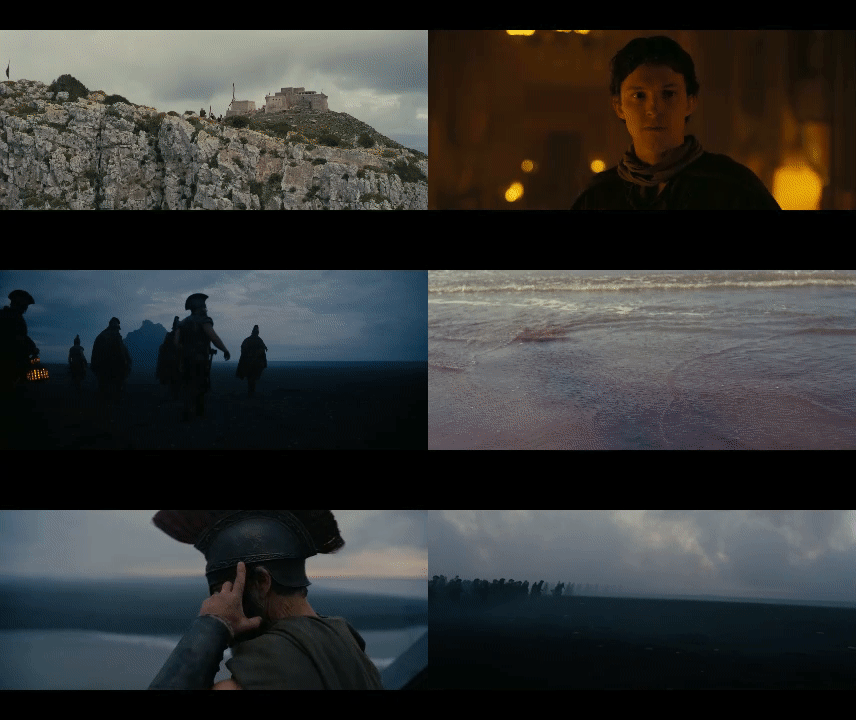
Christopher Nolan’s The Odyssey has already become one of 2026’s most discussed movies, and not only because it opens on July 17, 2026. The current trailer ignited a loud debate over its modern-sounding dialogue and mostly American-accented delivery, especially in scenes involving Matt Damon, Tom Holland, and Robert Pattinson. As of May 7, 2026, the official movie site confirms the release date, the adaptation of Homer’s epic, and the fact that the film was shot entirely with IMAX film cameras.
The real issue, though, is not whether Nolan “got the accent wrong” in any literal sense. If a film about ancient Greece is being performed in modern English, then every accent choice is already a translation choice. Ancient Greek pronunciation differed from both Modern Greek and from the national “school” pronunciations scholars use today, and ancient Greek itself varied across time and dialect. That means the argument is really about tone, convention, and dramatic effect, not about one modern English accent being truly authentic to Homeric Greece.
Christopher Nolan’s The Odyssey Accent Debate Explained
The simplest explanation is that Nolan appears to be choosing immediacy over faux-antique grandeur. The trailer does not present its characters as museum pieces speaking elevated “historical movie English.” Instead, it lets them sound contemporary, emotionally direct, and legible to a modern audience. That is why viewers heard Pattinson and Holland, both English actors, using American accents, and why Damon’s Odysseus sounds closer to a present-day dramatic lead than to the stately vocal style many audiences associate with sword-and-sandal epics.
That choice also fits the way the film is being framed publicly. The official synopsis sells The Odyssey as a “mythic action epic” rather than a scholarly reconstruction, and current trailer coverage emphasizes family stakes, division in Ithaca, and Odysseus’ desire to get home. In other words, the movie is being marketed as emotionally immediate and physically immersive first. The modern accents sound like part of that same strategy.

The Odyssey Trailer Accent Controversy: Why Viewers Expected British Accents
Viewers expected British accents because decades of film and television taught them to. Recent reaction pieces in The Independent and Euronews both note that many complaints were not really about Greek linguistic history but about a feeling that British accents “work better” for ancient or historical settings. GQ makes the same point more directly: for many moviegoers, period epics and British accents have become mentally fused, even when that tradition has little to do with actual historical speech.
That expectation is genre conditioning. British-accented prestige speech has long functioned in mass culture as a shorthand for status, antiquity, class, authority, or imperial power. So when The Odyssey refuses that shorthand, some viewers hear not “inaccuracy” but broken convention. The backlash says more about what audiences have been trained to expect from historical epics than about what ancient Greeks actually sounded like.
Why “next-Door Neighbor” Dialogue Works in Epic Movies Like the Odyssey
The much-mocked “daddy” line in the trailer only sounds wrong if the movie’s job is to preserve ceremonial distance. If the job is to make Telemachus’ wound feel immediate, then the line works differently: it reduces myth into family tension, which is one of the Odyssey’s central engines. The poem is about monsters and gods, but it is also about a son without a father, a wife under pressure, and a man trying to get home. Modern-sounding language can pull those relationships out of marble and back into flesh.
That is why “next-door neighbor” dialogue can be dramatically useful in an epic. Familiar phrasing lowers the formal barrier between audience and character. GQ argues that this sort of choice makes the story feel more intimate and grounded; current reporting from CinemaCon also describes Nolan’s version as family-centered. The trailer alone cannot prove how well that strategy will work across the full film, but it does show a coherent intention: shrink the emotional distance while keeping the visual scale enormous.
Are American Accents Historically Accurate for Ancient Greece in Movies?
No. But British accents are not historically accurate either. The authoritative linguistic baseline is that the pronunciation of ancient Greek can be reconstructed only approximately; it differed from Modern Greek and also from the many modern scholarly pronunciations shaped by national traditions. The Open University’s teaching material further notes that ancient Greek accenting was melodic or pitch-based, not stress-based in the way English works.
Ancient Greek also was not one stable spoken sound across all regions or centuries. Britannica notes that ancient Greek phonological systems differed from one period to another and from one dialect to another, while Cambridge’s overview divides the first-millennium BCE language into multiple dialect groups. So if a movie is being performed in modern English, neither American English nor British English can claim literal historical fidelity. At that point, accent becomes a matter of performance design rather than archaeological recovery.
Hollywood History of Accents in Historical Epics: Spartacus and Beyond
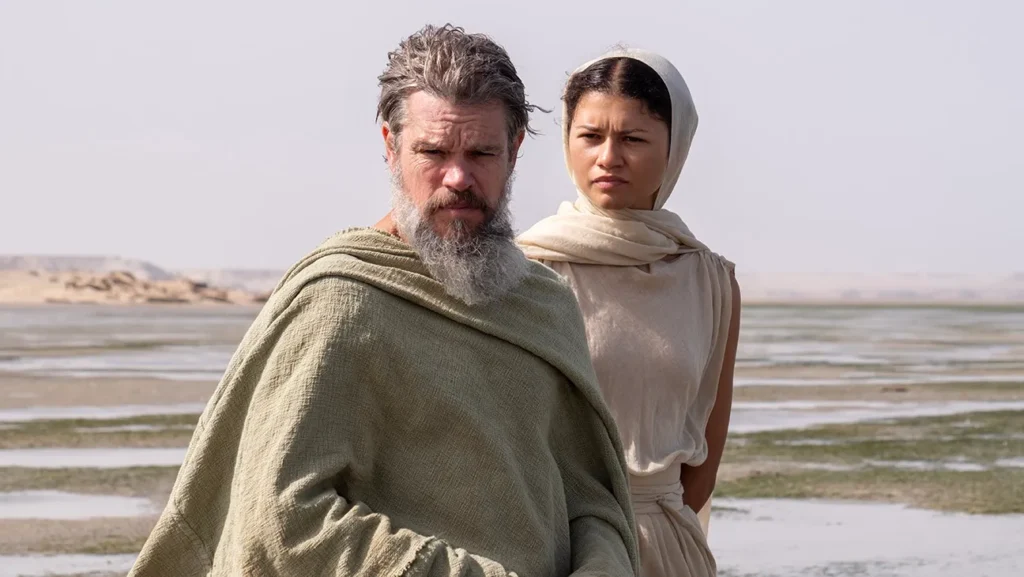
The idea that ancient-world movies have always sounded British is simply false. Hyperallergic traces a long mid-century pattern in which American accents often signaled liberty, piety, or identification with the audience, while upper-class British accents signaled empire, elitism, or oppression. In The Ten Commandments, that coding helped distinguish Hebrews from Egyptians; in Ben-Hur, Americans and Britons again mapped onto moral and political differences.
Spartacus is especially relevant. Hyperallergic notes that Kubrick’s film made enslaved gladiators sound American while Roman masters sounded British. A scholarly review in Arion makes the same point bluntly, observing that Rome’s accents in Spartacus and Ben-Hur were upper-class British, a casting logic meant to convey empire. GQ likewise argues that Spartacus already used accent contrast as thematic texture rather than historical reconstruction. So Nolan’s trailer is not abandoning tradition so much as breaking one particular later version of it.
By the time you get to Gladiator and beyond, the pattern had already loosened. Hyperallergic notes that even Ridley Scott’s Roman films mix accent signals more flexibly, while GQ points out that recent historical movies have become increasingly relaxed about strict national accent matching. The larger lesson is that Hollywood has never been consistent on accent authenticity in historical epics. It has always used accent as cultural coding.
Christopher Nolan Dialogue Style: Realism, Intimacy, and Sound Choices
Nolan’s broader filmmaking habits help explain why The Odyssey sounds the way it does. He has explicitly defended keeping production sound rather than relying heavily on ADR, saying he prefers “the performance that was given in the moment” over a later studio re-voicing. ITV’s reporting on his Oppenheimer comments also notes that Nolan connects new sound-filtering and quieter camera technology to the possibility of more intimate scenes than IMAX previously allowed.
That preference for immediacy sits alongside a longstanding interest in intimacy inside large-scale stories. In TIME’s profile of Nolan, he explains how Oppenheimer pursued closeness through first-person stage directions and tight visual alignment with Cillian Murphy, while cinematographer Hoyte van Hoytema described the film as unusually focused on faces. So while Nolan has not publicly released a formal manifesto about the accents in The Odyssey, the current choice fits his known pattern: spectacle on the outside, human proximity on the inside.
Why Modern Accents Can Make Mythic Characters Feel More Relatable
Modern accents can make mythic characters feel more relatable because relatability and prestige are not the same thing. GQ’s reading of the trailer is that British accents in these epics often elevate characters toward grandeur, while American accents can make them feel emotionally closer and more ordinary. That does not mean American accents are inherently better. It means they alter the register of the performance from stately distance to contemporary accessibility.
There is also a broader perception effect at work. Accent-attitude summaries and related sociolinguistic work consistently show that listeners separate prestige from warmth or familiarity; one widely cited popular summary describes British speech as sounding prestigious to Americans while “friendliness” sounds more like the listener’s own speech. That helps explain why a less ceremonial accent can feel more human in a mythic story. It does not create historical truth, but it can create emotional access.
Ridley Scott and Other Directors Letting Actors Use Natural Accents: What it Changes
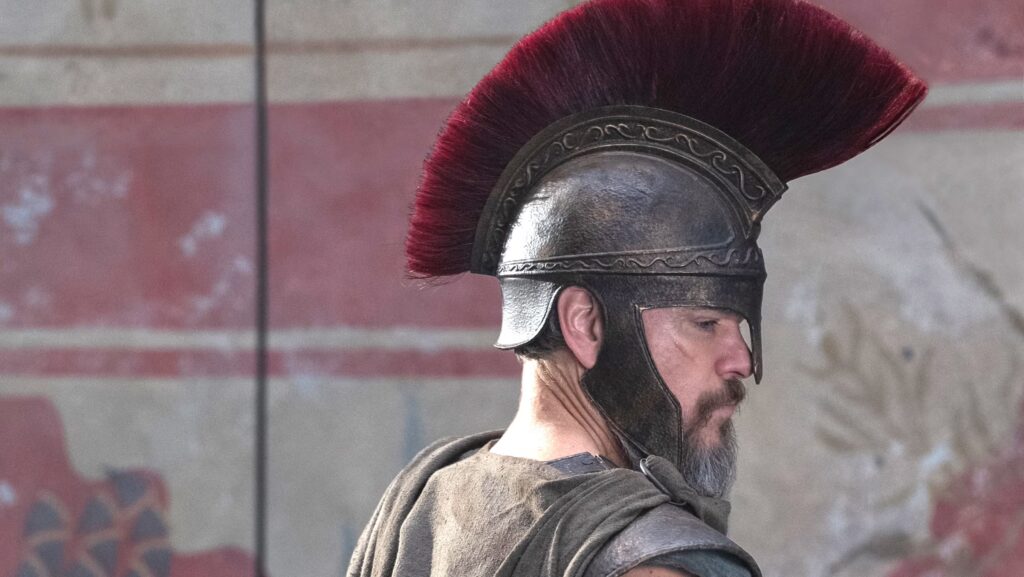
Ridley Scott is the clearest contemporary parallel. In his 2021 interview with Deadline, Scott said that The Last Duel had no French accent because that would have been a disaster. GQ uses Scott as evidence that recent historical films increasingly let actors find a workable performance voice instead of forcing a single false-authentic accent template across the cast.
Scott’s later comments on House of Gucci push the same idea from another direction. The Los Angeles Times reported that he was less interested in a strictly “Italian” accent than in a rhythm or cadence that fit the world of the film. GQ also points to Martin Scorsese’s The Last Temptation of Christ, where Willem Dafoe and Harvey Keitel largely kept natural speech patterns, making the Biblical story feel unusually intimate. What changes in this model is not just how the film sounds. What changes is where the audience’s attention goes: away from accent policing and toward presence, rhythm, status, and behavior.
Should Period Films Use “authentic” Accents or Performance-First Acting?
If a film chooses to reconstruct or revive historical language, that is one valid path. GQ points to Mel Gibson’s The Passion of the Christ and Apocalypto as examples of films that pursued linguistic distance much more aggressively. But once a movie shifts into modern English, “authentic accent” becomes a much shakier category because the base language itself is already a modern substitution.
For that reason, performance-first acting is often the more honest option. A fake prestige accent can create the illusion of seriousness without any genuine historical basis. A natural or strategically modern accent may be less ceremonially “period,” but it can be more transparent about what the film is doing: translating an old story into a living performance language. On the evidence available so far, that seems closer to Nolan’s wager.
Will the Odyssey Be Faithful to Homer’s Poem (Cyclops, Sirens, Underworld)?
The best current answer is: broadly yes, but not slavishly. The most detailed recent reporting says the film starts in Ithaca without Odysseus, as Homer’s poem does, and the current trailer coverage shows or describes the Cyclops, Charybdis, and Odysseus summoning the spirits of the dead. The same reporting suggests Nolan is keeping the poem’s crisis on Ithaca central, with Penelope, Telemachus, and the suitors occupying real dramatic space rather than serving as mere waiting-room characters for the monster episodes.
The important caveat is that pre-release fidelity is always partial. The Guardian notes that Nolan appears to have expanded the Trojan Horse material, even though that episode is only alluded to in the Odyssey itself, and the currently available footage has not yet clearly showcased the Sirens. But the same piece also reports that Nolan has hinted he wants the audience to inhabit a world saturated by divinity, which suggests he is not stripping the poem down into bare historical realism. The structure looks faithful; the emphasis looks cinematic.
How Nolan’s Non-Linear Storytelling Fits the Odyssey’s Structure
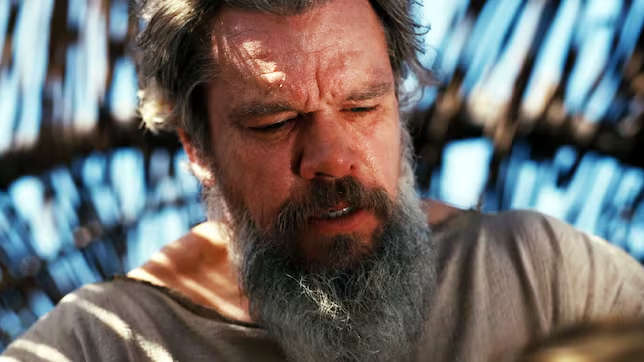
This is one area where Nolan may be especially well suited to the material. The Guardian reports that Nolan called the poem “the original non-linear narrative,” and that is not just clever publicity. The Odyssey famously begins in medias res, follows events in Ithaca before Odysseus returns, and turns many of its most famous adventures into retrospective storytelling once Odysseus reaches the Phaeacians. The text already behaves like a master-class in delayed revelation.
That matters because Nolan’s best-known films often rely on interleaved or reorganized time. TIME’s profile of Nolan highlights how he saw thematic chronology already present inside American Prometheus when shaping Oppenheimer. Applied to Homer, that instinct is not a distortion of the source but a match with it. If Nolan leans into the poem’s flashback logic rather than flattening it into straight-line adventure plotting, he may actually become more faithful by being more recognizably Nolan.
The Odyssey 2026 Release Date and What We Know so Far
As of May 7, 2026, the official movie site lists The Odyssey for theatrical release on July 17, 2026. The same official materials describe it as a mythic action epic shot across the world using brand new IMAX film technology. Recent reporting also confirms that Nolan revealed footage at CinemaCon on April 15, 2026, and that the official trailer launched online on May 5, 2026, after his appearance on The Late Show with Stephen Colbert.
What we know so far is enough to define the movie’s public identity. It is a large-scale adaptation of Homer, anchored by Matt Damon as Odysseus, centered on the journey home after Troy, and marketed as both a prestige event film and a physically immersive theatrical experience. Nolan himself told theater owners that the story has fascinated audiences for 3,000 years and called it not just “a” story but “the” story, which is a revealing way to frame the film’s ambition.
The Odyssey Cast List: Matt Damon, Tom Holland, Anne Hathaway, Zendaya, and More
The official cast list currently displayed on the movie site names Matt Damon, Tom Holland, Anne Hathaway, Robert Pattinson, Lupita Nyong’o, Zendaya, and Charlize Theron as the principal top-billed ensemble. That is the safest studio-confirmed roster to use in any cast summary as of this date.
Beyond the top billing, current trailer and feature coverage identifies Damon as Odysseus, Holland as Telemachus, Hathaway as Penelope, and Pattinson as Antinous. Recent press coverage also adds Jon Bernthal, Elliot Page, Mia Goth, John Leguizamo, Benny Safdie, and Himesh Patel to the ensemble. However, the official movie site has not yet published a complete character-by-character studio roster for every cast member, so some secondary role assignments remain press-reported rather than fully itemized in official materials. That distinction matters if accuracy is the priority.
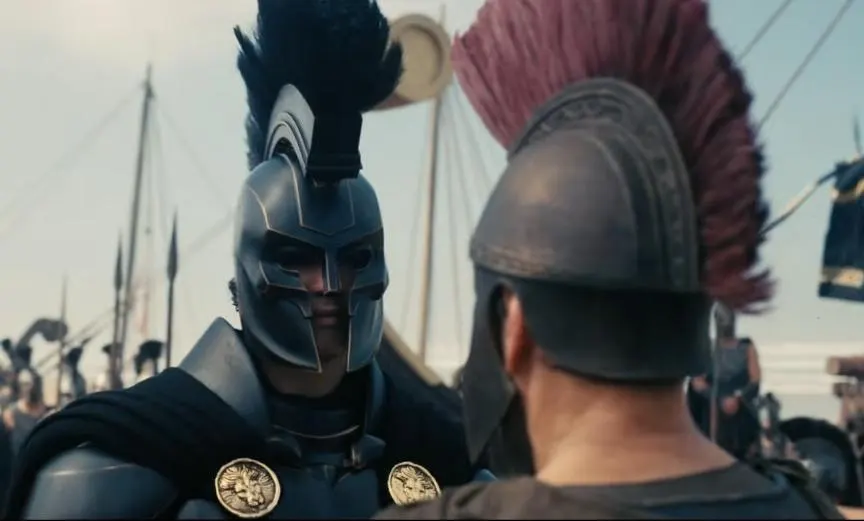
The Odyssey Filmed on IMAX What that Means for the Theatrical Experience
The headline fact is real and important: The Odyssey is being presented as the first theatrical feature shot entirely with IMAX film cameras. The official movie site states that the film was shot entirely with IMAX film cameras, and IMAX’s own investor materials described it as the first theatrical feature ever made that way. That makes the format part of the movie’s identity, not just an optional premium add-on.
What that means practically is not only a bigger picture. Recent reporting says Nolan and Hoyte van Hoytema used new, lighter-weight camera systems, while Nolan’s earlier comments about improved sound-filtering and quieter equipment show why this matters artistically: the format can now move closer to actors and preserve more intimate dialogue performance than older large-format workflows allowed. So the promise of the theatrical experience is a specific Nolan combination of scale and intimacy, not scale alone.
The Odyssey Runtime: How Long Christopher Nolan Says the Movie Will Be
Nolan has now said the film will run under three hours, but he has not revealed the exact runtime. Multiple recent reports, based on his Associated Press comments, state that The Odyssey is shorter than Oppenheimer, which ran three hours. That is the precise, currently verified answer. Anything more exact than “under three hours” would be speculation at this stage.
The reason is tied directly to the exhibition format. Nolan said the film was shot for IMAX film presentation and that the longest they have been able to get onto the projector in that format is three hours. So the runtime ceiling is not only aesthetic. It is also technical. That means viewers should expect a film that is still epic in scale, but tighter than the maximalist duration some had predicted from the source material alone.
Frequently Asked Questions (FAQs)
- Why are people arguing about the accents in The Odyssey?
Because the current trailer uses modern, mostly American-sounding delivery for an ancient Greek story, and many viewers instinctively expected the old prestige-epic convention of British accents instead. - Are the actors definitely sounding American in the trailer?
Yes. Recent trailer coverage specifically notes that Tom Holland and Robert Pattinson, despite being English actors, are heard using American accents, and that Matt Damon’s Odysseus does as well. - Would British accents be more historically accurate for ancient Greece?
No. Ancient Greek speech differed from both Modern Greek and modern English accents, and scholars can reconstruct only approximate features of pronunciation. - Did ancient Greeks speak with one standard accent?
No. Ancient Greek varied by period and dialect, and major linguistic reference sources describe multiple dialect groups and shifting phonological systems. - Is Nolan likely using modern accents on purpose?
That is the strongest reading of the available evidence. Nolan has long favored immediacy, in-the-moment performance, and intimacy inside large-scale filmmaking, and the trailer fits that pattern. - Will the movie include the Cyclops, the underworld, and other famous set pieces?
Current reporting says yes for the Cyclops and Odysseus summoning the dead, and likely yes for many of the poem’s major episodes, though the Sirens have not yet been clearly showcased in released trailer footage. - Is The Odyssey really a natural fit for Nolan’s non-linear storytelling?
Yes. The poem itself is structurally non-linear, beginning away from Odysseus and using retrospective storytelling for the best-known adventures. - When is The Odyssey coming out?
The official release date listed on the movie site is July 17, 2026. - How long will the movie be?
Nolan says it is under three hours and shorter than Oppenheimer, but the exact runtime has not yet been publicly announced. - Why does shooting entirely on IMAX matter so much here?
Because the film is being built as a theatrical event around large-format image capture and presentation, and newer camera and sound advances appear to let Nolan combine giant-scale visuals with closer, more intimate performance scenes.

Conclusion
The accent debate around Christopher Nolan’s The Odyssey is real, but it is being misnamed. The controversy is not fundamentally about historical correctness. It is about what audiences think epic movies are supposed to sound like. Once a Homer adaptation is performed in modern English, no accent choice is truly ancient Greek. British prestige diction, American naturalism, mixed speech, or reconstructed language are all artistic strategies, not neutral defaults.
On the evidence available so far, Nolan seems to be choosing performance-first immediacy: myth told at colossal scale, but voiced in a way that keeps the characters close. That choice has precedent in Hollywood history, it fits the structure of Homer’s poem better than many critics assume, and it aligns with Nolan’s own preference for present-tense performance and intimacy within spectacle. Whether every line will work in the finished film remains to be seen, but the accent choice itself is not a mistake by default. It is a coherent artistic argument.
Sources and Citations
- Official film sources for synopsis, cast details, studio presentation, and general movie information: The Odyssey Official Synopsis and Cast Page and The Odyssey Official Home Page.
- AP reporting for the film’s official announcement, Christopher Nolan context, and July 17, 2026 release date: AP – The Odyssey Announcement and Release Date.
- AP reporting for CinemaCon footage, early presentation details, and Nolan’s 2026 theatrical rollout context: AP – CinemaCon Footage and Nolan Presentation.
- Scholarly/critical context for classical epic film traditions, including discussion of British-accented Rome in films such as Spartacus and Ben-Hur: Arion – Classical Epic Film Accent Discussion.
Recommendations
- Closure of Midsummer Studios: What Happened to Jake Solomon’s Burbank Life Sim
- Skate is Adding a Limited-Time Nike SB Pop-Up Event (April 14–May 5): Dates, Grom at Night, Challenges, and Rewards
- Vampire Crawlers release date and platforms (Steam, Switch, Xbox, PlayStation)
- Why PixelHair is the Best Asset Pack for Blender Hair Grooming
- According to YouTube, “Independant Animators Are Changing the Industry” What the 2026 Animation Trends Report Reveals
- What is LARP? Everything You Need to Know About Live Action Role-Playing Games (History, Rules, Costumes, and Safety)
- Top 20 Hottest Video Game Characters: Icons of Beauty and Aura in Gaming
- How The View Keeper Improves Blender Rendering Workflows
- Minecraft Mod Lets You Control Giant Sphere That Absorbs Blocks
- How to Create Hair Cards in Blender for Game-Ready Characters: Complete Workflow Guide