









In This Article (9 sections)
Disney Lorcana Coconut Format Rules and How Multiplayer Games Work
Disney Lorcana Coconut Format is an experimental multiplayer format in which each player builds a deck around a special character represented by a Coconut card. Ravensburger describes Coconut as a codename rather than a finalized commercial name because the format remains in open beta. It was created to expand Lorcana’s existing multiplayer rules into a deeper experience with its own deckbuilding structure, central character identities and a modified victory condition. Players and card game publications have compared it with singleton multiplayer formats such as Magic: The Gathering’s Commander, but Coconut has its own rules rather than simply reproducing that system.
A game begins with each player choosing a Coconut card. That Coconut provides a special ability intended to guide the deck’s overall strategy. Players then choose up to three ink types, with at least one matching the ink associated with their selected Coconut, and build a deck containing at least 60 cards. Most individual cards are restricted to one copy, creating the singleton structure that defines much of the format. The exception is the normal Disney Lorcana character card associated with the chosen Coconut, of which up to four copies can be included.
Once play begins, Coconut largely follows normal Disney Lorcana multiplayer rules, but the victory threshold increases from 20 to 25 lore. Ravensburger expects three and four player groups to provide the strongest experience, although larger groups can experiment with the format and provide feedback. The higher lore requirement changes the pacing because a player approaching what would normally be the winning total still has further to go, giving opponents additional time to respond.
Multiplayer also changes how players evaluate threats. In a two player game, weakening the opponent usually improves your own position directly. In Coconut, spending several resources stopping one player can leave both of you vulnerable while another opponent advances. Lore totals therefore become political information. A player who moves too quickly toward 25 lore can become the common target of the table, so successful decks need to balance scoring, interaction and the ability to accelerate toward victory when the board is favorable.
How to Build a Disney Lorcana Coconut Deck With Singleton and Three Ink Rules
Building a Coconut deck begins with the Coconut rather than simply choosing the strongest individual cards. Its ability should establish the deck’s central direction, whether that means emphasizing particular character classifications, Songs, items, locations, challenges, questing or another recurring interaction. The associated ink also matters because at least one of the deck’s selected colors must match the Coconut, making that ink a permanent part of the deck’s structure.
Players may select up to three inks but are not required to use all three. The extra color provides access to combinations unavailable in ordinary two ink Lorcana decks, but adding an ink should solve a specific problem rather than simply increase the number of attractive cards available. One ink might supply the main synergy, another provide card draw and a third add removal or protection. A focused two ink Coconut deck can still be preferable if the third color weakens consistency.
Singleton construction changes the way consistency is created. Standard Lorcana decks can use several copies of their strongest draw cards, removal options or questers. Coconut generally limits supporting cards to one copy each, so players need redundancy through different cards that perform similar functions. A deck that requires regular card draw should include several unique draw effects. A combat focused strategy may need different cards that improve Strength, grant Rush, manipulate exertion or remove damaged characters instead of depending on multiple copies of one ideal answer.
The associated character is the major exception. Up to four copies of the normal character corresponding to the Coconut can be included, allowing the deck’s central identity to appear more reliably than almost every other individual card. Supporting cards should therefore work with the broader strategy rather than depend entirely on drawing one particular singleton combination.
Deck construction also needs a sensible ink curve. Three colors and a larger card pool can tempt players to fill the deck with expensive, exciting effects, but Coconut still uses Lorcana’s normal resource system. A functional list needs playable early turns, sufficient inkable cards and enough low and medium cost options to avoid falling behind before its more powerful effects become available.
Disney Lorcana Coconut Cards, Abilities and the 18 Character Beta Roster
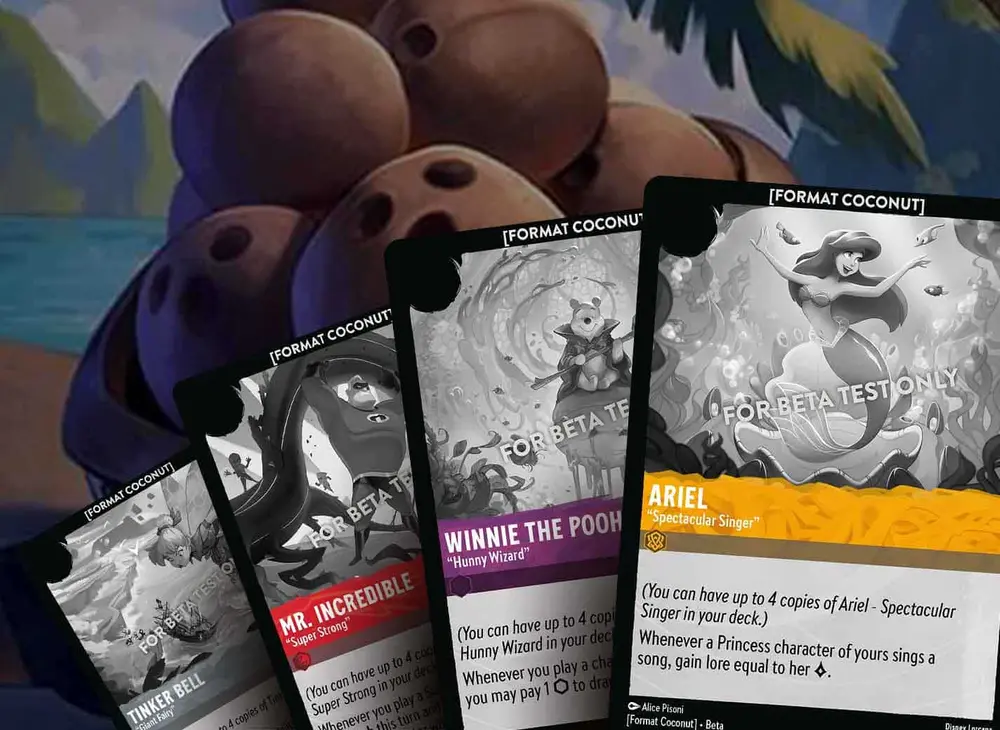
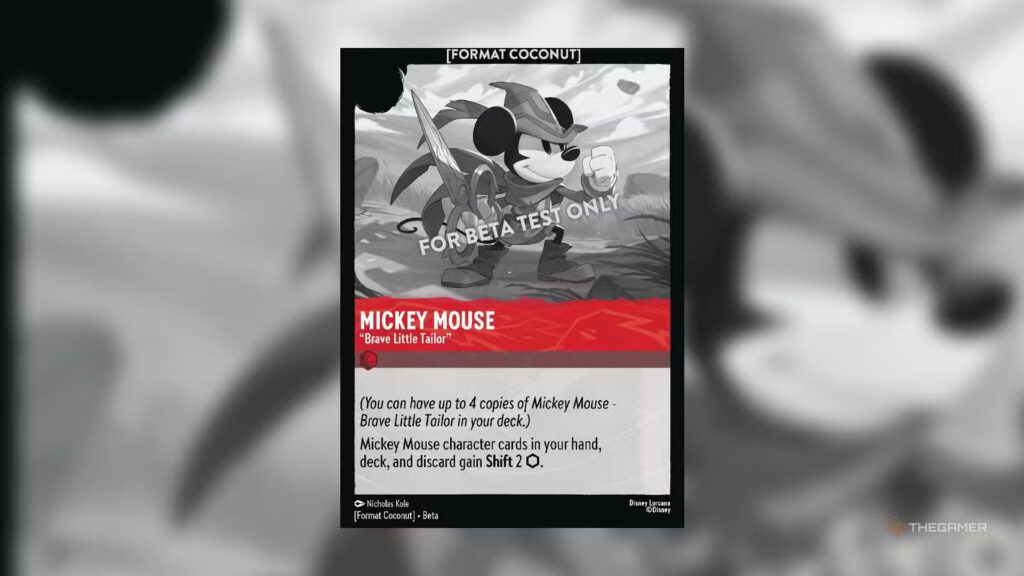
Coconut cards are special beta game pieces representing the character around which the deck is built. Each provides a format specific ability intended to inspire a particular style of deck construction. The Coconut itself is distinct from the ordinary playable character card associated with it. The special Coconut establishes the deck identity and ability, while the matching standard character receives the exception allowing up to four copies in the deck.
The initial beta contains 18 Coconut characters, with three associated with each of Lorcana’s six ink colors. The published roster includes Ariel, Spectacular Singer; Donald Duck, Fred Honeywell; Dumbo, Ninth Wonder of the Universe; John Silver, Greedy Treasure Seeker; Mickey Mouse, Brave Little Tailor; Moana, Curious Explorer; Mr. Incredible, Super Strong; Mufasa, Ruler of Pride Rock; Nick Wilde, Wily Fox; Pocahontas, Peacekeeper; Robin Hood, Sneaky Sleuth; Scar, Finally King; Sisu, Emboldened Warrior; Snow White, Merry as the Morning; Stitch, Rock Star; Tinker Bell, Giant Fairy; Ursula, Deceiver of All; and Winnie the Pooh, Hunny Wizard.
Choosing between them should depend more on the Coconut ability than on how powerful the corresponding character is in ordinary competitive Lorcana. Some abilities provide broad support for several strategies, while others give stronger direction toward a narrower theme. The Coconut’s ink must also be considered because it affects which color combinations are available for the entire deck.
The early roster already encourages significantly different approaches. Ariel can support Princess and Song oriented construction, while Stitch can favor strategies that develop numerous smaller characters. Pocahontas encourages a different relationship with multiplayer board states and lore generation. Those examples illustrate why the strongest cards for one Coconut may be mediocre in another.
Because Coconut remains in beta, none of these abilities should be treated as permanently fixed. Ravensburger has said community testing will influence adjustments to individual Coconut designs as well as the wider rules. The latest Coconut information is available through the Disney Lorcana Trading Card Game Companion app, making it the appropriate place to verify current abilities and legality while the format continues evolving.

Best Disney Lorcana Coconut Strategies for Reaching 25 Lore
Strong Coconut decks need to account for both singleton inconsistency and the realities of multiplayer. Card advantage becomes particularly valuable because a singleton deck can exhaust its hand quickly if it simply deploys every available card. Multiple unique ways to draw, recover resources or generate more than one benefit from a single play can help a deck remain functional across a longer multiplayer game.
Flexible interaction is equally important. With several opponents, there are more opportunities for powerful characters, items, locations and engines to appear. Narrow answers may remain useless for much of a game, while versatile cards can solve different problems depending on which opponent becomes dangerous. Permanents that create immediate value are also useful because surviving an entire round of opposing turns is less reliable when three players may have opportunities to interact with them.
Players should avoid becoming the obvious threat too early. Rapidly jumping ahead in lore can cause every opponent to redirect challenges and disruption toward the leader. A more effective approach can be to maintain steady scoring while preserving the ability to accelerate late. Characters or effects capable of creating a sudden lore increase become particularly valuable when they allow a player to stay within reach of the leaders before moving decisively toward 25.
Board control contributes directly to that race. Removing an opposing quester can prevent several future lore, while protecting one of your own recurring scorers can produce the opposite advantage. Coconut decks therefore need a real questing plan even when their central ability encourages elaborate combinations. A deck that controls the table effectively but cannot accumulate lore may simply create enough time for another player to win.
The best individual cards depend heavily on the Coconut and its selected inks, but several qualities are broadly useful:
- Cards that draw or replace themselves to reduce singleton inconsistency.
- Flexible interaction capable of answering several kinds of threats.
- Characters that provide useful abilities while still contributing meaningful lore.
- Cards that create immediate value before opponents can remove them.
- Effects with broad synergy across many cards rather than dependence on an exact two card combination.
- Reliable early plays and sufficient inkable cards to keep the deck functioning.
The goal is not simply to include the sixty most individually powerful cards available across three inks. Coconut rewards a coherent deck in which many unique cards contribute toward the same plan.
Disney Lorcana Coconut Open Beta and How to Start Playing
Ravensburger launched the Coconut open beta on July 28, 2026, presenting it explicitly as a period of experimentation rather than the final release of a finished format. The company wants players to test the multiplayer structure, evaluate the Coconut abilities and provide feedback about how the format performs in real games.
The easiest way to begin is through the Disney Lorcana Trading Card Game Companion app, which provides access to the current Coconut cards, their abilities and a digital lore counter. Players can choose a Coconut, build a deck of at least 60 cards under the singleton and ink restrictions and organize multiplayer games privately with friends without needing a dedicated commercial Coconut product.
Ravensburger has also been testing the format at major events. Gen Con included multiplayer beta sessions, Dev Tables using preconstructed decks and Coconut Social Hour events where players could use supplied decks or bring their own legal creations. The official event structure allowed participants to face as many as three opponents, reinforcing the intended emphasis on four player games.
Further public testing is scheduled for gamescom in Cologne from August 26 through August 30, 2026. Ravensburger has said that two tables will support both preconstructed and player built decks, with game designers available to explain the format and collect feedback directly from participants.
The beta structure means players should continue checking the Companion app and Ravensburger’s current rules when constructing decks. Ink restrictions, Coconut abilities or other details may change as the developers evaluate feedback. The current framework is therefore best understood as a playable foundation: choose a Coconut, build around its identity using up to three inks and mostly singleton cards, then compete in multiplayer until one player reaches 25 lore.
Frequently Asked Questions (FAQs)
- What is Disney Lorcana Coconut Format?
Disney Lorcana Coconut Format is an experimental multiplayer way to play Disney Lorcana. Each player chooses a special Coconut character whose ability helps define the strategy of their deck. Decks contain at least 60 cards, generally follow singleton rules, can use up to three inks and compete to become the first player to reach at least 25 lore. The format is designed to create more varied games and give decks a stronger identity around a particular Disney character. - Is Disney Lorcana Coconut an official format?
Yes, Coconut is officially designed and supported by Ravensburger, but it has not received a full final launch. It is currently an experimental format being tested through an open beta, allowing Ravensburger to collect feedback about its multiplayer rules, Coconut abilities and overall balance. The name Coconut is also being used as a codename, so aspects of the format could change before a final release. - How many cards do I need for a Coconut deck?
A Coconut deck must contain at least 60 cards. Most individual cards can appear only once because the format uses singleton focused deckbuilding. The major exception is the regular Disney Lorcana character associated with your chosen Coconut, which can appear up to four times. This gives the deck’s central character greater consistency while keeping most of the supporting cards varied. - Can a Coconut deck use three ink colors?
Yes. Players can build Coconut decks using up to three ink types, expanding the number of card combinations available compared with traditional two ink Lorcana decks. At least one of the selected inks must match the ink associated with the chosen Coconut. The other inks can then be selected to provide additional synergy, card draw, removal, protection or other tools the strategy needs. - Do I have to use all three ink colors?
No. The rules allow up to three inks, which means using all three is optional. A player can build with fewer colors if that produces a more focused or consistent strategy. Adding a third ink increases the available card pool, but it does not automatically improve a deck, especially if the additional color contributes little to the Coconut’s main game plan. - How much lore do you need to win Coconut?
The first player to reach 25 lore or more wins the game. This increases the normal Disney Lorcana victory threshold from 20 lore to 25, giving multiplayer opponents more time to react to someone approaching victory. Players therefore need to think carefully about when to push ahead because becoming the clear lore leader too early can cause the rest of the table to focus on stopping them. - How many players is Coconut designed for?
Ravensburger expects Coconut to work particularly well with three or four players, reflecting the format’s emphasis on multiplayer strategy. With several opponents, players must consider changing threats, different board states and which opponent is closest to winning rather than concentrating on a single rival. Larger groups can also experiment with Coconut, and Ravensburger has invited feedback about how those games perform. - How many Coconut cards are currently available?
The initial open beta includes 18 Coconut characters, with three associated with each of Disney Lorcana’s six ink colors. The roster provides a variety of characters and abilities intended to encourage different deckbuilding approaches. Because Coconut remains in beta, Ravensburger may adjust existing abilities or make other changes as it receives more feedback from players. - Where can I see Coconut abilities?
The current Coconut cards and their abilities are available through the Disney Lorcana Trading Card Game Companion app during the open beta. The app also provides tools such as a digital lore counter that can help during games. Since Coconut is still being tested and its rules or abilities could change, the Companion app is particularly useful for checking the latest available information before building a deck. - When will Disney Lorcana Coconut officially release?
Ravensburger has not announced a final release date for Coconut. The open beta began on July 28, 2026, with testing taking place through the Companion app, private games and public events. Ravensburger is using this period to gather feedback about the rules, multiplayer experience and individual Coconut designs before deciding how the format should develop and eventually receive a full launch.

Conclusion
Disney Lorcana Coconut Format represents a major experiment in how Ravensburger approaches casual multiplayer Lorcana. Rather than simply changing the number of players, Coconut redesigns the deckbuilding experience around spotlight characters, singleton restrictions, three ink access, and a higher 25-lore victory threshold.
The result is a format where familiar Disney Lorcana cards can perform very different roles. Cards normally overshadowed by more efficient alternatives gain relevance because almost every supporting card is limited to one copy. Meanwhile, three-color deck construction allows combinations that would be impossible under conventional Lorcana deckbuilding restrictions.
The Coconut itself provides identity and direction. Instead of beginning with sixty unrelated cards, players begin with a character and ask how an entire deck can exploit or complement that character’s special format ability. That approach supports both thematic decks and highly strategic builds.
Multiplayer adds another layer. Players must evaluate threats across several boards, decide when to challenge, determine how quickly they should accumulate lore, and avoid becoming the target of the whole table. Reaching 25 lore requires more than simply executing a normal constructed game plan against additional opponents.
Most importantly, Coconut is not finished. The July 28, 2026 launch is an open beta, not the final release of the format. Ravensburger is actively requesting player feedback, testing additional Coconut cards, evaluating balance, and discussing possible future changes.
For players interested in multiplayer Lorcana, creative deck construction, unusual ink combinations, and character-driven strategies, Coconut provides one of the broadest deckbuilding environments the game has offered. Its long-term rules and final form remain uncertain, but the beta already establishes a clear identity: multiplayer Disney Lorcana built around variety, replayability, experimentation, and the character at the center of every deck.
Sources And Citations
- Antonio Carlos, Cards Realm. “Lorcana: Format Coconut and reviewing all archetypes!” Published August 9, 2026, with a note stating that the article incorporates changes from August 6. Examines early strategies across the 18 Coconut options, including Princess and Song synergies for Ariel – Spectacular Singer, lore generation and multiplayer diplomacy for Pocahontas – Peacekeeper, and small-character swarm strategies for Stitch – Rock Star. It also explains deckbuilding restrictions and distinguishes the Coconut card outside the deck from the associated character cards included within it. (lorcana.cardsrealm.com)
- Disney Lorcana by Ravensburger. “New Multiplayer Format Open Beta.” The primary official source for Coconut’s announcement, open beta status, design goals, deckbuilding structure, three-ink limit, 60-card minimum, singleton restriction and designated-character exception, multiplayer recommendations, and 25-lore victory condition. It also covers Companion app availability, Gen Con and gamescom testing, community feedback, and possible future development. Date clarification: The official page currently displays August 7, 2026, while Lorcana.gg’s reproduction of the announcement is dated July 28, 2026. The official text confirms that Companion app access began July 28. (Disney Lorcana)
- Disney Lorcana by Ravensburger. “Disney Lorcana TCG Resources.” The official resource hub provides the comprehensive game rules, tournament rules, quick-start rules, and other rules documents. It also contains dedicated links to the Format Coconut Rules and Format Coconut Beta Coconut Cards List, making it the relevant official reference for checking beta-specific information alongside the standard game rules. (Disney Lorcana)
- Gen Con. “Disney Lorcana New Multi-Player-Format Beta Test.” The official Gen Con 2026 event listing identifies Ravensburger as the organizer and confirms public testing of the new multiplayer format. Its description specifies games against up to three opponents and states that participants could bring their own decks or use the organizers’ demo decks, with opportunities to play against developers. (gencon.com)
- John Hall, Star City Games. “Disney Lorcana Introduces New Experimental Multiplayer Format.” Published July 30, 2026. Summarizes Coconut’s 60-card minimum, singleton deck construction and its exception, 18 initial Coconut choices, allowance for up to three ink types, recommended three- or four-player groups, and 25-lore victory condition. The report also discusses the format’s accessibility goals and links to Ravensburger’s original announcement. (Star City Games)
- InkDecks. “Lorcana Coconut Cards.” The database lists 18 Coconut entries and links to their individual card pages. It supports identification of the characters represented in the beta roster, including Ariel – Spectacular Singer, Pocahontas – Peacekeeper, Stitch – Rock Star, Mickey Mouse – Brave Little Tailor, and the other listed Coconut characters. This is a third-party card reference rather than an official rules document. (InkDecks.com)
Recommendations
- Halo Studios is Reportedly Doing a “Lot” of Outsourcing for Halo: Campaign Evolved Explained
- Canceled Star Wars FPS Is Playable Again – Why “First Assault” Feels Amazing and Sad at the Same Time
- The Lord of the Rings: War in the North Legacy Edition Shadowdrops on Consoles and PC
- First Look at Xbox’s Gaming Copilot Leaves a Bad Impression as Microsoft Pushes AI Help to Consoles
- No Man’s Sky’s Latest Threat Looks Like a Star Wars Death Star Homage in the Swarm Update
- Parkasaurus Guide: Build the Ultimate Relaxed Dinosaur Park
- Silo Season 3 Is Borrowing Fallout’s Timeline Structure And It Could Change Everything
- The Mermaid Mask Point-and-Click Detective Game: Release Date, Gameplay, Puzzles & Story
- DayZ Nintendo Switch 2 Announcement Trailer Breakdown: Cool Edition Release Window, Gameplay Features, and What Fans Can Expect
- GTA Online: the Kortz Center Heist Update, How to Start, Payouts, Cars, Missions, and Rewards



































































































