










In This Article (7 sections)
IBM AI Governance Survey 2026: 80% of Executives Escalate AI Incidents to Leadership
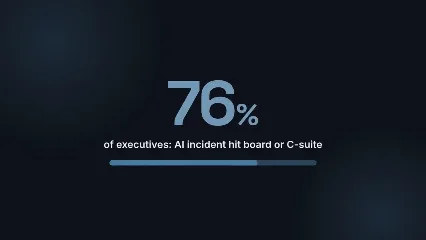
IBM’s 2026 AI governance survey found that 80% of surveyed executives said an incident involving artificial intelligence had reached their board or C-suite during the previous year. The IBM finding places enterprise oversight firmly on the leadership agenda, particularly as organizations expand these technologies across business operations. However, executive awareness does not necessarily establish that effective controls exist to prevent similar incidents from recurring. Reporting an incident confirms that a problem has been identified, but resolving its underlying causes requires understanding the affected system, its permissions, the decisions it made and the safeguards that failed.
As businesses increasingly connect automated applications to operational tools, IBM’s research highlights why governance must address what these systems can do rather than focusing exclusively on the accuracy of their responses. An assistant that produces an inaccurate summary presents one category of risk, while a system that uses the same incorrect information to modify customer records, approve transactions or contact external parties introduces additional consequences. This distinction becomes increasingly important as enterprises move toward agentic systems capable of independently performing tasks.
IBM’s survey highlights several findings concerning the relationship between technological adoption, executive oversight and organizational readiness:
- 80% of surveyed executives: Reported that an incident involving these technologies reached their board or C-suite during the previous year.
- 40% of respondents: Reported governance changes following such incidents.
- 35% of respondents: Said agentic systems were already in production.
- 75% of respondents: Expected some degree of decision autonomy by 2027.
- 37% of respondents: Considered their governance arrangements scalable for autonomous deployments.
- 98% of respondents: Reported board-level assignment of responsibility for related risks.
These IBM findings raise questions about whether enterprises are developing controls quickly enough to match the authority granted to automated systems. A deployment may pass an initial review but become more consequential as its capabilities expand. Connecting an assistant to a customer database introduces access to sensitive information, while allowing it to update that database increases the potential impact of mistakes.
Giving the same assistant access to additional automated systems can extend those consequences further. Governance therefore needs to follow these workflows throughout their operational lives, with approvals establishing clear boundaries around permitted tasks, accessible information and authorized actions. Changes affecting those boundaries should receive appropriate reviews rather than automatically inheriting approval originally granted to a less capable system. The IBM survey provides insight into executive experiences and expectations, but its findings should not be interpreted as independent verification of the technical effectiveness of individual organizations’ controls.
The high escalation rate also requires careful interpretation because IBM’s public summary does not establish one explanation for why so many incidents reached senior leadership. Several business considerations could contribute, including customer impact, uncertainty involving confidential information, disruption of critical services and the need for executive authorization. An organization might escalate an incident because management must approve additional expenditure, temporarily restrict a deployment or coordinate communications across several departments.
Another business may have reporting rules requiring senior leadership to receive information about relatively contained events. Consequently, escalation rates cannot independently establish incident severity or determine how safely organizations operate. A company with strict reporting requirements may escalate more incidents than another that reserves executive notifications for major disruptions, meaning a high reporting rate could reflect widespread problems, stronger detection capabilities, broader reporting requirements or a combination of these factors.
The more important management question concerns what happens after an incident reaches leadership. An effective briefing should explain the affected workflow, summarize known consequences, identify immediate containment measures and assign responsibility for investigating the problem while distinguishing established facts from remaining uncertainties. A board cannot resolve a technology-related incident simply by receiving a report. Its role is to ensure that management has the authority, resources and accountability required to investigate the event, address underlying weaknesses and verify appropriate corrective measures. Without standardized information about severity and impact, IBM’s escalation percentages should not be used to rank organizations according to operational safety.
IBM identified several incident categories, including agent failures, data exposure, automated decision errors and security breaches. Although these categories all concern artificial intelligence, they represent different failure mechanisms requiring different responses. An agent failure might involve an automated workflow completing the wrong task or continuing beyond an expected stopping point, while a decision error could involve an unsuitable recommendation, classification or business judgment. A security breach might involve compromised access, manipulated inputs or unauthorized activity. Organizations therefore need sufficiently detailed incident definitions to distinguish these situations rather than grouping unrelated problems under a broad label that offers little information for investigation and remediation.
Consider a hypothetical customer service assistant that reveals one customer’s information to another. Investigators would need to examine identity verification, retrieval permissions, session separation and response generation because the visible disclosure may originate from an earlier failure within the workflow. A different automated system might recommend an incorrect stock order after relying on outdated demand information, requiring attention to data freshness, validation procedures and purchasing authority rather than the controls associated with customer information disclosure.
Both situations could qualify as incidents involving these technologies, but their causes and corrective actions would differ. Near misses also deserve attention because a blocked attempt to access restricted information can reveal a weakness even when no disclosure occurs. Recording such attempts helps organizations identify recurring failure patterns before they produce more serious consequences, an approach consistent with the risk management concerns raised in IBM’s research.
IBM’s finding that 40% of respondents reported governance changes following incidents introduces another important distinction. The figure does not explain why particular organizations did or did not amend their policies, and it would be inaccurate to conclude that every business without a formal policy revision ignored the problem. Some incidents can be addressed through existing governance arrangements, such as revoking unnecessary permissions, repairing integrations or improving approval processes without rewriting enterprise policy. Other incidents may reveal that the organization never adequately defined whether a particular activity should be permitted.
When an existing policy prohibits an action but technical controls fail to enforce it, remediation should focus on implementation and evidence that the correction works. When responsibilities or permissions were never clearly established, a formal governance change may be necessary. Every material incident should nevertheless produce a documented learning decision explaining whether policy changes were considered necessary, which corrective measures were selected and how their effectiveness will be evaluated. Completing assigned remediation tasks does not automatically establish that risk has been reduced; a stronger closure process requires evidence that recurrence is less likely or that the consequences can be contained more effectively.
IBM’s findings must also be understood through the study’s methodology. Censuswide surveyed 3,221 executive management respondents at organizations employing at least 1,000 people across eight countries between September 14 and September 24, 2026. The countries included the United Kingdom, France, Germany, Italy, Spain, the Netherlands, Saudi Arabia and the United Arab Emirates. IBM’s release page displays October 14, while its dateline identifies October 15. The sample definition matters because findings from executives at large organizations should not automatically be applied to smaller businesses or every enterprise across the EMEA region. These countries represent selected European and Middle Eastern markets rather than every country included in the broader regional designation.
The results reflect respondents’ reports about their organizations rather than independently verified technical observations. The published IBM methodology does not establish that researchers inspected every incident, independently classified its severity or tested the effectiveness of each organization’s remediation measures. The public summary also provides insufficient methodological detail to evaluate every possible source of bias or establish representative rankings across individual countries and industries. These limitations do not eliminate the study’s relevance, but they define how its findings should be interpreted. The research provides evidence of reported executive experiences, organizational expectations and governance concerns rather than establishing causal relationships between specific practices and the frequency or severity of reported incidents.

Enterprise AI Agent Risks: Security, Accountability, Human Oversight and Operational Controls
The exThe expansion of agentic AI creates additional governance challenges for IBM and other enterprises because these systems can perform sequences of actions rather than simply generate responses. An AI agent may retrieve information, interpret instructions, select tools, execute an operation and use the result to determine what happens next. Each additional capability can increase the consequences of an error, particularly when the agent interacts with sensitive information, customer accounts, financial systems or production infrastructure.
OWASP identifies excessive functionality, permissions and autonomy as important contributors to excessive agency, explaining how unexpected or manipulated model outputs can become harmful actions when systems possess capabilities beyond those required for their intended purpose. IBM’s enterprise AI governance concerns demonstrate why approving an AI model is insufficient to establish that an enterprise deployment is safe because the surrounding application, connected tools and authorization structure determine what the system can actually influence.
Consider a hypothetical invoice processing agent that correctly reads an invoice but associates it with the wrong supplier. If the agent also has permission to change supplier banking information and release payments, the original classification error could develop into a financial loss. A more controlled arrangement would separate those capabilities because reading an invoice does not need to provide permission to change payment destinations, while preparing a payment request does not necessarily require authority to execute the transaction.
Governance weaknesses frequently appear at the boundaries between connected systems, particularly when different departments approve individual components without evaluating the complete chain of actions available to an agent. A meaningful IBM AI governance assessment should follow the workflow from the original instruction to its final business effect, ensuring that every consequential transition has an appropriate authorization rule and that the organization understands how errors could move between connected tools.
Data exposure presents another important risk for IBM and other enterprises because sensitive information may enter an AI workflow through a user request, retrieved document, connected database or external service before appearing in generated responses, diagnostic records or downstream applications. Protecting information requires examining the complete path rather than focusing exclusively on the final output. A customer service assistant, for example, may need access to an order’s delivery status without requiring the customer’s complete account history.
Restricting unnecessary access reduces the potential impact of mistakes and security compromises. Retrieval permissions are particularly important because an AI system searching enterprise documents should preserve the access restrictions associated with those materials. The ability to generate a convincing answer does not establish that the requester was authorized to receive the underlying information, an important consideration for IBM’s enterprise AI governance findings.
External content introduces additional risks because instructions embedded in material encountered by an application can influence subsequent behavior if the system treats that content as authoritative. OWASP identifies indirect prompt injection as one possible trigger for excessive agency, making it important to keep authorization decisions outside the model’s discretion. A document should not gain the ability to grant additional access simply because its contents instruct the agent to obtain it.
Security controls should also examine information leaving the workflow through exports, external destinations and diagnostic records. Restricting unnecessary transfers, validating destinations and protecting operational logs can reduce exposure that might otherwise remain undetected by output screening alone. These safeguards are also relevant to the enterprise AI risks highlighted by IBM.
Accountability becomes increasingly important as AI systems gain autonomy. IBM reported board level assignment of AI risk responsibility among 98% of respondents, but the most frequently selected owner for adverse agent outcomes, the CIO or CTO, received only 17%. This IBM finding highlights the need to connect strategic oversight with operational authority because assigning responsibility at board level does not necessarily clarify who is accountable for an individual automated decision or failure. A customer facing AI agent may rely on components supplied by several organizations, but the deploying business still needs someone accountable for the service outcome. A customer complaint cannot be resolved effectively if engineering, procurement and the supplier each treat responsibility as belonging to another party.
A workable IBM AI accountability arrangement should establish responsibilities across several organizational functions:
- Board oversight: Reviews organizational risk appetite, challenges management decisions and evaluates whether governance arrangements are appropriate.
- Executive management: Allocates resources, establishes reporting expectations and ensures material risks receive attention.
- Business owners: Determine whether AI workflows fulfill their intended purposes and remain appropriate for business operations.
- Technical teams: Maintain integrations, system configurations, permissions and operational controls.
- Security specialists: Evaluate access restrictions, potential compromises and technical exposure.
- Privacy and legal specialists: Assess information handling requirements, contractual obligations and legal risks.
- Incident response teams: Coordinate investigations, containment, remediation and recovery activities.
These responsibilities should reinforce one another without allowing ownership to become unclear. Deployment records should identify who can approve changes, accept residual risk, suspend operation and authorize recovery. NIST’s AI Risk Management Framework provides an organizing approach through its Govern, Map, Measure and Manage functions, supporting the treatment of AI risk management as an ongoing organizational activity rather than a review completed once before deployment. This approach also provides useful context for IBM’s findings on enterprise AI accountability. The practical test of accountability is whether a significant problem reaches someone capable of making and enforcing the necessary decision.
Governance becomes more demanding when AI systems change frequently. Adding a new tool connection, expanding access to data or modifying instructions can alter system behavior without resembling a traditional application launch. A periodic review process may fail to capture these changes, especially when governance records identify only the product name rather than its particular configuration and business use.
Organizations can address this problem by connecting AI governance with change management, ensuring that enabling external communications, granting access to additional databases or introducing transaction authority receives a review proportionate to the additional risks created. Autonomy should also be defined through specific permissions because an agent that chooses which approved document to retrieve has a different level of authority from one that negotiates commercial terms or modifies production infrastructure. IBM’s survey findings reinforce the importance of evaluating these changing capabilities.
A useful deployment decision should establish what an agent can decide independently, which actions it may execute and which activities require human approval. In a hypothetical procurement workflow, an AI agent might identify suitable suppliers, compare available options and prepare a purchase request, while a separate process verifies budgets, contractual terms and approval authority before an order is placed. Increasing autonomy would mean changing one or more of those boundaries, which should be supported by evidence of reliability and an understanding of the consequences of failure.
The scale of automated activity also matters because an individually reversible action can create substantial disruption if repeated across thousands of records before the problem is detected. Organizations should therefore consider cumulative transaction limits, operating duration and the number of affected accounts alongside the value or risk of individual actions, consistent with the governance challenges identified in IBM’s research.
Human oversight becomes meaningful when reviewers can intervene before consequential actions occur. A control that informs someone after an irreversible transaction has been completed serves a different purpose from a requirement for approval beforehand. Effective escalation thresholds should depend on observable conditions rather than vague instructions to escalate whenever a situation appears risky.
Relevant escalation triggers may include:
- The value of a proposed transaction.
- Access to sensitive or confidential information.
- Attempts to communicate with unfamiliar external destinations.
- Requests outside the workflow’s approved responsibilities.
- Conflicting information or insufficient supporting evidence.
- Repeated system errors or failed tool calls.
- Unusual transaction volumes or unexpected operational behavior.
These triggers should be expressed in enforceable terms. A general instruction to escalate risky situations is less precise than requiring approval before sending customer information outside authorized destinations. Reviewers also need sufficient context because an approval screen displaying only a confirmation button provides little basis for meaningful judgment. A useful escalation should identify the proposed action, relevant evidence, affected resources and uncertainties that could influence the decision.
Staffing and availability matter because approval processes can become ineffective when requests accumulate faster than authorized reviewers can handle them or arrive when no responsible person is available. Fallback behavior should be established in advance, allowing consequential workflows to pause until appropriate authorization becomes available. Organizations should test these procedures under realistic conditions to determine whether requests reach the correct people and permit intervention within the available time.
Monitoring provides another essential layer of control. A governance review describes how a system is intended to operate, while ongoing monitoring establishes what it actually does during deployment. Agentic AI monitoring should extend beyond the final response because meaningful errors may occur during tool selection, information retrieval, authorization or execution. An effective audit trail needs enough detail to reconstruct the sequence of events and determine whether a failure originated from unsuitable input, incorrect interpretation, an integration problem or unauthorized activity.
Monitoring should also connect system behavior to business limits, since repeated failed tool calls may indicate a malfunction, an unexpected export destination could suggest a security concern, and a rapid increase in transaction volume may require containment even when individual transactions appear permissible.
An effective audit trail may need to preserve:
- The original request or instruction.
- The identity or service account under which the system acted.
- The tools and connected services used.
- Relevant authorization decisions.
- Proposed and completed actions.
- Changes made to records or external systems.
- Errors, failed requests and unusual behavior.
- Human approvals and intervention points.
Logging introduces responsibilities of its own because detailed records can contain confidential information. Organizations should preserve evidence necessary for investigation while applying appropriate access restrictions, retention rules and protections for sensitive content. NIST’s framework emphasizes measuring and managing AI risks throughout the system lifecycle, supporting continuous evaluation after deployment. The objective is not simply to collect large volumes of technical information, but to maintain reliable evidence showing what the system did, which permissions applied and whether its actions remained within approved boundaries.
Emergency shutdown controls provide another way to limit consequences when ordinary safeguards become insufficient. Their effectiveness depends on whether they can stop the components capable of continuing harmful activity. Disabling a chat interface may not stop background jobs, queued transactions or active service credentials, so a meaningful shutdown mechanism must account for the deployed architecture and reach the systems responsible for execution. A practical arrangement should identify who can activate it, what activity it stops, how containment is verified and which dependencies could interfere with the process. Different incidents may require different measures, ranging from temporarily pausing one workflow to revoking access to a particular tool or suspending several related deployments during a broader compromise.
Shutdown and recovery must also be planned together because stopping an agent does not automatically reverse completed actions. An interruption may leave transactions partially processed or records inconsistent. A hypothetical account maintenance agent might stop after updating some customer records but before completing validation, requiring the organization to identify which changes occurred, which tasks remain incomplete and whether corrective action is necessary. Shutdown procedures should therefore be tested under realistic conditions rather than treated as reliable simply because an emergency control exists.
Organizations need to demonstrate that the intended activity stops and that enough information remains available to support reconciliation and controlled recovery. Together, authorization boundaries, human oversight, monitoring and containment procedures provide practical safeguards for increasingly autonomous systems, but their effectiveness depends on implementation and testing rather than written policies alone.

AI Governance Responsibilities, Liability, Regulatory Compliance and Enterprise Risk Management
The growing adoption of agentic AI introduces questions about who should be held responsible when automated systems cause harm. IBM’s survey found divided opinions among executives concerning liability for adverse agent outcomes, with 20% favoring proportional sharing of responsibility between deployers and vendors, 19% preferring a stronger regulatory framework and 14% favoring vendor responsibility. These figures represent respondents’ opinions rather than legal determinations and do not establish how courts or regulators would assign responsibility in a particular incident. Actual liability depends on the circumstances, applicable law and the roles performed by the organizations involved. Internal accountability policies, supplier contracts and statutory obligations answer different questions and should not be treated as interchangeable.
An AI deployment may involve several parties. One company might provide the underlying model, another might integrate it into enterprise software, and the deploying organization may determine which records and operational tools the system can access. A failure could arise from one component or several interacting decisions, requiring an examination of relevant conduct, contractual arrangements, technical controls and applicable law. Organizations should therefore identify potential areas of disputed responsibility before incidents occur.
Supplier agreements can establish intended uses, relevant limitations, requirements for incident cooperation and access to evidence needed for investigations. They can also explain how material system changes should be communicated and how participating organizations will coordinate when problems arise. However, contractual provisions do not independently determine the outcome of every future claim. Their practical value includes reducing operational uncertainty and supporting cooperation, while the deploying business remains responsible for maintaining effective ways to detect, contain and investigate harmful activity.
Regulatory developments create additional pressure for organizations to understand the capabilities and consequences of their AI deployments. The European Commission’s AI Act overview identifies obligations for relevant high risk systems concerning risk management, technical documentation, logging, human oversight, accuracy, robustness and cybersecurity. The published implementation timeline distinguishes relevant high risk use cases applying from December 2027 from certain AI systems embedded in regulated products applying from August 2028.
These distinctions matter because enterprises should evaluate each system according to its actual purpose and role rather than assume every AI application faces identical requirements. An internal drafting assistant, a customer service system and an agent authorized to execute business transactions may present different risks and fall under different legal considerations. Governance documentation should therefore connect the system’s intended purpose, operational permissions and possible consequences with the requirements applicable to that deployment.
A maintained inventory of AI workflows can provide the foundation for effective governance. It should identify material systems, their business purposes, accountable owners, connected tools, accessible information and permitted actions. Risk assessment can then focus on how those capabilities affect people, data and business operations rather than relying solely on general descriptions of the underlying technology. Testing should examine complete workflows instead of only evaluating the quality of model responses.
A system may produce accurate answers during a demonstration but behave differently when presented with incorrect information, unavailable services, conflicting instructions or failed approval processes. Meaningful evaluation should therefore include realistic scenarios that test whether the system remains within authorized boundaries and whether safeguards respond appropriately when something goes wrong.
Organizations can also improve executive reporting by moving beyond deployment counts and broad statements about governance maturity. Potential management measures include:
- Incident detection time: How quickly material AI problems are identified.
- Containment time: How long it takes to prevent an incident from causing further harm.
- Repeat incidents: Whether previously identified failures continue to occur.
- Authorization coverage: Whether material workflows have documented permissions and approval boundaries.
- Recovery readiness: Whether important systems have tested shutdown and restoration procedures.
- Remediation effectiveness: Whether corrective actions demonstrably reduce the relevant risk.
- Governance review coverage: Whether material changes to AI systems receive appropriate assessment.
These measures represent possible management indicators rather than additional findings from IBM’s survey. Their purpose is to connect executive reporting with operational evidence that leadership can evaluate. Incident investigations should also influence future deployment decisions because an unreliable integration, unclear responsibility or inadequate approval boundary may affect several systems using the same underlying components. Correcting one deployment may be insufficient when related workflows share the same weakness. Effective enterprise governance therefore operates as a continuous process rather than a collection of approvals completed before launch, with organizations maintaining evidence explaining why systems have particular permissions and how their authority can be reduced when operating conditions change.
This becomes increasingly important as businesses expand the autonomy of their AI agents. IBM found that 75% of surveyed executives expected some degree of decision autonomy by 2027, suggesting that respondents anticipated further movement toward systems capable of acting without continuous human direction. However, expecting greater autonomy does not establish that organizations have completed the technical, operational or governance preparations necessary to support it. Only 37% considered their governance arrangements scalable for agentic AI, highlighting a gap between anticipated adoption and reported readiness. Organizations may expect to expand automated decision making while remaining uncertain about whether existing oversight processes can manage larger numbers of consequential actions.
Scaling governance requires more than increasing the number of written policies. Controls must operate consistently across additional workflows, connected systems and business units while remaining proportionate to the consequences of individual actions. Manually reviewing every low risk decision may become impractical as automated activity increases, but allowing agents to execute every action without oversight can create unacceptable exposure. A scalable approach therefore distinguishes activities that may safely proceed within established limits from those requiring additional approval. Authorization rules, transaction limits, monitoring and escalation procedures should reflect the business impact of each activity, with routine low consequence tasks receiving different treatment from actions affecting sensitive records, external communications or financial transactions.
Change management is equally important. A deployment approved for retrieving information should not automatically retain the same governance status after receiving permission to modify records or initiate transactions. Changes in capability should prompt an assessment of whether existing controls remain suitable, including whether the system can operate within acceptable limits and whether human intervention remains available when needed. This approach treats autonomy as an explicit business decision supported by evidence rather than an automatic result of connecting more tools or increasing technical capability.
Board and executive oversight should also focus on decisions that management can influence. Receiving a large number of incident reports may demonstrate awareness, but it does not necessarily provide enough information to determine whether risk is increasing or decreasing. Leadership reporting should connect incidents with their causes, consequences, remediation decisions and evidence of improvement. The board’s contribution is to challenge whether management has established suitable responsibilities, invested in effective controls and maintained processes for addressing weaknesses across the organization. Operational teams must then demonstrate that those expectations translate into actual system behavior.
IBM’s findings collectively indicate that enterprise AI governance is becoming an increasingly important management responsibility as organizations introduce more autonomous systems into business operations. High incident escalation rates, reported governance changes and expectations of expanded autonomy highlight the need to connect executive attention with enforceable operational controls. The central challenge is ensuring that AI capabilities expand alongside an organization’s ability to understand, authorize, monitor and contain their actions.
Effective governance should ultimately answer a concrete question: what evidence justifies allowing an AI system to perform a particular action under specific conditions? When organizations can answer that question through documented responsibilities, tested controls and reliable operational records, they are better positioned to manage risks throughout deployment, operation, incident response and recovery.

Frequently Asked Questions (FAQs)
- What is the main finding of IBM’s AI governance survey?
IBM’s 2026 survey found that 80% of surveyed executives reported an AI incident reaching their board or C-suite during the previous year. The finding highlights how AI related problems have become significant enough to receive senior leadership attention. However, executive awareness does not automatically mean that effective corrective measures have been implemented. The broader concern is whether organizations can investigate incidents, contain their consequences and strengthen controls to prevent similar failures. - Does escalation mean an organization experienced a catastrophic AI failure?
No. An incident reaching senior leadership does not necessarily mean it caused severe damage or widespread disruption. Organizations have different reporting requirements, and some may escalate contained events because their governance procedures require executive notification. Determining severity requires information about the actual consequences, including affected customers, exposed data, financial losses or operational disruption. The escalation percentage alone cannot establish how serious every reported incident was. - Did IBM independently audit every reported incident?
No. The published methodology describes a survey conducted among executive management respondents rather than an independent technical examination of every reported AI incident. The findings reflect information supplied by participating executives about their organizations. Researchers did not establish through the published methodology that each incident was independently inspected or that the effectiveness of every corrective action was verified. The results should therefore be interpreted as reported executive experiences rather than comprehensive technical audit findings. - Why can AI agents require additional governance?
AI agents can go beyond generating answers by retrieving information, using connected tools and executing sequences of actions. This means an incorrect decision can affect customer records, financial transactions or other operational systems if the agent has sufficient permissions. Governance must therefore consider not only the accuracy of generated information but also the actions an agent is allowed to perform. Clear authorization boundaries, monitoring and appropriate human approval can help limit the consequences of mistakes. - Does every incident require a new governance policy?
No. Some incidents reveal problems with how existing policies are implemented rather than deficiencies in the policies themselves. For example, an organization may already prohibit unauthorized data access, but a technical configuration might fail to enforce that restriction. In such cases, correcting the control may be more appropriate than rewriting the policy. However, every material incident should produce a documented decision explaining what corrective action is required and how its effectiveness will be verified. - What should a human escalation process include?
An effective escalation process should identify the conditions that require human review, the person authorized to make the decision and the information needed to evaluate the proposed action. Reviewers should understand what the AI intends to do, which resources may be affected and what uncertainties remain. The process should also explain what happens if approval is unavailable. For consequential actions, the system may need to pause until an authorized person can intervene. - What information should an AI audit trail preserve?
An AI audit trail should preserve enough information to reconstruct relevant system activity, including the original request, tools used, permissions applied, approvals received and actions completed. It should also record important changes, errors and intervention points that may explain an incident. However, logging must be designed carefully because records can contain confidential information. Organizations should retain the evidence necessary for investigation while applying appropriate access controls and data protection measures. - Can an emergency shutdown reverse completed actions?
Not necessarily. An emergency shutdown can prevent further activity, but it does not automatically undo transactions, database changes or communications that have already occurred. Some workflows may also contain queued operations or background processes that require separate containment measures. Organizations therefore need recovery procedures capable of identifying completed and unfinished actions, reconciling affected records and determining whether restoration or corrective action is necessary. Shutdown and recovery should be tested together. - Can a supplier contract settle every question of AI liability?
No. Supplier contracts can define responsibilities, intended uses, incident cooperation and access to relevant evidence, but they do not automatically resolve every legal question arising from an AI failure. Actual liability depends on the circumstances, the conduct of the parties and applicable law. A deployment may involve model providers, software integrators and the organization operating the system. Clear agreements help reduce uncertainty, but effective technical and operational controls remain necessary. - What is the most practical first step for improving enterprise AI governance?
A practical starting point is to identify the AI workflows already operating within the organization and document their purposes, owners, connected systems and authorized actions. This creates a foundation for understanding which deployments handle sensitive information or can influence consequential business decisions. Organizations can then assess existing controls, establish escalation responsibilities and prioritize areas requiring stronger oversight. A reliable inventory also makes it easier to evaluate changes as AI systems gain additional capabilities.
Conclusion
IBM’s survey highlights an important management challenge: AI incidents can reach senior leadership before organizations have established effective processes for turning that awareness into stronger controls. Executive oversight is valuable, but preventing recurring failures requires a clear understanding of how AI systems operate, including the information they can access, the tools they can use, the changes they can make and the circumstances requiring human intervention. Organizations must therefore move beyond incident reporting and ensure that governance responsibilities are supported by practical safeguards throughout the AI lifecycle.
Clear accountability, enforceable permissions, meaningful monitoring and tested containment procedures provide a foundation for effective enterprise AI governance. Incident investigations should determine whether existing controls functioned as intended, identify weaknesses and assess whether similar deployments face the same risks. The central challenge is managing the authority granted to AI systems. Enterprises should be able to explain why particular permissions are necessary, what evidence supports those decisions and how access can be restricted or withdrawn when required. This approach makes AI oversight an operational responsibility throughout deployment, ongoing use, incident response and recovery.

Sources and Citations
- Source: IBM Newsroom, October 14, 2026 — Primary source for IBM’s enterprise AI governance survey, covering AI incident escalation rates, governance changes, agentic AI adoption, executive expectations, survey methodology, participating countries, and sample size.
- Source: National Institute of Standards and Technology (NIST), AI Risk Management Framework 1.0 — Establishes the four core AI risk management functions: Govern, Map, Measure, and Manage. Supports discussion of organizational accountability, continuous risk assessment, monitoring, and safeguards throughout the AI lifecycle.
- Source: OWASP Gen AI Security Project, LLM06:2025 Excessive Agency — Explains the security risks of granting AI applications unnecessary functionality, excessive permissions, or inappropriate autonomy. Supports discussion of authorization boundaries, tool access, and operational safeguards.
- Citation: OWASP LLM06:2025 Excessive Agency
- Source: European Commission, AI Act — Official overview of the EU artificial intelligence regulatory framework, including risk classifications, requirements for relevant high-risk systems, and the implementation timetable. Provides context for enterprise obligations involving risk management, documentation, transparency, human oversight, accuracy, robustness, and cybersecurity.
- Citation: European Commission AI Act Overview
Recommendations
- Zavvi Enters Administration: What Happens to Customer Orders?
- Essential Fallout Tips: Supply Lines, VATS, Ammo, Power Armor Training, Fallout TV Lore, and More
- Nintendo LEGO Donkey Kong Arcade Set Launches August 1 With Interactive Retro Features
- Task Bar Hero: the Pixel Art RPG Taking over Steam’s Most-Played Charts
- Rhythm Heaven Groove got a surprise free demo on the Nintendo eShop ahead of its July 2 launch
- Heart of the Beast: Official Trailer Breakdown and First Impressions
- Roelof Botha Joined SpaceX Board Without Sequoia Sign-Off, Report Says
- What Is Rigging in Animation? A Complete Guide for Beginners and Professionals
- Capcom Spotlight March 2026: Everything Announced (Pragmata, Monster Hunter Stories 3, Mega Man, Street Fighter 6)
- Echoes of Aincrad Official System Overview Trailer Explained: Gameplay, Combat Systems, Features & Everything We Know



































































































