






In This Article (8 sections)
Meta Kentucky data center: Meta’s Mason County Data Center Site, Land Area, and Local Approval
Meta’s proposed Kentucky data center became a publicly identified project on October 13, 2026, when Mason County officials named the company behind a large development planned near Maysville. The site is in unincorporated Mason County in northeastern Kentucky, with reporting placing the project around Big Pond Pike and the Big Pond and Tuckahoe roads area. That jurisdictional distinction explains why the Mason County Fiscal Court has taken the lead on the development agreement even though Maysville infrastructure, including water treatment and service extensions, could still be involved. The October 15 reporting that brought wider attention to the project followed the county’s local approval two days earlier.
The project had already generated debate before Meta was publicly identified. Mason County Judge-Executive Owen McNeill named Meta during the October 13 fiscal court meeting, after the developer’s identity had previously been withheld through non-disclosure arrangements. Project paperwork uses Crisham LLC, a Delaware limited liability company associated with the development, so identifying both the subsidiary and Meta helps connect the legal entity in local documents with the technology company behind the proposal. Public identification resolved one major factual question, but it did not end concerns about transparency, since residents had limited ability to examine the developer’s record or compare the proposal with Meta projects elsewhere before the disclosure.
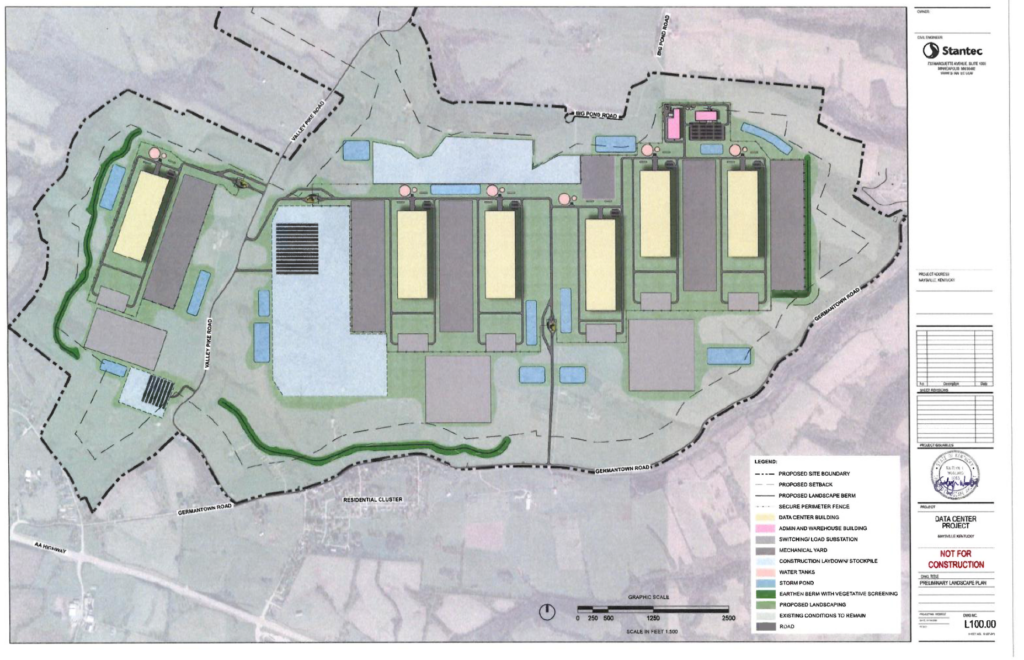
The development area is described using several different acreage figures that refer to different stages of the project. The county’s October agreement summary identifies approximately 2,900 acres associated with the broader project, while an earlier rezoning action covered about 2,080 acres. Those numbers should not automatically be treated as conflicting because property acquisition boundaries, zoning boundaries, and eventual construction areas can differ. Approximately 2,900 acres equals about 4.5 square miles, illustrating the overall scale without implying that every acre would be covered by server buildings.
A campus of that size can also include roads, substations, drainage areas, buffers, utility facilities, and land reserved for future phases. The practical effect on nearby households therefore depends more on building placement, construction entrances, access roads, utility corridors, and setbacks than on the countywide acreage figure alone. Two projects with similar total acreage could affect neighboring properties very differently depending on site layout. The relationship between acquired land and developed land will remain important as the project advances because buying land for expansion does not guarantee that every possible future building will be constructed.
The Mason County Fiscal Court unanimously approved a resolution authorizing a development and community revenue agreement for the hyperscale data center and technology campus. That decision moved the project into a more concrete local framework covering issues such as payments, infrastructure obligations, cooperation on approvals, and the financial arrangements supporting development. It should not, however, be interpreted as proof that every construction, utility, environmental, or state-level requirement has already been completed. A local development agreement and an operating campus represent different stages.
The clearest way to judge progress is therefore through measurable delivery. A payment mechanism approved in an agreement must still produce payments when its conditions are met, and a planned utility project must still be designed, approved, financed, and built. Residents can evaluate the project by tracking which obligations become due, when they must be completed, and what remedies apply if commitments are missed. Public identification of Meta and approval of the local agreement establish the framework, while future construction milestones will show how much of that framework becomes reality.

Investment, Jobs, Property Tax Incentives, and Community Revenue
The financial scale of Meta’s Mason County proposal is described through several figures that should remain separate. The company fact sheet attached to the county agreement summary states a $10 billion capital investment with potential expansion in later phases. County officials separately discussed an initial investment of approximately $15 billion during the October 13 meeting. The available descriptions do not clearly reconcile those figures, so neither should be silently substituted for the other or explained through unsupported assumptions about buildings, equipment, or later phases.
An even larger figure, $800 billion, has appeared in reporting about the industrial revenue bond arrangement. County attorney Jim Parsons explained that this amount relates to the financing framework and is not county debt. It should therefore not be described as money already spent, a direct Meta construction budget, or a liability borne by Mason County taxpayers. Industrial revenue bond authorizations can be far larger than immediate construction expenditures because they provide a legal structure for qualifying project property and financing over time.
The practical economic value of the investment will depend on what is actually built and spent. Initial construction, later expansion, equipment replacement, local purchasing, and long-term operations are economically different activities. A large headline authorization establishes potential scale, while completed facilities and documented expenditures provide stronger evidence of delivery. The same principle applies to job creation.
County presentation materials distinguish between temporary construction employment and permanent operating positions. They describe approximately 2,000 workers during construction, with employment potentially rising to about 4,000 at peak. The materials also describe at least 100 full-time jobs after the first phase and approximately 400 or more at full development. These figures should not be combined into one employment number because construction workers, first-phase staff, and eventual campus employees represent different stages of development.
DCD’s October 15 coverage reported 300 long-term roles, while local materials describe roughly 400 positions at full development. That discrepancy should remain visible rather than being forced into one number. The local economic effect will also depend on how many positions are filled by existing residents, how many regional businesses receive contracts, and whether training programs allow local workers to qualify for permanent technical roles. A recurring public report separating projected jobs, workers actually on site, permanent employees, and local hiring would provide more useful evidence than a single headline employment figure.
The proposed tax arrangement uses industrial revenue bonds to provide a long-term exemption from local property taxes on qualifying project property. Under the described ownership and leaseback structure, the company would instead make negotiated payments in lieu of taxes, or PILOTs. The term is expected to run for 40 years, making the payment formula and protected minimums central to evaluating the public-finance impact. The arrangement therefore raises two different comparison questions: how much more the project would contribute than the land’s previous use, and how much less it may contribute than a fully taxable data center.
The Kentucky Center for Economic Policy estimated that the first facility could receive about $50 million annually in net local property tax relief after substitute payments are considered. That is the organization’s estimate based on assumptions about taxable property, equipment, and tax treatment rather than a final tax assessment. Supporters may emphasize that the project would generate substantially more revenue than agricultural land produced previously, while critics may compare PILOT payments with the taxes a fully developed facility would otherwise owe. Both comparisons are valid but answer different questions.
The Ledger Independent’s account of the agreement summary describes annual PILOT payments of about $5 million to Mason County and $2 million to the Mason County School District for each project phase. It also describes a first-phase school utility revenue floor of $10 million, plus an additional $2.5 million for each later phase. Projected revenue and contractual minimum revenue should remain distinct because a forecast based on electricity purchases may exceed the amount actually guaranteed. For schools, predictable timing and enforceable payment triggers are particularly important because recurring staffing and education commitments rely on dependable revenue.
The agreement creates a potential funding channel for local schools, but it does not determine how the district will spend the money. Additional revenue could support staffing, facilities, student services, or other priorities depending on future school-board decisions. Construction-related receipts and revenues dependent on later phases should also be separated from operating income already being collected. Understanding those distinctions will be essential when evaluating whether the project delivers the public benefits used to justify the incentive package.
Roads, Water, Electricity, Construction Timeline, and Community Concerns
Infrastructure commitments form another major part of the Mason County proposal. The Mason County Post’s account of the county presentation describes commitments of at least $130 million, including water and sewer expansion, a contribution toward a new Maysville water treatment plant, and a public safety impact fee. Meta’s fact sheet separately describes approximately $115 million in infrastructure improvements and a $15 million public safety commitment. Those figures can coexist because they reflect different ways of grouping the same categories of spending rather than necessarily describing conflicting totals.
The company is also expected to cover costs associated with county road improvements or modifications related to the development. The practical value of those commitments will depend on specific locations, schedules, ownership responsibilities, and long-term maintenance. Funding construction does not automatically answer who will operate or maintain an upgraded road, water line, sewer system, or treatment facility over decades. Public reporting should therefore distinguish the cost of building infrastructure from the future cost of operating it.
Water remains an important issue because the company describes a closed-loop cooling design intended to minimize operational water use. That statement should not be interpreted as meaning the project would never use water. Construction, maintenance, domestic use, and final engineering arrangements can still create demand even if the primary cooling system recirculates water. The actual impact will become clearer through final designs and operating measurements rather than through the design concept alone.
Electricity requirements are also described at different scales. County materials identify an initial 396-megawatt data center, while other reporting discusses a broader campus that could eventually reach about 2.2 gigawatts. Those figures should remain tied to their respective development stages. Power capacity measured in megawatts is also different from energy consumption measured in megawatt-hours, so neither number establishes how much electricity the facility would use over a year.
The county summary describes commitments intended to prevent Meta-related electricity costs from being shifted onto residential and commercial ratepayers. Company materials identify East Kentucky Power Cooperative as the utility partner involved in energy planning. The effectiveness of those protections will depend on which substations, transmission lines, generation resources, or other facilities are needed and how their costs are allocated. A promise that other customers will not bear project costs becomes meaningful only when the utility agreements and rate treatment consistently enforce that separation.
Construction is not expected to begin immediately. The October agreement presentation forecast the initial phase beginning within 36 months after execution of the development agreement, with November identified as the anticipated start of land closings and approximately 24 months estimated for each additional data center building. A three-year window is a planning forecast rather than a fixed groundbreaking date. Land acquisition, engineering, utility work, permitting, and other approvals still need to progress before major construction can begin.
The first phase should also remain separate from full campus development. Completing one building would not mean that every future structure, road, substation, or supporting facility had been delivered. For workers and local businesses, opportunities will emerge at different stages, while permanent operating jobs typically appear closer to the point when completed buildings enter service. More reliable milestones will include completed land purchases, issued permits, utility construction, and a company-confirmed start of major site work.
County leaders have presented the development as an opportunity to expand employment, tax-equivalent revenue, and infrastructure. Construction workers could support local accommodation, food, transportation, and other services, while regional contractors may gain work and technical training could help residents qualify for permanent positions. These benefits remain potential outcomes rather than guarantees. Their scale depends on where workers come from, which businesses win contracts, and how much spending stays in the region.
The costs can also be distributed unevenly. Residents living nearest the site may experience construction disruption before broader public revenues arrive. Kentucky Lantern reported criticism from We Are Mason County over secrecy surrounding the developer’s identity, while WVXU reported concerns involving residents of a mobile home park who may need to relocate. Its October 15 coverage also described uncertainty about replacement housing and reported that a historic cemetery would need to be relocated under the development plans.
Those issues cannot be resolved through broad economic projections alone. Compensation paid to a property owner does not automatically solve the housing problem faced by tenants, and relocating a cemetery involves family history and community relationships beyond normal construction logistics. Effective community engagement would therefore require specific responses such as housing assistance, construction controls, monitoring arrangements, and accessible complaint procedures. The value of those measures would depend on whether they are implemented transparently and consistently.

State Incentives, Transparency, and What Remains Unconfirmed
Kentucky’s state incentive process is separate from Mason County’s local agreement. On October 15, Governor Andy Beshear said the state would examine what an applicant would pay in property taxes over the life of the project, including contributions benefiting schools, the county, and the state. Local approval therefore does not mean every state tax incentive has already been granted. Different governmental decisions can involve different eligibility standards, review procedures, and financial effects.
The Kentucky Center for Economic Policy identified the Kentucky Economic Development Finance Authority as the body responsible for reviewing a potential state data center sales tax exemption. Its analysis discussed a separate incentive involving qualifying equipment purchases that could last for a substantial period. Any state incentive should therefore be evaluated alongside the local property tax arrangement because looking at either one alone may understate the combined public subsidy. The October reporting establishes a review process rather than a final award.
A meaningful state review would compare the requested relief with the public benefits and the duration of the proposed investment. It would also need to consider how local PILOT payments, school revenues, infrastructure commitments, state tax treatment, and future project phases interact. A large investment proposal may justify substantial infrastructure planning without automatically establishing that every requested incentive is necessary. Final conclusions should follow the relevant state decisions and their published conditions.
Transparency will remain important throughout implementation. Naming Meta resolved the question of which company was behind Crisham LLC, but accountability requires more than identifying the parent company. Residents need access to agreements, payment schedules, infrastructure plans, construction updates, utility information, and changes to the project scope. Public identification marks the beginning of the oversight process rather than its conclusion.
Several important issues remain unresolved or require careful attribution. The available materials describe both $10 billion and approximately $15 billion in investment without providing a sufficiently detailed reconciliation. They also distinguish the first 396-megawatt phase from a potentially much larger campus and provide different estimates for permanent employment. Those variations should remain visible until later documents clarify them rather than being combined into a false single figure.
The reviewed information also does not establish which particular Meta services, AI models, or applications would run at the Mason County site. Assigning the facility to a specific workload would therefore be speculative. A data center can support changing computing requirements over its operating life, and planned capacity does not reveal the exact mix of workloads that will ultimately use it. Statements about the campus should remain limited to what the available project documents actually describe.
Other questions will become answerable only through implementation. Final water demand, completed utility upgrades, permanent employment, actual project expenditures, state incentive awards, and long-term electricity use cannot be measured accurately before the facility operates. Announced design intentions and forecasts should therefore remain separate from operating results. The most reliable evidence will come from dated permits, finalized agreements, completed construction milestones, utility records, payments received, and employment actually created.
The central issue is whether the approved framework translates into enforceable public benefits and a functioning data center campus. The October 13 approval establishes a significant local commitment, but a land agreement, tax arrangement, utility plan, and completed operating facility remain different stages. Tracking each stage separately will make it easier to judge whether the economic benefits, infrastructure improvements, and protections promised during approval are ultimately delivered.
Frequently Asked Questions (FAQs)
- Where is Meta’s proposed Kentucky data center?
The proposed development is in unincorporated Mason County, outside the city limits of Maysville in northeastern Kentucky. Reporting places the site around Big Pond Pike, with earlier descriptions also referring to the Big Pond and Tuckahoe roads area. The project is commonly associated with Maysville because of its regional location and because some infrastructure serving the site could involve Maysville systems. That does not mean the campus itself is inside the city’s municipal boundaries. This jurisdictional distinction also helps explain why the Mason County Fiscal Court has taken the lead on the local development agreement. - Why is the project described as nearly 3,000 acres?
The county’s agreement materials describe approximately 2,900 acres associated with the broader project, which is why the development is often summarized as nearly 3,000 acres. An earlier zoning action covered a smaller area of roughly 2,080 acres, but that figure relates to a specific rezoning action rather than the entire project boundary. Property acquisition areas, zoning boundaries, and the eventual construction footprint do not have to be identical. The larger acreage can also include roads, utility facilities, drainage areas, setbacks, and land reserved for future development. It should therefore not be interpreted as meaning that every acre will be covered by data center buildings. - Has Mason County approved the project?
The Mason County Fiscal Court unanimously approved a resolution on October 13, 2026, advancing the development and community revenue agreement for the proposed hyperscale data center campus. That vote is a significant local milestone because it establishes the negotiated framework for matters such as payments, infrastructure commitments, and cooperation between the county and developer. However, local approval does not mean every other requirement has already been completed. A project of this scale can still require additional land transactions, utility work, engineering, permits, and other approvals before construction proceeds. The distinction is between approving the framework for development and completing every step needed to build and operate the campus. - Is Meta investing $10 billion or $15 billion?
Both figures appear in the available materials, but they come from different sources and should remain separately attributed. Meta-related company materials describe a $10 billion capital investment with the possibility of further expansion, while county officials discussed an initial investment of approximately $15 billion. The reviewed descriptions do not clearly explain why the numbers differ. It would therefore be inaccurate to invent a reconciliation, such as assuming one figure covers buildings and another covers equipment, without supporting documentation. Future project filings or company disclosures may clarify the relationship between the two estimates. - How many permanent jobs are expected?
Local presentation materials describe at least 100 full-time positions after the first phase and approximately 400 or more permanent jobs if the campus reaches full development. These operating positions should be kept separate from the much larger construction workforce, which could involve around 2,000 workers and potentially reach about 4,000 at peak. The permanent employment figure also depends on how many later phases are actually built. One completed building would not automatically create the staffing level projected for the full campus. Actual local economic impact will also depend on how many of those positions are filled by residents and how much training or workforce development accompanies the project. - Does the tax agreement mean Meta would pay nothing locally?
No. The proposed industrial revenue bond structure would provide an exemption from certain local property taxes on qualifying project property, but that exemption is paired with negotiated payments and other financial obligations. The agreement includes payments in lieu of taxes, commonly called PILOTs, as well as other commitments tied to infrastructure and public benefits. The debate is therefore not simply about whether Meta contributes anything locally. The more important question is how the negotiated payments compare both with what the land previously generated and with the taxes a fully developed campus might otherwise owe. Those two comparisons can produce very different assessments of the agreement’s public value. - Would Mason County owe $800 billion?
No. Reporting about the industrial revenue bond structure includes a very large headline authorization, but county attorney Jim Parsons explicitly said the arrangement should not be understood as conventional county debt. The figure does not mean Mason County taxpayers are borrowing $800 billion to build Meta’s campus. It also does not mean that amount has already been spent or committed as immediate construction funding. Industrial revenue bond structures can use large authorization limits as part of their financing and property-tax framework. The relevant issue for residents is the county’s actual financial obligations and guarantees, not the headline bond ceiling by itself. - How could the project benefit schools?
The agreement framework includes payments intended for the Mason County School District and a utility-related revenue floor. Local materials describe annual school PILOT payments as well as a minimum revenue arrangement associated with the first phase and additional phases. The practical value depends on when those obligations begin, whether later phases are constructed, and whether the expected payments are actually received. Projected utility revenue and contractually protected minimum revenue should also be kept separate because they represent different levels of certainty. Once funds are received, decisions about how they are used would still belong to the school district and its governing processes. - Would the data center use water for cooling?
Meta describes a closed-loop cooling design intended to minimize operational water use by recirculating cooling water rather than continuously consuming large amounts. That is different from saying the entire project would use no water at all. Construction, employee facilities, cleaning, maintenance, and periodic servicing can still create water demand. The final engineering design will determine the actual operational requirements and how much water is needed under different conditions. The most reliable assessment will therefore come from completed utility plans and measured consumption once the facility is operating. - Is there a confirmed opening date?
No firm campus opening date is established in the reviewed material. The October agreement presentation forecasts that the initial phase could begin within 36 months of execution of the development agreement, which is a construction-planning window rather than a guaranteed opening date. Land purchases, engineering work, utility construction, permits, and other preparation can affect when major site work actually begins. Additional data center buildings would also have their own development schedules, with local materials estimating roughly 24 months for each later building. More reliable timing will emerge from completed land closings, permits, utility milestones, and a company-confirmed construction start.

Conclusion
Meta’s proposed Mason County data center could reshape parts of northeastern Kentucky through major construction activity, permanent technical employment, new public revenue, and significant infrastructure investment. At the same time, the project raises substantial questions about long-term property tax relief, rural land use, housing disruption, utility costs, and how promised community benefits will be enforced.
The clearest interpretation keeps the project’s figures and stages separate: roughly 2,900 acres describes the broader development area, investment estimates require careful attribution, first-phase employment is different from full-build staffing, and financing authorization is not the same as money already spent. Mason County’s approval establishes the framework for the project to advance, but it does not by itself prove that every phase, payment, infrastructure upgrade, or public benefit will ultimately be delivered. The project’s real value will be determined by completed construction, enforceable obligations, support for affected residents, transparent utility and tax arrangements, and consistent public reporting that allows the community to compare actual outcomes with the commitments used to justify approval.
Sources and Citations
- Mason County, October 6, 2026, Development & Community Benefits Agreement Summary: The county’s primary materials describe a multi-phase hyperscale data center campus on roughly 2,900 acres, with an initial 396 MW facility, land closings expected to begin in November, construction of the first phase forecast within 36 months, and later buildings taking about 24 months each. The materials also detail PILOT payments, construction and permanent-job estimates, infrastructure spending, power-cost protections, and closed-loop cooling commitments. maysville-online.com
Mason County agreement summary PDF - Data Center Dynamics, October 15, 2026, “Meta named as company behind 3,000 acre data center project in Mason County, Kentucky”: DCD confirms that Meta was publicly identified as the company behind the project, notes the earlier 2,080-acre rezoning, reports potential campus capacity of up to 2.2 GW, and says the agreement provides a 40-year local property-tax break through industrial revenue bonds. It also reports Meta’s $10 billion investment figure and roughly 300 long-term jobs, which differs from the local presentation’s roughly 400 at full buildout. Data Center Dynamics
Data Center Dynamics, Meta Mason County project - WKYT, October 13, 2026, “Mason County approves hyperscale data center in deal with Meta”: WKYT reports the unanimous Mason County Fiscal Court vote, identifies Meta as the company involved, and quotes county officials describing around 2,000 construction and trades jobs, a minimum of 400 full-time jobs, and an initial investment of about $15 billion. It also reports that the initial construction phase is expected to begin within three years. https://www.wkyt.com
WKYT, Mason County approves Meta data center deal - Ledger Independent, October 11, 2026, “Mason County Fiscal Court reviews community benefits agreement for data center project”: This is one of the most detailed accounts of the agreement presentation. It confirms the 2,900-acre site, 396 MW first phase, first-phase start within 36 months, annual $5 million county and $2 million school PILOT payments per phase, a $10 million school utility-tax floor for phase one, 2,000 to 4,000 construction workers, at least 100 first-phase permanent jobs and around 400 at full completion, plus at least $130 million in infrastructure commitments. maysville-online.com
Ledger Independent, community benefits agreement details - Mason County Post, October 8, 2026, “Mason County Fiscal Court presentation details proposed data center jobs, infrastructure and tax benefits”: The Mason County Post summarizes the October 6 presentation, including up to six data center buildings on about 2,900 acres, the 396 MW first phase, 2,000 construction workers with up to 4,000 at peak, land purchases beginning in November, and the expected 24-month construction period for later buildings. masoncountypost.com
Mason County Post, data center presentation summary - Kentucky Lantern, October 14, 2026, “Meta revealed as company behind controversial Mason County hyperscale data center”: The Lantern confirms Meta’s identity, the nearly 3,000-acre scale, the 40-year local property-tax exemption, annual PILOT payments, at least $130 million in infrastructure commitments, and approximately 400 full-time positions. It also documents criticism from We Are Mason County over the use of non-disclosure agreements and the lack of public transparency before Meta was named. Kentucky Lantern
Kentucky Lantern, Meta revealed as Mason County developer - WVXU, October 15, 2026, “Meta to build data center outside Maysville, Kentucky”: WVXU explains the $800 billion industrial revenue bond framework, emphasizing attorney Jim Parsons’ statement that this figure is not county debt. It also reports approximately 2,900 acres, a possible 2.2 GW campus, about $130 million in water, road and public-safety infrastructure, closed-loop cooling, and Meta’s obligation to cover power-infrastructure costs rather than shift them to other ratepayers. WVXU, NPR Cincinnati
WVXU, Meta data center outside Maysville - WUKY, October 15, 2026, “Beshear says state will closely review tax incentives for Meta data center”: WUKY reports Gov. Andy Beshear’s statement that Kentucky would examine the property-tax contributions and requested state incentives over the life of the project. It also notes the proposed $5 million annual payment to Mason County and $2 million to the school district and makes clear that local approval does not mean all state incentives have already been granted. WUKY
WUKY, Beshear on Meta data center incentives - Kentucky Center for Economic Policy, October 16, 2026, “Meta Data Center Receiving Approximately $50 Million a Year in Tax Breaks from Mason County”: KyPolicy estimates that the first data center could receive about $50 million per year in net local property-tax relief, even after the PILOT payments are considered. It also discusses a potential 50-year state sales-tax exemption on qualifying equipment if approved by the Kentucky Economic Development Finance Authority. The organization explicitly presents these figures as estimates based on assumptions, not finalized tax assessments. Kentucky Center for Economic Policy
Kentucky Center for Economic Policy, Meta tax-break analysis - LEX 18, October 14, 2026, “Mason County approves development agreement with Meta for data center”: LEX 18 places the project on more than 2,000 acres around Big Pond Pike, reports county expectations of more than 400 full-time jobs and around 2,000 construction and trades jobs, and documents displacement concerns affecting nearby residents. LEX 18 News
LEX 18, Mason County approves Meta development agreement
Recommendations
- Where Winds Meet, Official Imperial Palace Gameplay Trailer Explained: Release Date, Story, Combat Details & Everything We Know
- Diablo 4 3Rd Anniversary Event: Goblins, Massive XP Boost, Free Cosmetics, and Full June 2–9 Celebration Guide
- IO Interactive and Build A Rocket Boy End MindsEye Partnership as Hitman Crossover DLC Is Canceled
- All Anomalies in Animal Hospital Guide: Every Roblox Anomaly Explained
- Every Release Date from Every Event at Summer Game Fest 2026
- First Gameplay Trailer of Silent Hill: Townfall: It’s a First-Person Game and Everything We Know (2026)
- Best New Anime to Watch Right Now: Spring 2026 Picks
- Switch 2 Software Update Adds “Handheld Mode Boost” for Old Games – Performance Upgrade Explained
- We Build LEGO Winnie the Pooh: A 100th Anniversary Set Worth the Hype for Disney and LEGO Fans
- Echoes of Aincrad: Complete Guide to Growth Points (Best Stat Builds & Leveling Tips)



































































































