





In This Article (17 sections)
MOSS-Image 5B Release, 96.3% LongLongTextBench Result, and Multilingual Text Rendering
MOSS-Image addresses one of the most demanding challenges in AI image generation: creating graphics containing substantial amounts of readable text. Producing attractive illustrations and realistic photographs is only part of this challenge, as posters, educational graphics, infographics, and information cards also require accurate wording, logical reading order, and sufficient space for their intended content. OpenMOSS announced the public release of MOSS-Image-Base and MOSS-Image-SFT on October 16, 2026, alongside downloadable model weights and inference code. The project emphasizes text rendering, structured layout control, and support for prompts containing approximately 4,000 tokens, allowing users to provide detailed instructions about both visual content and text placement.
MOSS-Image is a text to image model family that supports natural language descriptions, tag sequences, and structured JSON layouts. These input methods allow users to specify what an image should contain and how its individual elements should be arranged. Natural language prompts provide a straightforward way to describe an intended composition, while structured layouts offer greater control over the organization of headings, paragraphs, illustrations, and supporting information. This flexibility is particularly relevant for graphics containing multiple text sections, where spacing, readability, and visual hierarchy are essential. Its publicly available weights also allow developers to investigate local deployment, build applications around specific checkpoints, and explore independent model adaptations.
LongLongTextBench Coverage and Evaluation
The project’s headline research result is 96.3% average text coverage on LongLongTextBench, representing its Mean-6 score across six language and length groups. The benchmark uses optical character recognition, commonly known as OCR, followed by word or character multiset recall to determine how much requested text can be recovered from generated images. OCR extracts recognizable writing from an image, while recall measures the proportion of requested content successfully identified. This evaluation is particularly useful because generated graphics may initially appear visually convincing while containing omitted words, substituted characters, or incomplete passages that become apparent only through closer inspection.
However, text coverage and exact reproduction measure different aspects of performance. Recovering most requested words does not guarantee that sentences appear in the correct sequence, punctuation remains accurate, or the composition follows a logical reading order. Multiset comparisons emphasize the presence of required words or characters rather than their grammatical arrangement. Consequently, the 96.3% result demonstrates strong text retention under specific benchmark conditions rather than establishing that nearly every generated image is completely accurate or ready for professional publication without further inspection.
LongLongTextBench contains 240 literary text tasks divided equally between English and Chinese, with target passages averaging approximately 1,340 characters. These lengthy passages introduce challenges involving character consistency, punctuation, spacing, text wrapping, and reading order. Generating a book cover containing a title and author’s name requires considerably less sustained accuracy than reproducing an interior page containing several paragraphs. The benchmark helps researchers evaluate whether substantial portions of requested writing survive the generation process, although it does not independently establish editorial correctness, factual accuracy, or professional page design.
Multilingual Rendering and Translation Considerations
MOSS-Image’s reported longest condition coverage scores provide further insight into its multilingual capabilities:
- Mean-6 text coverage: 96.3%, averaged equally across six language and length groups.
- English longest condition: 97.1% text coverage.
- Chinese longest condition: 92.4% text coverage.
- Benchmark size: 240 literary text tasks.
- Average target passage length: Approximately 1,340 characters.
English and Chinese introduce different rendering requirements because their writing systems rely on distinct character structures and spacing conventions. English requires accurate letter sequences, capitalization, word spacing, and punctuation, while Chinese characters frequently contain intricate internal structures that can become difficult to reproduce clearly at smaller sizes. Bilingual compositions introduce additional challenges because equivalent information may occupy different amounts of space in each language. A layout designed around English text may therefore produce awkward wrapping or overcrowding when adapted to Chinese.
Translation accuracy must also be evaluated separately from visual text reproduction. A perfectly readable sentence may contain an incorrect translation, while an accurate translation can become difficult to understand when compressed into an unsuitable layout. Organizations considering MOSS-Image for multilingual publishing should test the actual languages, terminology, dates, names, abbreviations, and content formats they expect to use. Although the reported results demonstrate promising English and Chinese text rendering capabilities, they do not automatically establish equivalent performance across other languages or writing systems.

MOSS-Image 5B Diffusion Transformer Architecture, 4,000 Token Prompt Capacity, and Structured Layout Control
MOSS-Image uses a 5B diffusion transformer architecture designed to generate images from detailed textual and structured instructions. According to its technical report, the system combines a single stream diffusion transformer with a frozen Qwen3.5-9B text encoder and a frozen FLUX.2 variational autoencoder. Each component performs a distinct function within the generation process. The text encoder converts user instructions into representations that the image generation system can interpret, while the diffusion transformer performs the central computation responsible for constructing the image. The variational autoencoder connects compressed image representations with the final visible output.
The 5B designation refers specifically to the diffusion backbone rather than the total number of parameters across every component within the complete inference pipeline. This distinction is important when comparing hardware requirements and model efficiency because image generators with similarly sized diffusion backbones can have considerably different resource demands depending on their supporting encoders, variational autoencoders, and runtime configurations. The architecture also differs fundamentally from conventional typesetting software because it generates text visually rather than positioning editable font characters according to fixed formatting rules.
This generative approach allows MOSS-Image to integrate illustrations, typography, and visual styling into unified compositions. However, it also introduces the possibility of incorrect spelling, inconsistent spacing, altered symbols, and missing punctuation. Even when the model produces visually convincing text, proofreading remains necessary because visual similarity does not guarantee exact character reproduction. These limitations are particularly important when generating technical explanations, educational materials, instructions, or documents containing numerical information where a small textual error could change the intended meaning.
Prompt Capacity and Effective Prompting
MOSS-Image supports prompts containing up to approximately 4,000 tokens, providing sufficient input capacity for detailed visual descriptions, extensive written content, composition instructions, and information hierarchy. Tokens are units used during text processing and do not correspond consistently to complete words, characters, or displayed lines. A larger prompt capacity therefore allows users to communicate more detailed requirements, but it does not guarantee that every instruction will be followed accurately. Conflicting instructions, unnecessary repetition, and excessive content density can still reduce the quality of generated compositions.
For example, requesting a minimalist poster while simultaneously requiring several lengthy explanatory paragraphs creates a conflict between visual simplicity and information density. The model may attempt to accommodate the requested content through smaller lettering, tighter spacing, or a more crowded composition, potentially reducing readability. Effective prompts should establish clear priorities, distinguish exact wording from descriptive instructions, and identify the elements that must remain accurate. The MOSS-Image user guide also recommends explicit line breaks when precise text wrapping is important, helping communicate the intended separation between sentences, headings, and paragraphs.
Structured Layout Control and Limitations
For greater composition control, MOSS-Image supports a structured layout format containing a scene summary and individual design items. Each item can include text, visual descriptions, and bounding boxes specifying its intended position within the image. The documented bounding box coordinate order is:
- Y minimum: The minimum vertical coordinate.
- X minimum: The minimum horizontal coordinate.
- Y maximum: The maximum vertical coordinate.
- X maximum: The maximum horizontal coordinate.
The coordinate system uses the canvas center as its origin. These bounding boxes provide more explicit spatial guidance than general instructions such as placing a headline near the top or an illustration near the middle. Users can reserve separate regions for headings, images, labels, and supporting paragraphs, helping establish the intended visual hierarchy before generation begins. However, layouts prepared for one resolution or aspect ratio may not maintain their intended proportions when reused with different canvas dimensions.
Structured instructions also do not transform MOSS-Image into a conventional design engine. The resulting composition remains an image rather than an editable document containing independently adjustable text boxes, shapes, and visual elements. Changing a particular heading or bounding box may require generating another version, potentially affecting surrounding details that were already satisfactory. Its layout capabilities should therefore be understood as composition guidance rather than guarantees of exact placement. Their practical effectiveness depends on how consistently the model follows instructions across repeated generations, particularly when handling dense text, complex arrangements, and unusual aspect ratios.

MOSS-Image Base vs MOSS-Image SFT, RealLayoutArena Performance, and Competing Image Generators
MOSS-Image-SFT is a supervised fine tuned version of MOSS-Image-Base, designed to refine image generation behaviour while retaining the same underlying architecture and inference pipeline. According to its official model card, the SFT checkpoint builds upon the capabilities of the Base model, with an accompanying comparison demonstrating clearer text grouping and a more organized whiteboard composition. These examples illustrate the intended improvements in visual hierarchy and readability, particularly for images containing substantial amounts of written information. However, they do not establish that the SFT checkpoint consistently outperforms the Base version across every prompt, artistic style, or generation task.
Choosing between the two checkpoints depends primarily on the intended workload. MOSS-Image-Base remains useful for researchers and developers investigating the underlying model or performing independent adaptations. MOSS-Image-SFT may provide a more suitable starting point for applications emphasizing organized graphics, readable text, and polished presentation. For educational materials and information cards, accurate wording and logical grouping may be more important than stylistic experimentation, whereas artistic applications may prioritize aesthetic consistency, atmosphere, and visual fidelity.
A meaningful comparison should evaluate both checkpoints using identical prompts, wording, canvas dimensions, numerical precision, and generation settings. Multiple outputs should be examined because comparing only one attractive example from each model provides limited evidence of consistency. Developers should also record the exact checkpoint and configuration used, since performance attributed to the broader MOSS-Image family should not automatically be extended to every derivative, adapter, or compressed version.
Performance Benchmarks and Practical Selection
MOSS-Image’s reported RealLayoutArena performance provides another perspective on its structured graphic generation capabilities. RealLayoutArena evaluates 61 poster, infographic, and interface design tasks through blind human comparisons. The reported MOSS-Image system ranked second with an Elo score of 1698.70. However, the evaluated workflow incorporates GPT-6 as a layout planner, meaning the result measures the combined planning and image generation system rather than MOSS-Image operating independently.
This distinction matters because a brief user request may not specify every detail necessary for an effective composition. A planning system can organize wording, establish visual hierarchy, and define the placement of individual elements before image generation begins. Strong performance may therefore reflect the combined effectiveness of planning and rendering. Human preference evaluations also consider qualities that differ from automated text coverage measurements, including visual balance, information organization, readability, and overall usefulness. Elo ratings represent relative preferences within a particular evaluation environment rather than percentages of correctly completed tasks.
The technical report also compares MOSS-Image with Qwen Image 2512 on LongLongTextBench:
- MOSS-Image: 96.3% average text coverage.
- Qwen Image 2512: 64.9% average text coverage.
- Reported difference: 31.4 percentage points in favour of MOSS-Image.
- RealLayoutArena ranking: Second place for the MOSS-Image system incorporating GPT-6 as a layout planner.
- RealLayoutArena Elo score: 1698.70.
The difference of 31.4 percentage points demonstrates MOSS-Image’s reported advantage in retaining substantial amounts of requested writing under the evaluated benchmark conditions. However, percentage points should not be confused with relative percentage improvement. Furthermore, strong performance in text rendering does not establish superiority across every image generation category. Portraits, product photography, environmental illustrations, lighting, atmospheric compositions, and typography introduce different requirements that may favour other models.
Selecting an appropriate image generator should consequently involve testing the actual production workload rather than relying exclusively on headline results. A publisher producing information cards may prioritize accurate wording and consistent layouts, while an artist creating environmental illustrations may place greater emphasis on visual style and atmosphere. Hardware requirements, generation time, output consistency, and correction effort also influence practical usefulness. A model producing impressive individual results may be less suitable for repeated professional use if substantial manual intervention is required after every generation.

MOSS-Image Practical Applications, Professional Publishing, and Graphic Design Limitations
MOSS-Image’s combination of sustained text rendering, extended prompt capacity, and structured layout instructions makes it a promising model for investigating information rich graphic generation. Potential applications include posters, educational materials, infographics, information cards, and interface design concepts. These formats require more than attractive visual presentation because the accuracy and organization of written information directly influence their usefulness. A visually impressive design can still fail its intended purpose if headings are misplaced, important details are omitted, or the relationship between labels and illustrations becomes misleading.
Different graphic formats introduce distinct requirements. Posters must communicate their central message quickly through clear focal points, appropriate information density, and sufficient contrast at the intended viewing distance. Educational graphics require accurate explanations and logical reading sequences, while infographics must preserve relationships between labels, objects, processes, and numerical values. An image may reproduce every requested word while still communicating incorrect information if labels appear beside unrelated objects or figures become associated with the wrong categories.
Potential applications of MOSS-Image include:
- Posters: Promotional, educational, and informational compositions containing headlines, illustrations, and supporting text.
- Infographics: Visual explanations involving statistics, comparisons, diagrams, and organized information.
- Educational materials: Learning graphics containing definitions, instructions, examples, and explanatory passages.
- Information cards: Structured compositions presenting concise facts, technical specifications, or reference material.
- Multilingual graphics: Designs incorporating English and Chinese text within shared or separate layouts.
- Interface concepts: Visual representations of potential interface arrangements, content hierarchy, and information presentation.
For professional publishing, the most dependable approach involves establishing accurate content before image generation and inspecting the completed output afterward. Approved wording should be prepared independently, particularly when an external planning system contributes to the composition. A visually convincing design may contain unsupported facts, inaccurate explanations, incorrect names, or altered numerical values. Text coverage alone cannot determine whether the final graphic communicates its intended message accurately.
A reliable MOSS-Image production workflow should include the following stages:
- Content preparation: Establish accurate and approved wording, including all essential names, dates, figures, and explanations.
- Layout planning: Organize headings, illustrations, labels, and supporting text according to their intended visual importance.
- Image generation: Select the appropriate MOSS-Image checkpoint, canvas dimensions, and inference settings.
- Visual inspection: Examine spelling, punctuation, text placement, readability, spacing, and relationships between written and visual elements.
- Factual verification: Confirm that the generated composition preserves accurate information without unintended substitutions or misleading associations.
- Final presentation: Assess visual quality, accessibility, consistency, and suitability for the intended publishing platform.
Accessibility introduces another important consideration because text embedded within a raster image is not automatically selectable or accessible to assistive technologies. Publishers may need to provide equivalent written content and appropriate image descriptions to ensure important information remains available to a wider audience. Readability should also be assessed at the dimensions at which the graphic will actually appear, since text that looks acceptable on a large canvas may become difficult to read when displayed on a smaller screen.
Limitations Compared to Editable Design Documents
MOSS-Image cannot entirely replace editable design documents containing separate text boxes, vector shapes, and independently adjustable elements. Professional publishing frequently requires small revisions involving corrected spelling, updated statistics, modified fonts, or repositioned labels. These changes are generally easier in traditional design software because individual elements can be adjusted without affecting the remaining composition. Revising an AI generated raster image may require another generation, potentially changing surrounding details. The model’s practical value therefore depends on whether its generation capabilities reduce overall production effort while maintaining the accuracy, consistency, and flexibility required by the intended application.

MOSS-Image Model Weights, Apache 2.0 Licensing, ComfyUI Integration, and Local Hardware Requirements
MOSS-Image provides publicly available model weights and inference code, allowing developers and researchers to investigate its capabilities beyond a hosted generation service. The official Hugging Face model cards identify Apache License 2.0 for the released weights and bundled inference code, while the project repository identifies its standalone pipeline implementation under the same license. Access to these components allows developers to examine how the system operates, preserve specific checkpoints, investigate local deployment, and compare different inference configurations.
However, releasing model weights does not automatically disclose every training example or guarantee that independent researchers can reproduce the complete pretraining process. Model accessibility, training data transparency, and full reproducibility remain separate considerations. Similarly, the model’s license does not automatically establish the obligations associated with external services, additional software packages, or assets used within applications built around it. Those components may have separate licensing requirements.
Version tracking is particularly important because checkpoints, inference implementations, and optional integrations may receive independent updates. Such changes can affect generation quality, compatibility, resource consumption, and system performance. Recording repository revisions, checkpoint versions, supporting components, and configuration settings provides a more dependable basis for reproducing experiments. Without these details, developers using what appears to be the same model may obtain different results because their installations contain different software versions or dependencies.
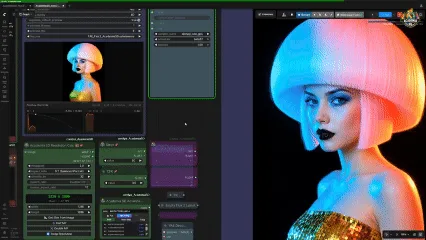
The project also provides ComfyUI integration, allowing users to load a local model directory in Diffusers format and connect the diffusion model, text encoder, and variational autoencoder through a visual workflow. This provides an alternative to interacting with MOSS-Image exclusively through Python scripts and allows users to incorporate its components into broader image generation workflows. However, the integration does not guarantee compatibility with every ComfyUI installation or extension. Successful operation depends on correctly configured model directories, compatible dependencies, and appropriate versions of the required components.
Local Deployment and Hardware Performance Considerations
The official Base model quick start specifies several local deployment requirements and options:
- Python: Version 3.10 or later.
- Graphics hardware: A CUDA capable NVIDIA GPU.
- Software framework: A compatible PyTorch installation.
- GPU resident execution: Keeps more model components in graphics memory to reduce transfer overhead.
- Component offloading: Transfers selected components between system memory and GPU memory.
- Sequential offloading: Reduces simultaneous GPU residency further, potentially increasing generation time.
The advertised 5B diffusion backbone does not establish a single dependable VRAM requirement for the complete inference pipeline. As a simplified parameter storage calculation, five billion parameters represented using two bytes per parameter require approximately ten billion bytes before accounting for the text encoder, variational autoencoder, intermediate activations, and other runtime resources. This estimate describes parameter storage rather than the total memory required to generate an image.
Actual hardware requirements depend on numerical precision, output dimensions, checkpoint selection, inference configuration, available GPU memory, system RAM, processing steps, and data transfer performance. Component offloading can reduce the amount of graphics memory required at a particular moment, potentially making generation feasible on systems with more limited VRAM. However, moving components between system memory and the graphics card introduces additional overhead that may increase generation time. Sequential offloading can reduce GPU memory residency further, although its performance tradeoffs may become more noticeable during repeated generation.
Output resolution is another important consideration because larger images require more spatial information to be processed, potentially increasing temporary memory consumption and computational demands. Higher resolutions may be particularly attractive for graphics containing small labels or extensive paragraphs, but increasing canvas dimensions does not independently guarantee accurate text reproduction or correct layout placement. Users must determine whether the additional processing expenditure produces meaningful improvements in readability and visual quality.
A dependable local performance test should document the following information:
- Exact MOSS-Image checkpoint and repository revision.
- Graphics card and available system memory.
- Software versions and supporting model components.
- Numerical precision and output dimensions.
- Inference step count and selected memory configuration.
- Peak GPU memory consumption and elapsed generation time.
- Number of generation attempts and manual corrections required.
Independent benchmark reproductions, representative failure cases, and transparent comparisons with competing models would provide stronger evidence of MOSS-Image’s practical capabilities. Evaluations should extend beyond text coverage to examine spelling accuracy, reading order, label placement, visual hierarchy, generation speed, and consistency across unfamiliar content. Publishing both successful and unsuccessful outputs would also help organizations understand the model’s limitations and estimate deployment costs more accurately.
Promising Development and Professional Use Considerations
MOSS-Image represents a promising development in AI generated graphics through its reported 96.3% text coverage, structured layout controls, multilingual capabilities, and publicly available model weights. Its architecture provides a foundation for producing more information rich visual compositions.
However, professional usefulness depends on consistent accuracy, manageable hardware requirements, and reduced correction effort. Independent testing and reliable production workflows remain essential to determining whether MOSS-Image can deliver readable and publication ready graphics at scale.

Frequently Asked Questions (FAQs)
- What is the main purpose of MOSS-Image?
MOSS-Image is designed to generate visually organized images containing substantial amounts of readable text. Its capabilities are particularly relevant for posters, infographics, educational materials, and information cards where accurate wording is as important as visual appearance. The model supports natural language prompts, tag sequences, and structured layouts, giving users greater control over content organization and intended placement. Its practical effectiveness depends on consistent readability, accurate text reproduction, and the amount of correction required before publication. - Does the headline score mean every image is almost perfect?
No. MOSS-Image’s reported 96.3% average text coverage measures how much requested writing can be recovered through OCR and text recall under LongLongTextBench conditions. It does not establish that 96.3% of generated images are completely accurate. An image can achieve high coverage while containing incorrect punctuation, spelling errors, misplaced labels, or confusing information sequences. Professional applications therefore still require proofreading, layout inspection, and factual verification. - Why does reading order matter alongside text coverage?
Reading order determines whether written information communicates its intended meaning. A graphic could contain every requested phrase while arranging its sentences, instructions, or labels incorrectly. For example, an educational infographic might reproduce all the steps of a process but display them in the wrong sequence. Text coverage measures the presence of requested content, whereas reading order determines whether that content remains understandable. Both are essential for accurate educational graphics, diagrams, and information cards. - Is the largest possible prompt always the best prompt?
No. Although MOSS-Image supports prompts of approximately 4,000 tokens, using the entire available capacity does not guarantee better results. Extensive prompts are useful when designs require detailed wording and precise composition instructions, but conflicting requirements and unnecessary repetition can reduce clarity. Effective prompts should distinguish literal text from visual instructions, establish clear priorities, and provide enough information to guide generation without introducing excessive complexity. - Can a bilingual benchmark establish performance in every language?
No. LongLongTextBench evaluates English and Chinese text rendering, and strong results in those languages do not automatically establish equivalent performance across other writing systems. Different languages introduce distinct character structures, punctuation conventions, spacing requirements, and writing directions. Translation accuracy also remains separate from visual reproduction. Organizations should test their intended languages directly using representative passages, technical terminology, names, and numerical information. - Why should Base and SFT be tested separately?
MOSS-Image-Base and MOSS-Image-SFT share the same underlying architecture but represent different model checkpoints. Supervised fine tuning is intended to improve aspects of generation behaviour, including text grouping and visual organization. However, it does not guarantee superior performance across every prompt or artistic style. Testing both checkpoints using identical inputs, canvas dimensions, and generation settings helps determine which provides more consistent results for a particular workload. - Does a structured layout guarantee exact placement?
No. Structured layouts and bounding boxes provide more explicit guidance about where individual elements should appear, but MOSS-Image remains a generative system rather than a conventional design engine. Crowded compositions, lengthy passages, and different aspect ratios can introduce spacing, alignment, and text wrapping problems. Users should verify the actual placement of headings, illustrations, and labels through repeated generation and inspection rather than assuming exact positioning. - Can generated graphics replace editable design files?
Not entirely. MOSS-Image produces raster images rather than editable documents containing independent text boxes, vector shapes, and graphic elements. These images can be useful for completed visual compositions, but correcting individual words, updating statistics, or repositioning labels may require another generation or external editing. Traditional design software remains more flexible for frequently updated materials and projects requiring strict typographic consistency. - What should a local performance test record?
A dependable test should record the exact model checkpoint, software versions, graphics hardware, available system memory, numerical precision, image dimensions, inference steps, memory configuration, and generation time. Peak VRAM consumption should also be measured because the 5B diffusion backbone does not represent the complete pipeline’s memory requirements. Recording unsuccessful attempts and manual corrections provides additional insight into practical production efficiency beyond generation speed alone. - What evidence would make the release more convincing?
Independent benchmark reproductions, transparent testing configurations, representative failure cases, and controlled comparisons with competing image generators would strengthen the evidence supporting MOSS-Image. Evaluations should examine spelling accuracy, reading order, label placement, visual hierarchy, multilingual consistency, memory consumption, and generation speed. Demonstrating reliable performance across unfamiliar content and realistic publishing workloads would provide a clearer indication of whether the model consistently reduces manual revision while producing accurate and readable graphics.

Conclusion
MOSS-Image presents a promising direction for image generation that must carry meaningful amounts of written information. Its release invites investigation into whether a locally controlled model can make text-rich graphics more dependable.
The reported coverage result is an encouraging signal, but successful design requires more than recovering words. Correct sequencing, legibility, factual accuracy and composition all affect whether an image communicates effectively.
The release is best assessed through its distinct components: the generator, the supplied content, the layout specification and any external planning stage. Testing those components together on representative work will reveal more than treating one benchmark score as a universal quality rating.
For publishing and design applications, the decisive measure is whether the complete workflow repeatedly produces accurate, usable graphics with an acceptable amount of human correction.
Sources and Citations
- MOSI.AI, MOSS-Image Technical Report: Primary research source covering benchmark construction, evaluation procedures, model architecture and reported results.
- Citation: MOSS-Image Technical Report – arXiv
- OpenMOSS, Official MOSS-Image Repository: Official repository containing the release announcement, inference examples, installation instructions and memory-management options.
- Citation: OpenMOSS – MOSS-Image GitHub Repository
- OpenMOSS, MOSS-Image-Base User Guide: Documentation covering prompt formats, layout coordinate conventions, sampling settings and post-training guidance.
- Citation: MOSS-Image-Base – Hugging Face
- OpenMOSS-Team, MOSS-Image-Base and MOSS-Image-SFT Model Cards: Official model documentation covering checkpoint descriptions, setup instructions, inference requirements and licensing information.
- Citation: MOSS-Image-Base Model Card | Official GitHub Repository
- OpenMOSS, MOSS-Image for ComfyUI: Official documentation covering ComfyUI integration, plugin installation, local model loading and workflow configuration.
- Citation: MOSS-Image ComfyUI Documentation
Recommendations
- Project Rabbit Official Reveal Trailer: Everything We Know, Release Date, Gameplay Details, Leaks & Full Breakdown
- Persona 5 Royal: How to Defeat Shadow Madarame (Complete Boss Strategy Guide)
- Frontier Legends – Official Early Access Launch
- Snowpiercer’s Whole Shtick Makes for an Interesting Shooter, That’s What Enginefall Feels Like, and it Makes for One of the More Interesting Shooters
- Pokémon Wind and Pokémon Waves Are Reportedly Releasing September 2027 – Everything We Know So Far
- Shai Matheson Explains Becoming Batman in Lego Batman Legacy of the Dark Knight
- Is Xbox Game Pass Worth It In 2026? Subscription Value, Explained
- Xbox Game Pass July 2026 Lineup Announced
- Empulse: The Titanfall-Inspired 6v6 Movement Shooter Bringing Mechs Back to FPS Gaming
- What is Romestead? Dark Fantasy Cozy RPG Explained



































































































