










In This Article (8 sections)
Nioh 3 Overview, Release Date, Editions, Platforms, and Open-Field Exploration
Nioh 3 expands Team Ninja’s demanding action role-playing formula without abandoning the speed, technical depth, and severe consequences that define the series. The first two Nioh games built their identities around aggressive melee combat, Ki management, elaborate weapon skill trees, supernatural yokai threats, and large amounts of randomized equipment. Nioh 3 retains those foundations while introducing larger open-field environments, two fully developed combat styles, increased vertical movement, a time-traveling historical narrative, and revised systems for Ninjutsu, Guardian Spirits, Soul Cores, and yokai powers.
Nioh 3 is the third main installment in Team Ninja’s dark samurai action role-playing series. Published by Koei Tecmo, it combines Japanese history and mythology with a fast combat system that rewards mechanical precision, intelligent equipment choices, and an understanding of enemy behavior. Although the Nioh games are frequently categorized as Soulslikes because of their demanding enemies, shrine-based progression, recoverable experience currency, and dangerous boss encounters, their combat structure is considerably faster and more systems-heavy than that description alone suggests.
The game casts players as Tokugawa Takechiyo, a warrior caught in a supernatural struggle involving his younger brother, Kunimatsu, and a catastrophic alteration of Japanese history. Takechiyo travels between historical periods with the help of the sacred sword Kusanagi, encountering famous warriors, political leaders, legendary figures, Guardian Spirits, and hostile yokai. This premise allows the campaign to move beyond one conflict or century, presenting several versions of Japan under different political, military, and supernatural conditions.
Mechanically, Nioh 3 remains an equipment-driven action RPG. Players defeat enemies, collect weapons and armor, earn Amrita, improve character attributes, unlock active and passive skills, strengthen Guardian Spirit relationships, and refine separate Samurai and Ninja loadouts. Victory depends on more than increasing numerical power. Players must recognize attack patterns, control distance, manage Ki, exploit openings, interrupt dangerous techniques, and understand when to defend, evade, counter, or change combat styles.
The sequel’s most important innovation is not a single weapon or ability but the relationship between its systems. Open-field exploration gives players more control over the order in which they face challenges. Style Shift provides two distinct combat toolkits. The expanded movement system adds jumping, aerial approaches, and greater verticality. Crucible areas create high-risk zones with their own health-related pressure. Together, these features make Nioh 3 feel broader than Nioh 2 without removing the technical demands that established the series.
Nioh 3 was released worldwide on February 6, 2026, for PlayStation 5 and Windows PC through Steam. It did not launch on PlayStation 4, and the official launch materials list only PS5 and PC as supported platforms. Steam may display February 5 in certain regions because of time-zone differences, but Koei Tecmo identifies February 6, 2026, as the official release date. By February 19, Koei Tecmo reported that the game had surpassed one million copies sold faster than any previous entry in the franchise, while total Nioh series sales had exceeded ten million units. Those early results suggest that Team Ninja’s decision to broaden exploration while preserving demanding combat successfully attracted both returning players and newcomers.
The Standard Edition contains the complete base game. The Digital Deluxe Edition combines the base game with the Nioh 3 Season Pass and several digital bonuses. Its launch package included the Chijiko Netsuke Charm, a Kodama Netsuke Charm, and an Infernal Weapons Set covering the game’s weapon categories. The Season Pass provides access to two planned expansions rather than functioning as a collection of minor cosmetic items. The physical release lineup also included a SteelBook Launch Edition in supported markets, pairing the game with a metal case and launch-specific Netsuke charms. A larger Treasure Box edition was offered for PS5 in selected regions, adding physical collectibles such as an art book, soundtrack CD, desk pad, and Scampuss-themed keychain.
Physical edition availability depends on region and remaining retailer inventory, so the original launch packages may not be equally accessible everywhere after release. Some preorder and early-purchase bonuses were attached to limited redemption periods. Those incentives should not be confused with the permanent content included in the Standard Edition, Digital Deluxe Edition, or Season Pass. Players purchasing the game after the launch window should examine the current product description rather than assuming that every original promotional bonus remains available.
A free demo was released for PS5 and PC, with qualifying progress transferable to the complete game. The demo provides an opportunity to test the basic combat rhythm, Samurai and Ninja mechanics, the character creation system, and technical performance before buying the full version. Its availability is particularly useful for PC players who want to determine how effectively their hardware handles the game’s open fields and visually dense battles.
Nioh 3 is not a traditional open-world game built around one enormous, uninterrupted map. Team Ninja describes its environments as open fields: large, interconnected regions that offer significantly more freedom than the contained missions of Nioh and Nioh 2 while retaining the carefully arranged encounters, shortcuts, shrines, secrets, and concentrated combat associated with the series. Each open field presents several possible routes and activities. Players can follow the principal objective, search for Kodama, discover treasure, enter settlements, investigate side paths, clear hostile areas, locate shrines, and confront optional enemies.
Vertical terrain and a dedicated jump function make rooftops, ledges, elevated paths, ruined structures, and concealed passages more important than they were in previous Nioh games. Exploration is therefore not simply a matter of crossing a wider landscape; it changes how players approach enemy groups and environmental hazards. The open-field design also modifies the series’ difficulty curve.
In a conventional linear mission, a player blocked by a powerful opponent may have limited alternatives beyond repeated attempts or leaving the mission entirely. Nioh 3 allows players to move elsewhere within a region, acquire better equipment, earn Amrita, complete optional battles, unlock shortcuts, improve skills, and return with greater power or knowledge. This flexibility reduces the likelihood that one encounter will completely halt progression without making the encounter itself easier.
Exploration remains dangerous. Open fields contain enemy patrols, ambushes, elite yokai, ranged attackers, environmental threats, and areas where supernatural influence changes the normal rules. Moving away from the principal route can produce valuable equipment and experience, but it can also expose an unprepared character to enemies substantially stronger than ordinary opponents. The distinction between “open world” and “open field” is therefore meaningful. Nioh 3 offers wider areas and greater route choice, but it does not dilute its combat across a largely empty map. Its regions are designed to preserve encounter density and deliberate progression. Different historical eras function as separate destinations, preventing the campaign from becoming one geographically continuous recreation of Japan.

Samurai Style, Ninja Style, Style Shift, Weapons, Builds, and Core Combat Systems
Nioh 3’s gameplay changes begin with freedom of movement. Players can jump, attack from elevated positions, reach previously inaccessible routes, and use greater verticality while exploring or fighting. This gives encounter designers more opportunities to position archers, hidden enemies, shortcuts, and objectives above or below the player’s initial path. It also makes scouting more valuable because enemies may approach from multiple levels rather than from a single corridor.
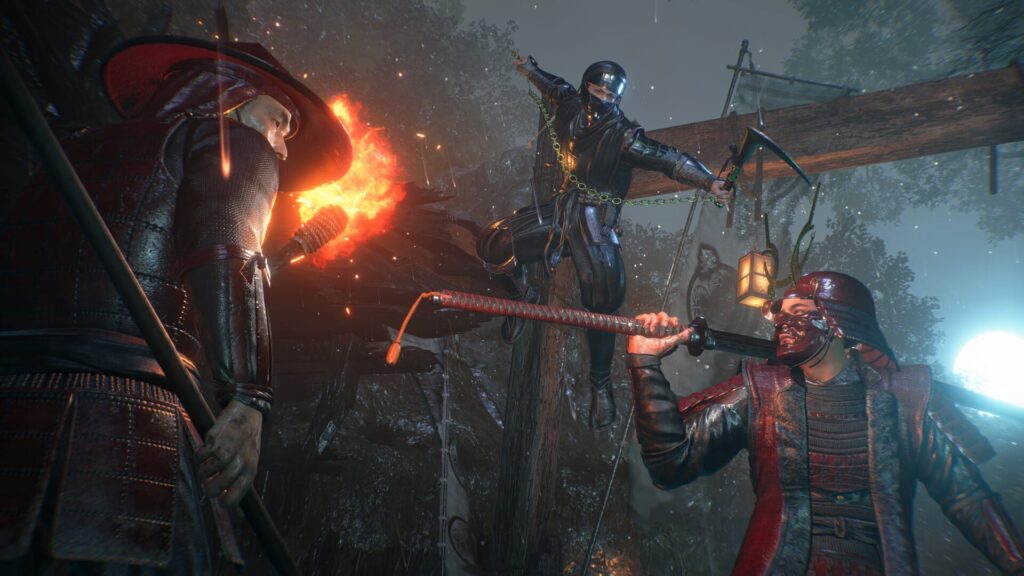
The second major change is Style Shift. Samurai Style and Ninja Style are not minor stances or temporary transformations. Each supports its own equipment, weapon categories, skills, Guardian Spirit configuration, appearance, and combat principles. Players can change between them during battle, effectively carrying two interconnected approaches into every major encounter. Samurai Style preserves recognizable Nioh systems, including three combat stances, Ki Pulse, precise guarding, and Martial Arts. Ninja Style replaces that rhythm with rapid movement, enhanced rear damage, Mist evasions, perfect dodges, acrobatic repositioning, and Ninjutsu powered by a rechargeable gauge. The result is not merely a choice between a strong character and a fast character. Each style manages defense, recovery, positioning, and resource generation differently.
Samurai Style is the more traditional expression of Nioh combat. It uses High, Mid, and Low stances, with each stance changing attack speed, damage, reach, Ki consumption, evasive movement, and defensive potential. High Stance generally favors heavier commitment and stronger attacks. Mid Stance provides a balanced approach that is particularly useful for guarding and controlled exchanges. Low Stance prioritizes speed, economical movement, and rapid repositioning.
Ki Pulse remains central to Samurai Style. After attacking, a recoverable section appears on the Ki Gauge. Activating Ki Pulse at the correct moment restores part of that spent Ki and purifies nearby Yokai Realm effects. Experienced players use Ki Pulse not as an occasional recovery trick but as part of their normal attack rhythm, allowing them to maintain pressure while avoiding exhaustion.
Samurai Style also uses Arts Proficiency and Deflect. Attacking and guarding contribute to the Arts Gauge. When the relevant conditions are met, Arts Proficiency can strengthen Martial Arts sequences, reduce their immediate Ki burden, and support more elaborate combinations. Deflect is the style’s parry-like defensive technique. A precisely timed guard avoids the ordinary Ki cost of blocking, inflicts Ki damage on the enemy, and contributes to both the Arts and Ninjutsu gauges.
Ninja Style is designed around mobility and positional advantage. It consumes relatively little Ki during basic movement, rewards attacks delivered from behind, and replaces the Samurai’s normal defensive rhythm with evasive techniques. Mist can be activated after an attack to create a decoy while the character rapidly moves away. It does not function as a Ki Pulse and does not purify Yokai Realm, so a Ninja player cannot simply reproduce Samurai habits with a faster animation.
Ninja Style’s Evade mechanic rewards precise timing. A correctly executed evade improves the safety of continued movement and charges combat resources. Footstool Jump allows the player to vault over an enemy and reposition behind it, creating opportunities to exploit the style’s rear-damage advantage. Ninjutsu is powered by a gauge that refills through successful attacks and evasive actions, encouraging active combat instead of requiring players to preserve a small number of consumable uses for emergencies.
Style Shift allows players to alternate between Samurai Style and Ninja Style without leaving combat. On the default PS5 control layout, the central command is associated with the R2 button, while PC players can use the corresponding assigned input. The transition changes the active weapon set, armor configuration, skills, Guardian Spirit setup, appearance, and style-specific mechanics. Because the styles can carry separate equipment, switching has consequences beyond movement speed.
A Samurai loadout may be built around heavier armor, stronger blocking, a long-reaching spear, and Ki-damaging Martial Arts. The associated Ninja loadout may use lighter equipment, talons, evasive bonuses, and Ninjutsu designed to create openings. Style Shift enables the player to move between those functions according to the battle’s immediate demands.
Switching is especially important when enemies prepare red-aura techniques. A properly timed Style Shift triggers Burst Break, interrupting or punishing the incoming attack. Burst Break deals Life and Ki damage and can reduce a yokai’s maximum Ki, making it an important route toward staggering supernatural enemies.
Poorly timed switching, however, may leave the player exposed to the full attack. Style Shift also supports offensive continuity. A player can begin with a Samurai weapon to damage an enemy’s Ki, change to Ninja Style to move behind the target, use rapid attacks to build the Ninjutsu Gauge, and then return to Samurai Style when a stable guarding or Ki Pulse rhythm is needed. The system is most effective when the styles complement each other instead of duplicating the same strengths.
New players may initially treat Samurai and Ninja as separate classes, but Nioh 3 is designed around their interaction. Remaining in one style is possible for ordinary encounters, yet advanced enemies increasingly test whether the player can adapt. Style Shift becomes more natural when it is practiced during exploration rather than reserved exclusively for bosses.
Nioh 3 divides fourteen principal weapon types between Samurai Style and Ninja Style. Samurai weapons include the sword, dual swords, spear, axe, odachi, switchglaive, and cestuses. These weapons support stance transitions, conventional Martial Arts, Ki pressure, guarding, and deliberate control of range. Ninja weapons include the ninja sword, dual ninja swords, kusarigama, tonfa, hatchets, splitstaff, and talons. These generally emphasize rapid attacks, mobility, ranged or extended-pressure options, and the ability to exploit brief positional openings.
The standard sword is one of the most adaptable Samurai options, combining reliable speed, reach, defense, and straightforward Martial Arts. Dual swords produce quicker sequences but normally deal less damage per individual hit. Spears provide excellent reach and can control multiple enemies. Axes and odachi favor powerful attacks, strong Ki pressure, and deliberate timing, although their slower actions can punish careless commitment. Switchglaives alter their form according to stance, making them well suited to players who enjoy frequent stance changes. Cestuses specialize in close-range pressure and chained strikes.
Ninja weapons follow a different philosophy. The ninja sword is a balanced, agile option suitable for learning the style. Dual ninja swords emphasize acrobatic combinations. Hatchets can attack at close range or be thrown, providing flexibility against enemies that are unsafe to approach. Tonfa deliver rapid strikes and are effective at damaging Ki. Talons are exceptionally fast but require the player to operate at very short range. Kusarigama can shift between close and extended attacks, while splitstaves provide long reach and unusual pressure patterns.
Equipment selection is as important as the weapon category. Weapons possess values such as Attack, Break, and Block, while familiarity increases through continued use. Armor weight affects movement, defensive performance, and Ki consumption. Light armor supports mobility but generally offers less protection. Heavy armor can make mistakes more survivable but increases the importance of Ki management. Each combat style can carry its own weapons, armor, accessories, and Guardian Spirit configuration.
Character growth is flexible. Amrita is used to improve core attributes, and those attributes can be reset. Samurai, Ninja, and shared skills draw from their respective progression resources. Skill points can be reassigned, allowing players to correct an inefficient early setup or experiment with a different weapon without permanently damaging the character. This flexibility means that the “best Nioh 3 build” is less about discovering one irreversible allocation and more about developing two complementary loadouts.
Useful build directions include:
- A practical beginner build pairs a balanced Samurai weapon with an accessible Ninja weapon. Sword and ninja sword create a reliable combination because neither requires extreme specialization to perform basic attacks, defense, and repositioning. Hatchets are another useful Ninja complement because their throwing options can pressure enemies that are dangerous at close range.
- A Ki-damage build can combine cestuses or dual swords with tonfa or talons. The Samurai weapon maintains direct pressure and benefits from Ki Pulse, while the Ninja weapon exploits a staggered opponent with rapid attacks. This build performs best when supported by bonuses that improve Ki damage, reduce Ki consumption, or reward consecutive attacks.
- A reach-focused build can pair spear or switchglaive with splitstaff or kusarigama. The objective is to control space, strike from outside an enemy’s immediate range, and use the second style when the opponent closes the distance. This approach is particularly useful in open fields where several enemies may attack from different angles.
- A heavy-punishment build can combine axe or odachi with a highly mobile Ninja weapon. The Samurai side creates large openings and delivers powerful strikes, while the Ninja side provides an escape route when the enemy becomes too aggressive. This pairing is safer than trying to make both styles slow and heavily committed.
The best build for a particular player should reflect execution skill as well as theoretical damage. A highly optimized low-defense setup is ineffective when the player cannot consistently evade. Early attribute investment should therefore protect the fundamentals: sufficient Life, manageable equipment weight, dependable Ki recovery, and damage scaling for the weapons being used. Guardian Spirits, Soul Cores, Onmyo effects, accessories, armor traits, and set relationships add further layers.
A coherent build should make these systems support the same plan. For example, a Ki-pressure build benefits more from effects that increase Ki damage or strengthen attacks against exhausted enemies than from an unrelated collection of small elemental bonuses. Nioh 3 rewards synergy, but mechanical familiarity with the chosen weapons remains more important than copying a high-level build without understanding its timing.
Ki remains the stamina-like resource that powers attacks, evasions, guarding, and other combat actions. Emptying the Ki Gauge at the wrong moment can leave the player unable to defend, making resource control one of Nioh 3’s defining skills. Samurai Style and Ninja Style solve this problem through different mechanics. Ki Pulse sustains Samurai offense, Deflect turns precise defense into Ki damage, Mist preserves Ninja mobility, and Ninjutsu expands tactical options.
Guardian Spirit and yokai-related systems have also been reorganized. Guardian Spirit Skills consume Spirit Force and are particularly effective at reducing the maximum Ki of yokai. Living Artifact becomes available when the Amrita Gauge is filled, temporarily empowering the character while its gauge remains active. Soul Cores contribute to the Onmyo Box, which supports Onmyo effects and Summoning Seals associated with defeated Crucible Wraiths. These mechanics preserve the supernatural build experimentation of earlier games while changing how those powers are accessed. Mastery comes from selecting the correct tool rather than attempting to solve every encounter with one repeated combination.
Despite these additions, the fundamental loop remains familiar. Players still manage Ki, collect randomized loot, develop weapon familiarity, improve attributes with Amrita, unlock skills, study enemy attack patterns, and return to shrines for recovery and preparation. Nioh 3 evolves the surrounding structure without replacing the systems that make successful combat feel earned.
Story, Historical Eras, Bosses, Yokai, Crucible Areas, Multiplayer, and Character Customization
Nioh 3 begins in 1622 at Edo Castle. Tokugawa Takechiyo, the grandson of Tokugawa Ieyasu and heir to the shogunate, is approaching the ceremony that will confirm his succession. Takechiyo possesses the unusual ability to perceive Guardian Spirits, connecting him to the supernatural forces operating beneath the political conflict. The succession is disrupted by Takechiyo’s younger brother, Kunimatsu. Influenced by a dangerous power and accompanied by yokai, Kunimatsu launches an assault that devastates the established order. The attack is more than a family rebellion: it creates a historical catastrophe capable of reshaping Japan’s future. Takechiyo survives with the aid of Kusanagi, a sacred blade whose power transports him across time.
The resulting campaign is structured around an attempt to understand and repair the altered timeline. Takechiyo encounters allies and adversaries from periods that would ordinarily be separated by centuries. Some are historical military figures, while others originate in Japanese legend, religious tradition, or the game’s supernatural reinterpretation of history. Takechiyo’s conflict with Kunimatsu gives the story a personal center. The protagonist is not traveling through time solely to collect artifacts or observe famous battles. The struggle concerns inheritance, legitimacy, family resentment, political responsibility, and the consequences of allowing supernatural power to manipulate human ambition.
Team Ninja uses the Tokugawa succession as a foundation but freely combines it with yokai mythology and alternate history. Takechiyo is both a participant in political history and an outsider to the eras he visits. He must cooperate with figures whose loyalties and values differ from those of his own period. This gives the campaign opportunities to explore how different generations understand warfare, authority, honor, and national stability without presenting the game as a literal historical simulation.
Time travel is one of Nioh 3’s principal narrative and environmental systems. The game moves through several distinct versions of Japan, including ancient Yamatai, the Heian period, the Sengoku era, early Edo in 1622, and Bakumatsu Kyoto in the nineteenth century. The differences between these periods affect architecture, landscapes, military technology, political factions, historical characters, and the kinds of enemies encountered.
The ancient setting connects Takechiyo with Queen Himiko and the world associated with Yamatai. Official post-launch documentation identifies this portion of the chronology with the year 247. The period gives Team Ninja room to combine limited historical evidence with mythology, spiritual imagery, and its own interpretation of early Japan. The Heian setting introduces a Japan shaped by aristocratic authority, warrior clans, religious institutions, and legends that later became central to samurai culture. Figures connected to the Minamoto clan, including Minamoto no Yoshitsune and Minamoto no Yoritomo, appear within the game’s alternate historical framework. Rather than presenting their stories as isolated biographies, Nioh 3 incorporates them into Takechiyo’s effort to understand the supernatural disruption of time.
The Sengoku period takes players into an age of fractured authority and sustained warfare. The 1572 setting includes Totomi and characters such as Takeda Shingen and Yamagata Masakage. The environment reflects the strategic and social instability of the era, with fortified positions, active battlefields, contested settlements, and powerful warriors whose historical reputations can be transformed into elaborate boss encounters. The 1622 Edo setting is Takechiyo’s original period and the foundation of the central succession conflict. Here, the campaign involves Tokugawa retainers and figures such as Yagyu Munenori, Hattori Hanzo, Saito Fuku, and Honda Tadakatsu. Their presence links the supernatural crisis to the institutions, alliances, and personal loyalties surrounding Tokugawa rule.
Bakumatsu Kyoto provides one of the strongest contrasts. Set during the turbulent final years of the shogunate, it introduces firearms, rapidly changing military conditions, urban political violence, and figures such as Takasugi Shinsaku, Okita Soji, and Tokugawa Yoshinobu. Locations associated with Kyoto, including the areas surrounding Kiyomizu and Honnoji, are reimagined as open fields threatened by human conflict and yokai influence.
The time-travel structure gives the campaign visual and mechanical variety, but it also supports its central theme. Takechiyo is trying to preserve a future while repeatedly witnessing periods in which Japan’s political order was uncertain. The game does not demand that players understand every historical reference before beginning. Familiarity with Japanese history adds context, but the principal relationships and conflicts are explained within the fictional narrative.
Nioh 3’s bosses include supernatural creatures, famous warriors, corrupted humans, and opponents capable of transforming between recognizable and monstrous forms. The game uses its multi-era setting to draw enemies from different historical conflicts and bodies of folklore. Even when a boss is inspired by a real person, Team Ninja frequently exaggerates that figure’s reputation, equipment, political role, or legend through supernatural mechanics.
Ordinary yokai also require more than raw damage. Some control space with large bodies or extended limbs, while others use illusions, projectiles, sudden movement, elemental attacks, or debilitating status effects. Officially featured enemies include creatures such as Otoroshi, Sunakake-baba, Mikoshi Nyudo, Yamabiko, Jailer Oni, Mermaid, Jakotsu-baba, and Kyokotsu. Their attack patterns vary widely, forcing players to reconsider weapon range, elemental preparation, positioning, and style selection.
Crucible areas represent one of the game’s most dangerous environmental systems. Within the Crucible, yokai receive a significant advantage and their attacks become more threatening. The area introduces Life Corrosion, a condition that reduces the player’s effective maximum Life when damage is taken. The missing portion can be recovered through successful combat and other Crucible interactions, but repeated mistakes can leave the character increasingly vulnerable. Players can reduce Crucible pressure by using Jizo-related blessings and interacting with the area’s special features. Defeating the innermost boss and dealing with the Crucible spike cleanses the affected region. Lesser Crucibles provide smaller versions of the same risk-and-reward structure, while Crucible Wraiths are tied to Summoning Seals and supernatural progression.
The Crucible changes how players interpret attrition. Outside these zones, surviving an attack with a small amount of Life may be sufficient if healing is available. Inside the Crucible, repeated damage can lower the character’s practical survival limit and make later encounters more dangerous. The best approach is therefore not to race blindly toward the central objective.
Clearing manageable enemies, identifying recovery opportunities, earning blessings, and opening safe routes can substantially improve the final confrontation. Boss preparation should account for this structure. Players should enter with familiar weapons, useful elemental or status options, healing resources, and a clear understanding of both combat styles. Because Burst Break can reduce yokai maximum Ki, recognizing red-aura attacks is especially important. Creating a stagger window often provides more value than attempting to trade damage directly with a boss whose attacks are strengthened by the Crucible.
Nioh 3 supports single-player progression and online multiplayer for as many as three participants. A co-op group therefore consists of one host and up to two additional players. The available systems include asynchronous grave interactions, visitor summoning, and more structured Expeditions. Bloody Graves allow players to challenge Revenants based on other players’ characters. These encounters are controlled by the game rather than by the original player in real time, but they reflect equipment and combat data associated with an online character. Benevolent Graves provide a more supportive variation by allowing assistance to be summoned from another player’s uploaded presence.
The Summon Visitor system lets a host offer Ochoko Cups to invite help. Up to two visitors can join, bringing the total party size to three. Visitors face certain restrictions, including limits on opening doors and containers, and their eligibility depends on their own progression through the relevant content. A visitor session normally ends when the objective is completed or when a critical participant dies.
Expeditions provide a more cooperative structure. Up to three players share an Assist Gauge that allows fallen participants to be revived while sufficient capacity remains. This reduces the likelihood that one mistake will immediately terminate the entire session, although repeated defeats can still exhaust the gauge. Expedition Story Mode can advance the host’s campaign, while Mission Mode focuses on completed missions and side activities.
Nioh 3 does not support cross-platform online play between PS5 and Steam. Players who intend to complete the campaign with friends should therefore purchase the game on the same platform. The absence of crossplay also means that online communities, character data, and matchmaking pools remain platform-specific. Co-op does not eliminate the importance of learning the combat system.
Additional players can divide enemy attention and create more opportunities to heal or attack, but enemy pressure and chaotic visual effects can make precise reactions harder. Coordinated teams should avoid surrounding a boss without a plan, because overlapping attacks may obscure red-aura cues and other important animations. The complete game remains playable alone. Multiplayer is an option for assistance, repeated missions, experimentation, and shared progression rather than a requirement for accessing the principal story.
Nioh 3 includes a detailed character creator for Takechiyo. Players can adjust physical build, facial structure, hair, voice, and other visual characteristics. The game also allows Samurai Style and Ninja Style to use separate appearances, enabling the same character to adopt visibly different identities when Style Shift is activated. Separate appearances are cosmetic and do not force a particular combat role. A heavily armored Samurai form can look substantially different from a masked or lightly equipped Ninja form, but players remain free to choose equipment according to statistics rather than visual theme. This distinction is important because Nioh’s randomized loot would otherwise make it difficult to preserve a consistent appearance throughout progression.
Customization continues after the opening sequence. Through the Eternal Rift, players can revisit their appearance, use presets, randomize features, save appearance data, and load previously created designs. Character Creation Codes make it possible to share designs within the supported platform environment. Official code prefixes distinguish PS5 creations from Steam creations. The game also separates equipment appearance from equipment performance. Players can alter the visible presentation of gear without replacing the statistics of the items they are actually using. This transmog-style system allows a preferred visual set to remain consistent while stronger weapons and armor are acquired.
Transformation options provide another layer of customization by allowing the protagonist to assume the appearance of certain unlocked characters. These systems support players who want to recreate historical figures, design an original samurai, build a visually distinct ninja, or preserve a particular aesthetic across dozens of equipment upgrades. Post-launch support has expanded the available preset options, with Update 1.05 adding community-created character presets alongside new endgame activities. Because appearance can be changed later, players do not need to delay the campaign out of concern that an early design decision will be permanent.

Nioh 3 Compared with Nioh 2, PC Requirements, PS5 Features, Updates, and DLC Plans
The largest difference between Nioh 3 and Nioh 2 is structural. Nioh 2 is organized primarily around individual missions selected from a regional map. Those missions contain shortcuts and optional paths, but their routes are comparatively contained. Nioh 3 uses open fields that connect principal objectives, side encounters, settlements, hidden locations, hostile territories, shrines, and optional bosses within larger explorable areas. This change affects difficulty as well as scale.
Nioh 2 often expects the player to overcome the current mission’s obstacles in a relatively fixed sequence. Nioh 3 provides more opportunities to change direction, improve the character, find better equipment, or approach an objective from another route. Team Ninja’s stated goal was to expand player choice without reducing the concentration of combat encounters.
Movement is also broader. Nioh 3 adds jumping and builds more encounters around vertical terrain. This may appear modest compared with Style Shift, but it substantially changes exploration. Players can reach rooftops, cross uneven structures, attack from elevated positions, and search for routes that would have been inaccessible in Nioh 2. Combat identity has shifted from Nioh 2’s human-and-yokai relationship to the Samurai-and-Ninja relationship. Nioh 2 allows the protagonist to use Soul Core Yokai Abilities, perform Burst Counters through Brute, Feral, or Phantom Guardian Spirit forms, and activate Yokai Shift. Nioh 3 instead provides two complete human combat styles, each with separate weapons, equipment, resources, and defensive mechanics.
Burst Break is functionally related to Nioh 2’s Burst Counter because both respond to dangerous red-aura attacks, but the surrounding systems differ. Nioh 2’s response is tied to the selected yokai form. Nioh 3’s response is tied to Style Shift, reinforcing the expectation that players will move between Samurai and Ninja during active combat. Ninjutsu has also been reconsidered. Ninja Style uses a gauge that refills through attacks and evasions, encouraging regular ability use. This makes Ninjutsu part of the style’s repeating combat cycle rather than only a limited supply of tools prepared before leaving a shrine. Samurai Style retains Ki Pulse and stances, preserving continuity for players who prefer the older rhythm.
Nioh 3’s Guardian Spirit, Living Artifact, Onmyo Box, and Summoning Seal systems redistribute functions previously associated with Yokai Shift and direct Soul Core attacks. The sequel still encourages supernatural builds, but returning players must learn where those abilities now fit rather than assuming that their Nioh 2 habits will transfer unchanged. The story is broader in chronology. Nioh 2 concentrates heavily on the Sengoku period and the rise of Toyotomi Hideyoshi through a supernatural reinterpretation of history. Nioh 3 moves across several centuries, using Takechiyo’s time travel to connect ancient Yamatai, Heian legends, Sengoku warfare, Tokugawa succession, and the Bakumatsu crisis.
Not every difference is automatically an improvement for every player. Those who prefer tightly contained missions may find open fields less direct. Players who enjoyed Nioh 2’s Yokai Shift forms may need time to accept their replacement. However, Nioh 3 provides greater route choice, more flexible character presentation, two extensive combat toolkits, and stronger environmental variety while retaining the series’ intricate loot and Ki systems.
The official minimum PC specification requires Windows 11, an Intel Core i5-10400 or AMD Ryzen 5 2600 processor, 16 GB of RAM, and either an NVIDIA GeForce GTX 1060 with 6 GB of video memory or an AMD Radeon RX 5600 XT Revision 2.0 with 6 GB. The game requires approximately 125 GB of available storage on an SSD. Under the official assumptions, this configuration targets 1080p at approximately 30 frames per second using the Very Low graphics preset with upscaling enabled.
The recommended specification lists an Intel Core i5-10600K or AMD Ryzen 5 5600X, 16 GB of RAM, and an NVIDIA GeForce RTX 3060 Ti with 8 GB or AMD Radeon RX 6700 XT with 12 GB. An NVMe SSD is recommended. This configuration is associated with a 1080p, 60-frames-per-second target at the Standard preset, again using the conditions stated by the publisher. Higher settings require substantially more graphics power.
The official High target for 1440p at 60 frames per second lists hardware in the range of an RTX 4070 or Radeon RX 7700 XT. The Very High 4K target lists an RTX 4070 Ti, Radeon RX 7900 XT, or Radeon RX 7900 GRE, depending on the configuration. Actual performance can vary according to drivers, background software, processor limitations, upscaling mode, and the density of the current open field.
The PC version supports modern reconstruction and performance technologies, including NVIDIA DLSS 4, AMD FidelityFX Super Resolution 3.1, and Intel XeSS 2. These options can improve frame rate or image stability on compatible hardware, although results depend on the selected quality mode and whether frame generation is enabled. The 125 GB requirement should be treated as a launch-era baseline because updates and downloadable content can alter the final installed size.
On PS5, Nioh 3 supports 4K presentation, DualSense haptic feedback, adaptive trigger effects, and 3D Audio on compatible equipment. Haptic effects are used to reinforce weapon impacts and defensive actions, while adaptive triggers can add resistance to interactions such as drawing a bow. Team Ninja has indicated that these effects were designed to communicate combat feedback without overpowering the player during rapid encounters.
The PlayStation version also includes accessibility and control options intended to help players adjust the presentation and interface. These features do not remove Nioh 3’s demanding encounter design, but they can improve readability, input comfort, and information access. Players deciding between PS5 and PC should consider more than raw visual resolution. PS5 offers a standardized hardware target and DualSense integration, while PC provides broader graphics adjustment, multiple upscaling technologies, and hardware-dependent performance potential.
The Nioh 3 Season Pass contains two announced expansions. The first is titled Hell Rising, and the second is titled Bloody Insurrection. Official product information states that the expansions will add new stories, enemies, yokai, bosses, and equipment. Access to some DLC content may require completion of relevant portions of the base game.
As of July 16, 2026, Hell Rising is scheduled for release by the end of September 2026. Bloody Insurrection is scheduled by the end of February 2027. These are publisher targets rather than guarantees that every region will receive the content at precisely the same hour, and release plans may be revised. Digital Deluxe Edition owners receive the Season Pass as part of that package, while Standard Edition owners can obtain it separately.
Post-launch updates have already expanded the endgame. Update 1.05 added Stone of Penance features, additional Battle Scroll missions, community character presets, and related progression options. Stone of Penance increases enemy strength in exchange for improved opportunities to obtain high-rarity equipment and develop accessories, making it primarily relevant to experienced players refining advanced builds.

Frequently Asked Questions (FAQs)
- What is the official Nioh 3 release date?
Nioh 3 was officially released on February 6, 2026. It is already available rather than being an upcoming title. Some regional Steam pages may display February 5 because of time-zone differences, but Koei Tecmo’s official launch date is February 6, 2026. Players checking availability should therefore treat the game as fully released on its supported platforms. - Is Nioh 3 an open-world game?
Nioh 3 is better described as an open-field action RPG, not a fully seamless open-world game. Its regions are much larger and more flexible than the mission areas in earlier Nioh games, with multiple routes, optional encounters, hidden areas, shrines, settlements, bosses, and side activities. However, the game does not take place on one uninterrupted world map. Different historical eras and locations are still presented as separate destinations, so it keeps Nioh’s focused encounter design while giving players more freedom to explore. - Which platforms support Nioh 3?
Nioh 3 is officially available on PlayStation 5 and Windows PC through Steam. It did not launch on PlayStation 4, and the official release materials do not list Xbox or Nintendo Switch versions. Players who want to play online co-op with friends should also pay attention to platform choice, because the PS5 and PC versions do not support crossplay with each other. - Can players use Samurai Style and Ninja Style in the same build?
Yes. Nioh 3 is designed around using Samurai Style and Ninja Style together rather than treating them as completely separate characters. Players can create separate loadouts for each style, including weapons, armor, accessories, Guardian Spirits, skills, and even visual appearance. During combat, Style Shift lets players move between the two, allowing one style to cover the other’s weaknesses. For example, Samurai Style can provide stronger guarding and stance-based control, while Ninja Style can add mobility, evasive options, rear attacks, and Ninjutsu pressure. - Which Nioh 3 combat style is better for beginners?
Samurai Style may feel more natural for returning Nioh players because it keeps familiar mechanics such as stances, Ki Pulse, guarding, Deflect, and Martial Arts. It gives beginners a clearer defensive structure and teaches the core rhythm of managing Ki. Ninja Style can also feel approachable because of its speed and mobility, but using it well requires good positioning, Mist timing, perfect evasion, Footstool Jump, rear attacks, and Ninjutsu management. The best beginner approach is to start with Samurai fundamentals, then gradually practice Ninja Style instead of ignoring Style Shift entirely. - Does Nioh 3 have online co-op?
Yes. Nioh 3 supports online co-op for parties of up to three players. Players can summon visitors for help or use Expeditions for a more structured cooperative experience. Expeditions include a shared Assist Gauge, which allows teammates to revive one another while the gauge has capacity remaining. Co-op can make difficult encounters more manageable by dividing enemy attention, but it does not remove the need to understand Ki, positioning, enemy patterns, and boss mechanics. - Does Nioh 3 support crossplay between PS5 and PC?
No. Nioh 3 does not support cross-platform multiplayer between PlayStation 5 and Steam. PS5 players can play with other PS5 players, and PC players can play with other Steam players, but the two platforms cannot join the same online session. Anyone planning to play the campaign cooperatively with friends should make sure everyone buys the game on the same platform. - Can the Nioh 3 character be customized after starting the game?
Yes. Players can change their character’s appearance after starting the game by using the Eternal Rift. This allows them to modify features, use presets, save and load designs, and apply supported Character Creation Codes. Nioh 3 also separates equipment appearance from equipment stats, so players can keep a preferred visual style while still equipping stronger gear. This means an early appearance choice is not permanent, and players do not need to restart the game just to redesign their character. - How much storage does Nioh 3 require on PC?
The official PC requirements list approximately 125 GB of available SSD storage. An SSD is required, and an NVMe SSD is recommended for the game’s recommended configuration. Players should also leave some extra space beyond the listed requirement because patches, updates, and downloadable content can increase the final installed size over time. If storage is limited, it is worth checking the current Steam installation size before downloading. - Will Nioh 3 receive story DLC?
Yes. Nioh 3’s Season Pass includes two announced story expansions: Hell Rising and Bloody Insurrection. Hell Rising is scheduled by the end of September 2026, while Bloody Insurrection is scheduled by the end of February 2027. Both expansions are expected to add new story content, enemies, yokai, bosses, and equipment. Players who own the Digital Deluxe Edition receive the Season Pass as part of that package, while Standard Edition owners can purchase it separately.

Conclusion
Nioh 3 demonstrates how Team Ninja can broaden a demanding action RPG without simplifying the systems that give it depth. The open-field structure provides greater exploration and route choice, but the game remains focused on concentrated encounters, dangerous enemies, and mechanically demanding bosses. Players can leave a difficult objective, strengthen their character, investigate another path, and return later, yet eventual success still depends on execution.
Samurai Style and Ninja Style form the center of the sequel’s design. Samurai combat develops the established relationship between stances, Ki Pulse, guarding, Deflect, and Martial Arts. Ninja combat introduces a contrasting rhythm based on Mist, precise evasions, rear attacks, acrobatics, and rechargeable Ninjutsu. Style Shift connects the two systems and ensures that switching can be both an offensive strategy and a defensive response.
The time-travel story gives the game a wider historical range than its predecessors. Takechiyo’s journey connects ancient mythology, Heian legends, Sengoku warfare, early Tokugawa rule, and the Bakumatsu crisis. Those eras are not merely visual backgrounds; they introduce different political tensions, characters, technologies, locations, and enemy concepts.
Nioh 3 is therefore an evolution rather than a rejection of the series. It preserves Ki management, randomized equipment, weapon mastery, Guardian Spirits, punishing boss design, and online cooperation while introducing larger environments, greater verticality, dual combat identities, revised supernatural systems, and planned narrative expansions. For players willing to study its mechanics, refine two complementary builds, and accept repeated failure as part of learning, Nioh 3 delivers one of Team Ninja’s most ambitious and technically layered action adventures.
Sources and Citations
- Team Ninja: Official Nioh 3 systems overview. This is the primary overview for Samurai Style, Ninja Style, Arts Proficiency, Deflect, Ki Pulse, Mist, Guardian Spirits, Living Artifact, the Onmyo Box, character creation, and multiplayer features. It also lists the seven base-game weapon categories associated with each combat style and confirms that players can configure different appearances for Samurai and Ninja. The separate DLC documentation covers weapon additions beyond that original lineup. (Team NINJA)
Citation: Nioh 3: Official Systems Overview - Team Ninja: Story introduction and character profiles. The official overview establishes the game’s fictional opening in 1622, Tokugawa Takechiyo’s approaching appointment as shogun, Kunimatsu’s attack, and the time-traveling intervention of Guardian Spirit Kusanagi. It also provides character profiles and voice credits for figures including Himiko, Hattori Hanzo, Yagyu Munenori, Saito Fuku, and the warriors encountered across different periods. These profiles document their roles in the game rather than serving as independent historical references. (Team NINJA)
Citation: Nioh 3: Story and Characters - Koei Tecmo: Web manual covering shared combat actions. The manual explains Ki, Guardian Spirit Skills, Living Artifact, Onmyo Magic, Style Shift, and Burst Break. It confirms that Soul Cores placed in the Onmyo Box provide corresponding magic and that a correctly timed response to an enemy’s red-aura Burst Attack can interrupt it and damage Life and Ki. It also distinguishes switching combat styles from the option to assign Style Shift and Burst Break to separate controls. (Game City)
Citation: Nioh 3 Official Web Manual: Common Actions - Koei Tecmo: Samurai Style manual. This chapter documents Ki Pulse recovery, purification of Yokai Realm pools, Arts Proficiency, Deflect, and the High, Mid, and Low stances. It specifically explains that a successful Deflect restores Ki and charges both the Arts Gauge and Ninjutsu Gauge. The manual therefore provides more precise mechanical support than a general description of Samurai Style as defensive or powerful. (Game City)
Citation: Nioh 3 Official Web Manual: Samurai Style - Koei Tecmo: Ninja Style manual. The official chapter explains Ninja Style’s movement, reduced Ki expenditure, increased damage from behind, Ninjutsu, Evade, and Footstool Jump. It also makes an important distinction about Mist: the technique is a dodge that consumes no Ki and can create a distracting decoy, but it does not restore Ki or purify a Yokai Realm. Those functions should not be carried over from Samurai Style’s Ki Pulse. (Game City)
Citation: Nioh 3 Official Web Manual: Ninja Style - Koei Tecmo: Crucible mechanics and rewards. This manual chapter explains strengthened yokai, Life Corrosion, Bodhisattva Statues, Crucible Spikes, Crucible Weapons, and Lesser Crucibles. It establishes that Life Corrosion reduces maximum Life and describes ways to recover or mitigate that reduction. It also explains how reaching maximum familiarity with a Crucible Weapon allows its associated Crucible Art to be acquired and assigned independently. (Game City)
Citation: Nioh 3 Official Web Manual: The Crucible - Koei Tecmo: Online play, Visitors, and Expeditions. The multiplayer chapter confirms up to three players and explicitly states that cross-platform multiplayer is not supported. It distinguishes Visitor assistance from Expeditions, including their different death, revival, and progression rules. It also explains Bloody Graves, Benevolent Graves, Bloodedge Demons, and the differences between Expedition Story Mode and Mission Mode. (Game City)
Citation: Nioh 3 Official Web Manual: Online Play - Koei Tecmo Europe: Official worldwide launch announcement. Published on February 6, 2026, this announcement confirms that Nioh 3 launched on PlayStation 5 and Windows PC through Steam. It also documents the launch trailer, available editions, free demo, save-data transfer, and time-limited early-purchase offers. Its dated bonus conditions are useful for distinguishing what was available at launch from promotions that have since expired. (KOEI TECMO EUROPE)
Citation: Open the Gates of Hell and Conquer the Crucible in Nioh 3, Now Available - Team Ninja: Edition contents and purchase bonuses. The official product page details the Standard Edition, Digital Deluxe Edition, SteelBook Launch Edition, and Treasure Box. It confirms that Digital Deluxe includes the base game, Season Pass, Chijiko Netsuke Charm, Infernal Weapons Set, and Kodama Netsuke Charm. The page separately marks the early-purchase and digital-preorder promotions as no longer available, preventing those historical incentives from being confused with current edition contents. (Team NINJA)
Citation: Nioh 3: Official Products and Edition Details - Koei Tecmo America: One-million-sales milestone. The publisher’s February 19, 2026 announcement reports that Nioh 3 exceeded one million copies sold worldwide, reaching that milestone faster than any previous entry. It also reports that the Nioh franchise surpassed 10 million cumulative sales. These figures should be attributed to that dated announcement rather than presented as a current September 2026 sales total. (KOEI TECMO AMERICA)
Citation: Nioh 3 Reaches Over 1 Million Copies Sold Worldwide, Fastest in Franchise History - PlayStation Blog: Hands-on exploration, combat, and DualSense features. Phil Hornshaw’s November 21, 2025 preview describes open-field exploration, branching paths, shortcuts, jumping, style switching, Deflect, and demonstrated boss encounters. It also reports DualSense haptic feedback during combat and adaptive-trigger effects when drawing a bow. This is a firsthand account of a prerelease demonstration, not a technical benchmark establishing the final game’s resolution or frame-rate performance. (PlayStation.Blog)
Citation: Nioh 3 Hands-On Report - Team Ninja: Official PC requirements and upscaling support. The specification page supplies Minimum, Recommended, High, and Very High hardware configurations, including Windows 11, 16 GB RAM, and at least 125 GB of SSD space. It explicitly lists DLSS 4.0, FSR 3.1, and XeSS 2.0. Its performance targets are qualified by graphics presets and enabled upscaling; the High and Very High targets additionally specify that frame generation is off. These conditions matter when presenting the requirements as performance guidance. (Team NINJA)
Citation: Nioh 3: Steam Version System Requirements - PlayStation Store: Season Pass names, contents, and scheduled release periods. The official listing names DLC 1: Hell Rising and DLC 2: Bloody Insurrection, describing two major expansions with new stories, enemies, yokai, bosses, and equipment. It also identifies the Chijiko Netsuke Charm bonus. The listing retains release windows of by the end of September 2026 and by the end of February 2027, respectively, with an explicit warning that details and dates may change. The first expansion’s actual release is confirmed by the announcement below. (PlayStation Store)
Citation: Nioh 3 Season Pass on the PlayStation Store - Koei Tecmo Europe: Hell Rising release and expansion content. The August 19, 2026 announcement confirms that Hell Rising was already available on PS5 and Steam, superseding descriptions that treat it as merely scheduled for September. It documents the Keian-era setting, Hoko and Shield weapons for both styles, Hundred Demon Realms Picture Scrolls, and the Enlightened One’s Journey difficulty. It also confirms that Bloody Insurrection was in development, without supplying a specific launch day. (KOEI TECMO EUROPE)
Citation: Nioh 3’s First DLC, Hell Rising, Out Now - Team Ninja: Producer Shibata’s free-update announcement. Published on April 20, 2026, Kohei Shibata’s message outlines the free update scheduled for April 27. It identifies additional high-difficulty Battle Scroll side missions, new skill rewards, Grace adjustments, and Stone of Penance, which increases accessory +Values and rarity in exchange for greater difficulty. This is the direct developer source for the purpose and announced scope of those additions. (Team NINJA)
Citation: A Message from Producer Shibata Regarding the Free Update - Team Ninja: Official update history. The indexed update notes document Stone of Penance and the addition of six character-creation presets based on the winning My Takechiyo entries. This is the relevant post-launch record, distinct from announcements promising future additions. The archive’s full entries did not render in readable form during this check, so the confirmation here rests on indexed extracts rather than a complete inspection of every version’s notes. (Team NINJA)
Citation: Nioh 3: Official Update History - Team Ninja: My Takechiyo character-creation contest results. The March 31, 2026 announcement identifies the six winning designs and includes comments from the development team. It states that the winners would become character-creation appearance templates in a future update. This supplies the origin of the additional presets, while the update history provides the separate evidence that they were subsequently added. (Team NINJA)
Citation: Results of the Nioh 3 My Takechiyo Campaign
Recommendations
- Echoes of Aincrad Crafting Guide: Recipes, Materials and Unlock Requirements
- Did Christopher Nolan’s Depiction of the Gods Pay Off in The Odyssey?
- Castlevania: Belmont’s Curse Runs at Only 30 FPS on Nintendo Switch
- EA Sports College Football 27 Preview: Defense Wins Championships
- Jurassic World Evolution 2 Complete Edition Comes to Nintendo Switch 2 on July 30, 2026
- Unity-Based Tool for JRPG Game Development: RetroGig’s Retro JRPG Template for SNES/PSX-Style RPG Systems
- Keanu Reeves & China Miéville BRZRKR: Light Draws Breath — Release Date, Story, Creative Team & Variant Covers
- CD Projekt Raises Profit Goals with Witcher 4, 5, and 6 Coming: 5 Billion PLN Target Explained
- Creepshow Official Announcement Trailer Reveals a New Anthology Horror Game Experience
- GTA 6 Leans Into Vice City’s Influencer Hustle Where Looks Matter



































































































