








In This Article (8 sections)
Pool of Radiance: Ruins of Myth Drannor Returns to Modern PCs
Pool of Radiance: Ruins of Myth Drannor returned to modern PCs on November 6, 2026, with releases on Steam and GOG. SNEG published the restoration in partnership with Wizards of the Coast, bringing back the 2001 adventure originally developed by Stormfront Studios and published by Ubisoft. The party based RPG takes place in the Forgotten Realms. Its campaign sends adventurers into dangerous elven ruins as a spreading evil threatens Faerûn. Tactical combat and dungeon exploration remain the foundation of an adventure that had long been unavailable to new audiences.
The scale of the campaign helps explain why these improvements matter. SNEG’s launch announcement describes a new Pool of Radiance beneath New Phlan, with Elminster sending adventurers to confront a sorceress and a dracolich. Players can create four heroes and recruit two companions, bringing the party to six. Characters can reach level 16, and the adventure includes more than 90 spells, including spells up to eighth level. Those details make the interface central to the experience.
A player is managing several characters with different capabilities, repeatedly moving between exploration, equipment, and combat decisions. Each unnecessary interaction can recur across many encounters. Making those commands easier to understand and reach can therefore improve the experience throughout the campaign, even when the underlying encounters and character systems remain familiar.
SNEG cofounder Artem Shchuiko considered the flawed RPG worth revisiting for its historical importance and overlooked strengths. Preserving only universally celebrated games would leave an incomplete account of how the medium developed. Ambitious experiments, uneven adaptations, and projects with interesting ideas can remain valuable even when their execution invites criticism. Older approaches to exploration, decision making, and party management also let players examine assumptions that later games may have changed. Restoring access allows audiences to distinguish lasting design weaknesses from technical obstacles that can be addressed. That argument does not require calling the game a misunderstood masterpiece; it gives players the opportunity to examine and judge it themselves.
The restoration also depended on work that happened before the technical investigation. In an August 16, 2026 interview with So Many Games, Shchuiko explained that Ubisoft, Stormfront Studios, and Wizards of the Coast had to be aligned before development could begin. Years separated the initial conversations from the start of technical work. That history puts the missing source code problem in perspective: engineering was one obstacle within a longer recovery process.
Having a working disc could help establish what the game did, but SNEG also needed the agreements that would make an official commercial return possible. The completed release consequently represents coordination between the parties associated with the original game as well as the technical work required to adapt it. For players, those preparations become visible through a straightforward purchase and installation, even though reaching that point took considerably more than locating a surviving copy.
Modern availability matters because installation problems, unsuitable display settings, and awkward interaction can dominate a first impression before the campaign has a chance to establish its appeal. A maintained release makes direct experience more practical than relying entirely on accounts from previous generations of players. Returning players may primarily want familiar exploration and combat to remain enjoyable. Newcomers also need the game to communicate its decisions clearly enough to make learning worthwhile. The restoration therefore has to balance continuity with improvements that help players reach and understand the adventure. Its appeal rests on experiencing this particular RPG more comfortably, rather than expecting it to compete with a contemporary production on every level.

Restoring the Original Engine Without Source Code
SNEG had no original source code, development tools, or documentation. A retail installation is designed to run a game, while a development project allows people to inspect, change, and rebuild it. Possessing the finished program does not automatically provide those development capabilities. Without documentation, engineers must also investigate whether unexpected behavior reflects an intentional rule, a technical shortcut, or an error. Shipped images do not establish that editable artwork, higher resolution originals, or the tools used to create them remain available. Keeping a playable copy and preserving a maintainable development project are therefore separate achievements that support different kinds of future work.
Compiled software presents a different kind of evidence from the files its original programmers worked on. The executable contains instructions the computer can run, but comments explaining a design decision and many original names may be absent. A disassembler helps expose machine instructions; a decompiler attempts a more readable representation of their logic. Ghidra’s training materials describe how its decompiler translates through an intermediate representation into C code.
That output still requires interpretation and does not automatically recreate the original project. For a restoration, the practical task is to understand relevant behavior well enough to change it safely. Recovering a useful explanation of an inventory routine is a different achievement from recovering the exact source file its author saved in 2001.
International retail editions supplied SNEG’s starting material, and the team reverse engineered the shipped game. Those copies provided both the software players received and a reference for how the original implementation behaved. Different regional editions can broaden the evidence available, although their existence does not prove that they contain useful code differences. Reverse engineering works backward from an implementation to understand its operation. Ghidra’s official documentation describes disassembly, decompilation, and analysis of compiled software as examples of the techniques available, but the published account does not establish which specific tools SNEG used. Consumer copies can consequently preserve valuable engineering evidence long after the development archive has become unavailable.
Comparisons also need to ask the right questions. In a game governed by combat calculations and changing character states, two encounters need not produce identical results merely because the same broad actions were selected. A meaningful investigation would examine whether the same rules and restrictions apply, whether resources are consumed appropriately, and whether displayed information agrees with the result. This is a general example of the reasoning such a restoration requires, rather than a description of SNEG’s private test procedures.
Understanding the old program was necessary both to modify it and to check the effects of those modifications. A successful startup does not demonstrate that inventory handling, combat transitions, and saved progress remain correct throughout the campaign. Consider a hypothetical status display: drawing it is only part of the work, because its information must come from the right source and update when the relevant state changes.
New controls must likewise request the correct action while respecting existing restrictions and exceptional situations. If an action produces a different result from the original release, engineers need to determine whether the cause is an interface error, an incorrect interpretation of game state, or a deliberate correction. These relationships explain why apparently small improvements can require investigation well beyond their visible appearance.
SNEG retained the original engine for speed and authenticity, with a policy limiting core system changes to bug fixes. Keeping the existing implementation reduced the range of behavior that would otherwise need to be reproduced from scratch. That includes interactions players experience even when those details never appear in a formal feature list. Working with older technology remains difficult, but retaining it allows the restoration to focus on particular systems and points of friction. Correcting a broken interaction also differs from revising a rule such as character progression, which can affect balance, encounter difficulty, and the value of other choices. The resulting expectation is continuity with the original adventure rather than a substantially rewritten design.
Shchuiko gave concrete examples of where SNEG drew that boundary. The team declined to add player selection of feats, introduce a missing mage class, or reduce the extra character points enjoyed by the supplied premade heroes. These would have changed the range or strength of the player’s choices. From a design perspective, adding an option can alter the usefulness of existing options and the difficulty of encounters built around them. Correcting the interface would then become a broader exercise in balancing the campaign. Preserving those restrictions keeps the restoration’s scope understandable: the player receives clearer access to the existing systems, alongside fixes for behavior identified as broken.
Dear ImGui supported rapid interface iteration, while an internal API exposed the game data needed by the new interface. Its official documentation describes a portable C++ library that produces drawing data an application can render. It can integrate with existing software without requiring an entirely new game engine, and its immediate mode approach aims to reduce duplicated interface state and synchronization work.
A button still needs accurate information about the selected character and whether its action is currently available. Activating it must also send the appropriate request to the game. Dear ImGui supplies interface building blocks, while the restoration’s engineering determines what they display and how they connect to the adventure. A polished panel would offer little benefit if its information were outdated or incomplete.
The original interface compounded that challenge because, according to Shchuiko’s 80 Level interview, it was largely a hardcoded collection of images. SNEG tried several interface frameworks before choosing Dear ImGui, and building the internal data API proved harder than drawing the replacement interface. An API is a defined way for one part of a program to communicate with another. In this context, it provides the connection between the new interface and information held inside the old game. Understanding that role makes the action bar a more substantial engineering accomplishment than its appearance alone suggests.
Consider how that connection must behave when the player changes characters while inspecting available actions. The interface needs to stop representing the previous hero, show the newly selected hero’s information, and direct subsequent commands to the correct recipient. Opening another panel or returning from a targeting screen should not leave the interface acting on an obsolete selection. This illustrates a general integration problem, not a disclosed layout of SNEG’s code. A reliable boundary allows presentation to change while the game remains responsible for its rules. It also gives developers a clearer place to investigate whether an unexpected result began with a user input, the data shown on screen, or the game’s response to the requested action.
Modern Interface, Visual, and Control Improvements
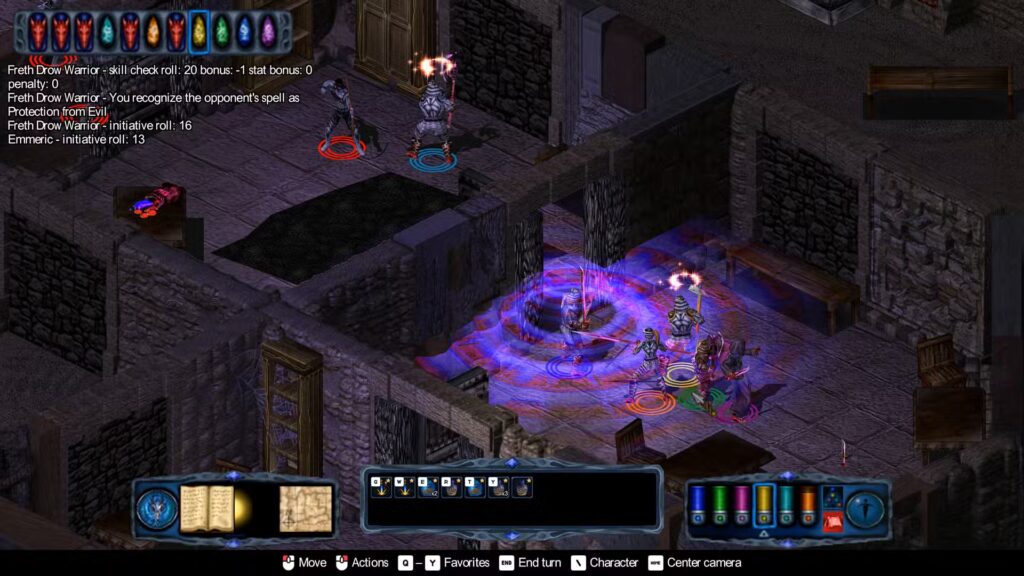
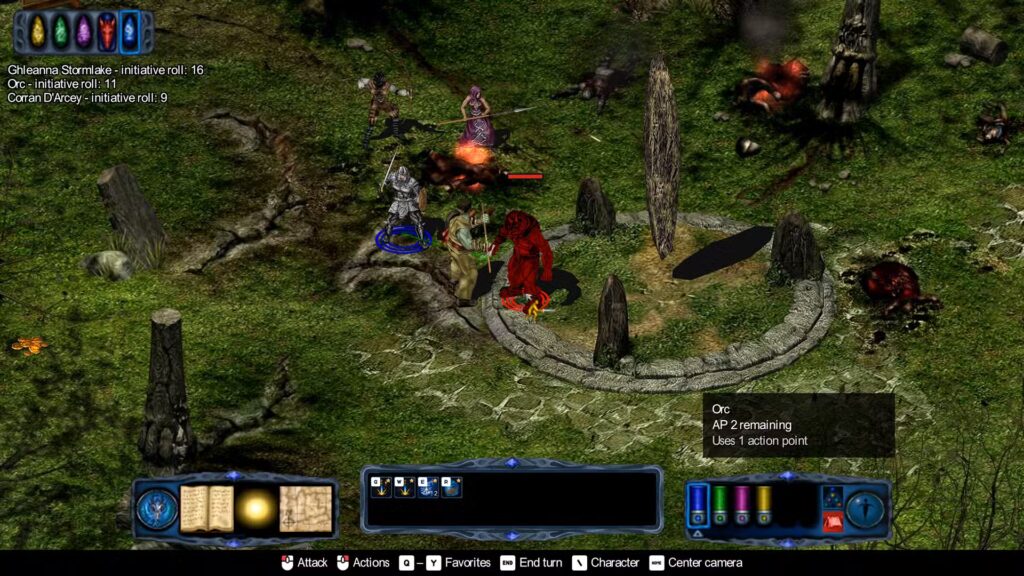
The restored edition adds an action bar, additional tooltips, and adjustable combat animation speed. An action bar makes frequently repeated commands easier to reach, helping players focus on choosing an ability rather than repeatedly searching for it. Clear access to an attack, spell, or other action can also help players compare options instead of selecting whichever command is easiest to locate.
Tooltips support a different part of that process by explaining symbols and functions without demanding immediate memorization. Combat animation speed controls the time spent watching a decision resolve, which is separate from the time a player wants to spend considering that decision. Across a long campaign, these repeated improvements can affect comfort as much as a more conspicuous visual change.
Shchuiko described an initial audit of actions that required needless steps or offered too little information. That approach gives the improvements a practical measure: whether players can reach an informed decision with fewer interruptions. A useful action bar supports a repeated sequence of selecting a character, checking available choices, choosing a target, and understanding the outcome. Improvements at several points in that sequence can accumulate. A faster route to a command matters less if its meaning remains obscure, while a clear explanation becomes frustrating if accessing the command still requires excessive navigation. Treating the sequence as a whole helps connect interface clarity with the pace of play.
The optional turn timer provides a separate way to adjust combat. SNEG’s launch materials distinguish traditional turn based play from a timed option that adds pressure while choosing actions. Animation speed concerns how quickly an action is shown after the choice has been made. A player who enjoys deliberation can therefore value quicker animations without wanting less time to consider a move. Another player may prefer the additional pressure of the timer. These settings address different sources of perceived slowness, so describing both simply as faster combat would obscure their purpose. The distinction is particularly useful in a party RPG, where planning and watching several actions unfold can occupy substantial parts of the same encounter.
SNEG rebuilt the main font as TTF, added missing glyphs, and created new action icons at twice the original resolution. Microsoft’s typography documentation explains that TrueType stores character shapes as outlines that can be scaled and converted into pixels for display. Font files also contain spacing and character mapping information, making this different from simply enlarging a fixed image of a letter.
Readability matters throughout a text heavy RPG because item descriptions, numerical values, and ability explanations all support informed decisions. Icons instead need rapid recognition and a consistent relationship with the surrounding artwork. Making an isolated interface element dramatically more detailed can attract attention for the wrong reason. Text and icons therefore benefit from different priorities rather than one universal scaling treatment.
Font reconstruction also has a practical relationship with layout. Clear letter shapes help only if a description fits its available space and remains distinguishable from nearby values and controls. Longer words, punctuation, and different character combinations can expose problems that a short menu label does not. Added glyphs expand the characters the font can represent, while spacing influences whether those characters remain readable together. These considerations explain why text deserves separate attention from decorative artwork. A player may tolerate an old background’s softness while still needing to distinguish a numerical value or read an ability description accurately. Preserving a font’s character and improving its legibility can serve both the atmosphere and the decisions the interface supports.
SNEG uses AMD FSR 1.0 to sharpen the game’s visual output. AMD describes FSR 1 as a spatial upscaler that processes the current image without relying on previous frames or motion vectors. Its principal stages perform edge adaptive upscaling and contrast adaptive sharpening. This changes how existing information is presented rather than demonstrating that every wall, floor, or object has been repainted.
As with enlarging a photograph, better processing can improve edges and reduce softness without establishing authentic detail absent from the source. A cleaner presentation can therefore be worthwhile without amounting to a comprehensive asset remake. The identified technology is FSR 1, so features associated with later generations, temporal reconstruction, or frame generation should not be assumed from the broader branding.
AMD’s documentation also describes FSR 1 as available in source form and designed for a broad range of graphics hardware, with support for DirectX 11, DirectX 12, and Vulkan. That makes it a useful example of a modern component that can fit an older game without dictating a replacement engine. Its relevance here is the ability to process the existing picture through an adaptable rendering technique. The wider engineering principle is selective modernization: a restoration can adopt a newer component for a particular job while retaining the systems that supply the game’s established content and behavior.
Launch materials confirm widescreen support, including 4K, but Shchuiko clarified that backgrounds and terrain had not been individually upscaled, correcting wording in an earlier announcement. Display resolution describes the dimensions of the final output, scaling describes how imagery is adapted to that output, and asset resolution describes the information stored in the artwork.
These are related but distinct parts of presentation. A game can work better on a modern monitor without replacing every source image, while higher resolution artwork alone does not guarantee readable menus or a comfortable view. Widescreen changes the shape of the available display area, but its effect depends on how the scene and interface are arranged within it. Buyers should therefore understand 4K as a supported display capability, not a promise that every element was newly authored in 4K. The useful assessment is whether the chosen resolution remains clear and comfortable at the screen size and viewing distance being used.
Controller support and reworked camera controls broaden how players can interact with the restored adventure. Adapting a tactical RPG to a gamepad involves character selection, command navigation, information inspection, and moving attention around the environment. Those tasks need consistent feedback, while camera handling must work comfortably alongside party and interface interactions.
Valve’s developer guidance recommends exposing all game functionality through controller configurations and avoiding conflicts when mouse style and joystick style inputs coexist. These are general platform recommendations rather than confirmation of the restoration’s exact implementation. The published descriptions do not supply a complete button map or establish a freely rotating camera. Players should check the game’s controls and settings for those details rather than inferring them from the broader feature descriptions.

Steam Deck Testing, Legacy Mode, and Storefront Options
Steam Deck testing came first, with external QA and public demo feedback also informing development. Shchuiko nevertheless acknowledged remaining imperfections. A handheld can expose interface problems because its physically smaller screen and constrained controls make it harder to rely on a full keyboard and mouse. Players need to understand what is selected, what a command will do, and how to move between tasks. Those demands can increase as more options become available later in a campaign, so a manageable opening encounter is not a complete test of usability. Handheld testing can reveal such issues early enough for changes to remain practical.
The reported interface testing covered combat near both the beginning and end of the game, inventory management, and exploration. The variety matters because a layout that works with a small collection of early choices can become cumbersome as more commands become available. Transitions deserve attention too. As a general testing example, opening an inventory, changing the active character, returning to combat, and then loading a save exercises relationships that isolated menu checks would miss. The relevant question is whether the player can complete a continuous sequence of ordinary tasks without losing track of the selected character, the available action, or the next required input.
The public demo supplied another opportunity to evaluate that experience. SNEG’s October announcement offered a demo during Steam Next Fest, with progress transferable into the full release. That arrangement let prospective players try the revised controls in the context of the adventure and retain their early progress. It also gave the team feedback from people who had not spent development learning its interface. Familiarity can conceal awkward interactions: someone who already knows where every command belongs may navigate a screen successfully even when a newcomer cannot see how to proceed.
Valve’s Steam Deck compatibility criteria examine controller access, input prompts, text entry, readable interface text, performance, and other requirements. These criteria show why accepting button presses is only one part of a usable handheld experience. A player must also be able to interpret the interface and access the functions needed to continue. Valve’s rating process is separate from the testing undertaken by a developer or publisher. SNEG’s attention to Steam Deck therefore should not be treated as evidence of a particular verification badge.
The confirmed information concerns the development and feedback process rather than an independently established compatibility rating. Valve makes the readability requirement concrete by assessing text at the handheld’s supported resolution and a normal viewing distance. Its guidance specifies a minimum character height of nine pixels at 1280 by 800, while recommending twelve pixels where possible. Those criteria illustrate why a sharp font and a comfortable font size are separate concerns. A crisp but tiny label can still be difficult to read during play.
Legacy mode preserves the original gameplay and visuals, including the original mouse interaction, while settings let players adjust the extent of the enhancements. This offers a way to compare how presentation and interaction affect the experience of the same adventure. For players interested in design history, it can reveal how interface demands influence perceived pacing. Returning players may also prefer familiar arrangements for reasons that extend beyond efficiency. The option recognizes that audiences do not all value the same improvements equally. It should not be interpreted as a promise to reproduce every failure associated with obsolete hardware or installations. Its purpose is to offer a choice of presentation and interaction within a release intended for present day use.
Pool of Radiance: Ruins of Myth Drannor is available on Steam and GOG, with announced standard prices of $19.99, £16.75, and €19.99. At a November 10, 2026 check, Steam’s US listing showed a 10% discount to $17.99 through November 20. Regional checkout prices can differ. Steam lists achievements and Steam Cloud support. GOG identifies its edition as DRM free and includes the soundtrack in MP3 and FLAC formats among its extras.
GOG also lists achievements and cloud saves, with synchronization available through the optional GOG Galaxy client. Its downloadable offline installer allows installation without that client. Steam likewise lists the original soundtrack as free additional content, so the music is not exclusive to GOG. These details make the practical comparison more precise. Players can weigh how they want to install the game, maintain local copies, and use synchronization features alongside their preferred controls.
Access to the campaign is the common result, while the surrounding installation and account features differ. Storefront choice can therefore reflect a preference for Steam’s integrated services across desktop and handheld use or GOG’s distribution model. Whichever edition is preferred, the release offers a maintained opportunity to explore this older RPG, its tactical decisions, and its place in Dungeons & Dragons gaming history.
Frequently Asked Questions (FAQs)
- When was the restored edition released?
Pool of Radiance: Ruins of Myth Drannor’s restored edition launched on November 6, 2026. The digital release became available on Steam and GOG. The original game dates to 2001, so these dates refer to different editions of the same adventure. SNEG published the restoration in partnership with Wizards of the Coast. The 2026 release brings that existing RPG to modern PCs with improvements to its interface, presentation, and controls. - Who developed the original game?
Stormfront Studios developed the original 2001 game. Ubisoft was its original publisher. SNEG publishes the restored edition, which was announced in partnership with Wizards of the Coast. The restoration retains the original engine while introducing changes intended to make the adventure more comfortable to play on modern systems. These credits distinguish the creation of the original game from the work involved in restoring and republishing it. - Is this the original Gold Box Pool of Radiance?
No, this release is Pool of Radiance: Ruins of Myth Drannor, the 2001 game. It is a different title from the earlier Gold Box Pool of Radiance. The shared main title can make the two easy to confuse when browsing storefronts or reading announcements. SNEG directs players seeking the earlier game to Forgotten Realms: The Archives; Collection Two. Checking the full title, particularly the Ruins of Myth Drannor subtitle, helps identify which adventure a listing contains. - How large can the adventuring party become?
An adventuring party can contain up to six characters. Players can create four heroes and recruit two additional companions. The distinction matters because the full party is assembled through both character creation and recruitment. Party composition helps shape the options available during tactical encounters. Planning how the characters’ abilities complement one another is therefore part of preparing for the campaign. - Is combat turn-based?
Yes, the game uses turn-based combat. Players can also choose an optional timed-turn approach. This adds pressure to decision-making while retaining the turn-based structure. It gives players a choice between taking their time over tactical decisions and making those choices under a timer. The separate animation-speed setting changes how quickly actions are presented rather than whether combat is turn-based. - What character progression does the game include?
The official description lists character progression up to level 16. Spells reach eighth level, with more than 90 spells included overall. Character levels and spell levels describe different aspects of progression and should not be treated as interchangeable numbers. The spell total describes the campaign’s available content without establishing that every character can use every spell. These are features of the existing adventure rather than newly added campaign content created for the restoration. - Does the restoration support controllers?
Yes, controller support is included in the restored edition. Revised camera handling accompanies the broader input support. A tactical RPG’s controls need to cover party selection, command navigation, and inspection of the environment. The available feature descriptions do not provide a complete button-by-button map for every device. Players should check the in-game settings to see the configuration available for the controller they intend to use. - Can players adjust combat pacing?
Yes, the restoration lets players adjust combat animation speed. This controls how quickly an action is shown after the player has chosen it. Faster animation can reduce the time spent watching repeated actions resolve. The optional turn timer is a separate feature that adds pressure while decisions are being made. Choosing faster presentation should therefore be distinguished from choosing timed tactical decisions. - What are the listed Windows requirements?
Steam lists Windows 10 or Windows 11. It also specifies that both the processor and operating system must be 64-bit. The listed requirements include 4 GB of RAM and 4 GB of available storage. Those figures refer to system memory and free drive space respectively, so they are separate requirements. The listing also contains graphics and DirectX requirements, which should be checked alongside these specifications when assessing a PC’s compatibility. - Is the GOG edition DRM-free?
Yes, GOG describes the restored edition as DRM-free. Its listing states that playing the game does not require activation or an online connection. DRM-free distribution does not remove the need to meet the game’s system requirements. The product page also lists soundtrack downloads among the included extras. Those downloads are available in MP3 and FLAC formats.
Conclusion
SNEG’s restoration of Pool of Radiance: Ruins of Myth Drannor shows why preservation must address how a game is played as well as whether its files survive. Working without the original development materials required the team to understand the existing software before improving the ways players interact with it. The revised interface, clearer presentation, and broader controls turn that largely invisible engineering work into practical benefits throughout the adventure.
These changes give returning players a more comfortable route back into the campaign and newcomers an opportunity to assess it firsthand. They do not erase the original game’s limitations or settle every argument about its design. Bringing a long-unavailable RPG back into ordinary digital distribution restores something more useful than a revised reputation: the opportunity for players to explore its strengths, encounter its weaknesses, and reach their own conclusions.
Sources and Citations
- 80 Level, November 6, 2026: Interview with SNEG co-founder Artem Shchuiko about the restoration’s engineering and design decisions.
https://80.lv/articles/this-forgotten-classic-d-d-rpg-was-revived-without-source-code-or-tools - SNEG via Games Press, November 6, 2026: Official launch announcement covering availability, pricing and the restored edition’s features.
https://www.gamespress.com/en-US/Restoration-of-classic-Dungeons-Dragons-game-Pool-of-Radiance-SN-78970 - SNEG via Games Press, October 19, 2026: Earlier release announcement containing the background-upscaling wording subsequently corrected in the developer interview.
https://www.gamespress.com/Restoration-of-classic-Dungeons-Dragons-game-Pool-of-Radiance-SNEG-Ltd - Steam, Pool of Radiance: Ruins of Myth Drannor: Official product listing with gameplay details, platform features, system requirements and purchasing information.
https://store.steampowered.com/app/4834760/Pool_of_Radiance_Ruins_of_Myth_Drannor/ - GOG, Pool of Radiance: Ruins of Myth Drannor: Product listing documenting the DRM-free edition, enhancement options and soundtrack extras.
https://www.gog.com/en/game/pool_of_radiance_ruins_of_myth_drannor - Dear ImGui, official GitHub repository: Technical documentation explaining the interface library and its integration with existing applications.
https://github.com/ocornut/imgui - AMD GPUOpen, FidelityFX Super Resolution 1: Explanation of spatial upscaling, edge reconstruction and sharpening.
https://gpuopen.com/fidelityfx-superresolution/ - Microsoft Learn, TrueType overview: Technical background on outline fonts, scaling, character mapping and rasterization.
https://learn.microsoft.com/en-us/typography/truetype/ - Valve, Steam hardware compatibility documentation: Criteria distinguishing developer testing from formal compatibility ratings, including input and text-readability requirements.
https://partner.steamgames.com/doc/steamhardware/compat?l=english - Valve, Steam hardware development recommendations: Guidance on controller access, mixed input and other considerations for handheld play.
https://partner.steamgames.com/doc/steamhardware/recommendations?l=english - National Security Agency, Ghidra: General technical background on compiled-software analysis, without implying that SNEG used this particular tool.
https://github.com/NationalSecurityAgency/ghidra - SNEG, official Steam Community announcements: Release information and identification of the collection containing the earlier Pool of Radiance game.
https://steamcommunity.com/app/3843540/announcements/
Recommendations
- Tales of Arise: Beyond the Dawn Edition Nintendo Switch 2 Release Date Trailer, Gameplay, Story Expansion, and Everything We Know (2026 Update)
- MTG Standard Rotation February 2027: Every Set Leaving Standard
- Dragon Quest Smash/Grow Returns at Tokyo Game Show 2026
- Grand Theft Auto 6: Confirmed Car List (2026 Full Vehicle Breakdown, Leaks & Trailer Sightings Explained)
- Escape the Backrooms PS5 and Xbox Series Release: Full Console Launch Explained, Gameplay Details, and Everything You Need to Know
- Media Molecule New Open World Game Explained
- Zero Parades: for Dead Spies, Official PC Launch Trailer Explained, Story Details, Gameplay Features, Release Date & Everything You Need to Know
- Faceware MetaHuman Facial Motion Workflow: A Complete Guide for Realistic Face Animation
- Aliens: Fireteam Elite Switch Shutdown: Why Owners Can No Longer Play the Game
- Ratchet & Clank: Ranger Rumble Canceled Before Global Release, Shutdown Set for May 2027



































































































