







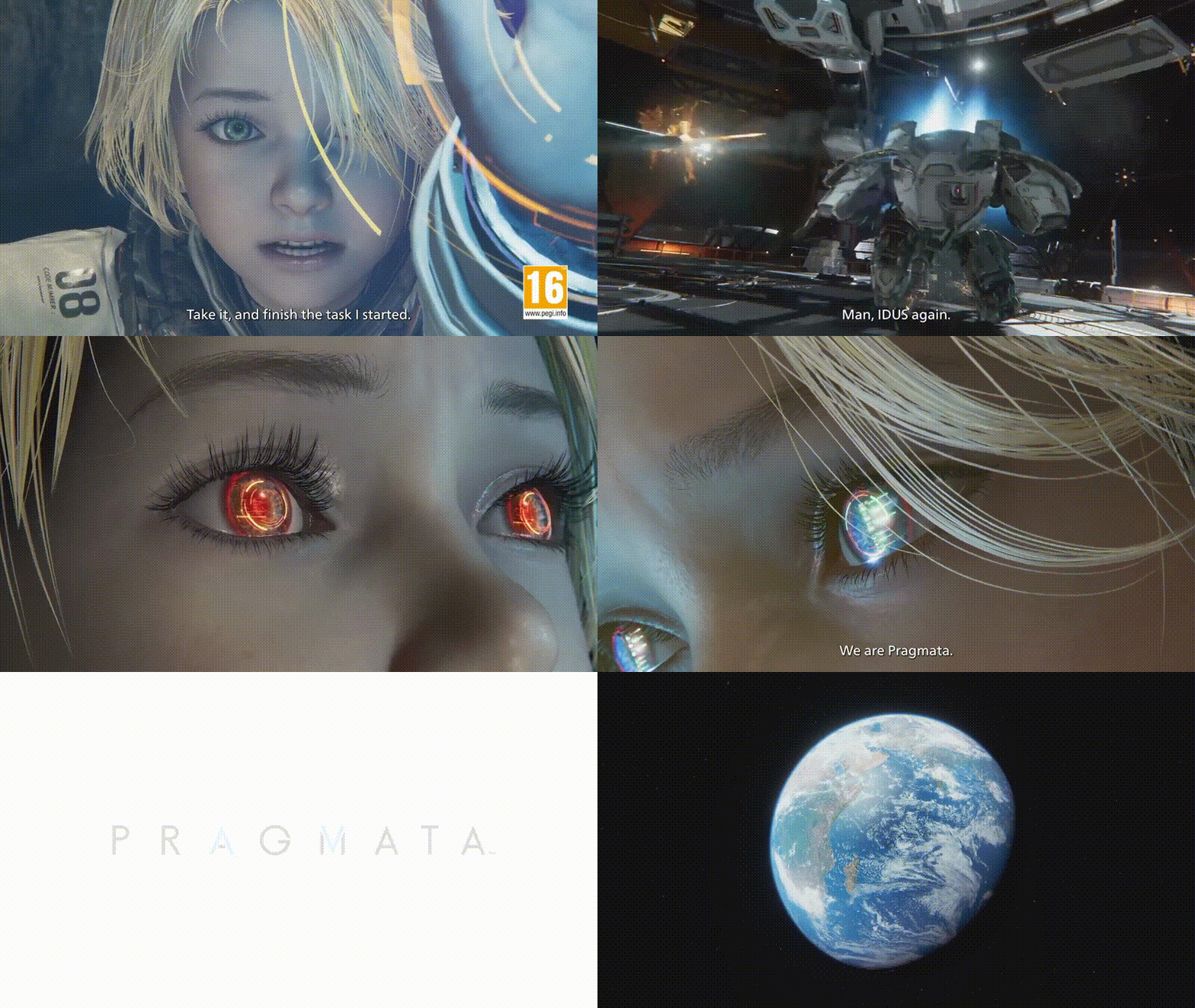
Pragmata turns a familiar modern game setup into something unexpectedly tender. Official materials describe a near-future sci-fi action-adventure in which Hugh Williams and the android girl Diana must survive a ruined lunar research facility by combining gunplay, hacking, and trust. What critics quickly noticed, however, is that the real distinguishing feature is emotional: Hugh is not written as a distant, brooding protector who slowly learns care, but as someone who offers warmth, reassurance, and curiosity almost from the start. That is why the “anti-Kratos” label fits so well, and why Pragmata’s central relationship has become one of the game’s main SEO-driving talking points in April 2026.
In This Article (19 sections)
Pragmata story overview: Hugh, Diana, and the moonbase crisis
At the broadest level, Pragmata is a moon-survival story with an intimate emotional center. Official and semi-official story descriptions present Hugh Williams as the human lead sent to a lunar facility after disaster strikes, where he becomes stranded and teams up with Diana, an android who can hack hostile systems and enemy defenses. Together, they navigate a research station cut off from normal order and try to find a way back to Earth.
The crisis is not just survival horror dressing. Multiple launch-period summaries describe the lunar installation as a corporate research site tied to advanced 3D-printing technology, Lunafilament, and an AI-governed infrastructure that has gone badly wrong. Reviews and previews repeatedly connect the moonbase emergency to a larger thematic web: corporate ambition, artificial replication, and the emotional costs of trying to automate human need.
Pragmata’s Hugh is the anti-Kratos explained
The “anti-Kratos” framing comes from a simple but powerful contrast. A recent analysis at Polygon explicitly positioned Hugh as the anti-Kratos because Pragmata’s parenting dynamic rejects gaming’s usual tough-love wisdom. In other words, the game does not build its emotional arc around a closed-off warrior reluctantly learning tenderness; it begins from tenderness and then asks what kind of story emerges when care is already present.
That makes Hugh the opposite of the modern God of War template in starting posture, not necessarily in narrative value. Official God of War materials describe Kratos and Atreus as father and son seeking a new life together, while contemporaneous reporting around that game emphasized Kratos as a distant, short-tempered father who has to learn openness over time. By contrast, Kotaku wrote that Hugh and Diana’s relationship starts sweet and stays that way, with Hugh never treating Diana like a burden and happily telling her about Earth. The “anti-Kratos” label therefore speaks less to combat style than to emotional design: Hugh guides before he hardens, reassures before he disciplines, and collaborates before he commands.

Why Hugh and Diana’s bond stands out in Pragmata
Critics keep returning to the same point: the Hugh-Diana relationship works because it is not built on forced friction. The Guardian said their pseudo father-daughter bond blossoms organically rather than feeling like forced sentimentality, while GameSpot praised the game for giving its heartfelt story enough room for relationship-building. Nintendo Life’s review roundup highlighted praise for a “tender and well-rendered” relationship that is not undercut by Hugh’s insecurities or by unnecessary conflict.
Just as important, Pragmata makes that bond playable. The Shelter hub is not only a systems menu; it is where Hugh talks with Diana, answers her questions, installs Earth-memory collectibles that create new scenes for her, plays hide-and-seek, and receives the drawings she makes as their bond deepens. The game therefore treats emotional attention as a core activity, not as optional flavor text bolted onto the action.
Who is Hugh Williams in Pragmata
Official character and store descriptions identify Hugh Williams as the human half of Pragmata’s dual-protagonist structure. He is a member of the team sent to investigate the lunar facility, and Capcom’s own story description on YouTube calls him a systems auditor. In play terms, he is the weapon-user and mover: he fights with firearms and uses built-in thrusters in his suit to traverse the station and evade danger.
What makes Hugh memorable is that the writing refuses to turn him into a cliché supersoldier. RPG Site describes him as a surprisingly lovable everyman, and another review emphasizes how empathic he is from the outset, especially in the way he nurtures Diana’s curiosity. Instead of deriving appeal from mystery or macho silence, Hugh feels approachable, mildly exasperated, funny, and emotionally available.
Who is Diana in Pragmata and why she matters
Official materials identify Diana, also known as D-I-0336-7, as a Pragmata: a unique android created using Lunafilament and designed with the appearance of a young girl. Capcom and PlayStation descriptions emphasize two crucial traits. First, she can hack enemy armor and the station itself, which makes her mechanically indispensable. Second, because of her limited accumulated data, she approaches the world with innocent wonder and fast-learning curiosity. Hugh gives her the name “Diana,” and official character text notes that she treasures it.
Diana matters because she is simultaneously the story’s heart and its tactical key. GameSpot identifies her as the emotional center of the narrative, while Kotaku and Windows Central both treat her curiosity and growth as the element that gives Pragmata its warmth and humanity. She is not merely the child to be protected; she is the partner who makes survival and progression possible.

Pragmata character dynamics: why Hugh feels more emotionally open
Hugh feels more emotionally open because the game gives him behaviors usually reserved for the end of fatherhood arcs, not the beginning. He names Diana early, tells her stories about Earth, responds to her wonder with explanation rather than irritation, and continues those exchanges through repeat conversations in the Shelter. GameSpot specifically notes that holographic Earth artifacts become opportunities for Hugh to talk about childhood and life on Earth, while the Shelter system deepens that dynamic with ongoing conversation, play, and memory-sharing.
That openness is also tonal. RPG Site describes Hugh as a nice, everyman presence who can be amusing and unexpectedly profound, and reviews repeatedly stress that his warmth never feels like a dramatic twist. In Pragmata, emotional openness is not a reward for surviving enough cutscenes. It is the baseline that makes the rest of the story meaningful.
Pragmata parenting themes and found-family storytelling
Pragmata is not a literal domestic parenting simulator, but it is clearly built around parenting-coded care. RPG Site calls the story one of found family and camaraderie between lost souls, and The Guardian describes Hugh and Diana as a pseudo father-daughter pair. Kotaku, meanwhile, argues that the game subverts the older “dad game” model by presenting a man who already enjoys guiding and encouraging the child-shaped companion in his care.
That matters because the game maps found-family storytelling onto both narrative and progression. Shelter interactions reward patience, conversation, and small acts of attention. The bond is not something the story talks about while the gameplay ignores it; it is part of how the player spends time, upgrades space, and understands why the pair keep going. Read through a gentle-parenting lens, Pragmata repeatedly suggests that explanation, play, and emotional safety are not distractions from survival but part of what makes survival worth pursuing.
How Pragmata avoids the tough-love parent trope in games
Pragmata avoids the tough-love trope by refusing the usual burden narrative. Kotaku’s review is especially clear on this point: Hugh never once treats Diana like a problem he has to endure until he learns a lesson. Instead, he talks to her, carries her, names her, and promises to show her the Earth he keeps describing. Nintendo Life’s roundup likewise highlights critical praise for a relationship that is not sabotaged by avoidable arguments or by the adult lead’s emotional immaturity.
AV Club sharpened that idea by arguing Pragmata works precisely because it is not a “sad dad” game. In that reading, Hugh is an example of upbeat, non-toxic masculinity rather than a man whose care only becomes legible through harshness, guilt, or repression. That is the game’s biggest tonal gamble, and the broad positive reception suggests it pays off.

Hugh vs Kratos: how their protector roles are different
The contrast with Kratos is strongest when looked at as a difference in protector logic. God of War’s Norse-era reboot is built around a father and son trying to live together while Kratos contends with grief, anger, and his own inability to communicate. Official PlayStation copy presents the arc as a father-son journey into a new life, and major 2018 coverage framed Kratos as distant and short-tempered before he gradually opens up.
Hugh’s protector role is more reciprocal from the start. Diana is not just the person he shields; she is the person whose hacking keeps him alive, opens pathways, and cracks enemy defenses. AV Club went so far as to argue that Hugh is less a classic father-protector and more a vehicle for Diana’s agency. GameSpot and PlayStation’s own previews echo that idea by presenting the pair as inseparable in both story and combat. Hugh protects through steadiness and willingness to help Diana flourish, while Kratos’ early Norse-era protection is shaped by caution, restraint, and emotional distance.
Capcom’s Pragmata themes: AI, care, trust, and survival
Pragmata’s sci-fi themes are not abstract decoration; they are materially expressed in the world. The Verge reported that director Yonghee Cho and producer Naoto Oyama intentionally designed enemies and city-like spaces to feel as though AI had made them, with human developers handcrafting “wrong” details to produce an uncanny, AI-generated effect without actually using generative AI in the game’s creation. That gives the station a distinct texture of imitation rather than invention.
Several reviewers frame this as part of a broader thematic argument about humanity. Radio Times reads the story as a cautionary tale about the dangers of AI and the hollowing-out of human creativity, while Space.com emphasizes that the game’s AI horror is less about superior machine intelligence than about unsettling imitation. Windows Central, meanwhile, argues that Diana’s curiosity and growth turn the whole experience into a meditation on what it means to be human. In that frame, care and trust are not sentimental add-ons but the moral counterweight to a world of replication, distortion, and machine-controlled survival.
Why Pragmata’s emotional story helps it stand out from other sci-fi games
A great many sci-fi games can offer collapsing facilities, rogue AI, and sleek art direction. Pragmata stands out because it uses those genre staples to support a story with unusual softness. GameSpot calls it a heartfelt tale that nurtures the relationship between its memorable characters, Tom’s Guide praises its earnest sci-fi story and heartfelt father-daughter dynamic, and Windows Central says the game carves out its own place in the genre by pairing curiosity and growth with distinctive combat.
Its structure helps, too. Reviews describing the game as concise, linear, and resistant to modern bloat suggest that Pragmata has enough room for quiet character beats without losing momentum. The result is a sci-fi adventure that feels less interested in overwhelming the player with scale than in making the player care about two people crossing an inhospitable machine world together.

Is Pragmata one of Capcom’s most heartfelt games in 2026
On the evidence available as of April 22, 2026, that argument is easy to make. Critics across GameSpot, RPG Site, Tom’s Guide, Windows Central, and The Guardian repeatedly describe the story as heartfelt, warm, moving, or emotionally resonant, and the dominant point of agreement is always the same: Hugh and Diana’s chemistry gives the game its identity.
The early market response strengthens that claim. Capcom announced that Pragmata surpassed one million units sold in just two days, and the storefront capture used for this analysis showed “Overwhelmingly Positive” English user reviews on PC, with 97% of 5,943 reviews marked positive at the time of retrieval. That does not prove universal consensus, but it does show that the emotional pitch of the game is connecting with both critics and players very quickly.
How Pragmata’s hacking-and-shooting gameplay reflects Hugh and Diana’s partnership
Pragmata’s combat is built on interdependence by design. In an official PlayStation interview, director Yonghee Cho said the team wanted to create something that set itself apart from traditional shooters, which led to the fusion of gunplay and hacking; he also explained that the goal was to make both mechanics essential so a player could not simply rely on one and ignore the other. That design philosophy makes the Hugh-Diana relationship mechanical, not just thematic.
Official character and gameplay descriptions split responsibilities clearly. Hugh uses firearms and suit thrusters to move, dodge, and finish targets, while Diana hacks enemies to expose weak points and hacks the station itself to open blocked paths. Capcom’s official gameplay page also notes that timing weapon use alongside Diana’s hacking is crucial, and the Shelter systems let players upgrade both Hugh’s combat capabilities and Diana’s hacking efficiency.
Critics repeatedly argue that this is where character and design lock together. GameSpot calls the Hugh-Diana tag-team the keystone of both the story and the combat hook, and Kotaku stresses that neglecting either character’s upgrade path simply does not work. In practical terms, Pragmata makes partnership the condition of play. Hugh cannot brute-force his way through the moonbase crisis, and Diana cannot survive it without Hugh’s mobility and firepower. The game’s central relationship is therefore reflected in every serious encounter.
Pragmata review roundup: what critics say about Hugh and Diana
The aggregate picture is extremely strong. As of April 22, 2026, OpenCritic listed Pragmata with a “Mighty” rating based on 123 critics, while contemporaneous reporting around launch put the game at roughly 86 on Metacritic and 87 on OpenCritic. Those numbers are snapshots and may shift with additional reviews, but they place Pragmata among the better-received major releases of the year so far.
The most notable pattern inside the reviews is not just praise for combat but praise for the leads. GameSpot gave the game a 9/10 and highlighted its heartfelt story and relationship-building. The Guardian said the duo’s bond grows organically and elicits smiles. Tom’s Guide lists the heartfelt father-daughter story as one of the game’s main strengths, while Windows Central describes Diana’s curiosity and growth as central to a larger reflection on humanity. Gaming Nexus goes even further, calling Hugh and Diana two of the best protagonists it has seen in games in a while.
The criticism is also fairly consistent, which makes the positive consensus more credible. Some reviewers note that the story can be predictable, that the combat feels odd before it clicks, or that the plot sometimes leans on familiar genre material. But even those reservations tend to sit beside the same conclusion: the Hugh-Diana pairing carries the game, and the emotional sincerity makes the whole package feel fresher than its premise alone suggests.

Pragmata release date, platforms, and launch details
Pragmata’s road to launch was long. In an official PlayStation interview, Cho recalled the game’s 2020 reveal, its movement from a 2022 target to 2023, and then its indefinite delay. At The Game Awards 2025, Capcom announced an April 24, 2026 release window, and a March 5, 2026 PlayStation recap then confirmed the date had been moved up to April 17, 2026.
For current launch details, the strongest source is Capcom’s April 20 press release. Capcom lists Pragmata as a sci-fi action-adventure on PlayStation 5, Xbox Series X|S, Nintendo Switch 2, and PC, with PlayStation 5, Xbox Series X|S, and PC dated April 17, 2026. Capcom’s official materials available to this analysis list the Nintendo Switch 2 version for April 24, 2026, and Capcom also confirmed that the game passed one million units sold in two days. Ahead of launch, the PC storefront also offered the PRAGMATA Sketchbook demo to showcase the hybrid combat system.
Frequently Asked Questions (FAQs)
- What is Pragmata about?
Pragmata is a near-future sci-fi action-adventure about Hugh Williams and Diana trying to survive a lunar research facility that has been overtaken by hostile AI and find a way back to Earth. Its premise combines corporate sci-fi, moonbase disaster, and a two-character partnership built around shooting and hacking. - Who is Hugh Williams in Pragmata?
Hugh Williams is the human lead. Official descriptions present him as a member of the team sent to investigate the lunar station, while Capcom’s story description identifies him as a systems auditor; in gameplay, he uses firearms and suit thrusters to fight and traverse the environment. - Who is Diana in Pragmata?
Diana, or D-I-0336-7, is a Pragmata android created using Lunafilament and designed with the appearance of a young girl. She is crucial both narratively and mechanically because she hacks enemy armor, opens pathways through the station, and functions as the emotional center of the story. - Why is Hugh called the anti-Kratos?
The phrase points to tone and emotional posture. Recent criticism frames Hugh as the anti-Kratos because, unlike the early Norse-era version of Kratos, he is not defined by distance, short temper, or tough-love withholding; he begins from warmth, guidance, and cooperation with Diana. - Is Pragmata a dad game or a found-family story?
It reads as both, but found family is the more precise label. Critics regularly describe Hugh and Diana as a pseudo father-daughter pairing, yet the game’s emotional logic is less about literal parenthood than about a caring bond formed under crisis. - How does the hacking-and-shooting system work in Pragmata?
Hugh handles movement, dodging, and gunfire, while Diana hacks enemies and environmental systems in real time. Capcom’s developers have said the entire combat structure was deliberately balanced so that players could not depend only on shooting or only on hacking; success requires both. - What themes does Pragmata explore?
The game explores AI imitation, care, trust, survival, and what remains uniquely human in a world of machine replication. Reviews and interviews repeatedly connect its strange environments, uncanny enemies, and emotional core to a broader critique of automated creation and corporate technological ambition. - How long is Pragmata?
Most launch-period reviews place a first playthrough in roughly the 11-to-15-hour range, depending on how much optional content and exploration a player pursues. GameSpot’s reviewer finished in about 12 hours, while RPG Site describes the game as lasting around 12 to 15 hours. - What are the Pragmata release date and platforms?
Capcom’s official materials list Pragmata on PlayStation 5, Xbox Series X|S, PC, and Nintendo Switch 2. For the sources captured in this research, PlayStation 5, Xbox Series X|S, and PC are dated April 17, 2026, while the Nintendo Switch 2 version is listed for April 24, 2026. - What do critics say about Hugh and Diana?
The critical consensus is that Hugh and Diana are the main reason Pragmata works. Reviewers consistently praise the warmth, charm, and organic growth of their relationship, even when they note that the larger plot can lean on familiar sci-fi ideas.

Conclusion
Pragmata’s Hugh is the anti-Kratos because he changes the emotional equation of the modern protector game. He is not compelling because he resists care and then reluctantly discovers it. He is compelling because he begins with care, and because the entire narrative and combat structure take that care seriously. Diana is not an accessory to that idea; she is its proof, as both the story’s beating heart and the gameplay’s indispensable partner.
That is why the “gentle parenting works” argument lands. In Pragmata, explanation beats intimidation, partnership beats domination, and emotional presence becomes a source of forward momentum rather than a speed bump to action. For a genre that often defaults to wounded stoicism, Pragmata feels distinct not because it abandons danger, but because it insists that survival is most meaningful when it makes room for trust, curiosity, and open care.
Sources and Citations
- Capcom (official site)
https://www.capcom.com - PlayStation Blog (official interviews & announcements)
https://blog.playstation.com - Steam (PC storefront for launch-state context)
https://store.steampowered.com - Metacritic (aggregated critic + user scores)
https://www.metacritic.com - GameSpot
https://www.gamespot.com - Kotaku
https://kotaku.com - Tom’s Guide (Gaming reviews & guides)
https://www.tomsguide.com
Recommended
- The Witcher Comics Comes to WEBTOON: Release Date, Where to Read, and What to Expect
- How to Make a Sci-Fi Movie with Metahuman in Unreal Engine 5: A Cinematic Workflow Guide
- Beast Of Reincarnation Release Date And Everything We Know About Game Freak’s Ambitious RPG (Gameplay, Story, Platforms & More)
- Broken Sword Shadow of the Templars Reforged Complete Guide and Walkthrough
- Mesh2Motion Animation App Introduces Spider and Snake Rigs in Release 10
- Upcoming Nintendo Switch 2 Games: 2026 Release Dates and Confirmed Titles Beyond 2026
- After Falling Big, Nintendo Stock Soars 10% After Pokémon Pokopia Releases and Sells Out
- Best Selling Books of All Time Ranked



































































































