











In This Article (9 sections)
Signet City Overview, Release Status, and Development Updates
Signet City is currently one of the most anticipated narrative-driven indie RPGs emerging from Gareth Damian Martin, the creator of Citizen Sleeper, and the studio Jump Over the Age. At the time of writing, there is no officially confirmed full release date, but development updates indicate that the project is in active production, with early conceptual builds and narrative prototyping underway.
The game has been described as being in a “deep pre-production to early production transition phase,” meaning core systems such as narrative branching, fungal biology mechanics, and host possession systems are actively being tested. Unlike traditional AAA RPG timelines, Signet City is being developed within a small, independent, narrative-focused framework, which often results in longer and more iterative development cycles.
Martin has emphasized a careful, story-first approach rather than rushing toward release windows, suggesting that Signet City will likely follow a similar philosophy to Citizen Sleeper by prioritizing narrative depth and systemic storytelling over fixed launch schedules. Current expectations in the indie RPG community suggest that a potential announcement window could come after additional gameplay reveals or a vertical slice demonstration, but no official confirmation has been provided.
Signet City is a narrative-driven “fungalpunk” RPG set in a decaying coastal urban environment where biological systems, machine intelligence, and human survival intersect. The game blends role-playing mechanics with experimental storytelling, focusing on transformation, parasitic systems, and environmental decay. At its core, it explores what happens when ecosystems evolve beyond human control, placing players in a world where fungal networks are not just environmental features but active systems of intelligence, communication, and control.
The game continues the thematic lineage of Citizen Sleeper, which explored capitalism, identity, and synthetic life. However, Signet City shifts its focus toward biological transformation rather than synthetic labor systems. This evolution places it firmly in the experimental RPG category, where narrative systems are as important as traditional gameplay mechanics. Unlike conventional RPGs with fixed character roles, Signet City appears to emphasize fluid identity structures, where players may inhabit multiple “hosts” or biological forms throughout the game.
Signet City Gameplay, Creative Vision, and Citizen Sleeper Connections
Signet City introduces a unique gameplay structure often described as “first-person parasite RPG mechanics.” This system suggests that players may not control a single static protagonist but instead interact with multiple bodies, hosts, or biological carriers. Gameplay likely revolves around navigating environments from shifting biological perspectives, managing parasite-host relationships, balancing survival with infection or transformation, and making narrative decisions that affect both body and mind states.
The “parasite RPG” concept implies that the player is not just a character but an evolving biological presence that influences or inhabits others. This creates a layered gameplay loop where agency is distributed across multiple entities. Rather than relying on traditional combat systems, Signet City is expected to lean into systemic interaction, where biological processes replace standard RPG stats like strength or agility. Instead, attributes may include infection level, fungal integration, neural control, or host stability.
This approach builds on experimental design principles seen in Citizen Sleeper, where dice-based systems were used to simulate precarious survival. In Signet City, those mechanics may evolve into biological probability systems rather than mechanical dice rolls. The game shares strong thematic DNA with Citizen Sleeper, particularly in its focus on systems-driven storytelling and vulnerable identities. However, while Citizen Sleeper focused on synthetic bodies and capitalist survival in space stations, Signet City shifts toward biological transformation and ecological collapse.
Shared narrative elements include:
- Choice-driven storytelling
- Systems-based progression
- Emotional minimalism
- Fragmented worldbuilding
- Non-traditional RPG mechanics
Both games reject conventional hero narratives. Instead, they emphasize survival within systems that are indifferent or actively hostile. Signet City appears to expand this approach by introducing physical transformation as a core narrative mechanic, potentially blurring the line between character progression and environmental change.
Signet City is developed by Gareth Damian Martin, an acclaimed narrative designer known for blending systems-based gameplay with deeply human storytelling. Their previous work, Citizen Sleeper, gained critical recognition for its emotional writing, tabletop-inspired mechanics, and philosophical exploration of identity in post-capitalist systems. The studio behind both projects, Jump Over the Age, operates as a small independent creative studio focused on narrative innovation rather than large-scale production pipelines.
Martin’s creative philosophy often centers on fragile systems of survival, identity as a mutable construct, the tension between autonomy and structure, and human experience within non-human systems. With Signet City, this philosophy expands into biological and ecological storytelling. Instead of exploring artificial intelligence or space capitalism, the focus shifts to fungal intelligence, ecological takeover, and symbiotic evolution.

Signet City Setting, Fungalpunk Identity, and Expected Platforms
The setting of Signet City is a decaying coastal metropolis on the edge of ecological collapse. The city itself is not just a backdrop but a living system slowly being consumed and restructured by fungal networks. Buildings are described as overgrown with organic matter, infrastructure is partially replaced by living tissue, and the boundary between architecture and organism has eroded.
The narrative environment emphasizes the following:
- Flooded industrial districts
- Bio-corrupted infrastructure
- Subterranean fungal networks
- Abandoned maritime zones
- Hybrid organic-machine ecosystems
The story appears to follow a world where humanity is no longer the dominant organizing force. Instead, fungal intelligence shapes the environment, rewiring both physical space and social systems. Players are likely to uncover fragmented narratives through exploration, host interactions, and environmental storytelling rather than traditional exposition.
The term “fungalpunk” defines Signet City’s unique genre identity. Much like cyberpunk focuses on digital augmentation and dystopian tech systems, fungalpunk centers on biological networks, decomposition, and organic intelligence. In Signet City, fungi are not merely environmental decoration but active participants in the world’s systems. They function as communication networks, memory storage systems, and possibly even decision-making intelligences.
Fungalpunk emphasizes:
- Decay as evolution
- Networks of biological communication
- Symbiosis between species
- Organic computing systems
- Reclaimed environments shaped by fungi
The inspiration likely draws from real-world mycology, ecological science, and speculative fiction exploring post-human environments. It reframes growth and decay not as opposites but as interconnected systems of transformation.
While no final platform list has been confirmed, Signet City is widely expected to launch on PC, with distribution likely through platforms such as Steam and possibly other digital storefronts. Given the publishing history of Jump Over the Age and previous indie release strategies, a PC-first launch is the most probable scenario. Console releases may follow depending on performance, funding, and publishing partnerships, as indie narrative RPGs often begin on PC due to flexibility in updates, patching, and experimental system integration.
Potential platforms include:
- PC as the primary platform
- Steam distribution
- Possible future console ports
- Potential cloud gaming services depending on publisher support
Signet City Visual Direction, Art Style, and Trailer Details
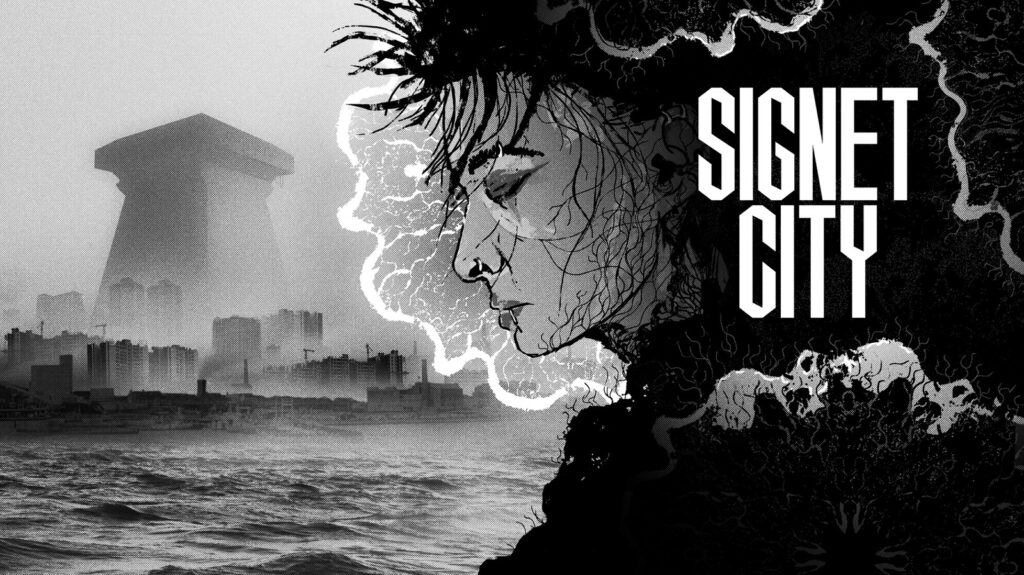
Although a full gameplay trailer has not been widely released, early visual materials and concept showcases suggest that Signet City places a strong emphasis on atmospheric storytelling. Its visual direction points to a world where clarity is intentionally obscured, reinforcing the game’s larger themes of transformation, uncertainty, and biological intrusion. Rather than presenting clean, easily readable environments, Signet City appears to embrace ambiguity, encouraging players to interpret its systems through interaction rather than direct exposition.
Key visual traits include:
- Monochrome-heavy environments with organic texture overlays
- Coastal industrial decay
- Fungal growth integrated into architecture
- Abstract biological overlays representing neural or fungal networks
- Minimalist UI inspired by systemic simulation design
The art style of Signet City is heavily influenced by monochrome palettes, industrial decay, and post-punk aesthetics. Its visual design focuses on high-contrast black-and-white environments, organic fungal structures blending with machinery, brutalist architecture overtaken by biological growth, grainy tactile visual filters, and minimalist character design that emphasizes silhouette over detail.
This aesthetic reinforces the game’s fungalpunk identity by making decay visually dominant. Instead of presenting a vibrant fantasy world, Signet City uses a subdued, almost archival visual tone. The result is a setting that feels both alien and familiar, grounded in industrial reality but transformed by biological processes.

Signet City Gameplay Systems, Lore, and Evolution Beyond Citizen Sleeper
One of the most distinctive features of Signet City is its rumored “hosts and possession” system. This mechanic implies that the player’s consciousness or influence may move between different biological entities, creating a gameplay structure where identity is unstable and constantly evolving. Choices are expected to affect not only narrative outcomes but also the physical transformation of the player’s current host, ensuring that gameplay and storytelling remain closely connected.
Core features likely include:
- Host switching mechanics
- Parasite integration levels
- Multi-body decision consequences
- Branching narrative outcomes based on biological control
- Risk-reward survival systems tied to infection
This approach aligns with the studio’s history of embedding mechanical consequences into narrative decisions. The lore of Signet City expands this idea through the concept of fungal networks evolving into biological computing systems. In this world, fungi store and transmit information, networks function like decentralized intelligence systems, cities become interconnected biological processors, and memory and identity may be encoded in organic matter.
This introduces a science-fiction concept where computation is no longer digital but biological. The implication is that Signet City itself may function as a massive living computer, with the player navigating not just a city but an evolving intelligence structure.
Insights from Gareth Damian Martin suggest that Signet City is designed to push narrative boundaries further than previous work. Key creative directions include expanding systems-driven storytelling into biology, exploring non-human intelligence systems, deepening emotional narratives through transformation, reducing reliance on traditional RPG structures, and emphasizing player interpretation over explicit explanation. The development philosophy remains consistent: create systems that generate stories rather than simply pre-write it. This supports replayability and emergent narrative depth, where each playthrough can produce different biological and emotional outcomes.
While Signet City and Citizen Sleeper share a narrative-first philosophy, the differences between them are significant. Citizen Sleeper focused on space station survival, synthetic bodies, capitalist structures, and dice-based decision systems. Signet City shifts that focus toward biological transformation, fungal ecosystems, host possession mechanics, and organic intelligence systems.
This evolution represents a move from synthetic dystopia to biological post-humanism, expanding the studio’s thematic scope from survival within systems to transformation into systems.

Frequently Asked Questions (FAQs)
- What is Signet City?
Signet City is a fungalpunk narrative RPG focused on biological transformation, identity, and systemic storytelling. The game appears to explore a world shaped by fungal networks, ecological decay, and shifting forms of consciousness, where the player’s role may involve inhabiting or influencing different biological hosts rather than controlling one fixed character. - Who is developing Signet City?
Signet City is being developed by Jump Over the Age, led by Gareth Damian Martin. Martin is best known for Citizen Sleeper, a critically praised narrative RPG recognized for its emotional writing, tabletop-inspired systems, and thoughtful approach to identity, survival, and social structures. - Is Signet City related to Citizen Sleeper?
Signet City is not presented as a direct sequel to Citizen Sleeper, but it shares thematic and mechanical DNA with it. Both games focus on vulnerable identities, systems-driven storytelling, and survival within hostile or indifferent structures. However, Signet City shifts away from synthetic bodies and space capitalism toward biological systems, fungal intelligence, and ecological transformation. - What genre is Signet City?
Signet City is a fungalpunk RPG that blends narrative design with systemic biological mechanics. Rather than following a traditional fantasy or sci-fi RPG structure, it appears to focus on experimental storytelling, host-based mechanics, environmental decay, and transformation as part of both its story and gameplay. - When is the release date?
No official release date has been announced for Signet City. Current information suggests that the game is still in an early production or development phase, with systems, narrative concepts, and core mechanics being explored before a full launch window is confirmed. - What platforms will Signet City release on?
Signet City is expected to release on PC first, likely through Steam or similar digital storefronts. However, no final platform list has been confirmed. Console versions may be possible later, depending on development progress, publishing plans, and post-launch support. - What is fungalpunk?
Fungalpunk is a genre concept focused on biological networks, decay, fungal intelligence, and organic systems replacing or reshaping human-built structures. In Signet City, this means fungi are not just visual decoration but may function as communication systems, memory networks, or even forms of decentralized intelligence. - Does Signet City have combat?
Traditional combat systems have not been confirmed for Signet City. Based on what is currently known, the game seems more focused on systemic interaction, transformation, survival, and narrative choice rather than conventional RPG battles. Conflict may be handled through biological states, host relationships, and environmental systems instead of standard weapons or combat stats. - What makes Signet City unique?
Signet City stands out because of its parasite-host mechanics and biological storytelling systems. The idea that players may shift between hosts or influence different bodies gives the game a distinct identity compared to traditional RPGs. Its fungalpunk setting, focus on organic intelligence, and emphasis on unstable identity also make it different from more conventional narrative games. - Will Signet City have multiple endings?
Multiple endings have not been officially confirmed, but branching narrative outcomes are highly likely given the developer’s past work. Citizen Sleeper placed strong emphasis on player choice, consequence, and different narrative paths, so Signet City is expected to offer meaningful variation based on decisions, host interactions, and biological transformation. Frequently Asked Questions (FAQs)

Conclusion
Signet City represents a major evolution in narrative RPG design, expanding the experimental storytelling foundations established in Citizen Sleeper into a fully biological, fungalpunk framework. With its focus on transformation, host-based identity systems, and ecological intelligence, it pushes indie RPG design into new conceptual territory.
Built by Jump Over the Age under the direction of Gareth Damian Martin, the game continues a philosophy of systems-driven storytelling where narrative emerges from interaction rather than exposition.
As development continues, Signet City stands out as one of the most ambitious narrative experiments in modern indie gaming.
Sources and Citations
- Jump Over the Age official website
https://www.jump-over-the-age.com/ - Signet City official website
https://www.signetcity.com/ - Citizen Sleeper official website
https://www.citizensleeper.com/ - Gareth Damian Martin official website
https://www.garethdamianmartin.com/ - Rock Paper Shotgun interview with Gareth Damian Martin
https://www.rockpapershotgun.com/topics/gareth-damian-martin - Eurogamer Citizen Sleeper coverage
https://www.eurogamer.net/search?search=Citizen+Sleeper - Narrative systems design talk by Gareth Damian Martin
https://www.gdcvault.com/search.php#&keyword=Gareth+Damian+Martin - Fungalpunk and indie RPG discussion
https://www.pcgamer.com/tag/citizen-sleeper/
Recommended
- The Blood of Dawnwalker Puts a Dark Twist on a Typical RPG Prologue: Everything We Know About Its Grim Opening and Story Setup
- Mass Effect Andromeda Was “Done Dirty” by EA, Actor Says: What Happened, What Fans Missed, and Where the Series Goes Next
- The Witcher 3: Songs of the Past Expansion Explained, Prologue Theory, Story Details, Release Window, and Geralt’s Return
- Helldivers 2 – Return of the Cyborgs Deep Dive: Release Date, New Enemies, and the Cyberstan Invasion
- Crimson Desert Global Release Time Confirmed as Preload Goes Live — Full Launch & Preload Schedule
- Halo Infinite Adds Surprise New PvE Mode: Firefight Gauntlet Explained, Features, and How it Changes Co-Op Gameplay
- Madden NFL 27 Gets Shown Ahead of Its August 13 Release Date
- Soldier Boy and Stormfront Take Center Stage in Bloody First Trailer for the Boys Spin-Off Vought Rising, Full Breakdown, Cast Details, and Story Explained
- Peaky Blinders: The Immortal Man Review – Is Tommy Shelby’s Return Worth It?
- Freelance and Indie Commercial License



































































































