







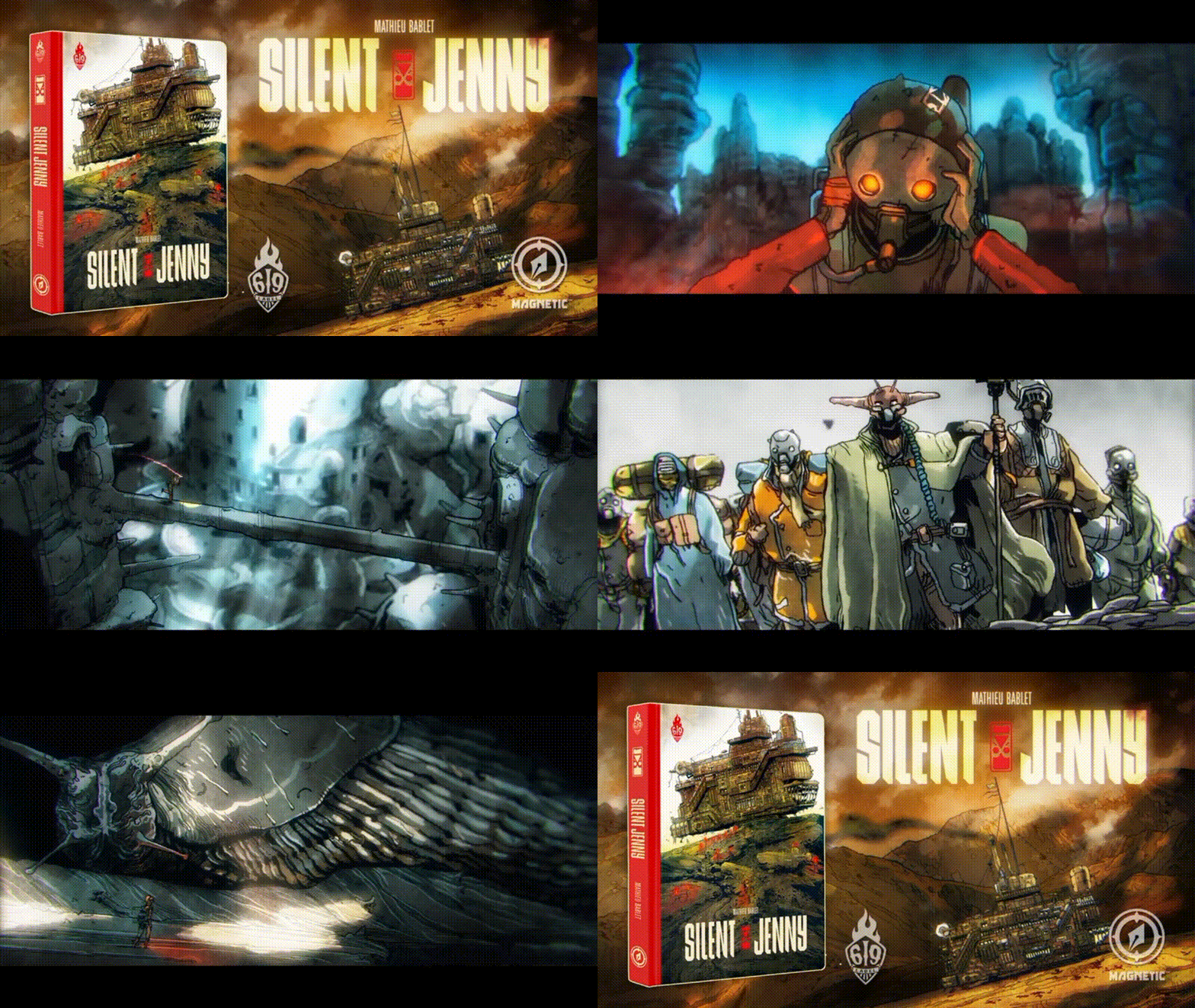
Originally published in France by Rue de Sèvres under the Label 619 banner in October 2025, Silent Jenny is now moving into the American market through a 2026 campaign led by Magnetic Press and presented with Oni Press. That publication history matters, because the book arrives at a moment when the anxieties it dramatises no longer feel speculative.
The FAO and UNEP both document how deeply human food systems depend on pollinators, while the WMO reports that 2015–2025 were the hottest eleven years on record, with 2025 ranking as one of the hottest years ever measured. Silent Jenny turns those converging pressures into a large-scale visual fable about ecological breakdown, technological overreach and the hard work of rebuilding social life after collapse.
What the graphic novel gets right is not a literal forecast that bees will vanish tomorrow and civilisation will end the day after. Its deeper accuracy lies elsewhere: in showing how climate crisis feels when it stops being an abstract policy debate and becomes a lived condition shaped by scarcity, improvisation, grief, mutual aid and failed techno-fixes. Publisher copy, author interviews and French reviews all point to the same idea: this is a post-apocalyptic work that refuses pure nihilism and instead argues that survival depends on learning how to make society differently.
What is Silent Jenny by Mathieu Bablet About?
Silent Jenny is a science-fiction graphic novel set in a future where climate change has ravaged the planet and the disappearance of pollinating insects has rendered huge areas infertile. At the centre of the story is Jenny, a solitary researcher trying to recover bee DNA so pollinating insects can be recreated, only to discover that restoring the old world may be less possible than imagining a new one. Both the French publisher synopsis and the English U.S. description agree on that essential arc: the book begins as a restoration quest and becomes a meditation on collective reinvention.
The novel’s official positioning also matters for how it should be read. The English edition description explicitly frames it as a “world-building book” and as an optimistic response to climate change, while French coverage describes it as the ecological close to Bablet’s futuristic triptych. In other words, Silent Jenny is not simply a disaster narrative. It is a speculative social novel disguised as a quest story.
Silent Jenny Climate-Ravaged Future Explained
The world of Silent Jenny is not a generic wasteland. French coverage describes it as a desertified planet of toxic atmospheres, sterility, corporate towers and roaming settlements, while major reviews add that the landscape is marked by resource scarcity, poisoned environments and constant movement. The result is a setting where ecology, infrastructure and politics are inseparable: survival is a logistical problem as much as a moral one.
That world is also structured by power. Reviews and interviews repeatedly identify the corporate conglomerate Pyrrhocorp as a dominant force, opposed by monad communities whose mobility is both practical and political. Bablet told Le Monde that the book imagines a future in which there has been no real ecological transition and no meaningful brake on extractivist capitalism. That is why the book’s climate-ravaged future feels convincing: it is built less on one apocalyptic event than on the extension of already-familiar systems of exploitation.

Why the Disappearance of Insects Ends Pollination in Silent Jenny
Inside the fiction, the disappearance of insects creates the end of pollination and therefore the collapse of fertility across vast regions. That premise is heightened for dramatic clarity, but it is rooted in real ecological dependence. FAO states that three-quarters of the world’s most productive crop plants depend at least in part on pollinators, and that pollinators affect 35 percent of global crop production by volume. UNEP adds that more than three-quarters of the world’s food crops rely at least partly on animal pollination, and that nearly 90 percent of wild flowering plants do as well.
What Bablet compresses is a complex real-world system. It is not only bees that matter, but a much wider pollinator web that includes butterflies, flies, moths, beetles, birds and bats. UNEP also notes that pollinator decline is driven by interacting pressures such as land-use change, intensive agriculture, pesticides, invasive species, disease and climate change. So the book is not literally right to reduce everything to one disappearing insect, but it is directionally right that pollination is a fragile ecological service and that its degradation would reshape both food security and social organisation.
Silent Jenny Plot Themes: Survival, Isolation, and Rebuilding After Collapse
The dominant themes of Silent Jenny are survival, solitude and reconstruction. Official copy emphasises that Jenny begins from an individual compulsion to restore what has been lost, but comes to understand that “the old world no longer exists” and that collaboration between communities matters more than nostalgia. French criticism extends that reading by calling the book a meditation on endings, survival, community and transmission rather than a simple ecological warning story.
That shift from lonely mission to collective ethics is the book’s emotional spine. In his 2025 interview, Bablet described the project as a way of asking how to “make society” differently, and Le Monde summarised the monad communities as attempts to reconstruct the living world through nomadic micro-societies. Reviews likewise stress that the book becomes more luminous as Jenny moves towards inner peace and social connection. This is why the story feels richer than straightforward collapse fiction: it is less interested in the spectacle of ruin than in the forms of life that might still be built afterwards.
Who is Jenny in Silent Jenny and What is Her Mission?
Jenny is the book’s quiet centre: a taciturn, often isolated figure defined initially by work, duty and persistence. The English publisher copy presents her as a solitary researcher trying to recover bee DNA and revive pollinating insects; French reporting adds that her task is not abstract laboratory work but dangerous field exploration tied to a corporate system and to the extreme risks of the world outside.
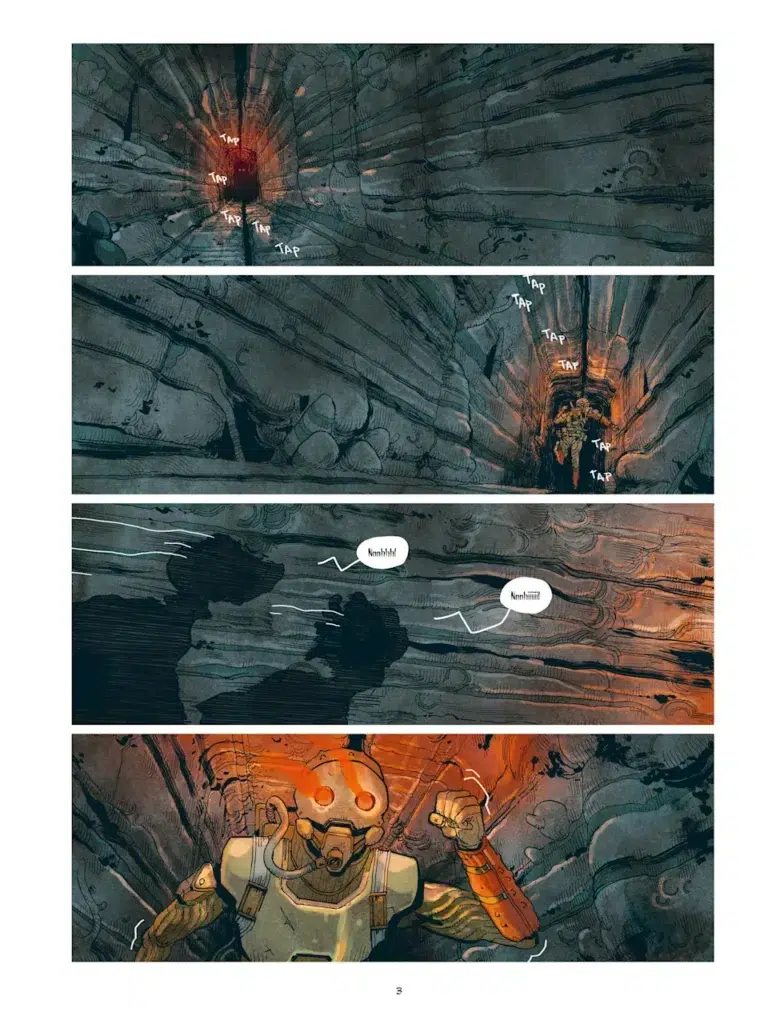
French critical coverage gives an especially useful layer of detail here. BDGest describes Jenny as a “microïde” who shrinks to microscopic scale for perilous missions into the inframonde, the underground micro-world where traces of bee DNA might still be found. That clarification helps explain why her mission feels so physically intense. Jenny is not just a scientist with an idea; she is also an operator whose body is exposed to the consequences of ecological ruin.
Silent Jenny “monads” Explained: the Mobile Island Civilizations
One of the most intriguing parts of the book is the concept of the monads. English retail copy calls them “mobile islands”, campaign materials describe them as “mobile cities”, and the French publisher describes them as motorised village-ships. Taken together, those variations point to the same underlying idea: monads are roaming settlements that are part vehicle, part habitat, part political community. They are not just a cool visual gimmick but the novel’s answer to how people survive on land that can no longer sustain fixed life.
The monads also carry the book’s social philosophy. Bablet told Le Monde that he drew inspiration from self-managed protest zones and eco-communities, especially experiments in establishing life while resisting growth and the effects of capitalism. That makes the monads more than mobile architecture. They are a model of provisional, collective, anti-extractivist citizenship. In Silent Jenny, world-building and political imagination are the same thing.
Silent Jenny Ending Explained (spoiler-Free Analysis)
Without spoiling plot beats, the ending of Silent Jenny is best understood not as a mystery-box reveal but as a philosophical resolution. The story begins with a restoration fantasy: recover the missing biological key, reactivate the old system, and restart the damaged world. The synopsis and critical reception both point instead towards acceptance, cooperation and the recognition that a broken world may require new forms of life rather than a return to the previous one.
That is why the ending lands as emotionally generous rather than merely bleak. French criticism describes the book as becoming brighter as it proceeds, while Bablet’s interview makes clear that he wanted to move beyond empty dystopian warning and towards forward motion. Spoiler-free, the essential point is this: the ending does not reward denial. It rewards adaptation, shared vulnerability and the courage to build in conditions nobody would have chosen. That reading is partly interpretive, but it is strongly supported by the book’s official description, Bablet’s own comments and the critical consensus around the album’s hopeful turn.
Silent Jenny and Climate Fiction: Why it Feels Disturbingly Timely Right Now
Silent Jenny feels timely because the climate background it evokes is already here, even if its endpoint remains fictional. WMO’s 2025 climate report says 2015–2025 were the hottest eleven years on record and that 2025 ranked as the second or third hottest year since modern observations began. FAO and UNEP both stress that pollinators remain essential to food systems, biodiversity and livelihoods, and that their decline is already being driven by several of the same forces Bablet turns into narrative pressure. The novel therefore taps into real contemporary knowledge rather than abstract eco-doom.
The book also feels modern because it understands the appeal and the limitation of technological substitution. Bablet told Le Monde that documentaries about hand-pollinated orchards in China and experiments with drone pollination helped inspire the story’s conceptual core. That is not purely speculative: scholarly work documents hand pollination in Chinese fruit regions under conditions of pollinator decline, and current research groups at universities such as UC Davis and MIT are actively developing robotic or drone-based pollination systems. Silent Jenny therefore gets something very specific right: when ecological systems fail, modern societies often reach first for technical patches before confronting structural causes.

Silent Jenny Graphic Novel Release Date and U.S. Edition Details
The original French edition of Silent Jenny was published on 15 October 2025 by Rue de Sèvres in the Label 619 line. The official French publisher page lists the standard edition at 320 pages, in a 24.2 × 32 cm format, priced at €31.90, and it records several alternate hardcovers released on the same date with the same page count and price.
For U.S. readers, the book’s first American publication is tied to the 2026 English-language rollout. Penguin Random House distributor metadata currently lists the English hardcover as available on 13 October 2026, published by Magnetic Press, at 312 pages, in a 9 × 12 inch format, priced at $34.99. Campaign FAQs also indicate that the standard hardcover will reach retail later than the Kickstarter window, possibly at a higher price point. As of 16 April 2026, those are the clearest U.S. edition details in public distributor and campaign metadata.
Silent Jenny Kickstarter Campaign: How to Back and What You Get
As of 16 April 2026, the live Kickstarter campaign is funded and in progress, with BackerTracker listing the campaign duration as 14 April 2026 to 1 May 2026. The practical way to back it is simple: go to the campaign page, choose a reward tier, and confirm the pledge. Because this is a crowdfunding campaign tied to multiple collectible versions, the most important step is not technical but editorial: read the tier descriptions carefully before backing, because the standard hardcover, the campaign-exclusive slipcase editions and the collector extras are not the same product.
The core offer is the premium hardcover edition, which Kickstarter copy describes as an oversized 9 × 12 inch hardcover with 312 pages printed on heavy uncoated stock. Beyond that, campaign materials identify a limited boxed-sleeve edition featuring a two-part “Monad shell” box, an exclusive Codex Artbook companion filled with concept art and additional lore, and a set of art prints. Separate publicity also confirms a limited resin model of the roaming monad village. Campaign FAQs further state that the limited slipcase edition, the Codex and other bonus items are exclusive to the campaign, while the individual hardcover is expected to arrive at retail later in the year.
One additional practical note matters for backers. The campaign page states that shipping will be calculated later because rates have been fluctuating, so the full final cost is not identical to the initial pledge number alone. Pre-launch promotions by Magnetic Press also advertised a free linen cardstock art print for physical pledges, but because campaigns can update perk language over time, prospective backers should rely on the current live campaign tier text rather than older teaser posts.
Magnetic Press and Oni Press Silent Jenny: Publisher, Format, and Editions
The safest way to describe the publishing arrangement is with some precision. In France, Silent Jenny is a Rue de Sèvres title within Label 619. In the U.S., public-facing campaign announcements present the 2026 launch as a Magnetic Press and Oni Press partnership. However, distributor metadata for the retail English hardcover lists Magnetic Press as the publisher on the ISBN record. That suggests Oni Press is functioning as a campaign and market-facing partner in the American launch, while Magnetic Press remains the formal publishing imprint named in book-trade metadata.
Format-wise, the split is equally clear. The French market currently has a standard hardcover plus multiple alternate-cover hardcovers from the 2025 release. The U.S. market is built around a retail hardcover and several Kickstarter-exclusive collector configurations, including the premium hardcover, a limited boxed-sleeve edition and a trilogy collector set. For readers trying to distinguish “publisher” from “edition”, that is the key distinction: the English text itself is one work, while the available format ladder ranges from ordinary bookstore hardcover to campaign-only collector object.
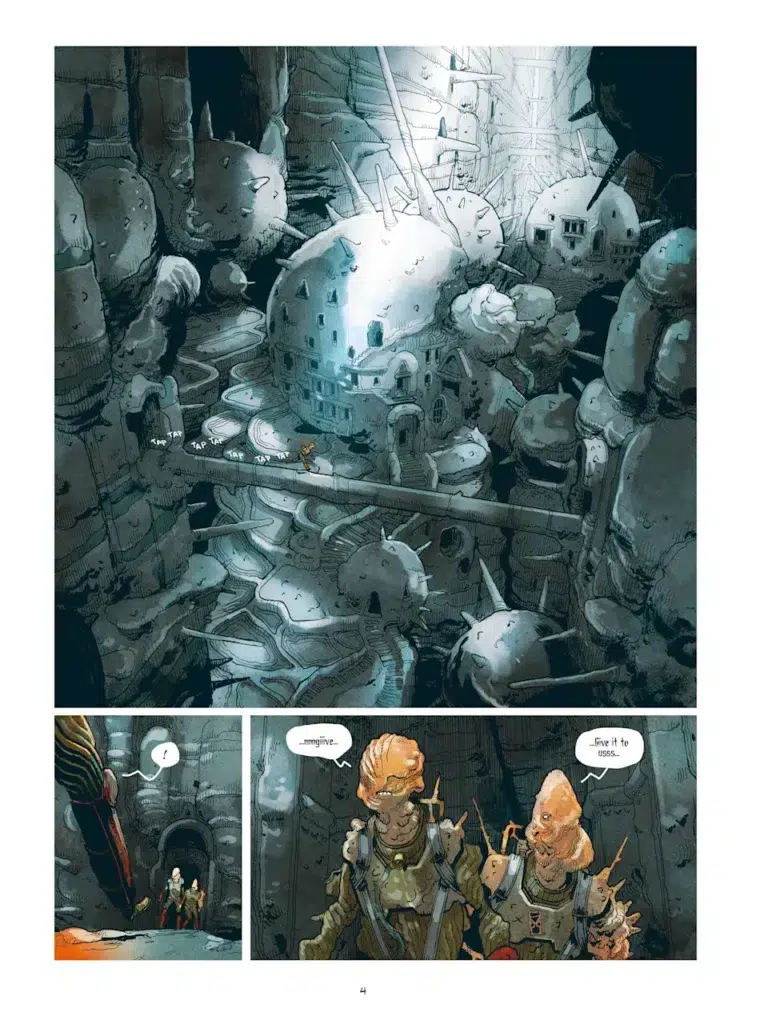
Silent Jenny Deluxe Box Set: What’s Included and Who It’s For
There are really two collector paths in the current campaign, and separating them avoids confusion. One is a Silent Jenny-specific limited boxed-sleeve edition, which includes the premium hardcover plus exclusive extras such as the Codex Artbook and related bonus material. The other is the larger trilogy collector version, which campaign publicity says gathers all three science-fiction books in a single premium presentation.
That larger trilogy set is the true deluxe box set. Kickstarter materials describe new premium editions with quarterbound spines housed inside a campaign-exclusive slipcase, and preview coverage specifies that the set collects Silent Jenny alongside the earlier volumes. It is therefore best suited to three kinds of reader: committed Bablet collectors, first-time English-language readers who want the whole thematic arc at once, and design-minded buyers who value the project as an art object as much as a reading copy. Readers who simply want the story itself can spend much less and still get the core text in the standard hardcover.
Silent Jenny Review: is it Worth Reading?
Yes, Silent Jenny looks worth reading, especially for readers who want ambitious climate fiction in graphic novel form rather than a quick, twist-driven dystopian thriller. French reception has been notably strong. The official Rue de Sèvres page records the book as the winner of the 2026 Libr’à Nous comics prize and notes additional finalist or selection status across several other French awards, including the 2026 selection from France Télévisions. That kind of sustained attention suggests the book has landed as more than a niche auteur release.
The critical case for the book is equally clear. Reviews praise its coherence, atmosphere, world-building and emotional luminosity, while noting that its pacing is deliberate and that Bablet takes time to establish the setting rather than racing towards constant shocks. That means the book will probably reward readers who enjoy immersive speculative fiction, philosophical science fiction and visual density more than readers seeking a straightforward action comic. In that sense, the best short review is this: if the premise sounds arresting and the slower, contemplative approach sounds like a feature rather than a flaw, Silent Jenny is very likely worth the time.
Silent Jenny vs Shangri-La and Carbon & Silicon: How the Trilogy Connects
Bablet and his French critics consistently describe Silent Jenny as the culmination of a science-fiction trilogy, but it is a thematic trilogy rather than a single continuous narrative. In Le Monde, Bablet explains the distinction directly: Silent Jenny follows the space-oriented science fiction of Shangri-La and the robotics- and cyberpunk-leaning future of Carbon & Silicon by turning towards ecological fable. ActuaBD makes the same point, describing the three books as linked symbolic stages in a broader science-fiction project.
What unifies the trilogy is not shared plot mechanics but shared concern. Across all three books, Bablet returns to capitalism, technology, corporate domination, forms of discrimination and the question of what remains recognisably human in broken systems. Magnetic Press’ Carbon & Silicon page likewise describes that earlier volume as a centuries-spanning cautionary tale about ecological, economic and cultural crisis, while the current Silent Jenny campaign frames the new book as asking what remains of our humanity when our tools are gone. The trilogy therefore moves from space systems to machine systems to ecological systems, but always stays focused on the social consequences of modern progress narratives.
Mathieu Bablet’s Art Style in Silent Jenny: World-Building and Visual Storytelling
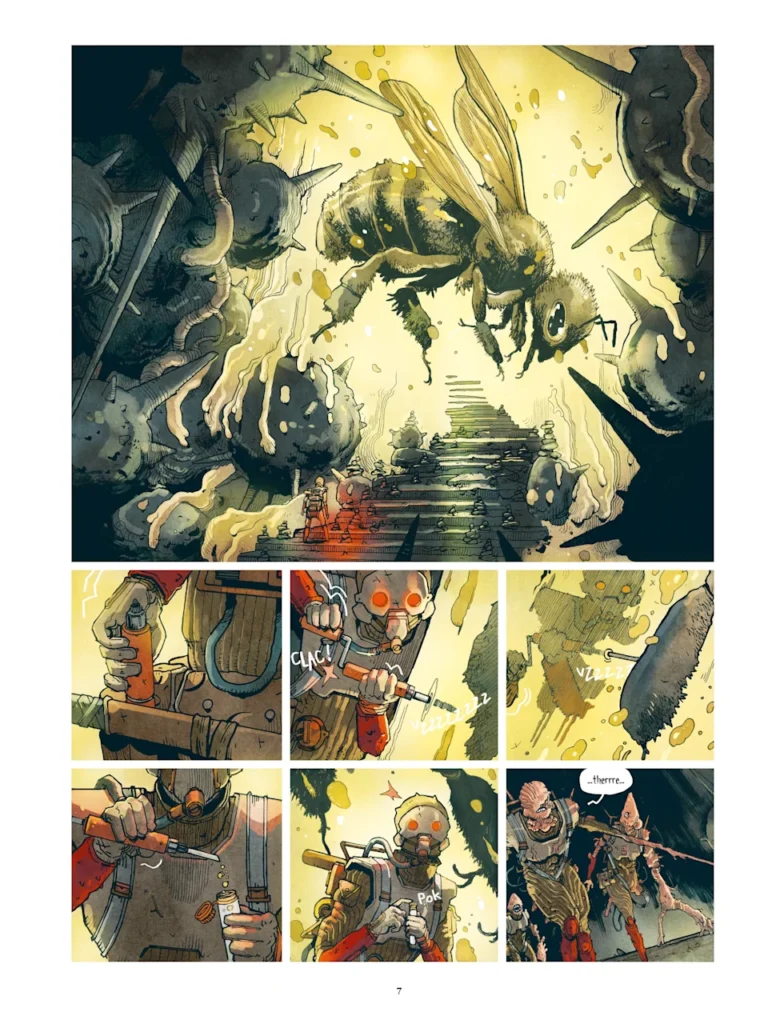
One reason Silent Jenny matters is that Bablet did not simply reuse the formal approach of his earlier books. In his 2025 interview, he said he wanted this time to truly “conceive a world”, and he linked that ambition to seventies French science-fiction artists such as Moebius and Philippe Druillet, to manga traditions, and especially to Nausicaä of the Valley of the Wind.
He also explained that for Silent Jenny he abandoned his previous pencil-contour approach in favour of brush and pen work, later moving into digital processes after the first hundred pages so he could push colour further. He specifically cited dry-brush texture for the mineral world and romantic painting as an influence on the light in some of the double spreads.
Reviewers saw those choices on the page. BDGest praised the ochre palette, the balance of geometric rigour and organic looseness, and the sense that the world remains readable even when the background becomes dense with design information. That is a useful description because it gets at Bablet’s real formal strength. He does not only design machines, ruins and horizons. He makes them narrate. In Silent Jenny, world-building is storytelling, and visual atmosphere carries philosophical meaning just as much as dialogue does.
Frequently Asked Questions (FAQs)
- Is Silent Jenny a standalone graphic novel?
Yes. Although it completes Bablet’s science-fiction trilogy, Bablet himself says the universe of Silent Jenny is distinct from the earlier books, which means it should work as a standalone read. Thematic echoes with the previous titles deepen the experience, but prior reading is not required to follow the plot. - Do you need to read Shangri-La and Carbon & Silicon first?
No, but it helps if the goal is to understand the trilogy as a larger body of work. Shangri-La, Carbon & Silicon and Silent Jenny each address different branches of science fiction, yet they share concerns about capitalism, technology and human futures. - When is the English U.S. edition of Silent Jenny released?
Current distributor metadata lists the English hardcover for 13 October 2026 from Magnetic Press. The Kickstarter campaign is live earlier, and campaign FAQs say the standard hardcover will reach retail later in the year. - Is Kickstarter the only way to get Silent Jenny in English?
No. Campaign FAQs say the individual hardcover is expected to go to retail later, possibly at a higher price. What Kickstarter uniquely offers are the collector extras, including the exclusive slipcase, Codex and other bonus items. - What is the difference between the standard hardcover and the campaign-exclusive editions?
The standard English edition is the retail hardcover. Campaign-exclusive editions add premium presentation and collector materials such as the boxed-sleeve version, Codex Artbook, art prints, limited slipcase formats and, in some cases, the trilogy collector treatment. - Is Silent Jenny hopeful or bleak?
It is both, but it clearly bends towards hope. The setting is harsh and the premise is catastrophic, yet the official copy stresses mutual aid and collaboration, and multiple reviews describe the book as becoming more luminous rather than more nihilistic. - How scientifically plausible is the pollinator-collapse premise?
The book exaggerates the endpoint for narrative force, but the ecological dependency is real. FAO and UNEP both say pollinators are vital to crops and wild flowering plants, and UNEP links pollinator decline to land-use change, agriculture, pesticides, invasive species, disease and climate change. - What are monads in simple terms?
They are roaming settlements: part city, part machine, part survival community. Depending on the source, they are described as mobile islands, mobile cities or motorised village-ships, but all three labels point to the same concept. - Is the original French edition already available?
Yes. The official French publisher page lists the standard edition as released on 15 October 2025 and available, along with several alternate hardcovers from the same date. - Who should buy the deluxe trilogy box set?
It is best for collectors, design-focused readers and newcomers who want all three English-language science-fiction books in one premium presentation. Readers who only want the story itself can safely choose the regular hardcover instead.
Conclusion
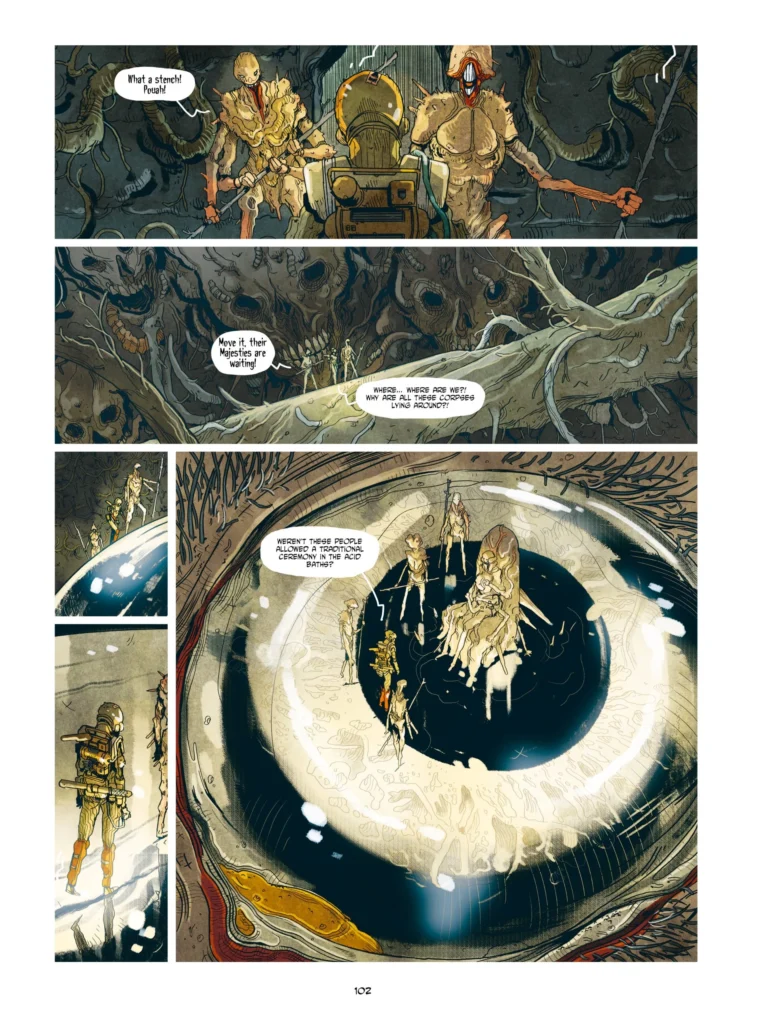
Silent Jenny stands out because it turns climate anxiety into something larger and more interesting than warning-sign fiction. It understands that ecological collapse is not only about weather, insects or barren land. It is also about social form: who controls infrastructure, whose solutions count, how communities move, and whether people can accept that the future will not be a repaired version of the past. That is what makes it disturbingly timely. It is not merely a comic about disaster. It is a comic about adaptation after faith in the old system has failed.
For readers interested in climate fiction, European graphic novels, or the best kind of speculative world-building, the book’s importance lies in its balance. It is visually grand without losing intimacy, political without becoming schematic, and bleak enough to be honest while still insisting on solidarity and motion. In a cultural moment saturated with apocalyptic imagery, Silent Jenny feels fresh because it argues that survival is not only technical. It is communal, emotional and moral.
Sources and Citations
- Official Rue de Sèvres catalogue page confirming French edition details.
https://www.ruedesevres.fr/catalogue/renaissance - Penguin Random House distributor metadata confirming U.S. release date, ISBN, price, format, and page count.
https://www.penguinrandomhouse.com/books/renaissance - Kickstarter campaign page verifying campaign window, exclusive editions, and collector content.
https://www.kickstarter.com/projects/renaissance-graphic-novel - BackerTracker campaign page confirming live campaign status and tracking details.
https://www.backerkit.com/projects/renaissance-graphic-novel - ActuaBD interview source covering trilogy context, themes, and author insights.
https://www.actuabd.com/Renaissance-interview - Livres Hebdo review source covering critical reception and awards context.
https://www.livreshebdo.fr/article/renaissance-graphic-novel-review - IPBES report grounding pollination dependence and pollinator decline claims.
https://www.ipbes.net/pollinators - FAO resource on pollination and agriculture context.
https://www.fao.org/pollination - Nature research publication supporting pollination science context.
https://www.nature.com/articles/pollination-research - Harvard University reporting on robotic pollination research.
https://news.harvard.edu/gazette/story/pollination-robots-research
Recommended
- Life Is Strange TV Show Adds a Veteran Emmy-Nominated Director: Karyn Kusama to Helm Prime Video’s First Episodes
- How to Create a Metahuman of Yourself: Turn Your Likeness Into a Digital Character in Unreal Engine 5
- How do I create a depth map using the Blender camera?
- Clair Obscur: Expedition 33 – Sales Milestones, Developer Insights, and Community Reactions
- Intergalactic: The Heretic Prophet – Release Date, Story, Cast, Gameplay, and Everything We Know
- All katsu curry recipes in Romeo Is a Dead Man: complete list, ingredients, buffs, and how to unlock them
- TANGLED Framework: Diffusion-Based 3D Hair Strand Generation with MultiHair and PixelHair Integration
- Can You Change the Focal Length of a Camera in Blender?
- Can you zoom the camera in Blender?
- After Johnny Cage, Karl Urban Wants To Play Red Dead’s John Marston What It Means for a Red Dead Redemption Movie