


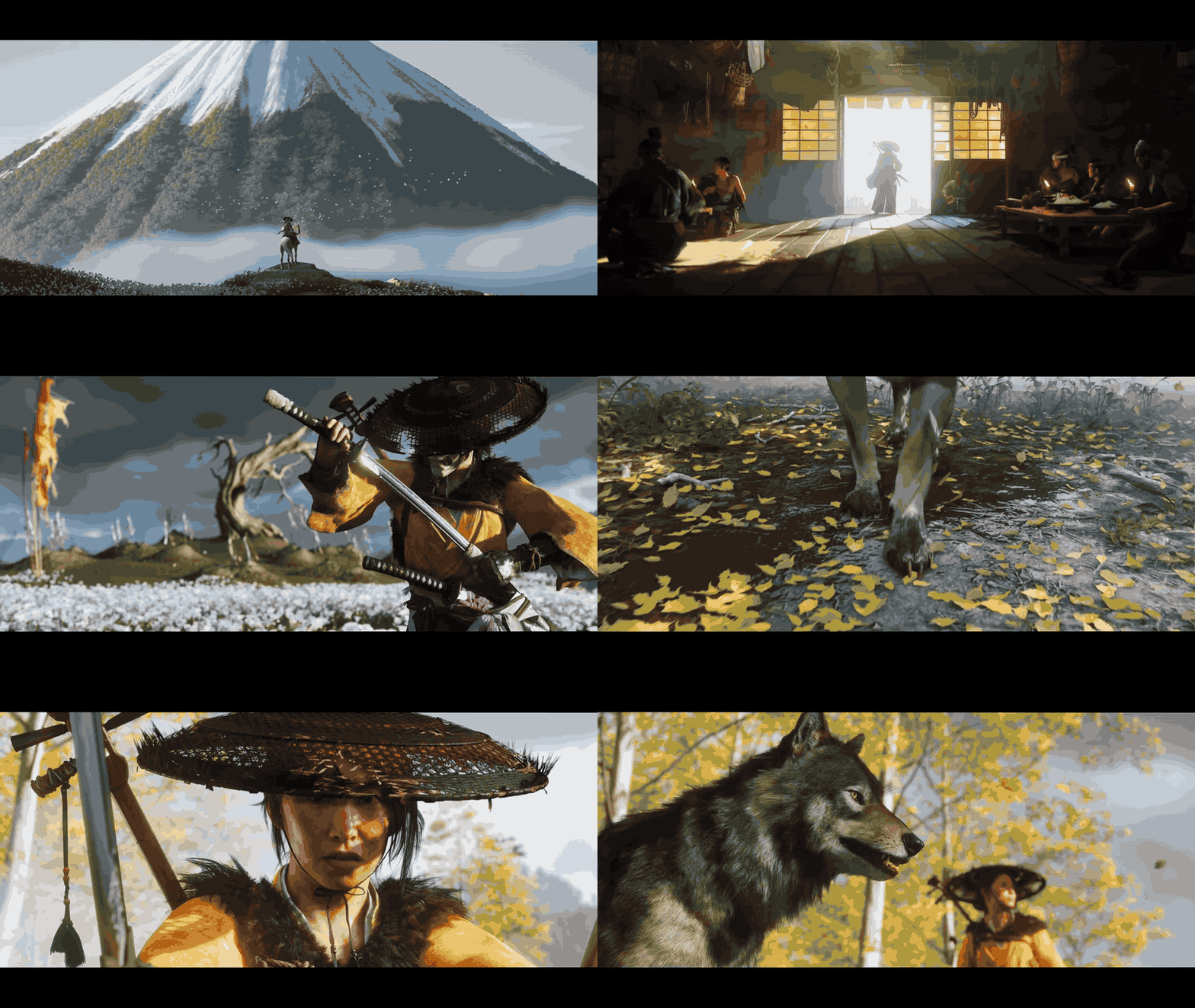
Ghost of Yōtei Cut Features Confirmed by Sucker Punch
During development, the team prototyped several ambitious concepts that were ultimately scaled back or removed:
- Dual-Timeline Gameplay: The ability to switch between young and old Atsu, requiring two parallel versions of the world (spring and winter) to exist simultaneously.
- Breath of the Wild-Style Climbing: A free-climbing system allowing Atsu to scale almost any surface.
- Diegetic World Map: A physical in-game object held by the character rather than a HUD menu.
- Rotating Map Feature: A map that would spin in Atsu’s hands to match her real-world orientation.
- Expanded Arsenal: Weapons like dual hatchets, shields, and war fans.
- Larger World Map: Two additional regions that were planned but cut due to time constraints.

Ghost of Yōtei Scrapped Climbing Mechanic
The developers initially tested a vertical traversal system inspired by The Legend of Zelda: Breath of the Wild. This prototype allowed Atsu to climb any cliff or building without preset grab points, promising total freedom in exploring Hokkaido’s rugged terrain.
Why Ghost of Yōtei Removed Breath of the Wild Style Climbing
The system was removed because it introduced significant balance and level design issues. Unrestricted climbing allowed testers to bypass intended challenges and sequence-break the story. Sucker Punch opted instead for a “curated” approach:
- Visual Cues: Climbing is restricted to specific rock faces marked with white stone (narratively explained as bird droppings).
- Controlled Progression: This ensures players engage with designed content rather than accidentally bypassing it.
Ghost of Yōtei Dual Timeline System Explained
One of the most complex scrapped ideas involved a dual timeline where players could toggle between Atsu at age 16 and her present self in 1603. This would have fundamentally altered the environment and available skills based on her age.
Ghost of Yōtei Multiple Worlds Concept Explained
This feature required building two complete open-world maps on top of each other—one for spring and one for winter. Sucker Punch directors admitted this was “far too big” to be feasible for the PlayStation 5’s memory and performance limits. The concept was eventually scaled back into scripted flashbacks, allowing players to experience Atsu’s past without the burden of two persistent open worlds.
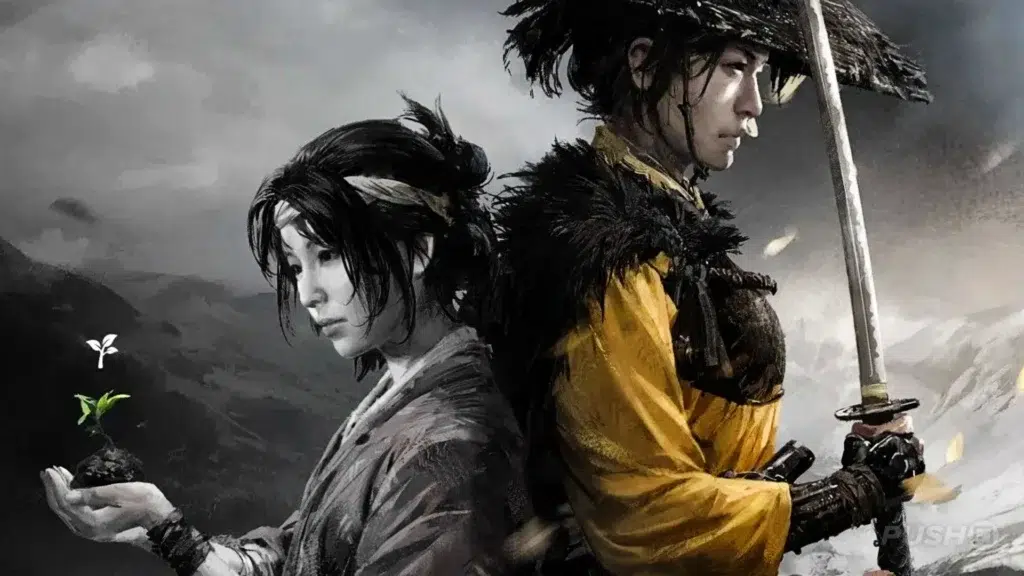
Ghost of Yōtei Diegetic Map System Explained
Sucker Punch experimented with a fully diegetic map to increase immersion. Players would see Atsu physically pull out a parchment scroll.
- Interactive Elements: The map was intended to show real-time weather effects, such as raindrops landing on the parchment.
- Manual Assembly: Players would find map fragments in the world and physically place them to reveal new regions.
Ghost of Yōtei Rotating Map Feature Explained
A subset of the diegetic map was a feature where the scroll would rotate to match the direction Atsu was facing. This was cut because it was disorienting and induced motion sickness in testers. The final game retains the “hand-drawn” aesthetic and the map-fragment collection but uses a traditional, static menu for navigation.
Why Sucker Punch Cut Major Ghost of Yōtei Ideas
The decision to trim these features came down to three factors:
- Scope Management: The studio (approx. 150 developers) chose to focus on quality over sheer quantity.
- Institutional Knowledge: Lessons from Ghost of Tsushima taught the team that a feature must serve the core vision to be worth the resources.
- Positive Editing Culture: The team held meetings to “celebrate” cut decisions, viewing the removal of a feature as a step toward a more polished final product.
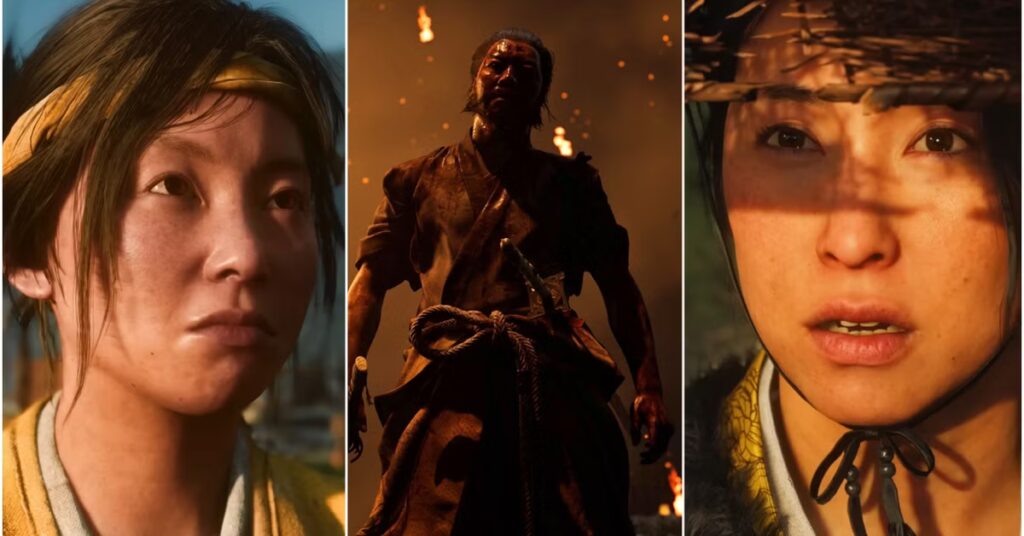
How Cut Content Changed Ghost of Yōtei Gameplay
The final version of the game was significantly shaped by these subtractions:
- Traversal: Exploration became more puzzle-like, requiring players to find specific paths rather than scaling walls at random.
- Story Delivery: The narrative became tighter and more linear, using cinematic flashbacks instead of interactive time-jumping.
- World Density: By removing two regions, the remaining map around Mount Yōtei became denser with high-quality content.
- Combat: The arsenal was narrowed to a set of highly tuned weapons (like the ōdachi and chain-sickle) rather than a vast, unbalanced variety.
How Ghost of Yōtei’s Final Version Differs From Early Concepts
| Feature | Early Concept | Final Version |
| Timelines | Interactive switching between two eras | Linear story with scripted flashbacks |
| Climbing | Climb any surface (unrestricted) | Guided climbing on white-marked rocks |
| Map | Rotating, physical object held by character | Static, stylized menu with diegetic art |
| Weapons | Dual hatchets, fans, shields, kanabo | Odachi, dual katanas, spears, chain-sickles |
| World | Sprawling, multi-island Ezo | Focused map centered on Mount Yōtei |
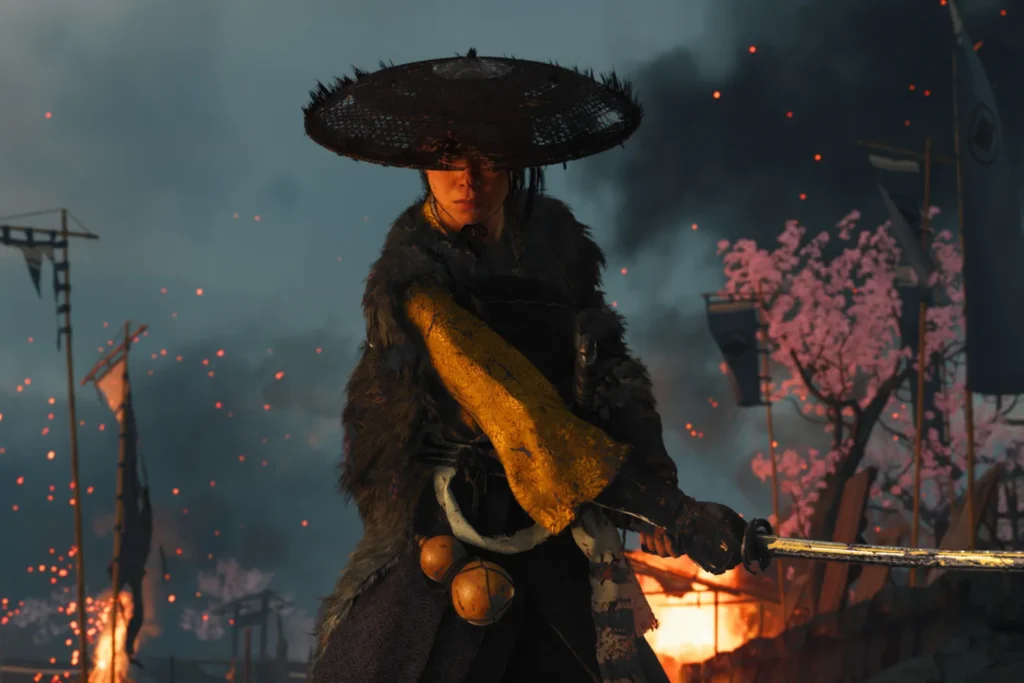
What Ghost of Yōtei’s Cut Content Reveals About Sucker Punch’s Design Philosophy
The development of Ghost of Yōtei highlights a philosophy of “addition by subtraction.” Sucker Punch prioritizes the player’s comfort and the game’s core emotional arc over technical showmanship. By dreaming big and then refining ruthlessly, they ensure that every mechanic in the final release is polished, intentional, and cohesive. the player’s experience and the game’s overall cohesion over any one feature. By analyzing what they chose to remove and why, we can appreciate the craftsmanship that went into Ghost of Yōtei. It serves as a reminder that sometimes saying “no” to a feature is what allows a game’s primary strengths to shine.
Frequently Asked Question (FAQs)
- Is Ghost of Yōtei a sequel to Ghost of Tsushima?
Yes. It is a standalone sequel set in 1603, approximately 29 years after the events of the first game. It features a new protagonist and region, allowing it to tell a self-contained story that does not require players to have recently played the original. - Who is the main character in Ghost of Yōtei?
The protagonist is Atsu, a female mercenary seeking vengeance against the “Yōtei Six,” a group of renegade samurai who slaughtered her family 16 years prior. She adopts the persona of an onryō (vengeful spirit) to hunt them across the Ezo (Hokkaido) region. - What major features were cut from Ghost of Yōtei during development?
Sucker Punch confirmed several ambitious cuts:- A dual-timeline system involving young and old versions of Atsu.
- A free-climbing mechanic similar to Breath of the Wild.
- A fully diegetic, rotating physical world map held by the character.
- Additional weapons including dual hatchets, a shield, and war fans.
- Two extra regions of the open world.
- Why didn’t Ghost of Yōtei include a Breath of the Wild-style climbing system?
Testing revealed that unrestricted climbing undermined the game’s balance and level design by allowing players to bypass intended challenges and chokepoints. To preserve the designed structure of exploration, climbing was restricted to specific surfaces marked by white rock outcroppings. - What was the dual-timeline feature planned for Ghost of Yōtei?
This feature would have allowed players to switch instantly between two eras: Atsu’s past (spring) and her present (winter). It was intended for puzzle-solving and witnessing environmental changes over time. It was removed because building two fully realized versions of the same map was deemed too massive a task; the final game uses traditional flashbacks instead. - How does the map work in Ghost of Yōtei? Is it really diegetic (in-world)?
While accessed via a menu, the map retains diegetic elements: it appears hand-drawn by Atsu, and players must manually place discovered map pieces. The original plan for a rotating, physical map held by Atsu was scrapped for being disorienting. The game maintains immersion by using natural cues like wind and animals for navigation instead of a mini-map or heavy HUD. - Are there any weapons that got removed from Ghost of Yōtei?
Yes. Dual hatchets, a samurai shield, and iron war fans were removed after the team determined combat depth could be achieved more effectively with other tools. A heavy Kanabo club was also redesigned into an Ōdachi greatsword. The final arsenal features katanas, spears, chain-sickles, bows, and firearms. - How large is Ghost of Yōtei’s open world and were any areas cut?
The final world is comparable in size to Tsushima Island. Although two additional regions were originally planned, they were cut to ensure the reachable map remained dense and detailed. Some inaccessible distant territories remain visible on the map as remnants of these original plans. - Does Ghost of Yōtei have a multiplayer mode like Legends in Ghost of Tsushima?
Yes. Ghost of Yōtei: Legends was released in March 2026 as a free update. It includes two-player co-op story missions and four-player survival modes featuring new enemies and supernatural scenarios inspired by the Yōtei setting and Japanese mythology. - What do the cut content and changes tell us about Sucker Punch’s approach to game design?
The process reveals a philosophy that prioritizes quality and cohesion over unchecked ambition. Sucker Punch prototyped high-boundary ideas but pragmatically removed features that hindered gameplay or exceeded scope. This approach focuses on delivering a polished, immersive core experience by refining or trimming any elements that might dilute the final product.

Conclusion
The journey of Ghost of Yōtei from conception to final product is a fascinating study in game development choices. For every feature that dazzles players in the final game, there were other bold ideas left on the cutting room floor. By exploring the cut content of Ghost of Yōtei, we gain a deeper appreciation for the game we got – and how close it came to being a very different experience.
Features like free-form climbing, dual timeline world-switching, and a fully diegetic rotating map all sounded great in theory, but each was removed with good reason. In their absence, Ghost of Yōtei was able to focus on what it does best: delivering a compelling open-world samurai adventure with a high level of polish and purposeful design.
These cuts also shed light on Sucker Punch’s development philosophy. The studio demonstrated that restraint and refinement are just as important as innovation. Rather than force every cool idea into the game, they made tough calls to remove or scale back features that didn’t serve the final vision. The result speaks for itself – Ghost of Yōtei was well-received as a worthy successor to Ghost of Tsushima, praised for its gripping story, rewarding exploration, and evolved combat. Many of those positives were achieved because the game’s scope was kept manageable and its features cohesive.
In the end, the “ghosts” of Yōtei’s cut content still haunt the game in subtle ways – a flashback here, an inaccessible mountaintop there, a map that feels hand-crafted – reminding us of what might have been. But rather than lamenting what was lost, we can admire how those ambitious ideas inspired the developers to find creative solutions that enhanced the game. Ghost of Yōtei as released is a stronger, more focused experience precisely because Sucker Punch dared to dream big and dared to trim those dreams into a shape that players could fully enjoy. The cuts were not errors, but intentional edits that ultimately allowed Ghost of Yōtei to become the excellent game that it is.
Sources and Citation
- GameSpot – “From Zelda-Like Climbing To Multiple Worlds: The Cut Content Of Ghost Of Yotei”, by Aron Garst (March 12, 2026).
https://www.gamespot.com/articles/from-zelda-like-climbing-to-multiple-worlds-the-cut-content-of-ghost-of-yotei/1100-6538760/ - GameSpot – Cut content of Ghost of Yotei (GDC 2026 talk coverage, continued).
https://www.gamespot.com/articles/from-zelda-like-climbing-to-multiple-worlds-the-cut-content-of-ghost-of-yotei/1100-6538760/ - GameSpot – Cut content of Ghost of Yotei (on cut areas and design process).
https://www.gamespot.com/articles/from-zelda-like-climbing-to-multiple-worlds-the-cut-content-of-ghost-of-yotei/1100-6538760/ - GameSpot – “Ghost Of Yotei Is Making You Touch Bird Poop Over And Over Again”, by Gabe Gurwin (Oct 29, 2025).
https://www.gamespot.com/articles/ghost-of-yotei-is-making-you-touch-bird-poop-over-and-over-again/1100-6535794/ - PlayStation Universe – “Ghost Of Yotei Dev Favours A Clean Screen Without…Mini-Maps”, by Michael Harradence (Oct 9, 2025).
https://www.psu.com/news/ghost-of-yotei-dev-favours-a-clean-screen-without-filling-it-with-mini-maps-and-infamous-yellow-paint/ - Wikipedia – Ghost of Yōtei (overview of sequel status and protagonist/story background).
https://en.wikipedia.org/wiki/Ghost_of_Y%C5%8Dtei - Wikipedia – Ghost of Yōtei (Legends multiplayer mode release information).
https://en.wikipedia.org/wiki/Ghost_of_Y%C5%8Dtei - GameSpot – Cut content of Ghost of Yotei (on climbing mechanic and why it was limited).
https://www.gamespot.com/articles/from-zelda-like-climbing-to-multiple-worlds-the-cut-content-of-ghost-of-yotei/1100-6538760/ - GameSpot – Cut content of Ghost of Yotei (on diegetic map details and adjustments).
https://www.gamespot.com/articles/from-zelda-like-climbing-to-multiple-worlds-the-cut-content-of-ghost-of-yotei/1100-6538760/ - GameSpot – Cut content of Ghost of Yotei (on weapons evolution, odachi vs kanabo).
https://www.gamespot.com/articles/from-zelda-like-climbing-to-multiple-worlds-the-cut-content-of-ghost-of-yotei/1100-6538760/
Recommended
- Pokemon Pokopia Withered Wastelands Guide: How To Increase The Humidity, Trigger Rain, And Rescue Onix
- Control Resonant Gameplay Trailer Shows New Enemies, Abilities and Everything We Know So Far
- What is the “Lock Camera to View” feature in Blender?
- Pokémon Pokopia Update Coming: New Bug Fixes, Progression Issues, and Patch Details
- When Is PS6 Coming Out, How Much Will the PS6 Cost, and Will PS6 Be Backwards Compatible? (2026 Update)
- Your Guide to Making 3D Models for 3D Printing
- How do I render from a specific camera in Blender?
- Nipsey Hussle’s Braids: A Symbol of His Legacy
- The Ultimate Guide to the Most Popular Black Hairstyle Options
- How to Modify MetaHuman: A Comprehensive Guide