






In This Article (24 sections)
The Expanse Books in Order
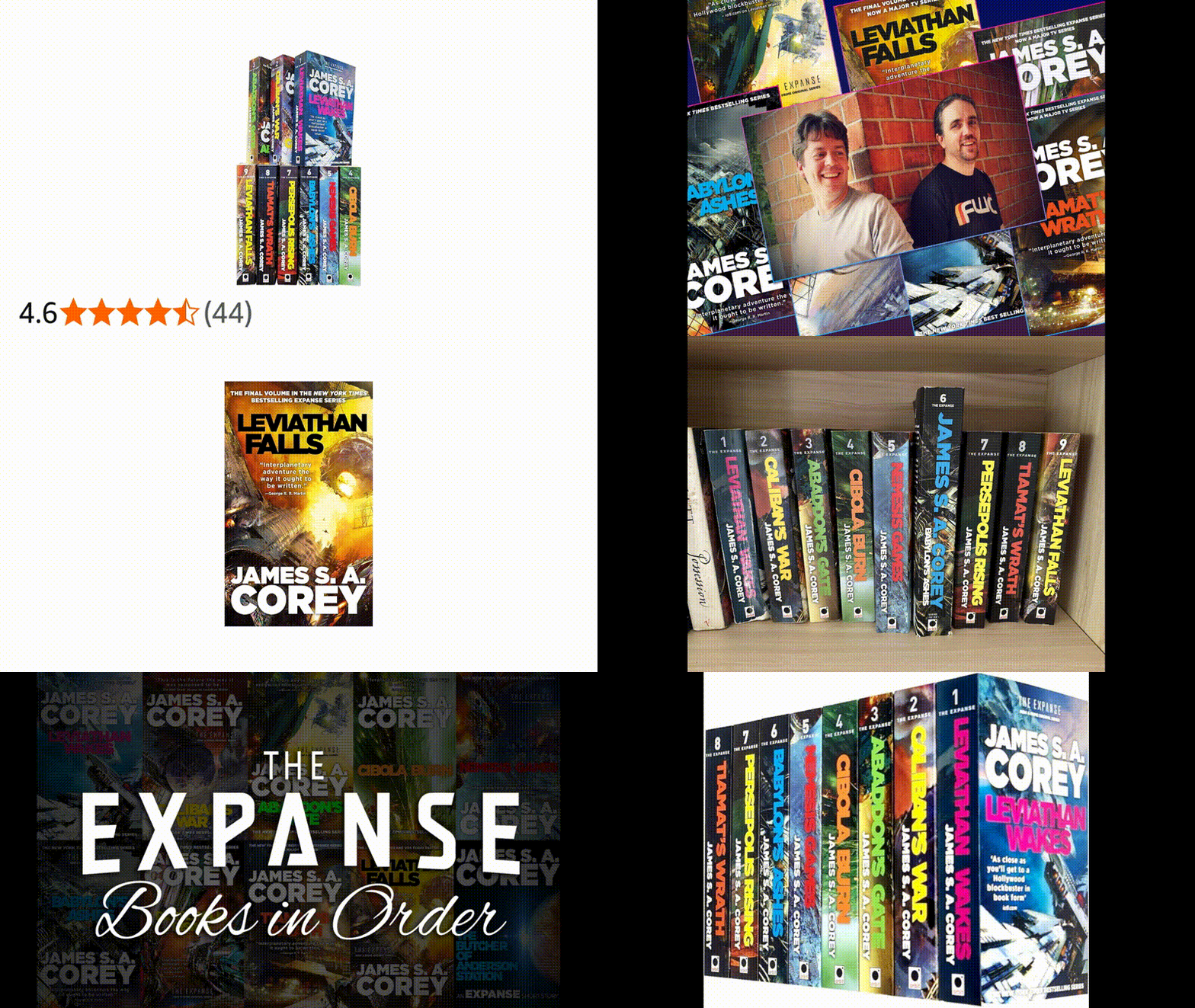
The Expanse is a space-opera series written by James S. A. Corey, the pen name for Daniel Abraham and Ty Franck. The saga includes nine main novels and several shorter works, focusing on interplanetary politics, alien technology, and human drama.
The Expanse Books Reading Order for First-Time Readers
The recommended approach for new readers is publication order, which matches the narrative sequence of the main story. The nine core novels are already in chronological order. Shorter stories are optional on a first read but can enrich the experience. The authors recommend release order to maintain the intended pacing and avoid spoilers.
The Expanse Books Publication Order
The series was released between 2011 and 2022. The full publication order including novels and short fiction is:
- Leviathan Wakes – Book 1 (2011)
- The Butcher of Anderson Station – Short story (2011)
- Caliban’s War – Book 2 (2012)
- Gods of Risk – Novella (2012)
- Drive – Short story (2012)
- Abaddon’s Gate – Book 3 (2013)
- The Churn – Novella (2014)
- Cibola Burn – Book 4 (2014)
- Nemesis Games – Book 5 (2015)
- The Vital Abyss – Novella (2015)
- Babylon’s Ashes – Book 6 (2016)
- Strange Dogs – Novella (2017)
- Persepolis Rising – Book 7 (2017)
- Tiamat’s Wrath – Book 8 (2019)
- The Last Flight of the Cassandra – Short story (2019)
- Auberon – Novella (2019)
- Leviathan Falls – Book 9 (2021)
- The Sins of Our Fathers – Novella/short (2022)
- Memory’s Legion – Collection of short stories (2022)

The Expanse Books Chronological Order
The in-universe timeline starts about 150 years before the first novel with “Drive,” followed by prequels “The Churn” and “The Butcher of Anderson Station.” The sequence then follows the nine novels, with novellas like “Gods of Risk,” “The Vital Abyss,” “Strange Dogs,” and “Auberon” interspersed. The timeline concludes with the epilogue “The Sins of Our Fathers.” This order is recommended for re-reads rather than first-timers to avoid spoilers.
How Many the Expanse Books Are There
The series consists of 18 total pieces of prose: 9 full-length novels and 9 shorter works (novellas and short stories). Most short fiction is collected in the volume Memory’s Legion.
The Expanse Novels List (All Main Books)
- Leviathan Wakes: Introduces the Rocinante crew and the protomolecule threat.
- Caliban’s War: Focuses on war on Ganymede and introduces Bobbie Draper and Chrisjen Avasarala.
- Abaddon’s Gate: Concerns the Ring Gate and the “slow zone.”
- Cibola Burn: Set on the frontier planet Ilus.
- Nemesis Games: Features the rise of the Free Navy as the crew separates.
- Babylon’s Ashes: A system-wide war against the Free Navy.
- Persepolis Rising: Set 30 years later, involving the rise of the Laconian Empire.
- Tiamat’s Wrath: The war against Laconia and ancient alien threats.
- Leviathan Falls: The series finale resolving the fate of humanity and the aliens.

The Expanse Novellas and Short Stories List
The shorter works include “Drive” (prequel), “The Churn” (Amos’s backstory), “The Butcher of Anderson Station” (Fred Johnson’s past), “The Last Flight of the Cassandra” (RPG story), “Gods of Risk” (Mars setting), “The Vital Abyss” (Protogen scientists), “Strange Dogs” (Laconia setup), “Auberon” (Laconian occupation), and “The Sins of Our Fathers” (post-finale epilogue).
Memory’s Legion Expanse: What it is and When to Read It
Memory’s Legion is a 2022 collection of all short fiction except “The Last Flight of the Cassandra.” It includes author notes and the exclusive final story “The Sins of Our Fathers.” It is best read after finishing all nine novels to avoid spoilers.
Do You Have to Read the Expanse Novellas Between the Novels
No, the novellas are optional. They flesh out backstories and side events but are not required to understand the main plot. “Strange Dogs” and “Auberon” provide the most direct context for the final trilogy.
Where to Start Reading the Expanse Books If You Watched the TV Show
Fans can start with Book 1 for extra depth or pick up at Book 7 (Persepolis Rising) to continue the story where the show ended. While the show is faithful, there are character differences, such as the character Drummer being a combination of several book characters.

The Expanse Books vs TV Series Differences
Differences include character consolidations (notably Drummer), altered fates (Alex Kamal survives in the books but dies in the show), and pacing adjustments. The show also omits the final three books’ story arc.
Which Expanse Book Does the TV Show End On
The TV show ends at the conclusion of Book 6, Babylon’s Ashes. It includes some teaser elements from the Strange Dogs novella but does not adapt the final three novels.
The Expanse Books After Season 6: What to Read Next
To finish the story, read Books 7, 8, and 9 (Persepolis Rising, Tiamat’s Wrath, and Leviathan Falls). These cover the Laconia arc. A comic series titled “The Expanse: Dragon Tooth” also exists to bridge the gap between Season 6 and Book 7.
Are the Expanse Books Finished (Is the Series Complete)
Yes, the series is complete. The authors planned a nine-book arc and finished it with Leviathan Falls in 2021. There are no current plans for a Book 10 or a sequel series.

James S. A. Corey the Expanse: Who Wrote the Books
James S. A. Corey is a pen name for Ty Franck and Daniel Abraham. Franck created the setting and world details, while Abraham contributed structure and novel-writing craft. They collaborate on every stage of the writing process.
The Expanse Audiobooks in Order
All novels and short stories are available as audiobooks. Jefferson Mays narrates the entire series, providing a consistent voice. The total series is over 180 hours long.
The Protomolecule in the Expanse Books
The protomolecule is an alien bioengineered substance created by an advanced civilization known as the Ring Builders. Launched toward Earth 2.5 billion years ago to hijack its biosphere, it was instead captured by Saturn’s gravity and remained frozen on the moon Phoebe. Upon its discovery and activation by humans in the 23rd century, the protomolecule began infecting and repurposing organic biomass—most notably on Eros Station—to fulfill its programmed purpose.
Initially perceived as a viral weapon, its true function was to construct a transportation network called the Ring Gates. The substance is semi-sentient, capable of molecular reconfiguration and data gathering, often using human “investigators” like Miller to function. While it serves as a “construction foam” for alien technology, its activation ultimately leads to a cosmic conflict involving the unknown entities that destroyed the Ring Builders.

Ring Gates in the Expanse Books Explained
The Ring Gates are wormholes built by the protomolecule that enable near-instantaneous travel between star systems. The first gate, the Sol Ring, appeared near Uranus and leads to the “Slow Zone,” an extradimensional hub containing a central Ring Station and over 1,300 portals to different systems. The network functions as a cosmic subway system, though the Station enforces a strict speed limit (approximately 600 m/s) to prevent catastrophic energy releases.
The opening of these gates triggered a massive colonization “gold rush,” shifting human politics and leading to the formation of the Transport Union. However, using the gates carries significant risks, as certain actions or high-traffic levels attract “unknown aggressors” from another dimension that can cause ships to disappear during transit.
Best Expanse Book to Start with (if You Don’t Want to Read All of Them)
Leviathan Wakes (Book 1) is the definitive starting point. It introduces the core crew of the Rocinante and Detective Miller while establishing the central protomolecule mystery through a blend of noir and space adventure. Because the series is a continuous narrative, reading it first provides essential context and world-building that would be lost if starting later. While it is part of a nine-book arc, it offers a satisfying, contained climax for those who only want to sample the series.
Books Like the Expanse (what to Read After the Expanse Books)
Several series offer similar themes for fans of The Expanse:
- Revelation Space (Alastair Reynolds): Focuses on ancient alien mysteries and gritty space opera.
- The Forever War (Joe Haldeman): Explores realistic military combat and the effects of relativistic travel.
- The Long Way to a Small, Angry Planet (Becky Chambers): Emphasizes “found family” crew dynamics and character relationships.
- A Memory Called Empire (Arkady Martine): Deeply explores interstellar political intrigue and diplomacy.
- Ancillary Justice (Ann Leckie): Features a protagonist that is a former starship AI within a complex empire.
- Children of Time (Adrian Tchaikovsky): Covers grand-scale terraforming and the evolution of alien intelligence.
- The Culture series (Iain M. Banks): Depicts a high-tech, post-scarcity society and its moral conflicts.
- Red Rising (Pierce Brown): A fast-paced series centered on solar system warfare and a rigid class hierarchy.

Frequently Asked Questions (FAQs)
Below are answers to some frequently asked questions about The Expanse books:
- How many books are in The Expanse series?
There are 9 main novels in The Expanse series, plus a number of shorter works (novellas and short stories). The nine novels run from Leviathan Wakes (Book 1) to Leviathan Falls (Book 9). In addition, there are nine Expanse novellas/short stories (most collected in Memory’s Legion), making a total of 18 pieces of fiction. The main story, however, is told across the 9 full-length books. - Is The Expanse book series finished?
Yes, the series is complete. The authors planned nine books and concluded the saga with Leviathan Falls in 2021. There are no current plans for a tenth novel. The final publication was Memory’s Legion (2022), a short story collection that included one new epilogue story. So readers can enjoy the series knowing it has a real ending and no lingering unfinished installments. - Do I need to read The Expanse novellas for the story to make sense?
No, the novellas are optional side stories. The main novels contain the full storyline. The novellas/short stories provide extra background, character backstories, or side adventures (e.g., Amos’s past in The Churn, or how the Ring builders’ tech works in Strange Dogs). They enrich the experience but are not required to follow the plot. You won’t be lost if you skip them, especially on a first read. You can always read them later if you’re curious. - What’s the best order to read The Expanse books?
The best order is publication order, which is also the chronological order of the main novels. In other words, read Books 1 through 9 in sequence. If you want to include novellas, you can slot them in according to release (or timeline) between the novels, but for first-time readers it’s fine to read all the novels first and then the short stories. The authors recommend publication order (with or without shorts) for the intended experience. - I watched all 6 seasons of the TV show – can I start the books at Book 7?
You can, since the show covers Books 1–6 pretty faithfully. Book 7 (Persepolis Rising) is the next story after the show’s finale. Jumping in there will let you continue the story beyond the TV series (which ended with the events of Book 6). However, be aware you might miss some nuances and minor differences from earlier books. Many fans still suggest reading from Book 1 eventually, but if your main goal is to see what happens after the show, start at Book 7 and read 7–9. - Which book does Season 6 of the show correspond to?
Season 6 of The Expanse aligns with Book 6, Babylon’s Ashes. The final episode of Season 6 is even titled “Babylon’s Ashes” and it wraps up the same storyline as that novel. Essentially, each season roughly mapped to a book (with some exceptions at season boundaries), and the show concluded at the end of Book 6’s plot. The show also included small elements of the novella Strange Dogs in Season 6, but it did not adapt any content from Books 7, 8, or 9. - How different are the books from the TV series?
The books and show are very similar in broad strokes, but there are some differences. For example, the character Camina Drummer is much more prominent on the show, absorbing storylines from multiple book characters (like Michio Pa and others). Also, one major character (Alex) survives through all books but is killed off in the show due to off-screen issues. Plot-wise, the show stays close to the books, with a few rearrangements of events and omissions of minor subplots. The tone and spirit are the same, but the books have more room for world-building and side characters. If you go from one medium to the other, you’ll recognize the story, just with some character differences and extra details in the books. - Who is James S.A. Corey? Is it one person?
James S.A. Corey is a pen name for two authors writing together: Daniel Abraham and Ty Franck. They co-created and co-wrote The Expanse. Ty Franck developed the original setting and plots (it began as an RPG idea), and Daniel Abraham is a novelist who teamed up with him to turn it into books. They write as a duo under that single name. So, James S.A. Corey isn’t a real individual, but the collaboration of Franck and Abraham. - Will there be more Expanse books or spin-offs in the future?
As of now, there are no plans for more Expanse novels beyond the main nine. The story is considered complete. However, fans of the show will get an official continuation in another form: a graphic novel series called The Expanse: Dragon Tooth is being produced to continue the TV storyline between Season 6 and Book 7. Also, the authors have occasionally written short fiction (the last short story was in 2022). They haven’t ruled out possibly revisiting the universe in some form someday, but nothing is announced. For now, if you want more Expanse, you can read the existing shorts, check out the comics when they release, or even try the Expanse board game or roleplaying game for a different spin. - In the books, what exactly is the protomolecule’s purpose?
The protomolecule is an alien-engineered agent designed to reshape life and create a transport network. The books reveal that it was sent by an advanced civilization to hijack other biospheres and build the Ring Gate system. In practice, when humans encounter it, it appears as a blue goo that infects living organisms and repurposes them to construct something (initially, a mysterious structure on Eros, later the Ring). So its purpose was to build the Rings linking star systems. By the time humans awaken it, its creators are long gone, and eventually we learn those aliens were wiped out by an even greater threat. In summary: the protomolecule is a tool to grow interstellar gates – a key that unlocked the galaxy for humanity, albeit a very dangerous key.

Conclusion
The Expanse books offer a thrilling journey from the confines of the solar system to the vast expanse of distant stars. With nine novels rich in political drama, compelling characters, and speculative science, plus numerous novellas for added flavor, the series has earned its place as a modern sci-fi classic. We’ve covered how to read the books in order, the role of the short stories, differences from the TV show, and much more. Whether you’re a newcomer deciding where to begin (hint: Leviathan Wakes) or a TV fan eager to see what happens after Season 6 (grab Persepolis Rising next), the world of The Expanse promises a rewarding experience.
James S.A. Corey’s universe is now complete, so you can enjoy the whole story start to finish – and perhaps find closure in the pages that the screen has yet to provide. And if you’ve turned the final page of Leviathan Falls and still hunger for that mix of space-opera excitement and thoughtful futurism, there’s a universe of other books waiting (from Revelation Space to A Memory Called Empire and beyond).
In the end, The Expanse is more than just a tale of spaceships and alien molecules – it’s about humanity writ large, with all our flaws and aspirations, flung into the great dark sea of space. As the series shows, even in the far future, our capacity for cooperation and conflict will shape the stars we touch. So, whether you’re belting out in the Outer Planets or grounded on Earth, we hope this guide helps you navigate The Expanse. Happy reading, and remember Beltalowda: “Doors and corners” – that’s where they get you.

Sources and Citations
- T.L. Branson – “3 Ways to Read The Expanse Books in Order”
- Stack Exchange (Scifi.SE) – “Which books follow the end of the TV show?”
- Stack Exchange (Scifi.SE) – “Differences between book and TV for Drummer’s storyline.”
- Wikipedia – “The Expanse (novel series)”
- The Expanse Wiki (Fandom) – “Ring Builders”
- The Mary Sue – “10 Best Sci-Fi Books for Fans of The Expanse”
- Book Riot – “8 Interstellar Books Like The Expanse”
- Goodreads list (related recommendations)
- Road Less Read – “Books Like The Expanse: Our Recommended Books”
- Wikipedia – “Short stories and novellas of The Expanse”
Recommendations
- Sojourn Past: Official Gameplay Trailer
- Managing Multiple Camera Settings in Blender with The View Keeper
- Soft Body Physics Simulation: Techniques, Algorithms, and Real-Time Workflows
- IO Interactive and Build A Rocket Boy End MindsEye Partnership as Hitman Crossover DLC Is Canceled
- Path of Exile 2: Return of the Ancients Release Time, Countdown, and Full Launch Details
- NCsoft Buys 70% of JustPlay: Deal Price, Strategy, and Impact
- Assassin’s Creed TV Show: Here’s Who Will Star In And Direct (Netflix Cast & Director Update)
- Tomodachi Life: Living the Dream Tops 2026 Console Revenue Charts: Full Breakdown of Sales Surge, Live-Service Competition, and Market Impact
- Northward Official Reveal Trailer: Everything We Know so Far About Gameplay, Story, Release Date, and Latest Updates
- The First-Ever Fight Club 4K Blu-Ray Release Comes With a Soapy Steelbook Cover



































































































