





In This Article (9 sections)
Tomb Raider: Legacy of Atlantis Release Window, Delay Speculation, and Full Reimagining Explained
The anticipated revival of the classic adventure franchise has generated significant speculation around its release window, with current industry expectations placing the game in a projected 2027 launch period. While no official confirmation has locked in a precise date, that timing aligns with typical AAA development cycles for modern re-imaginings built on next-generation engines such as Unreal Engine 5, especially projects involving extended pre-production, motion capture integration, environmental scanning, and iterative gameplay testing.
The rumored delay structure is linked to the ambition of fully reworking the original 1996 experience into a modern cinematic survival-adventure format. Industry-wide shifts toward quality-over-speed development cycles have also reinforced this speculation, as expectations for photorealistic environments and systemic gameplay depth continue to rise. The developers are reportedly prioritizing polish in traversal systems, lighting fidelity, and AI-driven enemy behavior rather than rushing toward an earlier launch window.
The game is widely understood as a full reimagining of the original Tomb Raider rather than a simple remaster. Unlike Anniversary-style updates, the project rebuilds core narrative and gameplay foundations using modern design philosophies while revisiting the mythological concept of Atlantis through a more complex archaeological thriller structure. Instead of linear level progression, the reimagining introduces semi-open exploration hubs, environmental storytelling, and dynamic puzzle systems that evolve based on player interaction.
At its core, the game retains Lara Croft’s identity as an elite archaeologist-adventurer, but recontextualizes her journey with deeper psychological themes including survival pressure, moral ambiguity, and the consequences of uncovering ancient civilizations. The project is designed to bridge nostalgic authenticity with modern expectations, giving longtime fans and new players a refreshed interpretation of the franchise’s origins.

Tomb Raider: Legacy of Atlantis Gameplay, Lara Croft Redesign, and Story Changes
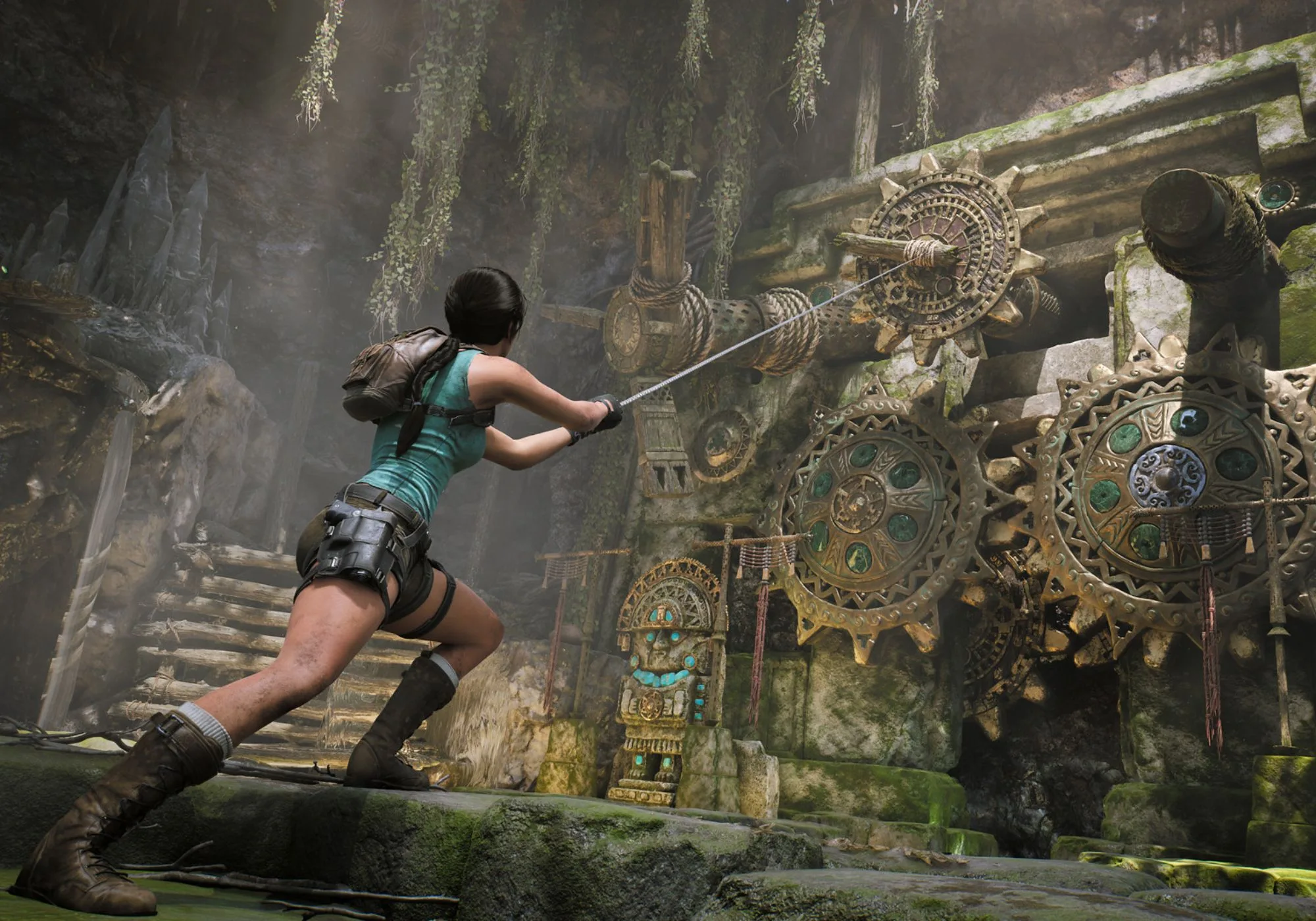
Gameplay in the game emphasizes a hybrid structure combining exploration, survival mechanics, environmental puzzle-solving, and tactical combat. Exploration has been redesigned around vertical traversal, climbing systems, rope physics, and contextual movement animations, allowing players to transition more seamlessly between traversal states while reducing interruption and improving immersion. Combat is more tactical than in earlier franchise entries, with stealth approaches, resource scarcity, and environmental advantage playing a larger role as enemies adapt dynamically and force players to reconsider direct confrontation.
Puzzle mechanics are deeply integrated into the world rather than confined to isolated puzzle rooms. Ancient ruins react to light, pressure, water flow, and artifact alignment, creating continuous cognitive engagement throughout exploration. This evolution brings the experience closer to modern cinematic survival adventures while preserving the franchise’s signature blend of intellect-driven progression and action pacing.
The return of Lara Croft represents a significant redesign effort focused on realism and narrative depth. Character modeling uses high-resolution scanning and motion capture to create expressive facial animation and realistic body movement, while the design shifts away from exaggerated proportions in favor of functional athletic realism. Her personality has also evolved, with this version of Lara portrayed as more experienced, cautious, and emotionally complex, reflecting the psychological toll of prior expeditions. Dialogue systems allow for more reactive storytelling, where player choices influence interpersonal dynamics and narrative tone, while costume design integrates practical expedition gear, weather adaptation systems, and modular equipment changes depending on environment and progression stage.
The narrative centers on the mythological “Scion of Atlantis,” an artifact believed to hold the genetic and historical memory of the lost civilization. The storyline expands significantly beyond the original Tomb Raider plot by introducing geopolitical tensions, rival archaeological factions, and ancient technological mysteries. Lara’s journey becomes both external and internal as she seeks the truth behind Atlantis while confronting ethical dilemmas about the exploitation of ancient knowledge. Narrative pacing is nonlinear, allowing players to uncover fragmented lore through exploration rather than strictly scripted sequences, with multiple interpretations of Atlantis’ downfall encouraging replayability and analysis.

Tomb Raider: Legacy of Atlantis Unreal Engine 5 Graphics, Platforms, and PC Requirements
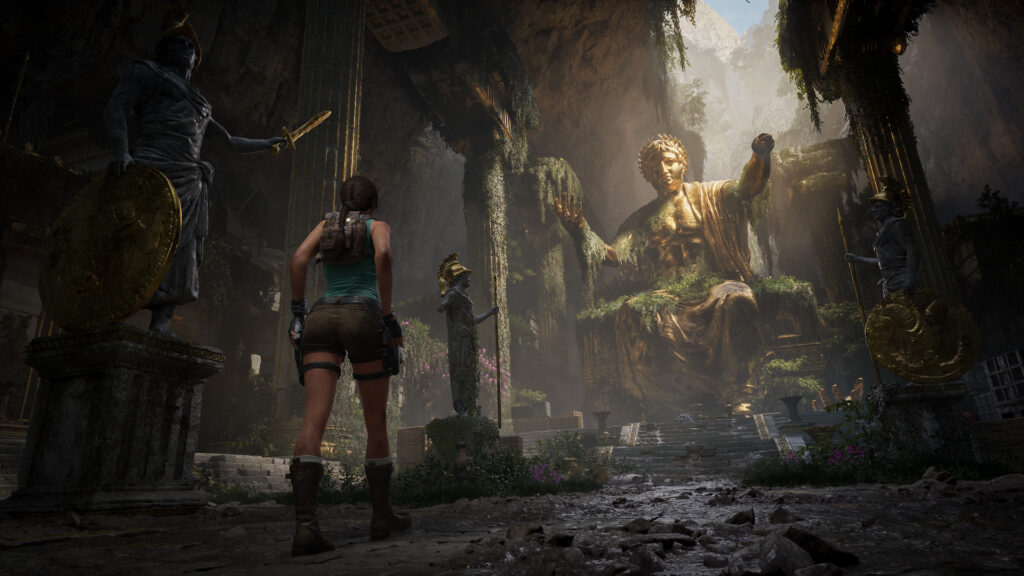
The visual foundation of the game is built on Unreal Engine 5, enabling next-generation rendering techniques that support a more atmospheric and immersive adventure. Key enhancements include Nanite-based geometry rendering for ultra-detailed environments, Lumen global illumination for dynamic lighting realism, high-fidelity water simulation for underwater exploration sequences, and photorealistic foliage alongside destructible terrain systems. These advancements allow ancient ruins, jungle environments, and subterranean chambers to react realistically to light and movement, reinforcing tension and discovery at every stage.
The game is expected to launch on major current-generation platforms including PC, PlayStation 5, and Xbox Series X, with potential expansion to future hardware such as next-generation Nintendo systems. Optimizations are being designed to take advantage of high-performance SSD loading, ray tracing capabilities, and advanced controller haptics. Cross-platform parity is also a key focus, aiming to ensure a consistent narrative and gameplay experience regardless of hardware, while scalable graphical settings allow for broader accessibility.
Although final PC specifications are not officially confirmed, expected requirements reflect the high fidelity of Unreal Engine 5 systems and the game’s dense environmental design philosophy.
Minimum requirements are projected to include:
- Mid-tier modern CPU architecture
- 16GB RAM
- Entry-level ray tracing capable GPU
- SSD storage required for streaming assets
Recommended requirements are projected to include:
- NVMe SSD for optimal loading performance
- High-end multi-core CPU
- 32GB RAM
- Advanced RTX-class GPU

Tomb Raider: Legacy of Atlantis AI Content Debate, Reimagining Status, and Modern Combat Systems
One of the most debated topics surrounding The game’s development is the potential use of AI-assisted content generation during asset creation. Critics argue that procedural or AI-assisted tools could affect artistic consistency, while supporters claim these tools can improve efficiency in environmental design and asset prototyping. The development team has reportedly emphasized a hybrid workflow that combines handcrafted design with procedural systems, aiming to maintain artistic integrity while accelerating production pipelines.
The project is best classified as a reimagining rather than a direct remake of Tomb Raider. While it retains the core narrative DNA and iconic locations of the original game, it significantly expands gameplay systems, story structure, and character development. This includes new dialogue systems, expanded exploration zones, and reworked puzzle logic that moves away from the original linear structure.
Combat also reflects this modernization, introducing tactical aiming, environmental takedowns, and limited resource management. A “focus mode” mechanic allows players to slow perception during high-intensity encounters, enabling more precise movement and targeting. Traversal is integrated with fluid animation blending, allowing Lara Croft to transition between sprinting, climbing, and jumping without rigid interruption.
Tomb Raider: Legacy of Atlantis Locations, Studio Collaboration, and Comparison with Earlier Games
The game spans multiple global and mythological locations, each designed with a distinct architectural identity and puzzle mechanics tied to cultural mythology. These environments include dense Peruvian jungles filled with ancient ruins, Greek coastal temples connected to early Atlantean myths, Egyptian desert tomb networks with hidden chambers, and the submerged and reconstructed city of Atlantis.
Development is reportedly led by Crystal Dynamics in collaboration with Flying Wild Hog. This partnership combines narrative expertise with technical combat and action design specialization, resulting in a hybrid production pipeline. Crystal Dynamics focuses on storytelling, character development, and franchise continuity, while Flying Wild Hog contributes combat mechanics and environmental interactivity systems.
Compared to Tomb Raider Anniversary and the original 1996 release, Legacy of Atlantis represents a far more systemic redesign. While Anniversary remained relatively linear, this reimagining introduces open-ended exploration and adaptive puzzle structures. The scale of environments, narrative depth, and gameplay freedom are significantly expanded, reflecting modern AAA design standards.

Frequently Asked Questions (FAQs)
- Is Tomb Raider: Legacy of Atlantis a remake or new game?
It is a reimagining of the original 1996 game rather than a direct remake or a completely new standalone concept. It keeps the core identity, major themes, and Atlantean foundation of the classic Tomb Raider, but rebuilds the experience with expanded story systems, modern exploration, redesigned puzzles, and updated character development. - Who is developing the game?
The game is reportedly being developed by Crystal Dynamics with support from Flying Wild Hog. Crystal Dynamics is associated with storytelling, franchise continuity, and character development, while Flying Wild Hog contributes to areas such as combat mechanics and environmental interactivity. - What engine is it using?
Tomb Raider: Legacy of Atlantis is being built on Unreal Engine 5. This allows the game to use modern rendering features such as detailed geometry, dynamic lighting, realistic water simulation, and dense environmental design suited to ruins, jungles, tombs, and underwater locations. - Will Lara Croft look different?
Yes, Lara Croft has a more realistic and grounded redesign. Her appearance emphasizes functional athletic realism, practical expedition gear, and more expressive facial animation through high-resolution modeling and motion capture, moving away from exaggerated character proportions. - What is the story about?
The story focuses on the Scion of Atlantis, an artifact believed to contain the genetic and historical memory of the lost civilization. The narrative expands into ancient secrets, rival archaeological factions, geopolitical tension, and Lara’s ethical conflict over the consequences of uncovering powerful ancient knowledge. - Is Atlantis fully explorable?
Yes, Atlantis is described as a major late-game environment. Rather than appearing only as a brief setting, it is expected to function as a significant explorable location tied to the game’s mythology, environmental storytelling, and puzzle systems. - What platforms will it release on?
The game is expected for PC, PlayStation 5, Xbox Series X, and potentially next-generation Nintendo hardware. Platform plans are focused on current-generation performance features, scalable graphical settings, and maintaining a consistent gameplay and story experience across supported systems. - Does it include combat improvements?
Yes, the combat system includes modern tactical and focus-based mechanics. Players can use tactical aiming, environmental takedowns, stealth approaches, limited resources, and a focus mode that slows perception during intense encounters for more precise movement and targeting. - Is it open world?
It is not described as a full open-world game. Instead, it uses semi-open exploration hubs that allow more freedom than the original linear structure while still maintaining a guided adventure format built around traversal, puzzles, story progression, and environmental discovery. - When is the release date?
The release date has not been officially confirmed, but current expectations point to a projected 2027 launch window. This timing reflects the scale of a modern AAA reimagining, especially one involving Unreal Engine 5 visuals, expanded gameplay systems, and extensive production work.
Conclusion
Tomb Raider: Legacy of Atlantis represents a major reinvention of the foundational Tomb Raider experience, merging modern Unreal Engine 5 technology with expanded narrative depth, redesigned gameplay systems, and cinematic storytelling. It positions itself as a bridge between legacy franchise identity and next-generation game design expectations.
Sources and Citations
- Official Developer Statements and Industry Interviews
https://www.crystald.com/ - Crystal Dynamics Official News
https://www.crystald.com/news - Unreal Engine 5 Technical Documentation, Epic Games
https://dev.epicgames.com/documentation/en-us/unreal-engine/unreal-engine-5-5-documentation - Epic Games Unreal Engine Official Website
https://www.unrealengine.com - Tomb Raider Official Website
https://www.tombraider.com - Tomb Raider Franchise Archive
https://www.tombraider.com/games - Crystal Dynamics Tomb Raider Franchise Information
https://www.crystald.com/projects/tomb-raider - Embracer Group Official Reports and Franchise Updates
https://embracer.com/reports/ - Game Developer Industry Analysis
https://www.gamedeveloper.com - GamesIndustry.biz AAA Game Development Analysis
https://www.gamesindustry.biz - IGN Tomb Raider Coverage
https://www.ign.com/games/tomb-raider - PC Gamer Tomb Raider Coverage
https://www.pcgamer.com/tag/tomb-raider/ - GameSpot Tomb Raider Coverage
https://www.gamespot.com/games/tomb-raider/
Recommended
- Planet Zoo 2 Revealed: Release Date, Gameplay Features, Aquariums, Aviaries & Everything We Know About the October 2026 Launch
- The Boys Spin-Off Teaser Explained: Vought Origins, First Supes, and What the Prequel Reveals About the VCU Timeline
- Can I use real-world camera settings in Blender?
- Control Resonant PC Gaming Show Appearance Confirmed, Release Details, Gameplay Changes, and Story Explained
- Subnautica 2: Where to Find Sulfur
- AMD Radeon RX 9070 GRE Review: Full Performance Breakdown, 1440p Benchmarks, Specs, and Value Analysis
- Project Hail Mary Is the Ultimate Hopecore Space Movie: Why Ryan Gosling’s Sci-Fi Epic Feels So Inspiring
- PlayStation’s New DRM Policy Might Reportedly Lock You Out of Your Games: What the 30-Day Online Check-In Rumor Means for PS5 and PS4 Owners
- The Adventures of Elliot: the Millennium Tales – Official Gameplay Demo Launch Trailer Explained | Everything We Know so Far
- Is Arcane 3D Animated? Unveiling the Secrets Behind Its Revolutionary Style



































































































