





In This Article (7 sections)
WARLOCK: Dungeons & Dragons Reimagines Creative Spellcasting
Invoke Studios and Wizards of the Coast unveiled approximately eight minutes of WARLOCK: Dungeons & Dragons gameplay during Gamescom Opening Night Live on August 25, 2026. Scheduled for release in 2027 on PC, PlayStation 5, and Xbox Series X|S, WARLOCK: Dungeons & Dragons moves away from the party based, turn based structure associated with some Dungeons & Dragons adaptations. Instead, WARLOCK: Dungeons & Dragons presents a third person, single player action adventure centered on Kaatri, an experienced warrior whose pact grants her dangerous supernatural abilities. The reveal introduced a dark fantasy open world built around exploration, real time combat, environmental interaction, and creative uses of magic.
Developed by Montreal based Invoke Studios and published by Wizards of the Coast, WARLOCK: Dungeons & Dragons is an original adventure rather than a comprehensive recreation of every Dungeons & Dragons class, rule, or character building option. The development team includes people who previously worked on Far Cry, Watch Dogs, Guardians of the Galaxy, and Deus Ex. Although character progression remains an important part of the experience, the game is primarily designed as an action adventure focused on one magical role, one written protagonist, and a world shaped around her particular abilities.
The central concept is not simply that Kaatri can cast powerful spells. Her abilities can move objects, restrain monsters, change her position, manipulate weather, and create new solutions to environmental or combat problems. Invoke studio head Dominic Guay explained that the team began with an interest in creative spell use before selecting the warlock class, which also provided a strong narrative foundation. A warrior who gains power by bargaining with an immensely powerful being immediately creates tension because receiving those abilities is only the beginning of the relationship.
This focused approach gives WARLOCK: Dungeons & Dragons a more specific creative identity. Rather than attempting to reproduce the entire range of tabletop Dungeons & Dragons possibilities, WARLOCK: Dungeons & Dragons explores how a carefully selected collection of abilities can produce unexpected results when combined with the environment, weapons, enemies, and other spells. Its appeal therefore depends less on providing the largest possible spell catalogue and more on ensuring that individual abilities remain useful across combat, exploration, and problem solving. The reveal raises the broader question of whether an action adventure can capture the improvisational appeal of Dungeons & Dragons without recreating its tabletop rules, and Invoke intends to pursue that goal through flexible magical interactions and systems that encourage experimentation.

Kaatri, Tasha, Skev, and the Darkon Story
In WARLOCK: Dungeons & Dragons, Kaatri is an experienced warrior who becomes a warlock while searching for someone she has lost. Her martial background remains important because she already possesses established weapon skills before entering an unfamiliar relationship with supernatural power. Tricia Helfer performs Kaatri through full performance capture, and the protagonist has a defined personality rather than functioning as a completely customizable moral blank slate.
Dominic Guay explained that her established characterization prevents actions such as indiscriminately killing villagers, meaning the game is not structured around a morality system that allows players to completely redefine her underlying identity. Creative director Jeffrey Hattem has also described her as someone discovering an unfamiliar place, allowing newcomers to learn about the setting alongside her. Her history and personality are written, but players can still vary how she approaches individual challenges.
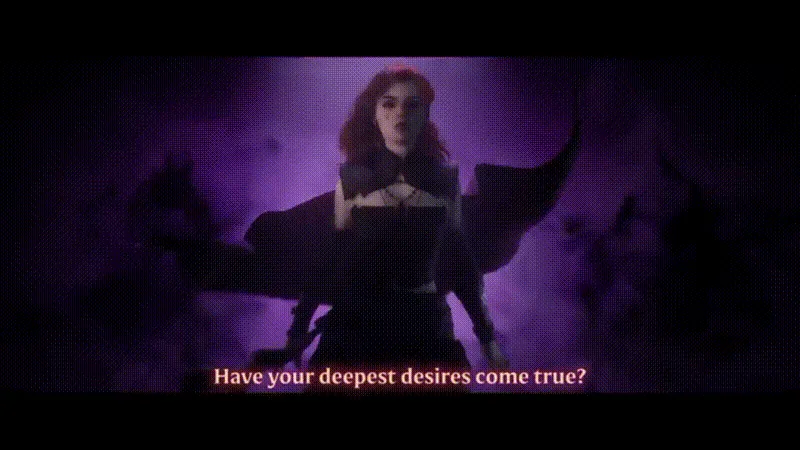
Kaatri’s patron in WARLOCK: Dungeons & Dragons is Tasha, the Witch Queen, performed through voice work and performance capture by Maggie Robertson. Tasha is presented as a useful but potentially dangerous ally whose assistance exists alongside hidden intentions and strong personal ambitions. She should not automatically be treated as a confirmed final villain because the available material instead emphasizes cooperation without complete trust. Kaatri benefits from their pact, but that does not mean their objectives are identical, and an apparently helpful instruction may serve more than one purpose.
Tasha is also directly connected to progression. She teaches Kaatri to perceive Raw Magic, a hidden source of power found throughout Darkon that can expand and transform her abilities. Exploration therefore offers more than ordinary rewards because Kaatri’s increasing power remains tied to the bargain that made her quest possible. The public material does not reveal how this relationship ends, so a betrayal, final confrontation, or specific conclusion has not been established. The tension comes from Kaatri relying on someone who can genuinely help her while never being certain that Tasha has revealed her complete purpose.
The story of WARLOCK: Dungeons & Dragons takes place in Darkon, a domain within Ravenloft’s Domains of Dread and a different setting from the Forgotten Realms locations closely associated with Baldur’s Gate 3. Invoke selected Darkon partly because its less familiar material could preserve a sense of discovery for experienced Dungeons & Dragons fans and newcomers. The threatened realm contains ruined castles, dangerous dungeons, attractive landscapes, and strange mists consuming the domain, creating a world that appears inviting in places while suggesting that something deeply wrong lies beneath its surface.
Exploration is intended to reward observation rather than constant dependence on precise objective markers. Broad search areas and a compass can direct players without identifying every destination, while interface elements can be toggled according to preference. Some interface features were disabled for the Gamescom demonstration, so the clean presentation should not be interpreted as confirmation that the finished game will provide no navigational assistance. Guay has described the overall experience as lasting tens of hours rather than hundreds, although this remains a broad description rather than a fixed completion time. The design emphasis is on building a relatively focused world where curiosity leads to meaningful discoveries instead of filling a larger map with repetitive activities.
The settlement of Crickshank demonstrates how this structure may work. Conversations and suspicious local activity can lead Kaatri toward optional investigations called Mysteries. One tip directs her toward a disturbing disappearance and an underground route that requires magical improvisation. The proposed experience follows a clear pattern: notice something unusual, investigate it, adapt Kaatri’s available magic to the obstacle, and use many of the same abilities when exploration develops into combat.
Kaatri is accompanied through Darkon by Skev, an imp with his own history, objectives, and reasons for travelling. He previously advised Darkon’s ruler and is searching for his missing master, giving him a personal quest that parallels Kaatri’s search. His knowledge of the realm makes him useful, but Guay has described him as an unreliable guide, suggesting that his explanations reflect his own personality and perspective rather than providing automatically complete or objective information.
Skev can offer practical assistance such as picking locks, and his abilities can be developed over time. However, players do not control him as an additional party member or need to protect him during combat. His presence allows information and discoveries to emerge through conversation rather than relying entirely on journals or environmental text, while his separate motives introduce uncertainty without requiring the player to manage another fighter.
His role also reinforces that WARLOCK: Dungeons & Dragons is a single player game built around controlling Kaatri. Supporting characters can provide assistance and narrative relationships, but no disclosed information suggests cooperative play or the ability for another player to control Skev. Unlike Baldur’s Gate 3, which supports online multiplayer for up to four players, WARLOCK is currently presented as a solo action adventure centered on a defined protagonist and her relationships.

WARLOCK Gameplay, Combat, Progression, and Release Details
The Gamescom 2026 presentation moved beyond WARLOCK’s earlier cinematic introduction by demonstrating how Kaatri’s abilities function during actual play. The footage emphasized observing the environment, combining spells, manipulating enemy positions, and following magical preparation with weapon attacks. Demonstrated examples included attaching a loose rock to a wall to create a platform, using short distance teleportation to cross a gap, and exchanging positions with an enemy immediately before a larger creature attacked. Another sequence showed Kaatri restraining a large opponent with black tentacles before a powerful physical assault sent blades into the target. These moments demonstrate how the same powers can contribute to traversal, puzzle solving, positioning, and direct combat.
WARLOCK: Dungeons & Dragons combines directly controlled movement, melee attacks, otherworldly weapons, spells, and rituals rather than using a turn based party interface. Magic can create an advantage before Kaatri commits to a weapon strike by restraining an enemy, redirecting an attack, interrupting movement, or changing the environment. The relationship between physical and magical abilities matters more than either system in isolation because the strongest approach may involve using a spell to establish the conditions for a decisive melee attack.
Resource limitations help shape this combat rhythm. Players cannot cast indefinitely, so movement between magical setup and close combat is part of the intended flow rather than making weapons optional. Weapon focused approaches are supported through magical and elemental improvements, while spells can create openings for powerful critical attacks. The important decision is therefore not only which attack causes the most immediate damage, but whether using an ability at a particular moment will produce a safer or more damaging opportunity shortly afterward.
Eldritch Blast, Tasha’s Leash, and Black Tentacles illustrate the different functions within the magic system of WARLOCK: Dungeons & Dragons. Eldritch Blast is a long range force attack capable of damaging enemies and objects. Tasha’s Leash can pull enemies or objects toward Kaatri, with certain targets able to be held and thrown. Black Tentacles creates grasping tendrils on tangible surfaces that restrain nearby creatures or objects. Although the demonstrated ability resembles Evard’s Black Tentacles from tabletop Dungeons & Dragons, its real time implementation should not be assumed to reproduce the tabletop spell’s exact targeting rules, duration, costs, or numerical effects.
Together, these powers separate direct force, movement, and restraint while allowing all three to interact. One spell can damage a target, another can determine where it is positioned, and another can prevent it from moving. Their depth comes not only from their individual functions but from how one ability creates the conditions for another. This structure supports encounters where players can construct a sequence of actions rather than repeatedly selecting the same damaging attack.
Environmental interactions in WARLOCK: Dungeons & Dragons apply the same philosophy outside direct combat. One demonstrated blocked route could be cleared conventionally with a weapon or by using Tasha’s Leash to manipulate a lamp and burn away the obstruction. The same general manipulation power can help extinguish fire by moving water toward it. These examples do not require a completely different tool for every obstacle. Players are instead encouraged to recognize practical properties, including whether an object can burn, carry water, be moved, or block something else.
Weather manipulation provides a larger example of this approach. Kaatri can perform the Downpour ritual before directing Witch Bolt at a metal pole near several enemies. The combination of rain, conductive material, and electricity allows the attack to spread through the group. Invoke generally prefers situations with several possible approaches rather than puzzles built around one prescribed answer. The footage therefore suggests that players will identify a desired result and assemble a workable method from their available powers, although the Gamescom presentation does not establish how consistently that freedom will appear throughout the complete game.
Invoke has deliberately selected a focused collection of spells for WARLOCK: Dungeons & Dragons instead of attempting to reproduce the full range of Dungeons & Dragons magic. Direct controller access is intended to make abilities immediately available and encourage experimentation, while repeatedly cycling through a large spell wheel would work against the pace of real time action. The resulting trade off places accessibility and speed ahead of offering the broadest possible catalogue. A smaller selection can still provide considerable depth when each ability has several uses and interacts with enemies, weapons, traversal, objects, and environmental systems.
Progression expands these tools over time. Many spells can be discovered through exploration and are optional, while individual abilities have their own upgrade trees. Attributes, perks, and equipment traits can also support different approaches. Character development therefore depends both on which powers the player discovers and how those powers are improved. However, the available information does not establish a complete list of upgrades, maximum levels, or optimal character builds. Immediate controller access also should not be treated as a complete accessibility specification because it does not confirm every planned remapping option, visual aid, difficulty setting, or input accommodation.
The public Gamescom video lasts approximately eight minutes, while some journalists attended longer demonstrations of roughly twenty minutes. Neither presentation represents a finished review or unrestricted opportunity to test every system. The footage demonstrates Invoke’s intended mechanics and creative direction, but it does not confirm final performance, balancing, or the consistency of every interaction across the completed game.
WARLOCK: Dungeons & Dragons is scheduled for release in 2027, but no specific month or launch day has been announced. Wizards of the Coast originally revealed the game on December 11, 2025, with gameplay planned for summer 2026 and release targeted for 2027. A separate announcement during Gen Con on July 30, 2026, confirmed Maggie Robertson as Tasha and identified August 25 as the gameplay premiere date. The Gamescom presentation therefore followed the previously announced schedule rather than establishing a more precise release window.
The confirmed platforms for WARLOCK: Dungeons & Dragons are PC, PlayStation 5, and Xbox Series X|S. The current announcements do not establish versions for PlayStation 4, Xbox One, Nintendo Switch 2, or any subscription service. Official PC hardware requirements also remain undecided, with the Steam listing showing the operating system, processor, graphics, and other minimum specifications as yet to be determined. Trailer footage can demonstrate the game’s visual direction and intended density of effects, but it cannot confirm performance on a particular graphics card, final resolution targets, graphics presets, or sustained frame rates.

Frequently Asked Questions[FAQs]
- When will WARLOCK: Dungeons & Dragons be released?
WARLOCK is currently planned for release sometime in 2027. Its Steam page lists only the year and does not provide a confirmed month or day, so the Gamescom gameplay reveal should not be treated as confirmation of a more precise launch date. - Which platforms will WARLOCK: Dungeons & Dragons support?
The confirmed platforms are PC, PlayStation 5, and Xbox Series X/S. Steam has a listing for the PC version, while Xbox Wire and the Gamescom announcement confirm the console releases. No additional platforms have been officially established by the available announcements. - Is WARLOCK: Dungeons & Dragons a multiplayer game?
No. WARLOCK is officially described as a single player action adventure centered on Kaatri and her journey through Darkon. Although she travels with supporting characters such as Skev, they are part of the narrative and gameplay experience rather than characters controlled by additional players. - Who plays Kaatri in WARLOCK?
Tricia Helfer performs Kaatri, the game’s protagonist. Wizards of the Coast specifically announced that her role includes full performance capture, meaning her contribution involves more than recorded dialogue and also helps shape Kaatri’s physical performance and presentation. - Is Tasha Kaatri’s patron?
Yes. Tasha, the Witch Queen, serves as Kaatri’s magical patron and is performed by Maggie Robertson. Their relationship gives Kaatri access to supernatural abilities, but Robertson has described Tasha as having her own motives and ambitions, meaning her assistance should not automatically be interpreted as completely selfless. - Where does WARLOCK take place?
WARLOCK takes place in Darkon, one of Ravenloft’s Domains of Dread. The setting includes ruined castles, dangerous dungeons, strange mists, and other dark fantasy environments, with Invoke using Darkon’s less familiar elements to create a sense of discovery for both experienced D&D fans and newcomers. - Does WARLOCK use turn-based combat like Baldur’s Gate 3?
No. WARLOCK uses real time action combat in which players directly control Kaatri’s movement, melee attacks, spells, and environmental interactions. Baldur’s Gate 3 instead uses turn based party combat, so the two games approach Dungeons & Dragons through substantially different gameplay systems. - Can spells be upgraded in WARLOCK?
Yes. Developer interviews describe individual upgrade trees for spells, along with attributes, perks, and equipment traits that can support different playstyles. Many spells can also be discovered through exploration, although Invoke has not yet revealed the complete upgrade catalogue, maximum levels, or final progression balance. - Can players control Skev directly?
No. Skev accompanies Kaatri as an imp companion who provides information and practical assistance, including abilities such as picking locks. Players can develop his abilities, but he is not directly controlled as another combat character, and they do not need to manage his survival during fights. - Is previous Dungeons & Dragons knowledge required?
No. Creative director Jeffrey Hattem has said WARLOCK is intended to be approachable for people who have never played Dungeons & Dragons. Because Kaatri herself is exploring an unfamiliar place, newcomers can learn about Darkon and its mysteries alongside her instead of needing extensive knowledge of D&D lore beforehand.

Conclusion
WARLOCK: Dungeons & Dragons’ Gamescom reveal establishes a recognizable identity: a single-player action-adventure in which magical problem-solving matters as much as attacking monsters. Its appeal lies in the possibility that a spell learned for one purpose can become useful in an entirely different situation.
The project is also making deliberate trade-offs. A written protagonist replaces unrestricted character authorship, real-time encounters replace turn-based party management, and a focused collection of versatile spells replaces an attempt to include everything D&D magic can do. Those choices should be judged by whether they work together, not by whether they reproduce another game’s strengths.
The most important remaining test is consistency. Prepared footage can demonstrate excellent individual ideas; the finished adventure must make discovery, experimentation, and combat satisfying across many hours. Ahead of the planned 2027 release, WARLOCK has explained its ambition convincingly. Hands-on testing will determine how fully that ambition survives the transition from demonstration to complete game.
Sources and Citations
- Wizards of the Coast Original WARLOCK Announcement: Introduces Invoke Studios’ single-player, third-person Dungeons & Dragons action-adventure, protagonist Kaatri and Tricia Helfer’s performance-capture role. Establishes its combination of magic, melee combat and open-world exploration, with a planned 2027 release.
Citation: Wizards of the Coast and Invoke Unveil WARLOCK - GeekWire Gen Con 2026 Coverage: Reports Wizards of the Coast’s Gen Con announcements, including Maggie Robertson as Tasha and the plan to reveal WARLOCK’s first gameplay during Gamescom on August 25, 2026. This is secondary reporting on the company’s presentation rather than an original Wizards press release.
Citation: GeekWire: Wizards of the Coast’s Gen Con 2026 Announcements - WARLOCK Official Gameplay Recap: Summarizes the gameplay shown during Gamescom Opening Night Live, including Kaatri’s spell combinations, rituals, exploration and magically summoned melee weapons. The article was published August 26, following the August 25 presentation.
Citation: WARLOCK Gameplay Revealed - Steam Official Store Page: Identifies Invoke Studios as developer and Wizards of the Coast as publisher. Confirms a single-player structure and 2027 release window for the PC version without providing a more specific launch date.
Citation: Warlock: Dungeons & Dragons on Steam - Game Informer Gameplay Reveal Coverage: Matt Miller describes mechanics demonstrated during the Gamescom presentation, including creating a platform from a loose rock, teleporting across gaps and exchanging positions with an enemy during an attack. The article reports demonstrated footage rather than hands-on experience with the finished game.
Citation: WARLOCK Debuts First Look at Gameplay - GamesRadar+ Hands-Off Preview: Jasmine Gould-Wilson covers Tasha’s Leash, environmental object manipulation, interactions involving fire and water, exploration and side activities called Mysteries. Its comparisons with Baldur’s Gate 3 are the writer’s interpretation of the demonstration rather than confirmation that the games share identical systems.
Citation: WARLOCK’s Different Approach to Dungeons & Dragons - PC Gamer Gameplay Analysis: Tyler Wilde examines the extended gameplay presentation and its spell-driven environmental interactions. The article also discusses the staged nature of the footage, making it useful for distinguishing demonstrated mechanics from unanswered questions about how freely those systems function during ordinary play.
Citation: The Next Big D&D Game’s Gameplay Reveal - Xbox Wire Gamescom Preview: Joe Skrebels describes demonstrated uses of telekinesis, Black Tentacles and environmental obstacles, along with combining Downpour and Witch Bolt. Also covers clue-led exploration and Mysteries while distinguishing witnessed mechanics from alternative solutions the writer imagines players might attempt.
Citation: WARLOCK’s Approach to Magic and Open-World Exploration - TechRadar Spell and Controller Design Interview: Draws on an interview with Invoke studio head Dominic Guay about using a smaller set of multifunctional spells that can remain directly accessible on a controller. Also discusses spell skill trees, upgrades, resource management and how magic connects with close-range combat.
Citation: WARLOCK’s Controller Accessibility, Multifunctional Spells and Upgrades - TechRadar Skev Interview: Dominic Guay explains Skev’s role as an imp companion with his own motivations, describing him as an unreliable guide who can assist with abilities such as lockpicking. The interview also discusses upgrades to Skev’s abilities without presenting him as a directly controlled combat companion.
Citation: Dominic Guay Explains Skev’s Role and Abilities - Wargamer Maggie Robertson Interview: Mollie Russell’s Gen Con interview explores Robertson’s interpretation of Tasha as charming, cunning, dangerous and morally ambiguous. These observations reflect the actor’s understanding of the character rather than confirmation of unrevealed plot developments.
Citation: Maggie Robertson Discusses Playing Tasha in WARLOCK - D&D Beyond Official Spell Descriptions: Provides the tabletop rules for spells such as Eldritch Blast, Misty Step and Evard’s Black Tentacles. Useful for explaining their Dungeons & Dragons origins, but not evidence that WARLOCK reproduces every tabletop range, restriction or damage rule exactly.
Citation: D&D Beyond: Official Spell Descriptions - WARLOCK Official Website: Provides the game-specific descriptions of abilities including Black Tentacles, Eldritch Blast, Downpour and Witch Bolt. This is the stronger reference for how the video game adapts its magic rather than assuming the tabletop rules apply unchanged.
Citation: WARLOCK Official Website: Gameplay and Spell Overview - Larian Studios Baldur’s Gate 3 Overview: Documents Baldur’s Gate 3 as a party-based RPG using turn-based combat based on Dungeons & Dragons fifth-edition rules, including systems such as initiative, advantage, disadvantage and roll modifiers. Provides context for comparisons without implying that WARLOCK uses the same combat structure.
Citation: Baldur’s Gate 3 Official Overview
Recommendations
- Echoes of Aincrad Crafting Guide: Recipes, Materials and Unlock Requirements
- Did Christopher Nolan’s Depiction of the Gods Pay Off in The Odyssey?
- Castlevania: Belmont’s Curse Runs at Only 30 FPS on Nintendo Switch
- EA Sports College Football 27 Preview: Defense Wins Championships
- Jurassic World Evolution 2 Complete Edition Comes to Nintendo Switch 2 on July 30, 2026
- Unity-Based Tool for JRPG Game Development: RetroGig’s Retro JRPG Template for SNES/PSX-Style RPG Systems
- Keanu Reeves & China Miéville BRZRKR: Light Draws Breath — Release Date, Story, Creative Team & Variant Covers
- CD Projekt Raises Profit Goals with Witcher 4, 5, and 6 Coming: 5 Billion PLN Target Explained
- Creepshow Official Announcement Trailer Reveals a New Anthology Horror Game Experience
- GTA 6 Leans Into Vice City’s Influencer Hustle Where Looks Matter



































































































