









In This Article (8 sections)
Why Bank of America Hired 1,000 Contractors After AI Found Software Flaws
Bank of America hired 1,000 contractors to help remediate software weaknesses identified through advanced artificial intelligence models, including Anthropic’s Mythos, according to chief executive Brian Moynihan’s remarks reported in October 2026. Reporting published on October 15 described an expansion that began during the second quarter rather than a hiring initiative launched that day.
The outside workers reportedly supplemented approximately 3,000 internal employees already engaged in software remediation across systems used by the bank and software supplied by outside vendors. The disclosure highlights a central challenge in modern cybersecurity: discovering vulnerabilities more quickly does not automatically increase the speed at which an institution can investigate, repair, test, and deploy fixes. It also does not establish that the identified weaknesses were exploited, that customer accounts were compromised, or that the number of contractors corresponds directly to the number of vulnerabilities found.
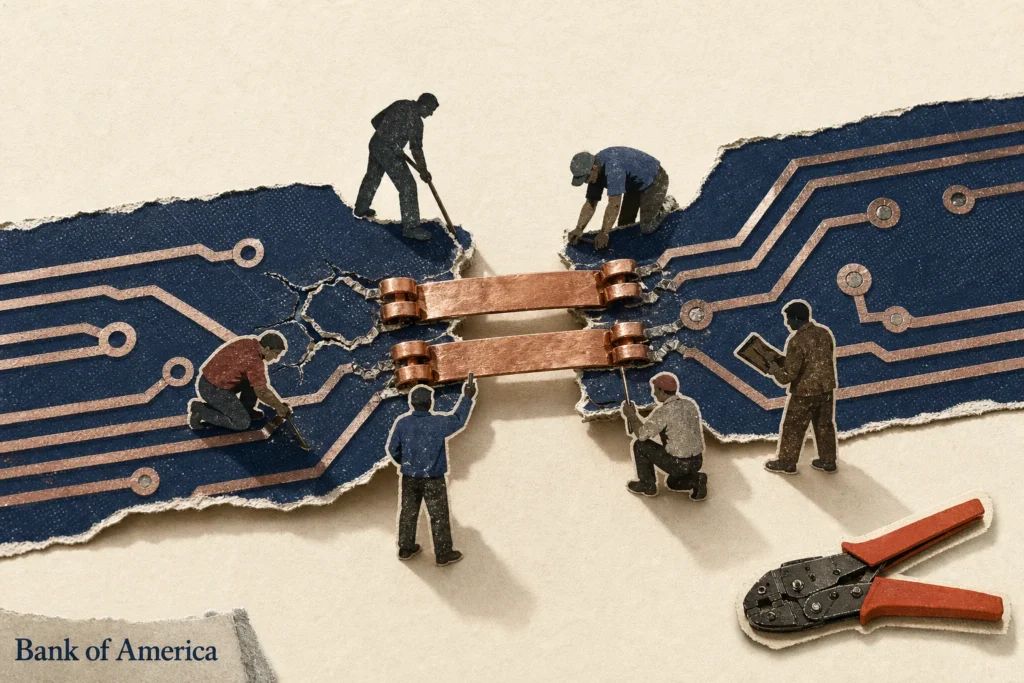
The need for additional workers reflects the difference between detecting a technical weakness and safely removing it from a complex financial environment. Once a model flags a possible vulnerability, an organization still has to determine whether the finding is valid, identify affected applications and deployments, assign responsibility, develop or obtain a repair, test the change, and verify that the weakness has actually been closed.
Those steps can affect systems supporting payments, account access, lending, trading, and internal operations, where a poorly implemented security fix could create serious functional problems of its own. Additional specialists can increase capacity by investigating findings, modifying applications, coordinating with vendors, preparing test environments, reviewing changes, and supporting releases at the same time. Staffing levels therefore indicate the scale of the remediation effort, but they do not reveal how many unique bugs existed or how many systems were compromised.
Moynihan discussed the work around Bank of America’s October 14 third-quarter results, with the bank’s investor relations materials confirming that its earnings call took place that day. Reporting on his remarks said the additional workers were classified as consultants rather than permanent employees, which matters when evaluating the bank’s staffing and expense decisions. A company can control permanent headcount while still increasing spending on temporary specialists required for a large corrective program.
The public remarks establish that software remediation required substantial additional capacity, but they do not provide a complete inventory of affected applications, a contractor-by-contractor assignment list, or an independently audited measurement of Mythos’s exact contribution. It would therefore be inaccurate to infer precisely which internal systems were affected, how exposed they were, or whether every repair originated from an AI-generated finding.
The reported spending also requires careful interpretation. Moynihan reportedly referred to quarterly remediation expenses of a couple of hundred million dollars or more covering both Mythos-related work and anti-money laundering remediation, without providing a separate figure for each program. Assigning that entire amount to AI-discovered cybersecurity work would therefore overstate what the disclosure establishes. Software remediation costs can include contractor fees, internal staff time, engineering tools, testing infrastructure, vendor support, release coordination, and independent assurance, while urgent repair work can also delay customer features or planned infrastructure projects. Spending alone is not a reliable measure of effectiveness because a large budget does not prove that the highest risks were fixed, just as a smaller budget does not prove neglect.
Cybersecurity remediation and anti-money laundering remediation should also remain distinct even when they appear in the same expense discussion. Cybersecurity focuses on protecting systems and information from unauthorized access, manipulation, disclosure, or disruption, while anti-money laundering programs focus on controls intended to identify and respond to suspicious financial activity.
Both may require technology changes, staffing, reliable data, governance, and documented corrective actions, but progress in one area does not automatically correct deficiencies in the other. Regulatory penalties, compliance remediation costs, and AI-related software patching expenses should therefore not be merged into a single cybersecurity figure without supporting financial disclosure. Any attempt to calculate Bank of America’s cost per vulnerability, contractor, or Mythos finding from the available information would be speculative.

Anthropic Mythos, Project Glasswing, and Why AI Discovery Creates a Patching Backlog
Anthropic introduced Claude Mythos Preview as a general-purpose language model with particularly strong cybersecurity capabilities, including the ability to investigate source code, identify previously unknown weaknesses, and, in controlled testing, develop demonstrations showing that some weaknesses could be exploited. Those descriptions come from Anthropic’s own published assessments and should not be treated as an independent technical audit of Bank of America’s systems.
AI-assisted vulnerability research can involve tracing permissions, examining how components exchange data, testing unusual inputs, and looking for assumptions that fail under uncommon conditions. A suspicious code pattern is not automatically an exploitable security defect because engineers still need evidence that the required conditions can occur and that the resulting behavior actually violates a security boundary. Likewise, reproducing a flaw in a test environment does not establish the exact risk posed in production, where deployment settings, software versions, access restrictions, and compensating controls may differ.
The public reporting does not provide enough technical detail to reconstruct how Mythos was used inside Bank of America. It would therefore be inappropriate to name particular programming languages, internal applications, databases, exploit techniques, or attack paths as confirmed targets. In general, vulnerabilities can arise when different components make inconsistent assumptions about permissions, input validation, call ordering, or the behavior of connected services. A system may function correctly during ordinary activity while failing under unusual combinations of requests or states. AI can help investigate those possibilities more systematically, but the technology should be understood as assisting with the discovery of weaknesses that already existed rather than creating or exploiting those defects against customers.
The larger operational problem begins after discovery because remediation contains several stages that AI does not eliminate. Detection identifies a suspected weakness, repair changes software or operating conditions to remove it, and verification determines whether the change worked without damaging intended behavior. A generated patch might block the suspicious request while also rejecting legitimate transactions, fix only the visible symptom, leave another path to the same failure, or introduce a different defect. Banks therefore need to test repairs against security requirements and normal business behavior before deploying them widely. NIST’s enterprise patch management guidance similarly treats patching as a process that includes identifying, prioritizing, obtaining, installing, and verifying updates rather than simply generating a code change.
A backlog forms when validated security work arrives faster than teams can complete those downstream steps. Anthropic’s initial Glasswing update explicitly identified human capacity to assess findings, report them, and design and deploy patches as a bottleneck, while also separating model-generated severity estimates from findings later reviewed by security researchers.
An authorization weakness, for example, may require engineers to reconstruct intended permission rules, determine whether integrations rely on existing behavior, coordinate with multiple application owners, and decide how to prevent unauthorized access without blocking legitimate users. If the affected software comes from an outside supplier, the bank may also need to wait for an upstream repair while deploying temporary mitigations. A growing ticket count can therefore reflect stronger discovery, inadequate remediation capacity, weak ownership processes, or several of those conditions at once.
Project Glasswing extends this idea by using advanced AI capabilities for defensive security work on important software. Anthropic’s launch materials describe controlled access for participating organizations, examination of first-party and open-source systems, and funding intended to help the wider security ecosystem respond to discoveries. For banks, earlier detection can be valuable because a weakness may be investigated and mitigated before an attacker independently discovers the same path.
However, effective use also requires defined testing boundaries, suitable environments, reliable software inventories, clear ownership, and a process for transferring findings to the teams responsible for fixing them. When a vulnerability affects widely used software, coordinated disclosure between researchers, maintainers, suppliers, and users becomes especially important so defenders receive enough information to act without unnecessarily accelerating exploitation.
Contractors, Legacy Systems, Third-Party Software, and Security Patch Prioritization
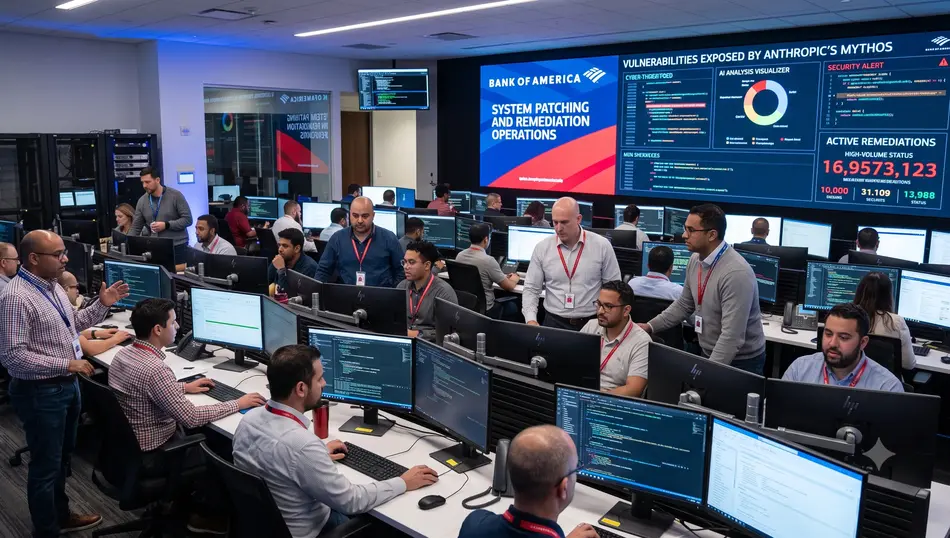
The exact responsibilities assigned to Bank of America’s 1,000 contractors have not been publicly disclosed, but a large remediation program generally requires several different kinds of work. Application owners understand how software connects to business processes, security researchers assess the weakness, developers implement repairs, test engineers verify functionality, and operations teams manage deployment and recovery. Contractors can expand capacity across these stages, but they still need documentation, clearly bounded access, well-defined tasks, and an internal decision maker who can resolve questions.
Adding people without improving coordination can create new bottlenecks because experienced employees may spend more time onboarding temporary contributors, reviewing unfamiliar changes, or correcting duplicated work. The most useful measures of progress are therefore validated outcomes such as whether each finding has an accountable owner, whether a repair passed review, whether every affected deployment received it, and whether follow-up testing confirmed closure.
Knowledge transfer is particularly important when temporary specialists are involved. Once contractors leave, the bank should retain the tests, documentation, engineering understanding, and preventive controls developed during the remediation effort. Otherwise, similar defects can reappear or future teams may be unable to explain why a particular change was made. A successful surge should ideally improve the organization’s permanent ability to prevent and address the same class of problem. Better testing, clearer system ownership, and reusable fixes can turn emergency remediation into longer-term engineering improvement. Contractor growth therefore indicates immediate capacity needs but does not by itself establish a permanent staffing model for the banking industry.
Older financial software can make remediation slower because its behavior may be deeply connected to long-established business processes. The problem is not simply the age of the code, but the number of dependencies surrounding it and how well those dependencies are documented. An established banking application might exchange information with payment services, reporting systems, internal ledgers, and external partners, meaning a seemingly minor interface change can affect several downstream systems.
Older applications may also lack extensive automated testing or depend on specialized knowledge held by relatively few employees, requiring teams to reconstruct the reasons behind existing behavior before modifying it safely. None of this means older systems are inherently insecure, since a well-maintained legacy platform can be more dependable than a poorly governed modern replacement.
Third-party software adds another layer because banks rely on commercial applications, operating systems, managed services, development tools, and open-source libraries they do not entirely control. A bank can discover a vulnerability in a supplier’s component without possessing the authority or source access needed to repair it directly. The institution must then determine affected versions, document evidence, communicate with the vendor, assess its own exposure, and obtain a supported fix.
The ownership chain can become complicated when a purchased application includes a library maintained by another organization, requiring coordination across several parties. Temporary mitigations such as disabling an unnecessary feature or restricting access can reduce exposure while a supplier develops a permanent repair, but those measures do not remove the underlying flaw.
After a vendor supplies an update, the bank still has to test and deploy it to every relevant environment. A supplier’s statement that a vulnerability has been fixed does not prove that every customer installation is protected. This makes software supply-chain security an ongoing engineering responsibility rather than something completed during procurement. Reliable inventories are needed so institutions know where affected components are deployed and which teams are responsible for them. AI-driven vulnerability discovery increases the value of that visibility because faster discovery is less useful when an organization cannot determine where vulnerable software exists.
Banks must also prioritize findings because engineering capacity is finite and not every weakness presents the same risk. Technical severity matters, but so do exposure, business consequences, accessibility, evidence of exploitation, and the importance of the affected service. A flaw reachable from an external network may present a different urgency from one requiring privileged access inside a tightly isolated environment. Weaknesses affecting sensitive information, payment authorization, or essential service availability may also deserve rapid action because of what a successful attacker could accomplish. CISA’s Known Exploited Vulnerabilities catalog can help identify flaws already being exploited, although newly discovered weaknesses may require urgent action before they appear there.
When a permanent repair cannot be deployed immediately, organizations may reduce access, disable affected features, add monitoring, or apply other temporary controls. These examples describe general security practice rather than Bank of America’s disclosed internal procedures. Effective prioritization also continues through deployment because closing a development ticket does not protect an affected production environment if the repair never reaches it. Open findings should therefore be assessed by severity, age, exposure, business importance, and deployment status rather than by ticket counts alone. Closing large numbers of low-risk defects should not obscure a small number of dangerous vulnerabilities that remain reachable.
What AI-Discovered Flaws Mean for Customers, Security Hiring, and Future Banking Operations
For banking customers, the most important question is whether discovered weaknesses affected account information, transaction integrity, or access to financial services. The reporting discussed here does not establish that Bank of America’s contractor expansion followed a successful attack, that customer funds were stolen through Mythos-discovered vulnerabilities, or that the bank suffered a related customer data breach. Those would be separate claims requiring independent evidence. Preventive remediation can be valuable precisely because organizations identify and fix weaknesses before customers experience harm. The existence of a large patching effort should therefore not be treated as proof that an attacker successfully exploited the underlying defects.
Customers may occasionally notice maintenance periods or changes in software behavior when banks deploy updates, but connecting a particular outage or interface change to this program without confirmation would be speculative. Individuals also cannot repair vulnerabilities inside a bank’s internal infrastructure themselves, which makes institutional accountability central to the security relationship. Banks must identify exposure, apply appropriate controls, verify repairs, and communicate accurately when a confirmed incident affects customers. Public explanations should distinguish between a vulnerability that was discovered, an attempted intrusion, a successful compromise, and verified customer impact. Treating those four stages as interchangeable can exaggerate risk without explaining what actually happened.
Bank of America’s reported expansion also suggests that stronger AI discovery can increase near-term demand for human security and engineering expertise rather than immediately replacing it. As models find more issues, people are needed to validate findings, interpret business consequences, coordinate ownership, develop fixes, test applications, communicate with suppliers, and verify production deployment. Roles that combine security knowledge with application engineering may become particularly useful because they can move an issue from detection toward a safe repair. Program managers with enough technical understanding to track dependencies can also help prevent important findings from becoming stuck between business units. Vendor coordination grows more important as well when discoveries involve shared components used across many institutions.
This does not establish that every bank will hire contractors at Bank of America’s scale or that AI will permanently increase cybersecurity employment. AI may also reduce the amount of human effort needed for repetitive analysis, code review, documentation, or well-understood repair tasks. The longer-term staffing effect will depend on whether those productivity gains exceed the additional workload created by broader and faster vulnerability discovery. Bank of America’s expansion is therefore best read as evidence of a current remediation capacity requirement rather than proof of an industry-wide employment trend. The lasting objective should be to improve engineering processes so institutions need fewer emergency surges over time.
The broader significance of Mythos and similar systems lies in the possibility that security organizations will discover software weaknesses much faster than traditional remediation processes can absorb them. That shifts attention from detection alone toward the entire vulnerability-management pipeline, including validation, ownership, prioritization, patch development, third-party coordination, deployment, and verification.
AI can help at several points in that process, but high-confidence repairs still have to preserve the behavior of critical financial systems while eliminating the security weakness. Banks that improve software inventories, automated testing, ownership, supplier management, and reusable security controls will be better positioned to benefit from faster discovery. The real measure of success is therefore not how many flaws an AI model finds, but how reliably the institution converts those findings into verified reductions in risk.
Frequently Asked Questions (FAQs)
- Did Bank of America hire 1,000 contractors specifically for software remediation?
Moynihan reportedly said Bank of America added about 1,000 outside contractors to help address software weaknesses identified through advanced AI models, including Anthropic’s Mythos. Those contractors supplemented roughly 3,000 internal employees already working on remediation. The figure therefore represents added capacity across investigation, repair, testing, vendor coordination, and deployment rather than a direct count of vulnerabilities. Some workers may have supported the same complex issue, while one person could also work across several related findings. The disclosure should therefore be read as evidence of the scale of the response effort, not as a measure of how many software defects existed. - Were the contractors hired on October 15, 2026?
No. The reporting described the contractor expansion as beginning in the second quarter of 2026. October 15 was the date of later coverage discussing Moynihan’s comments, while Bank of America’s third-quarter earnings call took place on October 14. That means the staffing increase was already underway before the article was published. Treating October 15 as the hiring date would incorrectly collapse the reporting date and the operational timeline into the same event. The more accurate interpretation is that the program had been running for months by the time it received wider attention. - Did Anthropic Mythos create the software flaws?
No. The reporting concerns weaknesses that AI helped identify, not defects that Mythos introduced into Bank of America’s software. Vulnerability discovery and vulnerability creation are separate events. A model can examine code, test assumptions, or identify behavior that appears to violate a security boundary without being responsible for the original design or programming mistake. Engineers must then validate whether the finding represents a real weakness and determine its practical impact. Nothing in the supplied disclosure supports the claim that Mythos caused the underlying software problems. - Does this mean Bank of America was hacked?
No. The contractor expansion does not by itself establish that Bank of America suffered a successful intrusion or customer breach. A vulnerability can be discovered before any attacker finds or exploits it, which is one reason preventive security testing is valuable. Discovery, attempted exploitation, successful compromise, and confirmed customer harm are four different events that require separate evidence. The reporting reviewed here does not establish that Mythos-discovered flaws led to stolen funds, exposed customer data, or compromised accounts. Any claim that the bank was hacked would therefore need independent confirmation beyond the remediation disclosure. - How much did Bank of America spend solely on Mythos remediation?
The reviewed reporting did not provide a separate figure for Mythos-related software remediation alone. Moynihan reportedly discussed quarterly remediation expenses of a couple of hundred million dollars or more while referring to both Mythos-related work and anti-money laundering corrective programs. Those are different categories of remediation and should not be combined into a single cybersecurity figure without a disclosed breakdown. Software remediation costs can also include contractor fees, internal engineering time, testing, vendor support, tools, and release coordination. Because the bank did not publicly allocate the total between those activities in the supplied material, any exact Mythos-only spending figure would be speculative. - Is Mythos only a cybersecurity scanner?
No. Anthropic described Mythos Preview as a general-purpose language model with particularly strong cybersecurity capabilities rather than as a conventional scanner that simply checks software against a fixed database of known vulnerabilities. Its published security work includes examining code, reasoning about possible weaknesses, and helping investigate whether suspicious behavior can be reproduced. That makes its role broader than signature-based scanning or basic automated vulnerability detection. However, a model-generated finding still requires validation because unusual code or a theoretical weakness is not automatically exploitable in a production environment. Mythos can assist investigation, but organizations still need evidence, engineering judgment, and appropriate security processes around its findings. - Why are people needed if AI can find and fix bugs?
Finding or proposing a fix is only part of software remediation. Engineers still need to understand how the affected application is supposed to behave, determine whether the flaw is real, review the proposed change, test it against legitimate business workflows, approve it, and deploy it safely. In banking systems, an apparently secure patch could still be unacceptable if it blocks valid payments, breaks account access, or disrupts another connected service. People also provide accountability when decisions involve business risk, regulatory obligations, or tradeoffs between temporary mitigation and permanent repair. AI can accelerate parts of the process, but the surrounding validation and operational work remains essential. - Can a vendor patch solve the problem immediately?
Not necessarily. A vendor patch is an important step, but the customer still has to determine whether the update applies to the software versions and configurations it actually uses. The patch may need compatibility testing before deployment, especially in a bank where one component can interact with payments, reporting systems, internal ledgers, and other applications. If immediate deployment is not possible, temporary measures such as restricting access or disabling affected functionality may be needed to reduce exposure. After installation, the organization must also verify that the vulnerability is actually closed in production. A vendor announcing a fix therefore does not mean every customer system becomes secure instantly. - Does the contractor count reveal how many vulnerabilities were discovered?
No. The number of contractors and the number of vulnerabilities measure completely different things. One complex flaw can affect many applications, require coordination across several teams, and consume substantial engineering time. Conversely, one specialist may work on multiple related findings over the course of the program. Contractors may also support testing, vendor coordination, documentation, deployment, or verification rather than directly repairing code. The disclosure provides no reliable formula for converting 1,000 contractors into a specific number of vulnerabilities. - Will AI permanently increase cybersecurity employment in banking?
That remains uncertain. More capable AI discovery can create immediate demand for people who validate findings, understand business impact, coordinate repairs, test changes, and manage supplier responses. At the same time, AI may reduce human effort in repetitive tasks such as code review, documentation, triage, or well-understood repair work. The long-term effect will depend on whether the extra workload created by broader security testing outweighs the productivity gains from automation. Software modernization, better testing, stronger ownership, and each bank’s operating model will also influence staffing needs. Bank of America’s contractor expansion therefore demonstrates a current capacity requirement, not a guaranteed permanent employment trend across the industry.

Conclusion
Bank of America’s reported addition of approximately 1,000 contractors demonstrates the operational consequences of faster AI-assisted vulnerability discovery. Identifying a weakness creates an opportunity to reduce risk, but realizing that opportunity requires validation, engineering judgment, supplier coordination, testing, deployment, and follow-up.
The disclosure also requires several distinctions. The reported hiring began before the October coverage. Contractor numbers do not reveal vulnerability totals. Combined remediation expenses do not establish a standalone Mythos budget. A software weakness does not, by itself, prove that an attacker compromised a system.
For the banking sector, the central issue is the capacity to convert findings into verified protection. Institutions that improve discovery without strengthening the repair process may simply accumulate more unresolved work. Those that connect AI testing with accountable engineering can use the same technology to improve the resilience of services customers rely on every day.
Sources and Citations
- Bank of America, Q3 2026 earnings conference call event page, October 14, 2026. Official confirmation of the earnings event and links to the bank’s supporting financial materials. Bank of America Corporation (BAC)
- The Next Web, “Bank of America CEO says 1,000 contractors are fixing AI-exposed flaws,” October 15, 2026. Reporting on the contractor disclosure, timing, internal staffing, vendor software, and combined remediation expenses. thenextweb.com
- The Register, “Bank of America had to bring in 1,000 contractors to patch all the bugs Mythos identified,” October 15, 2026. Additional reporting on Moynihan’s earnings-call discussion of remediation costs. theregister.com
- Anthropic, “Claude Mythos Preview’s cybersecurity capabilities.” Primary technical discussion of the model’s security evaluations, vulnerability research, and limitations on disclosing unpatched findings. anthropic.com
- Anthropic, “Project Glasswing: Securing critical software for the AI era.” Primary description of the defensive initiative, participating organizations, and support for software security work. anthropic.com
- Anthropic, “Project Glasswing: An initial update.” Primary discussion of validation results and the human work required to assess and remediate findings. anthropic.com
- National Institute of Standards and Technology, Special Publication 800-40 Revision 4, “Guide to Enterprise Patch Management Planning.” Foundational guidance on managing patches through prioritization, installation, and verification. csrc.nist.gov
- Cybersecurity and Infrastructure Security Agency, guidance on reducing risk from known exploited vulnerabilities. Primary guidance supporting prioritization of vulnerabilities with evidence of exploitation. cisa.gov
Recommended
- Best Drag Cars in Forza Horizon 6 for Maximum Straight-Line Speed
- New Avatar Aang Movie Trailer Looks Great After Major Leak: Release Date, Story, Cast, And Fan Reaction
- Godot 4.7’s Final Development Snapshot (Dev 5): Asset Store Overhaul, Rectangular Area Lights, and Inline Shader Previews
- 007 First Light Walkthrough Guide: Missions, Choices, Stealth, Gadgets, and Boss Tips
- Parkasaurus Guide: Build the Ultimate Relaxed Dinosaur Park
- Dark Light: Survivors Is a Genre and Perspective-Bending Roguelike Preview: First Impressions and Gameplay Details
- Final Fantasy Resonance Review: Famitsu’s 9/10 Scores and Campaign Length
- 3D texture painting app Wafer is now free in beta for Windows (download, features, and what to expect)
- CloverPit Console Release: PS5, Xbox, Switch, Gameplay, and Everything You Need to Know
- Forza Horizon 2 gets an unofficial fan-made PC port



































































































