







In This Article (8 sections)
Jolan Huijskes Blender Fracture Generator and Geometry Nodes Workflow
Environment artist Jolan Huijskes has detailed a procedural environment-art workflow built around Blender Geometry Nodes and Unreal Engine 5, using a personal Saros-inspired desert fan-art project to demonstrate how specialised tools can speed up the creation, destruction and set dressing of large game environments without removing artistic control. His first-person breakdown, published by 80 Level on September 4, 2026, presents the project as a technical environment-art exercise rather than work connected to the developer of Saros or to his professional employment.
Huijskes states that he created everything in the project himself and focused on three areas in particular: tool development, composition and art direction. His broader design philosophy is consistent across the project: procedural tools should minimise friction, minimise waiting time and maximise artist control.
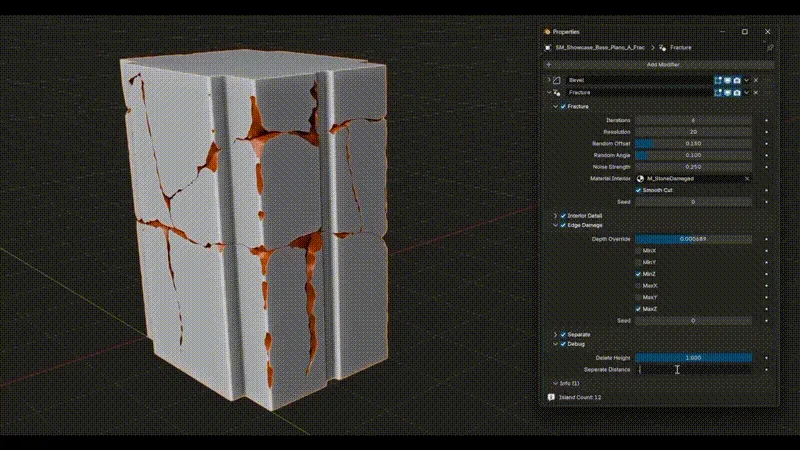
The most prominent part of the workflow is a Blender fracture generator built with Geometry Nodes. Huijskes developed it to solve a specific problem with modular architecture. A modular kit needs to repeat seamlessly, but careless damage can expose the boundaries between repeating pieces, particularly on the tops and bottoms of pillars or other stacked elements.
His fracture workflow therefore needed to generate convincing destruction without undermining the modular construction logic of the environment. Although Houdini could handle this kind of work through RBD systems, Huijskes identified the extra export, import and reprocessing steps as unwanted pipeline friction when assets changed. His goal was not to replace Houdini as a capable tool, but to keep the fracture process directly inside Blender so revisions could happen more quickly.
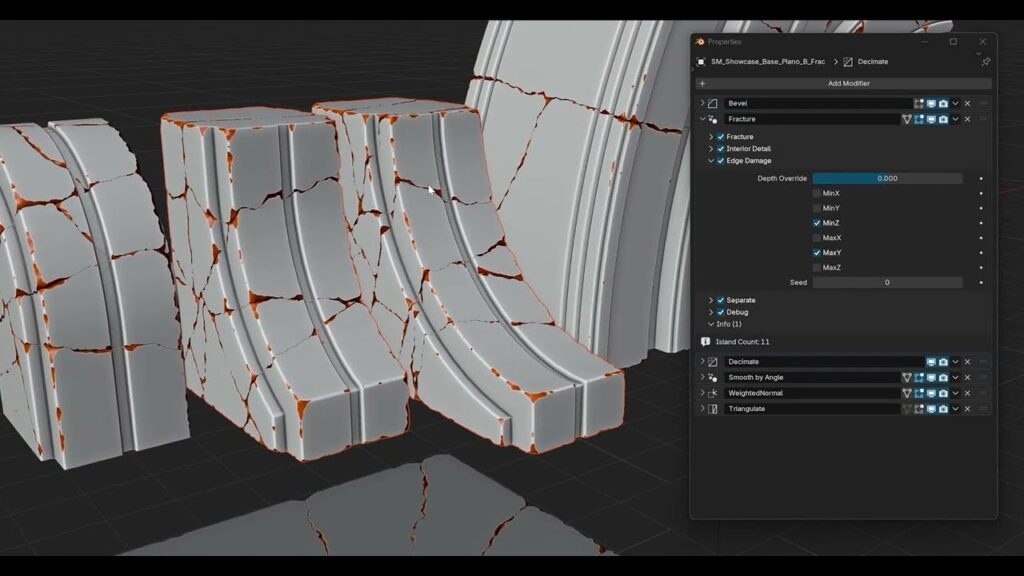
He initially explored Blender’s Cell Fracture approach but found it too limited for the level of customisation he wanted, especially when trying to produce more complex fracture lines with subdivision and noise. His Geometry Nodes solution instead works by repeatedly processing mesh islands. The system determines the longest axis of an island, creates a cutting plane aligned to that direction, displaces the plane with three-dimensional noise and then uses a Boolean operation to split the geometry. Huijskes says the longest-axis calculation uses Matrix SVD, which produced more believable cut locations than an earlier prototype. The system also prioritises larger islands so it does not continue producing excessive slivers or extremely thin fragments.
The generated fracture pieces then go through additional stages rather than being left as clean Boolean cuts. Interior surfaces receive displacement so exposed faces do not look unnaturally flat, while the September version uses triplanar-projected texture information for part of that treatment. Huijskes plans to replace that dependency with 3D noise in the free version. Edge damage is created by remeshing individual islands, inflating the result with noise and subtracting it from the original through another Boolean operation. Together, these stages produce larger fracture shapes, irregular interiors and damaged outer edges rather than a simple shatter effect.
The main value of the system is that it remains non-destructive and adjustable. Artists can change parameters after the initial fracture rather than being locked into a fixed collection of pieces. Huijskes also built debugging features that allow fragments to be removed or separated so interior surfaces can be inspected. Once the Geometry Nodes stage is complete, a custom Blender add-on prepares the pieces for export to Unreal Engine, separating procedural geometry creation from the workflow operations needed for engine integration.
He has said the fracture generator will be released for free, but no exact release date was announced in the material reviewed through September 22, 2026. The September 4 breakdown describes it as coming “soon,” while UI and UX work, dependency removal, customisation and distribution decisions were still being completed. September 4 is therefore the publication date of the technical breakdown, not the confirmed release date of the tool.
Unreal Engine Array Tool, Socket-Based Fracturing and Modular Destruction
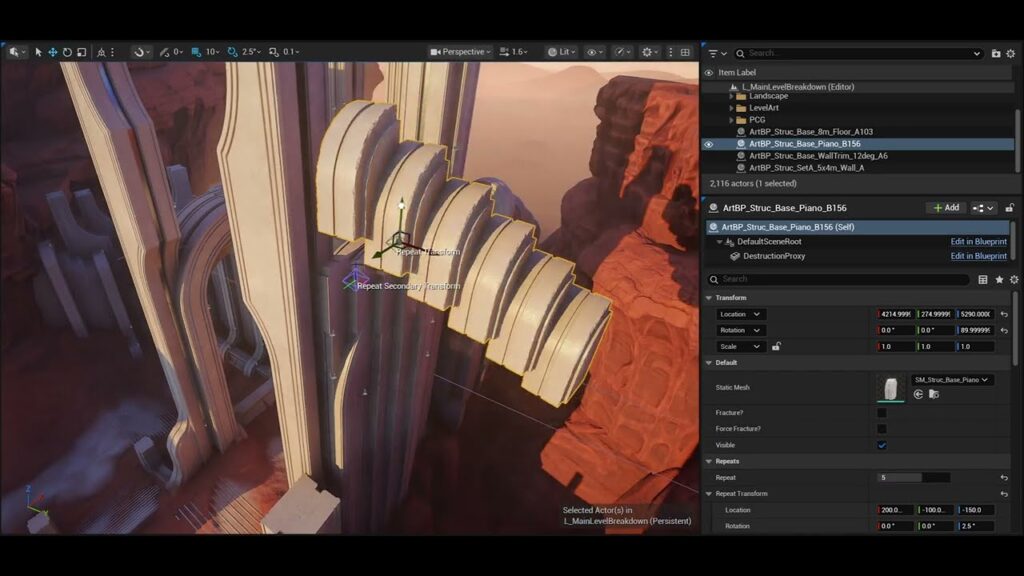
Huijskes’ Unreal Engine Array Tool addresses a separate problem: rapidly assembling very large repetitive structures from modular components. The Saros-inspired architecture in his project is highly repetitive and vertical, making manual duplication inefficient. His Blueprint-based system uses an Instanced Static Mesh component together with For Loops. One loop builds a row of repeated pieces using a specified transform, while another duplicates those instances along a second transform to create a two-dimensional array.
The logic is intentionally straightforward, and Huijskes recommends enabling Unreal’s Show 3D Widget option so artists can manipulate the transforms through a viewport gizmo instead of relying only on numeric input. The tool was created with Blueprint Component Script and is best understood as an artist-friendly construction system rather than a fully optimised production framework.
Huijskes is also open about the Array Tool’s limitations. Random flipping was not completely solved, and individual Blueprint instances can create additional Instanced Static Mesh components. For larger production environments, he suggests that better instance batching or Unreal Engine PCG could be explored. That caveat reflects the larger philosophy of the project: the goal is to remove repetitive work without pretending that a prototype tool automatically scales perfectly to every open-world production scenario.
The Unreal fracturing system begins with the pre-fractured assets created in Blender. Instead of performing the fracture operation live inside Unreal, Huijskes exports the separated pieces and reconstructs them in the engine. The challenge is preserving transform information. A fracture fragment is easier for an artist to manipulate if its origin is centred, but moving all origins to the centres removes the simple positional relationship needed to rebuild the intact object. Huijskes solved this by using Static Mesh Sockets as transform data carriers.
For each fractured piece, the Blender workflow creates an Empty using Unreal’s expected socket naming convention and places it at the correct original location. When imported, Unreal recognises the socket information and the Blueprint can retrieve its transform to reposition the fragment correctly. The sockets are therefore being used for more than ordinary attachment points. They carry the positional data needed to bridge Blender’s fracture preparation and Unreal’s reconstruction logic.
Once the pieces are reconstructed, Huijskes’ Unreal system allows level artists to control where destruction appears rather than relying on fully random breakage. Fracture spheres can determine which fragments remain visible or disappear, giving the artist direct control over the visual composition of damage. This lets destruction remain art-directed while still benefiting from procedural preparation. Huijskes reports minor performance issues after using more than roughly 150 fracture spheres, so the demonstrated setup should not be interpreted as infinitely scalable. Its strength lies in combining offline procedural fracturing with responsive in-engine authoring rather than attempting to simulate unrestricted runtime destruction.
Unreal Engine PCG Scattering and Procedural Desert Environment Construction
Procedural Content Generation handles another part of the environment pipeline: scattering secondary assets such as debris, rocks and vegetation. Huijskes did not want a system that simply randomised object placement across the landscape because composition, player navigation and environmental storytelling still depend on deliberate decisions from the level artist. His PCG work is therefore built around automation that reacts to existing level data and artist-selected objects rather than replacing authorship.
One of his main techniques uses Actor Data with options such as All World Actors, By Tag and Get Single Point. This allows the PCG graph to identify objects already placed in the world and respond to them. In the desert project, Huijskes used this to concentrate rubble around damaged architecture. He then added an Actor Array Variable that lets the artist manually select particular actors and feed them into the same system. Depending on the graph, those chosen actors can become places where procedural assets are added or areas where generated content is removed.
A Select node allows several behaviours to coexist inside the same graph. Debris can be restricted to regions near tagged architecture, while vegetation follows broader placement logic. The crucial point is that tags and manually selected actors provide an override layer. Procedural generation performs the repetitive placement work, but the artist still determines where important behaviours should occur. This is especially useful in larger environments where one universal scatter rule would interfere with roads, objectives, traversal paths, focal points or carefully composed ruins.
The full desert workflow is therefore built from several specialised systems rather than one all-purpose environment generator. Modular architecture provides the base vocabulary. The Unreal Array Tool expands those modules into large-scale forms. The Blender Geometry Nodes fracture generator creates damaged variants. Unreal sockets preserve the transforms needed to reconstruct those pieces. Fracture controls determine where destruction appears, and PCG fills the surrounding environment with debris and vegetation according to both procedural rules and deliberate artist input.
That separation is particularly effective in large barren landscapes where repetition quickly becomes expensive to handle manually. A structure containing hundreds of repeated components would take significant time to assemble one piece at a time, while rubble and vegetation might require thousands of individual placement decisions. Huijskes uses automation to solve the scale problem, but he repeatedly resists uncontrolled proceduralism. Large architectural forms still need deliberate composition, broken sections need art direction, and generated objects must respect pathways and storytelling priorities. The workflow is procedural in execution but directed in composition.
Blender and Unreal Engine Procedural Environment Art Pipeline and Artist-Control Principles
Huijskes’ project demonstrates a clear division of responsibilities between Blender and Unreal Engine. Blender handles geometry-heavy preparation. The Geometry Nodes system fractures modular assets, creates noisy interior surfaces and damages edges, while the custom add-on prepares the resulting fragments and their transform information for export. Unreal Engine then handles level-level decisions, reconstructing the fracture pieces through sockets, controlling visible damage with fracture spheres, multiplying architecture through the Array Tool and distributing secondary environment assets with PCG.
This division also explains why the workflow benefits from keeping each tool focused on one type of problem. The Blender fracture generator is an asset-generation tool because it changes the underlying geometry. The Unreal Array Tool is a construction tool because it turns modular components into larger structures. The socket-based fracturing Blueprint is an authoring tool because it lets artists determine where destruction appears after the pieces already exist. The PCG graph is a set-dressing tool because it distributes secondary assets while responding to information already present in the world. Keeping these responsibilities separate makes the overall pipeline easier to understand, modify and troubleshoot than forcing architecture, destruction and scattering into one monolithic procedural system.
The same principle applies to optimisation. The Array Tool is useful because it accelerates repetitive construction, but Huijskes acknowledges that its current handling of Instanced Static Mesh components may need more sophisticated batching in a larger production. The fracture Blueprint gives artists fine destruction control, but large numbers of fracture spheres can create performance concerns. PCG scales better for high-volume environmental placement because it can query tagged actors and process large areas, but it still needs deliberate exclusions and artist overrides to produce convincing authored spaces. The “best” tool therefore depends on the task being solved rather than on selecting one procedural system for an entire environment.
Huijskes’ three stated principles tie the whole workflow together. Tools should minimise friction so artists can use them without constant export, re-import or setup steps. They should minimise waiting so iteration remains fast enough for creative decisions to stay understandable. They should maximise artist control so designers, level artists and art directors can still determine composition, pathing, destruction and narrative emphasis. Automation is treated as infrastructure rather than a substitute for artistic judgment.
That philosophy is what makes the Saros-inspired project useful as a wider case study in procedural environment art. The project is not an official Saros production pipeline and should not be presented as documentation of how that game was developed. It is Huijskes’ own fan-art interpretation and a demonstration of how Blender Geometry Nodes, Unreal Blueprints, Static Mesh Sockets and PCG can be connected into a practical large-environment workflow. The central lesson is not that procedural tools should make every decision automatically, but that well-designed systems can remove repetitive labour while keeping the important creative decisions in the hands of the artist.

Frequently Asked Questions (FAQs)
- What is Jolan Huijskes’ Blender Fracture Generator?
It is a procedural fracture system built with Blender Geometry Nodes that creates broken versions of 3D meshes directly inside Blender. Huijskes developed it while working on modular architecture for his Saros-inspired desert environment, where destruction needed to look natural without exposing obvious seams between repeating pieces. The workflow is designed to remain non-destructive and adjustable, allowing artists to change fracture parameters and inspect the results without rebuilding the asset from scratch. - Is Jolan Huijskes’ Blender Fracture Generator free?
Huijskes has said that he intends to release the fracture generator for free. However, the September 2026 technical breakdown describes that release as forthcoming rather than already generally available. At that stage, he was still preparing the tool for wider distribution, including improving its interface, removing dependencies and making the system easier for other artists to customise. - When is the free Blender Fracture Generator release date?
No exact release date had been announced in the sources reviewed through September 22, 2026. Huijskes said the generator would be released “soon,” but also explained that UI and UX improvements, dependency removal, customisation work and decisions about distribution still needed to be completed. September 4, 2026 was the publication date of his detailed breakdown, not the confirmed launch date of the downloadable tool. - Does the Blender fracture tool require Houdini?
No. Huijskes specifically created the workflow so that the fracturing stage could be handled directly inside Blender instead of requiring an additional Houdini step. He did not suggest that Houdini is unsuitable for fracture work and acknowledged the strength of tools such as its RBD systems. His reason for staying in Blender was primarily workflow efficiency, since moving assets between applications adds export, import and reprocessing steps whenever the underlying geometry changes. - How does the Blender Geometry Nodes fracturing system split meshes?
The simplified process works on individual mesh islands and determines the longest axis of each suitable piece. It then creates a cutting plane aligned to that direction, distorts the plane with 3D noise and uses a Boolean operation to divide the geometry. Repeating the process produces additional fragments, while later stages add displacement to exposed interiors and procedural damage to edges so the result does not look like a collection of perfectly clean cuts. - What does the Unreal Engine Array Tool do?
The Unreal Engine Array Tool helps Huijskes construct large architectural forms by procedurally repeating modular static meshes instead of placing every component manually. It was built with Blueprint Component Script, Instanced Static Mesh components and nested For Loop logic, allowing one loop to create a row and another to duplicate that arrangement in a second direction. The tool is particularly useful for the large, repetitive structures in his desert environment, although Huijskes also notes that its current implementation has limitations that could require better batching for larger production scenarios. - Why does the Unreal fracturing tool use sockets?
Huijskes uses Static Mesh Sockets to preserve the original transform information of fracture pieces after they have been separated and given centred origins in Blender. Centring an individual fragment makes it easier to manipulate, but it removes the straightforward positional relationship needed to rebuild the complete object. By exporting correctly positioned socket data with each fragment, Unreal can retrieve those transforms and reconstruct the fractured asset in its original arrangement. - How does Huijskes give artists control over Unreal Engine PCG?
His PCG workflow combines procedural rules with information deliberately supplied by the level artist. Actor Data and tags allow the graph to react to objects already placed in the world, while an Actor Array Variable lets artists manually select specific actors that should influence generation. Those selected objects can determine where debris or vegetation is added, concentrated or removed, so procedural scattering handles repetitive placement without taking control of composition, paths and environmental storytelling away from the artist. - Is Huijskes’ Saros desert project official Saros development work?
No. Huijskes explicitly describes the environment as a personal fan-art project imagining a possible desert biome inspired by Saros. He states that the project was created by him and is unrelated to his professional work. The tools and techniques shown in the breakdown should therefore be understood as his own environment-art experiments rather than documentation of an official Saros development pipeline. - What is the main lesson from Jolan Huijskes’ procedural environment workflow?
The central lesson is that procedural systems work best when they remove repetitive labour without taking important creative decisions away from artists. Huijskes repeatedly emphasizes three goals: minimising friction, reducing waiting time and maximising artist control. His Blender fracturing, Unreal array construction, socket-based destruction and PCG scattering tools each automate a specific production problem while still allowing level artists to determine composition, damage placement, navigation and environmental storytelling.

Conclusion
Jolan Huijskes’ Blender fracture generator and Unreal Engine environment tools provide a valuable example of proceduralism designed around artists rather than automation for its own sake. His Geometry Nodes system creates non-destructive fracture pieces directly inside Blender, addressing consistency problems such as tiny fragments, thin pieces and unnatural cut locations through size-aware processing and longest-axis cutting. Interior displacement and procedural edge damage push the result beyond simple planar shattering.
The Unreal Engine side turns those prepared assets into a broader environment-production system. The Array Tool accelerates modular architecture construction. The socket-based fracturing Blueprint preserves transform data so pre-fractured pieces can be reconstructed and selectively removed. PCG scatters rubble and vegetation while tags and manually selected actors ensure that procedural placement remains responsive to composition and level-design requirements.
The most important factual qualification concerns the free Blender Fracture Generator itself. Huijskes has announced his intention to release the tool for free, but the detailed September 4, 2026 breakdown did not provide a firm release date. The generator was still undergoing dependency removal, UI and UX improvements, customisation work and distribution planning at that point.
Rather than presenting one universal procedural solution, Huijskes’ work shows how Blender Geometry Nodes, custom export preparation, Unreal Blueprints, Static Mesh Sockets and PCG can form a connected environment-art pipeline. For artists building large Unreal Engine worlds, the key idea is not simply to generate more content automatically. It is to automate repetitive processes while keeping the important visual and gameplay decisions in the hands of the artist.
Sources and Citations
- 80 Level, Jolan Huijskes, September 4, 2026: First-person technical breakdown of custom Blender Geometry Nodes fracture generation, Unreal Engine Array and Fracturing Tools, socket-based positioning, PCG scattering, and artist-controlled environment creation for a Saros-inspired project.
https://80.lv/articles/developing-tools-for-large-scale-3d-game-environments - Jolan Huijskes, LinkedIn, September 2026: Developer post sharing the 80 Level breakdown, confirming the use of custom Blender and Unreal Engine 5 tools, the Saros-inspired environment, and plans to release the Blender fracture generator for free without announcing a specific release date.
https://www.linkedin.com/posts/jolan-huijskes_unreal-engine-5-procedural-level-design-with-activity-7501705845408305152-6DOa - Epic Games, Using Sockets With Static Meshes: Official Unreal Engine documentation explaining how Static Mesh Sockets store attachment positions and transformations, providing the technical foundation for Huijskes’ method of transferring fracture-piece positioning data into Unreal Engine.
https://dev.epicgames.com/documentation/unreal-engine/using-sockets-with-static-meshes-in-unreal-engine - Epic Games, Unreal Engine FBX Content Pipeline: Official documentation covering the import of static meshes, animations, materials, textures and other assets from Blender and external digital-content-creation applications into Unreal Engine.
https://dev.epicgames.com/documentation/unreal-engine/fbx-content-pipeline
Recommendations
- Gostomel Warriors Steam vs VK Play sales comparison explained
- Microsoft Copilot Privacy Concerns: Contractors Reportedly View Uncensored User Photos and Prompts
- BOMBANANA! Launches on PC: Release Date, Three-Monkey Roles, and Bomb-Defusal Gameplay
- GTA 6 Finally Removes Face-Button Sprint Mashing
- Nathan Fillion’s Big Firefly Tease: Canon Animated Series With the Original Cast Reprising Their Roles (But It Still Needs a Streaming Home)
- Fortnite Now Hides D4vd Emotes by Default: Epic Adds Them to “Confrontational Emotes,” Offers Refunds, and Fans Demand Full Removal
- Study finds a ‘pain axis’ in LLMs: models represent self-directed harm and act to relieve it
- Fudan’s FlowTranslator Uses Training-Free Diffusion Editing to Translate Text Inside Images
- Gitee API Key Exposure Reveals 26,400 Working Credentials, Including OpenAI and DeepSeek
- Wētā FX VFX highlights reel for live-action Moana: Te Kā smoke, steam, and lava simulation



































































































