









In This Article (15 sections)
Master Facial Anatomy for Artists Course Structure, Beginner Use and Software Requirements
Ali Sadeghi’s Master Facial Anatomy for Artists is a 10.5-hour course focused on understanding and depicting the human face through drawing and sculpting. Its advertised scope connects anatomical structure with facial expression, aging and changes in facial fullness. Instead of treating the face as a collection of isolated features, the course approaches it through relationships between the skull, muscles and soft tissues. One important clarification for artists searching for an Ali Sadeghi facial anatomy course involving 3ds Max and FACS is that 3ds Max is not identified as mandatory software. The published requirements describe a fundamentals course without a specific software requirement, while separately mentioning basic familiarity with 3ds Max and rendering concepts.
The course is organized around a progression from structural foundations to changing surface forms. Its published sequence begins with skull structure, proportions, landmarks and muscles. The second chapter covers the eyes, eyelids, surrounding fat and movement. The third examines the nose and ears, while the fourth focuses on teeth, lips and nearby structures. Chapter five addresses superficial fat, aging, likeness and perspective, and the final chapter covers facial expressions. This structure makes it useful to think of the course in two broad stages: understanding the head’s supporting anatomy, then studying how that anatomy changes through movement, age and soft-tissue variation.
Beginner Level and Focused Study Approach
The course is classified by Wingfox as beginner level, which describes its intended entry point rather than guaranteeing that every learner will progress at the same speed. A beginner can make the material more manageable by keeping the artistic task simpler than the anatomical vocabulary. Someone studying the skull for the first time could begin by separating the cranial mass from the jaw rather than trying to memorize every opening and process. Likewise, someone studying the eye can first understand the eyeball and wrapping eyelids before attempting a polished portrait.
The August 2026 announcement suggests approximately four to six weeks of study at three to five hours per week. That should be treated as planning guidance rather than a verified average completion time or guarantee of proficiency. The 10.5-hour runtime also does not represent the full learning commitment. Pausing videos, completing drawings, correcting sculpts and revisiting difficult concepts can require considerably more time than passive viewing.
A more useful way to work through the lessons is to create small studies with narrow goals. An eye exercise can focus only on eyelid thickness, while a mouth study can examine projection in profile. These limited tests make it easier to determine whether the underlying concept is understood before moving on to a polished character. More experienced artists can use the same material diagnostically by comparing existing portraits or sculpts with anatomical references and spending more time on structures they continue to find difficult.
Software Flexibility and Scope Boundaries
The software question should also be separated from the anatomy itself. The published information does not indicate that learners must purchase or use 3ds Max to understand the course. Anatomical landmarks can be studied through drawing, sculpting or another familiar medium. Application-specific demonstrations are a different matter, since reproducing a particular scene or workflow may require knowledge of the software used in that example. Artists who already work comfortably in another program can therefore concentrate on the anatomical principle rather than learning an unfamiliar interface at the same time.
That flexibility should not be expanded into unsupported claims about compatibility. The course description does not establish that downloadable resources contain editable scenes for every application, nor does it confirm command-by-command instruction for 3ds Max. It also should not automatically be treated as training in retopology, facial rigging, shader development or final rendering. Those are related character-art skills, but their inclusion must be judged from the actual syllabus rather than inferred from the presence of 3D software.

Facial Structure: Skull, Muscles, Eyes, Nose, Ears and Mouth
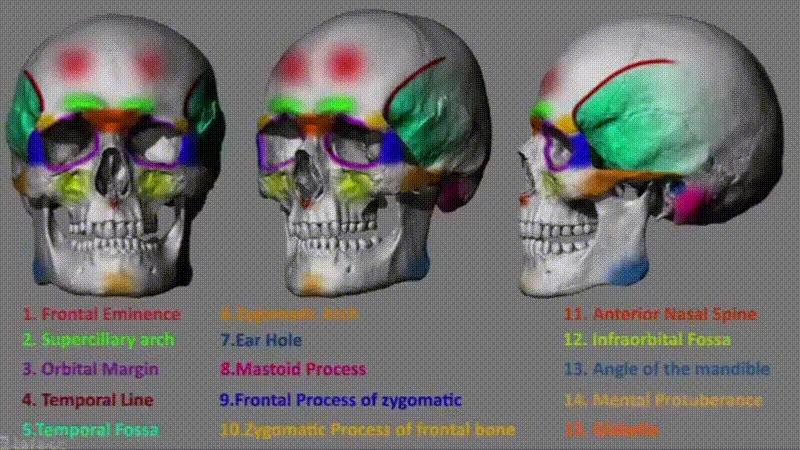
The skull provides the structural framework for understanding visible facial forms. The frontal bone contributes to the forehead and upper orbital region, the zygomatic bones form the cheek prominences, the maxillae form the upper jaw and the mandible forms the lower jaw. The bony orbit should also be understood as a three-dimensional cavity surrounding the eye rather than merely the visible opening created by the eyelids.
For artists, these structures are more useful when treated as relationships rather than as rigid proportion formulas. Questions such as how far the cheek projects relative to the eye socket, how far the upper jaw sits forward from the forehead and whether the jaw angle agrees with the overall head orientation are more informative than forcing every subject into an idealized template. A useful study can compare frontal and three-quarter references of the same person, mark a small number of structural anchors and then reconstruct the simplified head beneath them. Removing dramatic shading can further test whether the proportions remain convincing without tonal effects disguising construction errors.
Facial muscles add the next layer of understanding. Many muscles of facial expression connect with the skin and surrounding connective tissues, allowing contraction to alter the visible surface. The orbicularis oculi contributes to eyelid closure, the orbicularis oris moves the lips and the frontal belly of the occipitofrontalis raises the eyebrows. These should be distinguished from major chewing muscles such as the masseter and temporalis, which act on the mandible. Knowing the names is only an intermediate step. For artistic purposes, the more important question is what visible change accompanies a particular muscular action.
Expression and Facial Feature Construction
A practical expression study can compare a neutral face with one showing a dominant movement. The artist can first identify the larger region that changes, then add fine wrinkles only after the broader displacement is convincing. In sculpting, keeping a neutral version alongside the expressive version makes it easier to see whether the intended movement has been captured without unintentionally changing the character’s identity.
The eye is particularly useful for understanding why surface symbols often fail. A stronger structural model begins with an eyeball sitting inside the socket and eyelids wrapping around its curved surface. The lids have thickness, changing curvature and different visible profiles depending on the viewing angle. When an eye looks wrong, the first correction should not necessarily be the iris or eyelashes. The lid margins and their relationship to the globe are often more important. Drawing the same eye from the front, three-quarter view and side before adding the iris can help establish this volume.
The nose combines bony support, cartilage and soft tissue. Simplifying it into major volumes such as the bridge, tip, wings and underside makes it easier to understand from multiple angles. The profile tests projection, while an upward view clarifies the relationship between the nostril openings and surrounding forms. Instead of drawing nostrils as dark symbols, the artist should understand the volumes in which those openings sit.
The ear presents a different organizational problem. Important visible structures include the helix, branching antihelix, conchal region and lobule. Rather than copying each apparent groove independently, an artist can first establish the ear’s overall angle, outer rim and main internal branches, then refine smaller transitions. Both the nose and ear should ultimately be checked as parts of the entire head rather than treated as decorative pieces attached afterward.
Mouth Structure and Practice
The mouth is easier to construct when it is related to the dental region beneath it. The artistic concept of a “tooth cylinder” helps explain the curved support around which the lips wrap. The modiolus, a compact fibromuscular region near the mouth corner, also helps explain why the corner is not simply a crease cut into an otherwise static surface.
For practice, the mouth can first be constructed in profile to establish its projection relative to the nose and chin, then rotated into a three-quarter view to test foreshortening. When studying an open mouth, the overall dental arch should be placed before drawing individual teeth. A neutral closed-mouth sculpt can also be compared with an expressive version to check whether the corners, cheeks and lower face remain coordinated. The objective is not perfect symmetry but a specific mouth whose structure remains understandable across angles and expressions.
Facial Fat, Aging, Weight Change and FACS-Based Expression Study
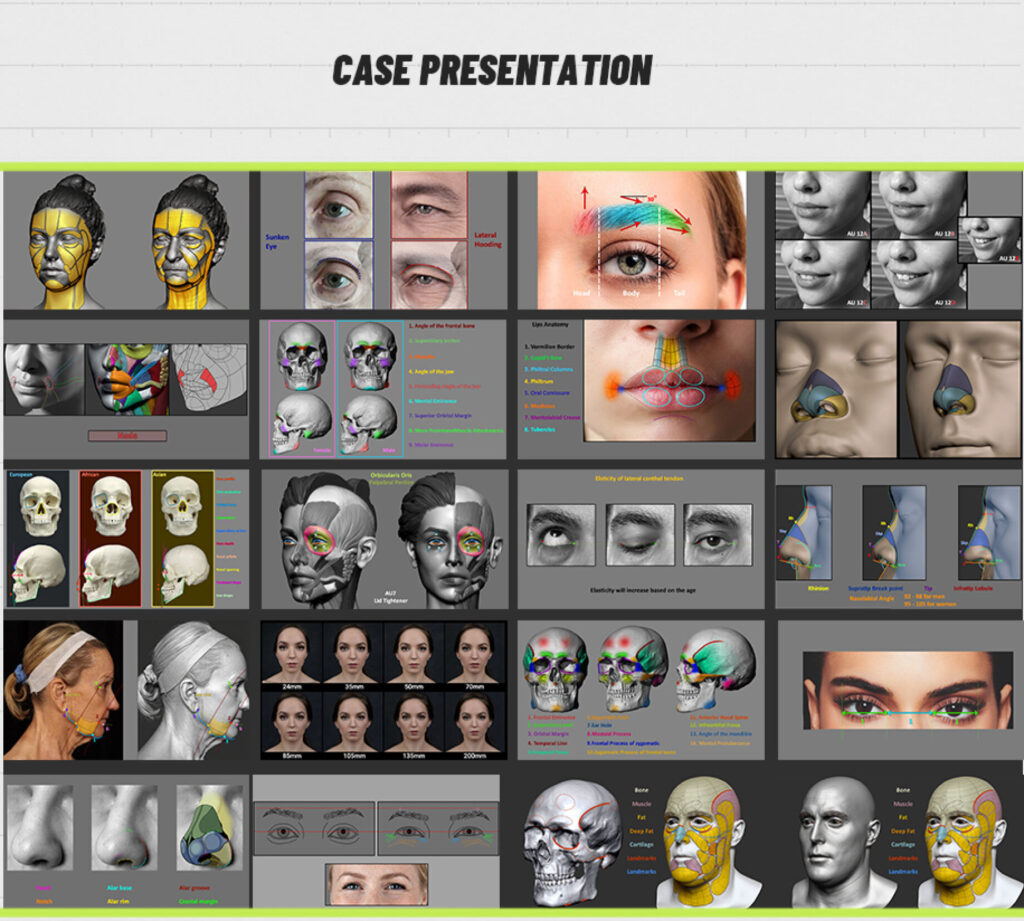
Facial soft tissue should not be understood as one uniform layer. Research cited in the course analysis describes distinct superficial facial fat compartments separated by tissue boundaries, while deeper fat compartments also contribute to facial form. For artists, the useful lesson is to think regionally rather than applying one global adjustment whenever a face becomes fuller, thinner or older.
This does not mean that a sculpt should display every anatomical compartment as a visible lump. Anatomical diagrams and natural-looking character surfaces serve different purposes. A better exercise is to duplicate a simplified head and alter only selected soft-tissue regions while keeping the underlying skull and primary construction consistent. Comparing how these changes affect the eye, cheek, mouth and jaw can help reveal which areas contribute most strongly to likeness.
Aging should likewise not be reduced to adding wrinkles to a young face. Research discussed in the material indicates that facial aging can involve changes in midface fat volumes, with differences between superficial and deeper regions. Body mass can also affect soft-tissue thickness, but age and body weight should not be treated as interchangeable variables. Population-specific research findings also should not be converted into a universal formula for every individual.
For character design, this means avoiding one-slider solutions. An older face does not need to become uniformly hollow, and a heavier face should not simply be the same head enlarged equally in every direction. Where suitable references exist, comparing photographs of the same person at different ages can help separate changes in overall volume, folds and fine surface texture. Major form changes should be established before wrinkle detail is added, ideally under consistent lighting and camera conditions so the comparison reflects actual structural decisions.
FACS Action Units and Expression Study
The course also identifies FACS as part of its approach to facial expression. The Facial Action Coding System describes observable facial movements through action units. It is anatomically based and is used in research and animation-related work, but identifying an action unit does not establish what a person privately feels or intends. For artists, the value lies in describing specific movements more precisely rather than relying on broad symbolic expressions.
For example, Action Unit 12 describes the lip-corner puller. That level of specificity can help an artist study exactly what changes between a neutral face and an expressive one instead of treating every positive-looking expression as the same generic smile. An effective study might show the same character in neutral, restrained and stronger versions of a movement while keeping lighting and camera position consistent.
FACS-based study should also be distinguished from formal FACS certification. An art course that uses action units as an instructional tool does not automatically provide the separate training, coding practice and proficiency testing associated with professional FACS coding qualification. Likewise, understanding facial actions does not by itself establish proficiency in facial rigging. Anatomy, expression design, coding and production rig implementation remain related but distinct skills.
Drawing Exercises, Assignments, Instructor Support, Pricing and Course Access
The course announcement describes drawing exercises involving expression-line tracing on photographs and 3D scans. To make this kind of exercise more useful than simple outline copying, it can be divided into three stages. First, annotate the reference with the structures or movements being investigated. Second, hide those annotations and reconstruct the main forms independently. Third, compare the reconstruction with the source and identify the most important difference.
Writing down the discrepancy can make the exercise much more actionable. Saying that an eye “looks wrong” gives little direction, while noting that the lower lid does not appear to wrap around the same globe as the upper lid identifies a specific structural problem. This kind of explanation turns observation into a question that can be studied.
Viewpoint also matters. Close facial photographs can distort apparent proportions, particularly around projecting features such as the nose. A photograph should therefore not automatically be treated as a neutral record of proportions. Likewise, when studying a 3D scan, the learner can rotate the model deliberately and check whether an explanation formed from one angle still makes sense from another. It is also useful to distinguish visible surface evidence from assumptions about deeper anatomy.
Uncertainty should remain visible in study notes. A fold, shadow boundary or surface depression may require additional references before it can be confidently attributed to a specific structure. Annotation is most useful when it improves observation rather than forcing every visible mark into an overly certain anatomical label.
Assignments Instructor Support Pricing and Access Caveats
The announcement states that chapters include assignment files and that learners can direct questions to Sadeghi. Those features should not be expanded into claims of guaranteed private mentoring, unlimited portfolio review, fixed response times or individualized critique for every exercise. Buyers whose decision depends on those services should verify the terms separately.
Assignments become more useful when each one has a defined goal. Before starting, the learner can identify what the exercise is meant to test. Afterward, they can record one successful relationship and one unresolved problem. An instructor question can then be made more specific by including the reference, the attempted construction and the exact point of difficulty, such as a mouth that reads correctly from the front but loses its projection in profile. Keeping earlier and corrected versions side by side also makes improvement easier to evaluate than looking only at a polished final image.
As checked on September 23, 2026, the Wingfox listing displayed a price of US$99, alongside a US$149 reference price and a stated 34% discount. A separate Wingfox Plus price of US$94.05 was also shown. These are dated observations rather than guaranteed future prices, so the final checkout should be reviewed before payment, especially when a promotion depends on membership or other conditions.
The course advertises lifetime access, while Wingfox’s published policy states that its courses are not available offline. Downloadable assignment materials should therefore not be confused with permission or functionality to download the lesson videos themselves. “Lifetime access” should also be interpreted narrowly rather than assumed to include unlimited future mentoring, ownership of the videos, redistribution rights or a permanent guarantee that the delivery platform itself will remain unchanged indefinitely.
Evaluating Course Value Against Specific Goals
For someone deciding whether the course is worthwhile, the most useful comparison is between the syllabus and the artist’s immediate needs. An artist struggling with facial structure may value a fundamentals-focused course very differently from someone who needs production-specific instruction in rigging or software-specific character workflows. A practical way to judge the course is to define an intended outcome before enrolling, such as constructing a more believable eye, keeping a head consistent across viewpoints or creating a more carefully observed facial expression. Those concrete goals provide a clearer measure of value than the discount percentage alone.

Frequently Asked Questions (FAQs)
- Who teaches Master Facial Anatomy for Artists?
Ali Sadeghi teaches the course. The course announcement identifies him as a 3D art director and character artist, and the material is structured around helping artists understand facial anatomy through both drawing and sculpting rather than focusing only on surface-level rendering. - How long is the course?
The advertised video duration is approximately ten hours and thirty minutes. That figure refers to the lesson content itself, not the total amount of time needed to learn the material. Pausing lessons, completing studies, correcting mistakes and revisiting difficult anatomical concepts can make the practical learning time considerably longer. - Is 3ds Max compulsory?
No. The published description does not identify 3ds Max as mandatory software for completing the course. Familiarity with 3ds Max and rendering concepts is mentioned separately, but the course focuses on anatomical principles that can also be studied through drawing, sculpting or another familiar medium. Artists seeking a specifically command-by-command 3ds Max course should therefore distinguish that need from the anatomy instruction being offered. - Can the material be relevant to traditional drawing?
Yes. Drawing is part of the advertised scope, so the course is not presented solely as software-operation or digital-sculpting training. Concepts such as skull structure, facial landmarks, eyelid construction, mouth projection and expression can be applied to traditional drawing because they concern how facial forms are constructed and observed rather than depending entirely on a particular application. - How should a complete beginner approach the material?
Begin with small structural studies rather than trying to produce polished portraits immediately. Choose one clear problem for each exercise, such as eyelid thickness, jaw placement or mouth projection, and compare the result with the reference before making a corrected version. Anatomical terminology is most useful when it helps explain something visible, so beginners should connect each new term to an observable form or movement instead of trying to memorize long lists without practical application. - Does the course cover aging and facial fat?
Yes. Both aging and facial fat are included in the advertised scope alongside skull structure, muscles, individual facial features and expression. The course therefore goes beyond basic feature construction by also addressing how soft-tissue volume and age-related changes can influence the appearance of the face. - Does studying FACS here provide formal certification?
The available course information does not establish that it provides formal FACS certification. FACS is included as part of the course’s approach to understanding facial expressions, but professional FACS coding proficiency involves a separate training and examination process. An art-focused introduction to action units should therefore not be treated as equivalent to that formal qualification. - Are assignments and instructor questions included?
Yes. The announcement states that chapters include assignment files and that learners can direct questions to Sadeghi. However, that should not be interpreted as a guarantee of private one-on-one mentoring, unlimited portfolio reviews or fixed response times. The published information supports access to assignments and a question mechanism, but not a broader individualized mentoring package. - What price was displayed when this article was researched?
The standard displayed offer was US$99 when the listing was checked on September 23, 2026. The page also showed a higher reference price and a separate Wingfox Plus price, so the US$99 figure should be understood as a dated promotional observation rather than a permanent price guarantee. Buyers should confirm the final amount shown at checkout. - Does lifetime access mean the videos can be downloaded?
No. Wingfox’s stated offline restriction means the lifetime-access label should not be interpreted as permission or functionality to download the lesson videos for offline storage. The course may include downloadable assignment materials, but those are separate from the streamed lesson videos. “Lifetime access” refers to continued access through the platform rather than ownership or unrestricted downloading of the video files.

Conclusion
Ali Sadeghi’s Master Facial Anatomy for Artists is best evaluated as a structured opportunity to investigate facial form, not as a shortcut that replaces observation and repeated practice.
Its potential relevance depends on the learner’s actual problem. Someone who can operate sculpting tools but struggles to explain the forms of the face has a different need from someone seeking detailed software commands, production assets or formal facial-action coding credentials. Keeping those goals separate prevents unrealistic expectations.
The strongest practical outcome would not simply be a completed viewing history. It would be a set of studies showing clearer construction, more specific anatomical reasoning and better identification of remaining errors.
A useful final self-test is to revisit an earlier portrait or sculpt without immediately polishing it. Identify the largest unresolved structural relationship, explain why it appears uncertain and make a focused correction. That turns anatomy study into a repeatable artistic method rather than a collection of terms, diagrams and watched lessons.
Sources and Citations
- Wingfox course listing for Ali Sadeghi’s facial anatomy training
Wingfox’s public course listing for Ali Sadeghi’s “Master Facial Anatomy For Artists – Ultimate Beginner to…” identifies Sadeghi as the instructor and describes the course as a beginner-level facial-anatomy program with approximately 10 hours of video and 22 lessons at the time indexed. The listing was last updated on August 19, 2026. This establishes the advertised course offering and structure, but it does not independently establish learning outcomes or effectiveness. Yiihuu
Citation: Wingfox – Master Facial Anatomy For Artists by Ali Sadeghi - Stephanie Almogabar and 80 LEVEL attribution
Stephanie Almogabar is an editor/writer at 80 LEVEL, and her public author archive establishes her authorship and publication activity on the site in 2026. I was able to verify her 80 LEVEL author profile, but the specific August 28, 2026 article referenced in your note was not surfaced reliably in the current search results, so I would not use a fabricated direct article URL for it. 80 Level
Citation: Stephanie Almogabar – 80 LEVEL Author Page - OpenStax Anatomy and Physiology 2e – facial muscles and skeletal context
OpenStax’s Anatomy and Physiology 2e provides foundational anatomical material on the muscles of the head, neck, and face. Its section on axial muscles identifies facial-expression muscles and explains their anatomical organization and functions, making it an appropriate source for skeletal and muscular context rather than an evaluation of an art course. OpenStax
Citation: OpenStax – Axial Muscles of the Head, Neck, and Back
Citation: OpenStax – Skeletal Muscle - Stan Prokopenko – eyes, nose, ears, and lips construction
Stan Prokopenko’s Portrait Drawing Fundamentals contains dedicated lessons addressing the anatomy, structure, construction, and drawing of individual facial features. The material includes anatomical and structural lessons for the eyes, nose, lips, and ears, supporting discussion of how artists simplify three-dimensional facial anatomy into drawable forms. Proko
Citation: Proko – How to Draw Eyes: Anatomy and Structure
Citation: Proko – How to Draw a Nose: Step by Step
Citation: Proko – How to Draw Lips: Anatomy and Structure
Citation: Proko – How to Draw Ears: Anatomy and Structure - Rohrich and Pessa – foundational facial fat compartment research
Rod J. Rohrich and Joel E. Pessa’s 2007 study investigated the anatomical compartmentalization of facial subcutaneous fat through cadaver dissections. Their findings helped establish the concept that facial fat is organized into discrete compartments rather than forming one continuous layer, providing foundational anatomical context for understanding facial form and age-related structural changes. PubMed
Citation: PubMed – The Fat Compartments of the Face: Anatomy and Clinical Implications for Cosmetic Surgery - Cotofana and colleagues – deep facial fat compartment anatomy
Sebastian Cotofana and colleagues investigated the functional anatomy of the deep facial fat compartments using CT, MRI, contrast material, and anatomical dissection. The work specifically concerns deeper facial structures and their spatial relationships, making it distinct from Rohrich and Pessa’s earlier characterization of facial fat compartments. PubMed
Citation: PubMed – The Functional Anatomy of the Deep Facial Fat Compartments
Citation: Wiley – Anatomy of the Facial Fat Compartments and Their Relevance in Aesthetic Surgery - American Society of Plastic Surgeons – longitudinal evidence of midface fat-volume loss
The American Society of Plastic Surgeons summarized a longitudinal study in which 19 patients had head CT scans taken at least a decade apart. Researchers reported measurable loss of midface fat over time, including reductions in both superficial and deep compartments. This provides aging context for facial-volume discussions without implying anything about the quality of Sadeghi’s instruction. American Society of Plastic Surgeons
Citation: ASPS – How Fat Loss Accelerates Facial Aging - Paul Ekman Group – Facial Action Coding System context
The Paul Ekman Group is the organization responsible for training and educational resources based on Paul Ekman’s work on facial behavior. FACS is an anatomically based observational coding system in which visible facial movements are represented as Action Units. It is principally a descriptive system for observable facial actions rather than a method that automatically determines a person’s internal emotional state from a face. Paul Ekman Group
Citation: Paul Ekman Group – Official Website
Citation: Paul Ekman Group – Official FACS Explanation Videos - Primary anatomical research on the facial modiolus
A 2026 anatomical study examined the modiolus, the region near the corner of the mouth where multiple facial muscles converge. Researchers used cadaveric dissection and three-dimensional reconstruction to clarify the spatial organization of the participating muscles. This provides primary anatomical support for discussions of how multiple muscles coordinate visible movement around the mouth and cheeks. PubMed
Citation: PubMed – A Structural Analysis of the Facial Muscle Modiolus - Photographic perspective can materially alter apparent facial proportions
Research on craniofacial photography demonstrates that camera-to-subject distance establishes perspective and can change the apparent proportions of facial structures. At short shooting distances, central structures such as the eyes and nose can appear enlarged relative to other parts of the face, which is important when artists use photographs as anatomical reference. PubMed
Citation: PubMed – Craniofacial Superimposition: Focus Distance and Photographic Perspective
Citation: PubMed – Estimating the Skull-to-Camera Distance from Facial Photographs - Experimental evidence that photographic setup changes depicted facial shape
A controlled study found that photographs taken using different focal-length/camera-distance combinations altered measured facial shape and observers’ perceptions of the photographed faces. Separate research comparing close-range smartphone selfies with standardized clinical photography also found measurable differences in apparent nose and facial proportions. These sources reinforce the need to account for photographic perspective when using photo reference for portrait construction or anatomy study. PubMed
Citation: PubMed – Focal Length Affects Depicted Shape and Perception of Facial Images
Citation: PubMed – Size and Perception of Facial Features with Selfie Photographs
Recommendations
- Echoes of Aincrad Crafting Guide: Recipes, Materials and Unlock Requirements
- Did Christopher Nolan’s Depiction of the Gods Pay Off in The Odyssey?
- Castlevania: Belmont’s Curse Runs at Only 30 FPS on Nintendo Switch
- EA Sports College Football 27 Preview: Defense Wins Championships
- Jurassic World Evolution 2 Complete Edition Comes to Nintendo Switch 2 on July 30, 2026
- Unity-Based Tool for JRPG Game Development: RetroGig’s Retro JRPG Template for SNES/PSX-Style RPG Systems
- Keanu Reeves & China Miéville BRZRKR: Light Draws Breath — Release Date, Story, Creative Team & Variant Covers
- CD Projekt Raises Profit Goals with Witcher 4, 5, and 6 Coming: 5 Billion PLN Target Explained
- Creepshow Official Announcement Trailer Reveals a New Anthology Horror Game Experience
- GTA 6 Leans Into Vice City’s Influencer Hustle Where Looks Matter



































































































