




What is Mixtape 2026 and Why is it Trending in Gaming Communities
Mixtape (2026) is one of the most anticipated narrative-driven video games from indie studio Beethoven & Dinosaur, the creators of the critically acclaimed The Artful Escape. The game has quickly become a major talking point in gaming communities due to its unusual approach to storytelling, its heavy reliance on music as an emotional language, and its bold depiction of adolescence in all its messy, uncomfortable realism.
Unlike traditional adventure or rhythm games, Mixtape is structured as a series of memory-based vignettes that follow a group of teenagers navigating the final stretch of adolescence. Each segment of the game is framed through the lens of a curated musical experience, where songs from past decades shape both the tone and structure of gameplay.
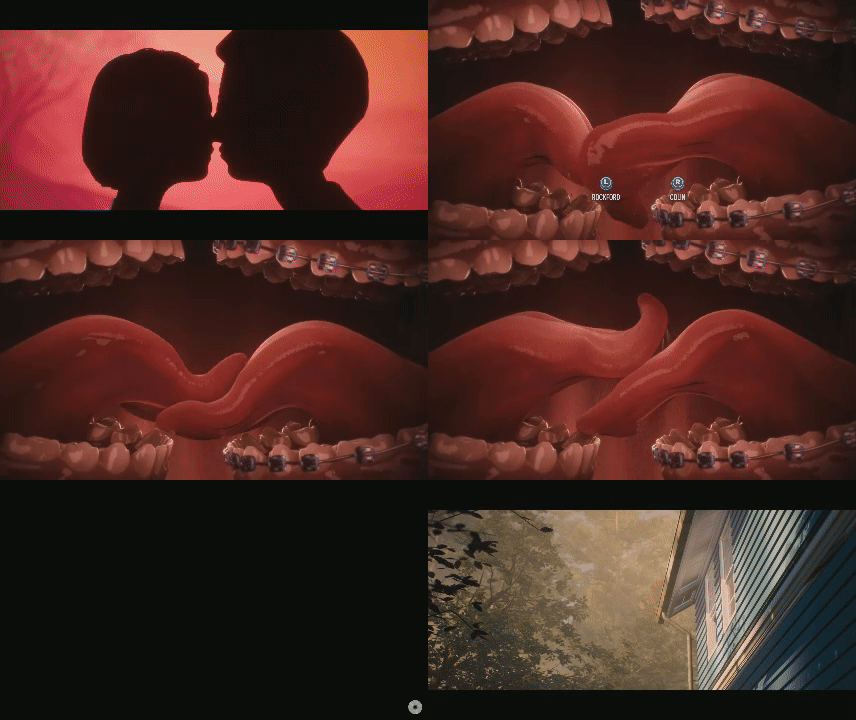
What has pushed Mixtape into viral territory is not just its nostalgic soundtrack or cinematic presentation, but one specific scene involving a teenager’s first kiss. The sequence has been widely described in previews and early discussions as intentionally awkward, exaggerated, and emotionally uncomfortable, so much so that it has been labeled by some players and critics as one of the “grossest” emotional moments in modern gaming.
The main keyword “Mixtape tries to capture the awkwardness of a teenager’s first kiss and succeeds, maybe a little too well. The Story Behind One Of The Grossest Video Game Scenes Of 2026” has become a recurring phrase in online discourse, highlighting how strongly the scene resonates with audiences.
The Story Behind Mixtape and Its Coming-of-Age Narrative Concept
At its core, Mixtape is a coming-of-age story. It explores adolescence not as a polished, cinematic memory but as something fragmented, embarrassing, emotional, and deeply personal.
The narrative follows a group of friends during their teenage years, each moment tied together through music that represents emotional milestones. Instead of presenting a linear plot, the game uses “memory tracks,” where each song unlocks a vignette tied to a specific emotional experience, first friendships, arguments, heartbreaks, and formative romantic encounters.
The developers at Beethoven & Dinosaur have described the project as an attempt to simulate how memory actually works. Rather than clean storytelling, Mixtape leans into emotional distortion, how embarrassment feels larger in memory, how small moments become monumental, and how awkward experiences often define personal identity more than heroic ones.
The first kiss scene fits directly into this philosophy. It is not meant to be romanticized. Instead, it is intentionally structured to reflect the confusion, physical awkwardness, and emotional overload that often define early teenage intimacy.
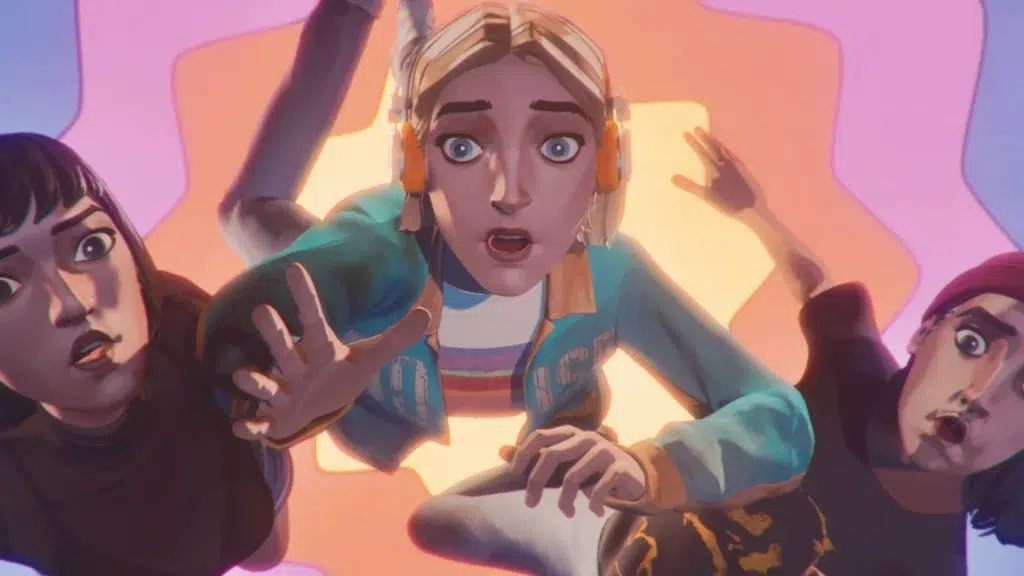
How Mixtape Captures Teenage Awkwardness in Interactive Storytelling
One of the defining features of Mixtape is its interactive storytelling approach. Instead of relying solely on cutscenes, players actively participate in emotional moments through simple but symbolically charged mechanics.
Teenage awkwardness is not just shown, it is played.
For example, dialogue choices are often delayed or interrupted, reflecting the hesitation of adolescence. Movement can feel slightly exaggerated or uncoordinated during emotionally intense scenes. Camera angles shift in uncomfortable ways, mimicking the lack of self-awareness many teenagers experience during formative moments.
The first kiss sequence is structured around these principles. Rather than presenting a smooth romantic animation, the game reportedly uses awkward timing, unpredictable inputs, and exaggerated physical feedback to simulate the nervousness and confusion of the moment.
This is where the controversy and fascination arise. Players are not simply watching discomfort, they are actively participating in it.
Why the First Kiss Scene in Mixtape Shocked Players in 2026
The first kiss scene in Mixtape has gained attention because it intentionally avoids romantic idealization. Instead, it focuses on realism, specifically the kind of realism that many people remember but rarely see represented in games.
According to preview impressions and developer commentary, the scene emphasizes:
- Hesitation and miscommunication between characters
- Physical awkwardness and timing mismatches
- Overwhelming sensory focus (sound, breath, movement)
- Emotional confusion rather than romantic clarity
The result is a sequence that feels intentionally uncomfortable. Some players have described it as “too real,” while others have called it emotionally difficult to watch or participate in.
This reaction is exactly what the developers intended. The goal was not to create a traditionally “beautiful” romantic moment, but to replicate the emotional intensity of adolescence, where even small experiences can feel overwhelming and embarrassing.
The Design Philosophy Behind Mixtape’s Gross-Out Emotional Realism
The term “gross-out emotional realism” has been used in discussions about Mixtape to describe its approach to uncomfortable authenticity. Unlike traditional narrative games that smooth over awkwardness, Mixtape amplifies it.
The design philosophy is rooted in three core principles:
- Emotional exaggeration – feelings are amplified beyond realism to match how they are remembered
- Sensory discomfort – visuals and audio are designed to create unease during intimate moments
- Memory distortion – events are presented as imperfect reconstructions rather than objective reality
The first kiss scene embodies all three. Instead of presenting intimacy as clean or cinematic, it is framed as a chaotic, emotionally overloaded memory that the player must navigate.
This approach challenges traditional gaming conventions, where intimacy is often stylized or idealized. Mixtape instead leans into the messiness of human experience.

How Beethoven & Dinosaur Created the Infamous Tongue-Controlled Minigame
One of the most talked-about mechanics in the first kiss sequence is an unusual interactive element often described in previews as a “tongue-controlled minigame.” While interpretations vary, the design concept is less about literal control and more about simulating awkward coordination during intimacy.
Beethoven & Dinosaur reportedly designed this segment to break player expectations. Instead of smooth animation or simple QTE prompts, players must manage timing, positioning, and reaction-based inputs that intentionally feel uncomfortable or uncoordinated.
The goal is not to simulate realism in a technical sense, but emotional realism, the kind of confusion and lack of coordination that can occur during a first kiss.
By introducing mechanical friction into an emotional moment, the developers force players to experience the same awkwardness the characters feel.
The Influence of 90s Nostalgia on Mixtape’s Visual and Emotional Tone
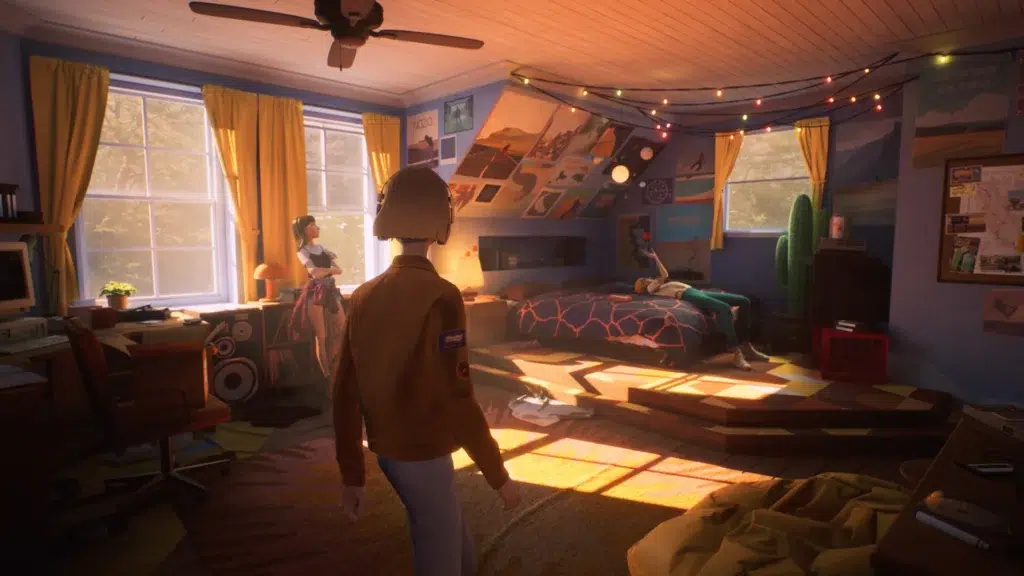
Mixtape is heavily influenced by 1990s culture, from its soundtrack to its visual presentation. The game uses a stylized aesthetic reminiscent of analog media, including VHS textures, film grain, and saturated color palettes.
This nostalgia is not just decorative, it is narrative.
The 90s setting shapes the emotional tone of the game, reflecting a time when teenage communication was less mediated by digital devices and more grounded in physical presence. This amplifies the awkwardness of scenes like the first kiss, where there is no digital buffer between emotion and experience.
The soundtrack, a central pillar of the game, reinforces this emotional framing. Each track is carefully chosen to evoke specific memories and emotional states, turning music into a narrative device rather than background decoration.
Why the Mixtape Awkward Kiss Scene Feels More Real than Most Video Games
What sets the Mixtape first kiss scene apart from other games is its refusal to sanitize emotional experience.
Most video games treat romance as either idealized or comedic. Mixtape instead occupies a middle ground where emotional authenticity takes priority over comfort.
Several factors contribute to this perception of realism:
- Imperfect timing between characters
- Unpolished emotional responses
- Lack of cinematic framing
- Player involvement in awkward interaction
By removing the “filter” typically used in games, Mixtape creates a sense of vulnerability that feels closer to real memory than scripted fiction.

How Music Shapes Emotional Storytelling in Mixtape Gameplay
Music is not just an aesthetic feature in Mixtape, it is the structural foundation of the game.
Each narrative segment is tied to a specific song that influences pacing, tone, and emotional framing. The soundtrack acts as a memory trigger, shaping how events are experienced and remembered.
During the first kiss scene, music plays a crucial role in amplifying emotional tension. Instead of guiding players toward romance, the soundtrack often contrasts the awkwardness on screen, creating emotional dissonance.
This technique reinforces the idea that memory is not harmonious, it is layered, contradictory, and emotionally complex.
Player Reactions to Mixtape’s Most Uncomfortable Interactive Moment
Early reactions to the first kiss sequence have been highly polarized.
Some players appreciate the authenticity and emotional bravery of the design, praising its willingness to depict adolescence without romantic filters. Others find the scene uncomfortable to the point of disengagement, describing it as intentionally awkward in a way that challenges traditional gaming expectations.
Common reactions include:
- “This feels too real”
- “I had to pause because it was uncomfortable”
- “It perfectly captures teenage memory”
- “I’ve never felt awkwardness represented like this in a game”
The diversity of responses highlights the effectiveness of the design, it succeeds precisely because it provokes strong emotional reactions.
The Psychology of Embarrassment in Video Games Like Mixtape
Embarrassment is one of the most powerful emotional tools in storytelling, yet it is rarely used in interactive media.
Mixtape leverages psychological principles of embarrassment, including:
- Self-awareness amplification
- Social vulnerability simulation
- Memory intensification bias
- Emotional replay discomfort
By placing players inside an embarrassing moment, the game triggers empathetic discomfort. This creates a strong emotional imprint, making the experience memorable even if it is unpleasant.
The first kiss scene is a direct application of this principle, transforming embarrassment into gameplay.
Why Developers Chose to Exaggerate Intimacy in Mixtape’s Kiss Sequence
The exaggeration in Mixtape is intentional. Developers at Beethoven & Dinosaur have consistently emphasized that adolescence is not subtle in memory: it is exaggerated, emotional, and often distorted.
By exaggerating intimacy, the game reflects how teenage experiences are remembered rather than how they objectively occur.
The kiss sequence is not designed to be realistic in motion, but realistic in emotional memory. That distinction is key to understanding its design philosophy.
How Mixtape Blends Humor, Nostalgia, and Discomfort into One Scene
One of the most unique aspects of Mixtape is its ability to blend conflicting emotional tones within a single sequence.
The first kiss scene is not purely uncomfortable. It also contains humor, nostalgia, and emotional warmth beneath the awkward surface.
This tonal layering includes:
- Humorous timing failures
- Nostalgic visual framing
- Emotional sincerity beneath discomfort
- Sudden shifts between embarrassment and affection
This complexity mirrors real teenage experiences, where emotions rarely exist in isolation.
Comparisons Between Mixtape’s Awkward Scenes and Other Narrative Games
Compared to other narrative-driven games, Mixtape takes a far more experimental approach to emotional storytelling.
Where many games focus on cinematic romance or structured dialogue systems, Mixtape emphasizes unpredictability and emotional friction.
In contrast to traditional narrative titles, it:
- Avoids polished romantic arcs
- Embraces discomfort as gameplay
- Uses music as emotional structure
- Prioritizes memory distortion over realism
This makes it stand out as one of the most unconventional narrative games in recent years.

What the Mixtape First Kiss Scene Reveals About Teenage Memory and Storytelling
Ultimately, the first kiss scene in Mixtape is not just about romance or shock value. It is about memory itself.
Teenage memory is often nonlinear, exaggerated, and emotionally inconsistent. Moments that feel small in real time can become defining emotional anchors later in life.
The game uses this principle to reconstruct adolescence as a series of emotional impressions rather than structured events.
The awkward kiss scene represents:
- The intensity of first experiences
- The unpredictability of emotional memory
- The confusion of adolescent identity
- The blending of humor and discomfort in hindsight
It is not meant to be comfortable, it is meant to be remembered.
Frequently Asked Questions (FAQs)
- What is Mixtape about?
Mixtape is a coming-of-age narrative game that explores teenage memories through music-driven interactive storytelling. - Why is the first kiss scene controversial?
Because it intentionally portrays awkwardness and discomfort rather than romanticized intimacy. - Who developed Mixtape?
Beethoven & Dinosaur, the studio behind The Artful Escape. - Is Mixtape a rhythm game?
Not exactly, it uses music as a narrative and emotional structure rather than pure rhythm mechanics. - Why do players find the kiss scene uncomfortable?
Because it simulates emotional embarrassment and awkward physical interaction in a highly immersive way. - What makes Mixtape different from other narrative games?
Its focus on emotional realism, memory distortion, and music-driven storytelling. - Is the game meant to be funny or serious?
It blends humor, nostalgia, and emotional discomfort intentionally. - Why is music important in Mixtape?
Music acts as the emotional backbone of each memory-based sequence. - Does Mixtape use realistic graphics?
It uses stylized visuals influenced by 90s nostalgia rather than photorealism. - What is the main theme of Mixtape?
The complexity and awkwardness of adolescence and how memories shape identity.

Conclusion
Mixtape stands out in modern gaming for its bold exploration of adolescence through emotional realism, music-driven storytelling, and intentionally uncomfortable interactive design. The infamous first kiss scene exemplifies its core philosophy: that memory is not polished or cinematic, but messy, awkward, and deeply human. By embracing discomfort rather than avoiding it, Mixtape redefines how video games can represent emotional experience, making it one of the most discussed narrative titles of 2026.
Sources and Citations
- Beethoven & Dinosaur — Official studio website for Mixtape information, promotional materials, and developer background
- Mixtape — Official game page from Beethoven & Dinosaur with trailers, screenshots, and promotional details
- Annapurna Interactive — Official publisher page for Mixtape announcements, trailers, and marketing materials
- Annapurna Interactive YouTube — Official trailers and video promotional material for Mixtape
- Mixtape Official Reveal Trailer — Official promotional trailer from Annapurna Interactive
- Xbox Wire — Official announcement and showcase coverage for Mixtape
- Xbox Games Showcase — Official showcase source for early reveals, trailers, and promotional coverage
- Xbox YouTube — Official showcase trailers and gameplay videos, including Mixtape promotional footage
- PlayStation Blog — Official platform announcements and promotional coverage for upcoming indie games
- Steam — Mixtape store page for official description, screenshots, trailers, and release information
- IGN — Early preview coverage, trailer breakdowns, interviews, and gaming publication reporting
- GameSpot — Early gameplay coverage, trailers, previews, and showcase reporting
- Eurogamer — Preview coverage, indie game reporting, and event-based impressions
- GamesRadar+ — Preview articles, trailer coverage, and gaming showcase reporting
- TheGamer — Indie game coverage, previews, interviews, and feature articles
- Video Games Chronicle — Showcase news, announcement reporting, and industry coverage
- Polygon — Game previews, developer commentary, narrative design coverage, and indie game analysis
- Game Developer — Industry analysis, narrative design commentary, and developer-focused reporting
- GDC Vault — Developer talks and professional discussions on narrative design, storytelling, and indie game development
- GDC YouTube — Free developer talks on game narrative, design trends, and interactive storytelling
- DiGRA Digital Library — Academic research on games, interactive storytelling, memory, play, and narrative design
- Google Scholar — Academic search for memory distortion, nostalgia, and interactive storytelling in games
- ACM Digital Library — Academic research on interactive narrative, player memory, and game storytelling systems
- JSTOR — Academic articles on memory, media, narrative, and interactive storytelling theory
- Project MUSE — Scholarly research on narrative media, memory studies, and game studies
- Games and Culture — Academic journal covering game studies, narrative design, memory, identity, and cultural analysis
- Eludamos: Journal for Computer Game Culture — Academic game studies journal covering narrative, play, and cultural interpretation
- Well Played Journal — Academic and critical writing on game design, narrative experience, and player interpretation
- First Person Scholar — Academic and critical essays on games, narrative, memory, and interactive media
- Game Studies — Academic journal for video game research, including narrative design and interactive storytelling analysis
Recommendations
- Meta Is Reportedly Working on an AI Model of Mark Zuckerberg: The “CEO Clone” Explained
- Camera View Preservation in Blender: Why Use The View Keeper?
- Injustice 3 Rumor Explodes: Why NetherRealm’s Next Fighting Game Might Be a DC Comeback
- Scientists Make Breakthrough That Allows Lab-Grown Brain Cells To Play A Sort Of Video Game (UC Santa Cruz Cart-Pole Results Explained)
- Achieving a Painterly Look in Blender: Techniques to Make 3D Animations Appear Hand-Painted
- Speed Racer Finally Races Onto 4K Blu-ray in May With SteelBook Release
- Street Fighter Movie New Trailer Breakdown: Every Major Game Reference Spotted
- Ornatrix Guide: Best Hair and Fur Plugin for 3D Artists in Maya, 3ds Max, and Blender
- The Expanse: Osiris Reborn — Everything We Know So Far
- Poxel.io: Complete Guide to the Pixel FPS .io Game (How to Play, Weapons, Modes, Maps, Skins, and Settings)