










What is Hiro Finance and what does it do?
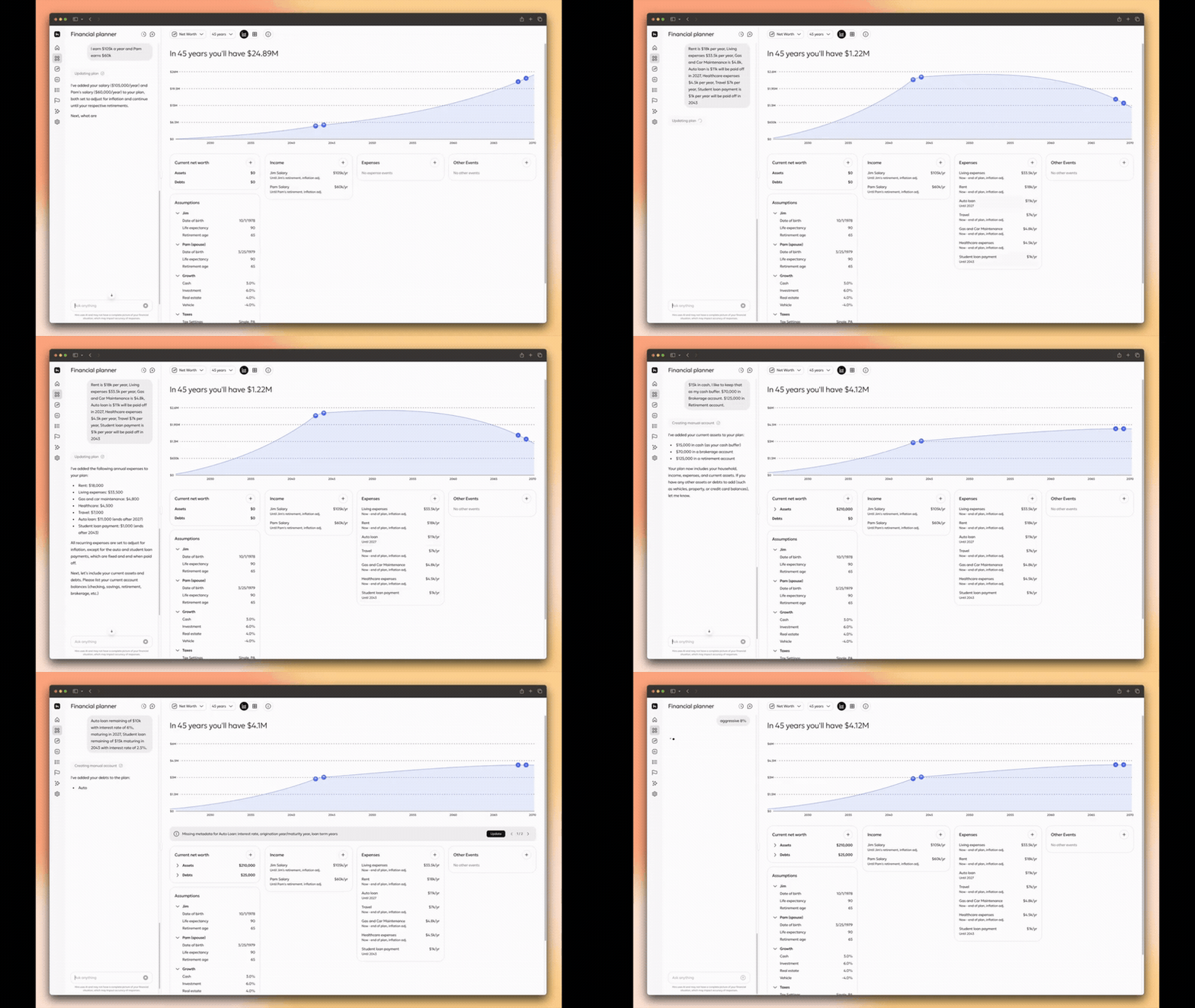
Hiro Finance is an AI-powered personal finance startup focused on helping users manage, understand, and optimize their money through automation and intelligent insights. The company developed tools that combine financial aggregation, budgeting, forecasting, and AI-driven recommendations into a single platform.
At its core, Hiro Finance aimed to function as a “financial co-pilot,” enabling users to:
- Connect bank accounts, credit cards, and investment portfolios
- Track spending patterns and categorize expenses automatically
- Generate personalized financial plans
- Forecast future cash flow based on income and habits
- Provide actionable recommendations to improve savings and reduce unnecessary expenses
Unlike traditional budgeting apps, Hiro Finance emphasized conversational AI interfaces, allowing users to ask questions like “Can I afford a vacation next month?” or “How can I save $10,000 this year?” and receive tailored responses.

When did OpenAI acquire Hiro Finance?
OpenAI acquired Hiro Finance in early 2026, marking its second startup acquisition within a single month. While exact financial terms of the deal were not publicly disclosed, the timing aligns with OpenAI’s aggressive expansion strategy into vertical AI applications—particularly in finance, productivity, and personal assistance.
The acquisition follows a growing trend of AI companies absorbing smaller, specialized startups to accelerate product development and gain domain expertise.
Why did OpenAI acquire Hiro Finance?
OpenAI’s acquisition of Hiro Finance appears to be driven by several strategic objectives:
- Expanding AI into personal finance: Financial decision-making is a high-value use case for AI assistants, and Hiro Finance brings specialized expertise.
- Strengthening ChatGPT capabilities: Integrating financial intelligence into ChatGPT enhances its utility as a daily assistant.
- Accelerating AI agent development: Hiro’s technology aligns with OpenAI’s push toward autonomous AI agents capable of handling complex, multi-step tasks.
- Acquiring talent and IP: The team behind Hiro Finance brings experience in fintech, machine learning, and user-centric financial design.
Ultimately, the acquisition reflects OpenAI’s ambition to move beyond general-purpose AI into highly specialized, real-world applications.
How Hiro Finance could improve ChatGPT for personal finance planning
The integration of Hiro Finance technology into ChatGPT could significantly expand its capabilities in personal finance planning. Potential improvements include:
- Real-time financial insights: ChatGPT could analyze user transactions and provide up-to-date recommendations.
- Automated budgeting: Users could receive dynamic budgets that adapt to their spending habits.
- Goal-based planning: AI could help users set and achieve financial goals like saving for a home or paying off debt.
- Scenario simulation: Users could explore “what-if” scenarios, such as job changes or major purchases.
- Conversational financial advice: Complex financial data could be simplified into easy-to-understand explanations.
This integration would position ChatGPT as a comprehensive financial assistant rather than just a conversational tool.
AI financial planning tools: what Hiro Finance was building
Hiro Finance was developing a suite of AI-driven tools designed to simplify financial management:
- Smart categorization engine: Automatically organizes transactions into meaningful categories
- Predictive cash flow modeling: Estimates future balances based on historical behavior
- Savings optimization algorithms: Identifies opportunities to increase savings without lifestyle disruption
- Debt management tools: Suggests optimal repayment strategies
- Conversational AI interface: Allows users to interact with their finances using natural language
These tools were built with a focus on accessibility, aiming to make financial planning intuitive even for users without financial expertise.
Who is Ethan Bloch (Hiro Finance founder)?
Ethan Bloch is the founder of Hiro Finance and a fintech entrepreneur with experience in building consumer-focused financial products. Before launching Hiro, Bloch worked in the startup ecosystem, focusing on simplifying complex financial systems through technology.
His vision for Hiro Finance centered on democratizing access to high-quality financial advice, making it available to anyone through AI. The acquisition by OpenAI highlights the value of his approach and the team he assembled.
Hiro Finance investors and funding (Ribbit, General Catalyst, Restive)
Hiro Finance attracted backing from prominent venture capital firms, including:
- Ribbit Capital
- General Catalyst
- Restive Ventures
These investors are known for supporting fintech innovation, and their involvement signals confidence in Hiro’s approach to AI-driven financial tools.
The startup raised early-stage funding to develop its platform, scale its engineering team, and refine its AI models before being acquired.

Will the Hiro Finance app shut down after the OpenAI acquisition?
In most acqui-hire scenarios, standalone products are either discontinued or gradually integrated into the acquiring company’s ecosystem. While no official announcement has confirmed the fate of the Hiro Finance app, likely outcomes include:
- Full shutdown with features absorbed into ChatGPT
- Partial integration into OpenAI’s existing tools
- Limited support period before discontinuation
Users of the Hiro platform may eventually transition to OpenAI-powered solutions offering similar or enhanced functionality.
What “acqui-hire” means in the OpenAI–Hiro Finance deal
An “acqui-hire” refers to an acquisition primarily aimed at bringing in a company’s talent rather than its product or revenue.
In the case of OpenAI and Hiro Finance:
- The engineering and product team is likely the main asset
- The underlying technology may be integrated into OpenAI systems
- The Hiro brand and app may not continue independently
This approach allows OpenAI to rapidly expand its expertise in financial AI without building a team from scratch.
OpenAI’s second startup acquisition in a month: what was the first deal?
The Hiro Finance acquisition is OpenAI’s second startup deal within a month, indicating a broader strategy of rapid expansion. The first acquisition involved another AI-focused startup, demonstrating OpenAI’s intent to consolidate talent and technology across multiple domains.
This pattern reflects increasing competition in the AI space, where speed and specialization are critical advantages.

OpenAI’s TBPN acquisition explained and why it matters
OpenAI’s earlier acquisition of TBPN (The Batch Processing Network) focused on infrastructure and data processing capabilities. TBPN specialized in optimizing large-scale AI workloads, making it easier to deploy and scale AI systems efficiently.
This acquisition matters because:
- It strengthens OpenAI’s backend infrastructure
- It supports the deployment of advanced AI agents
- It enables faster processing of complex tasks
Together with Hiro Finance, these acquisitions show a dual focus on both infrastructure and application-level innovation.
OpenAI’s strategy for AI agents in finance and budgeting
OpenAI is increasingly focused on developing AI agents capable of performing complex tasks autonomously. In finance, this could include:
- Managing budgets automatically
- Paying bills and scheduling transactions
- Monitoring subscriptions and canceling unused services
- Providing investment insights
- Alerting users to unusual spending patterns
By combining Hiro Finance’s expertise with its own AI models, OpenAI can accelerate the development of these capabilities.
Privacy concerns with AI-powered personal finance assistants
The integration of AI into personal finance raises significant privacy concerns:
- Data security: Financial data is highly sensitive and must be protected from breaches
- User consent: Clear permissions are required for data access and usage
- Transparency: Users need to understand how their data is being used
- Model training risks: Ensuring financial data is not improperly used to train AI models
Addressing these concerns will be critical for user trust and regulatory compliance.
AI in financial advice: regulation and compliance questions
AI-driven financial tools operate in a heavily regulated environment. Key considerations include:
- Compliance with financial regulations
- Avoiding unauthorized financial advice
- Ensuring accuracy of recommendations
- Liability for incorrect or harmful advice
Regulators may require AI systems to meet strict standards, especially if they influence financial decisions.
What’s next for OpenAI acquisitions in 2026?
OpenAI’s recent acquisitions suggest a continued focus on:
- Vertical AI applications (finance, healthcare, productivity)
- Infrastructure improvements for scaling AI systems
- Talent acquisition through acqui-hires
- Expansion into consumer-facing tools
Further acquisitions in 2026 are likely as OpenAI competes with other major AI companies to build comprehensive ecosystems.

Frequently Asked Questions (FAQs)
- What is Hiro Finance?
Hiro Finance is an AI-powered personal finance startup focused on budgeting, forecasting, and financial planning tools. - Why did OpenAI acquire Hiro Finance?
To enhance its AI capabilities in personal finance and integrate financial planning features into ChatGPT. - Will Hiro Finance continue to operate independently?
It is unlikely; the app may be shut down or integrated into OpenAI products. - What is an acqui-hire?
An acquisition primarily aimed at hiring a company’s team rather than its product. - Who founded Hiro Finance?
Ethan Bloch founded Hiro Finance. - How could this affect ChatGPT users?
Users may gain access to advanced financial planning tools within ChatGPT. - What was OpenAI’s first acquisition that month?
OpenAI previously acquired TBPN, a company focused on AI infrastructure. - Are there privacy concerns with AI finance tools?
Yes, especially regarding data security, transparency, and user consent. - Will AI replace human financial advisors?
AI may complement advisors but is unlikely to fully replace them due to regulatory and trust factors. - What does this mean for the future of AI in finance?
It signals rapid growth and deeper integration of AI into everyday financial decision-making.

Conclusion
OpenAI’s acquisition of Hiro Finance marks a significant step in the evolution of AI-powered personal finance. By combining Hiro’s specialized tools with its own advanced models, OpenAI is positioning ChatGPT as a comprehensive assistant capable of handling complex financial tasks. This move also highlights the broader trend of AI companies expanding into domain-specific applications while addressing challenges related to privacy, regulation, and user trust. As OpenAI continues its acquisition strategy in 2026, the integration of AI into financial planning is set to become more sophisticated, accessible, and impactful.
Sources and Citations
- Official OpenAI announcement confirming the acquisition of TBPN to expand global AI communication and support independent media initiatives.
https://openai.com/index/openai-acquires-tbpn/ - Reuters report detailing OpenAI’s acquisition of TBPN, its strategic purpose, and influence on AI industry communication and positioning.
https://www.reuters.com/business/media-telecom/openai-acquires-technology-talk-show-tbpn-surprise-move-2026-04-02/ - TechCrunch coverage explaining OpenAI’s first media acquisition and TBPN’s role in tech and business discourse.
https://techcrunch.com/2026/04/02/openai-acquires-tbpn-the-buzzy-founder-led-business-talk-show/ - Economic Times report outlining OpenAI’s 2026 acquisition strategy, including fintech startup Hiro backed by Ribbit Capital, General Catalyst, and Restive Ventures.
https://m.economictimes.com/tech/technology/acquisition-count-rises-inside-openais-major-deals-in-2026/articleshow/130264484.cms - Background on Ribbit Capital highlighting its focus on fintech investments and regulatory filings through the SEC.
https://en.wikipedia.org/wiki/Ribbit_Capital - Wired analysis discussing OpenAI’s TBPN acquisition as part of a broader strategy to shape public perception and AI discourse.
https://www.wired.com/story/openai-acquires-tbpn-buys-positive-news-coverage/ - Financial Times analysis noting OpenAI’s expansion into media and infrastructure positioning through TBPN acquisition and broader AI strategy.
https://www.ft.com/content/4fe4972a-3d24-45be-b9fa-a429c432b08e - Venture-backed fintech context showing how firms like Ribbit Capital, General Catalyst, and Restive Ventures fund AI-driven personal finance tools and infrastructure.
https://m.economictimes.com/tech/technology/acquisition-count-rises-inside-openais-major-deals-in-2026/articleshow/130264484.cms
Recommended
- Project Hail Mary Review: A Spoiler-Free Guide to the New Sci-Fi Event
- All katsu curry recipes in Romeo Is a Dead Man: complete list, ingredients, buffs, and how to unlock them
- The Unity Engine Has Officially Started Supporting Steam: What It Means for Developers and Game Distribution
- What is the clipping range in Blender cameras?
- How do I make the camera follow a path in Blender?
- How do I focus the camera on an object in Blender?
- How Mega Cat Studios Adapted God of War Into a Retro Pixel Art Game
- Halo Campaign Evolved Master Chief DLC Requires Fanta Soda Despite No MTX Shop
- What Is Depth of Field in Blender, and How Do I Set It?
- Super Mario Bros. Wonder – Nintendo Switch 2 Edition + Meetup in Bellabel Park Review: Is the Switch 2 Upgrade Worth It?