










In This Article (7 sections)
Hydroelectric Turbine Blueprint, Fragment Locations, and Crafting in Subnautica 2
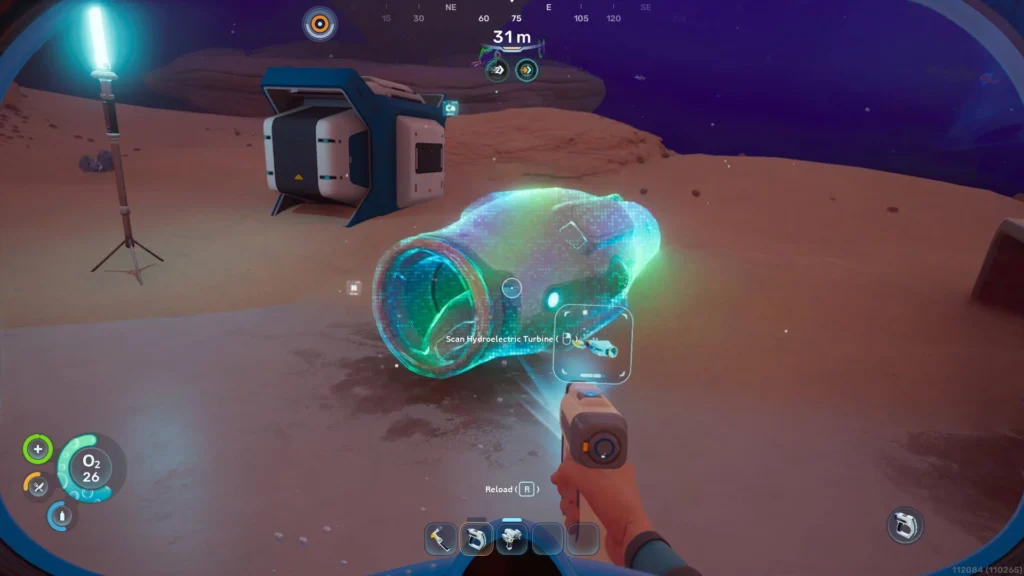
In Subnautica 2, the Hydroelectric Turbine is a mid game renewable power technology connected to underwater currents, deeper exploration, and more advanced base building. Unlike early power sources that can operate almost anywhere under suitable conditions, the Hydroelectric Turbine depends heavily on environmental water flow. This makes it particularly useful as players move beyond shallow survival bases and begin establishing permanent infrastructure in deeper areas where Solar Panels become less effective.
The Hydroelectric Turbine blueprint is tied to exploration and fragment scanning rather than one fixed coordinate. Players searching for it should concentrate on areas where strong currents form a major part of the environment, including deep trenches, underwater canyon networks, submerged river systems, and biome transition corridors. Wrecked industrial facilities, abandoned research sites, and advanced structures in these areas can contain turbine fragments, damaged components, data logs, or partial schematic information.
Common fragment locations include:
- Underwater canyon walls with strong directional currents: Fragments can appear along rock faces, current carved ledges, or around damaged equipment caught within the flow.
- Industrial wrecks near deep ocean trenches: These locations can contain power technology associated with former mining, research, or construction operations.
- Submerged river intersections: Areas where multiple currents converge are useful places to search around bends, drop offs, and debris deposits.
- Alien containment or research facilities: These structures may contain partial schematics, power technology, or data related to underwater energy systems.
- Thermal vent biome transitions: These areas combine environmental hazards with access to power related technology and useful crafting resources.
Fragment collection should be approached as a planned expedition because current heavy areas can include low visibility, dangerous creatures, thermal hazards, difficult terrain, and greater oxygen requirements. Players should bring improved oxygen tanks, Seaglides or other mobility equipment, spare batteries, Beacons, and reliable lighting. Marking promising current zones is particularly useful because the same areas containing fragments may later become suitable locations for working turbines.
Unlocking the Hydroelectric Turbine generally requires multiple fragment scans rather than a basic survival milestone. Players may need between two and four fragments depending on progression balance. Each successful scan contributes toward the complete schematic until the PDA has enough information to integrate the technology into the crafting system.
Progression can involve:
- Scanning turbine fragments in current heavy environments
- Unlocking mid tier fabrication and base technology
- Advancing far enough to obtain relevant PDA information
- Reaching deeper exploration zones with improved survival equipment
Once the required scans and progression conditions are complete, the Hydroelectric Turbine becomes available under the appropriate base utilities or power category. From that point, players can begin gathering materials and planning where the generator will connect to their base network.
The turbine is constructed through the appropriate Habitat Builder or fabrication interface and is deployed externally rather than inside an ordinary base room. Its environmental dependence makes placement especially important. Players should scout current zones before construction instead of building first and searching for a suitable location afterward.
Typical crafting materials include:
- Titanium: Provides the primary structural framework needed to withstand pressure and continuous current.
- Copper Wire: Supports electrical conduction between the turbine mechanism and the power network.
- Lubricant: Reduces friction within rotating blades, shafts, and other moving components.
- Advanced Wiring Kit: Regulates generated energy and integrates the turbine with more advanced electrical systems.
- Quartz or glass components: Provide protective casing and pressure resistant sections for internal systems.
More advanced configurations can also use lithium for reinforcement, nickel for greater deep sea durability, and Computer Chips for improved energy regulation. These requirements encourage exploration across several biome tiers rather than allowing players to build the complete system entirely from shallow resources.
Silver is particularly useful throughout this progression because electrical systems and advanced components frequently depend on it. Players can gather silver by mining sandstone outcrops in shallow caves, searching kelp biome walls, investigating wreckage containers, and using scanning tools to identify mineral rich areas. Stockpiling more silver than immediately required can reduce later delays because wiring and advanced electronics repeatedly consume it.
Construction itself follows a straightforward sequence. After completing the blueprint, gather the necessary materials, access the appropriate construction system, select the Hydroelectric Turbine from the power utilities category, and position it within a valid current.
The final placement should not be treated as temporary. A turbine in weak or still water can generate little or no useful energy, while one positioned correctly in a strong current can become an important part of a permanent deep sea power network.
Best Hydroelectric Turbine Locations, Power Output, and Base Connections
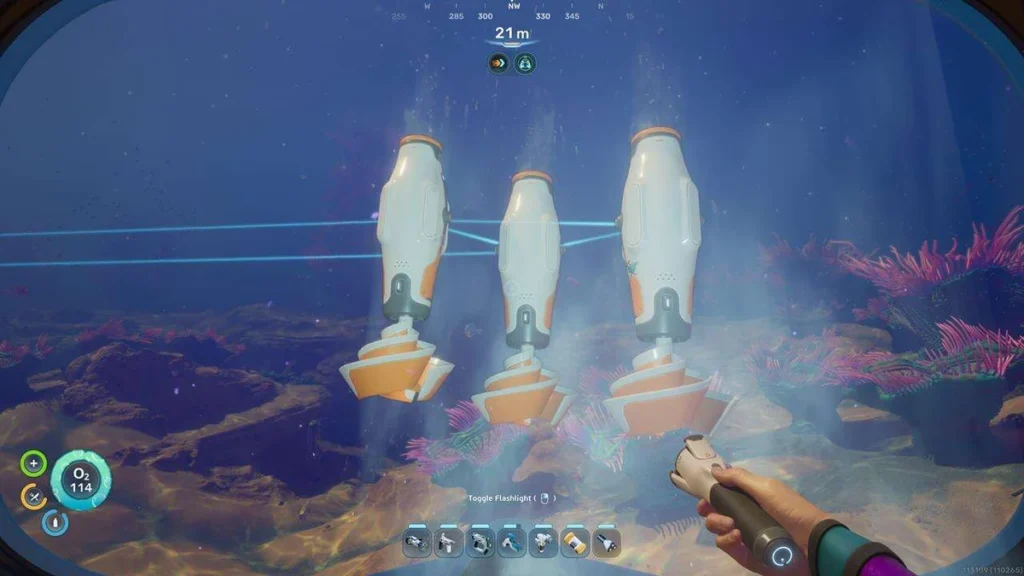
The best Hydroelectric Turbine locations are areas with strong, consistent, and directional water movement. Unlike Solar Panels, which depend primarily on sunlight and depth, turbines rely on how effectively they interact with currents. Proper placement therefore determines whether the structure becomes a weak supplemental generator or a dependable power source.
Useful turbine environments include:
- Deep ocean trenches: Narrow terrain can concentrate currents into predictable streams that support continuous generation.
- Underwater canyon corridors: Canyon walls funnel water through smaller spaces, creating strong directional flow.
- Submerged cave river systems: Underground water channels can provide steady currents suitable for deeper infrastructure.
- Biome transition funnels: Water movement can accelerate where different regions and terrain formations meet.
- Cliffside drop zones: Vertical currents along steep terrain can provide additional opportunities for turbine placement.
Players should avoid stagnant water, enclosed caverns with little movement, or visually active areas that do not provide meaningful directional flow. Safety also matters. A powerful current is less useful if the turbine sits directly inside a predator route, unstable thermal field, or difficult terrain that makes maintenance dangerous.
Current strength affects expected generation. Low current areas provide minimal power and may only be useful as supplementary sources. Moderate currents provide a steadier supply suitable for medium sized bases, particularly when several turbines operate together. Strong current zones provide the greatest continuous generation and are better suited to advanced fabrication, larger habitats, and deep exploration outposts.
The major advantage over Solar Panels is consistency. Hydroelectric generation does not depend on daylight, surface proximity, or night cycles as long as the turbine remains inside a usable current. This becomes increasingly valuable as bases move deeper into environments where sunlight becomes weak or unavailable.
Solar Panels remain practical for shallow bases and early outposts because they are simple and relatively inexpensive. Hydroelectric Turbines become more attractive once players need:
- Continuous power generation
- Reliable deep sea energy
- Reduced dependence on sunlight
- Greater scalability for large bases
- Stable power for advanced crafting and infrastructure
The strongest current is not always the best location for the main habitat. Current zones can be narrow, dangerous, difficult to navigate, or surrounded by environmental hazards. Power Transmitters solve this problem by allowing turbines to remain in productive locations while the base is constructed somewhere safer.
A Power Transmitter network begins with a node positioned close enough to receive energy from the turbine. Additional transmitters can then extend the connection across longer distances until the final node reaches the base power grid.
An effective setup involves:
- Place the turbine inside a productive current.
- Confirm that it is generating power.
- Position the first Power Transmitter near the generator.
- Add additional transmitters as needed across the route.
- Maintain a reliable connection between each node.
- Connect the final transmitter to the base power system.
Terrain should be considered while creating the chain. Thick rock formations, complicated cave bends, or excessive distances can make the route harder to maintain. Beacons can help mark remote turbines and transmitter lines when the network extends through deep or visually confusing environments.
Strong base locations therefore sit near current zones rather than directly inside them. Canyon edges provide access to concentrated flow while leaving the main habitat on stable terrain. Deep trench borders can combine power access with valuable resource routes, while modular outposts can use transmitter systems to draw energy from nearby current channels.
Players should also consider future expansion when choosing a location. A base that initially needs power only for oxygen, lighting, and fabrication may later contain Scanner Rooms, vehicle docks, storage areas, advanced crafting systems, and additional infrastructure. Leaving room for expansion prevents the power network from becoming difficult to reorganize later.
A well planned hydroelectric setup separates power generation from living space. Turbines remain in strong currents, transmitters carry the energy across safer terrain, and the main base remains accessible enough for frequent crafting, storage, and vehicle use.
Hydroelectric Turbine Problems, Placement Mistakes, and Efficient Power Strategies
Hydroelectric Turbines are more dependent on environmental conditions than simpler generators, so incorrect placement is one of the most common reasons they fail to perform properly. A turbine can be fully constructed yet produce little or no power if the surrounding water does not qualify as an active current zone.
If a Hydroelectric Turbine is not working, players should first confirm that the water is genuinely flowing rather than merely showing decorative movement. Moving the turbine slightly farther into the current or rotating it toward the direction of flow can improve performance.
Players should also check the complete power route. A functioning turbine will not help a distant base if the Power Transmitter chain is incomplete or the final connection does not reach the base grid. Each transmitter should be checked individually when troubleshooting a long route.
Nearby terrain and structures can also interfere with operation. Rocks, wreckage, base modules, or other environmental objects may obstruct the turbine blades or prevent proper alignment. Leaving open space around the structure reduces this problem.
Common fixes include:
- Confirm the turbine is inside an active current.
- Reposition it toward stronger water flow.
- Rotate the turbine to improve alignment.
- Check for terrain or structural obstructions.
- Verify the complete Power Transmitter chain.
- Confirm the final transmitter reaches the base grid.
- Make sure the blueprint and construction process were completed correctly.
Several broader mistakes can also reduce the effectiveness of hydroelectric infrastructure. Placing turbines in still water is the most obvious problem, but players can also waste resources by constructing generators before planning how the energy will reach the base.
Ignoring current direction can reduce generation, while building the base too far from the turbine without preparing enough transmitters can leave an incomplete network. Players should gather spare construction materials before starting long transmission routes so they do not have to repeatedly interrupt the project.
Overbuilding the base before establishing sufficient generation is another common problem. A small turbine setup may comfortably support essential systems but struggle once players add multiple high consumption modules. Power infrastructure should therefore expand alongside the habitat rather than after energy shortages become severe.
A practical progression path begins with Solar Panels for shallow survival bases. Bioreactors can provide fuel based energy where sunlight becomes less dependable, while thermal generators become valuable around geothermal regions. Hydroelectric Turbines then provide another renewable option for deeper bases positioned near suitable currents.
The best approach depends on the surrounding biome. A shallow base with excellent sunlight may have little reason to replace Solar Panels immediately, while a deep canyon habitat beside a strong current can benefit substantially from hydroelectric generation.
Players planning a long term turbine network should scout before building. Identify strong currents, check nearby predators and environmental hazards, determine where the main habitat will sit, and map the Power Transmitter route before committing materials.
Beacons are useful for marking both productive current zones and transmitter paths. They make maintenance easier when the network stretches across trenches, cliffs, or multiple biome boundaries.
Resource preparation should also account for future expansion. Titanium, copper, silver, lubricant, advanced electronics, lithium, and other materials can all become important as additional turbines, transmitters, reinforcements, and base modules are constructed.
The most effective Hydroelectric Turbine setup therefore combines four factors: strong current, safe placement, reliable transmission, and sufficient generation for the intended base size. Focusing on only one of these factors can produce an inefficient system even when the turbine itself is functioning correctly.
When properly planned, hydroelectric generation becomes especially useful for permanent deep sea infrastructure. It eliminates dependence on daylight, reduces the need for manually supplied biological fuel, and allows players to position power generation away from the main habitat.
This flexibility makes Hydroelectric Turbines particularly valuable around canyon edges, trench systems, cave rivers, and other environments where strong currents exist close to useful exploration or resource areas. By combining turbines with Power Transmitters and carefully positioned bases, players can create renewable power networks capable of supporting deeper and more demanding stages of Subnautica 2 progression.

Frequently Asked Questions (FAQs)
- What is the Hydroelectric Turbine in Subnautica 2?
The Hydroelectric Turbine is a renewable power generator that converts underwater currents into electricity for base systems. It becomes particularly useful during mid game and deep water progression, where sunlight becomes weaker and Solar Panels are less practical for powering permanent underwater infrastructure. - Where do I find turbine fragments?
Turbine fragments are typically found around deep water wrecks, underwater canyon systems, current heavy biomes, abandoned research facilities, and damaged industrial areas. Players should focus on places with noticeable directional water movement and carefully search nearby debris, machinery, containers, and structures for scannable components. - How many fragments are needed?
The blueprint usually requires multiple fragment scans, often around two to four depending on progression design. Each scanned fragment contributes additional schematic information until the PDA has enough data to complete the Hydroelectric Turbine blueprint and add it to the appropriate construction or power category. - Can I use turbines in shallow water?
Yes, Hydroelectric Turbines can be used in shallow water if the location contains a sufficiently strong current. However, shallow areas with weak or stagnant water may produce limited power, making Solar Panels a simpler and more practical choice for many early bases near the surface. - Do turbines work at night?
Yes, Hydroelectric Turbines can continue generating electricity during both day and night because they depend on moving water rather than sunlight. As long as the turbine remains correctly positioned in an active current and connected to the base power grid, lighting conditions do not interrupt generation. - What is the best biome for turbines?
The best locations include deep canyons, trench borders, submerged river systems, biome transition funnels, and other corridors where water moves consistently in a clear direction. These environments provide the sustained current needed for reliable generation, especially when supporting larger deep sea bases. - Why is my turbine not working?
Poor placement is usually the main cause. The turbine may be sitting in water that is too calm, facing away from the current, obstructed by nearby terrain, or disconnected from the base power network. Repositioning or rotating it within stronger flow and checking its power connection can often restore operation. - Do I need transmitters?
Power Transmitters are only necessary when the turbine is too far from the base for a direct connection. They allow players to position turbines inside stronger current zones and carry the generated energy across a greater distance, making it possible to keep the main habitat in a safer and more convenient location. - Is silver required?
Silver is commonly needed for electrical components such as Wiring Kits and other advanced power systems associated with hydroelectric infrastructure. Even if the exact turbine recipe varies, maintaining a supply of silver is useful because several parts of the broader electrical crafting chain can depend on it. - Are turbines better than solar panels?
Hydroelectric Turbines are generally more useful for deeper progression because they provide continuous power without relying on sunlight or surface proximity. Solar Panels remain effective for shallow early bases, while turbines become increasingly valuable for deep habitats and larger infrastructure located near strong underwater currents.

Conclusion
The Hydroelectric Turbine in Subnautica 2 represents a major advancement in underwater energy systems, bridging the gap between early survival power solutions and advanced deep sea infrastructure. By focusing on fragment collection, optimal placement in strong current zones, and proper power transmission setup, players can establish stable and efficient energy networks that support long term exploration and base expansion.
Sources and Citation
- Subnautica Wiki (General Mechanics Reference)
https://subnautica.fandom.com/wiki/Subnautica_Wiki - Subnautica Exploration and Biomes
https://subnautica.fandom.com/wiki/Biomes
Recommended
- Borderlands 4 Official Takedown and Bounty Pack 3 Teaser Trailer: Release Date, Hadron Abyss Raid, and a Zane to Kill for DLC
- Devil May Cry’s Dante – Complete Character Guide and Breakdown
- In 2025, Vietnam Residents Spent $825 Million on Mobile Games: Key Market Trends and 2026 Outlook
- A Hacker Has Allegedly Stolen Employee Data From Nintendo
- Valve Writer Erik Wolpaw Says Some At The Studio Have Been Experimenting With AI Tools: What It Could Mean For Future Valve Games
- Gears of War E-Day Gets Its Own Limited Edition Xbox Controller
- Motion Capture Suit Costs: Price Comparison and Best Options
- KeyShot releases KeyShot Studio 2026.1: new features, release notes, and system requirements
- Anya Taylor-Joy Joins The Lord of the Rings: The Hunt for Gollum as New Elf Seren – Everything We Know



































































































