







In This Article (8 sections)
Tesla Q3 2026 Earnings, Profit Decline, Margins, and Cash Flow
Tesla’s Q3 2026 earnings show a company generating substantial revenue and positive cash flow while absorbing much higher spending on artificial intelligence, autonomy, robotics, vehicles, batteries, and related development programs. Revenue was $28.046 billion, compared with $28.095 billion a year earlier, while GAAP net income attributable to common shareholders fell 43 percent to $787 million.
Diluted GAAP earnings per share were $0.22, adjusted diluted earnings were $0.48, and operating margin declined to 2.6 percent from 5.8 percent. Operating income fell 56 percent year over year to $718 million, which is a different measure from the decline in shareholder net income because operating income excludes items such as interest and income taxes. Adjusted earnings still exceeded the $0.45 analyst estimate reported by Teslarati, showing how a company can beat a particular forecast while still reporting substantially weaker profitability than a year earlier.
The clearest explanation for the operating-income decline is the gap between the improvement in gross profit and the increase in operating expenses. Tesla’s gross profit increased by $440 million year over year, while operating expenses rose by $1.346 billion. That additional spending exceeded the gross-profit improvement by $906 million, matching the decline in operating income from $1.624 billion to $718 million. The arithmetic indicates that the main pressure came after gross profit, where development, administration, facilities, software, employee compensation, and other operating costs absorbed the improvement generated by Tesla’s products and services. Better manufacturing economics alone may therefore be insufficient to restore previous operating margins if the broader expense base continues expanding rapidly.
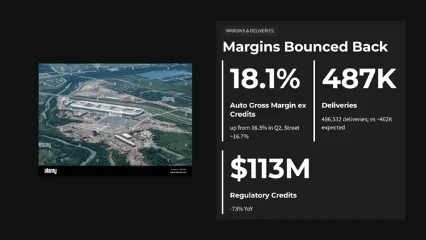
Automotive performance needs to be separated from companywide profitability. Tesla delivered 486,532 vehicles and produced 464,391, with Model 3 and Model Y accounting for 478,237 deliveries and other models contributing 8,295. Automotive revenue fell 3 percent to $20.560 billion, while automotive gross margin excluding regulatory credits was approximately 18.1 percent. That margin is much higher than Tesla’s 2.6 percent companywide operating margin because automotive gross margin measures the economics of the automotive business before broader operating expenses and the effects of other segments. A healthy product-level gross margin can therefore coexist with a thin companywide operating margin when research, administration, and other operating commitments are large.
Vehicle deliveries also cannot be interpreted in isolation from pricing and mix. The revenue produced by each delivery depends on model selection, geographic pricing, financing, incentives, software purchases, and foreign exchange effects. Delivering more vehicles than Tesla produced during the quarter does not by itself prove unusually strong demand or a production problem because vehicles built earlier can be delivered later and shipping schedules can shift the relationship between production and handovers.
Tesla also said it finished the quarter with its largest passenger vehicle backlog in four years and identified battery availability as a production constraint, but it did not publish a numerical backlog total. That limits the ability to independently measure the size, composition, or durability of the outstanding orders.
Regulatory credits were another important profitability factor. Automotive regulatory credit revenue fell to $113 million from $417 million a year earlier, and Tesla disclosed a $475 million revenue reversal involving the contractual return of previously delivered credits following restrictions affecting certain programs. That reversal is already part of the reported figures and should not be added again as though it were an additional loss outside the quarter. Regulatory credits depend on program rules, other manufacturers’ obligations, and contractual arrangements, which makes them less predictable than ordinary vehicle sales. The quarter therefore increases the importance of judging whether Tesla’s underlying automotive products can generate stronger earnings with less support from credit revenue.
Energy storage also contributed differently depending on whether the focus is gross margin or gross profit dollars. Tesla deployed 13.7 gigawatt-hours of energy storage, while energy generation and storage revenue fell 16 percent to $2.881 billion. Gross profit in the segment declined to $954 million from $1.073 billion, even though gross margin improved to 33.1 percent from 31.4 percent. This is possible because a business can earn a higher percentage margin on a smaller revenue base while still generating fewer total profit dollars. Tesla also disclosed $526 million of tariff refunds reducing energy costs and $339 million of refunds owed to customers reducing energy revenue, making simplistic revenue-per-gigawatt-hour calculations difficult to interpret.
Tesla remained cash-flow positive despite weaker operating profitability. Operating cash flow was $6.263 billion, capital expenditure reached $4.732 billion, and Tesla reported $1.531 billion in free cash flow under its stated definition. Free cash flow should not be confused with net income because accounting earnings include items such as depreciation and stock-based compensation, while working-capital movements and capital spending affect cash differently. Capital expenditures also reduce cash when paid but generally affect earnings over a longer period through depreciation rather than as an immediate operating expense. Management revised its 2026 capital expenditure expectation to approximately $20 billion, leaving the broader question of whether sustained operating cash generation can continue supporting Tesla’s expanding investment requirements.

Tesla R&D, Super Intelligence, Optimus, Cybercab, and Robotaxi Spending
Tesla’s research and development expenses rose to approximately $2.76 billion from $1.63 billion a year earlier, an increase of 69 percent. The company attributed the increase primarily to Super Intelligence and programs involving Optimus, silicon development, batteries, new vehicles, and higher stock-based compensation. That range matters because describing the entire increase as spending on one AI model would be inaccurate. Tesla is developing software, computing hardware, physical products, batteries, manufacturing systems, and robotics at the same time. These activities can raise current expenses well before they create identifiable revenue.
Tesla uses the term Super Intelligence, or SI, to describe its work on advanced intelligence and autonomy. Its SI and robotics materials connect that effort to vision, planning, computing hardware, and systems intended to interact with the physical world. The quarterly update included a target of reaching 400 megawatts of SI training compute by the end of 2026 for vehicle and humanoid autonomy work. That target describes infrastructure capacity, not a direct measure of intelligence, product readiness, or commercial success. The financial question is whether larger computing resources eventually produce more dependable autonomy, better robot task completion, lower failure rates, or cheaper service delivery.
Optimus illustrates the gap between technical development and commercial return. Tesla said Optimus production had begun in Fremont, although manufacturing remained in an early ramp, while Elon Musk placed anticipated deliveries to outside companies around the end of 2027. Management also acknowledged continued work on the robot’s design, AI, reliability, and useful operating life. A commercially valuable robot needs more than a convincing demonstration because industrial customers will evaluate repeatable task performance, productive hours, maintenance, reliability, integration costs, and economic savings. Tesla does not publish a standalone Optimus profit-and-loss statement, so the quarter does not support assigning a precise portion of the profit decline to the robot program alone.
Cybercab introduces a different spending model because Tesla is building not only a vehicle but also a transportation service. The company said Cybercab began providing Robotaxi rides in Austin on September 3, 2026. Operating such a network requires vehicle production, software, charging, maintenance, fleet coordination, and the ability to position vehicles where paying customers need them. Retaining vehicles in a fleet also changes the timing of returns compared with selling them directly because Tesla would need to recover vehicle costs gradually through service revenue. Useful long-term measures would therefore include paid utilization, revenue per operating vehicle, maintenance requirements, and cost per mile rather than fleet size alone.
Tesla’s target for customer participation in the Robotaxi network now extends into Q2 2027. During the earnings call, AI executive Ashok Elluswamy linked the plan to the V15 software release and integration with geographic operating boundaries and Tesla’s fleet-management systems. The target concerns initial customer vehicles entering Tesla’s managed Robotaxi fleet, not a promise that every privately owned Tesla will become fully autonomous on every road during that quarter.
Tesla’s current consumer product remains Full Self-Driving (Supervised), which the company’s support materials say requires an attentive driver and does not make the vehicle autonomous. The Q2 2027 target therefore matters financially because commercial participation determines when development spending might begin generating additional fleet revenue, but it remains a management expectation dependent on execution.
The broader timing challenge is that Tesla incurs substantial development costs before these programs generate mature external revenue. R&D expenses affect the income statement as they are incurred, while capital expenditure on long-lived equipment follows a different accounting schedule. This prevents development spending, capital spending, and future commercial returns from being treated as though they all affect profit at the same time. Tesla can therefore experience lower present operating income while building assets and capabilities intended for later products. Whether that tradeoff creates shareholder value will depend on how reliably the company converts technical progress into scalable and profitable commercial activity.

FSD, Energy, Backlog, and Tesla’s Evolving AI Revenue Strategy
Tesla’s reported active FSD subscription measure reached 1.74 million, up 67 percent year over year, but the figure combines customers who paid upfront with monthly subscribers while excluding free trials. It should therefore not be interpreted as 1.74 million identical recurring monthly payments. The distinction demonstrates a broader problem in evaluating Tesla’s AI businesses because user adoption, recognized revenue, recurring revenue, and profitability measure different things. A large user base can demonstrate interest without revealing exactly how much recurring income is produced or how durable that income will be. Subscription economics ultimately depend on realized pricing, retention, support costs, and whether customers continue finding the product useful enough to pay for.
Tesla’s wider strategy connects software, physical products, manufacturing, and service businesses through shared capabilities in computing and autonomy. In theory, advances in silicon, training infrastructure, vision systems, and software could support vehicles, Robotaxi, and Optimus simultaneously. That creates a possible efficiency advantage because one underlying capability might contribute to several future revenue streams. However, shared technology does not eliminate the separate engineering and commercial requirements of each business. A system suitable for supervised driving, an autonomous fleet, and a humanoid robot still needs to meet different reliability, operational, and customer-value standards.
The same need for separation applies to the energy business. Energy remained profitable at the gross-profit level, but its lower gross-profit contribution relative to the prior year gave Tesla less support against growing operating expenses. Increased storage deployment did not translate automatically into higher quarterly revenue because timing, project mix, pricing, and tariff adjustments affected the reported results. This illustrates why physical output measures and financial outcomes need to be examined together. Greater deployed capacity is economically valuable only if it produces durable revenue and adequate profit after direct and indirect costs.
Tesla’s backlog also supports the company’s expansion narrative without resolving the profitability question. Management said the passenger-vehicle backlog was the largest in four years, but backlog is not recognized revenue and does not reveal which models, regions, prices, or incentives dominate those outstanding orders. Battery availability was identified as a production constraint, showing that demand cannot be converted into deliveries unless the required components and configurations are available. A factory can have unused capacity while still being constrained by a particular battery, supplier, or regional configuration. The useful test is whether outstanding orders convert into deliveries quickly and profitably while preserving acceptable margins.
Automotive gross margin, operating margin, free cash flow, and AI adoption should therefore be interpreted together rather than used as substitutes for one another. Product margins indicate how much Tesla earns before broader operating expenses, while operating margin reveals how much remains after the company funds its wider organization. Free cash flow provides information about internal funding capacity, while FSD usage and backlog indicate potential demand without proving future profitability. No single metric resolves whether Tesla’s present spending is economically justified. The key question is whether the company’s expanding AI and robotics activities eventually add revenue and gross profit faster than the cost base required to create and operate them.

Tesla’s 2027 Execution Test for Robotaxi, Optimus, AI, and Future Profitability
Tesla’s most important financial challenge for 2027 is whether its new businesses can begin producing revenue and gross profit quickly enough to offset the expense required to develop them. Continued increases in R&D, computing infrastructure, robotics, software, batteries, and manufacturing would be easier to sustain if FSD adoption, fleet activity, vehicle sales, and other products generate expanding economic contributions. Growth quality matters as much as headline revenue because sales supported by temporary incentives or unusual accounting items may be less durable than revenue generated by repeat usage and stable customer demand. The quarter therefore shifts attention away from development announcements alone and toward evidence that commercial returns are beginning to scale alongside spending.
For Robotaxi, the most useful evidence will involve reliability, customer utilization, supported operating areas, and understandable fleet economics. Geographic expansion can demonstrate progress without proving that the vehicles produce an attractive return on the capital and infrastructure deployed. A larger fleet that spends much of its time idle or requires expensive maintenance may generate weaker economics than a smaller but heavily utilized one. Participation by privately owned vehicles could change the capital structure of the network, but it also introduces questions about vehicle eligibility, maintenance standards, operational responsibility, and fleet management. The Q2 2027 customer-vehicle target will therefore be important as a test of whether Tesla can move beyond company-controlled operations.
Optimus faces a similar transition from technical progress to commercial usefulness. Beginning production in Fremont demonstrates movement toward manufacturing, but outside buyers will ultimately care about whether robots perform valuable tasks repeatedly, operate safely and reliably, and reduce costs relative to human labor or alternative automation. Manufacturing scale only becomes economically meaningful if productive deployment keeps pace with it. Tesla’s stated expectation of external deliveries around the end of 2027 therefore places additional importance on reliability, service life, maintenance, and integration rather than unit output alone. Productive hours and customer savings will be more informative than demonstrations or factory counts by themselves.
Capital allocation will remain another major question. Tesla is simultaneously funding vehicles, batteries, training compute, silicon, autonomy, robotics, fleet infrastructure, and manufacturing expansion, all of which compete for money and management attention. Successful allocation requires choosing projects with achievable milestones and adjusting spending when evidence does not support the expected return. The company’s positive cash flow provides current funding capacity, but sustaining that position becomes more difficult if expenses continue rising faster than underlying gross profit. The revised capital expenditure forecast and future operating-cost growth will therefore need to be considered alongside technical milestones.
The quarter ultimately presents Tesla as a company deliberately accepting weaker near-term operating profitability while pursuing a substantially different future revenue mix. That strategy could become economically attractive if software subscriptions, Robotaxi activity, Optimus deployments, and other AI-enabled businesses scale with durable margins. It could also continue pressuring earnings if development timelines extend or commercial adoption produces less revenue than expected. The strongest way to evaluate 2027 progress is therefore to connect technical achievements with financial results rather than treating them as separate stories. Tesla will need to show not only that its new systems work, but that they can operate reliably, attract paying customers, and generate enough return to justify the growing investment behind them.

Frequently Asked Questions (FAQs)
- What was Tesla’s revenue in Q3 2026?
Tesla reported Q3 2026 revenue of $28.046 billion, compared with $28.095 billion in the same quarter a year earlier. That means total revenue was broadly flat year over year even though several individual business segments moved in different directions. Automotive revenue declined, energy generation and storage revenue also fell, while services and other revenue increased. The relatively stable top line is important because it shows that Tesla’s much larger decline in operating profit was not caused by an equivalent collapse in overall sales. The quarter instead points more strongly toward higher operating expenses and changes in the profitability of Tesla’s revenue mix. - Did Tesla report a loss in Q3 2026?
No. Tesla remained profitable in Q3 2026, reporting $718 million in operating income and $787 million in GAAP net income attributable to common shareholders. Operating income was down 56 percent from the prior-year quarter, while shareholder net income declined 43 percent. Those declines show that Tesla earned considerably less profit than it did a year earlier, but they do not mean the company generated a quarterly loss. Operating income and net income are also different measures because net income includes additional items such as interest and income taxes. The distinction is important when comparing Tesla’s reported percentage declines. - Why did profit fall when revenue was almost unchanged?
Profit depends on how much money remains after the costs and expenses required to generate revenue are deducted. Tesla’s gross profit actually increased year over year, but its operating expenses rose by substantially more, which absorbed that improvement and reduced operating income. Research and development, employee compensation, corporate costs, software, facilities, and other operating expenses can all contribute to that pressure. The mix of Tesla’s revenue also matters because different activities produce different gross margins, and regulatory credit revenue declined significantly during the quarter. As a result, nearly unchanged total revenue can coexist with a sharp decline in profit when expenses rise faster than the earnings generated by those sales. - How much did Tesla spend on research and development?
Tesla recorded approximately $2.76 billion in research and development expenses during Q3 2026, up from about $1.63 billion a year earlier. That represents an increase of roughly 69 percent. Tesla attributed the rise primarily to work involving Super Intelligence, Optimus, silicon development, battery technologies, new vehicles, and higher stock-based compensation. The figure therefore covers several development programs rather than representing a standalone budget for one project such as Optimus or Cybercab. It is also different from capital expenditure because R&D generally affects the income statement as incurred, while qualifying long-lived assets are typically capitalized and expensed over time. - Does Super Intelligence mean Tesla has achieved general superhuman AI?
No. “Super Intelligence,” or SI, is Tesla’s terminology for its advanced intelligence and autonomy strategy. The company connects the term with work in vision, planning, computing hardware, autonomous vehicles, and humanoid robotics. Using that label does not independently prove that Tesla has created a generally superhuman intelligence system. Infrastructure measures such as training-compute capacity also do not directly demonstrate intelligence, reliability, or commercial readiness. The more informative evidence will be observable product outcomes, such as safer and more dependable autonomous driving, reliable robot task completion, and economically useful deployment. - Will every Tesla drive without supervision in Q2 2027?
No. The announced Q2 2027 milestone concerns initial customer vehicles participating in Tesla’s managed Robotaxi network within supported operating areas. It should not be interpreted as a promise that every Tesla will become unsupervised on every road during that quarter. The plan also involves fleet-management systems, geographic operating boundaries, vehicle eligibility, and continued software development. Tesla’s current consumer Full Self-Driving product remains Full Self-Driving (Supervised), which requires an attentive driver and does not make the vehicle autonomous. The Q2 2027 date is therefore a management target for a narrower deployment rather than a universal autonomy deadline. - Is Optimus production the same as commercial readiness?
No. Starting production shows that Tesla has progressed from design work toward building physical robots, but commercial readiness requires much more than successful assembly. Customers need robots that can perform useful tasks repeatedly, operate reliably for long periods, and be maintained at a reasonable cost. Industrial buyers will also consider integration requirements, productive hours, support arrangements, and whether the robot produces measurable economic savings. Tesla has acknowledged that work remains on Optimus design, AI, reliability, and useful operating life. Production is therefore an important milestone, but sustained customer value will determine whether Optimus becomes commercially successful. - Did Tesla’s energy gross margin fall?
No. Tesla’s energy generation and storage gross margin increased to 33.1 percent from 31.4 percent a year earlier. However, the segment’s total gross profit declined to $954 million from $1.073 billion because revenue fell sufficiently to outweigh the improvement in percentage margin. This illustrates why gross margin and gross profit dollars should not be treated as the same measurement. A business can earn a larger percentage on each dollar of revenue while still producing fewer total profit dollars if the revenue base becomes smaller. Tesla’s energy business therefore improved its reported margin percentage while contributing less absolute gross profit than it did in the comparable quarter. - Was Tesla’s free cash flow positive?
Yes. Tesla reported approximately $1.531 billion in free cash flow for Q3 2026. Under the company’s stated calculation, this came from $6.263 billion in operating cash flow minus $4.732 billion in capital expenditure. Free cash flow provides information about how much cash remains after funding capital investments, making it useful when assessing Tesla’s ability to finance expansion internally. It is not the same as net income because accounting earnings and cash flow reflect expenses and timing differently. Tesla’s positive free cash flow therefore shows meaningful cash-generation capacity even during a quarter when operating profitability declined sharply. - What is the main issue to watch in 2027?
The central issue is whether Tesla can turn its rapidly increasing investment in AI, autonomy, robotics, batteries, and manufacturing into commercially useful products that improve financial returns. Robotaxi progress will need to be judged through reliable operations, customer utilization, cost per mile, and sustainable fleet economics rather than fleet size alone. Optimus will need to demonstrate dependable work, manageable maintenance, customer demand, and measurable economic value outside controlled demonstrations. Tesla must also balance these programs against continued spending on vehicles, batteries, computing infrastructure, and manufacturing expansion. The strongest evidence of success in 2027 will therefore be technical milestones accompanied by growing revenue and gross profit that justify the increasing investment required to reach them.

Conclusion
Tesla’s Q3 2026 results show the financial strain of funding several major technology programs at the same time, even while its core businesses continue generating substantial revenue and positive cash flow. The quarter also demonstrates why headline figures need context, since an adjusted earnings beat can coexist with lower annual profit, stronger segment margins can accompany weaker companywide profitability, and positive free cash flow can persist during heavy capital investment.
The key issue is whether Tesla can convert its rising spending on AI, autonomy, robotics, batteries, and manufacturing into reliable products and services that customers use at attractive economics. For 2027, progress will matter most when technical milestones are matched by growing revenue, stronger gross profit, manageable operating costs, and sustainable cash generation. Tesla’s strategy will ultimately be judged not by the scale of its investment alone, but by whether those investments produce durable commercial returns.
Sources and Citations
- Tesla Investor Relations, Q3 2026 Shareholder Update: Official Q3 materials report $28.046 billion in revenue, $787 million in GAAP net income attributable to common shareholders, $718 million in operating income, a 2.6% operating margin, $6.263 billion in operating cash flow, $4.732 billion in capital expenditure, and $1.531 billion in free cash flow. Tesla also discusses FSD, Robotaxi, Cybercab, energy, SI, and broader investment priorities. Tesla Investor Relations
Tesla Q3 2026 Investor Relations page - Tesla Form 10-Q, quarter ended September 30, 2026: Official SEC filing covering Tesla’s detailed financial statements, R&D and operating expenses, regulatory-credit revenue, cash flow, capital expenditures, SI investment, Cybercab, Optimus, tariffs, and other accounting disclosures. Tesla says it is investing heavily in R&D for SI, software, and fleet-based businesses, which will pressure profitability during this phase. SEC
Tesla Q3 2026 Form 10-Q on SEC.gov - Tesla Investor Relations, October 2, 2026: Official Q3 production, deliveries, and deployments announcement confirms 464,391 vehicles produced, 486,532 delivered, and 13.7 GWh of energy-storage deployments. Model 3 and Model Y accounted for 478,237 deliveries. Tesla Investor Relations
Tesla Q3 2026 Production, Deliveries & Deployments - Stock Analysis, October 21, 2026: Transcript of Tesla’s Q3 2026 earnings call covering FSD adoption, automotive margins, energy results, Robotaxi, Optimus, capital allocation, and forward-looking management targets. The call reports more than 1.7 million paid FSD customers, automotive gross margin excluding credits of 18.1%, and energy gross margin of 33.1%. StockAnalysis.com
Tesla Q3 2026 Earnings Call Transcript — Stock Analysis - Tesla SI & Robotics: Official Tesla material describing its work on autonomy, vision, planning, FSD inference chips, and Optimus. Tesla defines Optimus as a general-purpose autonomous humanoid robot and connects its SI work to vehicles, robots, inference hardware, and physical-world interaction. Tesla
Tesla SI & Robotics - Tesla FSD Support: Tesla’s official documentation states that Full Self-Driving (Supervised) requires an attentive driver and does not make the vehicle autonomous. It also explains driver-attention requirements, supported features, and regional availability. Tesla
Tesla Full Self-Driving (Supervised) Support - Electrek, October 21, 2026: Detailed Q3 earnings analysis covering Tesla’s flat revenue, 43% decline in GAAP net income, 56% decline in operating income, 69% increase in R&D, 18.1% automotive gross margin excluding credits, lower regulatory-credit revenue, 13.7 GWh energy deployment, backlog commentary, and higher spending on SI and Optimus. Electrek
Electrek — Tesla Q3 2026 financial results - Electrek, October 21, 2026 — FSD: Reports Tesla’s stated 1.74 million active FSD subscriptions, up 67% year over year, while noting Tesla’s metric includes both upfront purchases and monthly subscriptions and excludes free trials. Electrek
Electrek — Tesla FSD subscriptions reach 1.74 million - Electrek, October 21, 2026 — Energy: Reports that Tesla Energy revenue fell 16% to about $2.88 billion despite storage deployments rising to 13.7 GWh, while energy gross margin improved to 33.1%. Electrek
Electrek — Tesla energy revenue drops 16% - Electrek, October 21, 2026 — Robotaxi: Covers Tesla’s Q2 2027 target for customer-owned vehicles to join its managed Robotaxi fleet, clarifying that the target concerns supported Robotaxi operating zones rather than universal unsupervised autonomy for every Tesla. Electrek
Electrek — Tesla customer Robotaxi target moves to Q2 2027 - Associated Press, October 2026: Reports Tesla’s Q3 net income at $787 million, adjusted EPS of $0.48, roughly $28 billion in revenue, positive $1.5 billion free cash flow, rising AI investment, higher capex, and the reduction of Tesla’s full-year capital spending forecast to about $20 billion. AP News
- Teslarati, October 21, 2026: Reports Tesla’s Q3 revenue of $28.046 billion, non-GAAP EPS of $0.48 versus a $0.45 estimate, operating margin of 2.6%, operating income of $718 million, and $1.531 billion in free cash flow. TESLARATI
Teslarati — Tesla Q3 2026 Earnings Results - INDmoney, October 22, 2026: Provides a detailed financial comparison showing revenue of $28.046 billion, GAAP shareholder net income of $787 million, operating income of $718 million, operating margin of 2.6%, and $1.531 billion in free cash flow. It also examines higher R&D spending, FSD adoption, energy margins, Robotaxi, Optimus, and Tesla’s revised capital-spending outlook. INDmoney
INDmoney — Tesla Q3 2026 Earnings Analysis - INDmoney — Tesla financial data: Its Tesla stock page independently lists Q3 2026 revenue of $28.046 billion, gross profit of $5.494 billion, operating income of $718 million, and net income of $787 million. INDmoney
INDmoney Tesla financials
Recommendations
- Paramount Closes $111B to Warner Bros. Deal: WB Games Uncertain
- Final Fantasy X/X-2 HD Remaster Switch 2 Release Guide and New Features
- Blender DLSS (2026 Guide): Enable DLSS Ray Reconstruction for Faster Cycles Viewport Denoising
- Steam Controller Hidden Easter Egg Explained: Why It Screams When Dropped and What It Means
- ANBERNIC RG DDS: 3DS-Inspired Handheld Starts at $299.99
- Anthropic’s $660M Charity Match Bill Could Reach Billions After IPO
- Ghostly Whiskers Faces Haunted Paws Copycat Allegations on Nintendo eShop
- Chaos releases V-Ray 7.4 for Houdini
- Marvel Rivals “Daredevil’s Shadowed Start” Costume Trailer Explained: Release Date, Event Details, Skin Rewards, and Everything We Know
- Horror Romance Visual Novel This Game Is Not Real Gets Rejected By Steam For “Not Meeting Platform Criteria”



































































































