









In This Article (19 sections)
The Sinking City 2 Shift from Detective Investigation to Survival Horror
When Frogwares first revealed The Sinking City 2, one of the biggest talking points was how dramatically the sequel changes direction from the original game. The first The Sinking City built its identity around investigation systems, detective work, clue interpretation, and open-ended case solving. While combat existed, it often felt secondary to uncovering mysteries in a decaying Lovecraft-inspired world. The sequel, however, pushes survival horror to the forefront.
Frogwares has openly stated that The Sinking City 2 is designed first and foremost as a survival horror experience. That means limited ammunition, dangerous enemy encounters, resource management, environmental tension, and a stronger emphasis on fear rather than deduction. The studio appears heavily inspired by classic genre formulas that defined games like Resident Evil and Silent Hill.
This shift has divided longtime fans. Some players appreciate the tighter gameplay focus and cinematic horror direction, while others believe the franchise is losing the unique investigative identity that separated it from other Lovecraft-inspired games. Instead of evolving the detective systems that made the first game stand out, critics argue that the sequel risks becoming another conventional survival horror experience wearing a Lovecraft skin.
The transition is significant because the original The Sinking City occupied a niche that few modern games explored successfully. It mixed cosmic horror with detective gameplay in a semi-open world environment. The sequel’s move toward action-driven survival horror changes the tone, pacing, and player expectations entirely.
The Sinking City 2 Story Premise and Main Character Overview
The Sinking City 2 takes place in an alternate 1920s setting inspired by H.P. Lovecraft mythology. Rather than returning to Oakmont from the original game, the sequel moves players to the flooded city of Arkham. The city has been devastated by supernatural flooding and overtaken by eldritch corruption.
Unlike the first game’s detective-centered structure, the sequel focuses more heavily on survival during a citywide catastrophe. The protagonist is not positioned primarily as an investigator solving layered mysteries. Instead, the player becomes someone attempting to endure a collapsing environment filled with cosmic horrors, unstable survivors, and monstrous entities.
Frogwares has described Arkham as a dangerous urban labyrinth where streets are submerged, buildings are collapsing, and reality itself is deteriorating. The narrative reportedly emphasizes psychological instability and survival against impossible odds. Cosmic horror remains central, but it appears more focused on environmental dread and monster encounters than procedural detective work.
The game still includes optional investigative storytelling elements, environmental clues, and lore discovery, but those mechanics no longer appear to define the overall structure of the experience.

The Sinking City 2 Setting: Arkham 1920S Lovecraft Flood Storyline
Arkham is one of the most iconic fictional locations associated with Lovecraft lore, making its inclusion one of the sequel’s most anticipated features. Frogwares reimagines the city as a partially submerged nightmare consumed by supernatural flooding and cosmic corruption.
The flooded streets create a claustrophobic atmosphere that naturally supports survival horror gameplay. Waterlogged interiors, abandoned districts, ruined architecture, and narrow pathways all contribute to a stronger sense of vulnerability. The environment itself becomes a threat, not merely a backdrop.
The 1920s setting remains important because it reinforces the game’s noir-inspired horror identity. Old firearms, vintage architecture, limited communication systems, and social paranoia all contribute to the oppressive mood. The era also helps Frogwares maintain continuity with the first game’s visual style while shifting gameplay priorities.
Arkham’s transformation into a dying city allows Frogwares to lean harder into environmental storytelling. Players reportedly encounter scattered survivor camps, abandoned hospitals, occult locations, and flooded underground structures that reinforce the city’s collapse.
The atmosphere is arguably the sequel’s greatest strength. Even critics of the gameplay changes acknowledge that Frogwares understands how to create eerie Lovecraft-inspired spaces filled with dread and uncertainty.
The Sinking City 2 Hands-on Preview Impressions
Hands-on previews for The Sinking City 2 have highlighted the dramatic tonal change immediately noticeable within the first few hours. Preview players consistently describe the game as more intense, combat-heavy, and mechanically streamlined compared to the original.
Several early impressions note that exploration now feels riskier because ammunition and healing resources are intentionally scarce. Enemy encounters are more threatening, and players are encouraged to avoid unnecessary confrontations whenever possible. This approach mirrors classic survival horror design philosophies.
Preview coverage also suggests that the pacing is faster than the original game. Instead of slowly building investigations through clue gathering and deduction, The Sinking City 2 prioritizes tension through environmental danger and combat pressure.
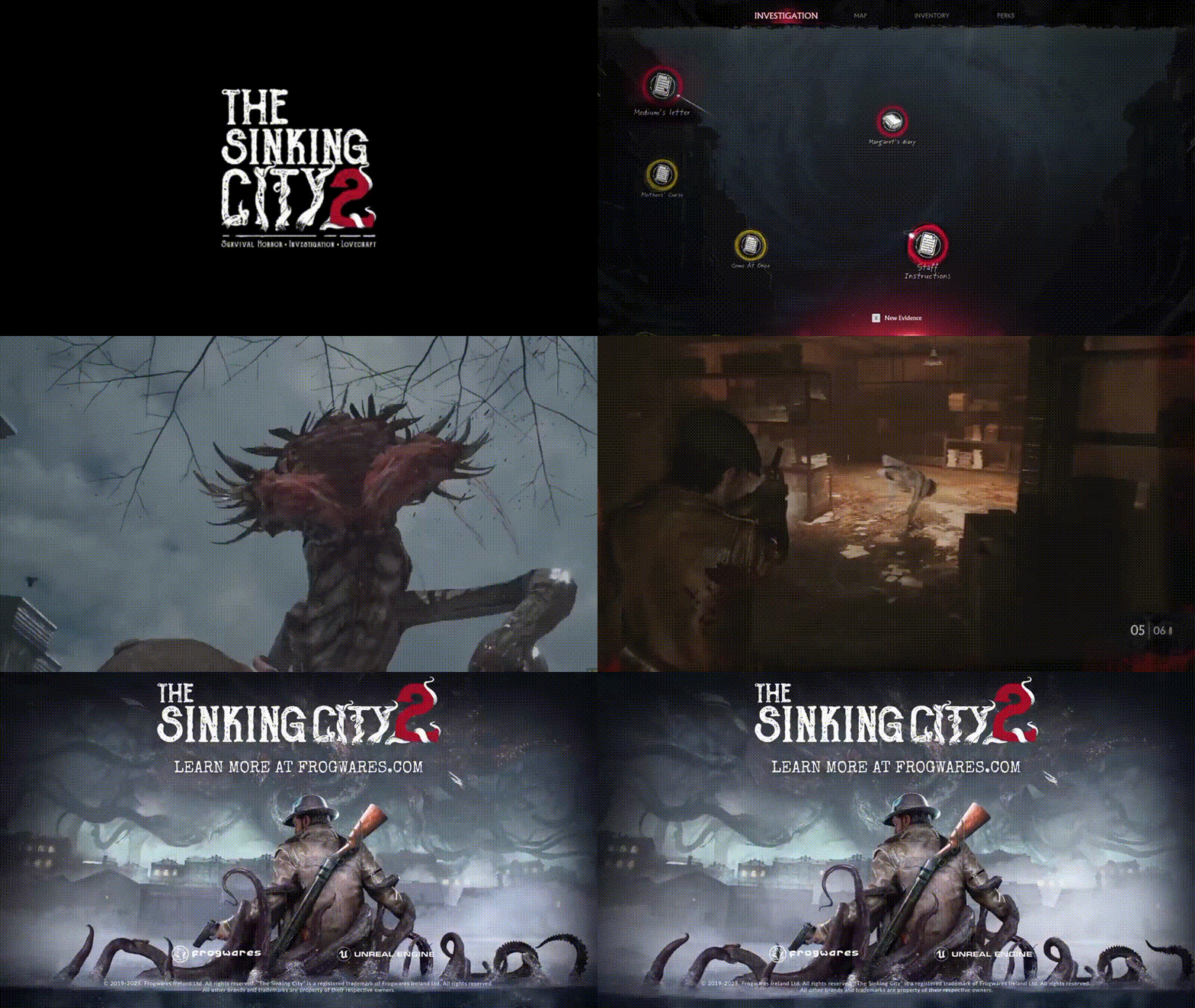
Many journalists praised the atmosphere, lighting, creature designs, and environmental detail. Unreal Engine 5 significantly improves visual fidelity, especially in flooded districts illuminated by dim lanterns, moonlight reflections, and unstable interiors.
However, some previews criticized the sequel for feeling overly familiar. Comparisons to Resident Evil remakes and Silent Hill are frequent, leading some critics to question whether The Sinking City 2 is evolving its own identity or borrowing too heavily from established survival horror formulas.
The Sinking City 2 Gameplay Changes Compared to the First Game
The gameplay structure in The Sinking City 2 differs dramatically from its predecessor. The original game revolved around investigations that required players to gather clues, interrogate suspects, reconstruct events, and make deductions. Combat existed but often lacked polish and importance.
The sequel reverses that balance. Combat and survival mechanics are now central systems rather than secondary features. Exploration is designed around resource scarcity, environmental threats, and enemy encounters.
Inventory management reportedly plays a much larger role. Players must carefully conserve ammunition, crafting materials, healing supplies, and utility items. This creates constant tension because every encounter carries meaningful consequences.
Exploration has also become more structured. While the first game embraced open-world investigation freedom, the sequel appears more focused on interconnected survival horror environments. This tighter design allows Frogwares to control pacing more effectively but reduces the sense of investigative autonomy.
Puzzle-solving remains present, though puzzles are now integrated into survival progression rather than detective reconstruction systems. Locked pathways, environmental manipulation, and exploration-based progression resemble traditional survival horror design.
For players who loved the original game’s detective identity, these changes may feel disappointing. For players frustrated by the original game’s combat weaknesses, the sequel’s redesign could represent a major improvement.
The Sinking City 2 Combat Focus and Limited Resources Explained
Combat is one of the biggest areas of transformation in The Sinking City 2. Frogwares has rebuilt encounters around tension, vulnerability, and resource management instead of empowerment.
Weapons are intentionally limited, and ammunition scarcity forces players to think carefully before engaging enemies. Encounters are designed to create anxiety rather than power fantasies. Running away is sometimes the smartest option.
Enemy placement appears heavily curated to maximize fear and uncertainty. Tight corridors, flooded rooms, darkness, and limited visibility all contribute to combat encounters feeling dangerous and unpredictable.
Crafting systems reportedly allow players to create limited survival tools, but crafting materials themselves are scarce. This creates strategic decision-making around resource allocation.
The game also introduces stronger enemy aggression and improved creature behavior compared to the first title. Monsters are faster, more threatening, and capable of overwhelming careless players quickly.
While these systems align closely with survival horror traditions, some critics argue they feel overly derivative. The formula of limited ammo, narrow corridors, locked doors, and oppressive creature encounters is familiar territory for longtime horror fans.

The Sinking City 2 Investigation Mechanics: Are Investigations Optional Now
One of the most controversial revelations about The Sinking City 2 is the reduced importance of investigations. Frogwares has confirmed that investigative mechanics are now more optional and less central to progression.
Players can still discover lore, examine environments, interpret clues, and uncover hidden narrative details, but the game no longer revolves around lengthy detective case structures. Instead, investigations complement the survival horror framework.
This decision fundamentally changes the identity of the franchise. The original game’s investigative systems, while imperfect, distinguished it from nearly every other Lovecraft-inspired title on the market. Removing that emphasis risks alienating players who specifically enjoyed the detective elements.
Supporters of the change argue that Frogwares is refining its strengths. The studio reportedly recognized that survival horror generated stronger player engagement than the original game’s slower investigative pacing. By focusing development resources on atmosphere, combat, and tension, the sequel may deliver a more polished overall experience.
Still, concerns remain that The Sinking City 2 could lose the experimental qualities that once made the series unique.
The Sinking City 2 Puzzles and Exploration Design Details
Puzzle-solving continues to play an important role in The Sinking City 2, although its implementation differs from the first game. Instead of deduction-heavy detective puzzles, the sequel emphasizes environmental progression puzzles commonly associated with survival horror.
Players may need to restore power systems, unlock pathways, manipulate mechanisms, locate keys, or decipher environmental clues to continue exploring Arkham. These systems reinforce pacing by alternating between combat tension and quieter problem-solving moments.
Exploration itself is more focused and interconnected than the original game’s open-world structure. Rather than traversing large investigative districts, players navigate denser environments designed for controlled horror pacing.
Flooded buildings, ruined apartments, abandoned institutions, and occult chambers reportedly contain optional lore discoveries that reward thorough exploration. Hidden resources, documents, and narrative fragments encourage careful investigation despite the reduced emphasis on detective mechanics.
The environmental design philosophy appears inspired by modern survival horror remakes that prioritize atmosphere and route optimization over sprawling open worlds.
The Sinking City 2 Monsters and Eldritch Horror Enemies
Creature design remains one of Frogwares’ strongest creative areas. The Sinking City 2 features grotesque eldritch entities inspired by Lovecraftian mythology, body horror, and psychological terror.
Many monsters reportedly exhibit distorted humanoid anatomy combined with aquatic mutations and supernatural corruption. The flooded setting naturally supports horrifying enemy concepts tied to water, decay, and mutation.
Enemy encounters are designed to emphasize fear and unpredictability. Some creatures move erratically through flooded environments, while others stalk players through dark interiors or emerge unexpectedly from submerged areas.
Psychological horror also influences enemy presentation. Certain encounters reportedly distort perception, manipulate sound design, and create hallucination-like effects to reinforce cosmic horror themes.
The creature roster appears significantly more aggressive and visually polished than the original game’s enemies. Unreal Engine 5 enables more detailed animations, environmental reactions, and lighting interactions that enhance horror presentation.
The Sinking City 2 Survival Horror Inspirations: Resident Evil and Silent Hill Comparisons
Comparisons between The Sinking City 2 and franchises like Resident Evil and Silent Hill have become unavoidable following preview coverage and gameplay reveals.
The game’s limited inventory systems, scarce ammunition, interconnected environments, environmental puzzles, and oppressive atmosphere strongly resemble modern Resident Evil remakes. Meanwhile, its psychological horror elements, decaying urban environments, and surreal storytelling evoke Silent Hill influences.
Frogwares has not hidden these inspirations. The studio openly acknowledges survival horror classics as creative influences behind the sequel’s redesign.
The challenge, however, lies in balancing inspiration with originality. Many critics believe The Sinking City 2 currently feels more like a collection of recognizable survival horror conventions than a bold reinvention of Lovecraft gaming.
This criticism does not necessarily mean the game will fail. Many successful horror games borrow heavily from genre traditions. The concern is whether The Sinking City 2 can establish its own distinct identity beyond atmospheric Lovecraft aesthetics.
If Frogwares successfully combines cosmic horror storytelling with polished survival mechanics, the sequel could still carve out a meaningful space within the genre.

The Sinking City 2 Unreal Engine 5 Graphics and Performance Expectations
The move to Unreal Engine 5 represents a major technical leap for Frogwares. Visual improvements are immediately apparent in environmental detail, lighting quality, reflections, water rendering, and character models.
Flooded streets showcase detailed reflections and atmospheric lighting effects that enhance immersion. Interiors feature dynamic shadows, environmental decay, and improved texture quality that contribute to the game’s oppressive tone.
Unreal Engine 5 also allows Frogwares to create denser environments filled with environmental storytelling details. Debris, damaged architecture, moisture effects, and dynamic lighting all strengthen Arkham’s visual identity.
Performance expectations remain cautiously optimistic. Frogwares is a smaller studio compared to major AAA developers, meaning optimization may still present challenges. Early preview builds reportedly experienced occasional frame drops and technical inconsistencies.
Still, the engine transition gives The Sinking City 2 a more modern visual presentation that helps it compete visually with contemporary survival horror titles.
Frogwares the Sinking City 2 Kickstarter Details and Funding Goals
Frogwares launched a Kickstarter campaign for The Sinking City 2 during development, partially due to the immense financial and logistical challenges created by the ongoing war in Ukraine.
The campaign aimed to secure additional development stability while maintaining production continuity under difficult circumstances. Fans responded positively, helping Frogwares surpass its funding goals relatively quickly.
The Kickstarter campaign also served as a marketing tool that generated visibility and community support for the sequel. Backers received promises of additional content, collector rewards, and deeper development transparency.
Frogwares previously used crowdfunding successfully for Sherlock Holmes The Awakened, which likely influenced the decision to pursue a similar strategy for The Sinking City 2.
The campaign highlighted how difficult game development can become during geopolitical crises, especially for studios operating directly within affected regions.
Why the Sinking City 2 Was Delayed to 2026 (War in Ukraine and Development Challenges)
The Sinking City 2 was delayed into 2026 due to multiple development complications, many directly connected to the ongoing war in Ukraine.
Frogwares has been transparent about the enormous challenges faced by its development team. Staff displacement, infrastructure instability, power outages, security concerns, and disrupted workflows significantly affected production schedules.
Despite these obstacles, the studio continued development while adapting to extremely difficult circumstances. Remote work adjustments, emergency relocations, and operational disruptions naturally slowed progress.
The delay also appears connected to Frogwares’ decision to expand the game’s technical ambitions through Unreal Engine 5 and a more polished survival horror structure. Transitioning to modern production standards while navigating wartime realities created additional complexity.
Most players and industry observers have been highly supportive of the delay given the extraordinary conditions affecting the studio.
The Sinking City 2 Release Window and Confirmed Platforms (PS5, Xbox Series X|S, PC)
The Sinking City 2 is currently scheduled for release in 2026. Frogwares has confirmed that the game is targeting PlayStation 5, Xbox Series X|S, and PC platforms.
The sequel is being developed exclusively for modern hardware, allowing Frogwares to fully utilize Unreal Engine 5 features without supporting older console limitations.
No Nintendo Switch version has been announced, likely due to the game’s technical requirements and visual complexity.
The release window remains somewhat broad, suggesting Frogwares is prioritizing development flexibility rather than committing to a narrow launch target prematurely. Given the studio’s circumstances and ambitious technical goals, additional adjustments remain possible.
Platform parity expectations appear strong, though performance optimization details have not yet been fully disclosed.

Is the Sinking City 2 Worth Buying If You Wanted Open-World Detective Gameplay
Whether The Sinking City 2 is worth buying largely depends on what players valued most about the original game.
Fans who primarily enjoyed detective investigations, open-ended clue solving, and slower narrative pacing may feel disappointed by the sequel’s survival horror emphasis. The reduced importance of investigations fundamentally changes the gameplay identity of the series.
On the other hand, players frustrated by the first game’s combat systems and uneven pacing may appreciate the sequel’s stronger mechanical focus. Survival horror fans who enjoy tense exploration, resource management, and atmospheric combat could find The Sinking City 2 far more engaging.
The sequel appears positioned as a darker, more polished, and more accessible horror experience. However, accessibility sometimes comes at the cost of originality. The central debate surrounding The Sinking City 2 is whether refining established survival horror formulas is enough to replace the investigative uniqueness of the original.
For Lovecraft horror enthusiasts, the atmosphere alone may justify the experience. For players seeking another detective-focused cosmic horror game, expectations should be adjusted accordingly.
Frequently Asked Questions (FAQs)
- What is The Sinking City 2 about?
The Sinking City 2 is a survival horror game set in a flooded version of Arkham during the 1920s. Players must survive eldritch horrors, explore dangerous environments, and uncover supernatural mysteries connected to Lovecraftian mythology. - Is The Sinking City 2 still a detective game?
Investigations still exist, but they are no longer the main focus. Survival horror gameplay now takes priority over detective mechanics. - Why did Frogwares change The Sinking City 2 into a survival horror game?
Frogwares stated that the sequel was redesigned to deliver a more focused horror experience with stronger combat, tension, and resource management systems. - What games inspired The Sinking City 2?
The sequel draws heavy inspiration from Resident Evil and Silent Hill, especially in its combat structure, environmental design, and horror pacing. - Is The Sinking City 2 open world like the first game?
The sequel appears more structured and interconnected rather than fully open world, allowing for tighter survival horror pacing. - What engine is The Sinking City 2 using?
The game is being developed in Unreal Engine 5. - Why was The Sinking City 2 delayed to 2026?
Development challenges caused by the war in Ukraine, combined with technical ambitions and production difficulties, contributed to the delay. - What platforms will The Sinking City 2 release on?
The game is confirmed for PlayStation 5, Xbox Series X|S, and PC. - Does The Sinking City 2 have limited ammo and survival mechanics?
Yes. Resource scarcity and survival management are major gameplay elements in the sequel. - Will fans of the first game enjoy The Sinking City 2?
Players who enjoyed the original game’s atmosphere may appreciate the sequel, but fans who specifically wanted detective-focused gameplay may find the shift disappointing.

Conclusion
The Sinking City 2 represents one of the most dramatic franchise pivots in recent survival horror development. Frogwares is clearly attempting to evolve the series into a more polished and commercially recognizable horror experience inspired by genre classics like Resident Evil and Silent Hill. The result is visually impressive, atmospherically rich, and mechanically more focused than the original game.
At the same time, the sequel risks abandoning the very qualities that once made The Sinking City feel distinctive. By reducing investigative gameplay and embracing familiar survival horror structures, Frogwares may create a stronger horror game while simultaneously creating a less unique one.
Whether The Sinking City 2 succeeds will ultimately depend on how effectively it balances Lovecraftian storytelling with its new survival horror identity. If the studio can merge cosmic horror atmosphere with refined gameplay systems, the sequel could become one of the most memorable Lovecraft-inspired horror titles in years. If not, it may be remembered as a game that traded originality for genre familiarity.
Sources and Citations
- Frogwares Official Website
- Frogwares Official News / Blog
- The Sinking City 2 Official Steam Page
- The Sinking City 2 Steam Community / News
- PlayStation Store – The Sinking City 2
- PlayStation Official Product Page – The Sinking City 2 (PS5)
- PlayStation Official YouTube (Announcements & Trailers)
Recommendations
- How do I set up a panoramic camera in Blender?
- How to Replace the Mannequin with a Metahuman in Unreal Engine 5: Step-by-Step Guide
- Solo Leveling: Karma, Official Story Trailer
- Bungie Ends Its Destiny Era and Cancels All Future Content Plans
- Fallout: New Vegas Director Josh Sawyer Gives Amazon’s Fallout TV Show His Thumbs Up
- How to Use Film Grain: A Complete Guide to Achieving a Cinematic Look
- The Lost Wild – Official Gameplay Trailer Breakdown, Release Date, Story, Dinosaurs & Survival Horror Details Explained
- Brendan Fraser is Training for the Mummy 4 and Asks Fans for Luck: Full Update on His Return as Rick O’Connell
- Obsidian Was Originally Planning To Make Fallout: New Vegas 2 – What Happened and Why It Never Released
- The Dragon Age: Inquisition Servers Are Finally Going Offline Over A Decade Later – What It Means for Players



































































































