




Season 4 context, release, and casting change
The fourth season of the series released globally on Netflix and arrives with a uniquely production-relevant premise: it is both a story continuation and a visual continuity challenge because of a lead-actor transition at the centre of the show’s identity.
Season 4 was positioned as the first half of the show’s endgame, with production structured to support longer-arc design decisions (from environments to magical “rules”) across the final two seasons.

The Witcher Season 4 release date and episode count and Liam Hemsworth Geralt look and character transition in Season 4
Season 4 premiered on 30 October 2025.
Netflix released all eight episodes, and later confirmed they were streaming.
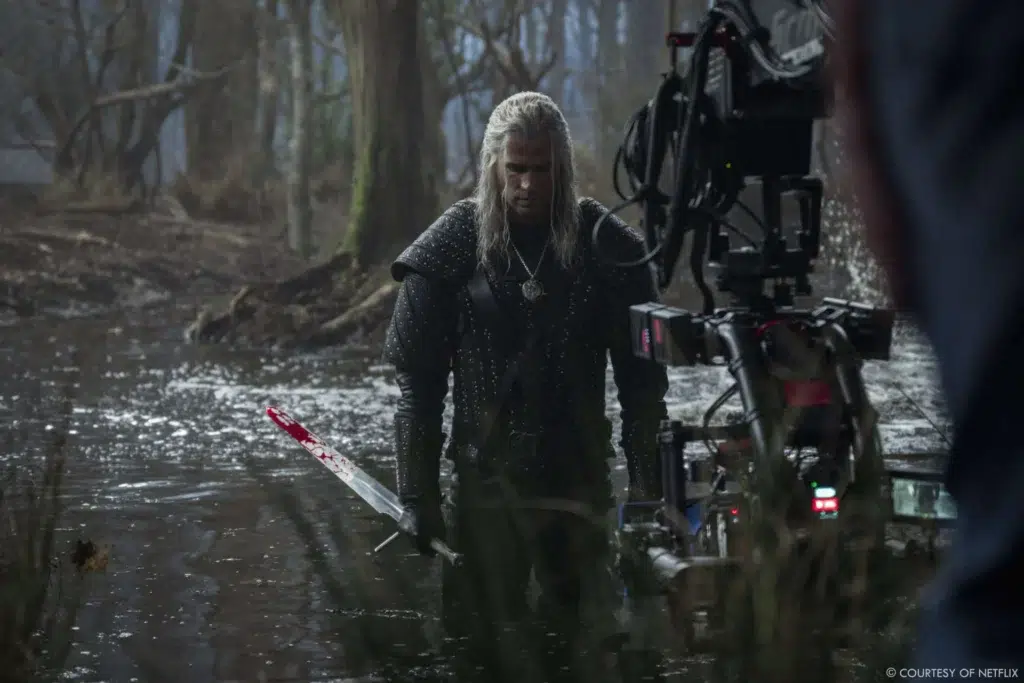
The season introduces Liam Hemsworth as Geralt, following Henry Cavill’s run in the role.
From Netflix’s own editorial coverage of the casting and rollout, the transition was treated as an “identity bridge” for audiences: the core character remains recognisable, while performance, costume, and the show’s visual grammar (including VFX-heavy sequences like spectral combat) are deployed to sell the new on-screen Geralt quickly.
Netflix also framed the final two seasons as a cohesive closing chapter, explicitly noting Season 4 was shot back-to-back with Season 5.
The Witcher Season 4 VFX pipeline, shot count and breakdown explained
Season 4’s VFX work is best understood as industrial-scale episodic filmmaking—a coordinated delivery across many vendors, with a heavy blend of creature animation, simulation, environment builds, and “invisible” continuity work.
A key organisational fact shaping the whole pipeline is that Sara Bennett joined after principal photography, taking over from Richard Reed. That kind of handover magnifies the importance of asset libraries, established look-dev, and vendor-facing documentation.
A practical way to map the season’s VFX, based on studio case studies and supervisor interviews, is to split the work into six interlocking categories:
Creature and character work (full CG creatures, partial creature augmentation, and close-up integration), often built on practical performances and prosthetics; magic effects (signs, portals, shields, energy streams, corruption motifs); environment and DMP work (digital matte paintings, terrain/sky replacements, atmospheric extension); set extensions and world-building (turning partial builds into large cities, battlefields, castles, bridges, and regions); action and weapons augmentation (digital blades, arrows, chains, digital crowd/soldier additions); and gore and visceral FX (blood, wounds, splatter, and destruction simulations).
Two production notes define how these categories interrelate in Season 4:
- The team reused some environments from earlier seasons but upgraded them to a higher standard, which implies either re-light/re-render passes, higher-resolution texture updates, additional set dressing, or revised atmospherics to meet the new season’s needs.
- Work was deliberately distributed to avoid overloading any single vendor, aligning creative ownership with schedule reality.

The Witcher Season 4 VFX studios and vendors list
Season 4’s credited vendor ecosystem includes a multi-studio vendor slate with a production structure designed to keep episodes moving in parallel.
Vendors publicly associated with Season 4 VFX work include:
- Cinesite
- One of Us
- Scanline VFX (now operating under the Eyeline brand)
- Digital District
- Crafty Apes
- Vine FX
- Milk VFX
- RVX
- Platige Image
- TPO VFX
- Orca Studios
- Xylem (credited in production thanks by the Production VFX Supervisor)
In addition to naming vendors, production coverage also identifies core VFX leadership roles that shaped delivery: David Stephens is cited as Production VFX Producer, and Roberta Leech is cited as Production Manager for VFX production operations.
How many VFX shots are in The Witcher Season 4 and before-and-after VFX comparisons
The Production VFX Supervisor reported a total VFX shot count of 2,550 shots for Season 4.
A separate trade write-up described delivery as “roughly 2,500” shots across eight episodes—consistent with the 2,550 figure when rounded.
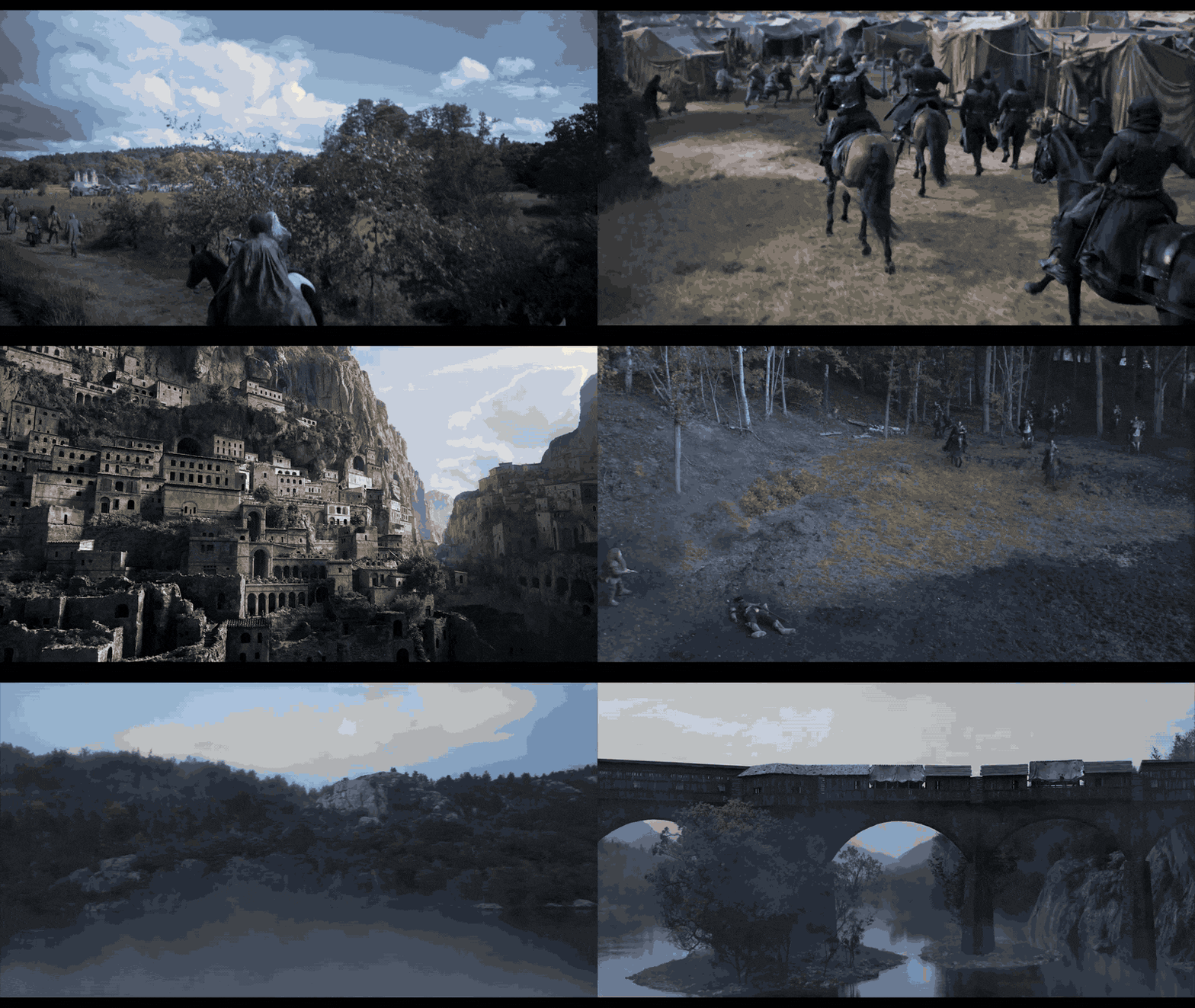
Public breakdown reels (and breakdown-aligned studio write-ups) are the clearest “before-and-after” evidence base for Season 4’s VFX, because they show how plates were extended, cleaned, simulated, and integrated into final shots.
Multiple vendors explicitly published breakdown reels or breakdown case studies for their Season 4 work, offering a practical view into:
- plate-to-final transformations for creature integration, environment rebuilds, and fight augmentation,
- environment build and simulation emphasis (including an Eyeline-focused breakdown presentation highlighted by industry coverage),
- and “invisible” changes designed not to be detected by audiences (clean-up, city extensions, sky work, and matte painting).
The Witcher Season 4 magic, Spellcraft and monster work effects upgrades
Season 4’s signature look is shaped by the tension between grounded photography and increasingly complex supernatural visuals—especially in portals, corrupted magic motifs, and creature horror executed at close range.
The clearest documented “upgrade” is not a wholesale reinvention of magic, but a refinement of detail, texture, and behavioural rules—especially for corrupted portal effects associated with Vilgefortz.
Key confirmed upgrades and expansions include:
- More detailed portals with corruption cues, including dark, inky tendril motifs introduced to communicate “evil” or contaminated magic.
- A refreshed “identity” for magic while keeping continuity, with the show maintaining an editorial reference library of prior magic looks, then pushing simulations and compositing to give the season a distinct feel.
- Character-specific spell aesthetics, illustrated by Cinesite’s description of a distinct colour palette for Yennefer of Vengerberg’s magic and an alternate dark “tar-like” look for Vilgefortz’s power in the same duel context.
- Rules-based physicality, with Vine FX explicitly emphasising that magic must retain “punch” and follow rules to remain authentic to the franchise’s identity.
The Witcher Season 4 creature VFX and monster design
Season 4’s creature work is documented as a hybrid design pipeline: the art department leads design, practical prosthetics and on-set work establish physical grounding, and VFX vendors extend, augment, and animate with CG and simulation layers.
Multiple sources identify Andrew Laws as the production designer leading art department creature designs, while Mark Coulier is credited for prosthetic and creature design foundations referenced by production leadership.
Documented creature and monster highlights include:
- Kikimora reprise and escalation: Cinesite describes revisiting the iconic opening fight concept from the show’s earliest season, then intensifying the new version by adding multiple adolescent Kikimoras, supported by creature FX grooming, muscle/skin simulation, and extensive water/blood simulation work.
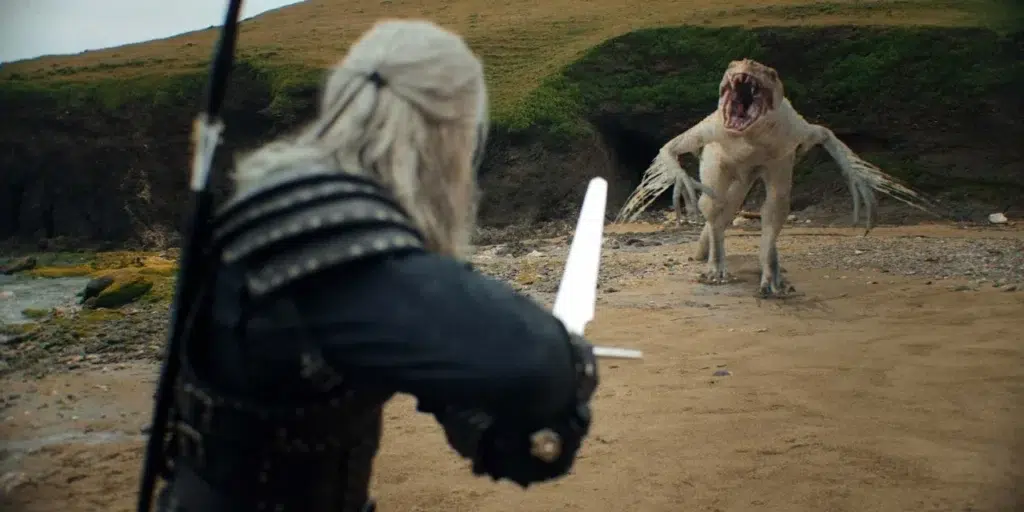
- Greylock and parasite-driven horror: production coverage describes the Greylock concept as a dog-like creature with infected tendrils, with the VFX team adapting art designs into practical/VFX-combined solutions.
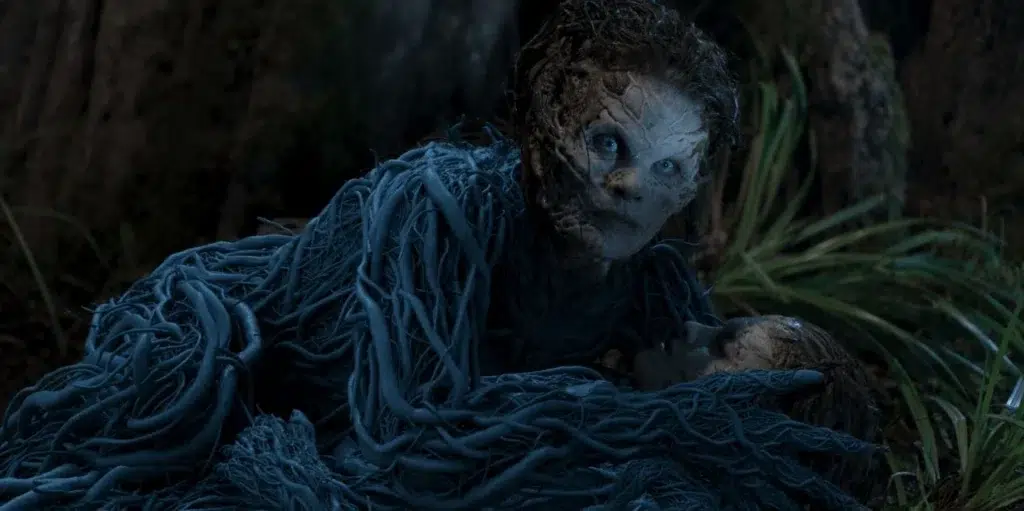
- Rusalka design augmentation: One of Us is directly credited with adding moving vines to a Rusalka concept to make the creature feel more rooted and “gnarly,” showing how creature identity can be built through secondary motion and surface behaviour.
- Macro-close creature integration: Vine FX describes developing Houdini-based muscle/skin/deformation systems for a tentacle creature sequence where the camera is extremely close, forcing high-fidelity contact, shadows, and facial indentation tracking.

The Witcher Season 4 environment extensions and digital matte paintings
Season 4’s VFX is not only about visible fantasy; it is also about geography control. The season expands locations, revises scale, removes recognisable markers, and uses environment work to keep the Continent cohesive while filming across real-world places and partial builds.
Multiple vendors explicitly confirm delivering environment extensions, digital matte paintings, and landscape alterations designed to stay invisible:
- Vine FX describes city extensions, sky replacements, mountain builds, clean-up work, and digital matte paintings, including a major Episode 2 chase sequence reconstructed almost entirely in CG using Lidar and practical plates.
- Production leadership also points to RVX’s DMP and environment skillset as part of the show’s long-running approach, while describing a strategy of capturing extensive real-world plates to ground digital augmentation.
This approach matters for audience perception: fantasy worlds fail when “edges” show (set boundaries, inconsistent skies, modern landmarks, mismatched topography). Season 4’s documented approach uses DMP and environment extensions as continuity glue—keeping tone and geography stable even when episode demands vary dramatically.
The Witcher Season 4 CG set extensions and world-building
Season 4’s VFX leadership describes a deliberate push toward practical grounding paired with targeted CG expansion. That includes:
- Overhauling established locations for scale, with Nilfgaard cited as a primary example where the “bones” of an existing build were used but the full environment was reworked to deliver greater scale and presence.
- A plate-library strategy, including plate shoots in multiple countries to build a real-world library later augmented and extended digitally.
- Environment-first vendor contributions, where vendors specialised in environments and DMP were used to accelerate and stabilise delivery across episodes.
Industry coverage of Eyeline’s Season 4 work also frames the season’s world-building as strongly environment-driven, showcasing before/after comparisons specifically highlighting the assembly of recognisable environments into the final dark-fantasy world.

Studio spotlights and Cinesite VFX work on The Witcher Season 4
The season’s VFX identity emerges from how different studios specialise: some anchor creature set-pieces, others build “invisible” geography, and others carry key magic beats that define the season’s tone.
Cinesite’s published Season 4 case study provides one of the most granular looks into the show’s VFX craft at sequence level. It centres on the strategic reprise of the Kikimora fight (used as a storytelling device) and escalates the stakes by adding multiple younger Kikimoras to the confrontation.
Key documented techniques and contributions include:
- Performance grounding and partial CG replacement, with an on-set bluescreen armature used for the lead actor’s performance foundation and selective enhancement such as replacing legs in some shots for dynamism.
- Creature realism through CFX and simulation, including grooming to define silhouette and muscle/skin simulation to create believable anatomical motion.
- Large-scale simulation demands, especially Houdini water simulation for the lake-based fight and fluid simulation for blood and splatter.
- Magic design within action choreography, including Quen shield surface interactions and an Igni-based effect driving smoke and magical remnants, supported by Houdini-driven FX and compositing collaboration.
- Early visualisation strategy, with Cinesite describing Nuke-based rough 3D tracking and colour-coding to choreograph a multi-creature, multi-leg animation challenge before final shooting and post execution.
Cinesite also documents contributions beyond the Kikimora sequence, including a magic showdown involving Yennefer and Vilgefortz and additional “invisible and magic related” work during a re-imagined battle sequence.
Scanline VFX work on The Witcher Season 4
A major Season 4 action highlight—the bridge creature fight described as an ogre/troll sequence—was assigned to Scanline VFX, with production leadership emphasising both design backstory and the practical-to-digital performance path.
The Production VFX team describes the creature concept as a transformed soldier with armour integrated into the body and weaponised hands, and notes the sequence relied on strong on-set plates featuring a stunt performer on stilts to establish scale and movement.
Scanline’s contributions to the fight are also described as including CG elements such as digital soldiers to expand battle scale and a CG chain used in the confrontation.
From a studio-structure perspective, it is also important that Netflix formally consolidated Scanline VFX and Eyeline Studios into a single brand identity, Eyeline, in October 2025. This matters because Season 4 publicity and breakdowns may appear under either naming depending on timing and context.
One of Us VFX work on The Witcher Season 4
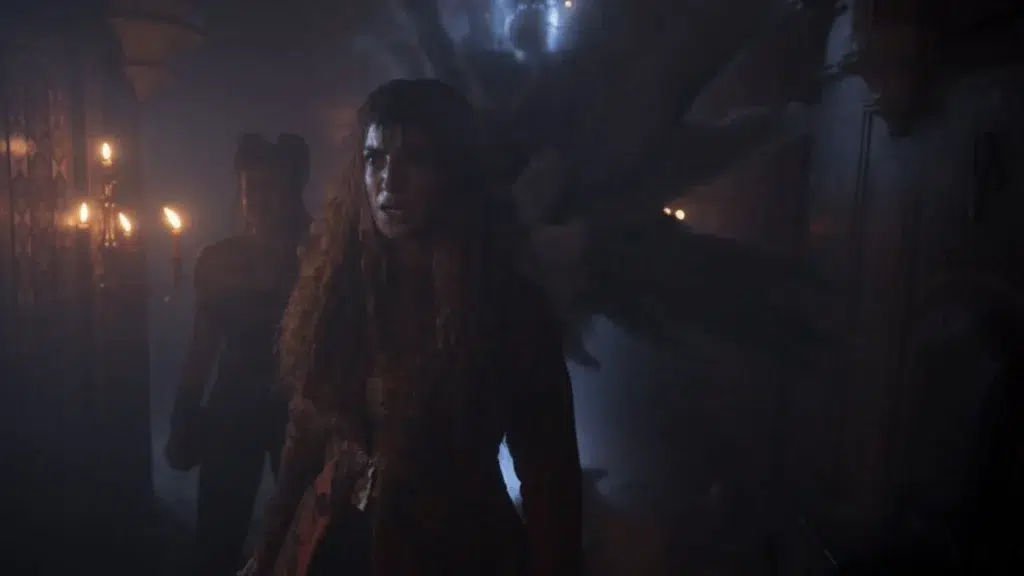
One of Us publicly states it delivered 210 VFX shots across four episodes, explicitly highlighting creature horror and environment immersion: the parasite-ridden Greylock, reimagined Roach Hounds, and the “Mother and Little Rusalka” swamp duo.
The studio’s published credits for the project also identify key internal production roles for its delivery, including a named VFX supervisor and producer leads—useful context for understanding how multi-vendor episodic VFX scales organisationally.
Platige Image VFX contributions to The Witcher Season 4
Platige Image’s own Season 4 materials describe a contribution of more than 100 VFX shots, spanning spell effects, environment extensions, and gore-enhanced action beats, with an explicit focus on grounding the effects in performance and story.
The Art of VFX’s Season 4 vendor coverage frames Platige’s work as shaping magic, violence, and atmosphere, citing portals, environment extensions, and graphic gore, and highlighting a particularly complex final-episode sequence spanning more than 50 shots.
In the season’s overall “magic language,” Platige is also credited in production leadership interviews for delivering the updated portal work under a named VFX supervisor, including the corruption-tendril concept used to signal darker magic.
Vine FX invisible VFX shots in The Witcher Season 4
Vine FX offers one of the clearest statements of invisible VFX scope for Season 4: extensive environment work including city extensions, sky replacements, mountain builds, clean-up, and digital matte paintings—explicitly designed to remain undetected.
The studio is also reported as having worked on seven episodes, delivering nearly 70 shots across 18 sequences, spanning creature development, close-up FX, environment extensions, combat enhancements, and established magical effects.
A particularly revealing example of invisible world-building is Vine’s description of an Episode 2 chase sequence rebuilt using Lidar scans and practical plates into a largely CG-reconstructed environment—an approach common in modern fantasy TV when geography, safety, and continuity needs exceed what was physically captured.
Frequently Asked Questions (FAQS)
- What is the confirmed VFX shot count for Season 4?
The Production VFX Supervisor reported 2,550 VFX shots for the season. - How was the VFX work organised across vendors?
Production leadership describes the show as being divided across 13 studios in total, managed by the internal production team, explicitly to avoid overloading any one vendor and to maintain schedule resilience. - Who led the VFX overall for Season 4?
Season 4 production coverage identifies Sara Bennett and Richard Reed as Production VFX Supervisors, with Bennett overseeing work after joining post-shoot. - Which vendors are most consistently cited for Season 4?
Public production and trade coverage lists vendors including Cinesite, One of Us, Scanline VFX/Eyeline, Digital District, Crafty Apes, Vine FX, Milk VFX, RVX, Platige Image, TPO VFX, and Orca Studios, with additional thanks including Xylem. - What is the biggest documented change to magic effects in Season 4?
The most consistently described change is refinement with added detail, including more detailed portals and a corruption look (dark tendrils) associated with “evil” magic, rather than a complete reinvention of the magic system. - How were creature designs kept consistent with the show’s established look?
Production leadership describes a pipeline led by the art department’s designs, supported by prosthetic/creature work, with VFX extending and refining to integrate into shots while staying grounded in the show’s world. - What is an example of “invisible” VFX in Season 4?
Vine FX explicitly lists invisible environment work such as city extensions, sky replacements, mountain builds, clean-up, and digital matte paintings, including an Episode 2 chase sequence rebuilt with Lidar and plates into a largely CG environment. - Which studio handled the iconic Kikimora reprise?
Cinesite documents reprising and escalating the Kikimora sequence, including additional adolescent creatures and extensive simulation and integration work. - What is confirmed about Scanline’s Season 4 work?
Production leadership attributes the bridge ogre/troll sequence to Scanline VFX, describing dependence on stunt plates, CG elements such as digital soldiers and a CG chain, and careful alignment to live-action action beats. - Where can before-and-after comparisons be found?
Before-and-after material is most directly available through official vendor breakdown reels and breakdown case studies released by contributing studios (for example: Cinesite, One of Us, Platige Image, and Vine FX), alongside industry coverage describing Eyeline’s before/after breakdown presentation.
Conclusion
Season 4’s VFX impact comes from scale (2,550 shots), organisation (a multi-vendor pipeline explicitly designed to distribute work), and craft choices tuned to audience perception: refined portals that signal narrative corruption, creature work that blends practical foundations with high-fidelity CG augmentation, and environment/DMP strategies that make geography feel coherent and lived-in without revealing the seams of production.
The season’s most instructive through-line is that VFX is not a single discipline here—it is the connective tissue linking casting transition, world continuity, and escalating fantasy spectacle into a consistent visual language that carries the show into its endgame.
Sources and citation
- Netflix Tudum — “All 8 Episodes of The Witcher Season 4 Are Streaming Now” (Christopher Hudspeth, Dec. 10, 2025).
- https://www.netflix.com/tudum/articles/the-witcher-season-4-liam-hemsworth Netflix — “Bringing the Best in VFX and Virtual Production Together as Eyeline” (Netflix corporate announcement, Oct. 15, 2025).
- https://about.netflix.com/news/bringing-the-best-in-vfx-and-virtual-production-together-as-eyeline The Art of VFX — “The Witcher – Season 4: Sara Bennett (Production VFX Supervisor) & David Stephens (Production VFX Producer)” (Vincent Frei, Nov. 4, 2025).
- https://www.artofvfx.com/the-witcher-season-4-sara-bennett-production-vfx-supervisor-david-stephens-production-vfx-producer/ VFX Voice — “Upgrades to Magic Effects Elevate The Witcher Season 4” (Trevor Hogg, Mar. 17, 2026).
- https://vfxvoice.com/upgrades-to-magic-effects-elevate-the-witcher-season-4/ Cinesite — “The Witcher Season 4” case study.
- https://cinesite.com/thewitcher-season-four/ One of Us — “The Witcher Season 4” project page.
- https://www.weacceptyou.com/project/the-witcher-season-4/ Platige Image — “The Witcher Season 4 VFX Showreel” official page.
- https://platige.com/project/vfx/the-witcher-season-4/ Platige Image — LinkedIn summary post for the Season 4 VFX showreel (spell effects, environment extensions, gore-heavy work).
- https://www.linkedin.com/posts/platige-image_platige-the-witcher-season-4-vfx-showreel-activity-7416851950668771331-jFEi Vine FX — “Witcher: Season 4” project page.
- https://www.vinefx.com/work/witcher-season-4 Televisual — “VFX breakdown: Vine FX for The Witcher S4” trade coverage.
- https://www.televisual.com/news/vfx-breakdown-vine-fx-for-the-witcher-s4/
Recommended
- Resident Evil Requiem Leads the US Monthly Charts for February 2026, With Launch Sales 60% Higher Than Resident Evil Village
- Marathon: Bungie’s New FPS – Gameplay Details, Developer Insights, and Community Reactions
- How do I set up a VR camera in Blender?
- Scientists Make Breakthrough That Allows Lab-Grown Brain Cells To Play A Sort Of Video Game (UC Santa Cruz Cart-Pole Results Explained)
- Official World Of Warcraft Music Video Is A Walk Down Memory Lane: “A Place to Call Home” Recaps 22 Years of Azeroth
- Kena: Bridge of Spirits Launches for Switch 2 on March 26 – Release Date, Features, DLC, and Gameplay Details
- Toy Story 5 Trailer Teases Woody’s Big Return: Trailer Breakdown, Lilypad Villain, Cast & Release Date
- Is Blender CPU or GPU Intensive? A Complete Guide to Performance in Blender
- How To Become Ruler In The Sims 4: Royalty And Legacy Guide
- How to Make Stylized Anime Hair Naturally in Blender