






In This Article (8 sections)
ZeroAllocPool by ElBranda for Godot 4.6 and High-Performance Memory Management
ZeroAllocPool by ElBranda is a high-performance memory management solution for game developers working with the Godot Engine ecosystem, specifically Godot 4.6 and above. It is implemented as a native C++ GDExtension and provides a drop-in object pooling system designed to eliminate runtime allocation overhead in performance-critical game systems.
At its core, ZeroAllocPool addresses one of the most persistent bottlenecks in real-time game development: dynamic memory allocation during gameplay. In traditional workflows, frequent allocation and deallocation of objects such as bullets, particles, enemies, and UI elements can create unpredictable CPU spikes, memory fragmentation, garbage collection pressure, and inconsistent frame timing. These issues become especially noticeable in action-heavy games, simulations, and large scenes where thousands of short-lived objects may be created and destroyed during a single gameplay session.
ZeroAllocPool solves this problem by pre-allocating memory and reusing objects through a managed pool system. Instead of continuously requesting memory from the system heap, the engine reuses pre-created instances that are reset and reassigned when needed. This creates a more deterministic memory model, where frame pacing becomes more predictable because pooled objects no longer trigger new allocations during active gameplay.
Dynamic memory management is especially complex in engines like Godot, which support both high-level scripting and low-level native optimization. ZeroAllocPool improves this process by introducing a structured allocation lifecycle built around:
- Pre-allocation of object pools at initialization
- Reuse of objects instead of destruction
- Batch recycling of unused objects
- Elimination of heap fragmentation during gameplay
This significantly reduces system-level memory calls. Objects remain in memory and are simply reset before reuse, leading to lower CPU usage during peak gameplay, reduced frame time variance, a more stable memory footprint over long sessions, and better scalability for large scenes and simulations.

Object Pooling, C++ GDExtensions, and ZeroAllocPool Architecture
Object pooling is a design pattern that reuses objects instead of repeatedly creating and destroying them. In game development, this is essential for maintaining consistent performance, especially when dealing with high-frequency objects. Instead of instantiating a new bullet every time a weapon fires, for example, the game retrieves an inactive bullet from a pool, resets its state, and reuses it. This approach is especially useful for projectile systems, particle effects, enemy spawning systems, UI animations, and physics-heavy simulations.
In the context of Godot Engine, object pooling is especially relevant because the engine combines managed scripting environments with native performance layers. Without pooling, repeated instantiation can lead to garbage collection spikes, memory fragmentation, increased CPU overhead, and unpredictable frame timing. ZeroAllocPool improves on script-level pooling by moving the pooling logic into a native C++ layer, reducing overhead and improving object retrieval and return performance.
Native C++ GDExtensions in Godot 4.6 allow developers to extend engine functionality with near-native performance. ZeroAllocPool uses this capability to operate outside the constraints of the scripting runtime, offering:
- Direct memory control
- Lower function call overhead
- Faster object retrieval and return cycles
- Reduced dependency on engine-level garbage collection
- Faster execution of core systems
- Reduced interpreter overhead
- Improved potential for multithreading
This makes ZeroAllocPool valuable for competitive multiplayer games, large-scale simulations, procedurally generated environments, and real-time physics systems. Its zero-allocation design means that once the pool is initialized, runtime memory allocation is effectively eliminated for pooled objects, allowing performance to remain stable even under heavy object churn.
ZeroAllocPool is structured around a layered architecture:
- Pool Manager Layer: Oversees all active pools
- Object Pool Layer: Manages individual object categories
- Memory Block Layer: Handles pre-allocated memory regions
- Reset and Lifecycle Layer: Restores object state before reuse
At initialization, memory blocks are reserved for each pool. Objects are constructed once and remain in memory throughout the game session. When an object is requested, the system retrieves an inactive instance, resets its state, and returns it to the game logic. When the object is released, it is marked inactive and returned to the pool without deallocation. This architecture ensures zero runtime allocation overhead for pooled objects.

Installing, Integrating, and Using ZeroAllocPool in Godot Projects
ZeroAllocPool is designed as a drop-in addon for Godot Engine 4.6 and above, making it accessible without requiring deep engine modification. A typical installation workflow includes:
- Downloading the ZeroAllocPool GDExtension package
- Placing the addon folder into the project’s
addonsdirectory - Enabling the plugin in project settings
- Registering pooling configurations in project initialization scripts
- Assigning pool types to relevant game objects
Once installed, developers can define pools for specific object classes and configure them by size, reset behavior, and reuse policy. The drop-in nature of the system allows it to work with existing projects without requiring full rewrites. Developers mainly replace standard instantiation logic with pool retrieval functions while keeping most gameplay logic intact.
Integrating ZeroAllocPool into an existing Godot 4.6 project typically involves:
- Installing the GDExtension
- Defining pool configurations
- Replacing
instantiate()calls with pool calls - Adjusting lifecycle management for pooled objects
This makes it practical for legacy projects that need better memory performance without a complete refactor. Instead of changing entire gameplay systems, developers can target the most performance-sensitive areas first, such as combat, visual effects, enemy spawning, or simulation-heavy systems.
To get the best results, developers should apply object pooling selectively rather than universally. Best practices include:
- Pool only high-frequency objects
- Avoid over-pooling rarely used objects
- Reset object state properly before reuse
- Monitor pool size to prevent memory waste
- Separate pools by object type for efficiency
Proper pool sizing is essential. If a pool is too small, the system may still need extra allocations. If it is too large, it wastes memory. Pooling should usually be introduced after profiling identifies performance bottlenecks, although it is often worth planning early for systems known to generate many short-lived objects.
Object pooling is most effective in scenarios involving high-frequency object creation, short-lived gameplay entities, real-time simulations, particle-heavy environments, and bullet or projectile systems. It is less useful for rarely spawned objects or systems where allocation is not a measurable performance issue.
Performance Benefits, Benchmarks, and Developer Use Cases
Compared with traditional memory allocation, ZeroAllocPool changes how objects are managed during gameplay. Traditional allocation relies on dynamic heap operations, where each object creation requests memory from the system and each destruction releases it. ZeroAllocPool avoids this cycle for pooled objects by using pre-allocated memory blocks and reusing existing instances.
The key difference is simple:
- Traditional Allocation: Runtime allocation and deallocation
- ZeroAllocPool: Pre-allocated and reused memory blocks
Traditional systems can suffer from fragmentation, garbage collection pauses, and frame drops during high-load moments. In bullet-heavy shooters, particle-intensive effects systems, large simulations, or long-running sessions, these issues can become visible to players as stuttering or unstable performance. ZeroAllocPool maintains consistent frame timing by ensuring pooled objects do not trigger new allocations during gameplay.
Garbage collection pressure is another common bottleneck in managed game environments. While Godot Engine uses optimized memory handling, frequent short-lived object creation can still increase overhead. ZeroAllocPool reduces this pressure by reusing existing objects, preventing short-lived allocation spikes, reducing heap churn, and stabilizing memory references. This gives the garbage collector less work to perform and helps keep the main game loop smoother.
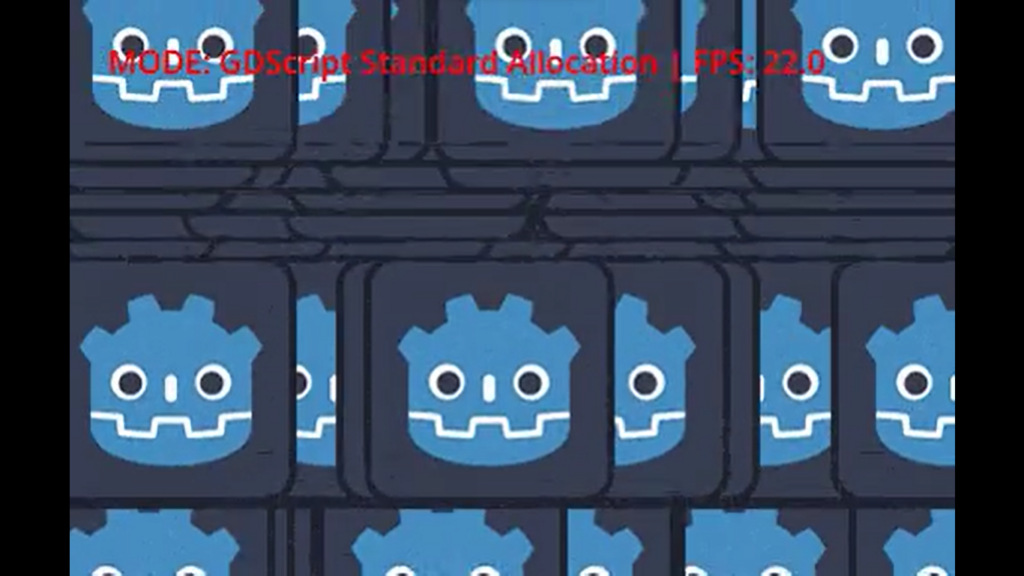
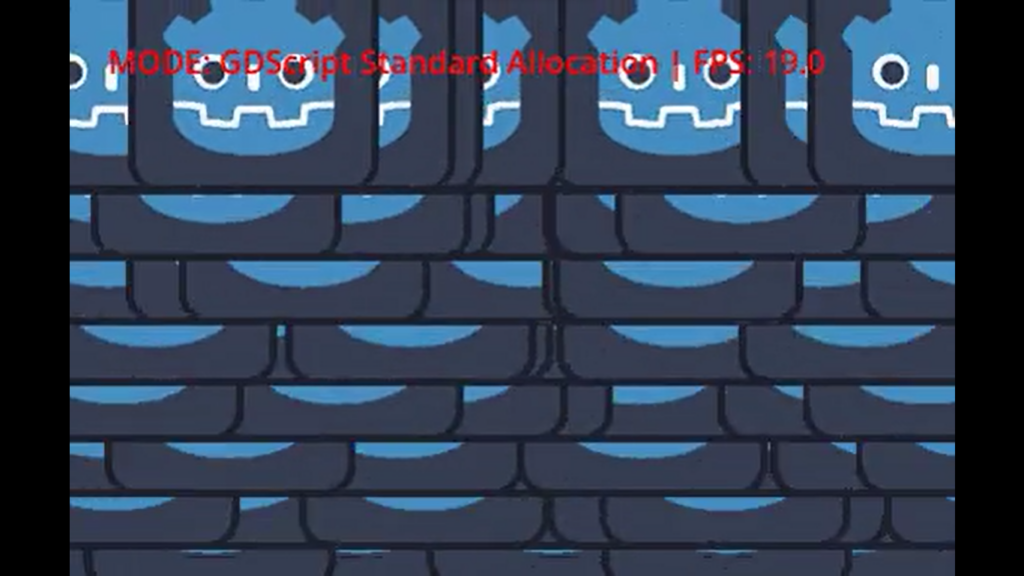
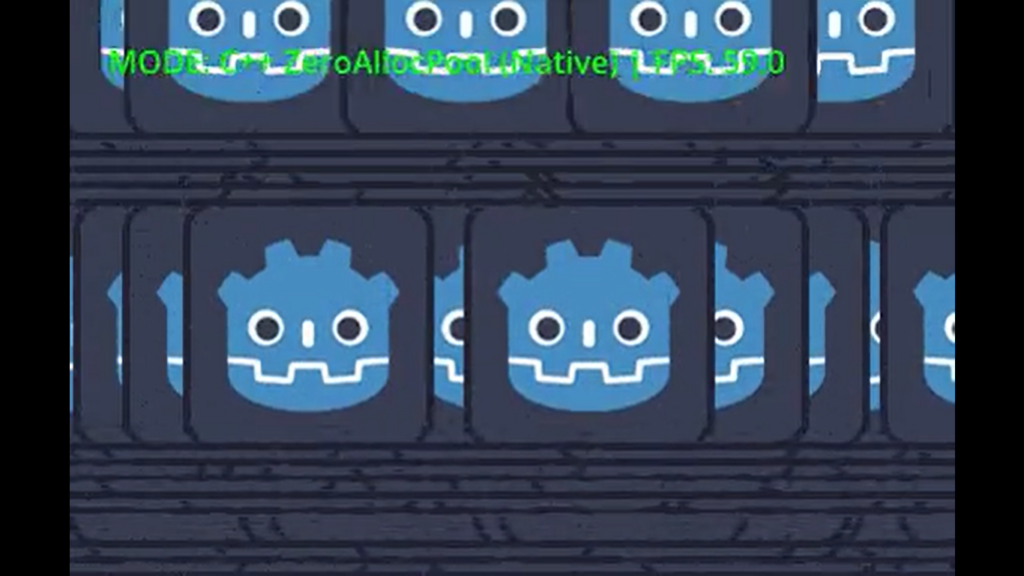
In typical benchmarking scenarios within Godot Engine environments, standard memory handling often shows frame spikes during object creation bursts, increased CPU usage during heavy gameplay, and variable memory usage patterns. ZeroAllocPool instead demonstrates stable frame timing under load, reduced CPU overhead during peak activity, and a flatter memory usage curve after initialization. The most noticeable improvement is frame consistency, even when thousands of objects are spawned per second.
ZeroAllocPool addresses several common memory management problems in Godot projects, including:
- Frame stuttering from frequent allocations
- Memory fragmentation in long sessions
- Garbage collection spikes
- Unpredictable performance under load
It solves these problems by eliminating runtime allocations for pooled objects, keeping memory usage stable, reusing object instances efficiently, and reducing pressure on system allocators.
For indie developers, ZeroAllocPool offers a way to achieve advanced performance optimization without building a custom memory system from scratch. For AAA developers, it provides scalability for large systems, predictable performance under load, efficient multithreaded compatibility potential, and reduced debugging complexity related to memory issues. In both cases, the main benefit is performance stability, making games less prone to frame spikes and memory-related inconsistencies.
Frequently Asked Questions (FAQs)
- What is ZeroAllocPool used for?
ZeroAllocPool is used for high-performance object pooling in game development. Its main purpose is to reduce runtime memory allocation by reusing pre-allocated objects instead of constantly creating and destroying them during gameplay. This is especially useful for systems that spawn many short-lived objects, such as projectiles, effects, enemies, or temporary UI elements. - Does ZeroAllocPool work with Godot 4.6?
Yes, ZeroAllocPool is designed specifically for Godot Engine 4.6 and above. It is built to work with the newer Godot GDExtension system, allowing developers to add native performance features without changing the engine’s source code. - Is it a script or native extension?
ZeroAllocPool is a native C++ GDExtension, not a regular script-based addon. This means its core pooling logic runs at a lower level than typical GDScript systems, giving it better performance for object retrieval, recycling, and memory control in demanding gameplay scenarios. - Does it improve FPS?
ZeroAllocPool does not directly increase FPS in every situation, but it can improve frame stability by reducing allocation-related stutters. Its biggest benefit is smoother performance during heavy gameplay moments, where many objects are spawned or recycled quickly. This helps prevent sudden frame drops caused by memory allocation spikes. - Is it hard to integrate?
No, ZeroAllocPool is designed as a drop-in addon for Godot projects. Developers usually install it through the project’s addon or GDExtension setup, configure object pools, and replace frequent instantiate() and destroy patterns with pool retrieval and return calls. Some setup is still required, but it does not demand major engine modification. - What types of objects should be pooled?
The best objects to pool are high-frequency objects that appear and disappear often during gameplay. Common examples include bullets, particles, enemies, hit effects, damage numbers, explosions, temporary UI elements, and spawned physics objects. Rarely used objects usually do not need pooling because they do not create enough allocation pressure to justify it. - Does it eliminate garbage collection completely?
No, ZeroAllocPool does not eliminate garbage collection completely. However, it significantly reduces the pressure caused by frequent short-lived object creation. By reusing objects instead of constantly allocating new ones, it gives the garbage collector less work to do and helps reduce stutters linked to memory cleanup. - Is it suitable for mobile games?
Yes, ZeroAllocPool is especially useful for mobile games because mobile devices often have tighter CPU, memory, and thermal limits. Reducing runtime allocations can help keep performance smoother, lower memory churn, and improve stability during effects-heavy or action-heavy gameplay. - Can it be used in large-scale simulations?
Yes, ZeroAllocPool is well-suited for large-scale simulations that involve heavy object churn. Systems with many agents, particles, projectiles, environmental objects, or repeated spawn cycles can benefit from pooled memory because it keeps allocation behavior predictable and reduces performance spikes during complex scenes. - Does it require engine modification?
No, ZeroAllocPool does not require modifying the Godot core engine. It works through GDExtension, which allows native C++ functionality to be added externally. This makes it easier to install, update, and use in existing Godot 4.6 projects without maintaining a custom engine build.
Conclusion
ZeroAllocPool by ElBranda represents a significant advancement in memory management optimization for developers working within the Godot Engine ecosystem. By leveraging native C++ GDExtensions and a zero-allocation object pooling architecture, it addresses one of the most critical performance bottlenecks in real-time game development: dynamic memory allocation overhead.
Through pre-allocation, object reuse, and structured lifecycle management, it ensures stable frame rates, reduced CPU spikes, and improved scalability across both indie and AAA projects. For developers building performance-sensitive systems, ZeroAllocPool provides a practical and efficient solution for achieving consistent runtime performance.
Sources and Citations
- Godot Engine Documentation: What Is GDExtension? Official System Overview and Native Library Integration
https://docs.godotengine.org/en/stable/engine_details/engine_api/gdextension/what_is_gdextension.html - Godot Engine Documentation: GDExtension C++ Bindings, Native Development and Performance Optimization
https://docs.godotengine.org/en/stable/tutorials/scripting/cpp/ - Godot Engine Documentation: GDExtension C++ Getting Started Guide and Native Code Implementation
https://docs.godotengine.org/en/stable/tutorials/scripting/cpp/gdextension_cpp_example.html - Godot Engine Documentation: GDExtension Resource Class, Library Loading and Engine Integration
https://docs.godotengine.org/en/stable/classes/class_gdextension.html - Godot Engine Documentation: GDExtension Configuration Files and Compatibility Requirements
https://docs.godotengine.org/en/stable/engine_details/engine_api/gdextension/gdextension_file.html - cppreference: C++ Memory Management Library, Allocators, Memory Resources and Allocation Strategies
https://www.cppreference.com/cpp/memory - cppreference: C++ Synchronized Pool Resource, Thread-Safe Memory Pooling and Block Allocation
https://en.cppreference.com/w/cpp/memory/synchronized_pool_resource - cppreference: C++ Unsynchronized Pool Resource, Single-Threaded Allocation Pools and Memory Reuse
https://en.cppreference.com/w/cpp/memory/unsynchronized_pool_resource
Recommendations
- How DREADMOOR Reached 200,000 Wishlists on Steam: Marketing Strategy, Viral Growth, and Indie Success Breakdown
- The Apex Legends event featuring Cyberpunk launches on July 14
- Fable Deep Dive Video Reveals Massive Life Sim System: NPC Relationships, Housing, Jobs, and Reputation Mechanics Explained
- The Tower of Beggars: Stormfell Academy Book One Review
- Fatekeeper Mar Guran Quest Walkthrough: Gate Puzzle, Courtyard Fights, and Forgotten Halls Route
- Hearth and Hamlet Releases August 19, 2026: Gameplay, Price and PC Details
- Overwatch players beg Blizzard to revert Mystery Heroes changes after removing perks and 5v5 matches: “Who asked for this?”
- Commodore 64 and ZX Spectrum Handhelds Delayed to April 2027
- Obsidian Was Originally Planning To Make Fallout: New Vegas 2 – What Happened and Why It Never Released
- Maximum Thunderness: Release Date, Gameplay, Co-Op, Demo, Characters, and Latest News



































































































