










In This Article (8 sections)
What AlphaProof Code Verified in Signal’s Machine Code
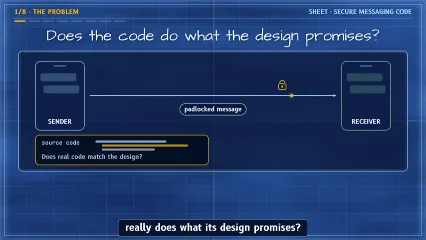
Announced on November 10, 2026, DeepMind’s AlphaProof Code work verified that a particular compiled implementation of Signal’s one-to-one messaging software protects message and handshake secrets under specified conditions, including some private-key exposures. The researchers used libsignal-protocol version 0.105.4 alongside version 1.6.0 of the Sparse Post-Quantum Ratchet library. They compiled the unmodified Rust components into a small Linux command-line program called libsignal-cli, giving the project an identifiable executable and a practical definition of sending or receiving a message.
AI agents wrote the mathematical arguments, human researchers approved the security claims, and the Lean proof assistant checked the resulting proofs. The work connected decisions made by that executable to statements about what an attacker could learn. Its assurance therefore concerns a defined implementation, attacker model, and set of conditions rather than every feature or deployment of the Signal application.
The project approached security through complementary symbolic and computational analyses. The symbolic proof tracked information available to an attacker through messages, public data, and specified key exposures. It also accounted for the order of events, such as whether a secret became available before or after a handshake. The computational proof bounded the advantage a resource-limited classical attacker could gain against message confidentiality or authenticity under assumptions about the underlying cryptography. These approaches address different aspects of the same security question rather than providing interchangeable guarantees. Together, they make the term verified meaningful by identifying the attacker, the protected information, and the circumstances under which each result applies.
The covered protocol stages were PQXDH, which establishes shared secret material, and the Triple Ratchet, which protects subsequent messages. Three command-line operations defined the practical boundary: initializing a session, sending one message, and receiving one message. Each invocation represented one party, with saved state carrying the conversation between operations. An additional command generated initial keys, but the theorems treated those keys as starting conditions and did not cover that command. Group messaging remained future work, while the computational result excluded multi-device state. These exclusions matter because another device introduces an additional location for session state, while a group adds participants and membership rules. A proof about the covered two-party interface cannot automatically establish the security of those different arrangements.
Delayed delivery illustrates why the implementation matters as much as the protocol description. Suppose Alice sends Bob three messages while his phone is offline, but the third arrives first when he reconnects. Bob’s software must advance far enough to decrypt that message, retain the keys needed for the first two, and remember which keys it has already used. Signal’s ratchet specification accounts for out-of-order delivery, but the executable must implement that bookkeeping correctly. The verification therefore included behavior involving encoded messages, saved keys for delayed deliveries, and earlier session records. By connecting observable program actions to the formal model, the researchers could examine whether the implementation preserved the permitted behavior rather than relying only on an abstract protocol diagram.
The machine model used AArch64, Arm’s 64-bit instruction architecture. Lean represented the executable as bytes and modeled instruction effects on processor position, registers, and memory. A Linux process model supplied surrounding operations such as reading inputs, accessing files, producing output, and exiting. This allowed low-level actions to be connected to higher-level events, including accepting a message and updating session state.
Reasoning about the executable also removed the need to assume that the Rust compiler correctly translated the covered source code, although the result remained specific to that build. Different compiler configurations or processor targets can produce different instruction sequences. An Android phone using Arm hardware does not necessarily run the verified Linux executable, and a desktop may use another architecture entirely. Extending the assurance to either product would require evidence connecting its own build and operating environment to the relevant theorems.
How PQXDH and the Triple Ratchet Protect Secrets Under Key Exposure
PQXDH, or Post-Quantum Extended Diffie-Hellman, allows Alice to begin a private conversation while Bob is offline. Before disconnecting, Bob publishes public key material known as prekeys. Alice retrieves his prekey bundle, checks the relevant signatures, and uses that information to establish secret material Bob can recover when he returns. The server can supply the public bundle without receiving the private keys needed for the calculation. PQXDH combines classical Diffie-Hellman calculations with a post-quantum key encapsulation mechanism. This hybrid construction addresses the possibility that an eavesdropper could record an exchange today and retain it until classical cryptography becomes vulnerable to a future breakthrough.
Authentication asks what Bob can infer when his software accepts a first message associated with Alice’s cryptographic identity. In the implementation, acceptance involves checking the authentication code on the first ratcheted message, and the proof links that event to earlier activity involving Alice and the session’s prekeys. The statement also identifies compromises or cryptographic breaks that would invalidate the inference, rather than treating a displayed name as proof of who typed a message. The implementation derives three initial values for the root, message chain, and SPQR, so the secrecy argument distinguishes disclosure of one value from disclosure of all starting material.
In the symbolic handshake analysis, a later defeat of Diffie-Hellman alone does not reveal the protected output when the post-quantum mechanism holds and the relevant secrets remain protected. Authentication still relies on classical cryptography, however, making confidentiality against later decryption different from authenticating a peer against an attacker who already possesses the relevant breaking capability. The computational analysis covers classical attackers. The post-quantum claim belongs specifically to the symbolic handshake analysis.
After the handshake, the Triple Ratchet combines the classical Double Ratchet with the Sparse Post-Quantum Ratchet, or SPQR. Each supplies material that a key derivation function combines into the key protecting an individual message. The recipient derives the corresponding key using the message header and its saved session state. SPQR spreads the data required for a post-quantum exchange across messages rather than making every short text carry a complete fresh exchange. Consequently, producing a distinct key for every message does not mean completing a new post-quantum exchange at the same rate.
DeepMind connected the compiled hybrid implementation to guarantees inherited from the classical ratchet. For the symbolic ratchet argument, the model even allowed the attacker to choose the SPQR contribution, testing whether the combination preserved classical protections under an unfavorable assumption. Establishing post-quantum recovery during an ongoing conversation requires a further argument about SPQR itself.
Forward secrecy concerns the effect of later exposure on earlier communications. If an attacker records a week of encrypted traffic and obtains Friday’s session state, the question is whether that material reveals Monday’s message key. A one-way symmetric ratchet should prevent a later chain value from reconstructing an earlier key once the necessary older material has been discarded. The precise exposure matters because a message key protects a particular message, whereas a chain key can derive further message keys along its chain.
The proof therefore distinguishes disclosure of the target key or an earlier derivable secret from disclosure of a later state. Delayed messages complicate the example because Bob may retain Monday’s skipped key until the message arrives. A snapshot containing that retained key differs from one taken after the key has been used and discarded. Reading Monday’s already-decrypted text from an unlocked screen is a separate route to the message and falls outside this cryptographic claim.
Post-compromise security asks whether future messages can become secure again after a temporary exposure. If an intruder obtains Alice’s session secrets on Tuesday and then loses access, merely advancing a chain the intruder already knows does not restore secrecy. Recovery requires fresh secret material outside the attacker’s knowledge, which a qualifying Diffie-Hellman ratchet step can provide. There is no universal recovery period measured in minutes or messages, because several texts sent while Bob remains offline do not establish that both parties have contributed fresh private values.
Once the required exchange occurs, an old snapshot can cease to reveal later message keys, subject to the theorem’s additional exposure conditions. Continuing access changes the situation because an attacker who can read newly generated keys can also observe material that would otherwise restore secrecy. Someone who reads new plaintext directly from the device does not need to derive its encryption key. Cryptographic session recovery and cleaning up a compromised phone are therefore separate problems.
How Researchers, AI Agents, and Lean Built and Checked the Proofs
Formal verification complements conventional auditing and testing rather than replacing them. Reviewers conducting an audit can follow concerns across storage behavior, dependencies, and unusual event sequences. Tests establish what happens for particular inputs, while regression tests check whether those inputs behave correctly after a repair. NIST’s guidance includes threat modeling, static analysis, historical test cases, and fuzzing because the techniques can expose different problems. A formal proof instead establishes a stated property for every execution permitted by its assumptions, with a single allowed counterexample sufficient to defeat the claim.
This makes specification quality essential: a theorem that excludes delayed messages cannot provide meaningful assurance about their eventual arrival. DeepMind assessed its original symbolic specifications against two previously fixed libsignal defects and reported that they distinguished the affected behavior from acceptable behavior. Those defects served as historical controls for the specifications, not newly discovered vulnerabilities or proof that every possible defect was covered.
Human researchers selected the properties to investigate and identified earlier cryptographic analyses that could support the work. An AI agent drafted formal statements, while an agent from a different model family reviewed them against the literature and implementation. Researchers requested revisions, resolved ambiguities, and sometimes required substantial rewriting before approving the statements. They also checked that honest conversations could satisfy the theorems’ opening conditions, rather than allowing the claims to become true only because successful communication was impossible under their assumptions.
Examples established that the parties could complete handshakes both with and without a one-time curve prekey. During proof construction, the project preserved a separate copy of each approved statement so that a difficult goal could not be silently weakened by adding a convenient assumption. Proposed changes to trusted assumptions followed an amendment process. Researchers reviewed those amendments at the end of each proof campaign.
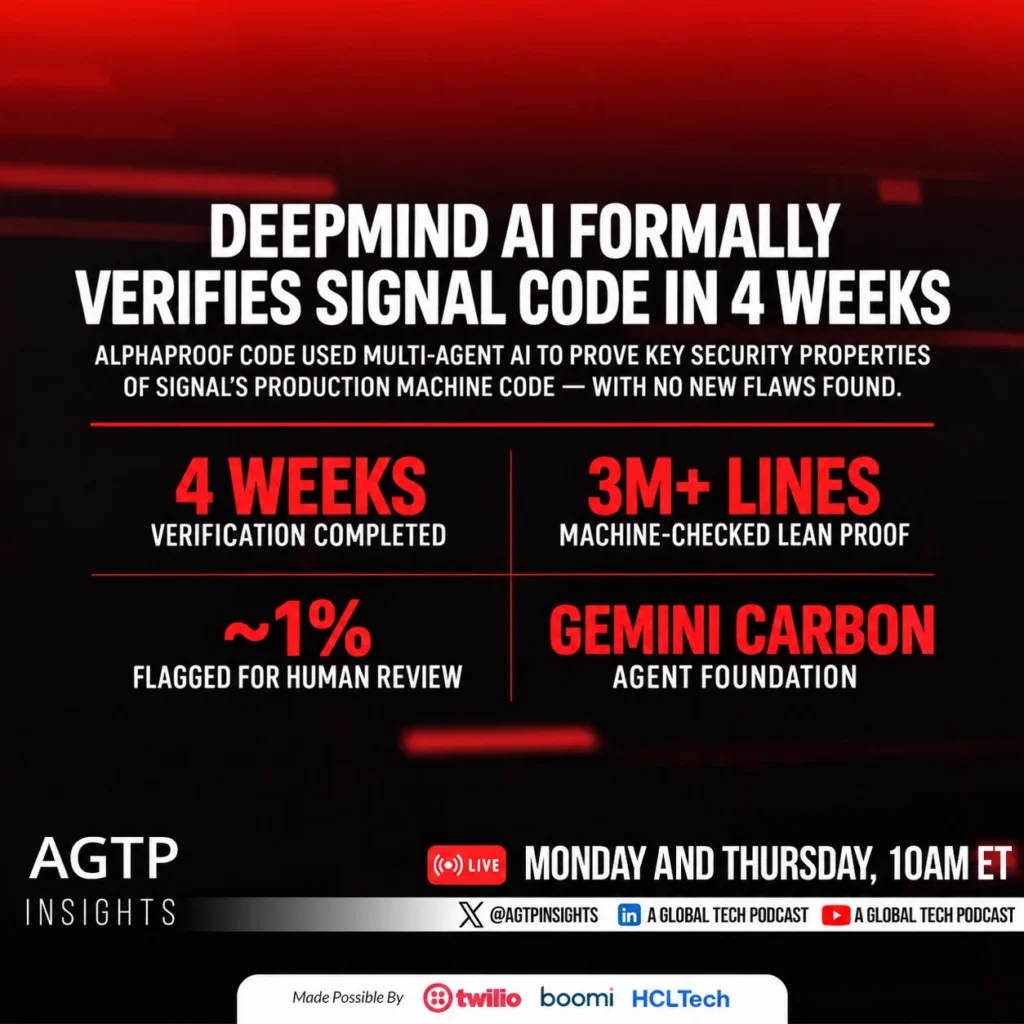
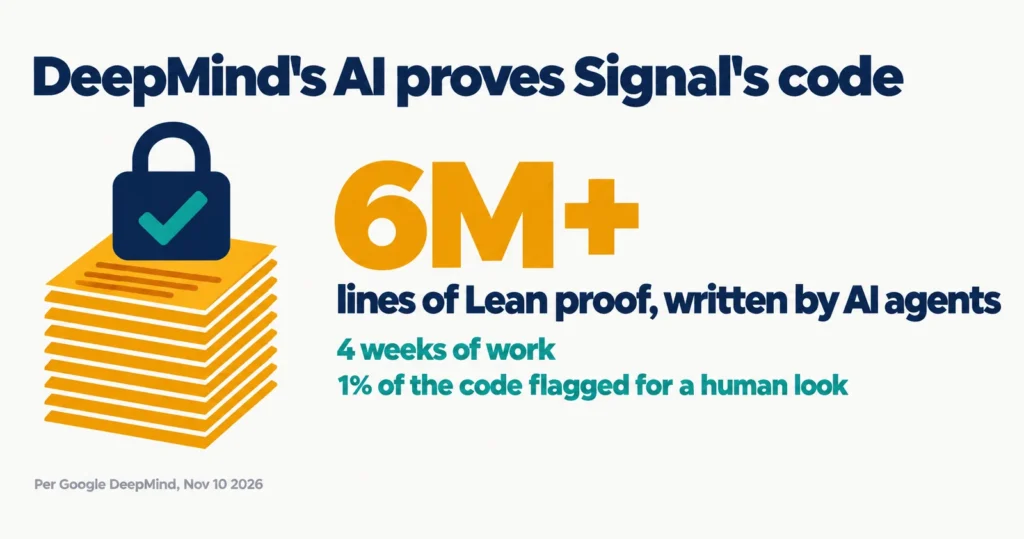
The original technical PDF reports approximately 6.5 million lines of Lean proof code, including about 5.3 million lines of binary reasoning shared by the symbolic and computational analyses. The online technical report gives a different total of approximately 6.3 million proof lines for the work it describes. Neither figure measures the size of Signal’s messaging library or the number of security properties established. Lean checks such arguments through formal dependencies, allowing smaller proven facts to support larger claims about the executable. It translates those arguments into a core mathematical language whose proof terms are checked by the kernel for the required types.
An AI-generated explanation that sounds plausible does not influence whether the kernel accepts the proof. The project added a comparator to check that the submitted proof established the exact approved target and depended on the intended definitions. It then replayed the proof in a fresh kernel environment, guarding against a theorem retaining its original name while an altered underlying definition made it easier to prove.
Five researchers directed the four-week campaign, with agents working concurrently and the symbolic and computational analyses proceeding in parallel. The authors state that agents wrote the proof code, while humans chose and approved claims, designed the strategy, investigated difficulties, and handled amendments. A clean proof build could itself take several hours, so the four-week figure describes elapsed research time rather than a single automated run. The project also benefited from substantial prior work, including Signal, Cryspen, and Inria’s PQXDH analysis published at USENIX Security in 2024.
Signal and Cryspen had additionally worked on SPQR’s design and Rust implementation. The broader Signal Shot initiative launched in April 2026 with the goal of extending machine-checked verification across Signal. Google declined to disclose the analysis cost to WIRED. The reported timeline therefore demonstrates the pace of this expert-directed campaign without establishing the cost of verifying another library or maintaining its proofs through future releases.
Trusted Assumptions, Scope Limits, and What the Result Means for Users
The trusted computing base contains the elements that must describe reality correctly for the proof to carry its intended meaning. Lean can establish that a theorem follows from definitions, but human judgment and independent evidence remain necessary to assess whether those definitions accurately represent the processor, operating environment, and security question. The original PDF reported about 26,000 lines of specifications and AArch64 semantics and relied on contracts for low-level cryptographic and other routines.
The online report describes about 27,000 lines and extends machine-code coverage into linked routines, including cryptographic primitives. It still identifies trusted assumptions about the machine, selected executable symbols, and the primitives’ mathematical properties. Correctly implementing a cryptographic calculation is distinct from establishing how difficult that calculation is to reverse. A mathematically valid theorem can therefore describe a narrower world than the one a user’s device actually inhabits.
The leakage model covers designated private keys and session state rather than every possible route to sensitive information. Side channels and other secrets held in device memory fall outside that model. The authors also state that their symbolic handling of a replayed initial message leaves a previously described replay-related forward-secrecy issue outside that theorem. That qualification should not be interpreted as evidence that the issue was resolved or proved absent by this work. More generally, an executable may perform operations beyond what a particular theorem needs to describe, so verification of stated claims does not mean that every behavior or exposure has been covered.
For Signal users, the result provides stronger evidence about important security promises between sending a one-to-one message and its successful decryption. The researchers followed those promises through implementation behavior involving the first exchange, changing keys, and retaining state for delayed messages. Signal CTO Ehren Kret told WIRED that the work increased Signal’s confidence in the implementation’s privacy guarantees, and the published proof is available for others to examine.
A separate practical question is whether the cryptographic session connects to the intended contact. Signal’s safety numbers allow participants to compare their one-to-one connection through a trusted channel. The proof explains what follows from particular cryptographic identities, while that comparison helps people connect those identities to a specific contact. These forms of evidence address different parts of private communication and should not be treated as substitutes for one another.
For services such as WhatsApp or Google Messages that use variants of the Signal protocol, the most transferable contribution is the verification method. Developers can examine how the researchers modeled attackers, connected messaging events to machine behavior, and checked generated proofs. A security claim about another service still requires identifying its own implementation, build, and handling of session state. Using a related protocol does not automatically transfer the guarantee established for libsignal-cli. Continuous verification across releases and support for additional processor architectures remain explicit goals of the wider Signal Shot effort, rather than completed outcomes of this particular proof.
Frequently Asked Questions (FAQs)
- Did DeepMind verify the entire Signal app?
No, the project verified selected security properties of one-to-one session code compiled into the specific Linux program libsignal-cli. The covered operations included initializing a session and sending or receiving individual messages, rather than every function available in Signal. The complete Android, iOS, and desktop applications contain additional code and operate in different environments. Group messaging remained outside the work, while the computational result specifically excluded multi-device state. The assurance therefore applies to the identified executable and its stated assumptions, not automatically to every Signal feature or deployment. - Which version of libsignal did AlphaProof Code verify?
The researchers used libsignal-protocol version 0.105.4 and Sparse Post-Quantum Ratchet, or SPQR, version 1.6.0. They compiled the unmodified Rust components into a Linux executable targeting the AArch64 instruction architecture. The public repository identifies those components and the toolchain used to produce the verified build. These details matter because changing a release, compiler configuration, or processor target can change the resulting machine instructions. Another researcher must establish that connection before applying the findings to a different version or application. - Can a later quantum computer decrypt a recorded Signal handshake?
Breaking classical Diffie-Hellman later is insufficient to recover the protected PQXDH handshake secret under DeepMind’s symbolic proof. The post-quantum mechanism must remain secure, and the relevant session secrets must have stayed protected. This addresses recorded traffic attacked after the exchange, not every possible quantum threat. Authenticating a peer against an already capable attacker is different, since PQXDH authentication still relies on classical cryptography. The quantum-related finding belongs to the symbolic handshake analysis, while the study’s computational analysis covers classical attackers. - Does every message complete a new post-quantum exchange?
No, a distinct message key does not mean that a complete new post-quantum exchange occurs for every message. The Triple Ratchet combines key material from the classical Double Ratchet and SPQR to protect messages. SPQR distributes its exchange data across messages to avoid attaching a complete exchange to every short text. Fresh message keys and completed post-quantum exchanges therefore occur on different schedules. This also means that sending another message does not, by itself, demonstrate post-quantum recovery after a compromise. - Can one stolen message key expose an entire conversation?
A single message key protects its associated message and does not generate the other message keys. Exposure of a chain key, root key, or larger session-state snapshot can have broader consequences. The timing and kind of exposure determine whether the attacker can derive a particular target key. A snapshot might also contain skipped keys deliberately retained for messages that have not yet arrived. Assessing the damage therefore requires identifying the stolen secret and its position in the conversation, not merely saying that a Signal key was compromised. - Did AlphaProof Code discover a new Signal vulnerability?
The team reported no newly discovered vulnerability in the portion of Signal it examined. Instead, it evaluated its original symbolic specifications against two historical defects that had already been documented and repaired. The specifications distinguished the defective behavior from behavior permitted by the security claims. This tested whether the formal statements captured meaningful failure cases, rather than merely whether the agents could complete a proof. It did not establish that all Signal code is free of vulnerabilities or that the specifications cover every possible defect. - Why do the reports say both 6.5 million and 6.3 million lines?
The original technical PDF reports approximately 6.5 million lines of Lean proof code. The online technical report gives approximately 6.3 million lines and describes its own breakdown of the work. Those figures belong to their respective documents, and the totals alone do not establish why they differ or which coverage is broader. Neither number measures Signal’s source-code size or the number of security guarantees established. Comparing coverage requires examining the theorem statements, definitions, and assumptions rather than relying on line counts alone. - Who decided what the AI agents had to prove?
Human researchers chose the scope, selected prior research, and approved the formal security statements. AI agents helped draft those statements, with an agent from a different model family reviewing them before humans requested revisions and resolved ambiguities. The approved statements were preserved separately while agents generated the proofs. Lean checked the mathematical arguments, while a separate comparator checked that the targets and dependent definitions matched the approved claims. This distinction matters because a logically valid proof can still answer a weaker or different question if its statement or assumptions change. - Can independent researchers inspect the verification?
Yes, Google DeepMind published the Lean material, specifications, and build information in its code-verification repository. A guide connects sections of the paper to their corresponding formal statements. This helps researchers locate a particular confidentiality, authentication, or implementation claim without first reading all of the proof code. Reviewers can then examine its assumptions, dependencies, and connection to the identified build. That supports targeted scrutiny of what was established and what remains outside the guarantee. - Will the proof automatically cover the next Signal update?
No, a proof about one compiled build does not automatically apply to a later update. A new build needs evidence connecting its instructions and behavior to the approved security properties. Even a small source change can alter machine code and require repairs to arguments about those instructions. Some earlier proof work may remain reusable, so maintaining verification does not necessarily mean starting over completely. Keeping that connection intact across releases is an objective of the wider verification effort, not an automatic guarantee for future versions.
Conclusion
DeepMind’s AlphaProof Code strengthened the connection between Signal’s security promises and the executable behavior that must uphold them. For a specified build of the one-to-one messaging library, researchers produced machine-checked arguments about accepting a first message, protecting earlier keys after certain later exposures, and recovering secrecy under defined conditions. Just as importantly, the work identifies where its guarantees stop, including the need for further proof of post-quantum recovery during an ongoing conversation.
The four-week effort’s enduring value lies in evidence that others can inspect, challenge, and use as a basis for further verification. Cryptographers can examine the assumptions, systems engineers can assess the machine model, and messaging developers can determine what evidence would connect another build to the established properties. For Signal users, the clearest gain is a more concrete basis for trust: specific privacy protections traced from protocol descriptions into the executable decisions that start and sustain a conversation, with the limits of those protections made explicit.
Sources and Citations
- Google DeepMind, November 10, 2026: The announcement introducing AlphaProof Code and the four-week Signal verification effort.
https://deepmind.google/blog/introducing-alphaproof-code/ - Google DeepMind, original technical paper: The published PDF documenting the 6.5 million proof-line figure, original trust assumptions, and division of work between researchers and agents.
https://deepmind.google/documents/36/Formal_Verification_of_Signal_4.pdf - Google DeepMind, online technical report: The browsable paper detailing the security theorems, their limitations, expanded machine-code coverage, and the 6.3 million proof-line figure.
https://google-deepmind.github.io/code-verification/ - Google DeepMind, code-verification repository: The public Lean proofs, pinned software versions, build information, and instructions for checking the headline theorems.
https://github.com/google-deepmind/code-verification - Signal, The PQXDH Key Agreement Protocol: The specification for asynchronous session setup, signed prekeys, authentication, and post-quantum forward secrecy.
https://signal.org/docs/specifications/pqxdh/ - Signal, The Double Ratchet Algorithm: The technical specification covering per-message keys, out-of-order delivery, the Sparse Post-Quantum Ratchet, and the Triple Ratchet.
https://signal.org/docs/specifications/doubleratchet/ - Signal, Signal Protocol and Post-Quantum Ratchets: Signal’s explanation of how the hybrid ratchet combines keys and spreads post-quantum exchanges across messages.
https://signal.org/blog/spqr/ - USENIX Security 2024, formal verification of PQXDH: Earlier research by Cryspen, Inria, and Signal on the post-quantum handshake using ProVerif and CryptoVerif.
https://www.usenix.org/conference/usenixsecurity24/presentation/bhargavan - Cryspen, October 2, 2025: An account of earlier work with Signal on the design, cryptographic components, and Rust implementation of SPQR.
https://cryspen.com/post/signal-spqr-verification/ - Lean, The Lean Language Reference: Documentation explaining how the theorem prover represents mathematical arguments and checks them with a small kernel.
https://lean-lang.org/doc/reference/latest/ - Beneficial AI Foundation, The ongoing quest for provably secure messaging: The Signal Shot team’s assessment of the milestone and remaining work on other architectures, protocol components, and continuous verification.
https://www.beneficialaifoundation.org/blog/signal-shot-milestone - NIST, Guidelines on Minimum Standards for Developer Verification of Software: Guidance on complementary methods including static analysis, historical testing, threat modeling, and fuzzing.
https://www.nist.gov/publications/guidelines-minimum-standards-developer-verification-software - Signal Support, safety numbers: Signal’s explanation of what participants can verify about a one-to-one chat by comparing safety numbers.
https://support.signal.org/hc/en-us/articles/360007060632-What-is-a-safety-number-and-why-do-I-see-that-it-changed - WIRED, November 10, 2026: Reporting on Signal’s response, the use of historical defects, and Google’s decision to withhold the project cost.
https://www.wired.com/story/a-new-ai-tool-from-google-deepmind-formally-verified-the-signal-protocol/
Recommendations
- Marvel Phase 6 Release Dates, News, Leaks, Rumors, and More: Full MCU Phase 6 Schedule
- Helldivers 2 Dev Promises Action and Better Communication After “Painful” Reddit AMA Criticism
- Palo Alto Networks in Talks to Acquire AI Agent Security Startup Clutch for $500M
- Kevin Roose Excerpt: Altman to Amodei Feud and OpenAI’s Reported 2017 AGI Auction Plan
- Clive Barker’s Hellraiser Revival also comes to Switch 2 on October 8 2026
- Carcass Clad: Release Date, Gameplay, Co-Op Tank Horror, and Story Details
- All Car Wash Locations in Fortnite Chapter 7 Season 3 (Complete Map Guide & Landmark Locations)
- Paralives: How To Level Up The Food Skill Fast (Complete Cooking & Skill Guide)
- All Anomalies in Animal Hospital Guide: Every Roblox Anomaly Explained
- Star Wars Galactic Racer is a Burnout Game: Why Fans Are Calling it the Burnout Revival



































































































