









DoorDash entered the era of agentic commerce with two major AI powered ordering initiatives announced on September 30, 2026. The company introduced a DoorDash AI text based AI ordering agent that works through Apple Messages while also opening a limited beta for DoorDash Corporate Ordering MCP, a system that allows companies to connect DoorDash ordering capabilities to workplace AI tools and internally built agents. The two launches address different sides of the ordering experience. The Apple Messages agent is designed for individual consumers who want to order food without navigating the DoorDash app, while the corporate MCP offering is aimed at organizations that want AI agents to handle employee meals, group orders, recurring lunches and office restocking.
Both products are built around the same broader idea: customers should be able to tell an AI system what they want and have that system take action instead of simply providing information. DoorDash’s approach is particularly significant because ordering food is a transaction rather than a simple search. An AI agent must interpret a request, find appropriate products, construct a cart, account for preferences, handle payment and ultimately cause a real world delivery to take place. These DoorDash AI tools therefore represent a move beyond conversational assistance and toward commerce workflows in which software can act on behalf of a customer or organization.
DoorDash’s consumer product is being introduced through a U.S. waitlist for iPhone users, while the Corporate Ordering MCP product is also in limited beta with access beginning through a company level waitlist. DoorDash has not announced a general public launch date for either experience, meaning both remain early stage products rather than fully available services.
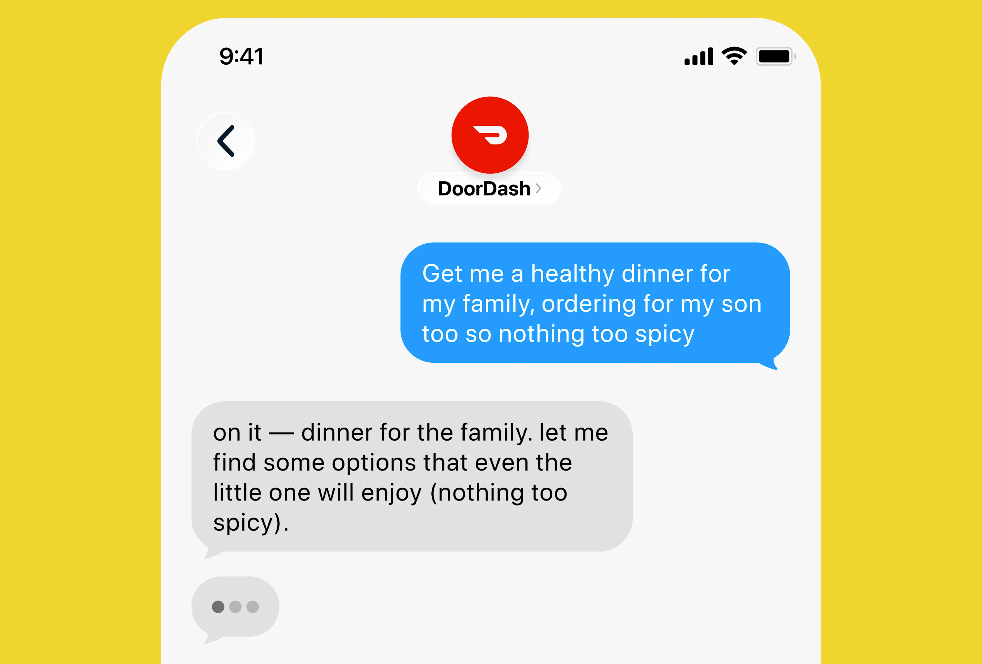
The consumer facing system is a conversational ordering agent that allows customers to interact with DoorDash through Apple’s Messages app instead of opening the conventional DoorDash application. Although it is commonly described as an iMessage feature, the actual interface is Apple’s Messages app, where customers can communicate with the DoorDash AI agent using ordinary text prompts. The objective is to remove much of the traditional friction involved in placing an order. Rather than launching DoorDash, searching for a restaurant, browsing a menu, selecting an item, customizing it, adding it to a cart and then checking out, a customer can simply describe what they want conversationally.
DoorDash’s examples include requests such as ordering a usual meal or finding a particular type of food for delivery to a specified location. The DoorDash AI agent can search nearby restaurants, examine menus and propose a cart based on the customer’s request. It can also return food photographs within the conversation, helping the customer evaluate recommendations without leaving the Messages thread. This turns the conversation into a lightweight shopping interface rather than simply a place for customer support or order notifications.
Personalization is another important part of the system. DoorDash can associate the customer’s phone number with an existing DoorDash account, allowing the DoorDash AI agent to use information such as previous orders and preferences. That makes requests such as “order my usual” more practical because the system can draw on account history rather than treating every conversation as a completely new interaction.
The service remains a beta experience rather than a fully open product. DoorDash opened a U.S. waitlist on September 30, 2026, with the initial rollout focused on iPhone users. Android availability has not received a definitive launch date. For now, the Messages based agent should therefore be viewed as an early test of how DoorDash can move ordering from a conventional app interface into a conversational AI experience that searches, recommends and prepares real purchases on the customer’s behalf through DoorDash AI.

In This Article (7 sections)
How DoorDash’s AI Agent Works in Apple Messages and Remembers Orders
The DoorDash AI agent is designed to understand natural language requests instead of forcing customers to use predefined search filters or navigate a menu hierarchy. A person can describe the food they want, specify a delivery location and provide additional requirements in ordinary language, and the DoorDash AI agent then translates that request into an actionable DoorDash order. For example, a customer could ask for their normal Friday night meal, and the DoorDash AI system can use previous ordering behavior to determine what that means in context. Alternatively, the customer could request a particular dish, ask for a recommendation based on a mood or craving, or look for something suitable for a group.
The DoorDash AI agent’s workflow combines discovery and ordering. It can search available local restaurants, examine relevant menus and construct a suggested cart without requiring the customer to move between restaurant pages. Recommendations can appear directly inside the Messages conversation and may include food photographs to provide additional context. Account recognition is important because the DoorDash AI system is designed to act as more than an anonymous food search chatbot. Bloomberg reported that DoorDash can match a customer’s phone number with their DoorDash profile, allowing the system to consider previous orders and preferences and use stored payment information during checkout.
This also illustrates the difference between a conventional AI assistant and an AI agent. A chatbot might simply tell someone which restaurant serves a particular dish, while DoorDash’s agent is intended to take additional steps by searching the marketplace, selecting relevant options, building the cart and helping complete the transaction. That ability to act on a request is central to the agentic commerce approach DoorDash is pursuing with DoorDash AI. Customers should still review AI generated carts before paying because the system can misinterpret instructions or select something different from what the customer intended.
Ordering through Apple Messages begins with access to the beta, which DoorDash is initially distributing through a waitlist for participating U.S. iPhone users. Once access is available, a customer can communicate with the DoorDash AI ordering agent using natural language. The request can be as simple as asking for a familiar meal or as detailed as specifying a food type, restaurant preference, delivery requirement or other condition. DoorDash AI interprets the request and searches its marketplace for suitable options.
The DoorDash AI agent can then suggest a restaurant and assemble a proposed cart. When recommendations are involved, food photographs can appear directly in the Messages conversation, allowing customers to evaluate potential choices without returning to the DoorDash application. Repeat purchases are another important part of the experience. Instead of remembering the exact restaurant, item, modifiers and extras associated with an earlier order, a customer can ask for their usual meal and let the DoorDash AI system use account history to interpret the request.
Personalization around previous orders is therefore one of the defining features of the system. A regular purchase may contain more detail than the customer remembers explicitly, such as repeatedly removing one ingredient, adding a particular topping or selecting the same side. An agent that understands ordering history can potentially reproduce those preferences without requiring the customer to explain every modifier each time. DoorDash has also described the DoorDash AI agent as capable of learning from repeated ordering behavior, and reports about the launch indicate that it may recognize recurring choices and ask whether a customer wants a familiar order based on established habits.
The more accurately the system recognizes routine behavior, the less effort the customer needs to put into repeat purchases. However, personalization should not be treated as perfect memory. AI generated orders can still contain mistakes, so reviewing the proposed cart remains important before the transaction is confirmed with DoorDash AI.
The consumer agent is primarily designed around DoorDash’s existing marketplace rather than operating as an entirely separate delivery service. Food ordering is the clearest use case, allowing customers to request a specific meal, ask for recommendations or repeat a previous purchase. DoorDash’s wider agentic ordering infrastructure also includes workflows involving restaurants and retailers, with developer documentation describing capabilities such as product search, cart management, order submission, order status checks, receipts and reordering through DoorDash AI.
The Messages announcement also points toward grocery oriented use cases. DoorDash cofounder Andy Fang described an example in which a customer could send a photograph of a refrigerator, allow the DoorDash AI system to identify ingredients missing from a recipe and then arrange delivery of those ingredients. This suggests that DoorDash views conversational ordering as something broader than simply texting a restaurant order. The longer term goal is for an agent to understand what a customer is trying to accomplish, determine which products are required and use DoorDash’s marketplace to fulfill that objective.
How DoorDash AI Handles Group Orders, Dietary Preferences and Checkout
Group ordering is one of the more complicated areas of food delivery because different people may want different meals, quantities and dietary options. DoorDash says its Messages agent is designed to manage these variables within a single order. The DoorDash AI agent can account for mixed dietary preferences and different quantities while building a proposed cart, reducing the amount of manual coordination required from the person organizing the meal.
For a family, this could mean handling several dishes and preferences through one conversation. For larger groups, the potential benefit is even greater because gathering individual selections can otherwise involve multiple messages, spreadsheets or separate conversations. DoorDash’s corporate MCP offering extends this idea into workplace ordering by allowing organizations to build group order workflows around communication tools. The company’s documentation specifically describes Slack based workflows in which employees can submit individual meal choices and a DoorDash AI agent can consolidate them into a group order.
AI assistance does not guarantee that every dietary requirement will be interpreted correctly. Serious food allergies and other important dietary restrictions still require careful verification. The role of the DoorDash AI agent is to simplify collecting and organizing preferences rather than eliminating the need to confirm that the final selections are appropriate.
Another major part of the experience is that checkout can be completed without requiring the customer to open the DoorDash application. DoorDash says customers can review and confirm an order within the Messages conversation while the DoorDash AI system manages the checkout process through the connection to their existing DoorDash account. Bloomberg reported that DoorDash can match a customer’s phone number with their DoorDash profile and use the stored payment information associated with that account.
This changes the role of the DoorDash app by making it one possible interface for accessing the company’s marketplace rather than the required starting point for every purchase. The intended flow becomes much shorter: tell the DoorDash AI agent what you want, review the proposed order and confirm it, rather than opening the app, searching, browsing, selecting, customizing and paying through several separate screens.
There is still an important security distinction. Completing checkout without opening the app does not mean the AI should silently charge a customer without authorization. DoorDash’s public description of the Messages experience includes customer confirmation before the order is finalized, while its corporate MCP documentation explicitly requires end user confirmation for real purchases made through its ordering tools.
That final confirmation step is important because an AI agent may interpret a request differently from what the customer intended. Keeping purchase authorization under the user’s control creates an important safeguard while still allowing most of the discovery, selection and cart building process to happen automatically. The result is a conversational DoorDash AI ordering experience that reduces friction while preserving a point at which the customer can inspect the order and decide whether the agent got it right.

What DoorDash Corporate Ordering MCP Is and How Companies Can Use It
DoorDash Corporate Ordering MCP is a DoorDash hosted Model Context Protocol server designed to connect workplace AI agents and internal company tools with DoorDash’s ordering infrastructure. MCP, or Model Context Protocol, is an open standard for connecting AI applications with external services and tools. Unlike the consumer Messages agent, which gives individual shoppers a conversational ordering interface, DoorDash MCP provides organizations with infrastructure that allows their own AI assistants and workplace systems to perform DoorDash ordering tasks.
DoorDash describes the MCP system as giving connected agents access to the same general catalog, cart and checkout systems that power DoorDash ordering. This means an employee can interact with an internal AI assistant while DoorDash handles the marketplace transaction and delivery behind the scenes. The corporate service remains in private or limited beta. DoorDash’s developer documentation says access is restricted to approved testers, while its September 30 announcement opened a broader company waitlist.
The system also separates company level integration from individual authorization. A business can connect its internal tools to DoorDash, but employees still authenticate through their own DoorDash accounts and agree to the relevant terms before an agent can act on their behalf. This allows companies to build shared workflows without giving an internal AI unrestricted access to every employee’s ordering account.
The core purpose of DoorDash MCP is to provide AI agents with a standardized way to interact with DoorDash’s ordering capabilities. Instead of simply recommending a restaurant, a connected agent can search for products, build and inspect carts, add or remove items, apply promotions, preview pricing and totals, submit orders, check delivery status, retrieve receipts and reorder from previous purchases. This makes MCP particularly useful for enterprise environments because DoorDash does not need to become a separate workplace application. Its ordering functions can instead become an action layer inside an organization’s existing assistant.
Office lunch coordination is one of the clearest examples. A company could connect DoorDash to an internal AI assistant and allow employees to submit lunch requests through the workplace tools they already use. Instead of assigning one person to collect everyone’s choices, the agent could handle restaurant discovery, interpret individual preferences, construct the cart and manage the order. DoorDash has also described recurring meal workflows in which eligible corporate meal benefits can be used for daily deliveries, allowing an agent to incorporate existing workplace food allowances into the ordering process.
This setup could also provide workplace level personalization. An agent could potentially use established restaurant rotations, employee preferences and dietary requirements to suggest meals without forcing an administrator to rebuild the same order every day. However, DoorDash MCP is not being presented as an unrestricted autonomous purchasing system. Employee authentication, authorization and transaction controls remain part of the process, meaning the goal is to reduce repetitive administrative work without removing control over who can place company funded orders.
Office restocking extends the same concept beyond meals. DoorDash says organizations can connect an AI agent to internal inventory information and use DoorDash as the fulfillment layer when snacks, drinks or office supplies run low. A company could maintain a list of frequently replenished items and establish rules for when they should be reordered. When stock reaches a defined threshold, the internal agent could identify a suitable product on DoorDash and prepare or place an order according to company policies.
DoorDash’s documentation also describes recurring restocking workflows in which employees can notify an agent that something is running low while the organization maintains a scheduled checkout process. The important distinction is that MCP supplies the connection to DoorDash rather than solving inventory management by itself. The company still needs to provide the inventory data, replenishment rules and authorization policies that determine when and how purchases should occur.
How DoorDash MCP Automates Slack Group Orders and Who Is Testing It
Slack based group ordering is one of the specific workplace scenarios DoorDash has highlighted for Corporate Ordering MCP. A company could build a Slack bot that opens lunch ordering in a thread, collects individual meal requests and then uses DoorDash to assemble and place the resulting group order. Instead of a human coordinator copying every selection manually, the agent can consolidate the requests and manage the ordering workflow.
DoorDash’s developer documentation describes an even more automated version of the process. A Slack bot can work from a rotation of restaurants, send out a group cart at a scheduled time, allow employees to add their individual dishes and remind anyone who has not yet submitted a choice. The connected agent can then use DoorDash’s cart and ordering functions to prepare the final transaction once the necessary approvals are in place.
Slack should be understood as an example of an integration that companies can build rather than a standalone DoorDash Slack product being released universally. DoorDash is supplying the MCP connection, while businesses and their AI tool providers can design the workplace experience around it. This is one of the main reasons MCP is useful. Instead of creating an entirely separate custom integration for every AI platform, compatible agents can use a standardized protocol to discover and invoke DoorDash capabilities.
The same architecture can support several workplace scenarios:
- Group lunch orders collected through Slack or another internal communication tool.
- Recurring daily meals funded through corporate benefits.
- Restaurant rotations based on employee preferences.
- Reordering from previous workplace purchases.
- Scheduled restocking of snacks, drinks or office supplies.
- Cart management, pricing checks, receipts and delivery tracking through an internal AI assistant.
DoorDash has identified SpaceXAI, Vercel, Cognition, Tempo and Mercor as early beta partners using the corporate ordering connector for employee ordering. These companies are part of the testing phase rather than evidence that DoorDash MCP is already available to every organization. DoorDash continues to describe the corporate product as a limited beta and allows other interested companies to join the waitlist.
The early partner group is particularly relevant because technology focused companies often already rely heavily on internal software, AI assistants and collaboration platforms. They therefore provide useful environments for testing agentic workflows in which software can perform real actions instead of merely retrieving information. One company might experiment with a Slack lunch bot, another with recurring employee meals and another with automated office supply replenishment.
These different use cases give DoorDash an opportunity to learn where the MCP model works well and where additional controls, integrations or safeguards are needed. The company has said it plans to use feedback from participating organizations to improve the system before expanding access. For now, SpaceXAI, Vercel, Cognition, Tempo and Mercor are best understood as early testing partners helping DoorDash evaluate how corporate agentic ordering functions in real workplace environments.
Frequently Asked Questions[FAQs]
- What is DoorDash’s iMessage AI ordering agent?
DoorDash’s iMessage AI ordering agent is a conversational system that allows customers to order through Apple’s Messages app instead of using the traditional DoorDash interface. Users can describe what they want in ordinary language, ask for recommendations, repeat familiar orders and review a proposed cart inside the conversation. The feature is initially being tested with U.S. iPhone users through a waitlist, so it is still a beta experience rather than a fully public service. - Can DoorDash AI order my usual meal?
Yes. DoorDash specifically highlights the ability to ask the agent to “order my usual.” The system can use information from a customer’s DoorDash account, including previous orders and preferences, to work out which meal that request most likely refers to and rebuild the appropriate cart. Because AI can still misinterpret preferences or modifiers, customers should review the proposed order before approving the purchase. - Do I need to open the DoorDash app to use the Messages ordering agent?
No. One of the main purposes of the feature is to let customers handle the ordering process directly inside an Apple Messages conversation. The agent can search for suitable restaurants, suggest items, prepare the cart and help with checkout without requiring the user to launch the DoorDash app. The customer still remains responsible for reviewing and confirming the final order before payment is completed. - Can DoorDash AI handle group orders?
Yes. DoorDash says the consumer AI agent can manage group orders that involve different quantities, meal choices and dietary preferences. This can reduce the amount of manual work required from the person organizing the meal because the agent can help consolidate several requests into one proposed cart. Customers should still verify important details, especially serious dietary restrictions or allergies, before approving the order. - Is DoorDash’s AI ordering agent available on Android?
Not yet as a broadly available feature. The initial rollout is focused on U.S. iPhone users because the service operates through Apple’s Messages app. DoorDash has not announced a specific Android release date, so Android users currently do not have an equivalent generally available version of the conversational ordering experience. - What is DoorDash Corporate Ordering MCP?
DoorDash Corporate Ordering MCP is a DoorDash hosted Model Context Protocol service that lets companies connect compatible AI agents and internal workplace tools directly to DoorDash ordering capabilities. Through that connection, an internal assistant can search for products, build carts, submit orders, check delivery status and access receipts. The goal is to let businesses add DoorDash transactions to existing workplace AI systems instead of building an entirely separate ordering platform. - Can companies use DoorDash MCP with Slack?
Yes. DoorDash specifically describes Slack based group ordering as one possible use case. A company can build or connect an agent that opens a lunch thread, collects employees’ meal choices, combines them into a group cart and then uses DoorDash to prepare or place the order. Slack is an example of an integration businesses can create with MCP, not a feature that automatically appears in every Slack workspace. - Can DoorDash MCP automatically restock office snacks?
Yes. DoorDash describes workflows in which a company’s own inventory information is connected to an AI agent that can identify when snacks, drinks or other supplies are running low. The agent can then use DoorDash to find replacement products and prepare or place an order according to the company’s rules. MCP provides the ordering connection, while the organization still needs to define its inventory thresholds, permissions and purchasing policies. - Which companies are early DoorDash MCP partners?
DoorDash has identified SpaceXAI, Vercel, Cognition, Tempo and Mercor as early beta partners using the corporate ordering connector. These companies are helping test how agentic ordering works in real workplace environments, including employee meals and other corporate workflows. Their participation is part of the limited beta and does not mean the MCP service is already generally available to all businesses. - When will DoorDash AI ordering become generally available?
DoorDash has not announced a confirmed general release date for either the Apple Messages ordering agent or Corporate Ordering MCP. The consumer feature is still being distributed through a U.S. waitlist for iPhone users, while the corporate service remains in limited beta with company level access and a separate waitlist. Broader availability will likely depend on how the beta programs perform and what DoorDash learns from early users and business partners.

Conclusion
DoorDash’s launch of an AI ordering agent for Apple Messages and its Corporate Ordering MCP represents a significant expansion of the company’s AI strategy. Rather than keeping ordering inside the DoorDash application, the company is making its marketplace accessible through conversational interfaces and external AI agents.
For consumers, the Apple Messages agent is designed to turn a familiar text conversation into a complete ordering workflow. Customers can request a meal, ask for recommendations, reorder familiar food, coordinate group orders and confirm checkout without navigating through the traditional DoorDash application. The ability to use order history and preferences makes the system more than a basic text-based ordering form.
For companies, Corporate Ordering MCP takes the concept into the workplace. Organizations can connect DoorDash to internal AI systems and create workflows for team lunches, employee meal benefits, Slack-based group ordering and office restocking. DoorDash is effectively providing the transaction and fulfillment infrastructure while companies decide how their own agents should interact with employees and internal systems.
The significance extends beyond food delivery. These launches demonstrate a broader shift toward agentic commerce, where the user increasingly communicates an outcome instead of manually navigating a marketplace. In this model, an AI agent can interpret the request, search available products, construct a cart and initiate a real transaction.
DoorDash is also addressing both sides of the emerging market. The Apple Messages agent is a consumer-facing interface designed to meet individuals where they already communicate, while MCP is an infrastructure layer designed to let businesses build their own AI-powered ordering experiences. That combination could allow DoorDash to remain part of the transaction even when the customer is no longer interacting directly with the DoorDash application.
The technology is still early. Both offerings are in beta or limited-access stages, and DoorDash has not announced final general-availability dates. AI accuracy, authorization, payment security, dietary interpretation and the reliability of automated recommendations will remain important considerations as these products expand.
For now, the clearest takeaway is that DoorDash is positioning itself for a world in which AI agents do not merely recommend where to eat. They can actually place the order. The company’s Apple Messages agent shows what that could look like for individual customers, while Corporate Ordering MCP shows how the same concept could reshape workplace purchasing and fulfillment.
Sources and citation
- DoorDash — “DoorDash brings office ordering to the AI tools teams already use” — September 30, 2026. Primary announcement for the Corporate Ordering MCP, corporate use cases, limited beta, early partners and employee authorization model.
DoorDash — Corporate Ordering MCP Announcement - DoorDash Developer Services — MCP & DoorDash CLI — Official overview of DoorDash’s agentic-ordering offerings, including Corporate Ordering MCP, organizational scope, limited-beta status and OAuth-based per-user authorization.
DoorDash MCP & DoorDash CLI - DoorDash Developer Services — About DoorDash MCP — Technical documentation covering the MCP server, private-beta status, corporate/organizational ordering, user authorization, catalog search, cart building, ordering, tracking, receipts and reordering.
About DoorDash MCP - DoorDash Developer Services — Available Tools — Official MCP tool reference covering
add_to_cart, cart management, pricing previews,submit_order, order tracking, receipts, order history and reordering. It explicitly states thatsubmit_orderrequires explicit end-user confirmation before a real charge is made.
DoorDash MCP — Available Tools - TechCrunch — “DoorDash launches an AI agent you can text to order food” — September 30, 2026. Covers DoorDash’s Apple Messages AI ordering launch, restaurant discovery, recommendations, food photos, group orders and the U.S. waitlist.
TechCrunch — DoorDash AI Agent in Apple Messages - Bloomberg — “DoorDash Debuts Text-to-Order AI Agent That Works in Apple Messages” — September 30, 2026. Covers phone-number matching with DoorDash profiles, order history and preferences, and checkout using the stored payment method.
Bloomberg — DoorDash Text-to-Order AI Agent - 9to5Mac — “DoorDash now lets you order by text in Apple Messages” — September 30, 2026. Details repeat orders, menu searches, local recommendations, food photos, group dietary preferences and checkout directly within the Messages conversation.
9to5Mac — DoorDash Ordering in Apple Messages
Recommendations
- Devil May Cry Season 2 Trailer Embraces Controversial Devil May Cry 2 Arc as Dante Faces Double Villain Threat in Netflix Anime Expansion
- Mariachi Legends: Mexican Metroidvania Launches April 27, 2027
- A Game About Breaking a Cube: Demo, Gameplay and Release Date
- Serenity Forge and Studio Meadowflower Unveiled Vivarium, a Hand-Illustrated Life Sim Adventure About an Endless Summer, a Tiny Terrarium Town, and the Strange Secrets Hidden Beneath Its Cozy Routines
- Starpath Space Flight Sim: Explore a Massive Universe Solo or Co-Op in this Open-World Survival Space Game
- Build a Rocket Boy Ex-Lead Animator Chris Wilson Statements Explained
- Is Blender CPU or GPU Intensive? A Complete Guide to Performance in Blender
- Blender’s Geometry Nodes For Beginners: Complete SEO Guide To Nodes, Procedural Modeling, And Faster 3D Workflows
- Ephere Releases Ornatrix 4 for Cinema 4D With Powerful New Hair Grooming Tools
- The Unreal Editor for Fortnite (UEFN) Now Features Star Wars Content: Templates, Assets, Publishing Rules, and Creator Requirements



































































































