






In This Article (8 sections)
Lou’s Lagoon Release Date, Platforms, Editions, and Technical Details
Lou’s Lagoon launched on August 27, 2026, as a multiplatform cozy exploration, crafting, and open-world adventure developed by Tiny Roar and published by Megabit Publishing. The game is available on PlayStation 5, Xbox Series X|S, Nintendo Switch, Nintendo Switch 2, and PC through Steam and the Microsoft Store. The broad release strategy gave players on every major current platform access to the same core adventure, including seaplane exploration, resource gathering, crafting, island restoration, fishing, customization, and the search for the missing Uncle Lou.
Tiny Roar and Megabit confirmed the August 27 date after previously announcing expanded PlayStation and Xbox versions alongside the existing Nintendo and PC plans. There is a minor discrepancy on Steam, where the base-game page records August 26, 2026, even though the official campaign and associated downloadable content use August 27. This appears to reflect regional unlock timing or the way Steam recorded the worldwide launch rather than a separate PC release. August 27 remains the main date for the game’s multiplatform rollout.
The PlayStation 5 edition includes features designed specifically for Sony’s hardware. DualSense haptic feedback provides physical responses during exploration, construction, and crafting, while adaptive triggers add resistance and feedback to compatible gathering actions. Tiny Roar also highlighted the PS5 SSD for faster loading and 4K HDR presentation for the colorful environments. The PlayStation Store categorizes the game under casual, adventure, and simulation.
The Xbox Series X|S version is optimized for Microsoft’s current consoles and supports Xbox achievements, cloud saves, Xbox Play Anywhere, 4K Ultra HD, and frame rates of 60 FPS or higher according to the Deluxe Edition listing. Xbox Play Anywhere allows a supported digital purchase to be accessed on both Xbox Series X|S and Windows PC within Microsoft’s ecosystem without buying a second copy. Cloud saves help preserve progress when moving between supported devices. This feature concerns ownership and progression, not multiplayer or cross-platform cooperative play.
Both Nintendo generations received the complete core game. The original Nintendo Switch edition supports TV, tabletop, and handheld modes, one local player, and Save Data Cloud through Nintendo Switch Online. Nintendo lists its file size at approximately 5.2 GB. The Nintendo Switch 2 version is a dedicated edition rather than simply the original release running through backward compatibility. It offers a higher frame rate, increased resolution, and enhanced presentation. An upgrade pack is available for Switch owners moving to Switch 2, with Nintendo’s launch information describing a no-cost upgrade path. The native Switch 2 edition has a larger file size because of its enhanced assets.
On PC, the game is available through Steam and the Microsoft Store. Steam supports single-player gameplay, achievements, cloud saves, controller input, Remote Play on TV, and Family Sharing. Steam lists Windows 10 64-bit as the minimum operating system and provides the following specifications:
- Minimum: Intel Core i3-9100F or AMD Ryzen 3 1200, 4 GB RAM, and an Nvidia GTX 1050 Ti or comparable graphics card with 4 GB VRAM.
- Recommended: Intel Core i5-10400 or AMD Ryzen 5 3600, 8 GB RAM, and an Nvidia GTX 1660 SUPER-class graphics card with at least 6 GB VRAM.
The standard edition has a U.S. list price of $24.99 across major storefronts, including PlayStation, Xbox, Steam, and Nintendo. The Deluxe Edition is listed at $26.99 before temporary discounts, while the Deluxe Pack can be purchased separately for $4.99 on supported platforms. The Deluxe Pack adds cosmetic content rather than a separate campaign:
- Bubblefan Engine: Leaves a stream of bubbles behind the seaplane.
- Lifeguard Skin: Adds a themed player outfit and matching bubble accessory.
- Beachside Decor Pack: Provides eight exclusive bubble-themed pieces of furniture.
Standard Edition owners still receive the complete story, archipelago, crafting systems, restoration activities, and gameplay progression. The Deluxe content is aimed at players who want additional visual customization. PC users can also purchase a digital art book and original soundtrack, with Steam offering bundles that combine these extras with the game.
Lou’s Lagoon was developed by Tiny Roar, a Hamburg-based German studio founded in 2015. Megabit Publishing, part of Aonic, handled the game’s main publishing campaign, including trailers, public demonstrations, playtests, platform announcements, and the final launch. Steam additionally credits rokaplay as a publisher. Megabit’s documentation identifies BKOM Studios as the team responsible for console-port development, while Tiny Roar remains the principal creator. The game had been publicly demonstrated for several years, beginning with an early gameplay teaser in June 2024, followed by development updates, demos, and community testing.
The game is designed as a single-player experience. There is no advertised online cooperative campaign or conventional multiplayer mode. Steam Cloud, Xbox cloud saves, Nintendo Save Data Cloud, and Xbox Play Anywhere are progression and platform conveniences rather than evidence of multiplayer support.

Lou’s Lagoon Story, Uncle Lou’s Disappearance, and the Limbo Archipelago
The story begins when the protagonist receives a distress call from Uncle Lou and travels to the tropical Limbo archipelago. Upon arrival, the player discovers that a powerful storm has damaged the islands and that Lou has disappeared. The immediate work of restoring homes, businesses, and communities runs alongside a larger investigation into what happened to him.
Players follow Lou’s trail, gather clues, speak with island residents, and explore increasingly remote areas in search of answers. Official descriptions avoid revealing the final explanation, allowing the disappearance to provide a forward-driving narrative for activities that might otherwise feel like unrelated crafting and rebuilding tasks. Every repaired location, new friendship, and discovered island can potentially bring the player closer to understanding where Lou went and what occurred during the storm.
Uncle Lou’s seaplane and delivery operation are also closely connected to the protagonist’s new responsibilities. The aircraft is not simply an item found at the beginning of the game. It represents part of the life and work left behind after Lou disappears, explaining why deliveries, aviation, island relationships, and the central mystery are tied together.
Limbo is an open archipelago divided among islands with different communities, visual identities, resources, and environmental conditions. Rather than presenting one continuous landmass, the world uses water and distance to make the seaplane necessary. Hidden islands, rare materials, challenges, and optional discoveries encourage players to leave the direct quest route and investigate the space between major settlements.
Tangle Bloom is one of the central locations. It is a flower-shaped island and the liveliest town in Limbo, although the storm has damaged its businesses before the player arrives. Helping the Charneys restore these establishments forms part of the wider community-rebuilding process. Smaller jungle islands around Tangle Bloom provide additional resources, secrets, and characters.
Gleam Reef introduces the Vooi, a community described as living according to the rhythm of the tides. Boulderia offers a sharp environmental contrast. It is a rugged settlement built on the back of a giant crab and inhabited by the Gorplins, who mine and consume valuable sugar crystals. These distinct societies prevent the archipelago from feeling like a collection of interchangeable tropical locations.
The communities support the game’s cozy identity because progression frequently comes from repairing places, helping residents, delivering resources, and strengthening relationships rather than fighting enemies. Quests given by the islanders reveal more about local life while directing the player toward new resources, gadgets, areas, and story clues.
Character creation lets players design their own protagonist instead of controlling a fixed hero. Available options include:
- Hairstyles
- Skin tone
- Eye color
- Eyebrow shape
- Facial hair
- Face markings
- Clothing and accessories
Additional outfits become available through progression and island shops. The Deluxe Pack adds the Lifeguard costume, but the standard game already contains a substantial customization system. This freedom matches the personalization available for the seaplane and island base, allowing the player’s character, aircraft, and living space to reflect a consistent style.
The colorful presentation and community-centered activities give the game a relaxed tone, but the storm and missing-person mystery prevent the archipelago from becoming a directionless sandbox. The player is rebuilding Limbo for its residents while also investigating a disappearance that connects the delivery business, the seaplane, and the islands themselves.

Lou’s Lagoon Seaplane Exploration, Open-World Flying, and Aircraft Customization
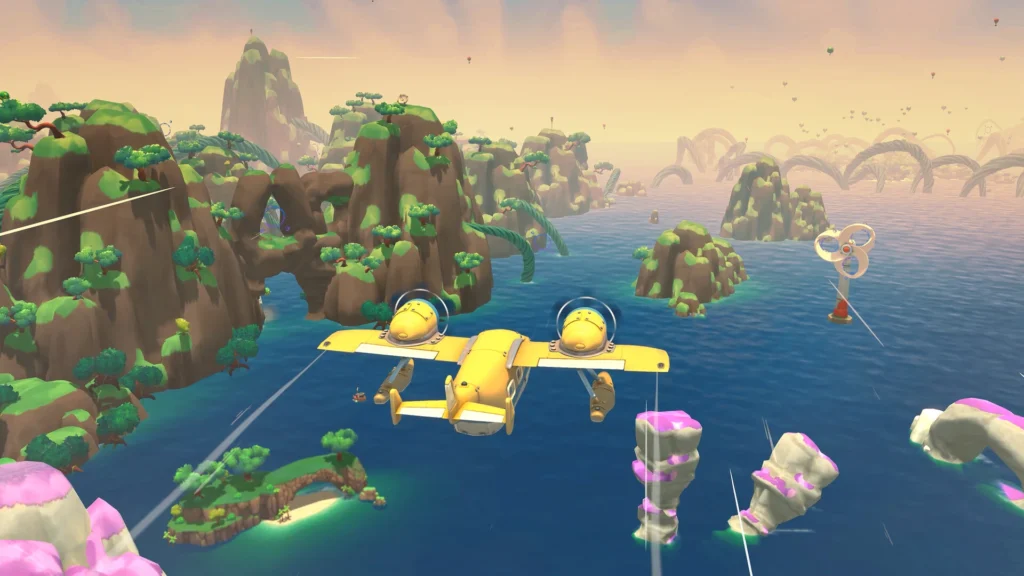
The customizable seaplane is the defining feature of Lou’s Lagoon and the main connection between the islands of Limbo. Flying is not reduced to a loading screen or automated fast-travel sequence. Players actively pilot the aircraft, navigate between settlements, discover hidden locations, avoid hazards, complete ring challenges, and transport collected materials.
The aircraft makes the fragmented geography of the archipelago part of the gameplay. A new island may contain resources required to repair a business elsewhere, while another may introduce a character whose quest reveals more about Uncle Lou. The seaplane allows players to move among those objectives while making travel one of the central attractions rather than a delay between land-based activities.
Flying challenges test control and navigation through rings and obstacle routes. Development material also introduced hazards such as tornadoes, helping ensure that aerial travel demands more attention than simply steering toward a map marker. Players become more familiar with the aircraft as they explore, gradually improving their ability to move efficiently through difficult routes.
The seaplane can be modified both cosmetically and functionally. Tiny Roar has shown interchangeable parts and visual options including:
- Plane bodies
- Wings
- Engines
- Colors
- Patterns
- Skins
- Other modular configurations
The modular design allows different components to work together while giving players freedom to create an aircraft that suits their preferred appearance. Practical upgrades improve the plane’s usefulness, while skins and patterns provide visual personalization. Earlier development descriptions also connected progression with increased cargo capacity, allowing the delivery operation to expand as the player becomes more established.
Materials collected around Limbo contribute to equipment and aircraft improvements. This creates a connected progression loop: flying reveals new locations, those locations provide resources, the resources support upgrades, and the upgraded plane allows the player to pursue more ambitious journeys.
The Bubblefan Engine from the Deluxe Pack is mainly cosmetic. It creates a stream of bubbles behind the aircraft but is not required for progression or access to distant islands. Standard Edition players retain the full flight system, functional upgrades, challenges, and customization options needed to complete the adventure.
Travel also connects with the game’s different pacing styles. The player may begin a session by flying through a ring challenge, land on an island to gather materials, repair a business, fish near the shore, return home to craft furniture, and then follow a clue connected to Uncle Lou. Aviation does not exist separately from the cozy systems, since it provides the movement required to connect them.
Platform features further support flying. DualSense haptics and adaptive triggers add physical feedback on PlayStation 5, while Switch handheld play allows the archipelago to be explored portably. Xbox cloud saves and Play Anywhere give Microsoft users flexibility when moving between console and PC.
The result is not a conventional flight simulator. The aircraft is accessible, colorful, and integrated into a broader adventure rather than focused on realistic cockpit procedures. Flight exists alongside crafting, story progression, community restoration, and character personalization, making the seaplane both transportation and a long-term expression of the player’s progress.
Swirler Resource Gathering, Crafting, Base Building, Fishing, and Restoration
The Swirler 2000 is the protagonist’s primary gathering tool and one of the mechanics most closely associated with Lou’s Lagoon. It functions as a vacuum-style multi-tool capable of collecting scrap, native plants, and resources produced by Limbo’s unusual wildlife. The collected materials support crafting, repairs, equipment upgrades, community restoration, and personal decoration.
Resource gathering is not merely optional environmental cleanup. The islands have been damaged by the storm, so rebuilding homes and businesses requires a steady supply of materials. Restoring those locations can unlock further character interactions, services, quests, and information connected to Uncle Lou.
Tiny Roar’s playtesting reports indicated that players responded positively to exploration and collecting with the Swirler, while the developers continued adjusting resource balance based on feedback. Additional tools expand the gathering system. Development updates showed a scanner designed to reveal concealed materials, allowing exploration to become more varied as the player gains new equipment.
The broader toolset is summarized through four central activities:
- Scoop
- Build
- Glide
- Fish
On land, players gather resources, repair damage, complete quests, and meet residents. Gliding creates another way to move through island environments, while fishing offers a slower activity separate from direct gathering. Tiny Roar discussed fishing repeatedly during development and acknowledged after one playtest that some participants struggled to discover the mechanic. The studio subsequently improved its visibility, confirming that fishing is a meaningful system rather than decorative scenery.
Crafting turns gathered materials into goods needed for restoration and personal use. Earlier versions of the game also included cooking. The 2025 demo featured a Zanana Curry recipe alongside seven quests, flying challenges, building repairs, and a limited explorable version of the overworld. The final release expands far beyond that demonstration while retaining the connected structure between collection, production, and rebuilding.
Base building gives the player a permanent personal space in Limbo. Players can establish and decorate an island base, including a beach hut and surrounding furnishings. This is separate from rebuilding community businesses, meaning construction serves two purposes:
- Restoring shared locations for island residents
- Creating a personalized home for the player
The Deluxe Edition’s Beachside Decor Pack adds eight bubble-themed furniture items, but the base game already includes decoration and building options. Players can therefore spend time improving their personal space without purchasing additional content.
The central gameplay loop combines all of these systems:
- Fly to an island using the seaplane.
- Explore the location and gather materials with the Swirler.
- Use scanners, gliding, or other gadgets to reach additional resources.
- Fish, complete quests, and interact with residents.
- Return collected resources to a settlement or personal base.
- Craft goods, repair storm damage, and upgrade equipment.
- Unlock new interactions, flight opportunities, and story clues.
- Continue following Uncle Lou’s trail across the archipelago.
This structure allows players to determine their own pace. Someone interested mainly in the story can focus on deliveries, restoration projects, and clues. A player drawn to cozy progression can spend more time fishing, collecting, decorating, cooking, and customizing the character or aircraft.
The game’s systems are designed to reinforce each other rather than operate as disconnected activities. Flying opens new areas, exploration produces resources, resources support construction, restored communities offer additional opportunities, and those opportunities move the player deeper into Limbo and closer to solving Uncle Lou’s disappearance.
By combining active seaplane travel with resource gathering and community restoration, Lou’s Lagoon sits between several genres. It has the freedom of an open-world adventure, the progression loops of a crafting game, the customization and social atmosphere of a cozy title, and an aviation system that turns movement across the world into one of its defining mechanics.

Frequently Asked Questions (FAQs)
- When did Lou’s Lagoon launch?
Lou’s Lagoon officially launched across its announced platforms on August 27, 2026. PlayStation 5, Xbox Series X|S, Nintendo Switch, and Nintendo Switch 2 all use that date. Steam records August 26 for the PC version, which appears to reflect regional unlock timing rather than a separate release schedule. - What platforms is Lou’s Lagoon available on?
Lou’s Lagoon is available on PlayStation 5, Xbox Series X|S, Nintendo Switch, Nintendo Switch 2, and Windows PC. PC players can purchase it through Steam or access the supported Microsoft Store version. There are no announced PlayStation 4 or Xbox One editions. - Is Lou’s Lagoon an open-world game?
Yes. The game is an open-world exploration and crafting adventure set across the tropical Limbo archipelago. Players can freely pilot a seaplane between islands, explore settlements, collect resources, complete flight challenges, find hidden locations, and decide how much time to spend on story objectives or relaxing side activities. - Is Lou’s Lagoon multiplayer?
No. Lou’s Lagoon is designed as a single-player experience centered on one player’s character, seaplane, island base, and investigation into Uncle Lou’s disappearance. Its cloud-save and cross-device features do not provide online co-op, and no cooperative campaign or competitive multiplayer mode is advertised. - Does Lou’s Lagoon support Xbox Play Anywhere?
Yes. Xbox Play Anywhere allows a qualifying digital purchase to be used on Xbox Series X|S and a supported Windows PC without buying the game twice. Xbox cloud saves also allow progress to follow the same Microsoft account, making it easier to continue the adventure on another compatible device. - What is the Swirler in Lou’s Lagoon?
The Swirler, also called the Swirler 2000, is the player’s main resource-gathering tool. It works like a vacuum-style multi-tool that collects scrap, plants, and materials found around Limbo. Those resources can then be used for crafting, upgrading equipment, repairing storm damage, and restoring local homes and businesses. - Can you customize the seaplane in Lou’s Lagoon?
Yes. Players can personalize the seaplane with different bodies, wings, engines, colors, patterns, and skins. Some changes are cosmetic, while functional upgrades improve its usefulness for exploration and delivery work. Progression can also increase capabilities such as cargo capacity, allowing the plane to support longer and more ambitious journeys. - What is included in the Lou’s Lagoon Deluxe Edition?
The Deluxe Edition includes the complete base game and the Deluxe Pack. The pack adds the Bubblefan Engine, which leaves bubbles behind the seaplane, a Lifeguard outfit with a matching bubble-themed accessory, and eight Beachside Decor furniture items. These are cosmetic extras and are not required to access the story, islands, crafting systems, or core progression. - What is different about Lou’s Lagoon on Nintendo Switch 2?
The Nintendo Switch 2 Edition offers a higher frame rate, increased resolution, and improved overall presentation compared with the original Switch release. It is a dedicated enhanced edition rather than merely the older version running through backward compatibility. Nintendo also provides an upgrade-pack route for eligible owners moving from Switch to Switch 2. - What is the main story of Lou’s Lagoon?
The protagonist travels to the Limbo archipelago after receiving a distress call from Uncle Lou. On arrival, they discover that a destructive storm has damaged the islands and that Lou has disappeared. Players help residents rebuild their communities, explore distant islands, and follow clues connected to Lou’s seaplane and delivery business to uncover what happened to him.
Conclusion
Lou’s Lagoon launched August 27, 2026 on PS5, Xbox Series X|S, Nintendo Switch, Nintendo Switch 2 and PC as an unusually broad combination of cozy simulation, crafting, open-world exploration and aviation. The foundation of Lou’s Lagoon 2026 is simple: arrive in Limbo after a storm, repair what has been damaged and find Uncle Lou. Tiny Roar then builds a much larger set of systems for Lou’s Lagoon around that premise.
The customizable seaplane in Lou’s Lagoon 2026 gives the archipelago its sense of scale and makes travel an active part of play. The Swirler in Lou’s Lagoon turns exploration into useful resource gathering. Crafting and restoration in Lou’s Lagoon 2026 connect those resources to the island communities, while fishing, gliding, base decoration, deliveries and character customization provide slower activities between major objectives. Meanwhile, the unresolved disappearance of Uncle Lou in Lou’s Lagoon supplies a central mystery that gives the otherwise relaxed progression a clear narrative direction.
Platform support is also one of Lou’s Lagoon’s strongest practical advantages. PS5 players in Lou’s Lagoon 2026 receive DualSense and 4K HDR features, Xbox users in Lou’s Lagoon gain Xbox Play Anywhere and cloud-save support, Nintendo players can choose between Switch and an enhanced Switch 2 Edition, and Lou’s Lagoon PC users have Steam and Microsoft options.
For anyone searching for a game built around flying between colorful islands, gathering materials, rebuilding communities and personalizing both a character and vehicle, Lou’s Lagoon offers exactly that combination. Its August 27, 2026 multiplatform launch transformed Lou’s Lagoon 2026, a project first shown years earlier, into a complete adventure spanning nearly every major current gaming platform.
Sources and Citations
- Official Megabit Publishing Sources
- Megabit Publishing: Lou’s Lagoon Official Game Page
This is the primary source for the game’s premise and principal features. It identifies the tropical Limbo archipelago, the destructive storm, Uncle Lou’s disappearance and the Swirler 2000. It also confirms gadget upgrades for collecting, building, gliding and fishing, seaplane ring challenges and customization, full character customization and construction of a personalized island base. The page currently lists Steam, Nintendo Switch, Nintendo Switch 2, PlayStation 5 and Xbox as platforms. (Megabit)
In-text citation: (Megabit Publishing, 2026a) - Megabit Publishing: Lou’s Lagoon Official Press Kit
The press kit identifies Tiny Roar as developer and lists Steam, Nintendo, Xbox and PlayStation. Its description covers flying between islands, collecting resources with the Swirler 2000, repairing storm-damaged communities, investigating Uncle Lou’s disappearance and building a beach hut. It also names important Limbo communities and locations, including Tangle Bloom, Gleam Reef and Boulderia. (Megabit)
In-text citation: (Megabit Publishing, 2026b) - Megabit Publishing: Lou’s Lagoon Release Date Announcement Trailer
Megabit’s official release-date trailer announced the August 27, 2026 launch. It is the appropriate source for connecting the date reveal with the game’s June promotional campaign and Wholesome Direct appearance. (YouTube)
In-text citation: (Megabit Publishing, 2026c) - Megabit Publishing: High-Flying Adventure Lou’s Lagoon Touches Down on PlayStation and Xbox
Published on March 9, 2026, this official announcement added PlayStation and Xbox to the previously confirmed Steam and Nintendo Switch versions. It also confirms Xbox Play Anywhere, allowing eligible players to use the Xbox version across supported console and PC devices without a separate purchase. The release describes the Limbo setting, Swirler 2000, seaplane challenges, fishing, gliding, character customization, plane customization and island-base building. (Megabit)
In-text citation: (Megabit Publishing, 2026d) - Megabit Publishing: Lou’s Lagoon’s Deluxe Edition Unveiled
Published on July 22, this first-party announcement explicitly states that the Standard and Deluxe Editions would launch on August 27. It confirms that the Deluxe Edition contains a Lifeguard character skin, the bubble-powered BubbleFan Engine and eight beach-themed decorative objects. It also confirms that Standard Edition owners can purchase the Deluxe content separately through the Deluxe Pack. (Megabit)
In-text citation: (Megabit Publishing, 2026e) - Megabit Publishing: Lou’s Lagoon Is Landing on Nintendo Switch 2
This July 16 announcement confirms a dedicated Switch 2 version alongside PC, PS5, Xbox Series X|S and the original Switch. Megabit says the Switch 2 Edition provides improved performance, a higher frame rate and higher resolution. It also includes direct descriptions of the seaplane, gadgets, character customization, plane customization and base-building systems. (Megabit)
In-text citation: (Megabit Publishing, 2026f)
- Megabit Publishing: Lou’s Lagoon Official Game Page
- Official PlayStation Sources
- PlayStation Blog: Fresh Look at Lou’s Lagoon, Coming to PS5 on August 27
Written by Tiny Roar’s Ines Neumann, this official developer article confirms the August 27 PS5 release and the Standard and Deluxe Editions. It provides detailed information about the character creator, unlockable clothing, seaplane parts and paint customization, aerial challenges and construction of a customizable home. (PlayStation.Blog)The same article documents the principal PS5 features. The console’s SSD is used to reduce loading times, DualSense haptic feedback supports exploration, crafting and building, adaptive triggers affect resource gathering, and PS5 supports 4K HDR output for the game. (PlayStation.Blog)
In-text citation: (Neumann, 2026) - PlayStation Store: Lou’s Lagoon for PlayStation 5
Sony’s official U.S. listing confirms the August 27, 2026 release, offline single-player support, Remote Play and DualSense vibration. As checked on September 14, 2026, it lists the Standard Edition at $24.99, Deluxe Edition at $26.99 and separate Deluxe Pack at $4.99. Prices can change by region or promotion, so they should be identified as U.S. storefront prices. (PlayStation Store)
In-text citation: (Sony Interactive Entertainment, 2026)
- PlayStation Blog: Fresh Look at Lou’s Lagoon, Coming to PS5 on August 27
- Official Xbox Source
- Xbox Store: Lou’s Lagoon
Microsoft’s official listing confirms Tiny Roar as developer, Megabit Publishing as publisher and August 27, 2026 as the release date. It lists Xbox Series X|S, PC and compatible handheld access, along with single-player support, Series X|S optimization, Xbox achievements, cloud saves and Xbox Play Anywhere. (xbox.com)The U.S. Xbox Store lists the Standard Edition at $24.99, Deluxe Edition at $26.99 and Deluxe Pack at $4.99 before temporary discounts. Its product description also confirms the Limbo archipelago, Swirler, Uncle Lou storyline, seaplane challenges, gadgets, customization and island-base building. (xbox.com)
In-text citation: (Microsoft, 2026)
- Xbox Store: Lou’s Lagoon
- Official Nintendo Sources
- Nintendo of America: Lou’s Lagoon: Nintendo Switch 2 Edition
Nintendo’s official U.S. page confirms the dedicated Switch 2 Edition’s August 27 release, one-player support and TV, tabletop and handheld modes. It lists improved performance with higher frame rate and resolution and identifies a 19.5 GB Switch 2 file size. The page also describes seaplane ring challenges, collecting, crafting, gliding, fishing, base building and the Uncle Lou mystery. (Nintendo Co., Ltd.)
In-text citation: (Nintendo, 2026a) - Nintendo of America: Lou’s Lagoon for Nintendo Switch
This is the official page for the original Switch software. It confirms that the game is supported on Switch 2 through backward compatibility but behaves like the Switch version unless the dedicated Switch 2 upgrade is installed. Nintendo UK independently lists the original Switch download at 5.2 GB, with one-player support and TV, tabletop and handheld play. (Nintendo Co., Ltd.)
In-text citation: (Nintendo, 2026b) - Nintendo of America: Lou’s Lagoon: Nintendo Switch 2 Edition Upgrade Pack
The Upgrade Pack requires ownership of the original Lou’s Lagoon game and adds the Switch 2 Edition’s higher frame rate and resolution. Nintendo lists the Upgrade Pack at 13.6 GB, with an August 27 release date. (Nintendo Co., Ltd.)
In-text citation: (Nintendo, 2026c) - Nintendo UK: Lou’s Lagoon: Nintendo Switch 2 Edition
Nintendo UK confirms the August 27 release, higher frame rate and resolution, single-player support and all three Switch play modes. Its regional page lists the complete Switch 2 Edition at 18.8 GB, rather than the 19.5 GB shown by Nintendo of America. This regional difference should be retained when citing download sizes. (Nintendo Co., Ltd.)
In-text citation: (Nintendo of Europe, 2026)
- Nintendo of America: Lou’s Lagoon: Nintendo Switch 2 Edition
- Official Steam Source
- Steam: Lou’s Lagoon Official Store Page
Steam identifies Tiny Roar as developer and Megabit Publishing and rokaplay as publishers. Its legal notice further identifies Aonic UK Ltd., trading as Megabit Publishing, as the publisher. Steam currently records the PC release as August 26, 2026, one day earlier than the announced console and general multiplatform date. (Steam Store)Steam confirms single-player support, 35 achievements, Steam Cloud, Remote Play on TV and Family Sharing. Its official U.S. pricing currently lists:- Base game: $24.99
- Deluxe Pack: $4.99
- Digital Artbook: $5.99
- Original Soundtrack: $4.99
- Minimum: Windows 10 64-bit, Intel Core i3-9100F or Ryzen 3 1200, 4 GB RAM and GTX 1050 Ti-class graphics with 4 GB VRAM.
- Recommended: Windows 10 64-bit, Intel Core i5-10400 or Ryzen 5 3600, 8 GB RAM and GTX 1660 Super-class graphics with at least 6 GB VRAM.
In-text citation: (Tiny Roar, Megabit Publishing and rokaplay, 2026)
- Steam: Lou’s Lagoon Official Store Page
- Official Development Updates
- Megabit and Tiny Roar: Lou’s Lagoon Devlog #00
This early development update covers improved flying mechanics, ring challenges, the scanner used to locate hidden resources, the glider, an early fishing system, customizable delivery-building elements and new city assets. It is the strongest first-party source for the scanner and glider’s development history. (Megabit)
In-text citation: (Tiny Roar, 2024a) - Megabit and Tiny Roar: Lou’s Lagoon Devlog #2
This update documents customizable seaplane bodies, wings, engines, patterns and colors. It also covers development of an overworld tornado hazard, world assets designed to remain readable from the air and an early air-race challenge. (Megabit)
In-text citation: (Tiny Roar, 2025a) - Megabit and Tiny Roar: Lou’s Lagoon Devlog #3
Devlog #3 explains how Tiny Roar developed Limbo’s open-world islands through concept art, greyboxing and distance readability. It identifies four major locations: Lou’s Island, Tanglebloom, Gleam Reef and Boulderia, each intended to provide a distinct visual identity and gameplay experience. (Megabit)
In-text citation: (Tiny Roar, 2025b) - Megabit and Tiny Roar: Lou’s Lagoon Devlog #4
This playtest-focused update records feedback about Swirler resource collection, resource balancing, flying controls and fishing discoverability. It also covers revisions to ring challenges, building and blueprint interfaces, menus, map readability, onboarding, progression, Nintendo Switch performance, quests, dialogue, animation and sound. (Megabit)
In-text citation: (Tiny Roar, 2025c) - Megabit and Tiny Roar: Lou’s Lagoon Steam Demo Announcement
This announcement describes an early playable version featuring Lou’s Island, the Swirler 2000, building repairs, deliveries, character customization, seaplane exploration and flying challenges. It is useful for distinguishing systems that were publicly playable during development from features documented only in devlogs. (Megabit)
In-text citation: (Tiny Roar, 2025d)
- Megabit and Tiny Roar: Lou’s Lagoon Devlog #00
Recommendations
- PlayStation Boss Teases Future Console Experiences Hinting at PS6 Handheld: “Leveraging Technologies that Work in Various Forms and Locations” Explained
- PlayStation Allegedly Confirms You’ll Have to Verify Your Game Licenses Every Month: PS5/PS4 30-Day Online Check-In Explained
- League of Legends Riftbound TCG: Hands-on with Unleashed: New Mechanics, Cards, Release Date, and Full Set Breakdown
- Hideo Kojima Finds it Really Sad that Sony is Killing PlayStation Game Discs
- Avengers: Doomsday, Lanterns, Clayface, and the Other Biggest Trailers From SDCC
- Rubinite: Dark Fantasy Boss Rush Gameplay Explained
- Blender 5.1: Release Date, Key Features, Performance Improvements, and Upgrade Guide
- The Internet Reacts to PlayStation Killing Off Game Discs: 15 Biggest Fan Concerns About Sony’s Digital Future
- State of Decay 3 Is Surprisingly Welcoming Despite the Zombie Apocalypse



































































































